




Abstract
The ways that the concept of development comes to mean refract individual value sets and map onto Guatemalan host-community residents’ attitudes toward mining. Economically oriented residents tend to support mining while those who prioritize public health and environmental advocacy tend to oppose it. Individuals who trust institutions of the state tend to support mining, while individuals who perceive these issues through the lens of their religious faith tend to oppose it. Concerns around public health are especially salient. Focusing on individual-level decision making rather than community-level action distinguishes between rationale and decision, thus highlighting the variegated social meanings underlying superficially similar attitudes. Mining attitudes and their rationales are heterogeneous and vary in intensity.
Las maneras en las que el concepto del desarrollo adquiere significado reflejan los valores del individuo y se alinean con las actitudes hacia la minería que poseen los guatemaltecos residentes en comunidades anfitrionas de proyectos mineros. Las personas que valoran el desarrollo económico tienden a apoyar la minería mientras que aquellos que priorizan la salud pública y la defensa del medioambiente tienden a oponerse. Las personas que confían en las instituciones del estado tienden a apoyar la minería mientras los individuos que ven estos temas a través del lente de su fe religiosa tienden a oponerse. Sobresalen en especial las preocupaciones en torno a la salud pública. El enfoque en la toma de decisiones a nivel individual en lugar de en la acción a nivel comunitario se diferencia entre la razón y la decisión, resaltando así los significados sociales que subyacen en las actitudes superficialmente similares. Las actitudes hacia la minería y sus razonamientos son heterogéneas y varían en su intensidad.
To host communities in remote parts of Latin America, mining represents dramatic transformations of the landscape, the economy, and the social fabric. Mining, with its promises and threats, generates divisions in communities as it increasingly shapes daily lived experience and becomes central to public discourse. Scholars principally identify these divisions as between mining’s critics and supporters and between those included and excluded from its economic benefits (Aguilar-González et al., 2018). Yet fault lines also emerge among supporters around differing expectations of what mining will contribute and among critics around different assumptions about the problems mining may engender. These less commonly considered divisions are the focus of this paper.
I argue that one basis for these divisions is the way the term “development” acquires meaning. “Development” is a blank canvas on which individuals express their value systems, which map onto and indeed shape their attitudes toward mining. Some people emphasize economic development and job creation, while others prioritize environmental conservation and still others local autonomy. Thus, mining becomes a platform that emphasizes the distance between various ways of making sense of development and can turn ostensibly inconsequential differences into conflict.
In 1959 the poet John Ciardi published How Does a Poem Mean?, which argues that the principal task of reading poetry, rather than seeking meaning, should be analyzing the structure of the poem—seeking the experience of the poem rather than the definition. I crib Ciardi’s title here to suggest that a focus on the ways that “development” comes to mean may be useful as an analytic tool—perhaps more useful than attempting to measure development itself.
The recent literature on mining conflicts largely emphasizes how mineral development transforms local social relations and spurs conflict. Some work sees different social meanings around certain phenomena as the basis for conflict. (e.g., Bebbington et al., 2008; Muradian, Martinez-Alier, and Correa, 2003; Warnaars, 2013). This article joins this endeavor by engaging the question “How do host-community residents’ individual understandings of development demonstrate their positions with respect to mining?”
Answering this question addresses two related issues in the literature on mining conflicts in Latin America. The first is a tendency to favor stories of resistance to mining on the community or municipal level and therefore to overlook the variegated individual responses to mining underlying these aggregate stories (e.g., Pedersen, 2014; Urkidi, 2011). Relatedly, scholars sometimes assume a convergence of perspectives among host-community residents regarding mining, which leads the literature to assign like decisions regarding whether to support mining to like motivations on the part of the individual (e.g., Haslam and Tanimoune, 2016). This produces an assumption of unanimity among residents, a tendency to treat rural communities as homogeneous vis-à-vis environmental decision making and a failure to explore gradations of attitude (Kuecker, 2007). These attitudes, far from static, ebb, flow, overlap, and feed back on one another. Painting communities with a broad brush mischaracterizes the nature of environmental conflict and often depends on the assumption that host-community residents “naturally” oppose mining (e.g., Copeland, 2018; Holden and Jacobson, 2009). Focusing on individual attitudes and logics draws attention to nuance and aims to parse the link between motive and decision to demonstrate that individual decisions stem from a dynamic cluster of motives and rationales.
In this paper I use a typology of six ways people interpret development and, interweaving multivariate and ethnographic analyses, show how these different understandings of development align with the ways that individuals respond to mining projects in their communities. In my research, interviewees understand mining and development as competing sets of trade-offs. Some participants reject the notion of development altogether, while others associate it closely with infrastructure and roads. The qualitative analysis also draws out the associations between religious faith and the concept of life in the context of mining conflicts and makes clear why public health is central to host-community residents’ discourses of development.
The New Extraction in Guatemala and the Consulta Comunitaria
Mining investment has grown across Latin America by more than 100 percent over the past 15 years, increasing Latin America’s share of global mining investment from 10 to 25 percent (Dougherty, 2016). This has generated a corresponding increase in conflicts around mine sites across Latin America (Arsel, Hogenboom, and Pellegrini, 2016). Guatemala, despite little history of multinational mining, has been emblematic of this upsurge. Ore and metal exports increased in Guatemala from 1 percent of total merchandise exports in 2001 to 9.6 percent in 2011, ten times the rate of the continent as a whole (World Bank, 2016). Given the inequality, impunity, and violence of daily life in Guatemala, mining conflicts have been numerous, protracted, and violent (Imai, Gardner, and Weinberger, 2016). The entrenchment of mining reflects the Guatemalan oligarchy’s long-standing entwinement with foreign capital and with the military, as well as the subjugation and exploitation characterizing race relations between ladinos and Mayas since the conquest (Fox, 2015). As Diane Nelson (2013: 7) writes, the mine and the uncertainty it elicits in residents evoke “older expressions of the painful duplicity of the conquest.”
Throughout the twentieth century, Guatemala’s mineral stocks were considered smaller and lower-grade than those of other Latin American countries such as Mexico, Peru, Bolivia, and Chile. In the mid-1990s, when the Central American republics sought to democratize, liberalize, and leave their legacies of military rule and conflict behind, they undertook an effort to increase foreign direct investment in mining, among other sectors. Guatemala passed a new Mining Law in 1997 reducing the royalty rate for mining companies from 6 percent to 1 percent of production value. Acquiring production licenses became simpler and cheaper and the concession sizes permitted increased. The new law combined the bureaucratic procedures for acquiring production and export licenses and required environmental impact studies. Together with the General Electricity Law of 1996, which reduced costs for energy-intensive mining projects, the “Maquila Law” of 1988, which exempted exporters from taxes on inputs, and the 1998 Foreign Investment Law, which expanded rights for foreign investors, the mining law created a powerful enabling environment for mining investment (Dougherty, 2011). Foreign investment in mining exploration exploded, aided powerfully by changes in mining and milling technology that made lower-grade deposits more commercially viable.
This surge led to the construction of three major nickel and four major gold and silver projects between 2002 and 2006, the largest and best-known of which was Vancouver-based Goldcorp’s Marlin Mine, a joint underground and open-pit operation with a vat-leach cyanidation milling process that stored tailings wet in a tailings pond. Other mines such as Escobal and Cerro Blanco were strictly underground operations with considerably less disruption to the ground cover and aesthetics of the landscape. Escobal employed a dry-stack-tailings procedure.
As mining expanded in Guatemala, it became controversial and more prevalent in public discourse. The controversy erupted particularly following a violent conflict in January 2005 between riot police and protesters in Los Encuentros, El Quiché, where a protester was killed and 16 others were injured (Yagenova, 2007). These events propelled the first use of the consulta comunitaria (community poll on mining, hereafter “consulta”) in Guatemala—in Comitancillo, San Marcos, in March 2005 and in Sipacapa, San Marcos, in June 2005. These consultas are based on a model imported from Peru that was later replicated in Colombia, Chile, and Argentina. They are linked to the concept of free prior and informed consent 1 and claimed as examples of the exercise of this right (Costanza, 2015). In Guatemala, they are nonbinding, semiformal votes at the municipal level that encompass both the town or city seat and the surrounding rural communities (aldeas). Often the Catholic diocese and local, national, and international nongovernmental organizations (NGOs) are involved in the underwriting and the logistics of these consultas.
In contrast to votes for candidates for political office, consultas regularly include the votes of minors, some as young as five years of age, as well as adults and are often accomplished by an open show of hands rather than a secret ballot (Dabroy, 2013). These variations have led mining’s sympathizers to describe the consulta processes as full of “irregularities” that mining’s critics defend as a reflection of traditional decision-making practices (usos y costumbres). Whether these consultas are binding is unclear. In 2007 the Constitutional Court ruled that they were nonbinding, but ten years later it seemingly reversed itself by revoking the mining and hydroelectric licenses of companies that had failed to consult indigenous groups. The legal scaffolding to support the claim that the results of the consultas are binding is tenuous. While the 2002 Municipal Code, in Articles 63–66, indicates that they are, the language is vague and limited. At the same time, Guatemala is a signatory to International Labor Organization Convention 169 on Indigenous and Tribal Peoples and the United Nations Declaration on the Rights of Indigenous Peoples, which include the right to prior consultation. Both these conventions are nonbinding. In 2018 a controversial bill before the Guatemalan Congress proposed to regulate consultas and establish universal procedures for their execution. Critics worried that the bill, were it to become law, would function to bureaucratize what is at present an organic process and circumscribe the power of communities.
The 2005 consulta in Sipacapa was the focus of a documentary, Sipakapa no se vende (Caracol Producciones, 2007), which helped make the consulta a global symbol of indigenous resistance to mining. The model caught on with indigenous communities and NGOs, leading to approximately 85 consultas across Guatemala by 2015 in which nearly a million people voted. A striking majority (over 99 percent) of participants voted against mining and other large-scale projects (Laplante and Nolin, 2014).
These consultas have received some cautiously laudatory scholarly attention. Some work has uncritically essentialized the consulta as a traditional indigenous decision-making mechanism, yet many analyses see it as a “hybrid” institution that integrates custom with Western discourses, instruments, and values (Walter and Urkidi, 2015). Much of the literature views the consulta as empowering for its participants—as a process of claims making, power assertion, and identity building (Costanza, 2015; Laplante and Nolin, 2014; Nelson, 2013). Other work foregrounds the legalistic/procedural dimension of the process as a claim of ownership of formal democratic processes that have historically excluded indigenous people (Gustafson and Guzmán Solano, 2016; Sieder, 2011). Other scholars embed the consulta in historical analyses linking civil-war experience to mining resistance (Wayland and Kuniholm, 2016). Nelson (2013), for example, calls the consultas “signs of recovery” from the trauma of genocide.
Despite the optimism with which the consulta is generally viewed, scholars also recognize its constraints, arguing that it can limit participation and lead to new forms of social exclusion by generating sharp social sanctions for holders of minority viewpoints and deep rifts between mining’s supporters and critics (Costanza, 2015). Even as the consulta aims to empower, indigenous communities remain disadvantaged in the process. As mining companies and antimining activist networks vie for indigenous support by mobilizing the symbolic resources of indigeneity, indigenous communities and individuals are often caught in the middle. Both sides purport to represent indigenous interests, but instead the process often reproduces traditional power dynamics and essentializes indigenous identity (Dougherty, 2011).
The near-unanimous results of these consultas against mining projects have often been interpreted as unanimous community opposition to mining and have been used to attribute homogeneous responses to host communities (see Solano, 2015). While a model of direct action, the results of these consultas nonetheless tell an incomplete story. Nelson (2015) reminds us that numbers and counting are embedded in relations of production and consumption and do political and emotional work. The consulta-as-numbers reproduces myths of ideological, political, and epistemological unanimity across agrarian Guatemala. As a result, the consulta is emancipatory and empowering even as it silences and obscures the complexity of decision-making processes.
How does “Development” Mean in the Context of Mining Conflicts?
Recent work in political ecology and emotional geography views resource and environmental conflicts as driven by disagreements over social meaning, particularly meanings of “development,” rather than over material rewards (Bebbington et al., 2008; Carruyo, 2008). In my research, “social meaning” refers to collective understandings of certain phenomena unique to particular places that are produced through historical and context-specific lived experience. This basic idea is labeled variously in the literature. Joan Martinez-Alier (2002) attributes environmental conflicts to differences in “valuation.” Light Carruyo (2008) uses the phrase “local knowledge.”
Many scholars have recently argued that resource conflicts center on the contrasting social meanings assigned to material phenomena rather than the phenomena per se. However, scholars differ on which meanings matter most. Many recognize the salience of territorial issues, particularly where land, sovereignty, and property rights are interwoven (Dougherty and Olsen, 2014a; Himley, 2016; Muradian, Martinez-Alier, and Correa, 2003; Warnaars, 2013). Others emphasize the meaning of development (Bebbington et al., 2008) and labor and gender (Carney, 2004). Chomsky and Striffler (2014) explore the complexities of mining union critiques of mining in Colombia as due to exploitative North-South relationships rather than only environmental concerns. Discrepan-cies in social meanings are a key constitutive force in environmental conflicts.
Scholars emphasize different structural and cultural forces in explaining the production of social meanings in the context of resource conflicts, but most agree that these meanings are products of social context and identity and, in turn, reconstitute the contexts and identities that produce them. For Warnaars (2013) memory, ontology, and everyday practices are their constitutive elements, while for Carruyo (2008) they are produced in dialogue with conventional Western ways of meaning-making through the processes of global market integration and migration networks.
Much of this literature attributes conflicting social meanings to the “alternative” or uneconomic perspectives of locals and contrasts these with the perspectives of company representatives. Judith Carney (2004) describes an “expanded moral economy” that shapes how Gambian peasants view development. Dougherty and Olsen (2014b) argue that where relational trust is high—where there are strong bonds among friends, family, and neighbors—community members are more likely to put the good of the community above that of the individual and be skeptical of outside miners. Martinez-Alier (2002) refers to “sacredness.” Muradian, Martinez-Alier, and Correa (2003) contrast “values” with “material interest” and resource “use” with “nonuse.”
This tendency to envision a values dichotomy between locals and mining company representatives dovetails with much of the broader mining-conflicts literature, which, even as it discusses dichotomies, works to blur these lines regarding the costs and rewards of mining by showing that indigeneity can encompass a wide range of attitudes toward mining (e.g., Anthias, 2018; Warnaars, 2013) and documenting how mining produces rifts and fissures within indigenous groups (e.g., Costanza, 2015; Dougherty, 2013). Multiple quantitative studies across different mining regions of Latin America consistently indicate about 25 percent direct support for mining in indigenous communities (Dougherty, 2013; Muradian, Martinez-Alier, and Correa, 2003). Often indigenous people seek to maximize economic returns even if this means negotiating with the company (Anthias, 2018). Yet this generally occurs within an expanded framework of “economic rationality” that includes territorial sovereignty and moral economy effects (see Anthias, 2018; Carney, 2004; Warnaars, 2013).
The different meanings assigned to development are not mutually exclusive. Host-community residents in Bolivia see development as representing ideas incorporating both territorial sovereignty and expanded infrastructure, and they perceive common paths to the two ends (Anthias, 2018). Indigenous people view the biophysical world as sacred and, simultaneously, as stocks of exploitable resources, despite the ostensible tensions between these beliefs (Muehlmann, 2009; Muradian, Martinez-Alier, and Correa, 2003; Warnaars, 2013). The meaning of development is also filtered through a conceptualization of work as both wage production and a source of dignity and identity (Carruyo, 2008). These differences in meanings of development—questions of sovereignty and dependency, conservation and use, and cosmology and rationality—are reflected not just in localized mining conflicts but in larger public and academic debates around the merits of so-called extractivism (Fabricant and Gustafson, 2014).
Particularly in rural parts of low-income countries where “development” is central to public discourse, resource use is key to the production of social meaning (Sultana, 2013). This is partly because “development” is ambiguous enough that individuals can ascribe diverse sets of personal values to it, making it a basis for the production of other, adjacent types of social meaning. Resource conflicts become a stage on which contrasting social meanings of development are revealed, as resources are laden with both material interests and values, making them especially conflictive and infused with emotion (Martinez-Alier, 2002; Perreault, 2017; Sultana, 2011). Yet few scholars have viewed this dynamism as a platform for gaining analytic purchase.
Methods
This research employs a mixed-method approach that interweaves ethnographic and multivariate analysis, homing in on consistent findings across the two data types. It builds on my long-standing relationship as a researcher and resident of Guatemala’s western highlands. The approach improves robustness and harnesses the strengths of the different methods while hedging against their weaknesses. Further, the qualitative data fill out the nuance of the narrative that numeric data miss.
The data collection and analysis were iterative: the early ethnographic analysis fed the survey design and analysis, which, in turn, fed the later stages of ethnographic analysis. From the literature I distilled a set of meanings of development. With these themes in mind, I conducted exploratory interviews with residents of several mining-impacted communities in Guatemala, from which I organized a taxonomy of six principal meanings of development for host-community residents: (1) economic gain, (2) spiritual sustenance, (3) self-determination, (4) conservation of nature, (5) improved public health, and (6) trust in the state. Some themes were consistent between the scholarship and the preliminary fieldwork while others were not. For example, many respondents saw positive public health outcomes as central to development. Others implied that trust in government and local institutions was important in making sense of development. From the above taxonomy, I devised a set of variables that I measured using agree-disagree statements on a five-point Likert scale. I then used descriptive statistics from the survey to inform sensitizing concepts for later rounds of semi-structured interviews.
Surveys were administered to residents (n = 476) of four Guatemalan municipalities in which there were mining licenses. The survey included 25 items on demographics, knowledge, and attitudes toward mining and development. In addition to the survey, this paper draws on 32 semistructured interviews with residents of the municipalities in which the survey was conducted. I selected the four municipalities for demographic, economic and geographic diversity, and access considerations so that the survey respondents would constitute a sample of the population that had participated in the consultas. Aguacatán is a large, majority-Mayan municipality in the southeastern corner of the department of Huehuetenango. It is home to five ethnic groups (Mam, K’iche,’ Aguacatek, Chalchitek, and ladino) and the site of two exploration licenses held by small companies principally interested in copper, silver, and gold. Tectitán is a small municipality in the southwest corner of Huehuetenango, abutting Mexico’s Chiapas state. It is home to a Maya Tectikek community and the site of three Goldcorp exploration permits for gold, silver, and copper. San José Ojetenam is a ladino municipality in the department of San Marcos, which abuts Tectitán to the southeast. Goldcorp held four exploration permits there for gold, silver, and copper. These three are agricultural municipalities with small town seats and extensive hinterlands situated between 5,400 and 10,000 feet above sea level in rugged, mountainous terrain. Asunción Mita, in the department of Jutiapa, is a ladino municipality in the eastern lowlands on the border with El Salvador. It is the site of the Cerro Blanco gold project, still in late exploration, which was developed by Goldcorp until 2017, when it was sold to Vancouver-based Bluestone Resources. All except Asunción Mita had conducted consultas that had produced decisive, near-unanimous votes against mining. I selected municipalities with varying experiences with mining companies and a mix of Mayan and ladino respondents within and across regions to distinguish between regional and ethnic differences (Table 1).
Comparative Demographic Data from Survey Sites
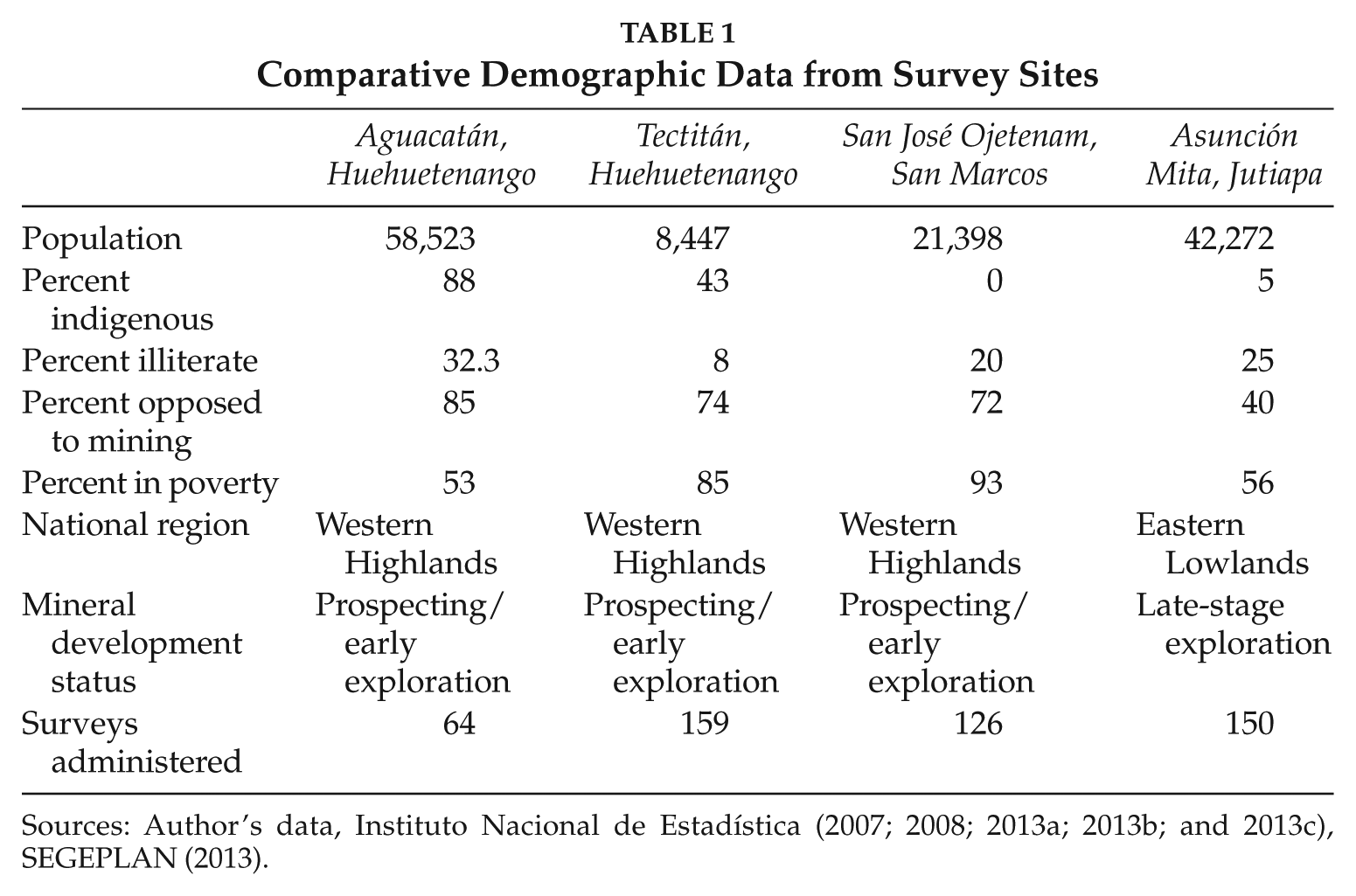
Sources: Author’s data, Instituto Nacional de Estadística (2007; 2008; 2013a; 2013b; and 2013c), SEGEPLAN (2013).
Given the limited phone and postal access in much of rural Guatemala and the low literacy rates characteristic of Huehuetenango (around 30 percent and much higher in the rural areas), I administered the survey individually and face to face. My sample is therefore not perfectly random. In each municipality I solicited approval to conduct research from the town council. I subsequently worked with the town council and the municipal planning office to identify representative aldeas. In each of these aldeas I hired schoolteachers from the community and trained them in survey administration. Through the town council I convoked community assemblies at which I divided the attendees into groups and assigned a survey administrator (including me) to each. The survey administrator then surveyed each member of the group individually in private.
Below I analyze a cross-section of these data to examine how the meanings of development described above correlate with residents’ level of mining tolerance. The dependent variables, which become the axes for each of the six models, measure tolerance for mining with two counterdirectional measures: “I am against mining” and “Mining is more beneficial than harmful.” I assessed familiarity with mining with the measure “The miners are part of the central government.” The independent variables measured respondents’ understanding of what development means. I measured economic gain-as-development with the statement “Job creation is more important than protecting nature.” I measured development-as-environmental conservation with the statement “Gold must remain buried in order for there to be water and land fertility.” I measured spiritual associations with development with “God demands that we don’t touch the land to remove minerals.” I measured development-as-public health with “Health is more important than having work.” I measured development-as-good governance with “I trust the government to defend my interests.” Finally, I measured self-determination with “I have the power to make a change in my life.” I developed these measures through the course of the early, exploratory ethnographic research. They recast terms, phrases, and questions that I heard repeatedly in early rounds of analysis as agree-disagree statements on a five-point Likert scale.
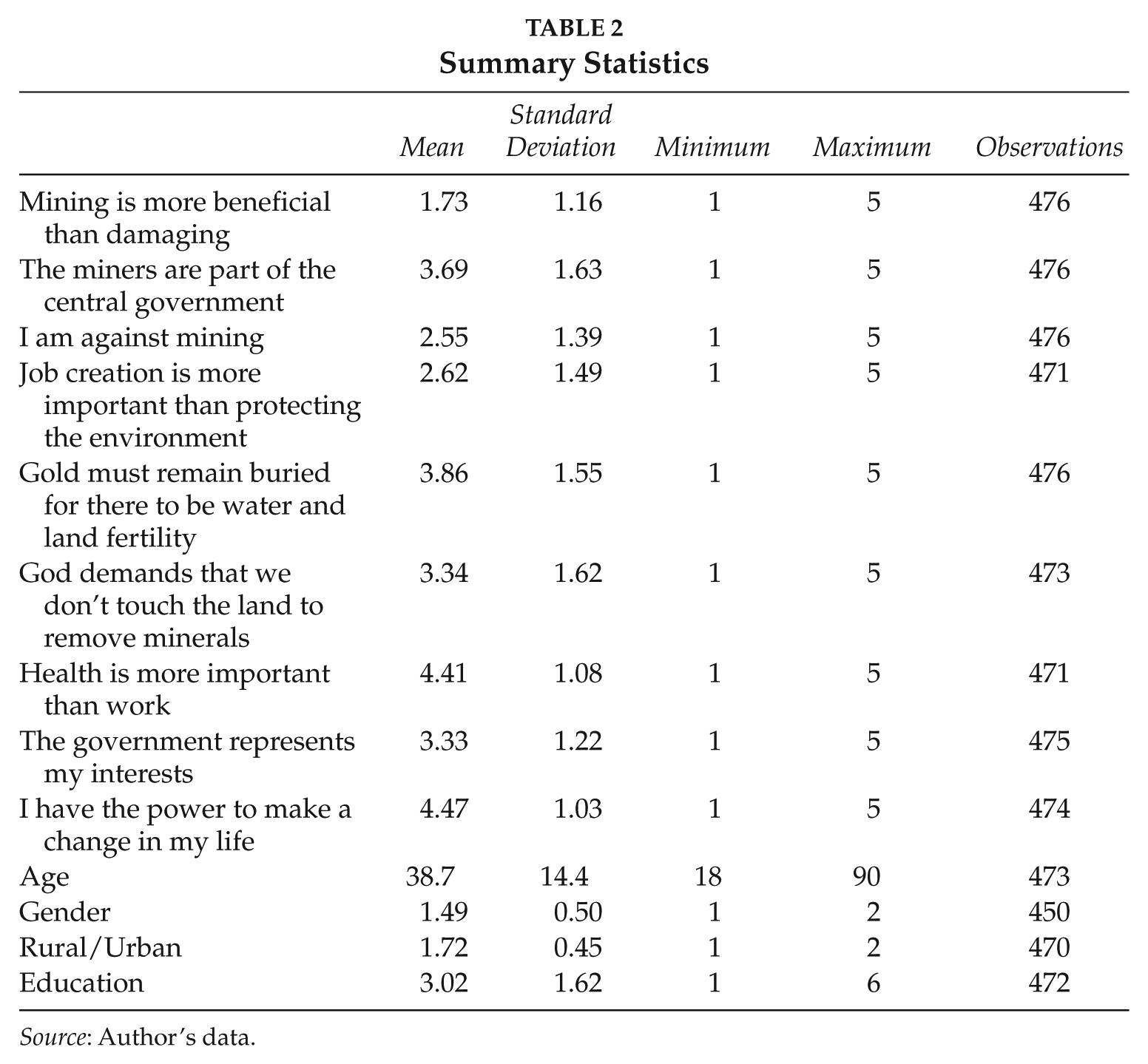
I employed an ordered probit specification to consider the underlying ordered nature of the data. I also included specifications that control for regional variation and robust standard errors with each specification. In each specification, I included a series of controls, including gender, age, educational level, and rurality (Table 2). The second set of models for each dependent variable (Table 3) included the regional controls.
Summary Statistics
Source: Author’s data.
Probit Results: Development and Mining Attitudes

Note: Robust standard errors in parentheses; ***p<0.01, **p<0.05, *p<0.1. Models 2, 4, and 6 include controls for regional variation.
Source: Author’s data.
Meanings of Development and Attitudes Toward Mining
The almost unanimous opposition to mining reflected in the counting of consultas does, in fact, belie the variation in individual mining attitudes present in indigenous communities and even in communities holding decisive consultas against mining. Two of the six categories of meanings of development—economic gain and trust in the government—were positively and significantly associated with mining support. Four categories—conservation, public health, spirituality, and self-determination—were positively and significantly associated with mining opposition.
The qualitative data complemented the multivariate findings. Individuals saw mining as representing “trade-offs” rather than as unequivocally positive or negative. As one tailor in Tectitán stated, “It’s complicated. You can’t just blindly argue that mining’s no good. Development brings advantages and disadvantages.” Individuals who emphasized the economic and materialistic benefits of development also tended to support mining or, at a minimum, express ambivalence. Participants who were critical of mining overwhelmingly valued public health and described development as incompatible with mining. Secondarily, mining’s critics emphasized self-determination and environmental stewardship as core values within development.
Most interviewees acknowledged the trade-offs of mining and described benefits and costs of hosting it. Yet most interview participants ultimately characterized mining’s costs as greater than its benefits. While the majority deployed “development” as a reflection of their values, some read it to mean access to benefit streams for members of the local capitalist class at the expense of the poor and articulated their values as alternatives to it. These participants also worded their opposition to mining in strong terms, associated development with infrastructure, and expressed skepticism of government. For example, a priest in Asunción Mita described his worries thus: “The deforestation of the natural environment with the goal of opening up roads, you know, the famous ‘connectivity.’ But the thing that we feel the most, the threat is that if they implement these projects, the mining, the contamination of water, will displace people.”
The means in Table 2 tell a conventional story but confirm the ambiguity within that narrative. While they follow intuitive assumptions about participants’ attitudes toward mining, few of them demonstrate strong sentiments. Most tend toward the neutral middle of the Likert scale. On average, respondents were more critical than supportive of mining and favored noneconomic interpretations of development (e.g., environmental protection and public health). The strongest sentiment was agreement with “I have the power to make a change in my life” (mean 4.47). The second-strongest sentiment was agreement with “Health is more important than jobs” (mean 4.41). The third-strongest sentiment was disagreement with “Mining is more beneficial than harmful” (mean 1.73). The most neutral (weakest) sentiment was “Government represents my interests” (mean 3.33). Another statement that received fairly neutral responses, albeit on the disagree side, was “Job creation is more important than protecting the environment” (mean 2.62). In sum, survey respondents tended to favor environmental protection and public health over economic development and to be more critical than supportive of mining, but the outcomes were generally weak sentiments, suggesting some ambivalence and indecisiveness on the part of host-community residents.
The third-strongest sentiment, with 65 percent indicating strong disagreement, was “Mining is more beneficial than harmful” (Figure 1). A majority (53 percent) of respondents agreed strongly with the statement “I am against mining,” and 13 percent reported more or less agreeing with that statement. However, 21 percent strongly disagreed, illustrating a more distinct split between these two perspectives. On average individuals agreed with the statement “I am against mining,” although the sentiment was fairly weak. This contrasts with the stronger disagreement with the statement “Mining is more beneficial than harmful,” suggesting that the majority of residents recognized that mining does damage but were not willing to decisively declare opposition. Health issues generated particularly strong sentiments and were widely understood as fundamental to well-being. Environmental concerns also generated strong emotions, while religious and economic matters inspired weaker ones (Figure 2).
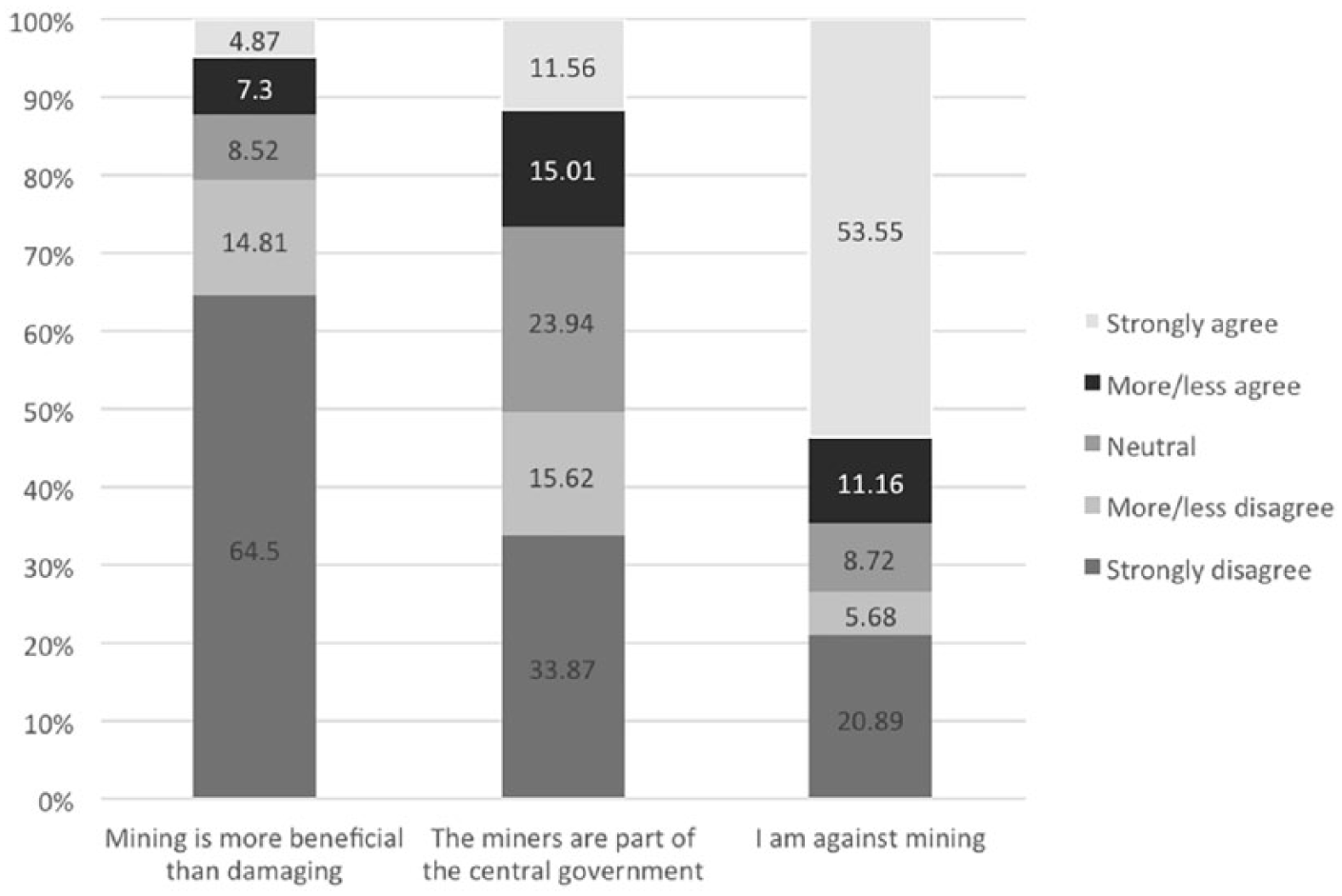
Support for mining.
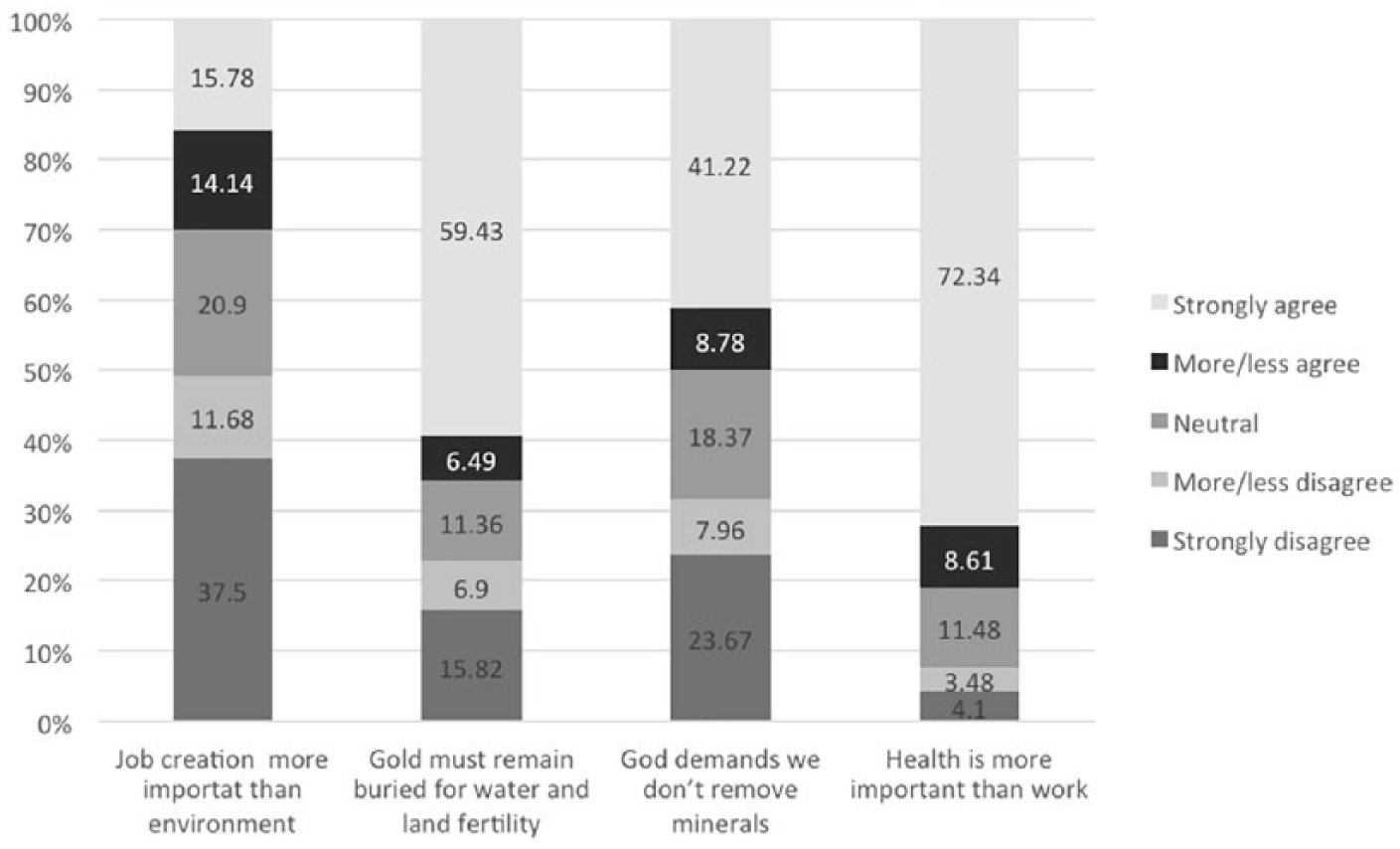
Support for differing meanings of development.
Respondents varied widely on their interpretations of development. They articulated trade-offs of development, particularly around environmental stewardship vs. economic growth. Responses to the measure of economic growth-as-development, “Job creation is more important than protecting the environment,” were relatively evenly distributed. While the modal category was to strongly disagree with the phrase (37.5 percent), nearly one in three individuals either strongly agreed or more or less agreed (29.92 percent), and one in five reported neutrality (20.90 percent). Responses were more uniform to the measure of environmental stewardship-as-development, “Gold must remain buried for there to be water and land fertility.” Nearly 60 percent strongly agreed with this statement. Forty percent strongly agreed with the statement “God demands that we don’t touch the land to remove minerals.” Finally, a strong majority (72 percent) supported the statement “Health is more important than jobs.”
The case-specific results fill out the multifaceted picture. Having direct experience with mineral production rather than just exploration led to tepid mining support and a clearer grasp of the technical aspects of mining. Residents of Asunción Mita disagreed that miners are part of the central government, which is not surprising given the development of the Cerro Blanco project there, but the result was similar for Tectitán despite its demographic and economic differences and starkly different for San José Ojetenam despite its geographic and economic similarities to Tectitán. Residing in Tectitán was strongly associated with mining opposition, while residing in Asunción Mita was weakly associated with mining support, which stands to reason since Mita receives direct economic benefits from mining. San José Ojetenam is a predominantly ladino municipality, whereas Tectitán and Aguacatán are predominantly indigenous, and residents of these municipalities opposed mining at similar rates and drew from similar discourses to talk about mining.
In contrast, residents of the largely ladino municipality of Asunción Mita were less critical of mining. If ethnicity were a salient variable, one would expect San José Ojetenam and Asunción Mita, two ladino municipalities, to parallel one another in terms of mining attitudes. Instead Ojetenam paralleled the indigenous municipalities and Mita was the outlier. The probit estimations in Table 3, by identifying underlying relationships between meanings and attitudes, inform our understanding of mining conflicts. Models 1 and 2 illustrate that development-as-economic gain is strongly and significantly correlated with mining support. This holds when community-level controls are applied (Model 2). These same individuals also believed that miners are part of the central government and disagreed with the statement “I am against mining,” as indicated by the negative coefficient in Models 5 and 6. Though the coefficient is less precisely estimated in the specification with regional controls, the direction of the effect remains constant.
A substantial minority of interviewees who considered mining’s benefits to outweigh its costs characterized it as a tool for economic development. One community elder in Asunción Mita commented, “We used to look at the young children and wonder ‘What future do they have?’ But today there are new things. The village is growing larger, becoming more civilized [with the advent of mining].” A smallholder farmer from Tectitán similarly stated, “With more people there are more ways to work and get money. There must be new types of work. We can’t just be tied to farming or we’ll never progress.”
In contrast, individuals who prioritized environmental stewardship or self-determination viewed mining as a threat to development. One peasant woman from Tectitán, for example, associated development with civic participation and leadership, stating, “I became a leader here because I like to participate and because I like development. So it’s like the people have named us to be representatives. I’m the president of a committee.” The same interviewee continued describing her attitude toward mining: “We stated that we didn’t want it. Because it was going to affect us—destruction of trees, water pollution and also it doesn’t have any benefit because we live, we eat from the land. And we have seen, in other places, that when they remove the minerals, the hills collapse because the land becomes loose.”
Respondents who viewed development as environmental stewardship were aligned with those who held a religious interpretation of development. Those who viewed environmental protection as development were more likely to believe that miners are part of the central government (Model 3) and highly likely to oppose mining (Models 5 and 6). Respondents who associated development and religion were likely to oppose mining (Models 5 and 6) and to believe that miners are part of the central government (Model 3).
Interview participants who associated religion with development frequently invoked the notion of “life” by associating mining with death or development/absence of mining with life. This association stemmed from the centrality of the notion of the dignity of human life to Catholic moral vision and social teaching. One religious leader stated, “I believe that, as agents of the Church, we must accompany the people in their resistance to these [mining] projects, which, instead of bringing development, just bring death.” Another interviewee, a lay representative of the Catholic Church active in the social wing of the diocese, stated, “We must pray that mining doesn’t start. People say that mining is practical. Everything is becoming more practical, but life is less and less. I have a nice house and everything, but if I die faster, we have less life.” Mining, for those with religious associations with development, threatens life.
Respondents who associated development with public health tended to oppose mining (Models 5 and 6), and this was consistent across specifications. They were also less likely to view mining as more beneficial than harmful, though this was estimated less precisely than some other results. Health-as-development respondents were likely to disagree that miners are part of the central government.
Public health was a salient qualitative theme as well. One community leader in the remote environs of Tectitán, for example, described his motivation for civic leadership as “seeing a little bit of change in the community, development in health, in education.” Another Tektitek smallholder farmer from a different aldea similarly stated, “Infrastructure is not the whole of development. The best development is education and health. These are the fundamental branches.” A woman affiliated with the Catholic Church in Asunción Mita similarly critiqued development-as-infrastructure, saying, “Why invest all that money in roads when people don’t even have beans and corn to eat? I can’t eat a road! That might be development, but other things are more necessary. Like health. Many people die here because of a lack of health, because of hunger.”
Many interviewees associated mining with a threat to their health. A peasant woman from San José Ojetenam explained, “The people are suffering because it affects their health. They ended up with terrible allergies.” Others saw a fundamental conflict between mining as economic development and the promotion of public health. A high-ranking elected official in Asunción Mita, for example, stated, “We are not opposed to development, okay? If mining will generate employment, benefit our people, then welcome. But if it threatens the health of our inhabitants, which is the most important, well, then, we’re going to act against them.”
Understanding development as the state’s responsibility was positively correlated with believing that mining is more beneficial than harmful (Models 1 and 2). This was among the most consistent findings across the models. This state-led development was further correlated negatively with the statement “I am against mining,” but the relationship was weak and ambiguous.
The correlation between trusting the government to execute development and supporting mining was corroborated in the qualitative data. An entrepreneur from Asunción Mita stated, “We are a country with much malnutrition, anemia, etc., because the state won’t invest in health, in something human, instead of just a road.” Another small farmer framed his discussion of development by saying, “Our community, we organize ourselves in an organic way—to develop independent from the state.” In contrast, a tailor from rural Tectitán invoked the state to justify his support of mining as development. “Regarding minerals, even the Constitution of the Republic says that mining is an urgent good for the country, for development.” Later in that same interview he said, “From my point of view, the government has to give the green light for mining. It has to study the issue and approve it. The government won’t do damage to its citizens.”
Residents who viewed development as self-determination were disinclined to believe that mining’s benefits outweigh its threats (Models 1 and 2). This relationship was significant and consistent across models (Models 5 and 6). The qualitative data unpack this relationship further. A priest who organized against mining in his town explained, “I believe in development. I believe in the hope of development to give us voice, but I don’t believe in destruction.” A peasant woman from rural San José Ojetenam emphasized the importance of technical information in making decisions, “At first we had little information. Even the educated townspeople asked, ‘What are the harms that [mining] causes?’ We sought information because information is power.”
For mining’s supporters, development goals were rationalist and economic. One peasant man in Asunción Mita, whose son worked for the mine, stated, “Mining is development, it’s change, it’s progress, it’s moving out of backwardness.” Another interviewee who had no direct benefit stream from the mine argued that mining improved educational attainment. “Now the children get to seventh grade, eighth grade. But before they just finished first or second grade. Now we’re seeing our development that we wanted.”
Residents opposed to mining characterized its supporters as focusing only on economic development goals. One community leader in Tectitán, for example, described his peers in neighboring San Miguel Ixtahuacán as follows: “Many people felt, ‘Let’s do it! We want mining. We want them to give us our money, and we’ll have a nice time. We’ll sell our land. We want development. Who doesn’t want development?’ But they never listened to their neighbors’ suffering. They couldn’t see the cracked houses, the sick children.” A young woman in rural San José Ojetenam made a similar statement: “They just talk about money. They say any work is good because they earn their salary and maintain their family. But they destroy the forest, the water. There’s destruction because the minerals are in the subsoil. And they trick us. They don’t consult us.”
Some mining critics articulated alternative conceptualizations of development, while others simply rejected the term entirely as overly preoccupied with infrastructure and, more specifically, road construction. One peasant woman in San José Ojetenam, for example, expressed an undertone of regret, stating, “There was no road where motor vehicles could go, just a path for horses. That’s how we used to get to town. Then they made the road with pickaxes and everything.” Another interviewee defined development critically as “cutting down trees to open up roads.” Similarly, a woman from rural Asunción Mita lamented, ”Development is about comforts in transport, housing, roads, food. Before, in this community, you wouldn’t see a house. When I was a girl you would see grass huts, mud huts, maybe a house made out of bamboo. Today, they are tearing down the last adobe houses. Today they build with bricks. There’s no warmth.” In using the term “warmth” in relation to adobe she appeared to be expressing a nostalgia for times past in which social relations were warmer.
Mining’s critics further described development as set of processes that excluded the majority in favor of a few, elite beneficiaries. A peasant woman in San José Ojetenam commented, “How does development serve us? A campesino doesn’t need a paved highway to bring his harvest home.” Another interviewee said, “Sometimes a big project calls itself development, but it doesn’t benefit all the people. It leaves out the poor.” Another participant argued that the real benefits of mining accrued to industrialized countries rather than local communities: They take everything. Then they come back just to sell it back to us at a higher price. The sheet metal is from that mineral. The iron is from that mineral. The lead. The planes, the cars come from that. We don’t see the benefits. Just the people that travel in cars, the airplane passengers, but we don’t see benefits in terms of local development.
Other respondents criticized mining companies for not producing the economic development they claimed to generate. One local government official in Tectitán, a Tektitek man, asked rhetorically, with reference to the neighboring mining town, San Ildefonso Ixtahuacán, “How is it possible that there is mining in a place and the communities are still poor?” A farmer in Asunción Mita added: “The miners have been here 12 years. So how is it possible that … the development they claimed to bring hasn’t happened? In fact, the community is poorer than ever because there are sicknesses, the crops don’t grow, the soil is contaminated.”
Conclusion
The findings of this study support the intuitive narrative around individual mining attitudes reproduced in the grey and scholarly literatures, but by focusing on motives and distinguishing between motives and outcomes it challenges the superficially similar attitudes frequently ascribed to communities facing mining expansion. It finds that those who associate religion and self-determination with development are likely to oppose mining, and those with high levels of trust in government are more likely to support mining. On average, most people in mining host communities in Guatemala, indigenous or otherwise, are doubtful about mining, although this is a tepid opposition and a significant minority supports it.
Teasing out the various ways development comes to mean and their relationships to mining attitudes clarifies the heterogeneity and ambiguity of mining attitudes in host communities and draws attention to the socio-cognitive processes individuals undergo in sorting out how mining means for them. The narrative of unanimous mining opposition is challenged in the literature focused on South America (e.g., Peru, Chile, and especially Bolivia), where longer histories of mining have institutionalized strong miner unions and wider distribution of benefits (Marston and Perreault, 2017). In contrast, the academic literature on Central America exhibits a strong tendency to gloss community responses as “resistance” while these findings reflect, as Gustafson and Guzmán Solano (2016: 143) write, that “(anti)mining movements are certainly expressions of resistance, but can only be partially understood through the language of opposition. More fruitfully, they can be seen as multi-scalar politically constitutive social processes.”
A key takeaway from this research is that public health is more critical for these mining host-community residents than environment or resource issues. Health issues are perceived communally, whereas resource concerns are more individualized. In part, this is because the enormous amounts of water used by mining have a single, identifiable point of origin, whereas the origins of health are diffuse. Additionally, the poor quality and discriminatory application of health care in rural Guatemala make good public health seem elusive to residents (Cerón et al., 2016). There is a utility-maximizing component to the pursuit of public health, but since public health’s benefits are broadly distributed this is a less individualistic concern than resource scarcity, for example. Relatedly, mining is seen as threatening health more acutely than depleting resource stocks. This may stem from the rhetoric of antimining organizing, which equates mining with death and an absence of mining with life.
This paper, following Nelson (2013; 2015), critiques research focused only on numbers as socially embedded and politically motivated. I demonstrate the partiality (in both senses) of the counting involved in the consultas as reflecting near-unanimous indigenous opposition to mining. I do this, not unironically, using numbers. These contrasting numeric narratives demonstrate both the power and the limitations of counting. Most of the current scholarship on mining conflicts in Latin America is qualitative, although there has been a recent wave of quantitative work (see Amengual, 2018; Arce, 2016; Haslam and Tanimoune, 2016; Wayland and Kuniholm, 2016). Here I bridge the two with a joint numeric and ethnographic data set.
This research further demonstrates the analytic utility of using social meanings of development as a platform to bring environmental decision making into focus. This approach might prove useful to future research. Does the typology of meanings of development hold up in other contexts? Are the relationships between meanings of development and mining attitudes consistent with respect to other types of conflicts? Is public health a chief concern of mining host-community residents in other contexts? The research also points to the need to explore the policy dimensions and best practices of mining conflict resolution.
Development is salient in public discourse in the rural developing world, where, imported from overseas technocrats, it has acquired a variety of dynamic, overlapping but distinct social meanings. The meanings ascribed to development vary so widely that the term becomes a reflection of individual values, caught up in identity formation, and thus becomes a medium through which individuals filter their understanding of mining.
Footnotes
Notes
Michael L. Dougherty is an associate professor of sociology at Illinois State University. His work focuses on the industrial dynamics and political ecologies of global resource industries and the environmental conflicts these industries engender. He recently coedited (with Kalowatie Deonandan) Mining in Latin America: Critical Approaches to the New Extraction (paperback edition, 2019).