



Abstract
Education is a pillar of buen vivir, the guiding ideal of Ecuador’s 2008 Constitution. In this framework, Ecuador made significant shifts in its education system from 2006 to 2016, the decade of the Citizens’ Revolution. The key buen vivir concepts and processes that framed these shifts were considering education as a right, as a social debt, and as a driver of a more just, knowledge-intensive and clean economy. Resource allocation, general access, learning, and inclusion of structurally marginalized groups showed significant improvement in this decade, along with other key political, economic and social changes, thus making significant advances in the emancipation of society toward buen vivir, and marking elements of how and why advancing this transformation is important.
La educación como derecho es un pilar del buen vivir, el ideal rector de la Constitución de Ecuador de 2008. En este marco, Ecuador realizó cambios significativos en su sistema educativo de 2006 a 2016. Los conceptos y procesos clave que enmarcaron estos cambios fueron considerar la educación como un derecho, una deuda social, y el motor de una economía más justa, intensiva en conocimiento y limpia. La asignación de recursos, el acceso general, el aprendizaje y la inclusión de grupos estructuralmente marginados tuvieron mejorías significativas, junto a otros cambios políticos, económicos y sociales claves, realizando avances significativos en la emancipación de la sociedad hacia el buen vivir, así como delineando elementos de cómo y por qué avanzar esta transformación es importante.
Between 2006 and 2016 Ecuador underwent significant social, political, and economic changes, of which education was a key part. This paper will present critical aspects of these changes in education in the context of wider transformations that have since seen important set-backs. Luna (2014) explores educational policy in Ecuador in the neoliberal years between 1980 and 2006, finding significant gaps, inequalities, and instability as austerity coupled with arbitrary distribution and the lack of a stable government prevented improvements in education during this period. By contrast, the decade from 2006 to 2016 saw considerable positive changes. Education became a public policy priority pursued by the Correa administration, which was elected to power in 2006 to promote a “Citizens’ Revolution” in the framework of buen vivir. In this paper, we begin our analysis of the changes in education in Ecuador in this decade with a theoretical discussion of buen vivir and the place of education within it. In the next section we discuss our methodology, and in the next we present and discuss our results and then conclude with some remarks on the reach and limitations of the present study and point to further avenues to explore. Education is not only a key right that government is required to guarantee in the framework of buen vivir; it is also required for the development of citizenship—another key aspect of buen vivir. In this respect, this essay presents critical aspects in which buen vivir, through changes in education, was advanced in the 2006–2016 decade.
Some Theoretical Remarks on Buen Vivir
Buen vivir (good living) is an ethical and political concept adopted in the 2008 Ecuadorian Constitution. Academically, it has generated much interest, theorizing, and meta-theorizing. At the meta level, some have adopted the view that it is “exhausted and meaningless” (for instance, in a paper review, Marc Becker, May 9, 2019); others have leaned toward a noncognitive perspective in which this intellectual artifact is empty, malleable, and porous but useful for political mobilizing of a populist bent (for instance, Mazzolini, 2012). A third meta-theoretical perspective affirms the existence of content for the idea while not denying the mobilizing utility that its preponderance in political discourse has had for making it concrete (akin to Williford, 2018). While a full defense of a realist stance on buen vivir is not the purpose of this paper, it is worthwhile to offer some suggestions that may elucidate it and make its use appealing.
Buen vivir has been discussed and presented in various frameworks of political philosophy, including Aristotelianism (Ramirez, 2012a), republican socialism (Ramirez, 2012b), Sen and Nussbaum’s capabilities approach (SENPLADES, 2009–2013), interculturalism (Huainacuni, 2010; Viteri, 2006), radical environmentalism (Huainacuni, 2010; Morales, 2007; 2008), indigenism (Macas, 2010; Pacari, 2009), and alternatives to development (Gudynas and Acosta, 2011; Viteri, 2006). Debates in political philosophy are not novel in any tradition, but all parties to the debate recognize buen vivir’s character as centered on rights and the importance of not just human life. These two fundamental aspects of buen vivir can be synthesized as follows:
First, buen vivir is against all forms of domination of one group or individual over another, including all forms of cultural, national, ethnic, racial, gender, and capital and class domination. It affirms human rights and the conditions for their complete application, including the universal right to basic services, which involves the decommodification and de-neoliberalization of basic interests and public goods even when this is against certain laws (rights being deontologically prior to laws—a contrast between rule of law and state of rights found in the Ecuadorian constitution). Interculturalism is a corollary of this: it proposes that cultures recognize each other and their collective rights, maintain dialogue, complement one another (correcting centuries of conquest and colonialism), and strengthen synergies. Recognition and redistribution are key elements for achieving this. Working for buen vivir requires allying with the oppressed toward their emancipation but not so that they themselves become oppressors. Rather, buen vivir requires the emanacipation of society as a whole.
Second, buen vivir opposes all forms of domination of Mother Earth. It affirms the rights of the Earth as a holistic ecosystemic subject against political, economic, and cultural practices that demonstrably destabilize its ecosystems, atmosphere, waters sweet and salty, forests, and plant and animal life. It also affirms the right and the conditions for a harmonious life between humans and the rest of Earth’s ecosystems of which humanity is a part. In this sense, it requires ecological emancipation.
Some of the most important implications of these ideas applied to education are that education is a right and that the strengthening of free, state-funded education is a social debt accumulated in the neoliberal years and a key element of changing the productive and distributive matrix (the “accumulation regime,” as it was called in the 2009 National Development Plan for Buen vivir) into a more inclusive, knowledge-intensive, and green economy. Before analyzing their concrete educational applications, we shall look at the normative and historical framework to which they belong.
Education as a Right
Before the 2008 Constitution, Ecuador’s 1998 Constitution formalized neoliberalism. It was not drafted with wide popular participation and authorization; in fact, it was predominantly drafted by traditional party elites with low popular approval ratings and imposed from a military base on the outskirts of Quito. Andolina (2003) details the way in which the indigenous movement, especially the Confederación de Nacionalidades Indígenas del Ecuador (Confederation of Indigenous Nationalities of Ecuador—CONAIE), influenced this process, particularly the “legitimacy politics” that allowed the inclusion of collective rights and recognition. The resultant constitution can nevertheless be characterized as imposed and undemocratic for three reasons. First, the mandate of popular consultation was breached: this consultation gave the National Assembly the “exclusive purpose to reform the Constitution,” not to create a new one (Supreme Electoral Tribunal, n.d.). Second, the composition of the assembly was dominated by politicians from parties (particularly the right-wing Partido Social Cristiano [Social Christian Party] and the Partido Democracia Popular [Popular Democracy Party]) with which 89 percent of the people did not identify (Latinobarómetro, 1997). Third, the constitution offered banks the convenient bargain that if they failed the state would bail them out with public funds, and with this financial moral hazard in place the banking system collapsed in 1999 and 2000. As half the banks went bankrupt and the state used public funds to try to save them, the economy collapsed, poverty shot up, popular dissatisfaction spiked, one out of every eight Ecuadorians had to emigrate, and on average no head of state lasted more than a year for a decade (1996–2006), expressing the crises that marked the people at this time (Restrepo, 2017a).
By contrast, the 2008 Constitution was written with wide citizen participation. A constituent assembly was democratically authorized to draft it, and it was legitimized by popular referendum while excluding financial capital interests from state bailouts. It emphasizes the supremacy of human rights over capital, in addition to affirming the rights of nonhuman subjects such as nature and its ecosystems and promotes complementarity, harmony, and decolonization. It is a framework that responds purposefully to the national and global crises brought about by imperial, class, racial, gender, and ecological domination. In this context, it directs the state to take an active role in bringing about change, creating and celebrating popular participation in the design, implementation, and control of public policy and the enjoyment of its fruits.
In the field of education, the constitution directs the state to allocate resources and implement policies to guarantee access to quality education for all. It specifies that state-funded education from preschool to undergraduate public higher education is guaranteed (Constituent Assembly, 2008: Articles 348 and 356). To do this, the government must increase spending on primary and secondary education (Transitory Disposition 18) until it constitutes 6 percent of the gross domestic product (GDP) in addition to allocation of resources to higher education in general. Public officials who impede the flow of resources to education are to be removed from office (Constituent Assembly, 2008: Article 348). Further, education as a right is specified in much broader terms than education as mere human capital formation. Article 27 identifies education as a right in the following terms (our translation): Education will be centered around human beings and will guarantee their holistic development in the framework of respect for human rights, the sustainability of the natural environment and democracy; it will be participatory, obligatory, intercultural, democratic, inclusive, and diverse, with quality and warmth; it will propel gender equality, justice, solidarity, and peace; it will stimulate critical thought, art, and the culture of exercise, individual and community initiative, and the development of competences and capacities to create and work. Education is indispensable for knowledge, the exercise of rights, and the construction of a sovereign country and constitutes a strategic axis for national development.
Education as a Social Debt
One of the fundamental reasons offered for prioritizing education in the framework of buen vivir and the Citizens’ Revolution (as the 2006–2016 period is commonly called) is a recognition of past grievances that must be redressed. Resources, instead of being used for the universal guarantee of rights and the social development of the country, had been put toward the accumulation of wealth of political and economic elites. The U.S. ambassador, Linda Jewell (2005), in an internal cable revealed by WikiLeaks, had described Ecuador as “one of the most unstable, undemocratic, and corrupt countries in Latin America [. . . with] political and economic systems based on competition by entrenched elites.” One area where there was substantial evidence of accumulation by dispossession, which essentially characterizes the neoliberal era of elite democracy described by the ambassador, was the management of the foreign debt, which had escalated as private-sector liabilities were transferred to the public sector. In the 1980s there were two fundamental mechanisms for bringing about this effect. One was the honoring of the debts of the 1970s dictatorship, which were acquired without the consent of the people and whose investment representation could not be verified (Comisión para la Auditoría Integral de Crédito Público, 2008). The other was sucretización, through which presidents Osvaldo Hurtado and León Febres Cordero multiplied the external public debt as a percentage of GDP by 275 percent by transferring international liabilities from private actors to the state (in sucres, its legal currency at the time). Public debt stocks as a percentage of GDP went up from 20 percent in 1981 to 75 percent in 1988 (World Bank, 2018). This public indebtedness was justified as “saving the productive apparatus of the country” but was used to cover the debts of exclusive luxury clubs such as the Quito Tennis and Golf Club, Club La Ballenita, and Club La Herradura with dubious connections to the productive apparatus (Acosta, 2008). In the 1990s and at the beginning of the twenty-first century, dispossession in favor of small groups with power in the country was carried out through the liberalization of banking (the General Law of Financial System Institutions of 1994) while providing banks free public insurance guaranteed by the state. What was considered an implicitly morally hazardous public insurance policy for too-big-to-fail banks in the United States was formalized explicitly in Ecuador in the Deposit Guarantee Agency Act of 1998 and the 1998 Constitution.
As the GDP stagnated, upward redistribution prevailed. On average, the GDP grew only by US$23.26 per year per person, and average growth was only 0.71 percent per year between 1987 (the first available figure) and 2007, while the concentration of wealth, as measured by the Gini index, intensified, rising from 50.5 in 1987 to 53.3 in 2007 (World Bank, 2018). With the banking crisis, deposit freeze, and dollarization of 2000, poverty increased by 44 percent (ECLAC, 2019) and 15 percent of the population emigrated to seek sustenance mainly in the United States, Spain, and Italy (Jokisch, 2014). Instability and the depletion of funds meant that there was no guarantee of the right to education. There were no stable, financed educational policies, and as a result a significant debt was built up in relation to this social right. When Milton Luna was minister of education during the first six months of 2019, he glorified the period prior to the Citizens’ Revolution—a period that he, under the Moreno administration, would work to restore. However, his 2014 analysis, while out of office, had been quite different (our translation): Between 1980 and 2007, education, in particular state-funded education, underwent a process of stagnation and regression amid reform initiatives that ultimately failed. The economic crisis and political instability made it impossible to reach goals of educational improvement and did not strengthen social, political, or productive actors. Public policy, and in particular educational policy, was inconsistent and weak, contributing to unstable and unstructured management. Educational agents were constantly confronted by the lack of economic resources and agreements.
Education and Change of the Productive and Distributive Matrix
Changing the productive and distributive matrix is key to the economy of buen vivir, and education is a fundamental potential driver of change in this sphere. The economic history of Ecuador characterizes the country as primary-product-dependent, with high levels of concentration, dispossession, and instability due to the swings of commodity prices in the international market. The oil sector produces half of Ecuadorian exports, and this, with the dollar as the legal currency, deepens the vulnerability of the national economy, which depends on net exports for its liquidity (Ruiz and Cisneros, 2014).
From 2007 on, the government promoted various economic reforms to strengthen the national economy and reduce vulnerabilities: (1) Savings of US$7 billion (equivalent to 7 percent of the GDP today) were made by refusing to pay portions of the foreign public debt that were identified as illegal and illegitimate and buying their respective bonds at discounted prices to avoid expensive lawsuits (Ghosh, 2013). (2) The constitutionalization of public ownership of nonrenewable natural resources increased the state’s net income by US$4,158 million between 2011 and 2014, which amounted to the doubling of the percentage of income from oil revenues for the state even while oil revenues as a percentage of GDP decreased (Altomonte and Sánchez, 2016: 181; Arroyo and Cossío, 2015: 36). (3) Banks were obliged to insure themselves with funds managed by the Deposit Insurance Corporation, the Liquidity Fund, and the Private Insurance Fund in order to avoid the moral hazard that had caused the crisis of 1999, when the banks were given free public insurance. Likewise, banks were required to maintain 60 percent of their liquid assets inside the country. These measures increased the stability of the banking system, reintroducing responsibility within free enterprise, while protecting liquidity and dollarization at the national level (Weisbrot, Lefebvre, and Johnston, 2013). The Constitution prohibited banks from owning media outlets, a measure that fueled a “violation of free speech” discourse as these financial interests tried to defend their information and communications power. (4) With the construction of eight major hydroelectric plants, the proportion of electricity consumption from renewables doubled. This meant a dramatic reduction of imports of energy derived from the burning of coal and fossil fuels and the beginning of exports of renewable electricity (J. Constante, 2016; S. Constante, 2016). (5) Austerity policies were reversed and social protections strengthened to create a welfare state. Public spending on social services, including education, doubled as a percentage of GDP, from 4.2 to 8.7 (Ray and Kozameh, 2012). (6) Transforming the economy into one more in line with buen vivir involved reducing the relative weight of the primary sector. Between 2007 and 2016 the primary sector grew by 22 percent, adjusted for inflation, while the more knowledge-intensive parts of the industry and services sector grew more than twice as fast, reaching 47 percent (Central Bank of Ecuador, 2017; Restrepo, 2017b).
The change in the productive matrix was accompanied by a marked difference in the distribution of the gains of the economy. The economy began to reverse the concentration of wealth in the hands of a few, and Ecuador became the third country in the world, after Bolivia and Moldova, in reducing inequality between 2007 and 2016, deconcentrating income from 53.3 on the Gini index to 45 (World Bank, 2018). Within the framework of buen vivir and the required changes in the productive and distributive matrix, education was fundamental for diversifying the economy and providing opportunities for all Ecuadorians to improve their economic condition and strengthen their autonomy. These system changes reversed the neoliberalism of the previous three decades of austerity of public services and social rights, market liberalization with ample protection for the financial sector, and the lack of national planning and long-term investment.
Data and Method
Within this framework of structural transformation, our main interest is to explore the evidence for educational change in Ecuador in the decade between 2006 and 2016. We chose to focus on the period for the following reasons: It was appropriate to begin with 2006, the last year of neoliberal government, since this was the country “received” by the new government promising to fight neoliberalism and work toward the creation of buen vivir. Further, Sabatier (2010) recommends that policy be evaluated by the decade, since year-by-year comparisons include considerable informational noise.
To zero in on educational policy, we descend through the educational stipulations of the constitution, the laws passed between 2007 and 2016 on educational access and quality, and the financing of education at the national level. These data are compared with those of other countries in the region using figures from the United Nations Economic Commission for Latin America and the Caribbean (ECLAC). We compare rates of enrollment for children between 5 and 14 years of age in Ecuador with those of a panel of selected countries from Latin America. We compare the evolution of the reasons for not going to school for children aged 5 to 14 and 15 to 17 using the most complete and reliable yearly national survey available, the Encuesta Nacional de Empleo, Desempleo y Subempleo (National Survey of Employment, Unemployment, and Underemployment—ENEMDU) carried out by the Instituto Nacional de Censo y Estadística (National Statistics and Census Institute—INEC). Since various ethnic groups have traditionally been excluded from the education system, we consider not only total changes in access but also ethnic composition in 2006 and 2016. We also look at the evolution of public and private education.
To identify changes in quality, we detail the main measures taken and the corresponding changes in learning results as evidenced by the difference between UNESCO’s 2006 and 2013 Regional Comparative and Explicative Tests in Math and Language, administered to fourth- and seventh-graders. Ecuador’s Instituto Nacional de Evaluación Educativa (National Institute for Educational Assessment—INEVAL) has since 2013 been administering comprehensive systemwide tests to millions of students and teachers to monitor progress in education and inform policies. While these tests have their valid critiques and limitations, they essentially measure changes in language, math, and natural and social science learning on a national and regional scale. They share with many standardized tests that they do not measure whether we are educating with the citizenship qualities and the social and ideological commitments of a Gandhi, a Mandela, and a Bolívar or with those of a technocratic Eichmann, and it is still a challenge for progressive social scientists to propose other general ways of measuring changes in quality. However, basic competences in math and reading are necessary if not sufficient features of quality education. It is unthinkable that a country could have a good education system without generating access to the production and comprehension of written knowledge, art, and other forms of expression or without teaching the young to add, subtract, multiply, and divide, thus depriving them of the basic skills for analysis, decision making, and work. Measuring these aspects does not tell us everything we need to know about the quality of the education system, but it does give us valuable information about fundamentals in a country with a history of not guaranteeing them.
Changes in Education Between 2006 and 2016
According to the Constitution, education is compulsory through the final year of high school (the last level of the national education system) and is guaranteed to be free up to the tertiary level. The financing of the system tripled and spending on higher education increased fivefold between 2006 and 2016, making Ecuador one of the top two (together with Costa Rica) Latin American countries in increasing resources for education as a percentage of GDP. Ecuador’s increase in state-funded education spending increased from 2.3 to 4.6 percent of its GDP from 2006 to 2016, more than three times as fast as that of the Latin American region as a whole, which increased from 3.2 to 3.9 percent (ECLAC, 2019). However, rights-based laws and financing without increased access would have been insufficient to guarantee the right to education, and access did indeed increase at all levels. Ministry records register a multiplication of access to early-childhood education by a factor of approximately 12, going from 27,470 children aged 3 to 4 years in 2007 to 327,940 in 2016 (Ministry of Education, 2016). Further, there was an increase of 523,300 boys and girls from 5 to 14 years old attending classes, equivalent to an increase of 18.67 percent, for a net attendance rate of 95 percent. Further, the increases in net access were led by indigenous people and Afro-Ecuadorians, whose numbers attending school increased by 48 and 49 percent, respectively (INEC, 2006–2016).
Participation in schools in the intercultural and bilingual system run by indigenous communities also increased significantly, from 95,471 students in 2006 to 148,956 in 2015, equivalent to a 60 percent increase (Ministry of Education, 2016). Further, there was a reduction in barriers to access to education for children between 5 and 14 years old; lack of economic resources was reduced by a factor of seven (INEC, 2006–2016). The net attendance rate in basic general education (mandatory primary and secondary school) experienced the greatest increase in the poorest quintile and in the rural areas of the country. This shows substantial progress in eliminating inequalities of access to education between rich and poor and between the people of the city and the countryside. Although there may be a discrepancy in access to education for children attending single-teacher schools in very remote places, the net result was substantially greater access to education, especially in the sectors where the highest rate of exclusion had previously been found. Further, the change was driven by greater access to the public sector, which promoted the inclusion of 632,640 additional children, an increase of 31 percent. Private education decreased by 24 percent (INEC, 2006–2016).
Further, between 2006 and 2016 the number of students between 15 and 17 years old going to school, generally in their final three years, increased by 289,769, equivalent to a 45 percent increase. In addition, the INEC-based National Information System reports that the percentage of people aged 18–29 who had finished high school increased from 46.96 percent to 62.99 percent, and there was a generalized reduction of barriers to access to education for young people between 15 and 17 years old, with the main barrier, “no money,” decreasing to less than one-third of its original magnitude. A recent study found that the inclusion of teenagers previously excluded from education by lack of economic means was significant in this period. Ecuador increased access to secondary education for poor students (bottom two quintiles) by 20 percent, ranking second in the region after Brazil (Elacqua et al., 2018). However, there was still a need to include 144,864 would-be students aged 15–17 who for one reason or another were not attending school. Within these general increases in access to education for young people aged 15 to 17, indigenous people led the increases with their additional 43,502 students, equivalent to an increase of 128 percent, and Afro-Ecuadorians by 12,326, equivalent to a 69 percent increase. This significant expansion in access to high-school education was driven by the public sector, with an increase of 306,052 students equivalent to 70 percent growth. For children of all ages, access to education showed gender parity (INEC, 2006–2016). In terms of change in the rate of net access to secondary education, Ecuador grew by 33.81 percentage points between 2006 and 2016, thereby making the largest leap forward among comparable Latin American countries in this period after a decade of having the worst performance (Table 1).
Ranked Changes in Net Access (%) to Secondary School, Various Latin American Countries, 2006–2016
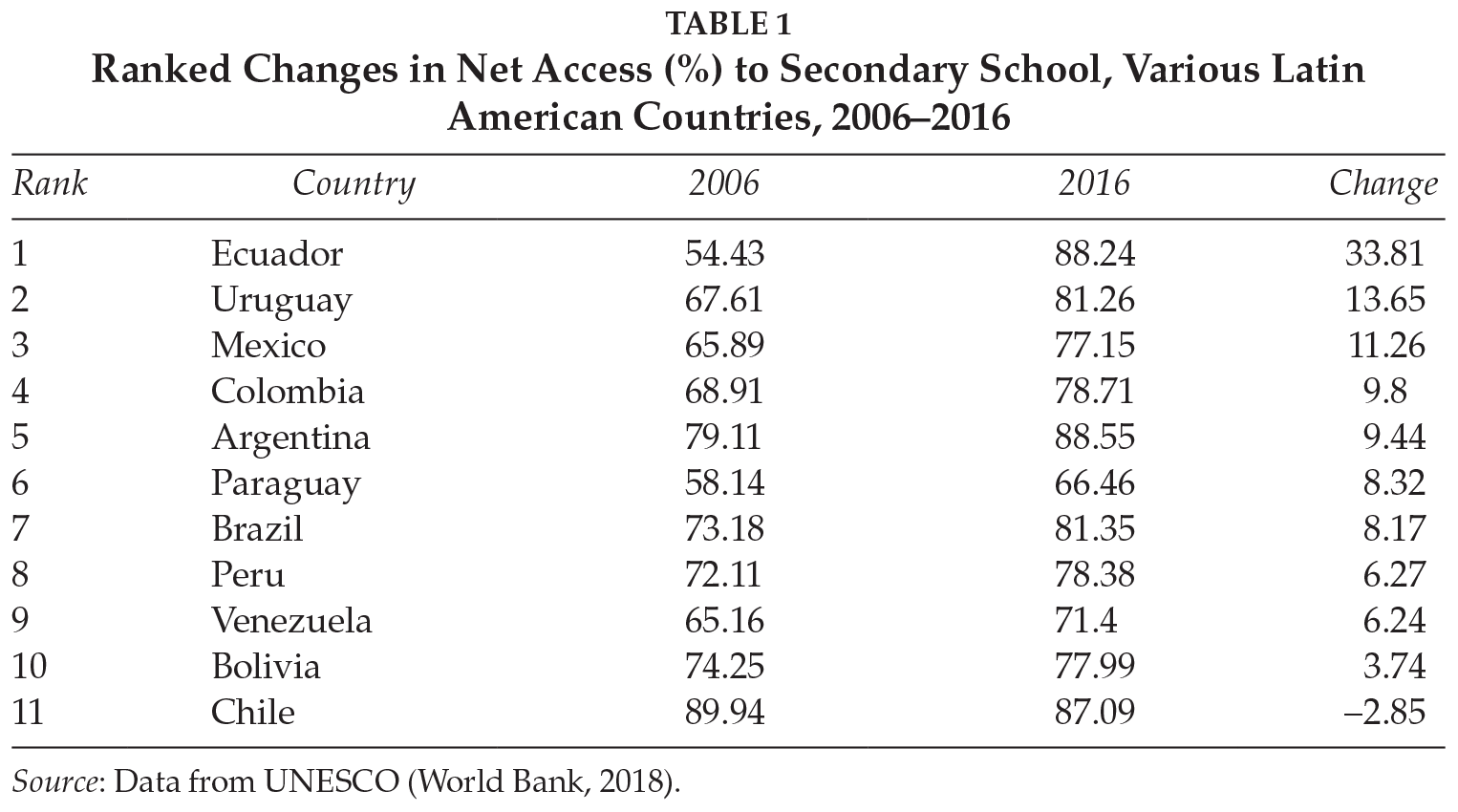
Source: Data from UNESCO (World Bank, 2018).
Of course, children go to school to learn. Rights-based laws, with significant increases in financing and access, still leave the right to education incomplete without improvement in learning. Spending on the national education system focused on improving both infrastructure and factors associated with learning and teachers. Improvement in the quality of teaching staff was based on the following measures: (1) improvement of the teacher selection mechanism through a national test called Quiero Ser Maestro (I Want to Be a Teacher) that was introduced after irregularities had been noted in the previous mechanism, controlled by the National Teachers’ Union; (2) systematic evaluation of teachers, now the responsibility of the INEVAL; (3) high-quality continuous in-service professional development on a massive scale, known as SíProfe; (4) promotion based on proven performance; (5) tripling of the salaries of teachers and school staff; (6) the closing of 23 poor pedagogical institutes; and (7) the creation of the Universidad Nacional de Educación (National University of Education—UNAE), with the mission of educating a critical mass of quality teachers with a model based on the theorization of practice and experimentation with theory through practical research from the first semester of teacher education (Ross, Cevallos, and Bruns, 2017). One result was that almost the entire population is now literate, and after a decade of the worst performance in the region Ecuador became the Latin American country that had most improved its literacy rate (UNESCO, 2013: Table 2).
Ranked Changes in Literacy Rate, Various Latin American Countries, 1996–2006 and 2006–2016
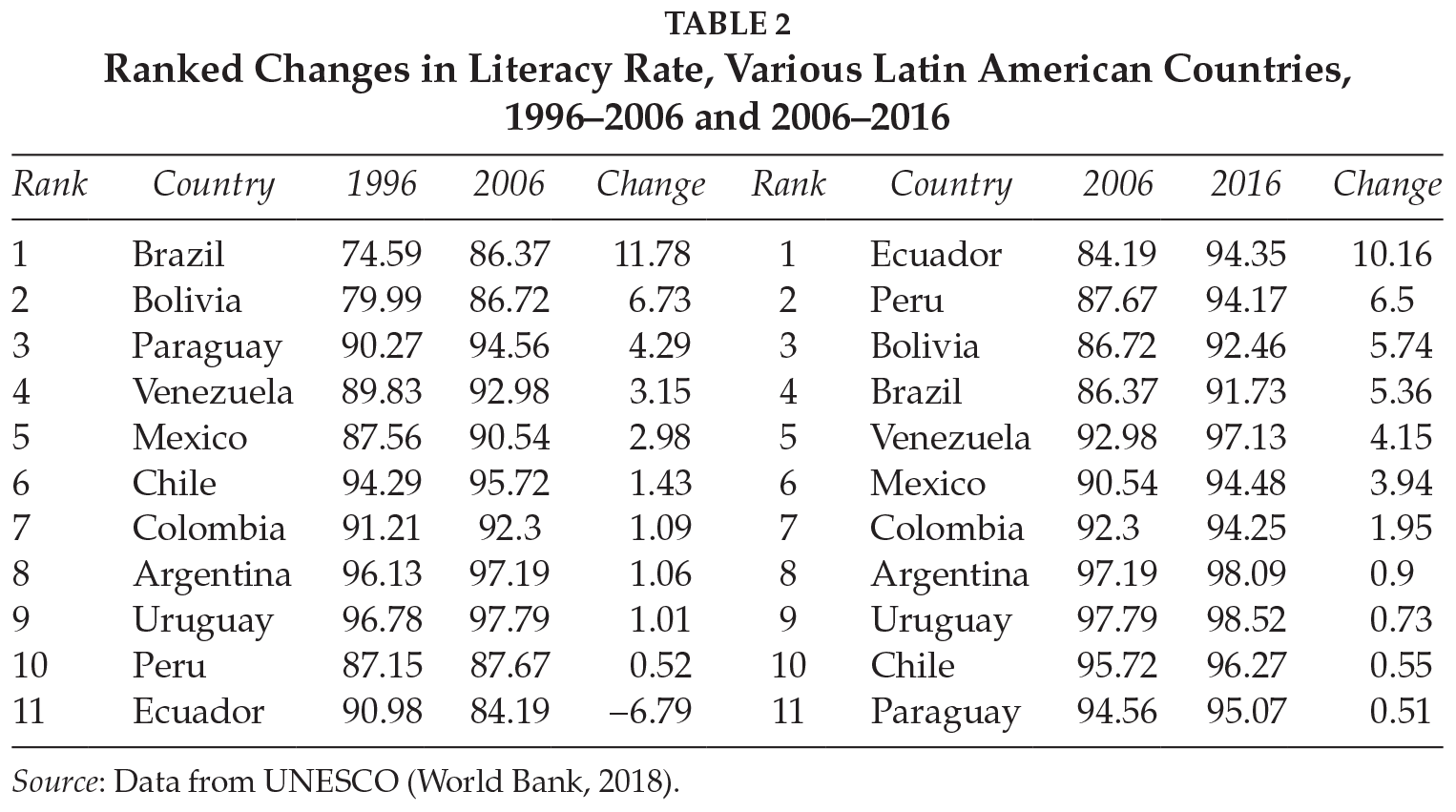
Source: Data from UNESCO (World Bank, 2018).
The improvement in math and reading of fourth-grade students showed Ecuador to be the second-most-improved country (of 15 tested) in reading and fourth-most-improved in math. Ecuadorian seventh-grade students demonstrated the highest level of improvement in reading in the region and the second-highest level of improvement in math. In static terms, this elevated Ecuador from the bottom cluster to the middle, still a modest position. However, in dynamic terms, in the aggregate, Ecuador was the top country in increasing access to the world of numbers and letters for its youth (Figure 1).
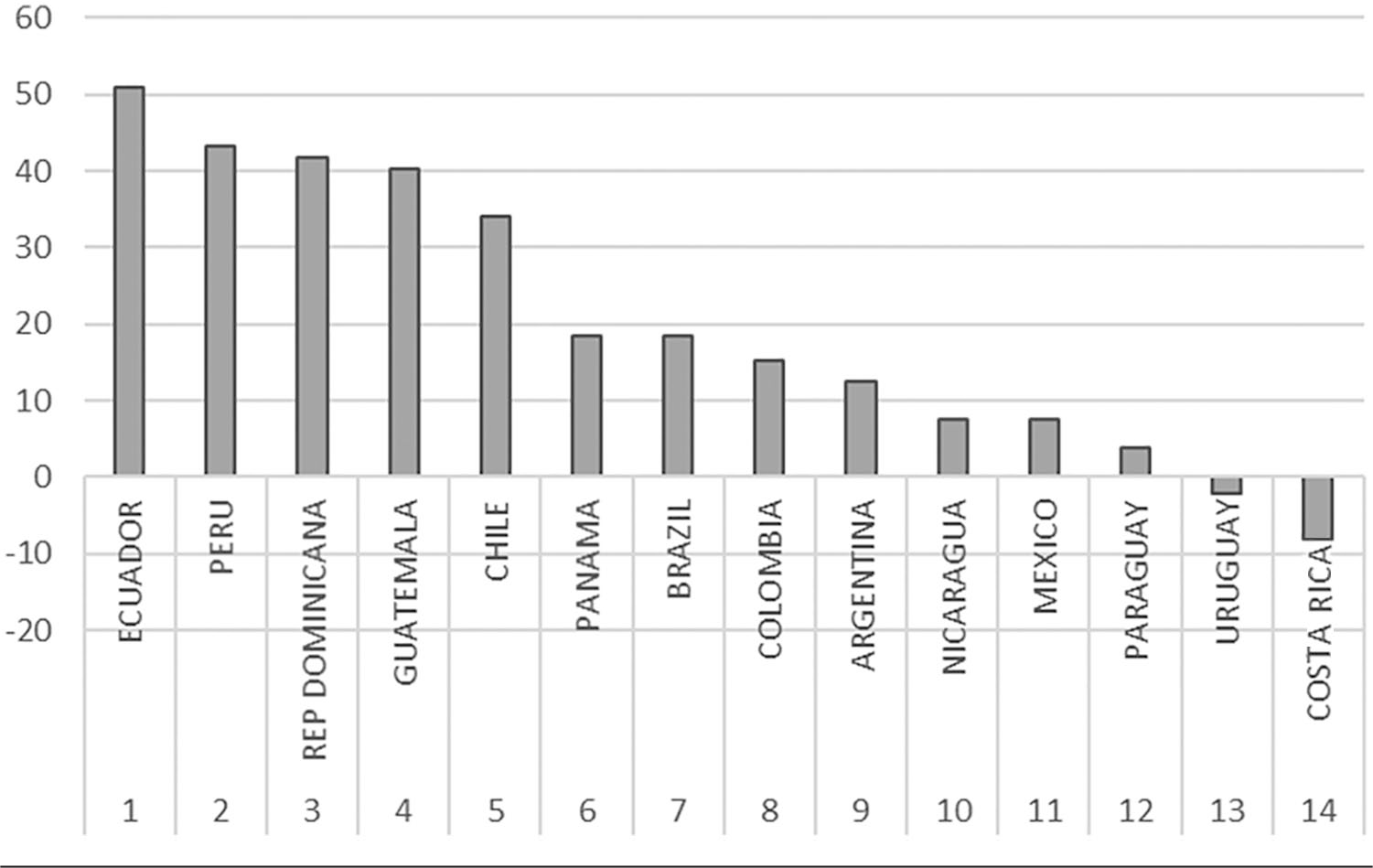
Ranked average increases in math and reading, 2006 and 2013 (UNESCO, 2006; 2013).
We will have to wait for the next UNESCO comparative exams to continue observing the evolution in learning region-wide. In the meantime, we can also consider the INEVAL exams, which began in 2013 and show improvements between 20 and 45 points in recent years. According to these data, in the fourth grade the frequency of underperformance decreased by approximately one-third between 2013 and 2016 while the frequency of satisfactory and excellent performances increased by a quarter. For seventh-grade students, the frequency of unsatisfactory performances decreased by approximately two-fifths while the rate of satisfactory performances doubled. For tenth-grade students the frequency of unsatisfactory scores was reduced by more than one-fifth, while satisfactory scores more than doubled. In the final year of high school, unsatisfactory scores were slightly reduced, while satisfactory performances doubled (INEVAL, 2017). Again, while these measurements are part of what makes for a quality education, they are not enough. Collaborative, citizen, ethical, and ecological competences and happiness are key additional components. Detection and development of these objectives remain an agenda for Ecuador and the world.
Free state-funded education with substantial increases in access and quality for all, especially traditionally marginalized groups such as indigenous people, blacks, the poor, and women, is essential for rolling back neoliberalism’s classism and racism and building buen vivir. This overall positive picture of progress does not prove that buen vivir has been realized. It still has significant gaps. Education continues to generate better learning outcomes in private schools for students of higher socioeconomic status than for those from a lower socioeconomic background, who frequently attend state-funded schools (INEVAL, 2017). It is worth mentioning that a policy of free public higher education was implemented so as not to discriminate against young people on the basis of their economic backgrounds, but because admission to the university depends on achieving the highest scores on examination such as Ser Bachiller (Being a Bachelor), economic discrimination is avoided in one step but reemerges at the next. Students from higher socioeconomic groups, who attend private schools, are more likely to obtain such scores. The challenge continues to be to provide relevant, high-quality education for all young people, as educational justice of wide access should not be mediocrity. Having committed and critical high-quality medical professionals, social and physical scientists, teachers, engineers, innovators, and artists is key for guaranteeing the rights to life, health, education, mobility, information, communication, housing, food, water, etc., for which higher education is key. For this, better selection processes and wider human, infrastructure, and economic capacities are required.
One issue that has been center-stage in education-policy debates in Ecuador is the evaluation of the “millennium schools.” Starting in 2008, the Correa administration built 107 top-quality state-funded schools (with running water, playgrounds, science and computer labs, and libraries) for lower-income families, frequently indigenous, in rural and urban areas. Opinion pieces by the researcher and former minister of education Rosa María Torres (2017) and the researcher and former minister of education Milton Luna (2019) have given voice to criticism of these schools as exclusionary, fraudulent, and (in Luna’s case) even “racist” and the conclusion that a return to “single-teacher schools” is the solution. These commentators do not refer to any study or systematic observation, and their remarks contrast with the fact that, as shown above, indigenous and lower-income people are the groups that proportionately most increased their entry to education in the years considered. Further, the most systematic study evaluating the impact of the millennium schools did not find that they had a negative impact on access (Ponce and Drouet, 2017). In addition, between 2006 and 2016 rural primary-school net attendance for children aged 5 to 14 increased from 87.86 to 95.28 percent and rural high-school net attendance increased from 31.28 to 63.90 percent, evidencing inclusion rather than exclusion.
When a point about access cannot be sustained, conversations about access to education and the millennium schools quickly turn to quality. As we have seen, the general trend is toward significant increases in learning. Further, Ponce and Drouet (2017), who analyzed millennium schools that began operation between 2014 and 2016, found 0.5-standard-deviation increases for the learning of math, and there have been no studies showing otherwise. It should also be noted that it is surprising that this study found any impact on learning at all, since these were schools that had just begun operation. Taking into account millennium schools that had begun operation between 2008 and 2013 might more accurately reflect their impact and potential. The findings are consistent with those of international studies underlining the importance of sufficient infrastructure for learning (Barrett et al., 2019). It must also be noted that the full potential of these schools has not yet been realized, since they are very young and still have to develop a better pedagogical model.
Teachers from the UNAE like us often visit rural schools, and in our weekly visits to millennium and many other kinds of schools between 2016 and 2019 we received positive comments from students, teachers, directors, and parents about these schools. In rural locations where there were no millennium schools—for instance, in Cañar and Azuay Provinces—parents frequently expressed the desire that a millennium school be built for their community. This has also been the experience of the director of the UNAE’s intercultural bilingual education program in Imbabura, Germán Flores (interview, Chuquipata, Cañar, July 22, 2019). Providing wider access to such schools would be a step in the same quality-and-pertinence-increasing direction. Anecdotal reports indicate that a small percentage of children has to travel too far to get to these schools and a better alternative to them needs to be found. Further, strengthening intercultural education for all students, not just indigenous ones, as the 2011 Organic Law of Intercultural Education and the 2010/2018 Organic Law of Higher Education demand, is still pending. One positive case is that of the Intercultural Bilingual Educational Millennium Chibuleo Unit, which has strong infrastructure, promotes indigenous cultural pertinence, is state-financed, and admits both indigenous and mestizo students, who learn not only Spanish and English but Kichwa and can earn the international baccalaureate.
Higher education has also changed in both quality and access. However, it can be said that while higher education has been well financed (2 percent of the GDP for universities, higher institutes, and polytechnics) and teachers’ qualifications have improved, especially with the requirement that they have Master’s or Ph.D. degrees (the number of which has doubled) and do research, according to the databases of the National Higher Education Information System and INEC’s ENEMDU surveys, there has been little increase in net access for undergraduate and postgraduate students. Enrollment in state-funded higher-education institutions, which is free, and graduate degree programs increased by 17 percent, while enrollment in private institutions decreased by 19 percent. Both undergraduate and postgraduate enrollment maintained equal access by gender between 2006 and 2016. The frequency of access for indigenous people increased by 70 percent, and the frequency of access by black people more than doubled. Mestizos remained the group with the highest level of access to graduate and postgraduate degrees (mestizos made up 71.9 percent of the population according to the 2010 census). Likewise, the economic reasons for not going to the university decreased substantially (INEC, 2006–2016).
While these trends, many of which are positive, make up the dominant changes in education, there are several higher-education policies and outcomes that may be criticized. For one, there has been very little net overall increase in access to higher education. Various hypotheses have been proposed as explanations, including the use of a standardized exam (the ENES and then Being a Bachelor) (Herrera, 2012) as opposed to the earlier determination by having the money to pay, having contacts, or ad-hoc selection. The exam was introduced to improve graduation rates and eliminate the filters of arbitrary selection and the capacity to pay. Public universities determined the number of students they could take for each program, students ranked the programs they wished to attend in different universities, and the system automatically assigned the students with the highest scores to the institutions they most preferred. This process ran until every program was full or until there were no more students wanting the programs that had places. As a result, the composition of the student body became more inclusive and diverse ethnically and class-wise and produced larger numbers of graduates; in fact, the number of students graduating from higher-education institutions almost doubled, from 83,410 in 2006 to 149,500 in 2015, according to the National Information System of Higher Education (2018). However, more places for students need to be made available, and further improvements of the selection process and its support mechanisms need to be made.
Other measures that can be criticized include aspects of the Prometeo program, the international scholarship program, and the overemphasis on Scopus and Web of Science publications for university quality assessments. The Prometeo program brought academics from around the world, almost exclusively for research, instead of focusing on building human talent and knowledge within the country. The international scholarship program financed very expensive higher-education scholarships but paid little attention to efficiency. Paying for education in the United States is very expensive, for instance, especially when European universities are available. Among other things, a better policy mix would have emphasized a Prometeo program with heavier teaching duties for invited professors. This would have better prepared graduates for projects in the country and would have been cheaper. University evaluations place heavy emphasis on Scopus- and Web of Science–indexed publications in an attempt to incentivize quality research and publication in a country with little tradition in this regard, but often the knowledge produced ends up in journals in English that require payment for access, essentially cutting Ecuadorians off from knowledge produced in Ecuadorian universities, including those that are publicly financed.
Discussion and Conclusion: A Thought on Education for Change
Between 1981 and 2006, Ecuador accumulated a large social debt with regard to the right to education driven by the neoliberal policies of the time. This exclusionary elite democracy redistributed wealth upward into the hands of the rich in a kind of Robin Hood process in reverse while forcing 15 percent of the population to emigrate. The poverty rate increased by 44 percent and homicide rates tripled, causing the highest level of political, economic, and social instability in the country’s history (Restrepo, 2017a). The lesson of all this, very relevant to political discussion in the country (as loud voices have wanted to “reinstitutionalize and democratize” the country back to pre-2006) and the region today, is that neoliberalism is a bad choice.
The 2008 Constitution realigned the priorities of society and the state around the ideal of buen vivir and its rights, including the right to education, with the implementation of adequate financing, progress toward universal access, the inclusion of traditionally marginalized groups, and learning increases in the context of wider system-wide transformations including the growth of a more intelligent, green, and inclusive economy and a more stable and participatory political system. Education is key for systemic emancipation. Changes in education until 2016 were driven by a political change that prioritized the guarantee of the right to education, the payment of the social debt, the construction of a welfare system, and a change in the country’s productive and distributive matrix. Buen vivir has at the core of its concept of social organization the elimination of domination and the guarantee of human rights and the rights of nature. The lesson is that adequate laws, financing, access, and learning are very important for constructing buen vivir.
Some other important aspects of buen vivir include interculturalism, decolonization, the promotion of the guarantee of the satisfaction of needs, the abandonment of cruelty to nonhuman animals, and ecological sustainability. The degree to which these other aspects of buen vivir have been brought to life remains to be explored and awaits further action and research. For instance, by law, all education is supposed to be intercultural, but it rarely is. Some efforts have been made to incorporate indigenous languages into schools, but their reach has been limited. Further, the indigenous movement frequently conceives of interculturalism as exclusively indigenous when it is supposed to be a dialogical meeting of worldviews. Widespread learning and understanding between cultures in Ecuador and the place of education in that space continue to require attention.
The building of citizenship as an agent of change and a new green economy require the correction of mistakes and the strengthening of the rights-centered democracy of buen vivir in Ecuador. However, at the time of this writing, the Moreno administration has rolled back much of what has been constructed and has handed over public policy to traditional internal and external groups of capital power, especially importers, financial institutions, and right-wing parties, a process accelerated by the shock of the COVID-19 pandemic. Because of this process, the right to quality education for all, a pillar of buen vivir, is severely under threat. Education is one of the key institutions for building citizenship and has a significant role in defending and advancing the construction of an emancipated society based on the principles of buen vivir. At the time of this writing, citizens face electing one of the two forces for president: neoliberalism with Guillermo Lasso or the Citizens’ Revolution with Andrés Arauz. By the time this is read, we should know which would better approximate buen vivir and which the citizens chose.
Footnotes
Ricardo Restrepo Echavarría is a professor at the Technical University of Manabí, Ecuador, and part of the Critical Studies for Social Justice Research Group. His research interests lie at the intersection of philosophy, social sciences, and policy. Agnes Orosz is a teacher educator professor and currently the director of the Language Center, at the National Education University of Ecuador.