



Abstract
Comparison of the paths of two countries with developmental regimes led by left-of-center parties, Chile and Mexico, shows that the democratic regime, Chile’s, had better social indicators than its authoritarian counterpart at the price of slower industrialization.
Comparação das trajetórias de dois países com regimes desenvolvimentistas dirigidos por partidos do centro-esquerda no Chile e México demostra que o regime democrâtico chileno teve maiores indicadores sociais que sua contraparte autoritária às custas de uma industrialização mais lenta.
Following the 1930s Great Depression, the crisis of economic liberalism opened the way for interventionist models that subordinated market functioning to sociopolitical objectives (Eichengreen, 2008; Levitt, 2006; Polanyi, 2001). Among these models, so-called developmentalism aims to achieve industrialization and technological catching-up through bureaucratic planning, active industrial policies, and long-term state-business ties (Amsden, 2001; Wade, 1990; Woo-Cumings, 1999). Historically, developmental regimes have been adopted by several countries in the Global South as an attempt to overcome their peripheral position in the international economic order (Caldentey, 2008; Pempel, 1998; 1999; Singh and Ovadia, 2018). Although the flagship cases of developmentalism took place in East Asian countries where right-wing nationalist parties governed through authoritarian political regimes (Johnson, 1987; Randall, 2007), this does not mean that left-of-center parties and democratic institutions are obstacles to developmental regimes (Woo-Cumings, 1999; Robinson and White, 1998; White, 1998). In Latin America, for instance, developmentalism has been a recurrent influence on the agendas of left-of-center parties by providing an economic rationale for challenging foreign capital and promoting domestic growth strategies (Wylde, 2012; Ban, 2013; Gezmis, 2018; Strange, 2014; Yates and Bakker, 2014). Similarly, as discussed by Fonseca (2015), the combination of democracy and developmentalism is more than a theoretical possibility, being observed in countries like Argentina under Juan Perón (1946–1955) and Brazil under Juscelino Kubitschek (1956–1961) and João Goulart (1961–1964). It is possible to argue, however, that the East Asian success introduced an analytical bias into the political economy literature that privileges the role of state bureaucracies and overlooks the relevance of political parties and institutions (Pempel, 1998; 1999). Against this background, this article aims to address the following research question: How does democracy affect the economic and social performance of developmental regimes led by left-of-center parties? It compares the case of Chile under the Partido Radical (Radical Party) (1939–1952), an experience that provides an opportunity to assess the mechanisms that connect democracy to economic and social outcomes in a relatively stable setting, with the case of Mexico under the Partido Revolucionario Institucional (Institutional Revolutionary Party—PRI) (1934–1982), a left-of-center party that combined authoritarian rule and developmental policies.
Because the literature on democratic varieties of developmentalism tends to overlook the role of political parties (Woo-Cumings, 1999; Robinson and White, 1998), our focus on the experience of left-of-center parties demands justification. Specifically, we argue that a left-of-center government differs from its conservative and centrist counterparts in its programmatic commitment to both economic transformation and social inclusion. As is illustrated by the Latin American Pink Tide, the concomitant pursuit of these two goals introduces dilemmas that are not the same as those faced by right-of-center administrations (Wylde, 2012; Loureiro and Saad-Filho, 2019; Yates and Bakker, 2014). Thus the contribution of this research lies in highlighting the existence of competing mechanisms that may theoretically shape the impact of democracy on the outcomes of left-of-center developmental governments in opposite directions. With respect to economic performance, for instance, democratic institutions allow left-of-center parties to build broader sociopolitical coalitions around developmentalism while imposing obstacles to policy reorientation, institutional reform, and redistribution of property rights according to the goals of economic nationalism. Similarly, in terms of social performance, democratic regimes provide more opportunities for bargaining and mobilization by autonomous labor unions and social movements but also exclude the possibility of radical changes in the distribution of wealth and income.
The remainder of this article is organized as follows. The first section builds the theoretical framework. The second section describes the research design, while the third and the fourth present the case studies on Chile and Mexico. The fifth section consists of final remarks.
From Developmental States to Developmental Regimes: The Role of Democratic Institutions and Left-of-Center Parties
Although Latin American scholars were already referring to developmentalism in the 1960s and 1970s (Cardoso, 1971; Fonseca, 2015; Jaguaribe, 1962), it was only in the 1980s that writers like Johnson (1982), Amsden (1989), and Wade (1990) put the developmental state framework at the center of the mainstream political science debate, providing a theoretical alternative to the neoclassical development paradigm amid the global rise of neoliberalism (Önis, 1991). According to Johnson (1999), the concept of the developmental state is both particular and generalizable. The term refers to the kind of economic policy followed by East Asian governments in the second half of the twentieth century but also can be extended to other countries that seek rapid industrialization and technological catching-up through state-led development 1 (Caldentey, 2008; Singh and Ovadia, 2018).
Considering the aforementioned literature, it is possible to conceptualize developmental states around three core attributes: active industrial policies, which provide private actors with a cohesive vision of the future based on the pursuit of structural change through rapid industrialization (Chang, 1993; 1995; 1999); a symbiotic relationship between the state and selected business groups that participate in policy formulation and benefit from market-conforming methods of intervention (Amsden, 1989; 2001; Wade, 1990); and a pivotal role for the bureaucracy, which is responsible not only for designing and implementing industrial policies but also for negotiating and enforcing the alignment of private business groups with the national development strategy 2 (Evans, 1995; Johnson, 1982).
As with any theoretical approach, the developmental state framework is not free of shortcomings. In this regard, Pempel (1998; 1999) criticizes the characterization of developmentalist bureaucracies as depoliticized, socially disembodied, and aware of a self-evident national interest and as neglecting the role of socioeconomic coalitions and the international political environment. It is against this background that he proposes the concept of the developmental regime to shed light on the way the principles of developmentalism are put into practice—shifting the analytical focus to the socioeconomic alliances, the political-economic institutions, and the public policy profile that enable successive administrations to pursue a developmentalist agenda. He contends that building a developmental regime requires the capacity to set the public agenda, a relatively stable socioeconomic support coalition, the ability to distribute benefits to supporters, and an ideology that legitimates the policies adopted. The developmental regime framework opens the way for discussing the pursuit of state-led development by left-of-center parties under democratic institutions.
Regarding the interaction between democracy and developmentalism, for instance, Robinson and White (1998) mention that the early literature on the topic considered democratic regimes more exposed to pressures that divert policies from the path of developmentalism, eroding the capacity to change economic institutions and redistribute property rights. In this regard, Johnson (1987) refers to an elective affinity between authoritarianism and developmentalism. Similarly, O’Donnell (1973) identifies a nexus between bureaucratic-authoritarianism and heavy industrialization in Latin America. Underlying this potential affinity, two factors deserve further attention. First, authoritarian regimes tend to be better able to maintain a stable and undervalued currency (Eichengreen, 2008; Steinberg and Malhotra, 2014), which contributes to the foreign competitiveness of the manufacturing sector and, consequently, the long-term sustainability of the developmental regime (Bresser-Pereira, Oreiro, and Marconi, 2014). In a similar vein, the distributive conflict that emerges from democratic disputes affects the risk assessment of lenders, paving the way for credit rationing (Wolfson, 1996).
At the same time, Woo-Cumings (1999) and Robinson and White (1998) contend that democracy and developmentalism are compatible. Among the factors that favor this possibility, for example, is that democratic institutions contribute to building long-term consensus around the developmentalist agenda (Furtado, 1964; 1984; Unger, 2008). In addition, openness to societal pressures favors the combination of economic transformation and social inclusion and benefits from the potential efficiency gains that emerge from deliberative development (Evans, 2003).
A similar duality emerges from the analysis of the interaction between left-of-center parties and developmentalism. In historical terms, for example, most developmentalist experiences have not been led by left-of-center parties, and the content of developmentalist policies may be incompatible with part of the leftist agenda because of the symbiotic relationship between capitalists and the state, which presents risks for labor unions and social movements. However, at least in the case of Latin American countries, developmentalism has been one of the constitutive ideas of left-of-center parties, providing a rationale for economic nationalism, resistance to neoliberalism, a rupture with dependency, and even income distribution. Throughout the twentieth century, for instance, developmentalist scholars associated with the United Nations Economic Commission for Latin America argued in favor of industrialization as a path to autonomous development (Furtado, 1961; Prebisch, 1950). Recently, developmentalism had an important influence on the agendas of the so-called Pink Tide governments 3 (Wylde, 2012; Ban, 2013; Féliz, 2019; Gezmis, 2018; Loureiro and Saad-Filho, 2019; Strange, 2014; Yates and Bakker, 2014).
Research Design
The units of analysis of our research are two governments led by left-of-center parties that built or tried to build developmental regimes in Latin America after the Great Depression. 4 The characterization of a government as committed to the building of a developmental regime stems from the presence of a developmentalist ideology that guides the bureaucracy in the creation of institutions and the formulation of active industrial policies and a symbiotic relationship between the government and selected business groups (Pempel, 1998; 1999). The classification of the ruling political party as left-of-center is less straightforward. In this regard, we consider the origin and the program of the party, paying special attention to its adherence to economic nationalism, the support of from labor unions and social movements and the ideology of opposition parties.
Regarding the definition of democracy, we adopted a procedural conceptualization that relies on the existence or not of institutional arrangements that enable political decision making through competitive elections (Schumpeter, 2008; Przeworski et al., 2000; Alvarez et al., 1996; Dahl, 1971). Considering the objectives of this article, this conceptualization reduces the risk of conflating the definitions of democracy and development if democracy were defined substantively.
Moving to the hypotheses, at least at the theoretical level there are competing mechanisms shaping the relationship between democracy and socioeconomic outcomes in a developmental regime led by a left-of-center party. In terms of economic performance, for example, heterogeneous interest groups such as capitalists and workers are more inclined to build long-term consensus around the developmentalist agenda if they can deliberate through democratic institutions (Unger, 2008). In addition, this openness to deliberative development leads to efficiency gains that emerge from the participation of societal actors in the policy design (Evans, 2003). In the case of social outcomes, democracy provides more space for independent labor unions and social movements to exert pressure in favor of income and wealth distribution (Furtado, 1964; 1984). In both dimensions, however, democratic regimes also have negative implications such as empowering interest groups that oppose institutional change, policy reorientation, and redistribution of property rights (Johnson, 1987). Moreover, with respect to economic performance, the democratic contention fuels currency overvaluation and distributive conflict, paving the way for the deterioration of external competitiveness, the postponing of private investment, and the rationing of credit supply (Eichengreen, 2008; Steinberg and Malhotra, 2014; Wolfson, 1996). Therefore, in the face of competing theoretical expectations, the impact of democracy on economic and social performance may be either positive or negative.
In this article, the assessment of this relationship relies in the first place on a case study centered on Chile under the governments led by the Radical Party (1939–1952)—left-of-center governments that attempted to build developmental regimes under democratic institutions. 5 Specifically, we analyze the impact of the political regime on two dependent variables: economic performance, measured by the evolution of the gross domestic product (GDP) per capita, the investment rate, and the participation of manufacturing industry in the economy, and social outcomes, measured by the evolution of the income inequality and the wage share in the national income. To mitigate spurious correlation, we also rely on process-tracing techniques. According to George and Bennett (2005) and Gerring (2007), process-tracing should be used to identify the causal mechanisms that connect the explanatory variables with the dependent ones. As stated by Beach and Pedersen (2013), mechanisms should be described in terms of entities and activities, and therefore we focus on the way the political regime favors or hinders the action of bureaucracies, business groups, and workers in the building of a developmental regime by a left-of-center government as a means to link these activities to observed economic and social outcomes.
We complement this analysis with a comparison of this case with the experience of the governments led by the PRI in Mexico 6 (1934–1982). In line with Mill’s (2011) method of difference, the Mexican experience was led by a left-of-center party that attempted to build a developmental regime but relied on authoritarian political institutions. We opted for classifying both parties as “left-of-center” instead of “left-wing” for two main reasons. In programmatic terms, the Radical Party and the PRI proposed a transformative agenda within the limits of capitalism, keeping their distance from socialism even in its reformist varieties. With regard to their positions on the political spectrum, despite some conjunctural approximations, both parties maintained a conflictive relationship with the communist movement, even coming to outlaw the Communist Party under their governments.
Other similarities are the pivotal role of economic nationalism in the party ideology, the relevance of natural resources such as copper and oil among exports, and administrative persistence through successive administrations. The use of the comparative method aims to assess to what extent an authoritarian regime has opposite economic and social implications. In this sense, as in the case of democracy, competing mechanisms can be theorized. Regarding economic performance, for instance, authoritarian regimes may be more likely to approve institutional reforms, reformulate policies, and redistribute property rights, fostering economic and social change (Johnson, 1987). In a similar vein, authoritarianism tends to favor currency undervaluation and stability, boosting the external competitiveness of manufacturing industries (Steinberg and Malhotra, 2014). However, the greater risk of corruption and the lack of participation of societal actors in policymaking may lead to inefficiency and difficulties in implementation (Woo-Cumings, 1999; Evans, 2003). Similarly, the lack of autonomy of labor unions and social movements and the interpenetration of state and business groups may negatively affect income distribution (Robinson and White, 1998).
We do not take the political regime as the sole reason for the differences between Chile under the Radical Party and Mexico under the PRI. Differences with respect to natural resource endowments and ethnic cleavages may also have contributed to divergent economic and social performances. These aspects do not, however, invalidate the pivotal role of political institutions. For example, even though Chile has relied on copper and Mexico on oil, both countries have faced the challenge of overcoming dependency upon primary goods in favor of industrial production. In a similar vein, the relative proportion of the indigenous population is higher in Mexico than in Chile, but this difference does not seem enough to explain their differences in terms of social policies.
The Democratic Developmental Regime in Chile (1939–1952)
From 1891 to 1925, Chilean political institutions were based on an unstable parliamentary system dominated by oligarchic interests (Vial, 1981). The economic counterpart of this regime was the dependence on exports of natural resources such as saltpeter and copper, which had a low impact on the national economy since they were predominantly under the control of foreign companies (Arrizabalo, 1997; Meller, 1996; Monteón, 1982). On the one hand, this dependent pattern of development made Chile the Latin American country most affected by the Great Depression. 7 On the other hand, the primary exports dynamized the social structure of the country by stimulating urbanization and more powerful labor unions 8 and left-of-center parties (Benavides, 1982; Morris, 2000; Palma, 1984). The recurrent political instability combined with the economic deterioration of the 1920s and 1930s led to the end of the parliamentary system in 1925, opening the way for the victory of the Radical Party in the 1938 presidential elections.
The Radical Party, created in 1888, was the first Chilean party to have a written program and statute. In these documents the party established as fundamental principles (1) the right to vote, (2) individual freedom, (3) the separation of church and state, (4) the independence of the judiciary, (5) free, secular, and compulsory primary education, and (6) the improvement of the legal status of women and workers. It was distinctive among oligarchic parliamentary institutions in having a base made up of the middle class (Faundez, 2007). Although originally aligned with liberalism, from the beginning of the twentieth century, the party was committed to economic interventionism. This ideological reorientation was embraced at its third national convention in 1906, when it recognized the existence of the class struggle and embraced a gradualist strategy aimed at reducing social inequalities through state intervention (Partido Radical, 1906: 1). In 1936 the Radical Party articulated the creation of an electoral coalition that united left-of-center organizations such as the Socialist, Communist, Democratic, and Radical Socialist parties and the Confederation of Chilean Workers. Although the alliance was dissolved in 1946, it represented an innovation in the Latin American context (Aggio, 2002). Three radical governments—led by Pedro Aguirre (1938–1941), Juan Antonio Ríos (1942–1946), and Gabriel González Videla (1946–1952)— maintained the democratic regime characterized by successive free and fair elections (Collier and Sater, 2004). In addition, the Radical Party constantly engaged in negotiations with liberal and conservative opposition parties with congressional representation. 9
Moving to economic performance, the characteristics of Chile under the Radical Party seem to indicate that democracy presented obstacles to the implementation of the developmental project. For instance, the necessary bargaining between the government and the right-wing opposition parties that held half of the seats in Congress led to the delay, limitation, and even rejection of key institutional changes (Moulian, 1985). An emblematic example was the creation in 1939 of the Corporación de Fomento de la Producción (Corporation for the Promotion of Production—CORFO), the institution that became the main bureaucratic apparatus for planning and financing development policies (Muñoz, 1993). After two months of intense debate, it was approved with only conservative votes after the ruling coalition agreed to withdraw a bill authorizing the creation of agricultural workers’ unions (Ortega, 1989). Because of this legislative bargaining, the executive had to abandon or adapt important items on its agenda.
CORFO’s administrative council was made up of 22 members representing the presidency, the legislature, state enterprises, various business associations, the Institute of Engineers of Chile, and the Confederation of Chilean Workers (Ortega, 1989). The corporation dominated the country's economic life until 1973, acting as a development bank that provided credit for the creation of several state-owned 10 and private companies and strategic private investment projects (Del Pozo, 1989). During the radical governments it controlled 30 percent of total investment in capital goods, more than 25 percent of public investment, and 18 percent of total gross investment (Meller, 1996).
Although the presence of different socioeconomic groups on its administrative council contributed to creating a relative consensus around industrialization and economic interventionism (Aggio, 1997), it also led to a reduction of policy autonomy. Therefore the pivotal role of bureaucratic planning was public financing and investment, avoiding more profound changes in property rights. Reflecting the bargaining between the government and the right-wing opposition, there were no expropriations of foreign companies or even incentives for agrarian reform 11 (Grant, 1983). This explains, for example, why business leaders forged in the radical period supported interventionist policies and believed that the development of private industry would not be possible without state intervention (Ackermann, 1970).
In line with this pattern of economic interventionism, after World War II the government expanded its support for the private sector through measures like differentiated import tariffs and multiple exchange rates as a means to avoid a retreat of industrial progress in response to the return of the flow of foreign goods (Echenique, 1983). These incentives, however, only partially compensated for the currency overvaluation trend that characterized the radical period (Astorga, 2007), reducing the competitiveness of manufacturing industries and slowing down the process of export substitution (Ffrench-Davis et al., 2000).
Democracy seems to have affected the design and implementation of social policies through two complementary channels. First, the Radical Party depended on the electoral and parliamentary support of other left-of-center parties, which appointed ministers and participated in policy formulation (Moulian, 1985; Reyes, 1989). Additionally, autonomous and strengthened labor unions 12 based on a growing working class were able to bargain with the government on issues like wage policy and the supply of public goods (Subercaseaux, 2009; Zapata, 2004). As might be expected, the social dimension of radical policymaking faced greater resistance from the opposition, representing most of the proposals barred by the Congress (Konings, 2010). Nonetheless, it was possible to expand the existing policies by, for example, increasing the coverage of social security from 52 percent to 80 percent of workers (Faundez, 2007). Similarly, the government consolidated the provision of public education by creating 500 schools and increasing by six times the number of students enrolled in primary education (Quezada, 2011). Technical schools focused on education for industry were also expanded, leading to the founding of the State Technical University in 1947.
With regard to wage policy, radical administrations created the so-called shared-sacrifice policy, connecting wages to the evolution of profits. In 1941 the government also established automatic wage increases indexed to the cost of living (Chile, 1956). As a result of these policies, during the radical period, the minimum wage was always above inflation, maintaining annual real wage growth at an average of 3.5 percent per year (Dingemans, 2011). According to Ackermann (1970), wage policy even came before economic growth and inflation control 13 in the order of radical priorities.
The aforementioned mechanisms and policies had implications for the economic and social outcomes of the developmental regime built by the radical administrations. Specifically, economic performance was less successful than social performance. In comparison with Mexico, despite presenting a similar trend regarding the proportion of the GDP represented by manufacturing (Figure 1), Chile exhibited slower growth in GDP per capita (Figure 2) and an almost stagnant investment rate (Figure 3). At the same time, the country experienced a decline in income inequality (Figure 4) and an increase in the proportion of the national income represented by wages (see Figure 5).
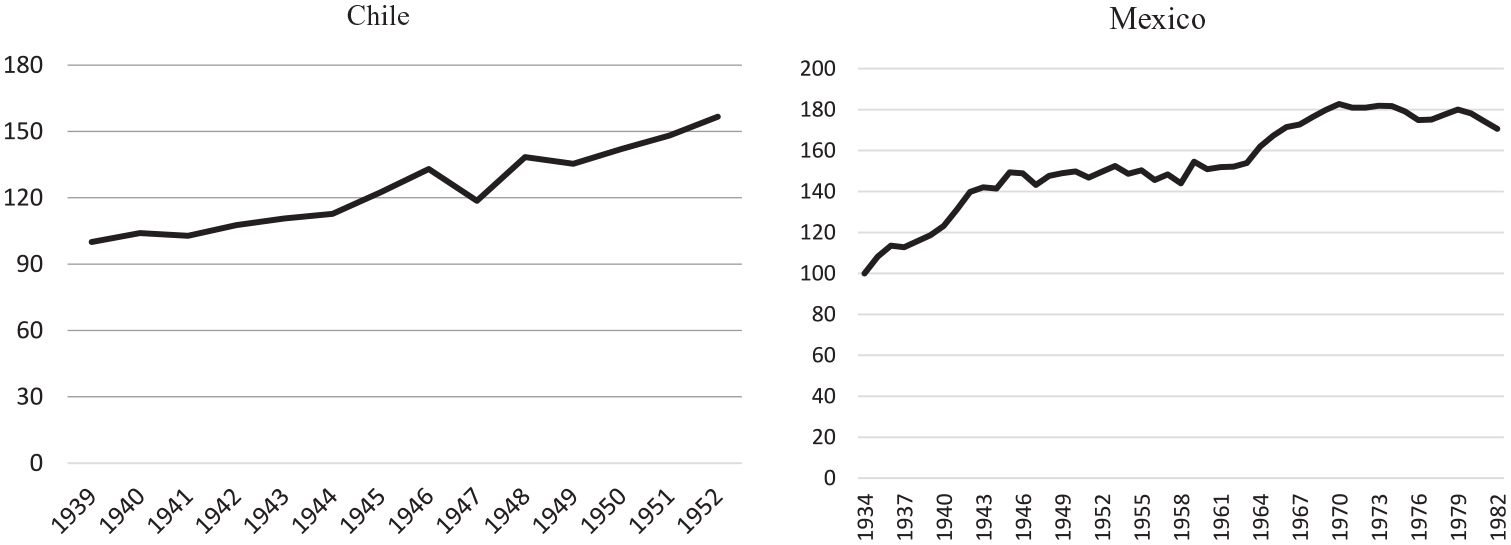
Manufacturing value added (% of GDP), Chile (1939 = 100) and Mexico (1934 = 100) (Montevideo-Oxford Latin American Economic History Database).

GDP per capita, Chile (1939 = 100) and Mexico (1934 = 100) (Montevideo-Oxford Latin American Economic History Database).

Gross domestic fixed investment (% of GDP), Chile (1939 = 100) and Mexico (1934 = 100) (Montevideo-Oxford Latin American Economic History Database).

Income inequality (Gini index), Chile and Mexico (Astorga, 2017).

Proportion of wages in national income, Chile and Mexico (Weber, 2017; Frankema, 2009).
Considering the feedback between the social and economic dimensions, the growth regime during radical administrations may have created a profit squeeze in which the increasing proportion of wages had a negative impact on the evolution of the investment rate. In a similar vein, the preponderance of state-owned credit in the financing of industrial investment was the counterpart of the lack of response of domestic private banks (Grove, 1951), which provided credit at a slower pace potentially reflecting business uncertainty with respect to long-term national development.
Despite the participation of business groups and right-wing parties in the building of the developmental regime led by the Radical Party, the notion of a profit squeeze helps explain why the bourgeoisie gradually withdrew from the developmentalist consensus, fueling the political conflicts that culminated in the 1973 military coup. Whereas a neoliberal approach would propose that wages must be contained to boost investment, a critical approach like ours contends that this tension between wage share and investment is an example of the limits of developmentalism as a progressive political position. In other words, since developmental regimes still rely on private decisions to achieve economic development, they may face a conflict between growth and redistribution, especially if they are unwilling (or unable) to take further steps in the direction of economic equality.
The Authoritarian Developmental Regime in Mexico (1934–1982)
During the government of General Porfirio Díaz (1876–1911), Mexico enjoyed relative peace as the expansion of the army and rural paramilitary forces led to the suppression of peasant revolts and banditry (Foster, 2007). Political disputes also declined through the elimination of political rivals, the appointment of the candidates for Congress by the president himself, and the maintenance of the office by fraudulent elections. In response to the political stabilization, foreign investment began to flow to the country, which experienced rapid economic growth and some industrialization mainly based on the mining and oil sectors. The construction of railways and telegraph lines was central to this process and decisive in unifying the country and strengthening state power (Kirkwood, 2000). This economic growth, however, was not reflected in the standard of living of the population; on the contrary, both in the countryside and in the city, working conditions only worsened as the landed oligarchy and foreign capital multiplied their gains. Growing dissatisfaction with the government escalated in 1907, when the downturn of the U.S. economy crippled the Mexican economy, and this, combined with the president's refusal to step down, led to the Mexican Revolution (1910–1920).
Of the consequences of the greatest civil war in Mexico, three stand out. First, it wiped out the political (though not the economic) power of the landed oligarchy (Dezalay and Garth, 2002). Secondly, with the enactment of the 1917 Constitution, it eliminated monopolies of water and mineral resources, limited foreign investment, destroyed debt peonage, granted labor the right to organize, and created the minimum wage and government insurance in times of unemployment, retirement, sickness, and death. Finally, it led to the creation of the PRI and the institutional framework that allowed it to remain in power for 71 years. Established in 1929 as the National Revolutionary Party and acquiring its current name in 1946, it was thought of as an organization that would merge all the allies of the Mexican Revolution as a means to resolve the conflicts of the presidential succession democratically and thus institutionalize the revolutionary program (Marban, 1970; Vargas, 2013). The ideals of political stability, nationalism, and social justice were pivotal in PRI discourse until the early 1980s (Hernández, 2016).
Although the key characteristic of the regime was its single-party aspect, its main actor was the country’s president. Since reelection was forbidden, presidents held power and direct influence over the party and the state only during the six years of their terms. This arrangement made possible the emergence of a strong leader in every election and at the same time prevented the individual usurpation of power. The only way the sitting president had of maintaining some degree of influence was by choosing the candidate for the next election—a presidential prerogative despite the party convention (Langston, 2006). Conventions were a mere formality, and presidential elections were just the same, serving only to legitimate authoritarian rule (Schedler, 2006). The absence of freedom and fairness is apparent in the restrictions on the electoral participation of opposition parties and the size of the ruling majorities (Gillingham, 2012).
The authoritarian political regime seems to have removed some barriers to the implementation of the developmental project. For instance, the government was able to massively redistribute property rights as a means to reduce dependency on foreign companies, which owned most of the country's industries and exploited natural resources without paying enough taxes (Hamilton, 1975). According to Foster (2007) and Kirkwood (2000), self-sufficiency and independence were common goals of all PRI administrations. In this regard, many interventionist policies were implemented, among them the nationalization of strategic industries such as steel, petrochemicals, railways, electric power, fertilizer, paper, cement, and sugar, the restriction of foreign investment, which was limited to manufacturing and to only a minority of the shares of any company, and the combination of government interference in management decisions with the provision of loans, tax breaks, and tariff protection. Because of these policies, far more interventionist than the ones deployed by the Radical Party in Chile, Mexico reduced its dependency on imports and achieved self-sufficiency in iron, oil, and steel (Foster, 2007). The Industrial Research Office of the Bank of Mexico, created in 1941 and made up of technocrats with complete autonomy to formulate industrial policy, was the center of bureaucratic planning. Moreover, the Cámara Nacional de la Industria de Transformación (National Chamber of Transformation Industries—CANACINTRA), established in the same year to replace the regional chambers of industry, allowed the government to deal with a unified national institution instead of a number of organizations (Story, 1986). Since it was overseen by the Department of the Treasury, CANACINTRA did not produce greater participation of private actors in policy making, serving mainly to subordinate the industrial business groups and legitimate bureaucratic planning (Gauss, 2010).
The authoritarian political regime seems to have affected the design and implementation of social policies through two complementary channels—the subordination of labor unions to the government and the increasing interpenetration of government and business interests. The main labor union of Mexico, the Confederation of Mexican Workers, was established in response to the PRI’s need for workers’ mobilization to advance its agenda (Kirkwood, 2000). At the time most unions were weak, disorganized, and rife with internal conflict (Angulo, 1990). With the building of this institutional structure the PRI was able to control organized labor, taming its capacity to bargain autonomously (Hamilton, 1975). The relationship between government and business groups followed a similar pattern. During the 1930s, the PRI government arbitrated strikes in favor of labor demands while conducting land reform and providing technical assistance to peasants (Foster, 2007), but as economic growth accelerated, forging the so-called Mexican miracle from 1940 to 1970, it suppressed the demonstrations that emerged as the result of income inequality and the deterioration of the standard of living (Cockcroft, 1983; Gutiérrez, 2005). This alignment of government and business agendas reflected a profit-led growth strategy that was based on low wages and income concentration (Fitzgerald, 1985). In line with this strategy and reflecting their control over organized labor, the PRI administrations managed to maintain a stable and undervalued exchange rate throughout the developmental decades (Astorga, 2007), boosting the foreign competitiveness of manufacturing and export substitution toward industrial goods (Ramirez, 1986). Similarly, by taming the distributive conflict, the PRI succeeded in stabilizing the expectations of private investors, paving the way for the expansion of the private credit supply, especially through the so-called financieras (loosely regulated investment banks that had a pivotal role in the financing of industrial investment) (Serrano, 2015). To a certain extent, this profit-led growth strategy culminated in the adoption of neoliberal policies in the 1980s in response to the exhaustion of the Mexican miracle and the import-substitution model.
These mechanisms and policies had implications for the economic and social outcomes of the developmental regime built by the PRI administrations. Specifically, their economic performance was more successful than their social one. In comparison with Chile (see Figures 1 –5), despite exhibiting a similar trend in manufacturing value-added, Mexico has shown much faster growth in GDP per capita and investment rate but an increase in income inequality and a decrease in the proportion of wages in the national income.
Final Remarks
In this article, we have discussed how democracy affects the economic performance and the social consequences of developmentalist regimes led by left-of-center political parties, comparing two Latin American cases: Chile under a democratic regime led by the Radical Party and Mexico under an authoritarian regime led by the PRI. In a nutshell, we have argued that political regimes shape the economic and social performance of left-of-center parties by mediating the action of bureaucracies, business groups, and workers. This analytical focus on left-of-center parties matters because their developmentalism was based on a shared commitment to economic transformation and social inclusion. The case studies suggest that left-of-center parties that implement a developmentalist agenda through democratic institutions tend to obtain better social performance—reducing income inequality and increasing the proportion of wages in the national income—than similar parties that pursue developmentalism in the context of an authoritarian regime. At the same time, democratic political regimes slow down the pace of economic transformation sought by left-of-center parties. Chilean democracy imposed more obstacles to the bureaucratic planning, policy reorientation, institutional reform, and redistribution of property rights that would have been necessary for fostering growth and investment while providing more opportunities for the bargaining and mobilization by autonomous labor unions and social movements that led to a progressive wage policy and an expansion of the supply of public goods.
The research discussed in this article has implications for the literature on developmental regimes. We have provided further evidence in favor of the compatibility of democracy and developmentalism argued by Woo-Cumings (1999) and Robinson and White (1998). Moreover, we have added nuance to this general argument by showing that democratic institutions have a heterogeneous impact on the social and economic dimensions of left-of-center projects. Finally, we have shown that, in the case of the Pink Tide governments of the twenty-first century discussed by Féliz (2019), Loureiro and Saad-Filho (2019), and Yates and Bakker (2014), the international conjuncture and the management of heterogeneous political coalitions constrained the capacity of progressive governments to achieve deeper socioeconomic transformations. In line with the theoretical framework proposed here, these experiences show that the democratic setting acted as an enabler of the mobilization of the popular sectors, favoring the design and implementation of inclusionary social policies. At the same time, business groups were able to weaponize democratic institutions against the economic programs of these administrations, imposing a myriad of obstacles to the transformation of the productive structure. Despite the differences between these cases, the general pattern that fosters social inclusion without altering integration into global markets and dependency upon primary exports applies to the experiences of Brazil under the Workers’ Party, Bolivia under the Movement toward Socialism, and Ecuador during the Citizens’ Revolution, encompassing both moderate and contestatory varieties of the Pink Tide governments.
Footnotes
Notes
Pedro Perfeito da Silva is a postdoctoral research fellow in the Department of Economics at the University of Leeds. Julia Veiga Vieira Mancio Bandeira is a Ph.D. candidate in political science at the Universidade Federal do Rio Grande do Sul.