




Abstract
Three multibillionaire-owned consortia in Mexico—Carlos Slim Helu’s Minera Frisco, Germán Larrea’s Grupo México, and Alberto Baillères’s Industrias Peñoles—have played a leading role in the process of accumulation through dispossession by perpetrating violence against indigenous and peasant communities in the form of the expulsion of thousands of people from their land, attacks on their security, health and ways of life, environmental depredation, fraud, criminalization, and murder. Examination of media reports of the most recent socio-environmental conflicts and corporate documents reveals the tension between profit accumulation through dispossession and territorial depredation in mining and various forms of resistance.
Los consorcios multimillonarios mexicanos—Minera Frisco de Carlos Slim Helu, Grupo México de Germán Larrea e Industrias Peñoles de Alberto Baillères—han desempeñado un papel protagónico en el proceso de acumulación a través del despojo efectuado a través de la perpetración de actos de violencia contra las comunidades indígenas y campesinas. Esto se ha manifestado en la expulsión de miles de personas de sus tierras, ataques a su seguridad, salud y formas de vida, así como depredación ambiental, fraude, criminalización y asesinato. Un análisis de los informes hechos por los medios de comunicación en torno a los conflictos socioambientales más recientes así como de documentos corporativos revela la tensión existente entre la acumulación de ganancias a través del despojo y la depredación territorial en el rubro de la minería, al igual que diversas formas de resistencia.
During the past three decades in Mexico, national and foreign (mainly Canadian) mining consortia have dispossessed tens of thousands of people of their land and water. This article shows the dimensions of this dispossession by three corporate patriarchs who, in a short period, have become the richest men in Latin America: Carlos Slim Helu, Germán Larrea Mota-Velasco, and Alberto Baillères. The theoretical framework for this research is Marxist theory, particularly the original accumulation of capital described in Chapter 25 of Capital (Marx, 1980 [1867]). Marx explains that the level of violence to which capital resorted in its genesis was due to an inherent requirement of accumulation—capital has to appropriate what does not belong to it in order to expand. Today’s big corporations appropriate Mexico’s public natural resources, dispossessing entire populations. These businessmen’s method of capital accumulation is similar to that of the origins of capitalism at the end of the fifteenth century in terms of the dispossession of land, plunder of means of subsistence, violation of the right to life of residents of the exploited regions, and the constant expulsion of populations from their places of origin.
The Empire of Capital by Ellen Meiksins Wood (2003) and The New Imperialism by David Harvey (2003) are key works for explaining the role of the global market and multiple mechanisms of dispossession used to strengthen the endless accumulation of profits by these mining consortia and the Mexican patriarchs’ accumulation of wealth. The main thesis is that the country has formed a new latifundism for mining and these three capitalists are playing a leading role in the process of accumulation through dispossession by exercising violence against indigenous and peasant communities in the form of the expulsion of thousands of people from their land, attacks on their security, ways of life, and health, environmental degradation, fraud, criminalization, and murder. This new latifundism is characterized by private appropriation of an unprecedented amount of territory in Mexico, partial or total disqualification of land for any other use, the destruction of ecosystems, and the constant use of force.
The three Mexican patriarchs own 3,684,767 hectares (see Table 1) for mining exploration and exploitation in 3,132 federal government-granted plots, covering an area similar in size to the states of Puebla or Yucatán (SIAM, 2017).
Concessons Granted to the Three Mining Consortia in 2015
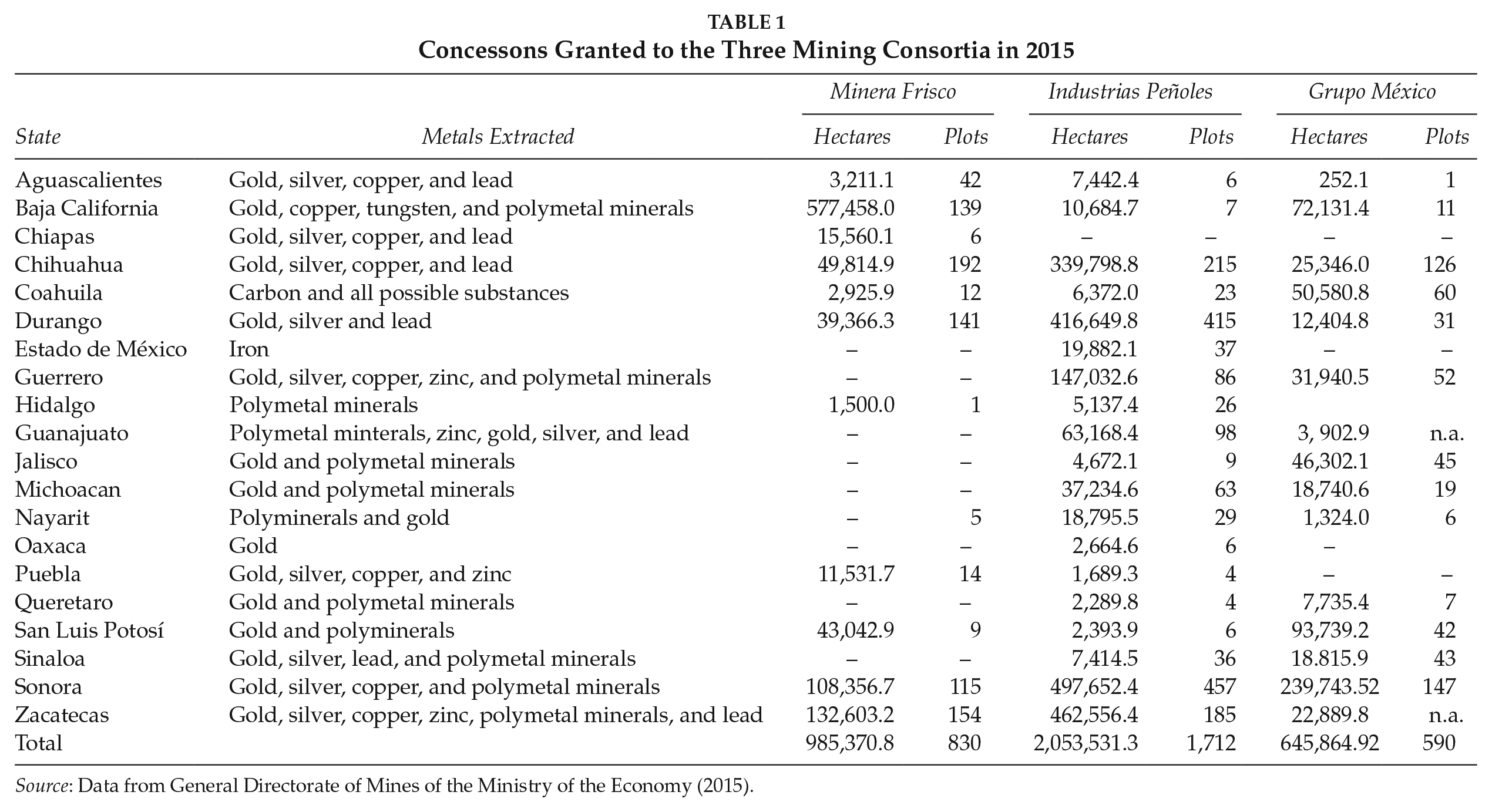
Source: Data from General Directorate of Mines of the Ministry of the Economy (2015).
The concentration of land in the country allows them to pillage metals, mainly gold, silver, and copper, and speculate with income from the land, to the point that 70 percent or more of their income comes from the extraction of these metals. The share prices of their consortia increased more than 50 percent between 2010 and 2017. Carlos Slim’s Minera Frisco, Germán Larrea’s Grupo México, and Alberto Baillères’s Industrias Peñoles tell speculators buying and selling stock that the land they have appropriated has probable reserves of metals. Recently, the plundering of metals has been determinant in these men’s increasing personal fortunes. They have become some of the richest men on the planet in three decades by engaging in accumulation through dispossession—using the same mechanisms as in original accumulation, dispossession, abuse, and depredation, staining every peso of profit with blood.
With the election of Andrés Manuel López Obrador (hereafter AMLO) in December 2018, the deep roots of the new latifundism in mining seem unchanged. In his campaign speeches, his program, and his administration’s first actions, the issue of mining concessions to national and foreign consortia has been approached only tangentially. The official who was in charge of the Subsecretariat of Mines (the government agency that issues mining concessions to private capital) during 2019 was a career official in the Secretariat of the Economy, Francisco Quiroga. Appointed by AMLO, he said that mining concessions would be maintained and taxes on mining consortia would not be increased for three years. His activity in national and international business forums focused on guaranteeing the continuity of the policies of the past two decades for mining capital. He said that the only path to development for many regions of Mexico was mining (Mineria en Linea, 2019). At most there would be an attempt to redistribute the income from mining. Pressure from socio-environmental movements, including those fighting against megamining, has been stigmatized as “conservative” by AMLO, who has suggested that some mining concessions will be reviewed as to whether they are “in order.” There was no hint in 2019 that the AMLO government was heading toward changing policies that have helped the mining consortia achieve exorbitant profits from the appropriation of land belonging to its original owners, which covers 19 percent of Mexico’s territory (Hernandez, 2014).
Mining as Primary Export
Business conglomerates in which mining exploitation is central are part of Mexico’s dominant capitalist bloc, and they have taken control of almost one-fifth of the national territory through dispossession facilitated by the federal government. This sector of capitalists has direct ties to international metal and mineral markets, but its main link is with the United States. Over 50 percent of these consortia’s gold, silver, and copper sales go to the United States. (Canadian mining capital has appropriated areas as broad as those of their Mexican counterparts, but its territories are dispersed among a great number of businesses.) The situation that has made this possible is the triad of accumulation in mining, the link among government at the federal and local levels and the mining consortia. Each of the actors in this triad intervenes in a specific way to guarantee high levels of accumulation for mining capital through violent means. The federal government has played a key role by changing Article 27 of the constitution, mining laws, and foreign investment laws in such a way as to create the conditions for the ceaseless accumulation of profits. Francisco López Barcénas (2017) explains that the reforms “represented the breakdown of the 1917 Revolution’s social pact and deeply affected ownership of natural resources, including land, water, forests, and minerals” and “allowed the privatization of land as a condition for changing the model of accumulation.” The Mining Law that took effect in 1993 permitted the unlimited concentration of land in the hands of national and foreign mining companies. It also allowed the granting of mining concessions for 50 years, extendable to 100. “In practice, it was one of the most neoliberal laws among those modified” (López Barcénas, 2017: 152–163).
Federal government policies have been decisive for the mining consortia in reducing production costs. Joan Martínez Alier (2014) points out that environmental, economic, and sociocultural damage done by the mining companies should be seen as successes for the companies by transferring environmental costs to thousands of poor people, future generations, and other species. Mining consortia do not pay for the destruction of ecosystems and the population caused by open-pit mining. Mexico has an average of 1.8 spills per year, more than anywhere else in the world (Lozano, 2018). Federal and local governments have protected the mining consortia by covering up the serious environmental problems caused by open-pit metal extraction, constantly validating them by falsely endorsing their supposed care of the environment. An example of this coverup is the recognition granted by the Mexican stock exchange to Larrea’s Grupo México for “environmental responsibility” in the same year (2014) that it spilled 40,000 cubic meters of copper sulfate into two tributaries of the Río Sonora, affecting more than 20,000 people. Another example is the constitutional controversy provoked in 2016 by Enrique Peña Nieto’s action against the state of Zacatecas for establishing an ecological tax on mining companies. In the first months of 2019 AMLO’s government declared that there would be a tax on environmental damage, but this has not materialized to date, and it would mean only a minor setback to the incessant reduction of business costs for mining companies. There is no evidence that this government is thoroughly investigating the environmental damage caused by Minera Frisco, Grupo México, and Industrias Peñoles.
Mexico’s new mining latifundism commits 22 million hectares of the country to mining companies (SIAM, 2017; SubVersiones, 2019). The three mining consortia have appropriated almost 4 million hectares of the country. Carlos Slim has the largest production of gold bars in the country, Baillères is the main producer of silver, and Larrea is the czar of copper. Slim has acquired a considerable part of Baja California, where he has 577,000 hectares. He has also bought land for tourism and infrastructure for ports. Baillères owns 339,798.8 hectares in Chihuahua, 416,649.8 in Durango, 497,652.4 in Sonora, and 464,556.4 in Zacatecas. In the past five years, he has increased the concentration of his territories in Guerrero, appropriating 147,037 hectares in a single municipality. He inherited mining concessions from his father, who obtained them in the 1930s, and is the only patriarch with a long tradition of ties and compadrazgo (co-godparenthood) relationships with federal governments (Orozco, 1983). Larrea has the largest copper deposit in the country and has the concession of 239,743.5 hectares in Cananea, Sonora. The sharp increase in the consortia’s concentration of mining concessions reflects the concessions granted during the past three presidential administrations. In addition to their concentration in states with mining traditions such as Chihuahua, Coahuila, Durango, Sonora, and Zacatecas, the three consortia have delved into new territories in San Luis Potosí and Aguascalientes and in Nayarit, Puebla, and Sinaloa. Carlos Slim, through his subsidiary Minera San Francisco del Oro, S.A. de C.V., has 15,560 hectares in Chiapas for extracting gold in the municipality of Solusuchiapa and 11,531.7 hectares in Tetela de Ocampo, Puebla. In Baja California, Larrea acquired a concession of 72,131 hectares for exploration for probable concentrations of copper, despite their being in a protected natural area.
In less than a decade, Mexico changed its mining profile thanks to the foreign investment mining laws, the liberalization of communal lands (to hand them over as mining concessions) and the North American Free Trade Agreement (NAFTA), which allowed companies in the sector to enter the world market of precious metals. The country shifted from production of metallurgical metals to that of precious metals, mainly gold and silver. Federal governments focused policies on promoting foreign investment, offering belts of gold and silver in the country’s mountain ranges. Mexico was promoted as a “world-class mining country” (a slogan contrived during the administration of Felipe Calderón [2006–2012]). Between 2001 and 2014, the production of gold in Mexico increased by five times, from 757,000 to 4.3 million ounces, exceeding that of all metals and minerals. By 2017, precious metal production as a proportion of metallurgical metal production had increased from 21 percent to 51 percent. Gold production rose from 7.2 percent in 2000 to 25.1 percent in 2010 and 33.5 percent in 2017 (Secretaría de la Economía, 2018). The proportion of the gross domestic product (GDP) represented by mining in 2017 was 1 percent, and formal employment in gold and silver megamining amounted to 1.9 percent of the economically active population. Nonmetallic mineral production employed 40 percent of mining industry workers, basic metals 30 percent, and the metallic minerals 20 percent, a total of 104,718 jobs.
Latin America has been the main receiver of foreign investment to extract precious metals; Mexico is second in offering limitless territories for mineral extraction. In 2016, 176 of the 275 foreign companies that obtained mining concessions (64 percent) were Canadian and 45 (16 percent) were U.S., and these two NAFTA member countries obtained the most concessions for precious and metallurgical metal exploration. Mexican governments have converted broad swaths of forest, jungle, desert, and water into resources that may be privatized, and mining consortia have appropriated them. A million and a half hectares of the land that has been granted to mining consortia (including those headed by Mexicans) are in protected natural areas (Armendariz-Villegas et al., 2015). The El Picante and Gran Desierto de Altar biosphere reserves are adjacent to the Gulf of California, and hundreds of thousands of hectares in the municipalities of Mexicali and Ensenada have been granted as concessions to subsidiaries of Slim’s and Baillères’s mining companies. Slim holds 300,000 hectares in Mexicali and Baillères 36,552.9 hectares in two municipalities in northern Sonora, conducting open-pit mining on the edges of the reserves (Servicio Geológico Mexicano, 2017). These concessions are maintained because, according to the Mining Law, mining is a “preferred public utility,” despite the fact that open-pit mining causes frequent spills of cyanide sludge, heavy metals, and oil, destroying ecosystems, damaging the health of communities, and devastating the livelihoods of indigenous peasant and fishing communities (Campa, 2014; CEL, 2015).
In 2016, Guerrero, Oaxaca, and Baja California represented only 3.71, 1.58, and 0.84 percent of the value of the nation’s gold production (Servicio Geológico Mexicano, 2016), but despite this they experienced negative impacts from gold extraction, confronting regionwide environmental damage and loss of communal lands, which once amounted to 82 percent of the land in Baja California, 79 percent in Guerrero, and 76.2 percent in Oaxaca (López Barcénas, 2017: 147). Guerrero has the most displaced people in the country. In Oaxaca, indigenous communities have fought Canadian and Mexican mining operations for over a decade. Environmental activists such as Bernardo Méndez Vásquez and Bernardo Vásquez Sánchez have been criminalized and killed, and their murders remain unpunished.
During the past three decades, large-scale capital accumulation in metal mining in Mexico presents all the features of the depredation and dispossession described by David Harvey (2003): privatization of land, environmental devastation, forced expulsion of indigenous peoples and peasants from their land, loss of communal landownership, and the advance of capital over the national territory, which contains the last remaining natural reserves and the opportunity to protect biodiversity.
Industrias Peñoles: Owning Land and Ruling Residents’ Lives in a Guerrero Municipality
In five years, mining consortia in Guerrero went from 16 percent of the state’s territory to 21.2 percent. Between 2011 and 2016, the Secretariat of the Economy increased the number of hectares under concession from 1,000,037 to 1,354,000. According to this federal agency, the state of Guerrero has 12 mining regions that cover a bit more than 60 percent of the state. Two of them are in the municipalities of San Miguel Totolapan and Arcelia Teloloapan. The first, in tierra caliente, covers 264,810 hectares. A handful of mining companies—mainly Industrias Peñoles, S.A. de C.V.—has been granted rights to 45.3 percent of this area, 38.8 percent of San Miguel’s territory. A decade ago, San Miguel Totolapan had 24,000 residents; today that number is down to 12,000. In the period in which Industrias Peñoles was acquiring more and more mining concessions, residents have suffered assassinations, kidnappings, extortion, threats, robberies, and destruction of their homes and witnessed deadly clashes between cartel hitmen. The drug trafficking groups La Familia Michoacana and Los Tequileros were in constant conflict (Torres, 2017). Residents were driven out of town by the violence and left it in the hands of organized crime and of Peñoles with its enormous concessions. Baillères appropriated almost 40 percent of the territory to extract gold, silver, zinc, lead, molybdenum, tungsten, and copper. Residents of 25 towns fled the region, leaving dozens of towns abandoned (Palma, 2018).
San Miguel Totolapan shifted in a few years from small-scale agricultural production to mining. After a long period of warfare against the population of San Miguel and other municipalities in Guerrero, the governor of the state, Enrique Astudillo, and the mining businessmen declared the formation of the Guerrero Mining Cluster in November 2017. Together with Mina Rey de Plata, which restarted activity in 2012 and projected producing 4.7 million ounces of silver in 2017, the other major project of Industrias Peñoles in Guerrero is the multimetal mine Capela, located in the municipality bordering San Miguel Totolapan, built with an initial investment of US$303 million. The opening of this mine removed people from dozens of villages in Guerrero’s mountain region. The Peñoles mining consortium possesses some of the largest stretches of land in Mexico, more than 2 million hectares. It holds first place in silver production in Mexico and is the main exporter of that metal. Its principal associate, Fresnillo, plc., has seven mines in operation, two projects in progress, and four areas under exploration. Its objective was to produce 65 million ounces of silver in 2018, and since 2011 it has focused on becoming the country’s main producer of zinc by concentrating the richest deposits of this metal in Guerrero and Durango (Industrias Peñoles, 2014).
In Sonora, ejido residents have fought back using legal resources and protesting against Peñoles-Fresnillo for imposing abusive contracts and usurping their lands. Peñoles’s gold and silver mine Soledad-Dipolos was forced to halt activities in 2013 by a complaint filed in the state’s agrarian court by ejidatarios that forced the authorities to suspend its permit for explosives use. The mine has been closed since then, and the company experienced losses of 20 percent in 2015. Despite its power, it lost an agrarian suit for illegal possession of 1,800 hectares belonging to the ejidatarios of El Bajío, in the municipality of Caborca, Sonora. The gold mine La Herradura, which has a concession of 3,600 hectares, the most productive of the consortia, has operated by invading ejido lands. The court ruled in favor of the ejidatarios because they proved that the company had used their land without paying them for 16 years and imprisoned five ejidatarios for dispossession. Dozens of women fought back during the five years that their husbands were imprisoned.
Germán Larrea’s Grupo México: Monopoly, Cost Reduction, Death, and Impunity
Grupo México boasts having the lowest costs for copper ore extraction in the world, reporting that production at the Buenavista del Cobre mine costs barely US$1.8 per pound of copper extracted. The price of copper on the global market decreased from US$3.60 to US$2.50 per pound between 2012 and 2015 (Grupo México, 2015). Grupo México’s reduction of extraction costs for copper has caused fatal accidents and the worst toxic spill in recent history. The United Nations rapporteur on toxic substance management, Baskut Tuncak, called the company “a blatant and flagrant example of those given the right to impunity” during a meeting with representatives of the Río Sonora Basin committees in May 2018 (Proceso, 2018). The spill of a tailings dam at the Buenavista del Cobre mine affected the health and livelihoods of more than 20,000 people, and throughout the past decade there have been fatal accidents in Larrea’s mines that the Union of Metallurgical and Similar Mining Workers of the Mexican Republic attributes to the very poor safety conditions. In February 2006, 65 miners were buried in the Pasta de Conchos coal mine, and no one from Grupo México has faced justice. This explosion was caused, once again, by inadequate equipment and lack of maintenance. The work is dangerous, and workers’ minimal labor rights are violated. Work shifts last 12 hours, workers do not have the right to organize, and most workers are hired by subcontracted companies. The municipal president of Cananea works to contain social mobilization in Buenavista del Cobre. He promotes residents’ relocation to other locations so that the company can expand. The Cananea mining enclave has displaced the inhabitants of the riverine areas of the Río Sonora, appropriated tens of thousands of hectares, and taken advantage of the sulfide spill that polluted farmland by buying the contaminated land (Tassinari, 2018).
Grupo México has a concession of 67,157.7 hectares called El Arco in the area adjacent to Baja California and Baja California Sur. Its subsidiary Mexicana del Arco, S. A. de C.V., acquired eight lots in the natural reserve of that name on the Sea of Cortez, the region where Arctic whales come to give birth every year. Construction of an open-pit mine in this territory has not yet begun, but when it occurs it will have dramatic consequences for the local ecosystem.. Grupo México owns concessions totaling 645,864.92 hectares throughout the country and in 1989 appropriated its richest copper deposit. The monopolization of this subsoil wealth allows it to compete with the other consortia on equal terms and position itself as one of the most important business groups in Latin America. It has 163 plots in the state of Zacatecas, covering 22,889.8 hectares. In addition to copper, it extracts lead, silver, and coal.
Behind every Grupo México territorial concession in the coal or copper basins of northern Mexico is a history of labor crimes, destruction of ecosystems, water grabbing, forced displacement, and death. From 2007 to 2011, the company fought against striking union miners in Cananea in Sonora, Taxco in Guerrero, and Sombrerete in Zacatecas. This battle involved the termination of the miners’ collective work contract in Cananea, reduction of wages and labor output, strike breaking, the hiring of nonunion workers, the criminalization of striking workers, and confrontations with the police. In February 2014, in a mine in the municipality of Charcas in San Luis Potosi, five miners died “because of the poor conditions of the facilities” (Rodríguez García, 2014). In 1989, Jorge and Germán Larrea bought the Mexican state copper company, Latin America’s third-richest copper mine, from the Salinas de Gortari government for US$475 million, a third of its value. In the mid-2010s Grupo México made a strategic alliance with the U.S. company Southern Copper to exploit copper in other countries such as Peru. Currently, the subsidiary of Grupo México that operates mines and several foundries in the United States has been denounced by Arizona miners for poor working conditions.
Federal government support was decisive in Cananea’s conversion into a mining enclave thanks to the huge profits from usufruct of a public good. Grupo México managed to get environmental and health damage lawsuits thrown out by the environmental authorities in other parts of the country such as Ciudad Juárez, San Luis de Potosi, and Monterrey. Soon after the Buenavista del Cobre spill, the residents of Bacanuchi organized into Río Sonora Basin committees, and almost four years later they had legal success. The Supreme Court ruled in favor of the residents, stating that those living near an open-pit mine had the right to question the actions of authorities who compromised their right to a healthy environment. The ruling determined that residents have the right to question mining monopolies and government authorities’ projects.
Carlos Slim’s Minera Frisco: Land Concentration, Environmental Devastation, and Forced Displacement
Carlos Slim’s conglomerate Grupo Carso bought Minera Frisco, S.A. de C.V., a consortium of almost 30 vertically integrated mining companies, from the Mexican government in 1985 (Minera Frisco, 2011). The history of Minera Frisco’s land accumulation began more than 30 years ago, but between 2005 and 2010 the consortium increased its land grabbing and investment to extract more metals. In 2010 it expanded its mines, the majority of which were open-pit mines for producing and trading lead, silver, zinc, and copper concentrates and gold and silver bar production, its main source of profit. It first sold shares on the Mexican stock exchange in 2011, the year that Slim increased his mining latifundios by thousands of hectares. Minera Frisco sells its shares with the guarantee of “territorial reserve and mining concessions” that ensure “the profitability and growth of the company” (Minera Frisco, 2016).
In 2014, Slim’s mining consortium produced 423,400 ounces of gold, a figure equal to 13.11 percent of national gold production. The gold bars are sold almost entirely in the United States. Minera Frisco has 10 mines, half of which began metal extraction only five years ago: Asientos and Porvenir in Aguascalientes, El Concheño, Ocampo, and El Coronel in Chihuahua, María in Sonora, San Felipe in Baja California, and Tayahua, San Francisco del Oro, and Gloria Estela in Zacatecas. These mines are emblematic cases of land grabbing and dispossession with disastrous environmental impact. They are located on land outside the area of mineral extraction and in states that have never had mines such as Puebla, Chiapas, San Luis Potosi, and Durango. Thirty-seven percent of the territory of Baja California has been granted as concessions to mining consortia, mainly to the Mexican patriarchs but also to Canadians. In 2014, the Secretariat of the Economy reported that 896,024.1 hectares (464 plots) in Baja California had been granted in concessions to mining companies,. Four years later, the privatization of Baja California land had increased by 59.5 percent as a result of the granting of 1,505,890.12 hectares as concessions to mining companies. Minera Frisco owns 22 percent, 577,458.0 hectares of this total (Servicio Geológico Mexicano, 2017).
Minera Frisco increased its accumulation of land in Baja California by defrauding ejidatarios. The San Felipe open-pit mine began operations in 1994 by renting communal land from 212 residents of the National Agrarian Plan ejido in the mountains of Mexicali. The subsidiary Minera San Felipe, S.A. de C.V., paid each resident a little over 1,500 pesos annually. In 2010, Slim’s mining company obtained more concessions and, in its pursuit of possession of the entire sierra, offered each resident US$2,000 per hectare to buy 8,560 hectares. Most residents rejected the offer, but Minera Frisco now occupies 45,000 hectares of the ejido with legal right to operate. “This company has wanted to turn the ejidatarios into laborers in the mine” (Wordpress, 2013).
Slim caused the forced displacement of the original residents of land on which he obtained mining concessions. In Zacatecas, for example, his subsidiary Minera Tayahua, S.A. de C.V., accumulated 85 plots amounting to 64,796 hectares in Melchor Ocampo, Concepción del Oro, and Mazapil and in 2010 began operations in a large copper deposit as Calcosita-Salaverna, S.A. de C.V. The residents of Salaverna were displaced to a new settlement called Nueva Salverna that, in contrast to the original town, which covered 200 hectares, barely covers 12. Twenty families refused resettlement and after two years were evicted by the state police. All of the government entities including the Comisión Nacional de los Derechos Humanos (National Commission of Human Rights) endorsed this expulsion.
Privatization of Public Companies, Appropriation of Land and Water
The plundering of precious metals and minerals in Mexico has played a leading role in increasing the fortunes of Slim, Larrea, and Baillères. Baillères, with US$10,800 billion, is one of the 10 richest men in Latin America, and Larrea, with US$13,900 billion, is the third-richest (Forbes México, 2017). Through their appropriation of the wealth of the subsoil through dispossession of land, reduction of extraction costs, acquisition of government protection for the environmental damage they have inflicted, and impunity they have externalized the costs of environmental degradation and thus benefited from extraordinary profits. They have also dispossessed the population of millions of cubic meters of potable water. In 2014, 230 mining companies extracted almost 437 million cubic meters of water, equal to the water consumption of almost 12 million people (Llano, 2016). Open-pit metal extraction requires the highest levels of water consumption in the entire industry and inevitably pollutes and destroys water sources. The government conceals data on mining companies’ irrational consumption of water. In Sonora, Zacatecas, and Michoacán, wells and rivers are the main sources of fresh water for the mining megaconsortia, mainly Grupo México, Industrias Peñoles, and GoldCorp in Zacatecas (Llano, 2016; CartoCritica, 2016). Grupo México has the largest number of concessions of water rights; its eight subsidiaries have 142 concessions of wells and rivers. In 2014 it extracted 90,616,942.80 cubic meters of water, of which its Buenavista del Cobre mine squandered 52 million. Five of Minera Frisco’s 14 subsidiaries used more than 10 million cubic meters of water in the extraction of metals in Baja California, Zacatecas, and Sonora, among other states. Industrial Peñoles and Fresnillo, Plc., extracted 5,647, 991 and 1,202, 559.1 cubic meters, respectively (CartoCrítica, 2016).
This new wave of accumulation by dispossession began in 1989–1991, when the government handed over part of the country's most valuable and productive state assets to this group of national entrepreneurs. Carlos Salinas de Gortari (1988–1994) sold more than 1,000 state-owned companies, including Telmex (to Slim) and the most important copper company (to Larrea), under the economic policy of liberalization of national assets such as land and the wealth of the subsoil. Mexico was ranked second in Latin America in the number of privatizations (Pérez Ramírez, 2013). The legislative changes of the 1990s, presidential decrees of divestiture of public companies, and the unprecedented concentration of assets of various branches of the Mexican economy by this handful of businessmen set off privatizing waves that allowed the monopolization of broad sectors of the market. Thanks to a second wave of privatizations in the mid-1990s under a different political party (the Partido Acción Nacional [National Action Party—PAN]), Slim, Larrea, and Baillères concentrated additional tens of thousands of hectares for their mining businesses and instigated the dispossession of state assets in electricity, railways, ports, and airports. They are currently investing in hydrocarbons; Slim recently created CarsoOil and Baillères Petrobal. The billionaires benefited from the energy reform of the end of 2012 promoted by the Partido Revolucionario Institucional (Institutional Revolutionary Party—PRI).
As long as the laws allowing land concentration in the hands of the mining consortia remain in force, open-pit mining is not prohibited for its devastating effects, and mining companies are not forced to remedy the damage they cause, the struggle against national and foreign mining capital will remain in the hands of ejidatarios and indigenous people. By definition, this is an unfair battle, because mining capital has the support of state institutions to guarantee and promote its reproduction.
Conclusions
David Harvey (2003: 116) explains that the many mechanisms of dispossession articulated in Latin America’s neoliberal era are opening the way for the constant accumulation of capital. Privatization of public companies has been one of the privileged mechanisms, along with the appropriation of land for the extraction of hydrocarbons and minerals, monopolization, and the financialization of economies and foreign trade. In Mexico this dynamic is expressed in the dispossession of indigenous peoples and peasants and the destruction of protected natural areas. The loss of social forms of landownership in Baja California, Oaxaca, and Guerrero is the other side of the creation of the new mining latifundism of the multibillionaire patriarchs Carlos Slim, Alberto Baillères, and Germán Larrea, who have almost completely taken control of municipalities such as San Miguel de Totolapan in Guerrero and Mexicali and Ensenada in Baja California. Their fortunes and the profit accumulation from their mining consortia are accompanied by the destruction of ecosystems, displacement of thousands of people, and death.
When Eduardo Galeano’s Open Veins of Latin America (1971) appeared, U.S. multinationals extracting petroleum and minerals from the Latin American subsoil represented capital from the postwar imperialist country. Galeano (1971: 22) gave us “a history of plunder, and at the same time, an account of how current mechanisms of dispossession function.” At that point it was inconceivable that the Latin American bourgeoisie would cross borders and emerge as partners of great transnational capital. However, one of the peculiarities of the neoliberal era is the incorporation of a select group of Latin American businessmen as players in the field of worldwide capital accumulation. Slim, Baillères, and Larrea have achieved this through multiple dispossession in which the state, by granting them concessions of land for mineral extraction, has supported and promoted their monopolization of land. Their fortunes began to increase exponentially at the end of the 1980s with the purchase of undervalued public companies, the concession of land for mining, and the signing of NAFTA. One might ask why U.S. businessmen were not the ones to take advantage of the possibility of appropriating public companies such as Telmex or Cananea. The answer lies in the business and family networks among those in the Mexican and U.S. governments and business. Carlos Salinas built close ties with the Clintons and Bush (Faux, 2008), and Slim’s and Larrea’s fortunes depended on their friendship with Salinas.
The extraordinary resemblance of the social consequences of contemporary extractivism and those of the original accumulation of capital described by Marx points to the intrinsic violence of this form of exploiting the resources of the subsoil: dispossession of hundreds of thousands of human beings of the means of survival and the possibility of life itself. The triad of accumulation made up of mining consortia, the federal government, and local powers including drug traffickers employs violent mechanisms that range from the creation of warlike conditions to expel communities to the spending of resources in pursuit of acceptance of mining and the policy of best business practices. In Guerrero, a new mining estate of Industrias Peñoles has led to the creation of a mining cluster that will extract more metals, both the result of drug traffickers’ attacking and displacing people.
Mining companies have shown a great capacity to live with organized crime in the country’s gold and silver belts. In Guerrero and Sinaloa, links between mining and organized crime producing and trafficking narcotics are common knowledge. War is the ideal situation for the mining companies because it places the population in no condition to resist. In some municipalities they have created enclaves in which the remaining population’s only option is to provide labor for mineral extraction. In contrast, in Sonora Grupo México and Industrias Peñoles have been forced to pay debts and fines and restore the lands they usurped by the resistance of ejidatarios, miners, and those impacted by the environment. For example, mobilizations of Sonoran ejido communities managed to stop production in the La Soledad mine, costing the Baillères consortium millions in losses, and ejidatarios affected by the copper sulphate spill in Río Sonora obtained a favorable judicial ruling stipulating that communities where a mining project is to be executed have the right to question its viability in terms of the health of the population.
The torrent of mining investments does not compensate for the suffering of tens of thousands from dispossession of land and water, pollution, violence, and labor overexploitation. There is no evidence of sustainable development in these forms of investment. Nor are there indications that AMLO’s current model of extraction is any different; he has ties to the patriarchs of mining and has talked about increasing income from mining and curbing the granting of mining concessions only after a fifth of the country’s land has been doled out as concessions. These commitments contradict the undersecretary of mines’s statements, which consistently promote foreign investment in the mining sector. AMLO’s commitment to real antiextractivist policies such as canceling the current mining law, cleaning up areas contaminated by open-pit mines, and returning land appropriated by national and foreign mining consortia can only be questioned.
Footnotes
Aideé Tassinari is a research professor at Universidad Autónoma de la Ciudad de México. Margot Olavarria is a translator living in New York City.