



Abstract
Evo Morales came to power in Bolivia after the gas war and a subsequent rebellion that overthrew two presidents in 2003 and 2005. However, the promised nationalization of hydrocarbons remained on paper, and a new extractivist offensive was launched that deepened processes of accumulation by dispossession. Plunder, environmental devastation, and recolonization of indigenous territories have increased because of different factors that are dialectically interrelated: (1) the 2006 oil contracts, which allowed transnationals to retain a dominant position in the sector; (2) the challenge of finding new gas reserves to maintain the current export volume; (3) the country’s substantial dependence on hydrocarbon revenues to maintain public expenditure levels, given that the productive matrix remains unchanged; and (4) the political degeneration of the Movimiento al Socialismo. However, there is no political and discursive coherence: the government conceals its policy behind a revolutionary discourse.
Evo Morales llegó al poder en Bolivia después de la guerra del gas y la subsiguiente rebelión que derrocó a dos presidentes en 2003 y 2005. Sin embargo, la prometida nacionalización de los hidrocarburos se mantuvo en el papel y se lanzó una nueva ofensiva extractivista que profundizó los procesos de acumulación por despojo. El saqueo, la devastación ambiental y la recolonización de los territorios indígenas han aumentado debido a diferentes factores que están dialécticamente interrelacionados: (1) los contratos petroleros de 2006, que permitieron a las transnacionales mantener una posición dominante en el sector; (2) el desafío de encontrar nuevas reservas de gas para mantener el volumen de exportación actual; (3) la dependencia sustancial del país en los ingresos por hidrocarburos para mantener los niveles de gasto público, dado que la matriz productiva permanece sin cambios; y (4) la degeneración política del Movimiento al Socialismo. Sin embargo, no hay coherencia política y discursiva: el gobierno oculta su política detrás de un discurso revolucionario.
The negative economic, social, and environmental effects of hydrocarbons exploitation are, according to Seoane (2013), a necessity of the current capitalist accumulation process—what has been termed “extractivism” in the Latin American literature. Extractivism is based on the intensive or large-scale extraction of natural resources oriented toward exports that involve very little or no industrial processing. Gudynas (2011) differentiates between classical extractivism, related to neoliberal policies, transnationalization, and privatization, and so-called progressive neoextractivism, in which the state enjoys a larger role and the supporting argument involves the fight against poverty and the promotion of national development. Although extractivism is carried out under different strategies, the social and environmental impacts remain constant while the nation’s subordinate incorporation into the international market becomes more pronounced (Seoane, 2013).
Watts (2009) states that “oil politics . . . works through complex forms of dispossession,” and Harvey (2003) has called these mechanisms “accumulation by dispossession.” This process, which can be seen as a continuation of what Marx called primitive accumulation, can take many forms, among them commodification, privatization, the erosion of welfare rights, and the appropriation of goods including natural resources. The history of Bolivia is full of examples of this looting. Bolivia has been plundered for its natural resources since the colonial era, when rich silver mines were discovered in Potosí. As the Uruguayan Eduardo Galeano (2004 [1973]: 16) wrote in reference to the region, “Our wealth has always fostered our poverty in order to feed the prosperity of others: empires and their native allies.”
Hydrocarbons (i.e., oil and gas) have played a crucial role in the history of Bolivia. The discovery of oil in southern Bolivia led to a conflict with neighboring Paraguay known as the Chaco War of 1932–1935, in which 50,000 Bolivians lost their lives. In 1937 oil was nationalized and the state confiscated Standard Oil’s assets, establishing the state company known as Yacimientos Petroleras Fiscales de Bolivia (Fiscal Oilfields of Bolivia—YPFB). Twenty years later, hydrocarbons went back into private hands as oil and gas reserves were handed over to Gulf Oil. This American company controlled the industry until 1969, when the second nationalization of hydrocarbons took place. A few years later, in 1971, there was a coup d’état, and the subsequent Hugo Banzer dictatorship handed back the hydrocarbons sector to foreign companies (Puente, 2011).
In 1996 a neoliberal government privatized several public companies, including YPFB, which remained as a residual enterprise after its main business units were sold off. A new hydrocarbons law was approved that reduced taxes on hydrocarbons from 50 percent to 18 percent (Puente, 2011). While private company profits multiplied, the Bolivian state was left with a deficit due to its reduced income and, as a result, was forced to request new loans from the World Bank and the International Monetary Fund. The latter demanded cuts in the public budget and the introduction of new taxes that would have their greatest impact on the poorest sectors of society (Spronk and Webber, 2007). As a consequence, between 1998 and 2003 the number of people living in poverty increased by more than 800,000 (Tabera, 2004) out of a population of 8.2 million at that time (Erbol, 2012).
From the Gas War to Evo Morales’s Rise to Power
In 2003, President Gonzalo Sánchez de Lozada promoted a plan to export natural gas to the United States via the Chilean port of Arica, but this attempt to deepen foreign control and dispossession in the Bolivian hydrocarbons sector triggered the so-called gas war of September and October. The protest was violently suppressed and resulted in more than 70 deaths. The president fled to the United States, and his vice president, Carlos Mesa, took office. In 2004, Mesa called a referendum on the fate of gas, and most voters responded that they were in favor of raising taxes once again, from 18 percent to 50 percent. This led to a new hydrocarbons law introduced in 2005, but the president and oil companies considered it excessive and the country’s conservative forces pushed for a presidential veto (Gordon and Luoma, 2008). At the same time, the social movements mobilized once more and demanded immediate renationalization, the expulsion of transnationals, the restitution of YPFB’s role prior to neoliberalism, and the industrialization of gas (Gutiérrez, 2005), and the Congress was forced to enact the hydrocarbons law.
That did not, however, put an end to the protests that had spread throughout the country. In early June 2005, more than 70 places along Bolivian roads had been completely blocked. La Paz was surrounded all the way from the city of El Alto, which had been on an indefinite strike for more than two weeks (Bolpress, 2005). In several parts of the country peasants had taken control of gas wells and other facilities (Gutiérrez, 2005), and this raised issues of power and enforcement. Both Mesa and the transnationals knew this, and, saying, “The law is now secondary” (Figueras, 2005), he resigned in an attempt at a constitutional resolution of the crisis (Gutiérrez, 2005). As Miguel Zubieta, leader of the Federation of Mining Workers of Bolivia, said during a massive march of 500,000 people in La Paz, “The oil companies want another clown in government to defend their interests, but we will make the new government of the people that arises today out of the Popular Assembly and pursue the nationalization of hydrocarbons” (Econoticiasbolivia, 2005a).
Deputy Evo Morales, leader of the Movimiento al Socialismo (Movement toward Socialism—MAS) and presidential aspirant, publicly requested that the social organizations lift the blockades and establish a truce. Because the MAS had some control over the peasant sectors of the valleys and in the East of the country and because the mobilized bases were worn out by a cycle of almost constant protest dating back to 2000, the struggle had become very difficult to continue (Econoticiasbolivia, 2005b). Although Morales had not been in favor of hydrocarbons nationalization (Gordon and Luoma, 2008), he “had to lean to the left, at least temporarily . . . in order not to lose his influence over ongoing events” (Gutiérrez, 2005). Therefore he decided to include the slogan of nationalization of hydrocarbons in his electoral campaign in December 2005 (MAS-IPSP, 2005). The MAS managed to unite most of the social movements around this project, which also spoke of an agrarian reform and a constituent assembly, eventually achieving electoral victory (Puente, 2011).
The Intensification of the Extractivist Model
Morales promised to end the plunder of Bolivia while industrializing and diversifying the economy. Nevertheless, his public policies intensified the primary export pattern (Escobar de Pabón, Rojas, and Arze, 2014). During the first nine years of his administration, there was an overall increase in income (Figure 1) due to the creation of the direct tax on hydrocarbons in 2005 and augmented by the increase in international prices (INE, 2018a) and in production volumes (INE, 2018b). This period of economic prosperity strengthened the illusion that it was possible to end the plunder without confronting the transnationals. As Brand, Dietz, and Lang (2016) assert, “It would seem that Latin America’s veins were open once again . . . but this time, at least in some respects, positively and under different conditions.” However, the weakness of this extractivist model has once again become apparent with the decline of international prices and the subsequent and abrupt reduction of Bolivian hydrocarbon rent in 2014 (Jubileo, 2018).
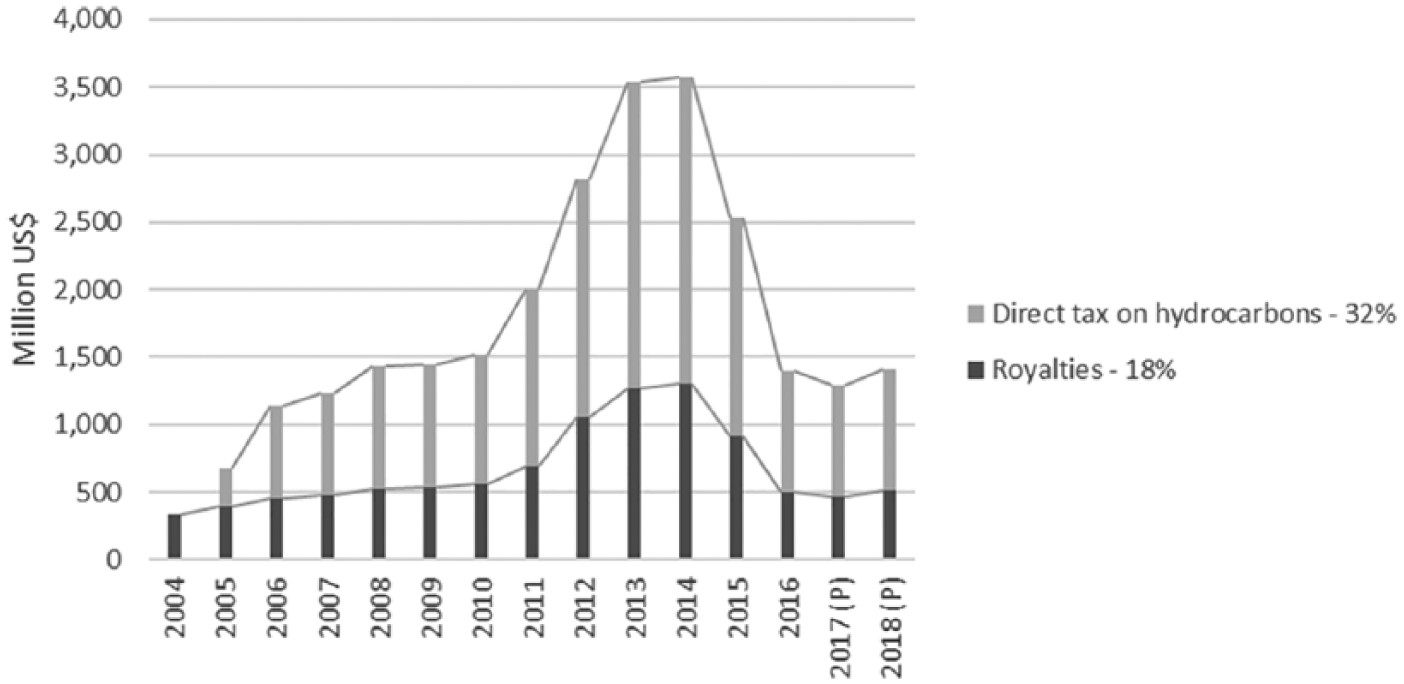
Hydrocarbon rents in Bolivia (Jubileo, 2018).
In response to the decline in oil and gas prices, the government sought to increase the volume of exports. As the researcher Jorge Campanini of the Bolivian Information and Documentation Center put it, “In the 2015–2020 national development plan and the 2020–2025 agenda, what they say is that we are going to do more projects, more exploration, more extraction and, if the gas and oil run out, sell electricity. But the idea is the same” (interview, Cochabamba, July 27, 2016). The government approved a package of regulations that gave oil companies more incentives to invest in exploration, but, as the executive director of the Bolivian Chamber of Hydrocarbons and Energy, Yussef Akly, pointed out, “It is a very complicated time for oil companies, so to attract investment the government has to offer conditions that are genuinely competitive” (interview, Santa Cruz, July 29, 2016).
Change and Structural Limitations
The question remains why the Morales government has not managed to overcome extractivism as the 2006 national development plan proposed and why it is now following an agenda that fits the interests of the oil companies. Some writers have offered explanations that emphasize structural limitations, including “the path-dependent effects of Bolivia’s previous neoliberal policies and the sociomaterial constraints of natural-gas extraction, transport, and use” (Kaup, 2010: 123–124). According to Kohl and Farthing (2012: 226), dependence on oil income “can undermine the development of the institutional capacity necessary to take full advantage of those same resources.”
Other writers, such as Webber (2017) and Andreucci (2016), have analyzed the Bolivian “process of change” in terms of Gramsci’s concepts of “passive revolution” and “transformism,” because “as social change stopped short of profoundly challenging dominant political economic relations, it resulted in the restoration or even consolidation of previously existing arrangements” (Andreucci, 2016: abstract). While Webber (2009) has identified the MAS project as neoliberal, Andreucci (quoted in Zegada, 2015) says that the MAS “has acted as a mediator between the radical demands issuing from popular sectors mobilized against neoliberalism and the dominant sectors.” Pressured by the social movements, the administration has sometimes been forced to lean toward the left and sometimes made pacts with national and transnational capitalist sectors in implementing its reforms.
To better understand the specific failures of the Morales government when it comes to a deep transformation of Bolivian society, it is important to analyze a series of dialectically related economic and political factors: (1) the oil contracts of 2006, which allowed oil companies to maintain a dominant position in the sector; (2) the lack of investment in exploration, which has jeopardized gas export commitments; (3) the substantial dependence on hydrocarbon rents when it comes to public revenues, given that the productive matrix has not changed; and (4) the political degeneration of the MAS.
Impacts of the Extractivist Model Under Morales
Economic and Social
Between 2005 and 2016, Bolivia’s Gini index fell from 58.5 to 44.6 (World Bank, 2018) and extreme poverty from 38.2 percent to 18.3 percent (Jubileo, 2017b). However, in the Bolivian Population and Housing Census of 2012, only 25 percent of the population had their basic needs covered (INE, 2012). This is, paradoxically, evident in the Guaraní communities, where the largest gas fields are located and where the poverty rate exceeds the average of the departments to which they belong (Arze, 2018). As Tomás Araray, the leader of the Council of Guaraní Captains of Tarija (interview, Tarija, July 28, 2016), said, “These communities do not have drinking water, they do not have electricity, there are no roads into these territories; they have lost surface water sources, the streams, as a result of oil exploitation activities, and the profits, due to the hydrocarbons issue, have yet to be seen.” This situation is partially explained by the fact that the exploitation of hydrocarbons, which is capital-intensive, has very low demand for local labor in Bolivia (Arze, 2018).
Environmental
In 2015 the government approved three decrees that opened up protected areas and indigenous territories to oil and gas exploitation, bypassing prior consultation and allowing for higher pollution levels (GoB, 2015a; 2015b; 2015c). According to Akly, “the government now understands the needs of the companies” (interview, Santa Cruz, July 29, 2016). The expansion of the oil frontier to almost 32 million hectares endangers fragile ecosystems and indigenous communities. Specifically, the government has allowed hydrocarbons activities in 11 of Bolivia’s 22 protected areas, affecting more than 3 million hectares (Jiménez, 2015), and in 75 of the nation’s 223 indigenous territories (Campanini, 2015; Jiménez, 2013; Paye et al., 2013; TIERRA, 2011). Bolivia’s ombudsman in 2016, Rolando Villena, argued that these decrees violated seven articles of the 2009 Constitution and five international treaties on the environment and indigenous peoples (Erbol, 2016), but the government was unwilling to back down. As the MAS senator Pedro Montes put it, “Exploration and exploitation in protected areas will continue, because it is our job to continue discovering raw materials for the benefit of the Bolivian people” (interview, La Paz, August 1, 2016).
The 2009 Constitution established the right to prior consultation. However, since 2015 the communities affected have a maximum of 45 days to reach an agreement with the oil companies, and if they fail to do so the ministry is to issue the environmental license requested so that the companies can continue “their activities uninterrupted, given that these are in the public interest” (GoB, 2015a). Decree 2195, issued in 2014, places limits on financial compensation for affected communities of 1.5 percent of the total investment (GoB, 2014). Anthias (2018) has also pointed to these negative impacts. As Ruíz (interview, Tarija, July 28, 2016) explains, “Extractive activities have had very severe environmental impacts in some areas. And this has negatively impacted the economy, because it has affected their water sources, their hunting, fishing, and farming grounds. The negative impact of the industry on the Guaraní culture and way of life is also important.” This also worries Lucio Ayala, the former president of the Confederation of Indigenous Peoples of Bolivia (interview, Santa Cruz, July 30, 2016): “With these hydrocarbons exploration projects the communities will have migration, the indigenous movement will be expelled. The government does not take a fair look at these dangers; all they want is development.”
The new environmental regulation for the hydrocarbons sector, approved in 2015 (GoB, 2001; 2015c), allows for a higher level of oil pollution than the previous 2001 regulation regarding bodies of water and so-called btex (benzene, toluene, ethylbenzene, and xylene), which are some of the most dangerous substances in petroleum residues (Mollo, 2011). This is worrisome because it has already been proven that the water consumed by communities located within 30 kilometers of oil fields contains various pollutants produced by the oil industry (González et al., 2010). For the MAS this “is not an imposition by the state but a need of the Bolivian people” (Pedro Montes, interview, La Paz, August 1, 2016).
Transnationals in Power
Hydrocarbons nationalization means that the state regains control not only of commercialization but also of exploration and exploitation. As Arze (2013: 14) has said, “Nationalization allows us to establish what things get produced and for what purposes, in addition to controlling the economic surplus generated by a sector.” On May 1, 2006, the Morales government proclaimed the third nationalization of hydrocarbons (GoB, 2006a), but this time there was no confiscation of property. By the end of 2006 none of the 17 private companies in the oil industry had left the country. All that had happened was the renegotiation of 44 contracts establishing that private companies had to meet the requirements of the 2005 hydrocarbons law, paying 18 percent in royalties and an additional 32 percent in direct taxes on hydrocarbons (Paz and Ramírez-Cendredo, 2018). In addition, more than US$2.5 billion were paid to buy 50 percent plus 1 of the shares of YPFB’s subsidiary companies, which had been privatized in the 1990s (Fernández, 2016).
The new contracts established YPFB’s participation in the profits of the transnationals, since they are now its “partners.” The transnationals are in charge of the “upstream” part (exploration, drilling and production) and must deliver all their production to YPFB, which is responsible for the “downstream” process (refining and commercialization) (Jubileo, 2012). However, all the risks of oil investment are transferred to YPFB via the recognition of the expenses of the transnationals, the so-called recoverable costs. This means that YPFB pays for the salaries, equipment, transportation costs, etc., of these companies (CEDLA, 2007). Under this arrangement, the transnationals were left with an average profit of almost US$800 million annually between 2006 and 2016 (Jubileo, 2017a). This explains why they would want to be “partners” with YPFB. It also evidences the way they continue to plunder Bolivia.
The nationalization decree led the government to audit all the companies operating in the country. These audits, conducted by the Ministry of Hydrocarbons, revealed that the oil companies had violated previous contracts, made very few investments, damaged the environment (Hora 25, 2008), and evaded US$1.7 billion in taxes (Soliz Rada, 2008). As Orgáz (2011; 2012) has shown, the government has lost a lot by failing to expropriate the transnationals as it did in nationalizing Gulf Oil in 1969.
The result of the MAS government’s hydrocarbons policy is that transnationals remain dominant in the sector. In 2015 a so-called incentives law established higher prices for the transnationals’ production of liquids (gas and oil condensates) (GoB, 2015d). The companies had formerly had to sell these liquids at a fixed price of US$27.11 per barrel on the domestic market, retaining US$13.56 after paying 50 percent in taxes. With the incentives law, they receive US$30–55 more (depending on international prices) per barrel and can therefore make a profit of up to US$68.56 per barrel (Arze, 2015). The incentives cover not only production in new areas (thus encouraging investment in exploration) but also production in existing areas. It is not surprising that Repsol’s president, Antonio Brufau, has said that he considers Bolivia “a magnificent country to invest in” (Página Siete, 2015).
The incentives will be partially financed with the money these same companies pay in taxes, since 12 percent of the direct tax on hydrocarbons is reserved for this purpose (GoB, 2015d). As Jiménez (2015) says, “This, in practice, is nothing other than the expropriation from the Bolivian people of a percentage of the resources that, by law, they ought to obtain from hydrocarbons extraction.” In 2016 the state received not 50 percent of the total value of hydrocarbons sales but a mere 44.6 % the transnationals obtained 40.8 percent and YPFB 14.6 percent of this income (Jubileo, 2017a). The MAS senator Pedro Montes’s response was “What do I care about the reduction? It will not have an impact” (interview, La Paz, August 1, 2016). However, the deficit created by the incentives law has already led to suspension of work on and abandonment of municipal projects (Jorge Campanini, interview, July 27, 2016). This comes on top of the decrease in revenues due to the decline of international hydrocarbons prices. In 2018 the departmental administrations saw a tax revenue reduction of 57 percent, compared with the highest levels recorded in 2014, while municipal governments experienced a 33 percent drop (Jubileo, 2018). According to Campanini, “These are rationales employed during the neoliberal era—that is, you burden the population. There is a deficit, but we make the population assume this burden, while the state encourages companies to do some kind of work or exploration with the money.”
The Challenge of Finding New Gas Reserves
Now the government faces the enormous challenge of finding new gas reserves in order to continue exporting at the current volumes (Trigo, 2017). The problem is that the 2006 oil contracts established no commitments or investment guarantees (Paz and Ramírez-Cendredo, 2018). Oil companies invested only in the exploitation of known reserves, since that allowed them to take advantage of the high international prices of hydrocarbons experienced during the first nine years of the Morales administrations. However, “this damaged exploration activities, which were neglected, and currently poses an enormous challenge to the national authorities, who must not only replenish the consumption of recent years but also increase certified reserves in order to guarantee the fulfillment of contracts signed with Argentina and the new one to be negotiated with Brazil when the current contract expires in 2019” (Jubileo, 2016: 3). In addition to the external market, there is an internal gas market that has tripled since 2005 and will continue to grow because of government programs involving natural gas, liquefied natural gas, and electricity generation networks (Jubileo, 2018). New reserves are needed, and “finding them is expensive and complicated” (Yussef Akly, interview, Santa Cruz, July 29, 2016).
New exploration and exploitation areas have been reserved for YPFB since 2005. By 2015 they numbered 99, totaling more than 29 million hectares (Campanini, 2015). If to that we add the areas where oil companies already have operating contracts (Jiménez, 2013), the new hydrocarbons frontier totals almost 32 million hectares, more than 29 percent of Bolivian territory (Campanini, 2015). This expansion of the oil frontier endangers national parks, fragile ecosystems, and a substantial portion of indigenous territories. To date YPFB has done very little in the reserved areas. For Akly (interview, Santa Cruz, July 29, 2016), this result was “reasonable to expect” because “a public company is always more bureaucratic, heavier, because it needs to get authorization, because it has to obtain the budget, it has to go to Congress.” For this reason, he said, the government had decided to look for new partners among the transnationals, and the latter had replied that if it wanted new investment in the exploration zone it would have to “improve the regulations and conditions of competitiveness.” According to Patricia Molina, the director of the Bolivian Forum on the Environment and Development (interview, La Paz, August 1, 2016), the result was that the government is now “fully complying with an agenda imposed by the oil companies.” It has accepted the myth that it needs the transnationals to discover hydrocarbons reservoirs and to cover the risk of exploration. However, a study by Gandarillas and Rodríguez (2011: 17) shows that “the old YPFB was more efficient than foreign companies, drilled more wells, and had more exploratory success.” Additionally, even though Bolivia has significant hydrocarbons reserves, this would not justify new export contracts.
Dependence on Hydrocarbon Rents and the Productive Matrix
In the context of high income of 2005–2014, there was a significant increase in current expenses (salaries, pensions, benefits). Public investment also multiplied under the Morales administrations, from US$629 million in 2005 to an estimated US$6.2 billion in 2018 (Jubileo, 2018). However, public expenditures are heavily dependent on hydrocarbon rents. During the 2005–2016 period, hydrocarbon rents represented 33 percent of the income of the state apparatus (Jubileo, 2017a), among the highest in all of Latin America (Farthing and Kohl, 2014). This heavy dependence on hydrocarbon revenues has negative impacts during a period of low international oil prices such as 2015–2018 (INE, 2018a), which is characterized by high fiscal deficits. As a result, Bolivia’s external debt rose to more than US$9.5 billion in 2018. In just one year, from December 2016 to December 2017, the external debt grew by 28 percent (Jubileo, 2018). Sectors that could diversify the economy and generate income and employment have not been prioritized. Between 2007 and 2011, public investment in the industrial sector amounted to only 1.2 percent of state investment (Escobar de Pabón, Rojas, and Arze, 2014). This trend has continued: in 2018 only 2 percent of the investment budget was assigned to the industrial sector (Jubileo, 2018).
The government’s 2006 national development plan concluded that the primary-export pattern did not support national development and it was therefore necessary to diversify the economy and build a model “comprised of aggregate value and the industrialization of renewable and nonrenewable natural resources.” This change of model was seen as “an essential condition” for reversing inequality and eradicating poverty in the country. It was also proposed that the state be the main agent and promoter of this new model (GoB, 2006b). The government says that it has fulfilled its promise to industrialize gas with the construction of a urea and ammonia plant in 2017, but less than 5 percent of these fertilizers will be for the domestic market (Melendres, 2018). The export pattern has been maintained, and it does very little to sustain national development.
Bolivia continues to have a backward capitalist economy with low productivity in which precarious jobs have increased and there is increasing exploitation of labor (Escobar de Pabón, Rojas, and Arze, 2014). Official data show that informal employment increased from 59.1 percent in 2005 to 75 percent in 2015 (ILO, 2016; Yañez and Landa, 2007). According to the international secretary of the Bolivian Workers Central, Jaime Quispe (interview, La Paz, July 29, 2016), “The government does not have policies on how to generate an economy. We have always been told that there is more investment, but how does it reach the citizens? It doesn’t.” For the researcher Carlos Arze, Bolivia’s inability to leave extractivism behind is due not to the lack of resources but to the lack of “a social class that, within the framework of the established order, has enough interest and power to follow through on this decisive point” (Vila and Orgáz, 2014). In my opinion, in a backward capitalist country like Bolivia the bourgeoisie is too weak and dependent on foreign capital to be able to industrialize and develop the country.
The Degeneration of the MAS
The Morales government is now pursuing an agenda that coincides with the interests of the oil companies. These reconciliations are a result not simply of the nation’s heavy dependence on hydrocarbon revenues but also of the political degeneration of the MAS.
External Attacks and Internal Divisions, 2006–2008
After its 2005 electoral victory, the government enjoyed the national majority’s support to promote structural changes in the country. However, both the MAS and the other social movements had internal differences regarding the way those changes should be enacted. Social sectors such as the Bolivian Workers Central, the miners, and the Landless Peasant Movement wanted a more open confrontation with the transnationals, the latifundia, and the national oligarchy, while the pro-capitalist sectors of the government and the MAS, led by Vice President Álvaro García Linera, chose the path of dialogue (Krommes-Ravnsmed, 2014). This conflict also led to the exit from government of the minister of hydrocarbons, Andrés Soliz Rada. He had signed a ministerial resolution in August 2006 that took control of the refineries from Petrobras, thus enacting the nationalization decree. However, Brazil complained to the vice president and he gave in to this subimperial power and froze the measure that was going to affect Petrobras. As Soliz Rada said, “In addition to external attacks, I had to face strong internal obstacles” (El País, September 9, 2016). After his departure García Linera’s group tried to prevent the completion of the oil audits, mistreated auditors, destroyed important documents; the official in charge of the audits, Enrique Mariaca, even suffered a violent assault that temporarily kept him from work. According to Soliz Rada, “the progress of the audits worried the palace group,” and when the authorities began receiving the first results internal censorship and a hasty arrangement of contracts with the oil companies were imposed (Sagárnaga, 2010). These events reflect the internal struggle between reformist stances and more radical ones within the MAS and the other social movements. During 2007 and 2008, the town of Camiri, known as the oil capital of Bolivia, witnessed strikes and roadblocks demanding a “true nationalization” of hydrocarbons (Petropress, 2008). As Mirko Orgáz, vice president of the Camiri Civic Committee, said, “Evo is pulling the wool over our eyes; real nationalization means that the capitals of transnational corporations should be expropriated, and that has not been done” (BBC, 2007).
Governmental vacillation strengthened the right-wing opposition, which managed to rearticulate itself during the first two years of the Morales administration. From its bastions in the East of the country, it orchestrated a separatist movement, organizing referendums on autonomy in the departments of Santa Cruz, Tarija, Beni, and Pando during the first half of 2008. With these referendums they hoped to force the government to agree to modify the proposed new constitution, which was going to affect land tenure and ownership of natural resources. Some government representatives declared that they were open to dialogue, but the referendums were met with popular resistance and mobilizations throughout the country. Then, on August 10, there was a recall referendum in which more than two-thirds of the voters said that they wanted Morales to continue his work. The social movements thought that this would put an end to the obstacles and the government would move forward with structural changes (Schlez, 2008). Instead the oligarchy, supported by the imperialism embodied by the U.S. embassy, attempted to orchestrate a coup in the departments of Santa Cruz, Tarija, Beni, and Pando (Schlez, 2008). Between September 9 and 11, 2008, it took over state institutions and airports, attacked and occupied oil and gas installations, and launched attacks against the headquarters of social movements, the radio stations, and state television. On September 11, 2008, 30 peasants were killed in the department of Pando: Bolivia was on the verge of a potential civil war (Fuentes and Munckton, 2008).
It was then that the Brazilian foreign minister, Celso Amorim, declared that if Morales failed to secure the pipeline, Brazil might establish contacts with the Eastern governors (Arostegui, 2008). However, in the poor and populous neighborhood of Santa Cruz de la Sierra known as Plan 3000, the social movements resisted right-wing attacks and called on the people of Bolivia to mobilize (Zibechi, 2009). Thousands of peasants, miners, and workers began a siege around Santa Cruz meant to “take over latifundia and factories,” according to a document signed by Bolivian Workers Central and the National Coordination for Change (Bolpress, 2008). This mobilization stopped the attempted coup d’état, but the government then put a halt to mobilizations and invited the right to negotiate changes in the proposed new constitution before it was subjected to a referendum (ABI, 2008a). The right succeeded in modifying 146 of the 411 articles approved by the constituent assembly in 2007 (ABI, 2008b). While the issue of hydrocarbons nationalization was raised, the right managed to introduce a paragraph stating that “in no case will [the new legal regime] entail neglect of acquired rights” (GoB, 2009: Disposiciones transitorias, octava (I)). By contrast, in the constitutional proposal approved by the constituent assembly in 2007 it declared that the state had to issue a resolution on concessions on natural resources “that contravene the present Constitution” (CJA, 2008: Disposiciones transitorias, octava (I)). With this modification the de facto power of the gas and oil transnationals was ensured.
Right-Wing Infiltration and Conflicts With Social Sectors, 2009–2013
The government achieved a substantial electoral victory in the December 2009 elections, obtaining a two-thirds majority (Cuiza, 2016). However, the contradictions between the popular expectations that had allowed the MAS to reach power and the consequences of its conciliatory policy increased during Morales’s second term (Schneider, 2014).One of the conflicts took place in December 2010, when the government issued a decree known as the gasolinazo, which eliminated state subsidies on gasoline, diesel, and other fuels sold in the domestic market, practically doubling their cost. The measure was meant to “encourage investment” by transnationals to increase gas and oil production (Pereira, 2010), but the sectors hardest hit were the poor, given that the prices of all the products in the basic market basket shot up following the decree (Stefanoni, 2010). The social movements saw this as a victory for the oil companies, and a general strike played a fundamental role in reorienting the government’s decision; the administration repealed the decree (Gilbert, 2010; Sosa, 2010).
The following couple of years witnessed several mobilizations on the part of workers, peasants, and indigenous people trying to influence and guide the government’s decisions (e.g., salary issues, pensions, and the conflict over the highway through the Isiboro Sécure Indigenous Territory) (Schneider, 2014). The left wing of the MAS launched a manifesto seeking to “redirect” the process of change in terms of a genuine nationalization of hydrocarbons and more sustained efforts to overcome extractivism (CPR, 2011). The manifesto was harshly attacked by the vice president (García Linera, 2011), and, generally speaking, there was very little debate within the party regarding the need for redirection. Some MAS Youth congresses proved the exception: left-wingers got political documents with important social demands approved, including the nationalization of mines managed by transnational companies (Taboada, 2011). That said, the leftist groups within the MAS were not well organized, and conservative sectors eventually took the lead, supported by infiltrated right-wing groups that had opportunistically jumped on the bandwagon (Mendoza, 2009). It should be remembered that the number of jobs in the public sector increased by 74.5 percent between 2005 and 2015 (Mamani, 2016), a sign that the bureaucracy had gained a solider basis for maneuver in opportunism and clientelism, which also allowed it to degrade the political debate within the party. As a result, the MAS became locked in an internal struggle to conquer positions of power and public posts. Instead of having militants serve as the channel that connected social demands with the socialist struggle, the bases were called on as simple electoral activists. In this context, some ministers, former ministers, and rank-and-file militants left the party (Curi, 2015) and little by little the pro-capitalist groups within the MAS grew stronger.
Class Collaboration, 2014–2018
In 2014 García Linera said, “The MAS is no longer that of 2005; it has been changing its proposal; no longer communitarian, it has embraced the ‘cruceño model,’ which is capitalist” (quoted in Ortiz and Salvatierra, 2014). This pursuit of class collaboration was also reflected in the 2014 general elections and 2015 local elections, in which the MAS invited many right-wingers to run (Lucha de Clases, 2014). The national leadership thought that to obtain the vote of the middle class it had to offer a moderate program and therefore invited guest politicians who were not identified with the social struggles. Defectors readily accepted the MAS’s offers in order to obtain governmental positions and economic benefits. However, as the Bolivian socialist leader Marcelo Quiroga Santa Cruz said, in politics “certain sums subtract rather than add” (quoted in Rodas, 2010), because with these types of alliances mistrust and disappointment are spreading among militants, workers, and peasants, ultimately strengthening the right (Rodas, 2010). They were also questioned by the bases. In the municipality of Pailón, Santa Cruz, a MAS leader said, “It is very sad that our party, which used to be a political instrument for the sovereignty of the people, a party of the poor, is now gradually becoming a party of the right” (Erbol, 2014).
Morales won 61.36 percent of the votes in the 2014 presidential elections, while the total votes obtained by MAS candidates in the local elections of 2015 was 41.79 percent (Cuiza, 2016). In 2015 the MAS lost to the traditional right-wing parties in almost all of the most populous cities in the country, even El Alto, the epicenter of the 2003 gas war (Cuiza, 2016). The government then tried to embrace the capitalist model further, flirting with entrepreneurs and agroindustrial companies by offering them guarantees and political representation (Saavedra, 2015; TIERRA, 2017). The national bourgeoisie and the transnational corporations found this advantageous because, as the former deputy minister of lands under the Morales government, Alejandro Almaraz (2015), said, “Business interests now enjoy the protective and viable political and social legitimization that the laws and institutions of previous governments could not provide.” To maintain political and social legitimacy, the government tried to co-opt the social organizations (Almaraz, 2015) or spread division (Paredes, 2018), labeling any claim or mobilization against it “right-wing” or “imperialist” (ABI, 2010; El Día, July 2, 2012; Lucha de Clases, 2015). For example, in April 2017 García Linera spoke harshly of “environmentalist colonialists” in referring to a march made up of hundreds of indigenous people protesting against the entry of YPFB and Petrobras into the Tariquía protected area in Tarija, where they live (Somos Sur, 2017).
It is clear, however, that the government is risking a crisis of legitimacy with regard to its interaction with the social movements. According to Quispe (interview, La Paz, July 29, 2016), “There is widespread discontent against the government. As workers, we have complied with the process of change but, unfortunately, this government does not respect us; rather, it works to our detriment.” Popular discontent led to an electoral defeat on February 21, 2016, regarding a constitutional referendum on whether Morales should run for president once again. Then, in 2017, a ruling by the Plurinational Constitutional Court allowed for the indefinite reelection of all elected authorities in the country. As a result, the 2019 election is likely to result in a weakened government and legislature, leading to intensified class collaboration. However, objective conditions are also opening up political space to the left of the MAS. As Quispe has pointed out, We have proposed nationalization without compensation, but in the end this has not been fulfilled. We do not like the fact that those monies are going to transnationals. We’ll fight. We will not allow them to put the burden on the population. . . . We cannot allow this government to act against indigenous peoples and workers. We fight for the rights and welfare of all Bolivians.
Conclusions
The struggle for hydrocarbons nationalization paved Evo Morales’s way to victory in 2005. The impoverished Bolivian people hoped to put an end to the plunder of their country, but the contracts signed with the transnationals in 2006 abrogated nationalization. In spite of this, there was a period of economic prosperity between 2006 and 2014 due to the direct tax on hydrocarbons, high international prices for gas and oil, and an increase in export volumes. Some came to believe that economic independence could be achieved without confronting the transnationals, but in fact they consolidated their dominance in the sector. Because of a slowdown in the Bolivian economy, the government was forced to comply with an agenda that essentially serves transnational interests. As de Janvry (1981: 197) put it, “It is this contradictory position of exclusion and dependence that both limits the reformist capacity of the state and commits it, however autonomous it may appear for purposes of legitimation, to the promotion of the conditions necessary for accumulation.”
These latest governmental setbacks are the result of economic and political factors that, as I have shown here, are dialectically interrelated. The persistent dominance of the oil transnationals, the constant challenge of finding new gas reserves, the heavy reliance on hydrocarbon revenues to cover public expenditures, and the failure to diversify economically, along with the political degeneration of the MAS, have kept the MAS project from achieving its initial goals. The government has covered up these policies with a revolutionary discourse, but it now risks a crisis of legitimacy with regard to its interaction with the social movements given that its extractive policy has exacerbated processes of accumulation by dispossession.
Supplemental Material
DS_10.1177_0094582X18820294 – Supplemental material for The Frustrated Nationalization of Hydrocarbons and the Plunder of Bolivia
Supplemental material, DS_10.1177_0094582X18820294 for The Frustrated Nationalization of Hydrocarbons and the Plunder of Bolivia by Jeppe Krommes-Ravnsmed and Mariana Ortega Breña in Latin American Perspectives
Footnotes
Jeppe Krommes-Ravnsmed is a geography and geoinformatics Master’s student at the University of Copenhagen. He lived in Bolivia from 2006 to 2011, where he studied at the university in Santa Cruz de la Sierra. He thanks Linda Farthing, Marjorie Bray, and Paul Dosh for their constructive comments on earlier drafts of this article. Mariana Ortega Breña is a freelance translator based in Mexico City.
References
Supplementary Material
Please find the following supplemental material available below.
For Open Access articles published under a Creative Commons License, all supplemental material carries the same license as the article it is associated with.
For non-Open Access articles published, all supplemental material carries a non-exclusive license, and permission requests for re-use of supplemental material or any part of supplemental material shall be sent directly to the copyright owner as specified in the copyright notice associated with the article.
