



Abstract
Ethnographic field interviews collected in three municipalities of Oaxaca explain how the Mexican state’s response to the Chiapas earthquake facilitated capital accumulation while intensifying indigenous-campesino grievances against megaprojects and resource extraction. State policies in Oaxaca’s Isthmus of Tehuantepec during the fall of 2017 reinforced social inequality by way of three key mechanisms: neglect, dispossession, and pacification. Making sense of the way state institutions exercised power during this disaster benefits from combining a critical perspective on global capitalism with long-standing frameworks of cultural genocide and internal colonialism.
Las entrevistas de campo etnográficas recogidas en tres municipios de Oaxaca nos muestran cómo la respuesta del Estado mexicano al terremoto de Chiapas facilitó la acumulación de capital al mismo tiempo que intensificó las quejas de campesinos indígenas contra los megaproyectos y la extracción de recursos. Las políticas estatales en el istmo de Tehuantepec en Oaxaca durante el otoño de 2017 reforzaron la desigualdad social a través de tres mecanismos clave: abandono, despojo y pacificación. Para poder dar sentido a la forma en que las instituciones estatales ejercieron el poder durante este desastre es importante combinar una perspectiva crítica sobre el capitalismo global y marcos teóricos de larga data en torno al genocidio cultural y el colonialismo interno.
On September 7, 2017, the Chiapas earthquake struck Mexico from its epicenter about 60 miles off the southern Pacific coast in the Gulf of Tehuantepec. Measuring 8.5 on the Richter scale, this was the most powerful earthquake to hit Mexico since the 1985 earthquake in Mexico City (which had a moment magnitude of 8.0) and the strongest earthquake registered globally in 2017. It was felt by 50 million people from Mexico City to Guatemala, but Mexico’s Isthmus of Tehuantepec suffered the greatest physical impact.
As has been readily apparent during the COVID-19 pandemic, government responses to a sudden disaster reflect the correlation of underlying political, economic, and social forces at any given time. In the wake of this most recent earthquake in southern Mexico, the policies of local, municipal, state, and federal institutions were embedded in and reinforced the contradictions of Mexico’s dependent neoliberal capitalism. As have studies of other disasters that triggered increased inequality and unrest (e.g., Dupuy, 2010; Sehnbruch, 2017; Morris, Hayward, and Otero, 2018), analysis of this earthquake helps contextualize how the Mexican state’s systemic drive to put capital accumulation in command of development policy renders campesino-indigenous communities concentrated in Mexico’s South more vulnerable to natural/ecological disasters. Based on ethnographic fieldwork and interviews with earthquake survivors in the Isthmus of Tehuantepec, this article details how the exercise of state power immediately following this earthquake bolstered social inequalities via three key mechanisms: neglect, dispossession, and pacification. Each of these was met with substantial and innovative forms of popular mobilization from human rights groups and everyday Oaxacans.
Along with Latin American nations in general, Mexico has been ensnared in what some call “the politics of dispossession and neoliberal enclosures of communal goods” (Navarro, 2015: 22). Relatedly, the legacy of former President Enrique Peña Nieto (2012–2018) includes “energy reform” (del Castillo-Mussot et al., 2018: 109–110; Cypher, 2014), oil privatization (Cypher, 2018), and corrupt impunity under the cover of an ongoing “war on drugs” (Rosen and Zepeda, 2016: 61–80). The region of Oaxaca where I performed this fieldwork, the Tehuantepec Isthmus, has been a cradle of socialist and nationalist political activity, particularly by the Zapotecs in and around the city of Juchitán, at least since the early 1970s (Campbell 1993; Rubin, 1997). Its unique and turbulent historical identity has been noted by many scholars and is a source of pride for inhabitants of the region, who continue to dissent against the Mexican state and its developmental program.
Contemporary socio-ecological/territorial conflicts in the Isthmus have expressed themselves in multiple forms. Since about 2012, state and paramilitary violence have been directed at the opponents of land grabs for the largest wind energy corridor in Latin America (Dunlap, 2018a; Miranda, Altamirano, and Cerqueda, 2015). Communities in the region have also protested since 2016 against a World Bank–supported, federally decreed special economic zone (Ávila and Romero, 2017) now commonly referred to as the Trans-Isthmus Corridor (González, 2019; Portal Automotriz, 2015), which offers transnational corporations tax exemptions in exchange for expanded foreign investment in parts of Oaxaca and Veracruz. Industries like logging, hydroelectric dams, and oil pipelines have further divided the Isthmus’s local population (Rodriguez, 2017, López, 2012; López Gómez, 2016; Ávila-Calero, 2017; Dunlap, 2018b; 2018c). More recently, campesino-indigenous organizations and rights networks have been agitating for the suspension of mineral exploration contracts in several municipalities that were awarded by Mexico’s federal government to mining companies (mostly Canadian) without the prior informed consent of the affected residents (Morosin, 2020). While gradually privatizing communal property for export-oriented transnational capital, such megaprojects in this geostrategic corner of Mexico all prioritize short-term capital accumulation while degrading the environment, endangering human rights, reviving internal colonialism, and uprooting traditional forms of social reproduction (López, 2019: 142). This article aims to connect this macro political economy to the state’s having exposed vulnerable campesino-indigenous communities to further indignities after a large-scale disaster.
As earthquake debris remained strewn about communities for months and many survivors lived in tents or on the streets, a confluence of public institutions and private actors facilitated capital accumulation via a controversial urban renewal program. Implemented in a crisis situation, this program upended the physical characteristics of this territory while rupturing its cultural fabric. During this contentious period the state’s program of reconstruction came to be widely viewed as a threat to the economic survival and cultural life of indigenous people. Preexisting political protest networks adapted their claims, strategies, and tactics to these intense new circumstances. Their efforts to bring about an alternative, indigenous-led form of reconstruction reflect the Isthmus’s long-standing tradition of radical mobilization (e.g., Rubin, 1997; Talcott, 2014).
To make sense of the Mexican state’s response to this earthquake, I combine critical perspectives on global capitalism-imperialism with Gramscian approaches to social control and indigenist frameworks on cultural genocide. Below I develop that theoretical argument and identify neglect, dispossession, and pacification in reference to the empirical realities I encountered in the field.
Theoretical Overview
As organized militancy against Mexico’s ruling party was militarily defeated in the Isthmus in the early 1980s by the Partido Revolucionario Institucional (Institutional Revolutionary Party—PRI), former Zapotec agrarian rebels of the Coalición Obrera, Campesina, Estudiantil del Istmo (Isthmus Coalition of Workers, Peasants, and Students—COCEI) began brokering deals with the government and multinationals throughout the 1990s (Dunlap, 2018c). Today, indigenous rights and environmental activism in the Isthmus typically take the form of loosely organized collectives, networks, nongovernmental organizations, and small-producer associations (e.g., agrarian cooperatives) rather than political parties. Grassroots resistance and opposition to megaprojects by these forces had reached a high point before the earthquake (Ávila and Romero, 2017: 158). Grasping the articulation of the state’s response with the opposition from community-based networks in multiple municipalities requires understanding the economic, political, and cultural shape of state power in the Isthmus.
Many analysts see Mexico’s political system as uniquely “clientelist” (e.g., Shefner, 2001: 594–595; Hilgers, 2009; Hellman, 2008) or “corporatist” (Ansell and Mitchell, 2011), with decision making being channeled by the state through the exchange of material goods for political support. Indeed, patronage and coercion are predictable outcomes when masses of a population are unable to meet their most basic material needs. 1 For example, because of their having signed agreements with the government, many popular movements found themselves unable to mount any protest when President Carlos Salinas de Gortari (1988–1994) opened Mexico’s economy to “free-trade” agreements with the United States and Canada. The operative relationship of this clientelism is found not solely or mainly at the level of the nation-state but at the level of the world-system; since the last third of the nineteenth century the United States has effectively converted Mexico into a client state (Nova, 1988: 22, 25). This history of imperialist expansion, along with a Mexican oligarchy (de Regil, 2018), continues to influence the class nature of the state and the patterns of power we observe today. If the Mexican state makes corrupt “clients” out of its citizens, this is because it is a mostly reliable client of imperialism/transnational capital, with a Mexican bourgeoisie as an active agent of this process.
The convergence of interests between capital and the state can be seen in myriad cases, but in the Isthmus it applies primarily to natural-resource-seeking capital (investment in raw materials that does not require large quantities of local wage labor) rather than industrial capital (e.g., manufacturing). An assortment of foreign monopolies and the Mexican fraction of the transnational capitalist class guided by the Consejo Coordinaro Empresarial (Business Coordinating Council—CCE) have shared a consensus for over two decades on the need to integrate southern Mexico more deeply into the global economy. This project requires the Mexican government to finance the infrastructure and security while providing a legitimating discourse for domestic consumption (Ávila and Romero, 2017: 145, 149). As the latest instantiation of this objective, the Trans-Isthmus Corridor hinges on exploitation and privatization of the Isthmus’s rich natural resources, biodiversity, and geographic position. Using the language of Latin American political ecologists (e.g., Gudynas, 2009), my respondents generally derided this as an “extractivist” development model. 2
Today, social property in the form of ejidos and comunidades still remains a salient feature of the economic base (Binford, 1985; Reina, 2013) as it does in the state of Oaxaca as a whole, which contains roughly 671 ejidos and 621 comunidades (López Bárcenas, 2012: 126–127). Ejidos are agricultural and residential lands distributed during the Mexican revolution’s land reform that are governed by local assemblies (Stephen, 2002). While ejido parcels are worked individually, with the proceeds of cultivation accruing to individuals, they are registered as social property (Binford, 1985). Communal lands are precolonial land claims that are locally governed, often according to indigenous norms (López Bárcenas, 2012: 125). Article 27 of the constitution was revised in 1992 to allow expropriation, sale, and lease of social property (López Bárcenas, 2011: 131–136). Nevertheless, the relations of production in the Isthmus, where social ownership of land is still prevalent, impose a juridical fetter on global capitalism’s competitive drive for privatization and trade. More simply put, the remaining system of ejido and communal lands is an inconvenience to the state and to investors who are aware of Oaxaca’s bounty but unable to access it directly. Short of expropriation by the state, private industry must still obtain permission from the land’s social owners in order to operate extractive industries on social property.
What Arturo Escobar (2010) calls indigenous “relational ontologies,” though in no way interchangeable with a “peasant” worldview, have been nourished by these same social forms of landownership. The Isthmus Zapotec culture of guendaliza’a, obligations to one’s surroundings and neighbors (Altamirano-Jiménez, 2013), exemplifies a “symbolic framework of group experience” (López Bárcenas, 2012: 128). For many Zapotecs, this reflects the district of Juchitán’s legacy of Zapotec autonomy and rebellion against the Mexican state and various foreign powers (Binford, 1985; Rubin, 1997). Thus it is not surprising that ethnic groups in the Isthmus tend to be suspicious of government-backed megaprojects. The state continues to practice a kind of class-based internal colonialism (Stavenhagen, 1965; 1974) in the multiethnic and majority-indigenous Isthmus by virtue of its continual efforts to “impose, preserve, or extend hegemony over the ethnic groups [and] their territories” (Loza, 2018: 100). This is evident in the federal and state governments’ denial of regional political autonomy. The national state undemocratically grants extraction and energy contracts to foreign corporations at windfall prices, with little regard for the social and ecological effects on the land’s inhabitants (e.g., López Bárcenas, 2012). Core-periphery hierarchies (Chase-Dunn and Hall, 2019), depeasantization (McMichael, 2012), and racist internal colonialism (e.g., Loza, 2018) combine to marginalize campesino-indigenous communities in the Isthmus from the Mexican polity.
These contradictions manifested themselves in the response of the state to the natural disaster of September 2017 in the form of neglect, dispossession, and pacification, all of which were happening more or less simultaneously in multiple affected places in the Isthmus. Neglect by government agencies—inadequate provision of goods and services to victims both immediately and over time—disproportionately displaced people from rural areas, and this cultural and social dissolution allowed corporations and the state greater access to those areas, which they sought to use for the export-oriented extraction/transport of energy and resources. This, combined with the spread of markets in agriculture (not just any markets but those vertically controlled by transnational capital), eroded peasant practices. Against this backdrop, state neglect during natural disasters undermined indigenous people’s social cohesiveness and strained their ability to manage their territory.
Dispossession—according to Butler and Athanasiou (2013: 2) “what happens when populations lose their land, their citizenship, their means of livelihood, and become subject to military and legal violence”—is linked by the anthropologist Tania Murray Li (2009) to neoliberal policies that have abandoned social support for rural populations and/or concentrated land in a few hands, producing a “devastating threat to indigenous people’s lives and livelihoods” (Li, 2010: 385). The Isthmus has confronted these trends for years (e.g., Lucio, 2012). Supplementing the critical research on dispossession, Short’s (2010) sociological approach to indigenous genocide emphasizes that the destruction of a social group may take place not only through physical means (i.e., through the killing of its members) but by cultural means (i.e., by inflicting damage upon its way of life). Short applies the original definition of “genocide” (the destruction of a distinct social group [Lemkin, 1944]) to the contemporary struggles of many indigenous peoples around the world. He writes that genocide “can be achieved in a variety of ways not restricted to physical killing. It could be through . . . suppression of language, religion, law, kinship systems, and other cultural practices through which the people maintain the relations among themselves, or through the imposition of severe conditions of life that break down social solidarities” (Short, 2010: 842). Applying these insights to the form of reconstruction adopted by the Mexican state during the Chiapas earthquake, I suggest that in implementing policies and practices that incentivized home demolition, governmental authorities disrupted the attachments to land, place, and collective memory that serve as one of the foundations for indigeneity in the Isthmus. I thus treat the coercive demolition and attempted demolition of inhabitants’ traditional homes as “cultural dispossession” that can pave the way for cultural genocide/culturcide. 3
Pacification—the production and reproduction of “more pliable populations through developmental programs while trying to eradicate those who are deemed recalcitrant to liberal rule” (Kienscherf, 2016: 1183)—was the effect of public policies that combined social welfarism with increased military presence. Singling out certain groups for coercive or consensual treatment reflects and reinforces prevailing social hierarchies (Kienscherf, 2016: 1189). “Pacification” is a more accurate description of the state’s approach to campesino-indigenous communities after the earthquake than the more traditional term “clientelism,” since it targets specific oppositional groups (and/or localities) in an attempt to manage or extinguish their dissent. 4 These insights, which borrow from Gramsci’s theory of hegemony, 5 help explain how governmental responses to the earthquake extended prior counterinsurgency policies that undermined local dissent and indigenous self-determination.
Neglect, dispossession, and pacification should not be viewed as fixed processes that are predestined to secure capital’s total influence over the Isthmus region. Mechanisms of inequality are not inevitable but, like capital itself, relational and interactional. Therefore, particularly in their early phases of implementation, mechanisms of inequality are vulnerable to being challenged and interrupted by collective action “from below.” 6
To summarize my theoretical perspective: the Mexican state is a product of well over a century of dependent integration into the world economy. Mexico is dominated particularly (but not exclusively) by the U.S. government and by transnational corporations based in North America. As part of this, the Mexican state practices its own form of internal colonialism toward indigenous peoples. It maintains hegemony by combining selective violent coercion with extensive patronage and pacification. Culturcide and cultural dispossession of indigenous ethnic groups is especially pronounced in the state’s priority of funding and legitimating large-scale infrastructure that is most conducive to globalized capital accumulation. As one example, the Trans-Isthmus Corridor is predicated on intensified trade in (and extraction of) the Isthmus’s biodiversity and its world-strategic location between two oceans. Using ethnography to interpret personal narratives from survivors, we gain a living sense of how state policies and actions after the earthquake reproduced inequalities of power that have been built into Mexico’s political economy and mode of governance. We also learn how local community activists and everyday people sought openings in which to collectively challenge the three main mechanisms of inequality that emerged.
Methodology
This article is based on ethnographic fieldwork I carried out in the state of Oaxaca. From early October to late December of 2017, I lived in the municipalities of San Francisco Ixhuatán (pop. 9,000), Unión Hidalgo (pop. 13,000), and Ixtepec (pop. 24,000), mainly in their capital towns of the same name. These communities are located in the western, coastal area of the Tehuantepec Isthmus. They are closely linked to Zapotec culture, although mestizos and other ethnic groups (including a small number of Asian immigrants) also live in these areas. After interviewing members of organizations in this region throughout the previous year about their opposition to mining companies, I returned for a second stint of fieldwork soon after the earthquake disaster.
Drawing on prior connections with locally based social movement organizations, I was permitted to join and take notes on public meetings that were organized by community groups for earthquake survivors. I also attended local community radio broadcasts in Unión Hidalgo with the Colectivo Binni Cubi, volunteered at centros de acopio (makeshift relief centers managed by community activists), and visited families that I met through these meetings. For this article, I interviewed 15 respondents in their homes. Interviews were conducted in Spanish, recorded with the oral consent of the respondents, and transcribed for analysis. Unless otherwise noted, most respondents chose to be named.
Local Context and Relevant Government Institutions
About 800,000 people were physically affected in the Isthmus, where 70,000 homes were damaged and 15,000 damaged beyond repair (Figure 1). It was reported that 98 people died in the earthquake, with 78 of these casualties occurring in Oaxaca. In Juchitán, the city closest to the quake’s epicenter, 75 percent of 20,000 homes were damaged. Well into the month of November, thousands of aftershocks (measuring up to 4.5 on the Richter scale) continued to provoke anxiety among residents that their homes would tumble down on them. The aftershocks caused some already damaged homes to fall completely. Many people felt unsafe sleeping indoors, but they were also reluctant to sleep outside in their hammocks for fear of vandals and crime.
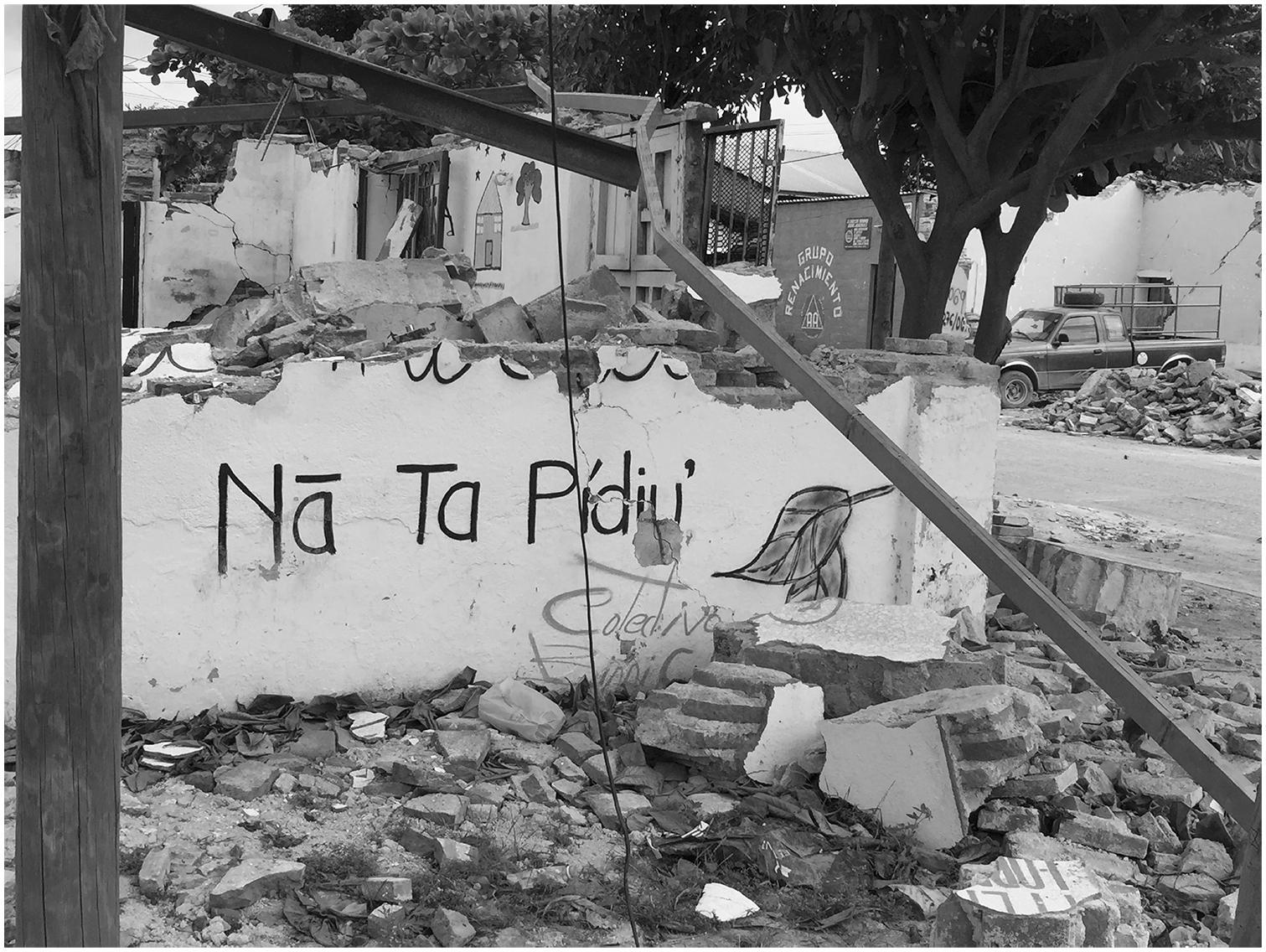
Collapsed home in Unión Hidalgo with mural by Colectivo Binni Cubi. Photo © Alessandro Morosin.
The earthquake was followed by heavy rains in the Isthmus. In lagoon towns like the ethnic Ikoots fishing village of San Mateo del Mar, stagnant waters flooded the streets and contributed to skin infections, and this added to collective feelings of insecurity. In this situation of momentary panic, many rumors circulated. I overheard people at fiestas and in other social settings wondering whether the quake had been provoked by mining exploration in the nearby Chimalapas Mountains or was a plot by the U.S. and Mexican governments to drive local people off of their valuable agricultural lands.
Mexico’s federal government announced 16 billion pesos in relief funds for affected areas of Oaxaca and Chiapas, while Oaxaca’s state government authorized 200 million pesos for home reconstruction. But just two weeks later, on September 19, another earthquake of 7.1 magnitude struck Mexico City, ironically on the thirty-second anniversary of the 1985 one. A total of 370 people perished in Mexico City, Morelos, Puebla, the state of Mexico, and Oaxaca. As the Mexico City earthquake shifted much of the media attention away from the situation in Oaxaca and Chiapas, international aid and government relief to the Isthmus diminished.
Several agencies of the Mexican federal government acted as important players. One is the Secretaría de Desarrollo Agrario, Territorial y Urbano (Office for Agrarian, Land, and Urban Development—SEDATU), which runs Mexico’s National Housing Commission. The federal savings bank and the natural-disasters fund established in the late 1990s were also involved. The combined policy of these agencies was to distribute stored-value bank cards to Mexicans who signed forms “proving” that their homes had been demolished or damaged. For homes declared a “total loss,” meaning those with serious irreparable damage, the federal government offered 120,000 pesos (about US$7,000) distributed by the fund over a period of four months and contained in two stored-value debit cards. One of the bank cards was to be used for purchasing new building materials and the other for the cost of day laborers for rebuilding.
Rosario Robles, a member of the left-reformist Partido de la Revolución Democrática (Party of the Democratic Revolution—PRD), was head secretary of SEDATU from 2015 through 2018 as part of Peña Nieto’s cabinet. As such, she was the federal official in charge of agrarian and urban development during both of Mexico’s 2017 earthquakes. A year after the earthquake, while Robles and Oaxaca Governor Alejandro Murat (PRI) were giving speeches in Oaxaca City commemorating the rebuilding effort (which Robles called “participatory” and “empowering”), the Isthmus was experiencing marches, highway blockades, and community forums that protested the state and federal governments’ unkept promises of relief and reconstruction (Matias, 2018b). Robles was dubbed persona non grata by social movements in the Isthmus, who saw her as having abandoned the region during the earthquake. Since she had also strongly supported the development of the Isthmus into a wind energy corridor, she was criticized by some of my respondents for opening the door to cement companies that had enriched themselves by constructing 23 wind energy parks in the Isthmus for the benefit of large enterprises and multinationals, a process that displaced Zapotec farmers from their communal parcels. In the name of renewable energy, this project had bypassed the internationally mandated free, prior, and informed consent of indigenous peoples (Dunlap, 2018d)—even while families in the region pay high electricity bills and 2 percent of inhabitants do not have access to electricity at all (Greyl, 2015). Robles has also long considered mining a dynamic force for the development of Mexico. She touts the industry’s generation of income for 2.5 million families and frames mining development as a fiscal boon to schools, sanitation, and roads.
Advocacy of special economic zones involves all of the basic arguments used by capital to make resource extraction and increased accumulation palatable to the public. It also suggests that foreign investment in open-pit mining plus special economic zones that stimulate private investment and trade are part of a single policy agenda that transnational elites are pursuing in the name of the Mexican people who have not benefited from globalization. 7 While publicly signing a convention with the governors of Michoacan and Guerrero that linked parts of these two states in a special economic zone under the auspices of SEDATU, Rosario Robles spoke of these zones as “the only way to combat poverty and inequality” (Notimex, 2015). In the same speech, Robles applauded Peña Nieto’s fiscal reform, which raised taxes on mining companies (SEDATU, 2018; Notimex, 2015).
Rosario Robles’s ties to construction companies exemplify a marriage between government and industry. While talking with me in a café in Juchitán, Fernanda Latani Mendez, a young radical feminist geographer from Ixtepec, named some of the families invested in big construction businesses that she suggests benefited from SEDATU’s response to the earthquake: “Lopez Lena, Gurrión, and some others—these are the same bastards who have paved the way for the wind energy companies since 2004!” Construction companies like Lopez Lena and Gurrión are run by powerful Oaxacan families that have benefited from the construction of multiple wind energy farms on communal lands in the Isthmus over the past decade and from government policies after the 2017 earthquake. David Gurrión is the owner of gas stations, supermarkets, car dealerships, hotels, ranches, newspapers, and hardware stores throughout Oaxaca and other states in Mexico and is well-known for his construction company. A native of Juchitán, he entered the political scene under the governorship of Ulises Ruiz Ortiz, the repressive governor who was fought by a protest movement in the streets for months in 2006 (Stephen, 2013). While a federal deputy and municipal president, Gurrión pursued favors for his family and other partners in the construction industry. His construction company was also alleged to have defrauded customers of the materials they had paid for (Indigo Staff, 2014). The interests of the Lopez Lena and Gurrión families and their construction companies dominated the governmental “relief” response after the earthquake.
Residents began observing that local governments planned to demolish damaged homes and rebuild them with federal funds. In many communities, these plans were denounced as financially insufficient for the reconstruction and rebuilding and culturally inadequate because of their proposed smaller rooms, homogeneous architecture, and standardized construction materials (e.g., concrete).
Ethnographic Narratives
Resilience in the Face of Neglect
Susana lives on a lot in Ixtepec where two families (a total of eight people) occupy two small houses. Five weeks after the earthquake, she and her neighbors were living outdoors in tents that her husband and brother-in-law had fashioned out of wood that they had bought from a coconut farm. Susana is a supporter of the Comité Ixtepecano Vida Territorio, an antimining activist coalition based in Ixtepec. Her husband is a taxi driver, and she makes 180–240 pesos a day (about US$10–$15) selling tortillas in the streets. The main room in their small cinder block home, which took years to construct, had caved in, making it unsafe to sleep in. The first few days after the quake were the most difficult: “It felt hopeless to sleep in the rain. . . . It was really a spiritual pain to see fallen homes and people who were hurt.” The quake hit on a Thursday, and the family did not have electricity until the following Monday. Even though there is a military base in Ixtepec, Susana found it difficult to acquire aid, food, and supplies. She said that the marines did distribute some goods, such as tuna and rice, but they would not come to one’s door with them. “Nobody knocked on our door . . . to say that relief goods were being passed out.” She was successful in getting aid only if she flagged down the soldiers in the street while she was out selling tortillas. She also protested that government reconstruction efforts ignored local employment needs and capacities: We have people here who manufacture nails, day laborers who produce cement blocks. Why not give the work to our people here, instead of bringing material from outside? The mayor contracts a construction company that brings its own workers. We have many people here who are workers, who need work. We didn’t think it would take such a tragic situation for us to get jobs. People who have knowledge and skills, they leave, instead of applying that knowledge here.
Skilled Ixtepecans emigrate in search of work, while local workers and businesses are left out of development plans, and this pattern of dependence was accentuated after the disaster.
Yolanda is a schoolteacher at the public grade school in Ixhuatán. She was educated in one of the rural normal schools in Oaxaca’s Mixteca region—she and her husband both have sympathies and commitments with the political left. Her family’s middle-class home did not suffer extensive damage beyond some cracks in the cement wall, but she says that the aid they received from the government was still insufficient to repair it. Her husband is a photographer who has worked in the United States professionally and who created an online photo gallery that captured scenes of destruction and reconstruction in Ixhuatán a month after the earthquake. Yolanda said that the earthquake convinced her that “nothing is secure or eternal. That night was like being born again. We began to love one another again as families, neighbors, brothers.” The next morning, she found the town devastated and grieving. She recounted that it took as long as a week for the federal government and the military to arrive with relief and that people from Ixhuatán who now lived in other regions of Mexico were the main help: The authorities really didn’t show much solidarity. At least they could have held a meeting bringing us together as townspeople, giving us more information about what to do after an earthquake. Instead they were just telling everyone to go to Reforma [a neighboring town] for relief. . . . They didn’t do what they promised, as always. People expected another 15,000 pesos to repair their damaged houses.
Yolanda’s sister-in-law, Silvia, is a minimum-wage worker at a local school and the wife of a high school math teacher. She and her family were sleeping in a windowless half-constructed house with dirt floors on their lot because their main house was too damaged and they could not afford to repair it. She also felt abandoned by Ixhuatán’s local government: For the first three days after the earthquake, we had nothing to eat. Just cookies and coffee that a store owner gave to my son because they had fallen on the floor during the quake. We don’t matter to the presidente [mayor, municipal president]. He never walked the streets to greet us and ask what was happening, how we were doing. There was aid, but it was given by private persons, people from the pueblo who live in Monterrey, Jalisco, Mexico, Veracruz. . . . It was given by the Church. But from the authorities? From the municipio? Nothing for us. We didn’t receive any help.
The only local government programs appear to have benefited those who were politically connected. Under a program called Empleo Temporal that was initiated after the earthquake, people in some municipalities could sign up to get a basic wage (900 pesos total) to pick up debris from streets and houses. In nearby Unión Hidalgo, a student named Alfonso Arenas López who is active with the community radio station La Otra Radio informed me that 700 people were rejected by the program. These people complained that they had seen elderly relatives of police or municipal secretaries picking up one or two pieces of debris, taking photos as proof, and then quitting. Meanwhile, others in need were not informed about how to sign up for the program. According to Silvia, this also took place in Ixhuatán: “For the people who could access the program, great, good for them. But for el pueblo, we the people didn’t know. This program was only among them, all covered up.”
Germana Cueto Fuentes, an elderly widow I interviewed in Ixhuatán with her unmarried cousin Julietita, said that they knew community members whose debit cards were devoid of funds and were still waiting for the government to survey their homes as of mid-November. She said that her brother was promised 30,000 pesos but received only 15,000 (interview, Ixhuatán, 2017).).
A Zapotec activist from Unión Hidalgo who wished to remain anonymous perceived “corruption, poor leadership, absence of authority, and a total lack of order” in the days following the earthquake. Through his ties to campesino associations working against the expansion of Unión Hidalgo’s wind energy park (e.g., Manzo, 2017; Critchley, 2017), he had learned that the debit cards given out by the government were fraught with irregularities, with some residents receiving empty debit cards and “cloned” cards. These deficiencies in aid have been acknowledged by the national government itself. Virgilio Andrade, the director of the federal savings bank, filed charges against 60 cases of cloned debit cards that had defrauded families in Oaxaca and Chiapas (Mexico News Daily, 2017), with the largest portion of such cases reportedly coming from Ixtepec (Manzo, 2018).
SEDATU was tasked with surveying the damage from the earthquake, sending its personnel house-to-house in each community to record how many families needed financial assistance in rebuilding their homes, but by February 2018 the media reported that more than 20,000 families had never been surveyed. About 5,000 were requesting reclassification of the original assessment the government had given them, which they claimed was erroneous. Protesters later accused the governor and all levels of government of being “inept, incapable, and dishonest” (Matias, 2018a).
This pattern of state neglect was reinforced in other family narratives. Elida Rosado Santiago and José Sergio Toledo are a married couple with children who live in a neighborhood of Ixtepec’s 6th Section. The daughter of a campesino, Elida has a small home-based fashion design business, while José Sergio is a taxi driver. During a conversation with them in their home, whose rooms were cracked and caving in, Elida opined that “the distribution of relief was not equitable. The army’s soldiers went street to street [at first], but then they became more closed off. As women, we would ask for milk and diapers: these things are for the children! They would tell us we’d need a written document to get these and that they’d get back to us in 10 or 15 days.”
Since schools had been closed for two months during the time of this November 2017 interview, the children had to be supervised by families. By early January 2018, according to Ixtepec’s mayor Félix Serrano Toledo, more than half of Ixtepec’s 50 schools were still unusable. I observed teachers holding classes in parks and on private property (Briseño, 2018). Five of the 41 municipalities in the Isthmus (Ixtepec among them) could not fully resume normal classes by January, affecting 41,000 children.
An anonymous respondent commented: “The first five or six days we had no electricity, little water. . . . It was a real state of emergency. This brought a situation of panic, psychosis, paranoia. . . . It was very difficult to organize in those conditions.” He witnessed people being denied debit cards for choosing not to demolish their houses even though this was not an official government policy. In his view, demolition companies, contractors, and equipment owners were complicit with national regulatory agencies: “Debris was thrown on the side of road, on riverbanks, and in all the wrong places. Their goal was to move debris as fast as possible so as to make more money. In Ixtaltepec, PROFEPA [Mexico’s Federal Environmental Protection Agency] inspected the mayor and gave him a fine that he didn’t pay and he continued throwing debris in the same place.”
Cultural Dispossession, Cultural Resistance
All of my respondents believed that reconstruction should respect cultural autonomy, and this was best expressed in the symbolic significance of their homes (Figure 2). Jorge Alberto Valencia Varrajas and his family have had negative experiences with local government and construction companies ever since their home, store, and warehouse were damaged by the earthquake. When the damage was surveyed, the authorities declared the property a total loss and issued an order for its demolition. Varrajas refused. According to his son Jorge, “This building used to be a military barracks during the Porfiriato—a patrimony of the pueblo. It is more than 100 years old. It gives this neighborhood its aesthetic aspect. We think it can be restored.” Jorge suspects that his father received the order to demolish the home in retaliation for his posting of information about the earthquake on Facebook and the family’s opposition to demolition. When the family subsequently received a debit card in the mail, there were no funds on it (Jorge Varrajas, interview, Ixtepec, October 25, 2017):

This is my heritage, do not destroy. Photo © Alessandro Morosin.
For now, the resistance [in Ixtepec] is composed of about 500 of us who don’t want our homes to be demolished. But if at a certain point the government obliges us to buy [cement and other home-building goods] from a certain provider, maybe relatives of the mayor or his political party, then we would form another movement to be able to buy from whomever we want. Everything is interlinked here, everything is all about money, but I think this movement of resistance has begun. . . . In Ixtepec, there are certain construction companies that are in charge of demolition. They are run by militant PRIistas [members of the PRI party] whom we know very well. In Ixtaltepec, the mayor has his own construction company, and I’m almost sure that he’s behind the home demolitions there. I understand that they are getting paid 80,000 pesos [about US$5,000] per home, which of course is very good business for them. Tearing down a home means money. That’s why they want to demolish our homes—with no respect for history or for the rights of the people.
The traditionally styled home links indigenous people to their past. As Susana pointed out, it stands as a reminder of ancestors who endured and resisted indignities on this very territory. In this sense, opposing official home demolition policies can be seen as a way of resisting cultural dispossession. Isthmus homes have aesthetic qualities that help establish the visual distinctiveness of the place. They are made of adobe or brick with a sloped, gabled roof (INAFED, 2019). They tend to have large rooms and high ceilings to resist the intense heat of the region. Vernacular Isthmenian homes are functional, symbolic of local culture, and visually unique. In a region gripped by neoliberal policies, the common home helps maintain the collective identity for a communally oriented way of life.
At the time of my fieldwork, SEDATU was offering 120,000 pesos (about US$800) for each home that was designated a total loss and proposing to replace it with a 54-square-meter home (Figure 3). In demanding that homes and buildings be refurbished to conform to the area’s aesthetic character, José Sergio Toledo spoke in the name of place, memory, and culture: I’m not asking on my own behalf, I’m asking on behalf of my city, so that this cultural sensibility is not lost, so that we maintain the life we are used to. I couldn’t imagine this corner having houses with concrete roofs (techo de colado). This landscape wouldn’t be the same. I want this architecture to be maintained and conserved but with secure technical features—stronger and firmer.

Rebuilt“ home in Unión Hidalgo. Photo © Colectivo Binni Cubi.
He and his wife, Elida, feel that mutual aid on the community level has been eroded over time by individualism. Since they associate the sharing of labor burdens with indigenous values, they see the earthquake not simply as a tragedy but as a chance to defend indigenous norms: Many people lament it, but this earthquake gave us the opportunity to rescue many things, such as the tequio [volunteer labor for community benefit]. . . . I’m 59. When I was young, it was clear. We would all help a neighbor build his house. We called it hechar un colado, colar el techo (raising a roof). . . . The señora would cook a pig for the neighbors who would come help you. This would save a lot of money, and you’d be able to build more. Unfortunately, we have been bombarded by cultural changes through television, causing us to lose this way of living communally. This sentiment had been dormant in us but now it’s awakened.
Fernanda sees these tequio-built homes as an agent of local resistance. She feels strongly about “the right to inhabit a place—the mode of life that we have, in the place we choose to live.” She believes that this right was violated as residents were unduly pressured to tear down their homes. She watched government personnel survey damaged properties and make arbitrary decisions as to which houses would be demolished: This view [that our homes could not be restored] was implanted by people, or better put, by personnel who were not trained and did the work of the state to benefit capital in an almost immediate way. These people who were surveying houses would literally enter and say, “There’s a small crack? Your home is uninhabitable. You need to go.” All of us are against rebuilding a house in the homogeneous way the state wants, such as cement, steel, low ceiling, etcetera. . . . This project of gentrification is about homogenizing housing and eliminating local knowledge.
Demolition via federal- and state-funded debit cards whose funds would end up in the hands of construction companies began immediately. Fernanda noticed that 90 minutes after the quake in the neighboring town of Ixtaltepec homes were already being demolished, catching activists like her off guard. She also claims that debit cards were not being accepted in smaller hardware stores, only in chain stores. Tolteca and CEMEX, transnationals headquartered in Monterrey, were licensed to accept the cards, but Cruz Azul and some other local stores were not: “Cruz Azul is a co-op. It’s the only place that sells a ton of cement for 2,000 pesos. The rest charge 2,800 or 3,200.” She added that to receive debit cards as earthquake relief families had to sign a document agreeing to demolish their homes. Thus dispossession of both property and cultural identity was set in motion by state policies of earthquake relief propelled by a combination of national agencies, bureaucratic local politics, and market forces.
Pacification vs. the Struggle for Autonomy
Pacification is geared toward “maintaining a social order that is formatted for the imperatives of capital accumulation” (Kienscherf, 2016a: 1183), and therefore it is an additional mechanism for preserving and bolstering unequal power relations between hegemonic and subaltern groups. State functionaries and the dominant political parties have invested years of political and economic capital in the Isthmus Special Economic Zone/ Trans-Isthmus Corridor. There is little reason for them to sincerely engage with the membership of groups such as the Grupo Ecologista Zanatepec, the Comité Ixtepecano Vida Territorio, APPJ Radio Totopo, the Asamblea de Pueblos Indígenas del Istmo de Tehuantepec en Defensa de la Tierra y el Territorio, and other activist groupings whose members oppose neoliberalism (Morosin, 2019). Activists in Juchitán and neighboring towns who speak out publicly and mobilize communities against government-backed projects such as the wind energy corridor (López Gómez, 2016) have faced assaults, death threats, and kidnapping attempts (Morosin, 2021; Caro et al., 2015: 14, 15). Understanding this recent history helps explain why the state moved to contain and outmaneuver independent grassroots organizations in the process of seeking to regain legitimacy after the disaster. Consistent with the PRI’s history of clientelism, the state characterized earthquake survivors as “aid recipients.” This tended to atomize them into individuals awaiting cash transfers, impeding mass mobilization.
Alfonso Arenas López, an engineering student who currently lives in his native town of Unión Hidalgo, is a founding member of the Colectivo Binni Cubi (New People Collective), a group of five volunteers whose goal is to “foment and fortify our indigenous Zapotec culture” (interview, Unión Hidalgo, December 2017). The group accomplishes this mission through the production of music, a radio station (La Otra Radio) documentaries, murals (Figure 4) poetry, and the cleanup of public spaces, among other projects (see https://sites.google.com/site/lubilunisa/). It is also a consistent opponent, on social and ecological grounds, of Unión Hidalgo’s existing wind farms and of the Gunaa Sicarú Windfarm Project proposed by a French company (Critchley, 2017). After the 2017 earthquake, Alfonso was dismayed upon observing that “nobody was organized”—that the municipal authorities made little effort to learn the needs of the people, gather people with skills and ability to help, and implement a community-based plan for reconstruction. This work fell to the networks of civilian groups and movement activists. In his view, the local government’s promises of dispensing cash relief pacified people into adopting a welfare-recipient mentality instead of leading them to help one another. By undermining an indigenous culture of collective ownership and collective management, social transfer payments induce townspeople over time to accept the state’s megaprojects in exchange for social peace. Combined with a strategic military display, this policy amounted to pacification—hegemonic social control.

Home in Unión Hidalgo restored after the earthquake with mural depicitng its owner by Colectivo Binni Cubi. Photo © Colectivo Binni Cubi.
Mexico’s army and marines have had a substantial presence in the Isthmus since the wind parks arrived, and an anonymous respondent pointed out that this militarization increased after the earthquake: They arrive and they install themselves, right? In Matias Romero, Ixtepec, San Dionisio del Mar, here at checkpoints on the Pan-American Highway, in Ixhuatán right next to the community eatery that was set up after the earthquake . . . wherever you turn, there is a lot of military presence. It’s really impressive because the people began to see it as something familiar. . . . Maybe they don’t have any preplanned strategy of occupation, but they’re everywhere.
This respondent felt that the normalization of a military presence was part of projecting the state’s paternalism. Just as it has worked to minimize and discredit indigenous activism, it has inhibited grassroots collective action by earthquake survivors: The army takes on an attitude of “assistance,” right?—an emergency plan. The army is a face of the state, and so is the municipal government. The municipal government assumes no responsibility, because they argue that earthquakes were a phenomenon beyond their control that couldn’t be foreseen. So they detained trucks at the entry of the town of people who had come to donate goods. They placed obstacles on people who came from outside to offer relief. . . . But the army were the ones dispensing aid, distributing water, tents. . . . So, people who were in a state of fear and panic viewed this as something beneficent, right? This marginalizes people to take a passive and receptive attitude. This is something that propitiates, appeases. This is how we get the disarticulation of social movements. . . . The social movement hadn’t predicted this kind of scenario. [We had] no preexisting program on how to react to an earthquake.
The postearthquake deployment of troops to political hotbeds of resistance (e.g. Juchitán, Unión Hidalgo, Ixtepec) conjured up disturbing memories for antiwind-park and antimine activists based in these communities, whose anxiety about militarization seems warranted. Movement activists know that military force has been deployed against people in the Isthmus who oppose megaprojects (Peace Brigades International, 2014; Dunlap, 2018a) and that this could take place again (Comité Ixtepecano /Espacio de Mujeres, 2016).
Some activists used communication technologies and their online followings to build social solidarity and funds from local as well as extralocal supporters. Immediately after the earthquake, Manuel Ruiz, coordinator at the Preparatoria Jose Martí in Ixhuatán, posted a blog with reports about the earthquake and its social fallout that was eventually published as a book. In the blog for Day 7 after the quake, an online communiqué associated social welfare handouts with militarization and corporate colonization (Preparatoria Jose Martí, 2017: 25): “Communitarianism is waning with the distribution of government donations to individuals. . . . Politicians fulfill the role of dividing the people while capital benefits. Fractured communities are easy to conquer to implement transnational projects. This is all opening the way for the approval of the special economic zones.” In another chapter Manuel thanked supporters and friends in Mexico and around the world for the online donations that would help rebuild the high school, but he took care to add (69): We have no gratitude at all for the municipal government and the state/federal authorities. Despite the fact that the municipal president’s father worked with our institution for 30 years and the councilor of education graduated from our school, nobody has come by to check on us, much less to offer help. . . . Despite being notified multiple times, they never came to survey the damage to our school. They couldn’t even make themselves useful to come and ask us to move the students to a safer building.
The high school helps coordinate mobilizations across the Isthmus against mining projects and is well known for its vocal opposition to the special economic zone. The building has been vandalized and teachers have received death threats (Manuel Antonio Ruiz, interview, Ixhuatán, February 2017). In December 2017, the collapsed high school was being reconstructed completely by volunteer labor without any financial support from government agencies. It was left with thousands of dollars in debt to the truck operator who picked up and disposed of the concrete debris that remained of its collapsed walls. These are the experiences that have emboldened Manuel to write, “Fractured communities are easy to conquer.” Again, he sees the state (with its military, debit card payments, and politically selective reconstruction efforts) as a force that fomented social divisions in the disaster’s aftermath.
Still, according to an anonymous respondent, the state did not completely impede all independent organizing: “People who are minimally organized, like the comuneros’ assembly or the collectives . . . acted for the common good by gathering relief donations and helping people.” During the disaster, such groups continued (but also modified) their prior strategies for the defense of land and territory. From my interviews with members and supporters of the Comité Ixtepecano, the Colectivo Binni Cubi, and the Preparatoria Jose Martí it is evident that an anticapitalist civil society sector sought to provide direct relief to families at the same time as working to counter state-sponsored neglect, dispossession, and pacification.
Conclusions
A disaster is not just a physical but a social event. An earthquake or a hurricane is not a “disaster” unless the built environment and the social system are vulnerable. Disasters originate in social conditions that are distinct from natural events (Blaikie et al., 1994). The globalization of capitalism, class structures, underdevelopment, environmental degradation, and internal colonialism combine to make a variety of disasters inevitable. In other words, “disasters are part of a set of negative externalities that occur as a consequence of larger political-economic trends and that must be explained by reference to those forces” (Tierney, 2007: 510).
How does the Mexican state exercise power during a disaster, and with what consequences? The national and state government’s response to the earthquake in 2017 was (like neoliberalism in general) materially and culturally detrimental as well as psychologically traumatic for this region of more than a million people. The state was primarily concerned with maintaining social order so as to continue attracting investment. Neglect was palpable in the government’s lack of preparedness in remote, rural, and marginalized areas of the Isthmus, and this neglect compounded the suffering and trauma of an already marginalized population.
Additionally, systematic home demolition in exchange for government payment served the interests of local, national, and transnational capital. The hurried and profit-driven “reconstruction” carried out by an array of companies and government agencies dispossessed vulnerable populations of their property without free and informed consent (Dunlap, 2018d). Home demolition represented the erasure of communal forms of life that had been a source of identity and resilience for Zapotecs and other indigenous peoples.
Dispossession took both material and cultural forms. In the original concept of genocide developed in the 1940s, the annihilation of culture was often linked to the destruction of a social group: “So-called derived needs are just as necessary to [group life] as the basic physiological needs. . . . The destruction of cultural symbols is genocide [because it] menaces the existence of the social group which exists by virtue of its common culture” (Moses, 2010: 12). The destruction of the traditional indigenous home and the swift architectural/aesthetic changes implemented by government employees amplified the grievances communities had with regard to the Special Economic Zone/Trans-Isthmus Corridor. Many campesino-indigenous organizations allege that mega-infrastructure policies are forcibly imposing an urban, commodified, “extractive” way of life on communities that once revolved around subsistence production, social ownership of lands and fisheries, and an obligation to one’s neighbors and surroundings that is known by the Isthmus Zapotec term guendaliza’a (Morosin, 2020; Altamirano-Jiménez, 2013). Home demolition and urban renewal made the Isthmus into a new outlet for accumulation, but rather than moving in to tap the region’s natural resources and energy it arrived to profit from people’s wrecked homes. As in the construction of wind parks (and, perhaps, future open-pit mines), the way for this capitalization of the construction sector was paved with massive funding and political will from several federal agencies. The “aid” was then administered by local governments in an inequitable, incompetent, and clientelist fashion, disrupting the cultural symbols and communal ontologies that serve as valuable markers of collective Zapotec identity.
Finally, the deployment of military force, rather than serving civilian needs, projected hegemonic order and legitimacy. Residents reflected on how a confusing and often inaccessible system of bank-cards-as-relief contributed to pacifying survivors. But as a liberal form of hegemonic social control, pacification was not completely successful. Tierney (2007: 512) recalls that during the 1985 Mexico City earthquake “rapid and effective self-help measures undertaken by victims themselves stood in stark contrast to the sluggish governmental response” and that this contrast hastened the PRI’s eventual downfall. Susana expressed a determination to defend Ixtepec against incoming extractive industries that would deprive future generations of livelihood and dignity: At least we can be thankful that all of this reminded us of how we need to support one another and stay united. It’s the same with the mines: If we don’t stay united, they will come in and do whatever they want. But if we defend what’s ours, and more than that, if we defend what belongs to the future generations, if we learn to raise our voice and say “Enough,” we can put a stop to the arbitrariness in the way they treat us.
The physical devastation, psychic insecurity, and material privation left by the earthquake and aggravated by the government’s response did not extinguish the communal spirit and flexible resourcefulness of organized radical networks in the Isthmus. Indigenous, feminist, and territorial activism in this geostrategic region was not buried among the rubble and debris. Many continue to mobilize against the expansion of wind parks, mining companies, the Trans-Isthmus Corridor, and the Mayan Train (Lichtinger and Aridjis, 2018). In the face of the earthquake’s destructive adversity, preexisting networks and cultures of solidarity have been drawn upon and expanded. The struggle for life continues.
Footnotes
Notes
Alessandro Morosin is an assistant professor of sociology and criminology at the University of La Verne.