



Abstract
The question this article addresses is how and to what extent international military forces can support nongovernmental organizations (NGOs) in armed conflicts and postconflict arenas. As non-state actors, NGOs have serious security problems and their current protection is not sufficient to secure humanitarian operations. The Afghanistan NGO Safety Office (ANSO) was established in 2002 to solve this problem. The ANSO innovation resulted in a new NGO–military security collaboration mechanism. In particular, the article examines whether the NGO–military security collaboration mechanism established between NATO International Security Assistance Force, the United Nations Assistance Mission in Afghanistan, and the ANSO could be a fourth way in narrowing NGOs’ security gap in addition to the existing three ways (judicial, theoretical, and practical). I would argue international military forces need to take into account ANSO model organizations for fulfilling their responsibility to secure NGOs in armed conflicts and postconflict arenas.
Following the end of the Cold War, the world's political structure began to change rapidly during the last decade of the twentieth century. After the shock of the 9/11 attacks in 2001, the international community began new discussions on the structure for international security. In spite of the continued uncertainty about the final form of this restructuring, it is clear the nature of war have not changed, whereas the character of warfare has been changing for centuries. 1 One important contemporary development is that while traditionally states were thought of as the main actors in war, today, non-state actors and an increasing ambiguity of the battlefields have become important features of warfare. Non-state actors have gained a leading position in international relations in the twenty-first century. Indeed, it has become very common for non-state actors to participate in recent armed conflicts, either as belligerents, such as insurgent groups and private military companies, or as noncombatants such as the media and nongovernmental organizations (NGOs). However, as both non-belligerent and non-state actors in recent armed conflicts, NGOs have some security concerns in battlefields owing to host states’ frequent inability to provide them sufficient protection.
NGOs can endeavor to secure their environment in three ways: judicial, theoretical, and practical. The judicial way is a protection covering the host country’s responsibility to secure NGOs according to international law. The theoretical way encompasses the main principles of NGOs. The main principles of NGOs are independence, neutrality, and impartiality, which are proofs for local people that NGOs are not their enemies. The practical way is based on experiences on the field such as the establishment of close relations with local people and the use of security guards for protection. However, these three ways are insufficient in recent armed conflicts, and it creates a security gap for NGOs. The security gap of NGOs is a problem for their operation in unsecured environments. One reasonable option for solving this problem is to acquire support from international military forces. This raises the question of how and to what extent the support can be acquired from international military forces without harming humanitarian operations. However, the nature of both sides impedes working together.
The question of this article is to examine how and to what extent international military forces can support NGOs in armed conflicts and postconflict arenas. In Afghanistan, an organization for NGO security, the Afghanistan NGO Safety Office (ANSO), was established in 2002. This innovation resulted in a new NGO–military security collaboration mechanism in 2006. In this article, I argue that the innovation of ANSO has created a new dimension for NGO security in unsecured environments, namely as an NGO–military security collaboration rather than cooperation and coordination.
This article aims to explore how the security of NGOs has been provided and managed in recent armed conflicts by obtaining support from international military forces. In order to achieve this aim, the mechanism for filling the security gap of NGOs in Afghanistan is chosen as a case study. The reason for choosing Afghanistan as a case study is my field experience in NGO–military relations in Afghanistan, which allows me to compare theoretical literature with realist field experiences. In essence, the Afghanistan case is taken as a sample from the universe because the international community’s Afghanistan campaign including international military forces, international organizations, and NGOs is both the most prolonged and most recent in the post–Cold War era. Therefore, I examine whether the ANSO experience creates a collaboration mechanism for possible further NGO–military security relations in unsecured environments.
During the study, I have used unclassified reports, documents, and manuals from NGOs, ANSO, the United Nations (UN), and military sources in addition to personal field experiences. Yet there are two limitations to this study. First, NGO–military relations are deliberately confined to the security concerns of NGOs since there are many other concerns of NGOs in the field. 2 Second, the security concerns of humanitarian and international NGOs are discussed without any reference to states.
In this article, I examine the issue from general to specific. Therefore, initially, I characterize NGOs and their security concerns. Later, I describe the main features of recent armed conflicts in terms of state and non-state actors as well as the role of NGOs as non-state actors in Afghanistan in the light of developments within the country since the 9/11. I then analyze NGO–military relations by examining and explaining the case of Afghanistan and ANSO based on empirical sources. In conclusion, the importance of ANSO and the NGO–military security collaboration mechanism experienced in Afghanistan is emphasized.
NGOs and Their Security Concerns in Unsecured Environments
Without understanding security concerns of NGOs in unsecured environments as well as security countermeasures, the NGO–military security collaboration mechanism experienced in Afghanistan cannot be analyzed. The difficulties and threats caused by various factors impeding effective NGO operations constitute security concerns of NGOs on one hand. On the other hand, judicial, theoretical, and practical ways of NGO security and possible military support, in cooperation, in coordination, or in collaboration, are two pillars of countermeasures. Therefore, after defining NGOs in general I lay out NGOs’ security problems in theater and then define countermeasures. In this way, the strengths and weaknesses of both ways will be assessed. The UN sources define “NGO” as follows: “A non-governmental organisation is a not-for-profit, voluntary citizens’ group, which is organized on a local, national, or international level to address issues in support of the public good.” 3 Basically, there are three kinds of NGOs: local NGOs, international NGOs, and government-created NGOs. Government-created NGOs and local NGOs may have close relations with states, and during the armed conflicts their security concerns may differ from international NGOs. International NGOs are mainly independent institutions with different structures and policies. Thus, policies of international NGOs for civilian–military relations differ from each other although their security concerns are similar. The Children of War, Save the Children, CARE, Oxfam, and International Medical Corps are examples of NGOs that are considered in this article. International NGOs, which deal with humanitarian relief, are the subject of this article and termed as NGO.
The security concerns of NGO workers have increased during the last two decades. There is substantial evidence for this, in the numerous studies and reports related to casualties, kidnapping, and threats against NGOs in armed conflicts and postconflict theaters. 4 For example, the report of the Secretary General for General Assembly, distributed in August 2009, states that thirty-six NGO staff died between July 2008 and July 2009. 5 In sum, 1,222 incidents including attacks, detentions, assaults, harassments, forced entries or occupations of premises, armed robberies, vehicle hijackings, residential break-ins, and some major thefts occurred in that period. 6 The previous report published for July 2007–July 2008 shows that the death toll and the incidents were 63 and 1,077, respectively. 7 Although the UN bureaucracy tends to be conservative in its estimates, even the UN reports show that NGOs are under threat. Given the increased threat to NGOs, the question arises of how NGOs can continue to operate in a secure environment.
There are classical possibilities for NGO security: judicial, theoretical, and practical (Table 1). The judicial way is based on International Humanitarian Law which states that the security requirements of NGO staff should be acquired by a host government with 1949 Geneva Conventions and additional Protocol I. 8 However, the hostile and ambiguous environment in recent armed conflicts and the probable inability of the host government to secure the environment have led to a widespread failure in the implementation of this legal rule.
Ways of NGO Security.

Note: NGO = nongovernmental organization.
The second way is the theoretical protection provided by NGOs’ fundamental principles of independence, neutrality, and impartiality. 9 “Independence” is defined as the ability for NGOs to act without political pressure; neutrality is defined as not taking sides and impartiality is defined as giving aid only on the basis of need. Theoretically, these principles should ensure safe access. However, in practice, these principles have not been sufficient due to the hostile and ambiguous environment in recent armed conflicts.
As for the third way, initially, I am going to articulate the threats, and subsequently define security alternatives against these threats. The threats against NGO staff are classified into two groups by a field security handbook published by Save The Children: targeted and nontargeted threats. 10 Crime, acts of violence, staff disappearance, and psychological intimidation are targeted threats. Nontargeted threats are work and travel, wrong place, wrong time, and indiscriminate weapons. In order to minimize security risks generally, the security strategies triangle is highlighted as for the taxonomy of security alternatives (Table 2). The triangle consists of acceptance, protection, and deterrence. The triangle strategy contains a step-by-step approach from broad-based relationships to armed protection, ranging from soft to hard protection. Initially NGOs need to acquire consent from host authority and subsequently adopt and use protective procedures and consequently threaten with counterviolence. These strategies are based on different principles.
In order to implement these strategies, NGOs should have an awareness of their security needs. NGOs serving in the field during and even after armed conflicts are in danger and at the top level of threat may need armed protection. The question of which circumstances would justify NGOs demanding armed security support is problematic. NGOs should not harm their main principles—independence, neutrality, and impartiality, but the safety and the security of NGOs’ staff are crucial for the success of their current and prospective operations. This creates a dilemma. There have been some attempts to hire private security guards, but these have provoked claims that they were harming the main principles of NGOs. Moreover, the subject of this article, the NGO–military security collaboration mechanism, begins after these first three steps have been taken. Even if NGOs do hire private security guards, 12 this does not end the responsibilities of the international military forces. For example, in cases of NGO staff abduction, no commander of international military forces can deny his or her responsibility for dealing with this issue. 13 Thus, the safety and security of NGOs is an issue for international military forces at all times. 14
The Security Strategies Triangle for NGOs. 11
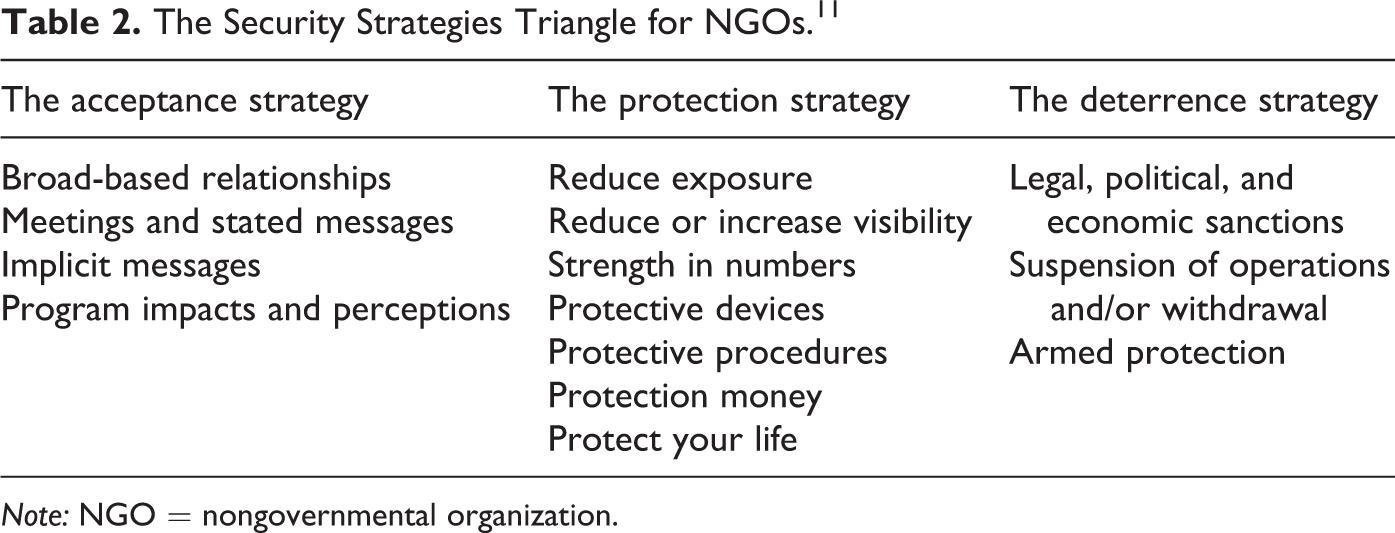
Note: NGO = nongovernmental organization.
After having taken first three steps, NGOs still need to be supported by the military without harming their main principles. How and to what extent NGOs can be supported by the military as a fourth step of their security? Essentially, there are three alternative ways of military support: coordination, cooperation, and collaboration (Table 1).
There have been a large number of NGO operations during recent armed conflicts but NGOs are reluctant to co-act with military forces. Prior experiences of the NGO–military relations covering “coordination” and “cooperation” resulted in this reluctance. In fact, these two relationship mechanisms imply the control of NGOs by governmental institutions. Hence, the new relation mechanism named as collaboration, vice coordination, and cooperation emerged. At that point the question is, “What are the definitions of coordination and cooperation as well as their strengths and weaknesses in terms of military support of NGOs?” Consequently the reason for emergence of collaboration can be discerned.
Although the three words share the prefix “co-” defining togetherness, each one has nuances that create operative differences if we use these words for defining NGO–military relations. The Oxford English Dictionary defines the word “coordination” as “the organisation of the different elements of a complex body or activity so as to enable them to work together effectively.” This means that coordination is possible between more than one element of the same organization. Additionally, these elements have to work together for the sake of efficiency. In essence, the most important point is harmonization and this requires someone, a coordinator, in the role of overseer. In the same dictionary, the definition of the word “cooperation” is “the action or process of working together to the same end.” Therefore, it requires a group, a goal, and a work plan to act together. Consequently, words coordination and cooperation contain control via either a coordinator or a work plan so mutual sides are under inspection. The togetherness utterly harms NGOs’ operations as they act together with military.
Field experiences of NGO–military relations are a reflection of the definitions of these words. Considering the “control” capacity of two words, coordination and cooperation, both the NGO–military coordination and cooperation mechanisms can result in NGO intelligence rather than NGO security. That is why NGOs are sensitive even about words and may prefer the word collaboration especially for relations with military forces. The reason for this is that NGOs do not want to harm their main principles. The first difficulty for NGO–military relations was experienced in the Balkans after the end of the Cold War. 15 For example, during the second half of the 1990s, while the NATO air campaign was ongoing in Serbia and Kosovo, the NATO troops in Albania and Macedonia established camps for refugees and subsequently handed them over to NGOs. Moreover, NATO supported humanitarian agencies both for security and logistics. This was cooperation between NGOs and the military. Due to the cooperation of NATO forces with NGOs during the humanitarian operations, humanitarian NGOs faced difficulties in acquiring consent from Belgrade, as a host country authority, to operate in Kosovo. Thus, direct support from the military has the effect of eroding the main principles of NGOs. These problems provoke the discussion of military intervention to humanitarian efforts in retrospect 16 and consequently lead to a consensus that security support from the international military forces cannot include cooperation or even coordination. Eventually, NGO–military relations need another option that can accommodate more mutuality without any reservations comparing to the words coordination and cooperation. This option is collaboration.
The meaning of collaboration is defined as “the action of working with someone to produce something” as a first meaning at the Oxford Dictionary. The second definition is as follows: “traitorous cooperation with an enemy.” Interestingly, both definitions are related to the subject of this article, though treason is beyond its scope. Unlike coordination and cooperation, collaboration focuses on the result rather than the process itself. It does not need any structural harmonization and intends to build a consensus. Instead it merges deeply contrasting or even conflicting ideas and views for a specific purpose. Moreover, collaboration is possible between unimaginable partners regarding the second definition. Collaboration is not about control at all but is concerned with a purposeful result.
The common point of coordination and cooperation is control and thereby connected elements, whereas collaboration focuses on a purposeful result without controlling by the interlocutor. The control is the main factor eroding the main principles of NGOs due to dominance of military forces in such kinds of relations. On the other hand, collaboration does not aim to control but instead is in the pursuit of a specific result while different sides of the relation are cooperating with each other. 17
Hence, collaboration is the silver bullet for the problem of how military forces can support NGOs without eroding their main principles, independence, neutrality, and impartiality. By using the collaboration mechanism instead of coordination and cooperation, NGOs can receive support from the military without being overseen or without establishing a common structure.
In Afghanistan, ANSO is the facilitator, not a coordinator, of this collaboration mechanism between NGOs and the military. It has to be stressed that NGOs and ANSO are not keen to be in close relations with military forces. The main demands of ANSO for NGO security are, first, reciprocal information sharing for awareness; second, establishing high-level contacts for raising of complaints and, third, behind-the-scenes advocacy on issues of NGO safety. In sum, both NGOs and ANSO want to maintain their relations with the military to the level of collaboration.
As a result, collaboration 18 is seen as the most suitable mechanism for NGO–military relations regarding the side effects of coordination and cooperation, which include erosion of the main principles. As stated before, there are three steps, judicial, theoretical, and practical, that need to be taken before support from the military to NGOs in unsecured environments takes place. Even these three steps have not been sufficient and there is still a security gap for NGOs in unsecured environments such as Afghanistan. The fourth step is military support, the mechanism of which needs to be collaboration. Therefore, the next question is how to construct an effective method of NGO–military security collaboration. However NGOs, ANSO, and the international military forces have constraints for this collaboration mechanism.
In order to answer this question, the core problems of international military forces related to the multinational environment have to be explained. The problems result from the convergence of different operations, such as peacemaking, security, development, and humanitarianism, in unsecured environments in the first decade of the new century. 19 A limited empirical study which was published in 2009 sorts these problems as follows: importance of type of mission; cultural differences and their influence on coordination and communication; trust in the foreign militaries; rotation systems; reintegration of military personnel at home; competency of other countries in theater; cultural differences between the US and European Armed Forces; hierarchy; language; and previous experience and cross-cultural training. 20 According to the study, these problems can be solved to some extent by pre-deployment training, except for the difficulty of understanding of the mission by those from different countries with different language abilities. 21 International military forces have an array of problems to solve in advance. For example, in Afghanistan, international military forces have some problems deriving from national caveats, 22 misunderstandings, different rules of engagements, and different national legal systems. 23
In particular, international military forces have difficulties in establishing contact with NGOs even if these forces are under one command. These difficulties of multinational forces were the initial problem for a coherent approach that resulted in a lack of cooperation and coordination with NGOs. Additionally, international military forces needed a bridge for cooperation with NGOs because not only were the military unable to co-act, but also NGOs did not want to harm their main principles. Consequently, the ANSO was innovated as the bridge.
NGOs as Non-State Actors in Armed Conflicts and Afghanistan Case
Afghanistan is the purposive sample for examining security concerns of NGOs in unsecured environments because of the dual face of the international attempts to intervene in the country. The dual face comprises reconstruction and war. The “reconstruction” aspect consists of the UN agencies, NATO forces, the Afghan government, and NGOs who have been occupied with rebuilding the country. The “war” aspect of the dual face consists of the military operations that the coalition forces and the Afghan government are undertaking against al-Qaeda, the remnants of the Taliban regime, and the insurgents against the Afghan government. The dual face of these efforts creates ambiguity and is not confined only to the case of Afghanistan but is also evident in other armed conflicts around the world. This ambiguity has created a chaotic atmosphere for both soldiers and civilians. As non-state actors, NGOs keep aspirations for humanitarian operations alive during and after armed conflicts and this creates a security gap for them. Filling the security gap has not been easy since the end of the Cold War because both NGOs and international military forces have been reluctant to engage with each other due to their natures. This problem first emerged in Balkans in the 1990s and is ongoing in Afghanistan. In order to analyze NGO security and the collaboration mechanism in Afghanistan, first, I will describe the role of NGOs as non-state actors during the recent armed conflicts. Second, I will explain the situation of the Afghanistan theater for NGO operations.
The theoretical footing of NGOs as non-state actors in international relations theory and war theory should be explained. Contemporary international relations theory as well as war theory accepts non-state actors as an inevitable reality. In international relations theory, the various roles of non-state actors have been long stated. In fact, the roles of non-state actors in international relations had been discussing for thirty years from the 1970s. Moreover, recognition of nation-states as the sole actors in international relations has been obsolete. In essence, the theoretical discussions of international relations state that all functions of states, including the right to wage organized violence, can be performed by actors other than nation-states. Hence, the theory of international relations has a place for non-state actors for the purposes of theory building. 24 In recent years, scholars have been studying on the interactions between domestic and international structures of governance and non-state actors empirically. The reason for this is that international relations cannot be explained without taking non-state actors into account. 25 This approach has ramifications on war theory, which has naturally begun accommodating the existence of non-state actors.
As for the war theory, the existence of state and non-state actors in the context of the transformation of war has been discussing as one of the main issues. Both “new” and “old” war discussions have arisen since the end of the Cold War, 26 and much of the theoretical focus has been on the emergence of new characteristics of armed conflicts in the post–Cold War era. One of the most prominent of these is the increasing participation of non-state actors in recent armed conflicts. While the number of interstate conflicts has decreased between 1945 and 2009, the number of intrastate conflicts has increased. 27 In the post–Cold War era, interstate conflicts have become an exception in the international system. As a result, during the post–Cold War era new discussions against classical war theories have emerged as a “new war discourse.”
The new war proponents 28 had claimed that classical war theories, mainly Carl von Clausewitz’s, were obsolete because they exclude non-state actors. At the end of these discussions, a middle way was found between two camps, classical war theorists versus the new war proponents, by focusing on the core of Clausewitz’s well-known trinity. Contemporary interpretations of Clausewitz’s thoughts have stressed the changing character of war rather than its nature and claim that his theory is compatible with the presence of non-state actors. 29 On this view, although Clausewitz’s trinity comprises the people, the army, and the government, the core of the trinity consists of hatred, passion, and enmity; the play of chance and probability; and war’s subordination to rational policy, respectively. 30 Therefore instead of taking into account the people, the army, and the government the core of the trinity allows scholars to consider other actors, namely non-state actors. This contemporary approach urges scholars to think about Clausewitz’s trinity deeply and to find out the acceptability of explaining non-state actors by considering the core trinitarian concept. That is to say, the state of the art of war theory 31 views the existence of non-state actors, thereby NGOs, during recent armed conflicts as a reality.
Having seen NGOs as non-state actors in armed conflicts in the war theory, the Afghanistan theater needs to be examined to understand security concerns of NGOs in particular. The key word in the history of Afghanistan is “failure,” not only for the empires that have invaded it 32 but also for the country itself. This is a dramatic lesson for all actors and makes the current situation crucial for the international community. The word “failure” has become the nightmare for all the actors that have been working to “build up” the state of Afghanistan since 2001. On the other hand, the dual face of the international attempts in Afghanistan makes the country a laboratory for understanding the features of recent armed conflicts. The distinction between armed conflicts and peacekeeping operations has been blurred in Afghanistan. It is noticeable that civilian and military personnel need to work closely together, not only in armed conflicts but also in the postconflict arenas. In fact, a strong demand for a coherent approach during the peacekeeping operations was stressed by Lakhdar Brahimi’s 33 report of the Panel on United Nations Peace Operations just before the Afghanistan case. 34
Although Afghanistan had suffered from violence since the 1970s, with the beginning of the twenty-first century a new phase of conflict began. The 9/11 attacks in the United States caused Afghanistan to become the center of gravity for efforts against global terrorism, as it was a base of the al-Qaeda terrorist organization.
The day after the 9/11 attacks, the UN Security Council expressed its support for the efforts with Resolution 1368. On the same day, NATO invoked Article 5, its mutual defense clause. 35 The United States led an international coalition to overthrow the Taliban regime in Afghanistan. This coalition cooperated with local opposition forces and entered Kabul within eight weeks of the start of the attacks. These actions typify the dual faces (war and reconstruction) of the international community’s Afghanistan effort. The coalition forces waged war against the Taliban under the campaign named Operation Enduring Freedom, and an international effort was simultaneously activated to ensure Afghanistan’s security and development.
The international community and all parties, including Afghan groups opposing the Taliban, gathered in Bonn on November 27, 2001, under the UN leadership as a start of the “Bonn Process.” The process set out an agenda for political reform, securing the environment, and the reconstruction of the country. The Bonn Process was based on Lakhdar Brahimi’s “light footprint” approach, as indicated in his report on the UN peace operations. 36
In December 2001, the Taliban regime collapsed and a road map for reconstruction was drawn up. The international community was committed to providing assistance for political reconstruction and security through the UN. As the US-led coalition forces were waging war in the field, the efforts of the international community produced the Bonn Agreement and later the Afghan interim authority emerged. The Afghan interim authority gave its consent to the international community and led the postconflict operations. Between 2001 and 2005, the Afghan interim authority, Emergency Loya Jirga 37 and Constitutional Loya Jirga worked together and established a constitutional national council, a president, and a provincial administration.
A key element of the Bonn Process was security. A plan for security sector reform addressed the problem of securing the environment. The security sector reform process was divided into five areas: military reform, police reform, counternarcotics, judicial reform, and the disarmament, demobilization, and reintegration of ex-combatants. Soon after the Bonn Process, international military forces and Afghan security partners were dealing with security issues in Afghanistan. The United Nations Assistance Mission in Afghanistan (UNAMA) and the lead country, Japan, dealt with the disarmament, demobilization, and reintegration process, while the United States and its partners worked on the establishment of the Afghan National Army. The international community’s involvement included the disarmament, demobilization, and reintegration activities of the Afghan militant forces, securing environment by the coalition forces, and security assistance by NATO International Security and Assistance Force (ISAF) with the UN mandate. In sum, there are not only postconflict reconstruction efforts but also armed conflicts within Afghanistan.
As stated before, ISAF was deployed in Afghanistan after the Bonn Agreement under the UN Security Council mandate. The principal tasks of ISAF were to aid the interim government in developing a security structure, aid the country’s reconstruction, and to assist in developing and training of future Afghan security forces. The NATO-led ISAF area of operation covered all of Afghanistan with around 130,000 troops from forty-eight countries, including all NATO members and twenty-eight provincial reconstruction teams. 38 The provincial reconstruction teams are small teams of civilian and military units to provide security for aid workers and help reconstruction. The provincial reconstruction teams play a key role in Afghanistan’s provinces in three respects: security, reconstruction, and political stability. In fact, the innovation of the provincial reconstruction teams in Afghanistan made NATO’s expansion easier. Both UNAMA and NGOs were the other actors supporting Afghanistan's reconstruction.
After the end of the Bonn Process with the establishment of the Constitutional Loya Jirga at the end of 2005, the Afghan authorities prepared the Afghanistan National Development Strategy for establishing governance with all necessary institutions within the country. 39 The Afghanistan National Development Strategy was a response to the lack of a specific national plan for reconstruction during the Bonn Process. 40 On January 31–February 1, 2006, during the Afghan-led London Conference, the Afghanistan National Development Strategy turned into the Afghanistan Compact with the approval of the international community. The Afghanistan Compact outlined the mutual commitment of both Afghanistan and the international community comprising approximately sixty countries, 41 and had three major pillars: security, governance, and development. With the end of the lead-nation concept, the Compact required that a joint board cochaired by the UNAMA and the Afghan government should implement all efforts in Afghanistan. This newly established mechanism is the footing for international efforts to reconstruct the country. For humanitarian operations, NGOs acting under the Afghanistan Compact are important elements of the reconstruction in addition to UNAMA and the Afghan government.
The dual face of international attempts creates an ambiguity for all actors with the threat of failure. Moreover, NGOs’ vulnerability creates an insecure environment for them. As stated before, the security concerns of NGOs are high all around the world. The worst geography for NGO security is, unfortunately, Afghanistan. According to the Aid Worker Security Database, 42 a project recording major incidents against aid workers from 1997 onward, the amount of incidents against NGOs was 214 between 1997 and 2010. For a comparison, during the same period Sudan was in second place with 190 incidents and Somalia came third with 153 incidents out of 1,079 incidents in the world. Moreover, the security situation steadily worsened until the 9/11 in Afghanistan. In the country in 2001, the amount of incidents was six, two killed and four wounded. However, in 2010, the number reached sixty-three, twenty-three killed, thirteen wounded, and twenty-seven kidnapped. Consequently, in addition to the failure of other attempts, securing NGO operations as well as staff is failing in Afghanistan. This additional failure urges all sides to take the necessary steps in filling the NGOs’ security gap.
Filling the NGOs’ Security Gap: ANSO
NGOs are key actors in Afghanistan in addition to the Afghan government, the international community, and the international military forces. In fact, NGOs have been serving since the Russian invasion of Afghanistan in 1979 and operated there even during the Taliban period. Developments soon after the 9/11 attacks made this country an important destination for international organizations, international military forces, and NGOs. Afghanistan is a proper case for NGO–military relations since the military structure is quite complicated and NGOs are widespread. The military structure is complicated because there are two different military forces under one command in Afghanistan: NATO-led ISAF and the US-led coalition forces. Along with international military forces and the UN agencies, there are a number of NGOs in Afghanistan. NGOs have been working in Afghanistan in accordance with its Law on NGOs enacted in June 2005. Since all NGOs need to be registered with the Ministry of Economy’s Department of NGOs, we can derive accurate information about them from official records. As of February 2010, there are 1,468 national and 326 international NGOs registered with the Afghan government. 43 According to the department’s reports, in 2008 local and international NGOs implemented 2,753 projects and spent approximately 820 million US dollars which is approximately 8 percent of the gross domestic product of Afghanistan. Hence, it can be interpreted that NGOs have a key role for the reconstruction of the country.
The large number of NGOs demands security for humanitarian operations. In addition to threats of conflict, support attempts of military forces to humanitarian operations result in a military interruption to NGO operations, as well. Humanitarian operations implemented by military forces, especially by the provincial reconstruction teams, cause the local community to confuse military staff and NGO staff. This can impair the independence, neutrality, and impartiality of NGOs in the eyes of the local public. The existence of international military forces even for humanitarian operations may create insecure environments for NGOs. To say the least, securing the environment for NGO operations is an issue in Afghanistan. Thus, the demand for NGO security resulted in an innovation of a new approach for NGO security in 2002, the ANSO.
ANSO is not an NGO but rather a project hosted by an NGO and describes itself as a nonprofit humanitarian activity. The project is co-funded by the European Commission Humanitarian Aid, the Swiss Agency for Development and Cooperation, and the Norwegian Ministry of Foreign Affairs. Initially, the International Rescue Committee hosted ANSO because of the necessity of a legal host. Since 2006, the host has been Welthungerhilfe. There are 5 offices (north, south, east, west, and central) throughout Afghanistan. At the center, ANSO has an ANSO advisory board, a director, and an operations coordinator. At the regional offices, there are ANSO regional security advisors.
Afghanistan is an insecure place for NGOs in ways outlined above in spite of the existence of international military forces. Nick Downie, former director of ANSO, stated “Killing aid workers is a new mode, it’s a fashion. And it’s an effective one… It’s classic insurgency-prevent development, use fear to capture the hearts and minds of the people” during a conference on Crisis Management and Information Technology in 2005. Subsequently, Mr. Downie passed his observations on the possibility of preventing deaths by better awareness of dangers and threats in their environment. 44 Paradoxically, in some cases, the presence of military forces may result in insecurity. Since the collaboration between security forces and NGOs is inevitable in Afghanistan, the insecure environment invited further innovation by ANSO. The essence of the ANSO innovation is based on a one-way flow of data relating to security awareness, from security forces to NGOs. Otherwise, the flow of data from NGOs to security forces may damage the main principles of NGO. Moreover, in extremis, international military forces support NGOs with military operations in addition to security data flow.
ANSO was innovated to satisfy the demand for security coordination within NGOs. The main role of ANSO is as a security consultancy so ANSO has a network with NGOs and keeps in touch with them via e-mail and phone. ANSO, first, collects security data from different sources, second, manages the data, and finally disseminates the information free of charge to its network including NGOs excluding any military, governmental, or private sector groups or personnel. The function of ANSO is quite clear and not complicated, but the data collection and information dissemination are rather controversial issues. 45 In particular, NGOs do not have the expertise for being aware of unsecured environments. Thus, ANSO adapts NGOs to an insecure environment by the flow of information process. At the first phase of that process, ANSO collects security data from its points of contacts including ISAF, the coalition forces, the UN Department of Safety and Security, the Afghan authorities, and others including news reports. And subsequently, ANSO transforms this data into information by using its expertise and knowledge so ANSO produces regular weekly and quarterly reports as well as colorful maps, which show the security situation. Consequently, ANSO disseminates this information to its network as a hub. Additionally, ANSO, in case of emergency, communicates the security alerts to its contacts via e-mail messages or mobile phones. The structure of the ANSO is simple and efficient compared with the red tape of the international military forces in Afghanistan.
ANSO is a learning organization which has been transforming itself since the beginning. ANSO was founded as the Afghanistan NGO Security Office in 2002. Later, in 2005, it has changed its name as the Afghanistan NGO Safety Office although the abbreviation remains as ANSO. 46 The reason of the change is understandable regarding the sensibility of NGOs even for words. Among NGOs, the term “security” was evoking a relation with military institutions so the term “safety” was preferred. In fact, this terminological change was an indicator of the evolution or, in other words, transformation of the organization.
In 2005, the preliminary assessments for ANSO operations identified both successes and failures. ANSO’s failures were caused by the incompetence of technological infrastructure, unawareness of NGO staff regarding security, and the incapability of forecasting some attacks against NGOs. ANSO’s successes caused ANSO to be seen as a bright, new, innovative initiative, which created effective collaboration with international military forces. 47 At the end of 2005, ANSO changed human resources policy so that its management failures were resolved. ANSO, mainly, had used to employ ex-security staff having awareness and knowledge of security issues until 2006. Civilian staff with security background was a brilliant way for creating relations through sharing cultures with military forces. However, the ANSO failures mentioned above were the result of this human resources policy and its management failures. Since 2006, ANSO has changed its human resources policy by recruiting personnel who have at least a graduate degree in a relevant field. In fact, in 2005 not only ANSO but also the UN and ISAF assessed the effectiveness of the collaboration.
The ANSO and ISAF coordination mechanism implemented between the innovation of ANSO in 2002 and 2005 was deemed insufficient, so the mechanism was redesigned and reinforced by a new mechanism that includes in extremis support to NGOs. In 2005, the necessity for regulating the mechanism was identified from lessons learned from field experiences. The coordination mechanism was based on liaison units between ISAF and ANSO and covered security information flow. However, the reluctance of either side to cooperate made the liaison system ineffective. Hence, UNAMA, through the UN Department of Safety and Security, began playing a critical role for the success of collaboration and, notably, the security of NGOs. 48 The UN Department of Safety and Security was established in 200549 and hires retired security personnel who are aware of the institutional culture of the security forces. Collecting security incidents in real time is a big challenge, which needs a solid collaboration because of the complex international military and political structure in Afghanistan. ANSO advisors need to keep in contact with their counterparts. At this point, the role of the UNAMA plays a critical role because UNAMA creates a platform to share security data. UNAMA has constant liaison units from both ISAF and the coalition forces. These liaison units pass information to UNAMA not only for the UN agencies but also for NGOs. In short, the collaboration mechanism has three pillars: ISAF, UNAMA, and ANSO.
There are two unclassified military documents regulating ISAF and NGOs relations: the ISAF Provincial Reconstruction Teams Handbook and the Standard Operating Procedure ISAF In Extremis Support to the Government of Islamic Republic of Afghanistan and the International Community. The first sets out rules for a general framework of relations and the second sets out security issues between ISAF and NGOs. According to ISAF Provincial Reconstruction Teams Handbook, there are several points of contact in interacting with NGOs. For the initial contact with NGOs, ISAF staff needs to contact NGOs via both nonmilitary and non-NGO agencies, which mean an NGO coordinating body, UNAMA, or Afghan officials. The handbook also orders ISAF members to act transparently in their approaches to NGOs. 50 In essence, NATO documents define NGO relations under an umbrella of civilian–military relations with NATO document allied joint publication as follows: “The co-ordination and co-operation, in support of the mission, between the NATO Commander and civil actors, including national population and local authorities, as well as international, national and non-governmental organisations and agencies.” 51 Thus, NATO documents urge ISAF to interact with the NGOs through the NGO coordinating bodies, UNAMA, or Afghan officials in general. This general approach is the basis for security interactions.
The mechanism of interaction between ISAF and the NGOs was revised during workshops attended by ISAF, UNAMA, and ANSO representatives in 2005 and a reorganized procedure emerged in 2006. The ISAF regulates its relation in extremis between the Government of Islamic Republic of Afghanistan and the international community with the Standard Operating Procedures document. This document was first published in August 2006 and is being reviewed annually. The Standard Operating Procedures covers NGOs in addition to the Afghan government and international community and paves the way to support them in extremis that is to be declared by the commander of ISAF on a case basis. 52 Response to civil disturbance constituting a direct threat, providing medical assistance, and undertaking extraction operations are examples of in extremis support. ISAF emphasizes its policy of providing support to these organizations principally in extremis by denying full support for logistics and security. That is to say, ISAF will conduct in extremis support unless the conditions encroach on operational commitments. On the other hand, ISAF promises planning, preparation, command control/coordination assistance, and force protection advice as well as joint planning and rehearsals. 53 ISAF paves the way for exchanging information to NGOs via ANSO according the Standard Operating Procedures 322. The UN Department of Safety and Security has some responsibilities such as providing a radio link for coordination between ANSO and ISAF. There are other communication means such as the Afghan Security Protected Network and TETRAPOL 54 secure voice communications with ANSO. ANSO also has a contact with the Headquarters of ISAF Combined Joint Operation Centre.
As a result, ISAF accepts ANSO and UNAMA as interlocutors 55 by both documents so that they regulate not only the security information flow but also in extremis support of ISAF to NGOs through UNAMA and ANSO. Hence Afghan officials, ANSO as NGO coordinating body, and the UN Department of Safety and Security as an UNAMA subunit are the main points of contact. 56 Essentially, there are two pillars of the security relation between ISAF and NGOs: security information flow and operational in extremis support. Security information flow functions overtly one way from ISAF to NGOs via the UN Department of Safety and Security, thereby ANSO, on one hand. On the other hand, the operational support functions two way between NGOs and ISAF. First way is the operational support in extremis from ISAF to NGOs. The second one is from NGOs to ISAF which resulted from the necessity of gathering updated and detailed information in advance to support NGOs in extremis by the international military forces. By doing so, ISAF gains information via the UN Department of Safety and Security, thereby ANSO, covertly. In fact, this security information exchange is a purposeful result of the collaboration mechanism. This creates mutuality, resulted in as collaboration, between NGOs and the military without eroding the main principles of NGOs.
In February 2011, a new organization was born entitled the International NGO Security Organization (INSO) as a third wave, considering foundation in 2002 and the transformation in 2005, of ANSO transformation. The International NGO Security Organization was awarded the grant for operation of ANSO and took over the management of ANSO in July 2011 from Welthungerhilfe. And it should be stressed that ANSO is still remaining. 57 In essence, the staff of ANSO founded the INSO to lead and establish new NGO Safety Offices (NSOs) around the world based on ANSO experience in Afghanistan. The third wave of the transformation is an indicator for the capacity of ANSO as a role model organization in any insecure country. The goal of the INSO is to establish a global hub for the NGO Safety Offices. 58 Hereinafter, ANSO is about to create a new well-known abbreviation in international relations literature as NSO. Prudently, the INSO initiative is another brick for the global standardization of NGO safety platforms.
Conclusion
In this article, I have sought to identify how and to what extent international military forces can support NGOs without harming NGOs’ humanitarian operations. This issue has been a problem since the Balkan experience during the post–Cold War era. As non-state actors, NGOs have security problems and their current protection, judicial, theoretical, and practical, has not been sufficient to secure humanitarian operations in unsecured environments during recent armed conflicts. However, international military forces have a potential to deal with this issue to some extent, but the interaction between NGOs and military is quite controversial because of their conflicting agendas. Hence, international military forces cannot cooperate and coordinate effectively with NGOs. In these circumstances, I highlight the new security collaboration mechanism emerged in Afghanistan and the innovative establishment as well as evolved function of ANSO.
In Afghanistan, international operations consist of both warfare and postconflict reconstruction attempts, and this can be termed the dual face of the international operations. This dual face is also found in other recent armed conflicts around the world. In the analysis of the Afghanistan case, first, I perceive ISAF as the main international military force though the existence of other military actors such as the coalition forces and Afghan National Army. This is a compulsory limitation for the analysis because of the inaccessibility of data. Second, I highlight ANSO as a security coordination organization of NGOs in the country. ANSO is an innovative model and has created a security collaboration mechanism especially for security awareness of NGOs in Afghanistan. As a result, these perceptions allow me to analyze the NGO–military security collaboration mechanism.
The interaction between military forces and NGOs is an issue for each side because of their natures. In fact, without a model for the mechanism any attempt to create effective collaboration mechanism would be flesh without bone. The innovation of ANSO in 2002 and reorganization in 2006, establishment of UN Department of Safety and Security in 2005, and ISAF workshops based on lessons learned from NGO casualties between 2001 and 2005 caused the mechanism regulated in 2006 for securing NGO operations. Hence, in Afghanistan, not only NGOs but also the international military forces have awareness for NGOs’ security by this mechanism.
In conclusion, I would argue that the current mechanism in Afghanistan creates a fourth way for NGOs’ security in addition to first three ways, the judicial, theoretical, and practical and that ANSO plays a vital role for that mechanism. However, this mechanism is neither coordination nor cooperation. With the compromises of both sides, NGOs and military, the mechanism is limited to collaboration. So, this does not necessarily mean that the security gap of NGOs is fulfilled, and NGOs still need to find further ways to improve their security. But, at least, the fourth way creates a basis for support of international military forces. Eventually, international military forces need to take into account ANSO model organizations in fulfilling their responsibilities. Considering the foundation of the International NGO Security Organization, further studies may focus whether ANSO can be considered a role model around the world.
Footnotes
Acknowledgments
I would like to thank to Hew Strachan, Patricia Shields, Anna Wells, Andrea Baumann, Mesut Uyar, Leo Gough, and Omar Misdaq for their constructive criticisms and comments on the drafts of this article. Additionally, I am very grateful for the cooperation and interest to the team of the University Oxford Programme on the Changing Character of War during the study in Oxford.
Author’s Note
The opinions expressed herein are those solely of the author and not of any institution.
Declaration of Conflicting Interests
The author declared no potential conflicts of interest with respect to the research, authorship, and/or publication of this article.
Funding
The author disclosed receipt of the following financial support for the research, authorship, and/or publication of this article: The study in Oxford University was supported by the Scientific and Technological Research Council of Turkey (Türkiye Bilimsel ve Teknolojik Araştırma Kurumu—TÜBİTAK).