




Abstract
Can the presence of international organizations reduce civilian deaths caused by aerial bombing? This commentary examines this question in the specific context of the U.S.-led war in Afghanistan. We evaluate this based on interviews conducted with members of international organizations that were present in Afghanistan during the conflict, existing intergovernmental organizations, nongovernmental organizations, and government reports, and with quantitative data on civilian casualties between 2008 and 2013. We conclude that there is tentative evidence from Afghanistan that international organizations can in fact reduce the severity of civilian killings that result from the use of air power. However, there is much need for greater data sharing to more fully answer this important question.
Keywords
Between 2014 and 2020, American forces engaged in more than 50,000 air strikes in Afghanistan, Iraq, and Syria (Khan, 2021). By 2014, the United States and its International Security Assistance Force (ISAF) partners had drastically reduced the number of boots on the ground in Afghanistan. When the military turned toward air strikes and drones, it promised the most precise and transparent air campaign ever (Khan, 2022). However, reporting by the New York Times, and their release of the Civilian Casualty Files, provides evidence that the military did not deliver on either of those promises.
On the precision front, while the U.S. military reports the ratio of civilian deaths as one for every 157 strikes, reporters found that ratio to be closer to one death for every five strikes (Khan, 2017, 2022). On the transparency front, the military’s civilian casualty figures are much lower than what was observed on the ground (Al Jumaily, 2021). The job of bringing attention to civilian casualties has often fallen to intergovernmental organizations (IGOs) like the United Nations, as well as to nongovernmental organizations (NGOs) such as Airwars, Human Rights Watch, Amnesty International, and the Center for Civilians in Conflict. In Afghanistan, the Afghanistan Independent Human Rights Commission, a national human rights institution, has also contributed significantly to this work.
NGOs and IGOs play an increasingly important and visible role in the effort to bring casualty information to the public and to help minimize civilian killings on the ground. In earlier research, we show cross-nationally that NGO presence diminishes the number of casualties that result from air power in military interventions (Allen et al., 2021). However, that work still leaves open the question of whether this pattern is observed within specific conflict zones like Afghanistan. Because of increased data availability on civilian killings, new opportunities exist to further our understanding of the role that international organizations (IOs; both IGOs and NGOs) can play in decreasing civilian casualties.
In the remainder of this commentary, we discuss civilian casualties in Afghanistan and the ways that IOs have sought to reduce these killings. We reference a series of interviews with IO officials present in Afghanistan during the conflict. 1 We also present a statistical analysis that shows a negative association between NGO presence and civilian killings from air power in Afghanistan. We conclude with a discussion of future directions and the need for more systematic data gathering and sharing of information on civilian casualties in Afghanistan and other conflicts. This is an incredibly important question given the increasing reliance by major powers, like the United States, on using air power to achieve their military objectives. Given the increased risk of civilian killings that comes along with relying on air power, further probing the conditions under which these killings can be reduced is an important question for both academic and policy-making audiences.
Air Power in Afghanistan
Afghanistan is an important case for exploring the relationship between air strikes and civilian casualties. Air superiority was a critical advantage for the United States in the Afghan War, starting in 2001. American efforts during the first two weeks of the 2001 war consisted of only air strikes against both al Qaeda and the Taliban. The Afghan capital fell less than two months after the start of the war. Yet the air strikes continued for nearly two decades as the United States fought the Taliban in an attempt to support the democratically elected government against this insurgency (Paris, 2013).
While more than half of the bombs dropped during the conflict were precision-guided munitions (Meilinger, 2017), aerial bombing still killed civilians frequently. The war in Afghanistan thus provides an example of a state using air power to achieve its military aims, seeking to avoid targeting civilians, but still increasing civilian casualties through collateral damage. The large and varied IGO and NGO presence in the country also allows us to consider the effectiveness of various civilian protection strategies in preventing these deaths.
When discussing civilian protection in the context of air power, it is important to note that sometimes civilians are targeted intentionally, and in other instances, they are harmed collaterally. While this commentary deals specifically with collateral harm to civilians, it is not always straightforward to interpret the intentions of an attacker using aerial bombing. As noted by an IO staff member, the military forces conducting aerial operations make the decision to take the risk of harming civilians during each strike. The calculations behind such decisions appear to vary depending on that military force’s specific strategic objectives at that moment, as well as on the tactics employed by the opponent (IO Interview #3, “Interview with International Organization Staff Member #1,” April 6, 2021).
Precision-guided munitions as well as improvements in intelligence gathering have increased the military’s ability to discriminate between military and civilian targets, but no system is foolproof (Meilinger, 2017). Even as wealthy industrialized democracies tend to pursue capital and firepower-intensive strategies and aim to limit civilian casualties, many civilians die from collateral harm or as victims of retaliatory attacks when major powers use air power in military interventions (Caverley, 2010). Military forces, including the United States’, are responsible for calculating proportionality and taking precautions for any attack that they undertake. As noted in our interviews, while military forces very seldom released information on such assessments in Afghanistan, especially with respect to targeting details, it is possible to infer from the casualties themselves that military forces were at times willing to consider high thresholds of civilian casualty risks. This includes situations where military forces considered that conducting an air strike was particularly advantageous to military strategy, such as instances when a strike was used to target powerful individuals (IO Interview #3, “Interview with International Organization Staff Member #1,” April 6, 2021).
In addition, protecting civilians in asymmetric conflicts is complex because it is often difficult to distinguish between rebel combatants and civilians not involved in hostilities. Air power cannot be used in the same way as it is in major power interstate war. Insurgents do not have capital cities, regular armed forces, war industries, and transportation infrastructure in the same way that states do (Corum & Johnson, 2003). There is thus increased potential for civilians, or the areas they live in, to be targeted by aerial bombings.
As noted by an interview subject, many of the documented civilian casualties in Afghanistan occurring from aerial bombings were cases where the civilian status of the individual(s) came into question, as well as when there was uncertainty regarding the identity of those killed (when it may have been difficult to confirm that the individual(s) targeted were the person(s) actually killed by the strike). Civilian harm also occurred where strikes targeted objects (rather than individuals) deemed to be military objectives but located in civilian-populated areas. Where such objects were targeted, civilian harm was often documented if there was a question of whether the intended target could be considered a legitimate military objective, as well as if the strike misidentified or missed its target (IO Interview #1, “Interview with International Organization Staff Member #1,” April 6, 2021).
An interview subject further pointed out that differences between the numbers of civilian casualties acknowledged by military forces and those documented by IOs often resulted from disputes about the civilian status of an object or individual. This was often the result of differences in interpretation of international humanitarian law principles, and occurred not just in accidental killings but in cases when the party carrying out the air strike confirmed that the correct target was hit. The interview subject emphasized that these disputes were not limited to air strikes, but applicable to nearly all means of harm to civilians attributed to all parties to the conflict in Afghanistan (IO Interview #1, “Interview with International Organization Staff Member #1,” April 6, 2021).
An example of such differences in interpretation is highlighted in a United Nations Assistance Mission in Afghanistan (UNAMA) human rights special report issued in 2019. This report notes differences in the interpretation by the United Nations and the United States with respect to potential classification of drug labs in Bakwa, Afghanistan, as military objects (UNAMA Special Report, May 5, 2018).
Civilian Protection From Air Power in Afghanistan
Our previous research finds that a human rights NGO presence mitigates the effect of aerial bombing on collateral civilian harm (Allen et al., 2021). In the original study, we proposed three mechanisms through which this can occur: direct advocacy/naming and shaming, directly aiding and training local populations in protection efforts, and providing a line of communication between parties to the conflict and civilian populations. Before turning to the data from Afghanistan, we discuss how these three dynamics played out in Afghanistan. Much of this relies on anonymized interviews that we conducted with IOs working on the issue of civilian protection in Afghanistan.
Direct Advocacy and Naming and Shaming
Direct advocacy with involved parties is often done under the shadow of potential naming and shaming (Keck & Sikkink, 1998; Murdie & Davis, 2012). For example, an interview subject noted that in some cases, they shared information privately with parties to the conflict. Their decisions about whether further action (such as public naming and shaming) would be useful often depended upon the actions taken by the party in response to the private discussions. They noted that they did not refrain from publishing findings when parties asked them to do so, but rather that they refrained from making specific case details public when they were “satisfied with the actions taken” by the party to address the issue (IO Interview #3, “Interview with International Organization Staff Member #1,” April 6, 2021; IO Interview #1, “Interview with International Organization Staff Member #1,” April 6, 2021).
If such advocacy is not effective, then the option of publicly shaming is available. As noted by an interview subject, if there was remaining concern about an incident, they often considered it appropriate to publicly highlight it, even if [the party to the conflict] stated that it had taken corrective action. In some cases, the public reporting would include a note as to what, if any, corrective actions the party had said they would take, and which had so far actually been taken (IO Interview #1, “Interview with International Organization Staff Member #1,” April 6, 2021).
An example of a decision to publicly name and shame a party to the conflict after an incident that caused civilian harm is exhibited in a publicly released 2018 UNAMA special report on air strikes in Dasht-e-Archi, Afghanistan. This was a case in which there was an air strike in Taliban-controlled territory by the Afghan Air Force, with 81 child casualties (30 killed and 51 injured) that came out of it. The report details how the UN mission undertook direct engagement with the Government of Afghanistan on the case, notes corrective actions that were promised, and further highlights actions which remained outstanding (UNAMA, April 2, 2018, Special Report).
The evolution of the North Atlantic Treaty Organization’s (NATO) ISAF policy toward aerial bombing and casualties is also instructive. In 2009, when General Stanley McChrystal served as the commander of NATO forces in Afghanistan, he issued a directive that highlighted the importance of avoiding civilian casualties. He stated that they “must avoid the trap of winning tactical victories—but suffering strategic defeats—by causing civilian casualties or excessive damage and thus alienating the people” (NATO, 2009). The directive specifically referenced avoiding civilian casualties through air power by asking military officers to “limit the use of force like close air support against residential compounds and other locations likely to produce civilian casualties in accordance with this guidance” and allowed its use in residential compounds only “under very limited and prescribed conditions” such as “self-defense where it is determined no other options [. . .] are available to effectively counter the threat” (NATO, 2009).
Although this directive was not motivated solely by IGOs and NGOs, it followed active shaming, which arguably influenced ISAF leadership to act (Kolenda et al., 2016, p. 31; Mahanty & Shiel, 2019). Human rights organizations, such as Human Rights Watch (2008) and Center for Civilians in Conflcit (CIVIC, 2009), produced reports on ISAF civilian casualties in late 2008 and 2009, before the release of the directive that specifically publicized civilian casualties from air power (Kolenda et al., 2016). Beyond stated policy, the actual cases of civilian casualties from air power decreased in Afghanistan following this activism. In 2008, 39% of civilian casualties in Afghanistan were caused by NATO; by 2012, this number had dropped to 9% after the implementation of the McChrystal directive (Kolenda et al., 2016).
Direct Aid and Training in Protection Efforts
IGOs and NGOs in Afghanistan also sought to decrease civilian harm from air strikes by directly engaging with affected civilian populations. This often included providing first aid and information about shelters, as well as coordinating the efforts of first responders. For example, IGOs and NGOs both often met with tribal elders and youth representatives and gave them information about how to prevent casualties and taught them how to engage in advocacy (IO Interview #3, “Interview with International Organization Staff Member #1,” April 6, 2021).
In 2015, an Afghan NGO, the Liaison Office, began working with CIVIC to protect civilians from harm during the conflict. The Liaison Office’s on-the-ground knowledge, plus CIVIC’s larger pool of resources, enhanced their ability to protect the local population. Part of this effort involved the creation of Civilian Community Protection Councils. These councils worked directly with communities in helping them build the capacity to protect themselves from harm in conflict (Marifat, 2017).
Providing Lines of Communication
The third avenue through which NGOs and IGOs in Afghanistan sought to decrease civilian collateral was through providing a line of communication between civilian populations and warring parties using air strikes. In the case of Afghanistan, one of the roles the community councils played is that of communicating their concerns to NGOs, which in turn communicated them to parties to the conflict. The Civilian Community Protection Councils were thus able to share the local population’s security concerns and demands with government and nongovernment actors, something that would not be an option for individual civilians.
Advocacy and coordination with parties to the conflict through an exchange of information on civilian harm caused by operations is also one of UNAMA’s major civilian protection roles. For example, because the United States often did not have any boots on the ground in areas where they were carrying out aerial bombing, it was impossible for them to go in afterward and directly evaluate harm. Instead, the U.S. forces were known to rely on video footage or intelligence sources to estimate casualties (a similar methodology to that often used by the Afghan army when it could not reach areas of civilian harm allegations (Special Inspector General for Afghanistan Reconstruction [SIGAR] Report, October 2018). In contrast, the UN mission talks to victims, witnesses, tribal elders, hospital workers, and other actors who they have access to because they have staff on the ground in field offices. As a result, individuals can meet the staff in safe locations to discuss the details of reported civilian casualty incidents. The UN mission then verifies information, requiring three different types of credible sources to verify each claim and cross-check information. They subsequently share appropriate details of its findings with parties to the conflict (UNAMA Protection of Civilians Annual Report, 2020).
The UNAMA also had access to locations in Taliban-controlled areas when the Americans did not. Because of their perceived neutrality, they were able to go into those areas and verify casualties and details of harm (UNAMA Special Report, May 5, 2018). Civilians were also likely to be wary of visiting a military base to report harm to family members or claim compensation for their own injuries. The IGO presence is a way to overcome such barriers. Thus, by engaging in information exchanges with parties to the conflict, both the UN mission and the party to the conflict were able to improve their reporting and civilian casualty documentation. This resulted in a better ability to address victim needs and make suggestions for corrective action to mitigate against such harm in the future (UNAMA Protection of Civilians Annual Report, 2020).
In future research, we plan to further explore these three pathways through which IGOs and NGOs protect civilians. In the remainder of this commentary, we examine existing data on civilian casualties in Afghanistan across ISAF regional commands and assess whether those casualties were lessened by the presence of NGOs on the ground.
Looking to the Data—NGOs and Civilian Killings From Air Power in Afghanistan
We present an analysis that utilizes available data on civilian killings and NGO presence. To our knowledge, this is the first statistical, quantitative analysis of the relationship between NGO presence and air power civilian killings at the subnational level. There are a few possible sources for identifying civilian killings in Afghanistan, each with some limitations. Ideally, we would use information collected in reports by the UNAMA, 2 which has generated reports on allegations of civilian killings in Afghanistan between the years 2007 and 2020, but the province-level data are only publicly available for 2007. There are also a few months of data available from the Afghanistan Rights Monitor for the year 2010 (Afghanistan Rights Monitor, 2011). Again, while this is an incredibly rich source of data, it does not provide sufficient temporal coverage. The source with the greatest temporal coverage is the civilian casualties (CIVCAS) data, which was produced by the ISAF, shared with Science, and used in Shortland et al. (2019). What makes this data source appealing is that it is available for the years 2008 to 2013. It also provides separate measures of two types of killings that result from air power, from both fixed wing close air support and helicopters used for close air combat. 3
However, there are some drawbacks to the data. Part of this commentary’s goal is to show what we can learn from the existing public data but also make an appeal for more widespread data sharing from other organizations. First, the existing data are gathered at the regional command level, not the provincial level. This decreases the sample size and produces units that vary in size and in the number of provinces included in each one. Second, the counts only include killings that were confirmed by ISAF. Given that ISAF is both the perpetrator of many of the killings and the actor tasked with identifying the killings, there is good reason for caution. NGOs have also criticized these data for likely undercounting the number of individuals killed as a result of ISAF activities (Mahanty & Siemion, 2019). However, there is no indication that the bias is uneven across regions.
If the civilian casualties data are indeed biased downward in its counts across regions, it is less useful for purely descriptive purposes. However, as long as that bias is systematic across geographic regions, it does not pose a problem for examining the association between NGO presence and civilian killings. While it is incredibly important that public data be available for those descriptive purposes, it is also possible to use the data that are currently available to develop a better understanding of how civilians can be better protected during war. Ultimately, we rely on the civilian casualties data to provide a first cut at the relationship between NGO presence and civilian killings by ISAF forces. We measure killings that result from air power in three ways: as the number of killings from fixed wing aircraft, the number of killings from rotary wing aircraft (helicopters), and as all killings that result from air power.
The civilian killings data are aggregated at the regional command level, based on ISAF administrative units. The average number of civilian killings in a regional command per year is 29, and it ranges up to 141 civilian killings in a year. ISAF divides Afghanistan into six regional commands, and the number of provinces within each range from 1 to 14, with Kabul broken out into its own regional command. We currently have data for the years 2008 to 2013. 4
The NGO data include all NGOs (both local and international) in Afghanistan, across a range of policy areas, at the provincial level between 2000 and 2014 (Mitchell, 2017). As the data are gathered at the provincial level, we rely on an archived version of the ISAF website, which provides a list of the provinces included in each regional command. 5 We generate two measures: The first counts all the NGOs present in the provinces that make up a regional command. The second is a measure of the standard deviation of the NGOs within that regional command, across provinces. This allows us to consider whether NGOs are widely dispersed throughout that territory or concentrated in just a few provinces.
We also take into account several other variables that might confound the relationship between civilian casualties and NGO presence. To account for the severity of conflict across the regional commands, we include a measure of conflict intensity in each region (Sundberg & Melander, 2013). We also consider state capacity and development using the World Development Indicators Afghanistan Time Series Dashboard. Similarly to Sullivan (2016), we include literacy as an indicator of state capacity, which can impact both the presence of NGOs and the number of civilian killings. We also use electricity consumption as a proxy for development. 6
Results
Table 1 presents the findings. Models 1 to 3 estimate the relationship between killings from fixed wing aircraft, from rotary wing aircraft, and a combined measure, respectively, and the NGO count and conflict intensity variables. Models 4 to 6 are analogous to Models 1 to 3 but include the three additional control variables. Across the models in Table 1, the count of NGOs has a negative and statistically significant relationship with the number of civilian killings from ISAF air power. This is consistent with our expectation that IO presence decreases the level of civilian killings that result from air power.
Air Civilian Killings
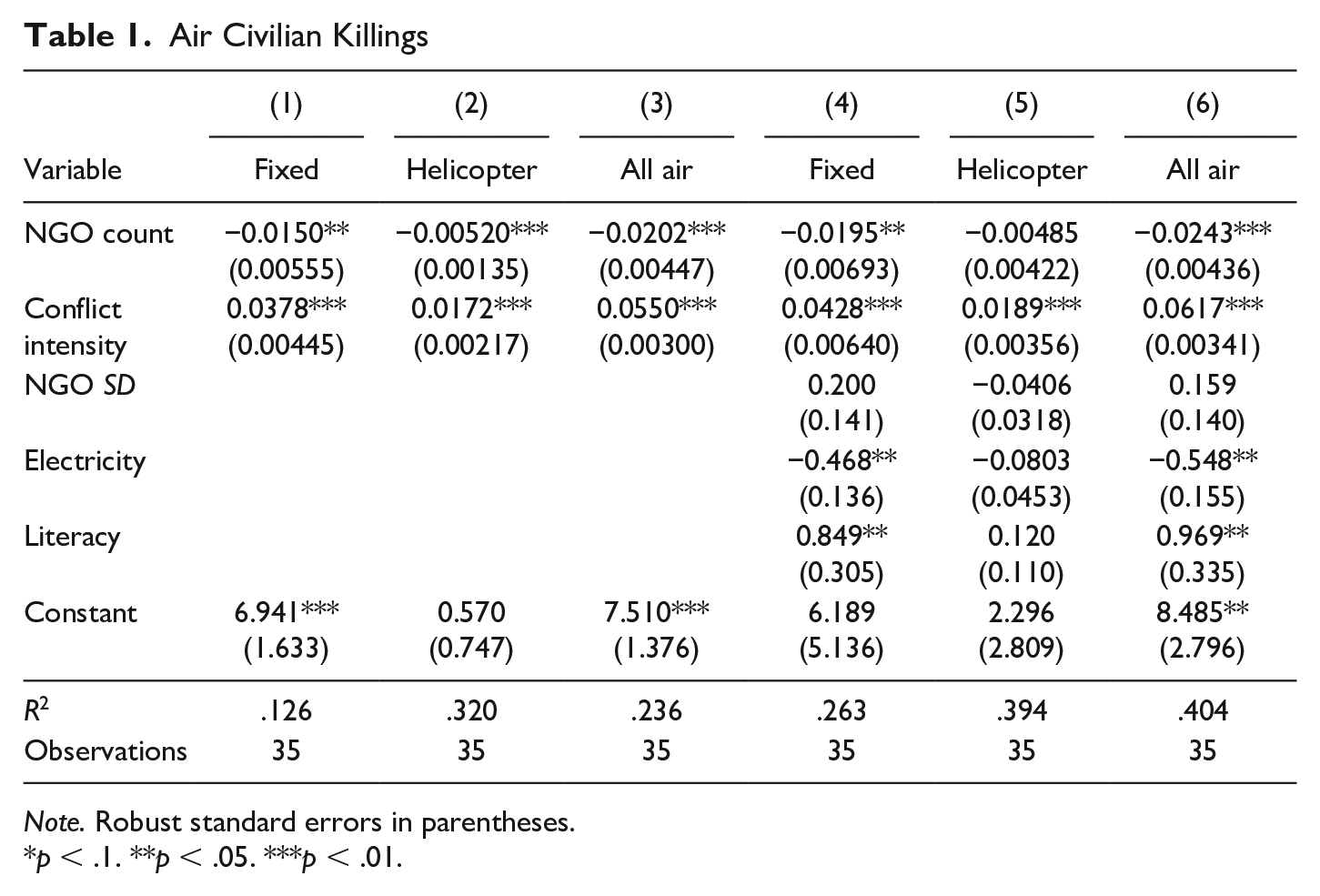
Note. Robust standard errors in parentheses.
p < .1. **p < .05. ***p < .01.
Figure 1 plots out the pattern from the estimation in Column 6. This figure shows that for every increase of 100 organizations in a regional command, there is an approximate decrease of 2.4 civilian killings from air power. When there are 50 organizations in a geographic area, the findings show that we should expect 24 civilian killings from air power. When that increases to 350 NGOs (about 1 standard deviation) the number of civilian killings decreases to approximately 17 individuals.
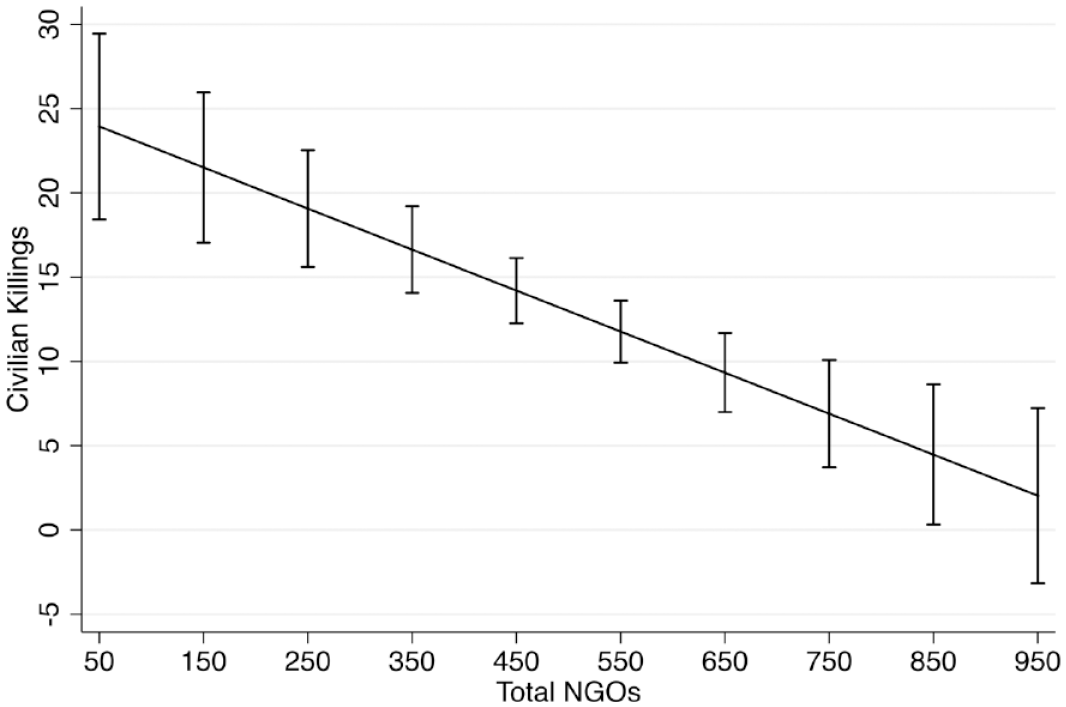
NGOs and Air Power Civilian Killings.
Conflict intensity is unsurprisingly positively associated with the number of air power killings. Electricity consumption is negatively associated with the civilian killings from fixed wing aircraft and the combined measure, but not the helicopter killing dependent variable. Finally, literacy rates are positively associated with civilian killings from fixed wing aircraft and the combined measure. Although we include literacy rates as a way to measure the state capacity of a region, which we would expect to be negatively associated with killings, it is possible that they are proxying urbanization and population density, which would both be expected to be related to increased killings.
Conclusion
These findings on NGOs and civilian killings from air power are consistent with existing cross-national work and our expectations. A Supplementary Appendix shows that this same pattern does not appear for NGOs and civilian killings from ground forces; the pattern is unique to protection from air power. This is consistent with the observation that air power is more regularly associated with civilian killings and that a lot of the activity that NGOs engage in related to civilian protection focuses on preventing deaths from aerial attacks.
While some caution is needed in interpreting these findings, these data, along with the interviews we conducted, justify continuing to gather additional data to answer the question of what civilian protection strategies are most effective in the context of air wars. As a field, we need to continue pursuing more, and more detailed, data about Afghanistan and about the many other conflicts where air power is used, and civilians are dying as a consequence. This work focuses on cases in which civilians are not the primary target, but there is already evidence that an NGO presence in Ukraine may be mitigating civilian casualties from intentional Russian bombing of civilian targets. Thus, some of the findings from this research may carry over to cases of intentional targeting of civilians. Future work, aided by greater data availability, should explore this extension.
Supplemental Material
sj-docx-1-afs-10.1177_0095327X221100780 – Supplemental material for Air Power, International Organizations, and Civilian Casualties in Afghanistan
Supplemental material, sj-docx-1-afs-10.1177_0095327X221100780 for Air Power, International Organizations, and Civilian Casualties in Afghanistan by Susan Allen, Sam R. Bell and Carla Martinez Machain in Armed Forces & Society
Footnotes
Declaration of Conflicting Interests
The authors declared no potential conflicts of interest with respect to the research, authorship, and/or publication of this article.
Funding
The authors received no financial support for the research, authorship, and/or publication of this article.
Supplemental Material
Supplemental material for this article is available online.
Notes
Author Biographies
References
Supplementary Material
Please find the following supplemental material available below.
For Open Access articles published under a Creative Commons License, all supplemental material carries the same license as the article it is associated with.
For non-Open Access articles published, all supplemental material carries a non-exclusive license, and permission requests for re-use of supplemental material or any part of supplemental material shall be sent directly to the copyright owner as specified in the copyright notice associated with the article.
