



Abstract
In wars fought against insurgents, civilian casualties present the challenging dilemma of balancing security and stability while targeting insurgents who operate within the civilian population. In Afghanistan, the International Security Assistance Force (ISAF) has made minimizing civilian casualties a top-tier strategic issue. Yet beyond annual reports, there has been a lack of data-driven analysis into the number of civilians killed by ISAF operations. This research investigates ISAF-caused civilian casualties between 2010 and 2013, incorporating civilian casualty events to investigate changes in ISAF “lethality.” This analysis finds that although ISAF-caused civilian casualties decreased overall, this was mitigated by the tactic employed (airpower vs. on the ground operations). The implications of this analysis for theories of military adaptation, future population-centric operations, and current military operations (e.g., in Iraq and Syria) are discussed.
What is it that we don’t understand? We are going to lose this fucking war if we don’t stop killing civilians.
In his 2009 report on military progress in Afghanistan, General Stanley McChrystal (2009), the then Commander of the U.S. Armed Forces in Afghanistan, concluded that there was an urgent need for a significant change in the operations of the International Security Assistance Force (ISAF). A central tenet of this need for change was that ISAF-caused civilian casualties were eroding ISAFs credibility among the local population, and in turn, significantly bolstering the Taliban’s strategic goals. When General McChrystal took over as the commander of ISAF (COMISAF), he implemented a series of strategic and tactical realignments and adaptations focused on minimizing civilian casualties, including implementing more restrictive rules of engagement, increasing cohesion of civilian and military efforts, building up the Afghanistan National Security Forces (ANSF), and emphasizing nonkinetic activities. 1 The goal was not to eliminate kinetic operations (ISAF operations were concurrently moving into the highly contested areas of Kandahar and Helmand) but to ensure that kinetic activities were deployed in a counterinsurgency (COIN)-centric manner. The civilian population is the ultimate prize in COIN operations (Catignani, 2012).
Civilian Casualties in Afghanistan
Civilian casualties are potentially the most salient, visible, and systematic measure of a war’s cost (Asthappan, 2016). As a result, in war, observers pay special attention to casualties and attempt to estimate their future direction to make decisions regarding support for war (Gartner & Segura, 1998; Gartner, Segura, & Barratt, 2004). Civilian casualties enrage the local population, encourage insurgent recruitment, and are highly damaging to coalition efforts in Afghanistan (see Bordin 2011). Condra, Felter, Iyengar, and Shapiro (2010), using civilian casualty and “significant activity” (SIGACT) data from Iraq and Afghanistan, identified a “revenge effect,” finding that for every ISAF-caused incident that caused two civilian casualties (within an average-sized Afghan district), there was one more insurgent attack over the next 6 weeks. Furthermore, not only do ISAF-caused civilian casualties have a highly detrimental effect on the populations’ perception of ISAF, but this is also subject to an in-group distortion effect. The ISAF-caused civilian casualties result in decreased support for ISAF, yet this punitive perception is not transferred to the Taliban when they cause civilian casualties (Lyall, Blair, & Imai, 2013). This reinforces the importance of minimizing ISAF-caused civilian casualties even though insurgent groups are known to cause over 80% of total civilian casualties (Shortland & Bohannon, 2014).
Reducing civilian casualties is both a moral and strategic issue, but it also presents a dilemma as stability requires security, and security requires the targeting of insurgents who are often operating within and around the civilian population (Jones, 2008, p. l; United Nations Assistance Mission Afghanistan [UNAMA], 2008, 2009, 2010, 2011, 2012, 2013). Thus, in ensuring security, a degree of civilian casualties is inevitable. Military forces must therefore find the balance, because too much force runs the risk of turning neutrals into enemies and replenishing the ranks of the insurgency, while too little force allows insurgent groups time and space to rebuild, train, and recruit (McChrystal & Stanley, 2009). This balance between achieving military goals and maintaining civilian safety has also been referred to as the “annihilation–restraint paradox,” in which there is a commitment to the “overwhelming but lawful use of force” while complying with noncombatant immunity (the view that noncombatants should not be harmed or targeted during war; Kahl, 2007).
Early ISAF operations were not striking this balance well, and as ISAF commander McChrystal noted that ISAF “had shot an amazing number of people, but to my knowledge, none has ever proven to be a threat” (Oppel, 2010). To redress this issue, a series of strategic adaptations occurred, including establishing a civilian casualty tracking cell (CCTC; which became the Civilian Casualty Mitigation Team or CCMT in 2011) to learn and respond to tactical events that results in civilian harm. The CCMT allowed ISAF to learn from civilian casualty events and improve as a force (Bohannon, 2011). Prior to the CCMT, neither ISAF nor UNAMA had the procedures or systems to address civilian casualties in Afghanistan. The CCMT then expanded this role from data collection to monitoring and outreach as well as filtering lessons learned back into predeployment training (Civilians in Conflict, 2014). At the same time, General McChrystal also identified the role of ISAF air strikes and issued tactical directives aimed at limiting their use. Escalation of force (EOF) was also identified as a cause of civilian casualties and new directives were issued to avoid the need for soldiers to fire their weapons in situations of an oncoming vehicle. There is preliminary evidence of the success of these adaptations in that civilian casualties caused by air-to-ground engagements have decreased since 2010 (Chaudhuri & Farrell, 2011) and the number of civilian casualties caused by EOF dropped by 50% after these directives were issued (Bohannon, 2011).
Even the top military brass in ISAF, at times, struggled to find the balance that mitigates the civilian casualties but does not decrease the military’s firepower against the insurgents (Kaplan, 2014). Once in command, General Petraeus issued a tactical directive that while emphasizing the need to “reduce the loss of innocent civilian life to an absolute minimum” (noting that “every Afghan civilian death diminishes our cause”) emphasized the need to balance efforts to mitigate harm to civilians with the “obligation to protect [ISAF] troops.” This tactical directive, therefore, aimed to rebalance the scales of civilian casualties and force protection because “it is a moral imperative both to protect Afghan civilians and to bring all assets to bear to protect our men and women in uniform” (Petraeus, 2010, p. 1). In Nagl’s (2013, 199) view, “McChrystal’s guidance had limited the ability of American units to call in air support or artillery fire even when they were under enemy fire but Petraeus restored firepower to its proper place.”
This Study
Through annual reports of civilian casualties (e.g., UNAMA, 2009, 2010, 2011, 2012, 2013, 2014), we know that ISAF-caused civilian casualties have decreased, and insurgent-caused civilian casualties have increased. In this article, using new data released from ISAF through Science, we provide a detailed examination of ISAF-caused civilian casualties throughout the latter years of the war. Furthermore, by integrating civilian casualty “events”—the number of ISAF operations that resulted in any civilian killed or injured—and the number of civilian casualties caused, we also present the first analysis of ISAF “lethality” toward the civilian population.
This research provides a data-driven examination of ISAF as an adaptive organization in Afghanistan. Research has often discussed the need for militaries to adapt to optimize their operations in war (Rosen 1991), and work has recently begun to document ISAF’s adaptation in Afghanistan (see Farrell, Osinga, & Russell, 2013). While these works detail the tactical and strategic adaptations employed by ISAF forces in Afghanistan, what they often lack is a quantifiable measure of effect. Thus, while scholars often view that ISAF has adapted (e.g., Farrell, 2010), little analysis exists of whether these adaptations achieved the desired result. Given the central focus of minimizing civilian harm in ISAF’s adaptation in Afghanistan, civilian casualties provide a direct measure of effect. 2
The goal of this study is to provide a data-driven analysis of ISAF-caused civilian casualties in Afghanistan. In testing ISAFs ability to mitigate civilian casualties, this article also investigates civilian casualty data within and between each of the six regional commands (RCs). Moreover, this article explores the variations in lethality among the several different ISAF tactics that cause civilian casualties. The theoretical support for these analyses and their implications are drawn from the wider COIN and military adaption literature.
Beyond national-level trends, the empirical understanding of the occurrence and causes of ISAF-related civilian casualties in Afghanistan remains poor. Firstly, and most importantly, as the number of ISAF-caused civilian casualties has decreased over time, so have the number of ISAF-led operations. Concurrently, the number of ISAF troops in Afghanistan has drastically decreased from 132,457 in July 2011 to 41,124 in September 2014 (ISAF, 2014). ANSF strength has amassed to 340,632 (Department of Defense [DoD], 2014, 2), and ISAF have transitioned over 480 fully functioning bases to the ANSF (DoD, 2014, 7). ANSF also led 99% of operations in 2014 (DoD, 2014, 43). Thus, it is highly plausible that decreased ISAF activity writ large could be driving a drop in ISAF-caused civilian casualties rather than ISAF becoming a “safer force” per se. Here, we test this hypothesis.
Secondly, it is important that we parse out civilian casualties beyond national trends and investigate civilian casualties within RCs. There are two reasons for this; firstly, civilian casualties in Afghanistan are, to a degree, dependent upon enemy activity and the intensity and nature of insurgent activity differs across the different RCs in Afghanistan (and to a degree, within then over time). Secondly, ISAF’s structure varies across all RCs, and it represents “an ad hoc organization composed of forces from over 23% of the world’s nations, each with their own strategic interests, and forces that were technologically, doctrinally, and culturally unique” (Aldair, 2011, 1) The ISAF force within each RC is therefore a composite of different national force structures.
When considering population-centric military adaptation, then, previous research has noted that in Afghanistan there have been a series of bottom-up adaptations (i.e., small-scale adaptations that results in minor alterations to the tactics, techniques, and procedures [TTPs]; Farrell, 2010, 3) within British Forces in Helmand (Beljan, 2013; Farrell, 2010), Dutch forces in Uruzgan (Kitzeb, Rietjens, & Osinga, 2013), German forces in RC-North (RC-N; Rid & Zapfe, 2013), and Canadian forces in Kandahar (Saideman, 2013). It is therefore viable to assume that ISAF adaptations differed between RCs, and the effects of this on changes in civilian casualties trends within and between RCs warrant further analyses. Given the nature of ISAF as an organizational structure (reiterated in the Aldair quote above), it is important to investigate whether (and the degree to which) the strategic adaptations employed by General McChrystal and General Petraeus diffused throughout the different RCs and thus whether the trends in ISAF-caused civilian casualties differed within and between the RCs.
Finally, this research looks at the differences in civilian casualties caused by different ISAF tactics. Kahl (2007) discussed the effect of refinements to TTPs for roadblocks in Iraq, and elsewhere Bohannon (2011) highlighted the effect of deploying new measures at traffic stops to prevent EOF incidents. However, not all tactics may be as receptive to adaptations in COIN wars. Airpower specifically has been linked to increased civilian casualties (Walsh, 2014). Examining tactical differences in civilian casualties therefore provides important insight into the degree to which civilian casualties can be avoided depending on the nature of military operations in a given conflict.
Data
The Civilian Casualty Tracking Cell/Civilian Casualty Mitigation Team (CCTC/CCTM) maintains a database of ISAF investigations into civilian casualty reports and allegations including all reports where is it confirmed that ISAF-caused injury (for specific breakdown of how civilian casualties are reported, see ISAF, Civilian Casualty Standard Operating Procedures, 2011). In 2011, ISAF provided Science with the CCTM’s official database of civilian deaths and injuries between 2008 and 2010. This has since been used to examine the trends of violence toward civilians in Afghanistan. In 2014, ISAF rereleased these data providing the clearest and most up-to-date picture of the cost of ISAF operations to civilians in the area (Bohannon, 2014, 721). This data set contains the number of civilians killed and injured by ISAF, and insurgent groups, grouped by RC. Additionally, this data set identifies the cause of each civilian casualty. For ISAF, causes contained include direct fire (DF), indirect fire (IDF), EOF, close combat attack (CCA), and close air support (CAS). It also includes a count for road traffic accidents and “others” (all information regarding the reporting and release of these data can be obtained via Bohannon, 2011, 2014).
These data also include an additional variable that documents the number of ISAF-caused civilian casualty events. A civilian casualty event is defined as “any event which results in civilian casualty” (with “casualty” meaning death or injury, ISAF Standard Operation Procedure, 2011). Civilian casualty event data are also disaggregated across RC and tactic. Thus, these data identify not only the number of civilian casualties caused but also the number of times ISAF forces caused an event in which any civilian casualties occurred. This is an important addition in that by looking at both the number of civilian casualties caused and the number of civilian casualty events together; an independent metric of lethality 3 can be generated. Thus, independent of the potentially confounding variables identified above, this lethality metric allows an investigation of not only if ISAF decreased the number of civilians killed and injured overall but also if ISAF was able to mitigate the scale of casualties when operational activity caused civilian casualties. To date, no data have examined ISAF lethality toward civilians, and these new data therefore present a unique opportunity in support of wider efforts to examine ISAF’s impact on Afghanistan’s civilians.
Results
ISAF-Caused Civilian Casualties
Between January 2010 and December 2013 (48 months), ISAF was responsible for 658 civilian casualty events that resulted in the death of 537 civilians and injured 785 (1,322 total). Therefore, ISAF was responsible 9.59% of all civilians killed and 6.54% of all civilians injured within this time period of 2010–2013. Figure 1 shows the trends for ISAF-caused civilian casualties as well as the number of ISAF troop casualties in that same time (gathered from icasualties.org) 4 .
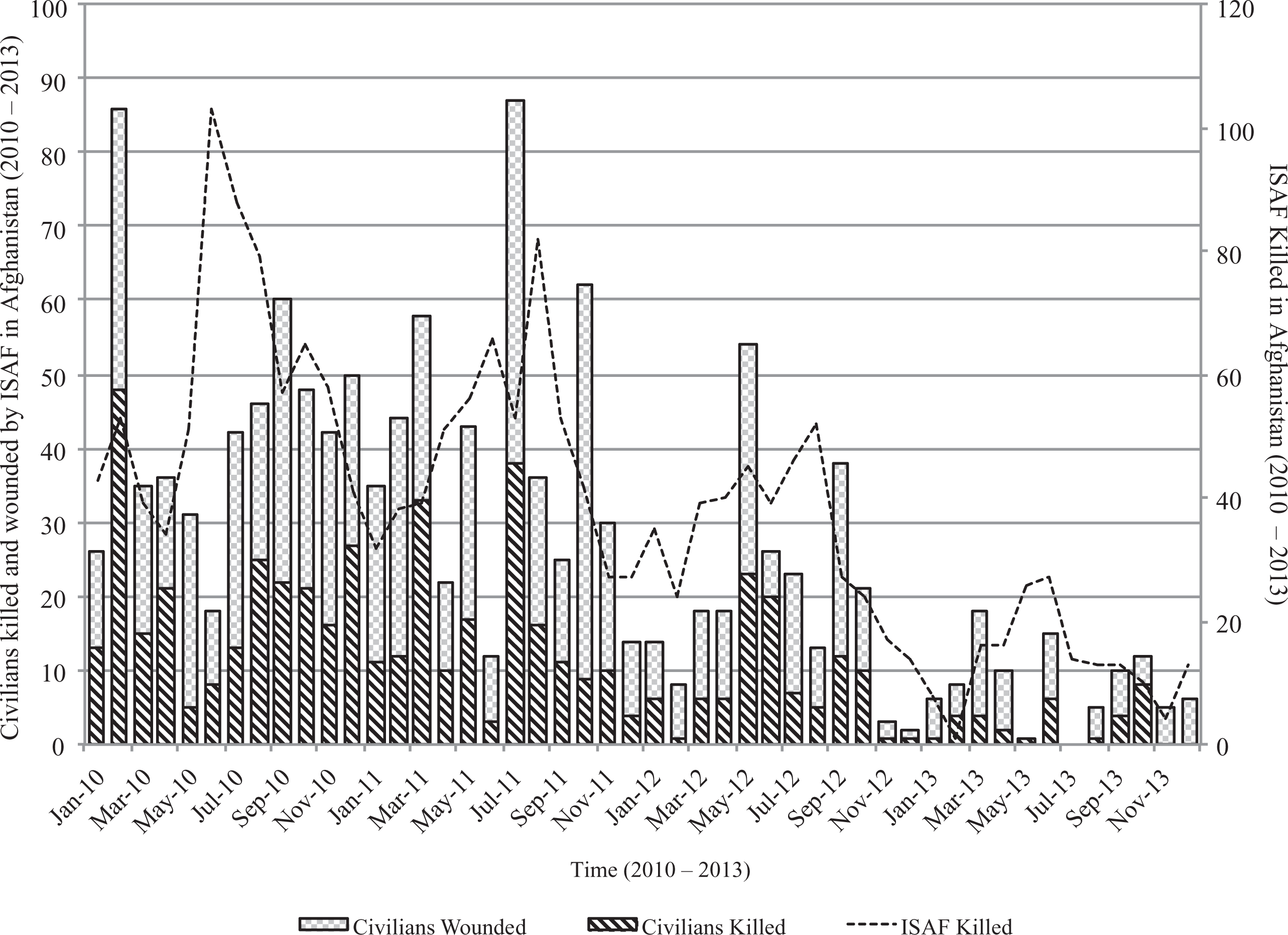
Civilian and International Security Assistance Force casualties in Afghanistan (2010–2013).
Consistent with wider reports, ISAF-caused civilian casualties decreased over time. In 2010, ISAF killed 234 civilians followed by 174 in 2011, 98 in 2012, and 31 in 2013. Thus, the number of civilians decreased by 25.64% in 2011, 43.67% between 2011 and 2012, and 68.36% between 2012 and 2013. Overall, ISAF-caused civilian casualties decreased by 86.75% between 2010 and 2013. Civilian injuries caused by ISAF followed this same pattern. ISAF forces injured 286 civilians in 2010, but only 65 in 2013, a 77.27% decrease since 2010.
Several potential covariates exist for which data are not available, which could affect trends in ISAF-caused civilian casualties. To navigate this issue, ISAF lethality was calculated as the proportion of the number of ISAF civilian casualty events to the number of ISAF-caused civilian casualties. Similar to ISAF-caused civilian casualties and injuries, ISAF lethality also decreased between 2010 and 2013. In 2010, ISAF killed, on average, one civilian per event (M = 1.04, standard deviation [SD] = .51). This decreased to less than one civilian per event in 2011 (M = .83, SD = .31), 2012 (M = .95, SD = .72), and 2013 (M = .49, SD = .42).
To examine the trends of ISAF-caused civilian casualties over time, a series of repeated measures analysis of variance and multivariate analysis of variance tests were run to examine changes in the number of civilians killed, and ISAF lethality both between different RCs, and between different ISAF tactics (i.e., CCA vs. IDF). The full reporting of these results is included in Online Appendix I. Below, we discuss the most pertinent findings in relation to what is known about tactical adaptations (and the nature of ISAF operations) that occurred within each RC between 2010 and 2013.
ISAF-Caused Civilian Casualties Between Each RC
The degree of ISAF-caused civilian casualties greatly varied between RCs, as did the trends in civilian casualties within each RC over the 4 years measured here (see Figure 2). Overall, RC-South West (RC-SW) and RC-East (RC-E) were responsible for the greatest number of civilians killed (36.87% and 37.05%, respectively) and injured (30.95% and 40.59%, respectively). This is not surprising, given the fact that the majority of ISAF’s fight against the Taliban has been focused on RC-South (RC-S) and RC-E, furthermore RC-S and RC-E often house the largest contributions of ISAF troops, implying that the tempo and extent of ISAF operations are likely to be increased in RC-S and RC-E. However, while ISAF was able to decrease the number of civilians killed in RC-S and RC-SW, it was not able to decrease the number of civilians killed by ISAF Operations in RC-E. Furthermore, as shown in Figure 2, there are differences in the degrees to which ISAF was able to become less “lethal” between RCs.
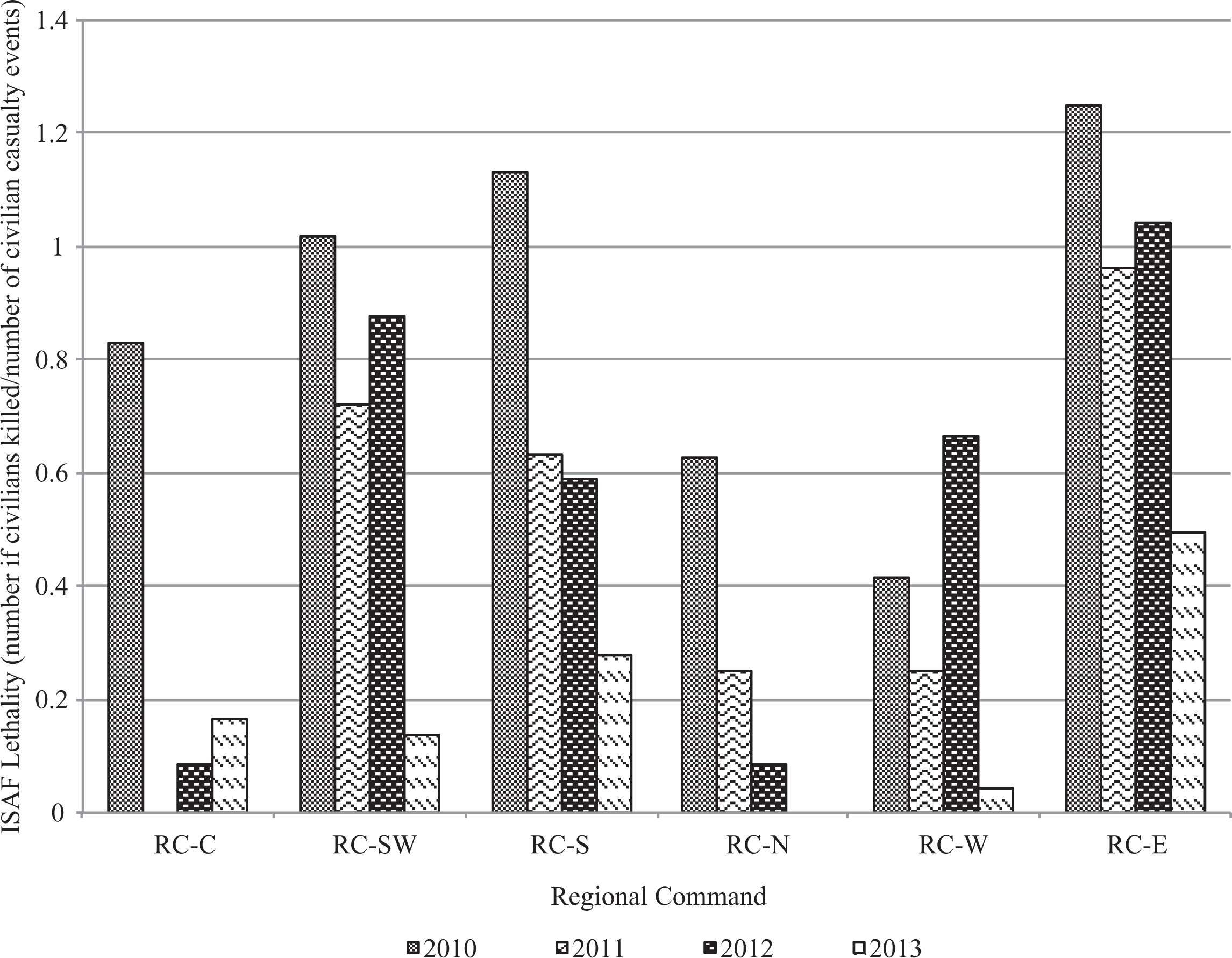
International Security Assistance Force lethality in Afghanistan across the six regional commands (2010–2013).
ISAF-Caused Civilian Casualties by Tactic
The numbers of civilians killed or wounded by each tactic are presented in Table 1. Overall, CAS was responsible for the largest proportion of civilian deaths (27.18%). The second most prevalent cause was close combat attacks (CCA, 18.81%) and DF (18.8%). EOF caused 17.50% of all civilian deaths. In 2009, General McChrystal specifically raised concern with the number of civilian casualties caused by EOF, and here evidence supports that EOF lethality has decreased over the past 4 years of the war in Afghanistan. In 2010, 84 EOF events resulted in 44 civilian deaths (lethality of 0.52), in 2013, 30 EOF events caused 12 civilian deaths (lethality of 0.4, a 23.64% decrease). Civilian casualties caused by ISAF airpower have been a significant concern throughout the war in Afghanistan. The data analyzed here show that between 2010 and 2013 CAS became 69.69% less lethal.
Civilian Casualties Caused by International Security Assistance Force Across Six Different Tactics.
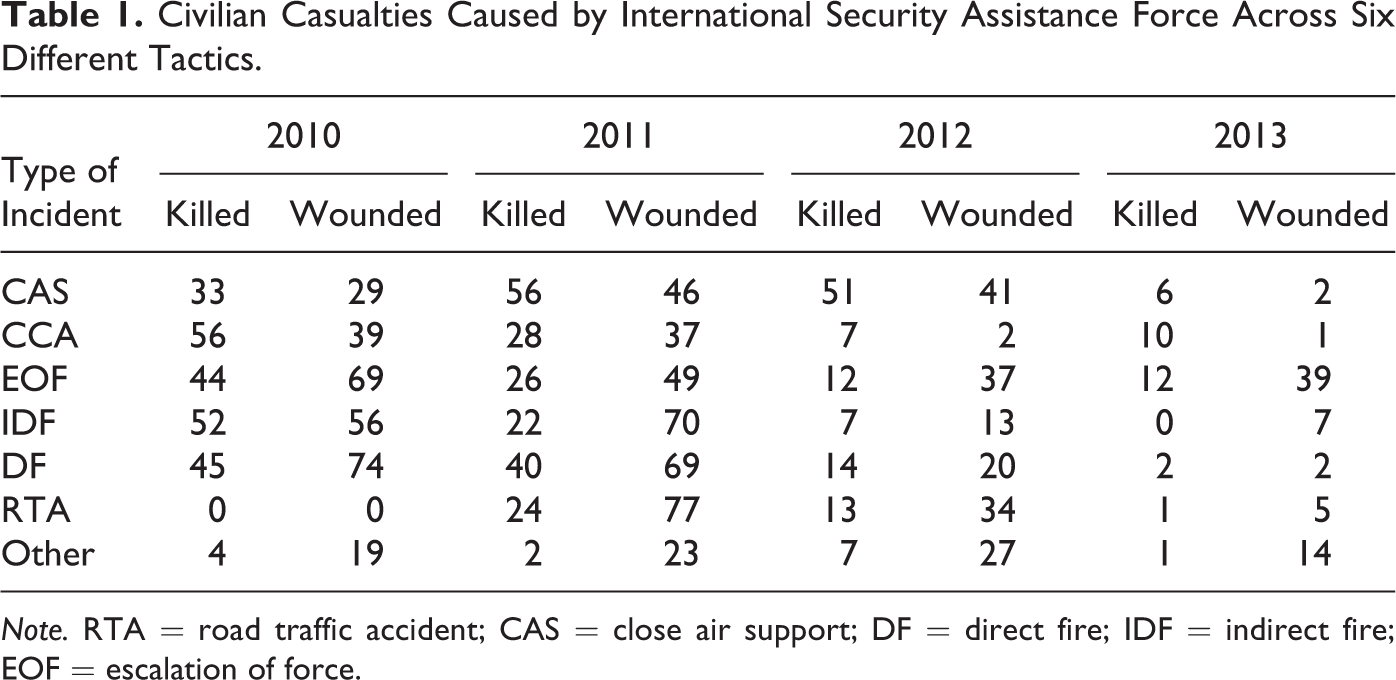
Note. RTA = road traffic accident; CAS = close air support; DF = direct fire; IDF = indirect fire; EOF = escalation of force.
Data Limitations
Several differences between the data presented here and other civilian casualty data presented on Afghanistan must be considered. First, the number of civilian casualties caused by ISAF, when reported by ISAF, is far lower that the number of ISAF-caused civilian casualties reported by UNAMA. This discrepancy clearly raises questions about the veracity of the data presented here, but it is important to note that UNAMA draws across two distinct causes of civilian casualties. Specifically, UNAMA reports civilian casualties caused by antigovernment elements (i.e., individual and armed groups involved in the conflict against the government or ISAF) and progovernment forces that include ISAF and Afghan government forces (see UNAMA, 2014, for definitions). As such, the numbers of noninsurgent deaths reported by UNAMA are notexclusively ISAF caused but involve a third actor not accounted for in these data. This is especially important when considering that recent UNAMA data have shown that ANSF are a less careful toward civilians than their ISAF partners (UNAMA, 2013). Thus, as ANSF increasingly take the lead on security operations, it is likely that their influence on civilian casualty statistics increases with this.
Second, there are also key definitional differences between the way that nongovernmental organizations (NGOs) and military organizations define who is classified as a civilian versus who is a member of a terrorist/insurgent organization, and there are differences in the quality and quantity of confirmatory information needed between NGO and military estimations of civilian casualties (Seybolt, Aronson, & Fischoff, 2013). This is also especially important when considering the intelligence capability required for confirming civilian casualties. Specifically, during the later years of the data presented here, there were fewer operational bases dispersed across a smaller operational area, decreasing situational awareness because there are fewer personnel and sensors to monitor ground operations (Anderson & McCreary, 2015).
Finally, these data do not include civilian casualties that occurred outside of ISAF operations but were caused by ISAF personnel. For example, the “Panjwai Massacre,” in which Staff Sergeant Robert Bales murdered 16 civilians and wounded 6 others is excluded in the ISAF database (March 2012: RC-S: 0 deaths and 5 injuries), whereas UNAMA do report this (UNAMA 2012, p. 36). Thus, the ISAF data presented here and the UNAMA data reported annually are not mutual measures of the same phenomena. When considering these issues, it is important to note the general lack of convergence in civilian casualty data (Kahl, 2007). When counting the number of civilian casualties in Iraq, estimations range from under 100,000 (Iraq Body Count) to 601,000 (Burnham, Lafta, Doocy, & Roberts, 2006) to more than 1,000,000 (Opinion Research Business, 2008).
An additional limitation is the use of ISAF lethality as a measure of ISAF’s ability to minimize civilian casualties. As mentioned above, analyzing counts of civilian casualties is problematic because it is affected by a series of more general operational factors associated with the drawdown and transition to ANSF in Afghanistan. Furthermore, the data for these variables (e.g., the number and nature of ISAF operations in total or the number of ISAF-led ANSF operations) are sparingly available, making it hard to factor them into analyses. The lethality calculation allowed for the development of a metric of civilian casualties that was, to a degree, independent of other wider confounding variables. Nonetheless, the lethality statistic presented here is still limited, as it only shows ISAF lethality when a civilian casualty event occurs. As such, it may not be a viable metric for ISAF lethality overall because the data do not present cases of nonoccurrences, that is, the number of ISAF operations that did not cause a civilian casualty. To develop a truer picture of ISAF lethality, future analyses should draw on both tactical events with and without a civilian casualty event. Despite this flaw in the lethality statistic, the data presented here still show significant decreases in ISAF lethality. Thus, even if the lethality analysis is limited to the number of civilians killed when ISAF caused a civilian casualty event, the analysis still supports that ISAF became a safer, more restrained force (within certain tactics and RCs) within instances causing civilian casualties. This is, therefore, still an important data point to consider when conducting an analysis of a military’s ability to conduct civilian-centric operations.
There is a further issue in the attempt to draw inferences about operational outcomes from organizational statistics, namely, an inability to infer context. Currently, there are few available correlates that can be used to analyze important issues such as operational context (i.e., were these civilian casualties caused in areas were ISAF were “surging” to seize territory from the Taliban or “holding” territory against a resurgent Taliban force), Furthermore, there is perhaps an unquantifiable issue of “juking the stats,” given the known top-down pressure to minimize civilian casualties. That said, the latter is viewed as being highly unlikely, given that this top-down pressure resulted in a significant organizational adaptation centered on the ability to transparently and accurately measure the amount of civilian harm caused by ISAF (Bohannon, 2011). To put this point in perspective, the data here show a clear decrease in the number of civilians killed by ISAF in 2013, but there are many possible explanations for this. Ideally, this large decrease in the number of civilian casualties caused by ISAF could be the result of ISAF killing less civilians. However, equally, it could also be the result of ISAF having less assets on the ground to record the number of civilians killed (or an increased reliance on “remote” operations such as drones).
While these discrepancies and the possible reasons behind them must be held in mind when considering the implications below, in the absence of any open-source data as detailed as that analyzed in this study, the analysis presented here still represents the clearest picture yet of ISAF-caused civilian casualties, even if we must maintain that the data represent “civilian casualties as ISAF see’s it.” Furthermore, the study itself is focused on the total number (and changes in), the number of ISAF-caused civilian casualties during ISAF operations, and not (as other research does; Condra, Felter, Iyengar, & Shapiro, 2010; Lyall et al., 2013) the effect of civilian casualties on a given dependent variable (e.g., insurgent behavior or population attitudes). Hence, while our analytical insight is limited by the lack of context and correlated variables, we still maintain that it provides a true test of whether ISAF did successfully adapt.
Discussion and Future Directions
Between 2010 and 2013, ISAF operations resulted in 537 civilian deaths, a death toll one tenth of that caused by insurgent groups, and a quarter of the number of ISAF forces killed in Afghanistan during this same period (Shortland & Bohannon, 2014, 731). Since 2009, there has been a top-down adaptive movement to emphasize the protection of the population that has largely been viewed as a success (see Farrell et al., 2013). But it is important that researchers, where possible, use quantifiable metrics to test these views on military adaptation. This is especially important, given the ease with which retrospective commentaries on the nature of military operations can quickly become viewed as established fact (independent from the actual military operations themselves). A prudent example of this is the British Armies “tradition” and “expertise” at conducting COIN-centric operations. In a recent exploration of this tradition, Smith and Jones (2015) instead highlighted that “the narrative of a British COIN ‘inheritance’ in part reflects the stories that the army told about itself, at various points accepting—or, more accurately, often half-accepting and partially endorsing—the view that it did indeed possess a tradition of counterinsurgency excellence” (p. 148). The U.S. Army currently emphasizes the need (at both the individual and organizational level) to be an “adaptive force,” and in doing so, it is only logical that lessons and experiences of adaptation in Afghanistan are drawn upon. Before the adaptation of ISAF in Afghanistan becomes engrained in the retrospective narrative (and this is not to state that ISAF did not adapt in Afghanistan, evidence is clear that a series of tactical and strategic adaptation did occur), it is important that the outcomes of this adaptation are evaluated to ensure that the process of military adaptation resulted in the intended real-world effects.
Importantly then, this research has shown that ISAF did become a safer force toward the local population and ISAF-caused civilian casualties decreased over time. Thus, when discussing ISAF’s adaptation, this research provides an important set of metrics that show that, overall, the strategic adaptation started by General McChrystal (and continued by General Petraeus) resulted in a safer ISAF force. This is based on both an analysis of the number of civilians killed by ISAF and their lethality (a metric not previously tested). In this analysis, we also further parsed out ISAF’s impact on the Afghanistan population by looking at ISAF-caused civilian casualties across and within the six RCs as well as between seven different types of tactic that caused civilian casualties.
Although we offer strong support to the view that ISAF became a safer force overall, this relationship was not universal to all RCs nor across all types of tactic that cause civilian casualties. In General McChrystal’s original tactical directive, he focused on issues with EOF and the use of CCA. This study confirmed that the number of civilian casualties caused by these tactics significantly decreased throughout the later years of the war. However, the degree to which these tactics were able to avoid civilian casualties differed. Specifically, EOF showed significant year-to-year decreases in the numbers of civilians killed and its lethality, whereas CCA only showed a more dispersed decrease between 2011 and 2013 (with minimal changes in lethality). Furthermore, within certain RCs, CAS (and CCA) showed little decreases (and even increases) in the number of civilians killed and their lethality.
The finding that EOF-caused civilian casualties showed a larger decrease may imply that TTPs surrounding EOF were more responsive to adaptation than other tactics. One viable reason for this is that to mitigate EOF-caused civilian casualties, ISAF were able to design and implement a series of tactical-level adaptations aimed at increasing the alternative available to a soldier (see Bohannon, 2011; Farrell, 2010). Specifically, prior to the tactical directive in 2010, if a vehicle did not slow down, ISAF soldiers had few nonlethal options. After 2010, more options for warning drivers at a distance were employed including dazzlers, paintball guns, and chalk bullets (Bohannon, 2011, 59). The fact that all dismounted tactics (EOF, IDF, and DF) showed decreases in lethality shows that, to a degree, they were able to mitigate their impact on civilians. In comparison to these ground tactics, airpower (CAS and CCA) did not show significant decreases in lethality. This lends supports to the view that when discussing how military adapt dismounted operations may be more easily altered to minimize the harm they cause to civilians. In relation to Farrell’s (2010, 568) view of tactical adaptation as “tinkering with tactics, techniques and technologies,” it is viable that on-the-ground tactics (IDF, DF, and EOF) are more easily “tinkered” with than other tactics (e.g., the use of airpower).
While CAS and CCA did not significantly decrease their lethality, both overall (but to varying degrees within RCs) decreased the number of civilian deaths they caused. This implies (though cannot be verified until CAS and CCA that result in no civilian casualties are incorporated into the analysis) that tactically CCA and CAS are harder, in practice, to deploy in a manner in which civilian casualties are caused. This postulation is logical given the likely use of CCA and CAS. In the rural areas of Afghanistan, CCA and CAS are ideally suited in that the likelihood of collateral damage is low (Jones, 2008, p. 121). CCA and CAS are rarely used in urban areas of Afghanistan because of a high risk of collateral damage, unless troops are being overrun. Given that General Petraeus lifted restrictions on the use of CCA and CAS in situations when troops were under contact, it is not surprising that their lethality remained high, as it is viable to propose that the CCA- and CAS-caused casualties resulted from urban operations, within which protection of the troops outweighed affected considerations for collateral damage. That said, the data are insufficient to further this hypothesis because it lacks a geographical and situational aspects in cases of civilian casualties caused by CCA and CAS. Future research (e.g., that uses SIGACT data) should explore this hypothesis.
The relative stability of CCA and CAS lethality has significant implications when we consider the nature of future operations that forces are likely to encounter (i.e., Libya, Syria, Iraq). Future conflicts continue to be population-centric in that insurgent groups continue to operate in and around a civilian population (United Kingdom Ministry of Defense, Future Character of Conflict, 2010). Thus, minimizing civilian casualties is likely to remain a central strategic objective. The issue then is that current conflict interventions (e.g., Syria and Iraq in 2014, Libya in 2011) rely on the use of aerial weapons (rather than a ground force; a trend that is likely to continue; Callum, 2010). There is an expectation that aerial weapons result in less collateral damage due to the technology behind them (Walsh, 2014), and “drone enthusiasts” argue that the technology can accurately destroy their intended targets while causing less collateral damage (Brown 2007). This is a significant issue, as airpower is likely to be increasingly used over a ground force because of the lower risk to personnel (Kreps & Zenko, 2014, p. 133). Based on the analysis given here, military deployments that extensively rely on the use of airpower struggle to minimize civilian casualties despite their strategic importance.
Here, we also showed that efforts to decrease civilian casualties varied between RCs. In Afghanistan, each RC varies in cultures, inhabitants, and the nature and degree of insurgent activity as well as the ISAF force governing each RC, including their standard operating procedures. This analysis identified that RC-S and RC-SW were most receptive to adaptation, as these RCs showed year-to-year improvements in the number of civilians killed, while ISAF also consistently decreased their civilian lethality in RC-SW. This finding is especially interesting considering that RC-SW was home to the most intense fighting forces, and overall (along with RC-E, and to a degree RC-S) RC-SW was responsible for the majority of ISAF-caused civilian casualties. RC-S and RC-SW also have a significant ISAF troop density in comparison with RC-North (RC-N) and RC-West (RC-W) (see ISAF, 2014).
While the differences in civilian casualties did not significantly differ between the RC-N, RC-W, and RC-Capitol (RC-C), they did decrease. RC-E, however, was the only RC to show a large increase in the number of civilian casualties (in 2011 vs. 2010). RC-E also had the highest lethality rate across all years. This implies that the operational environment in RC-E did not allow ISAF forces to implement new TTPs and adopt strategic adaptations that aimed to minimize civilian harm. There are many reasons for this. Firstly, it is viable that RC-E was home to the most hostile insurgent activity (warranting increasing security activity), and there is support for this assertion, given that, for example, between October 2011 and March 2012, RC-E accounted for 34% of all enemy-initiated attacks.
Furthermore, in RC-E, the data show a spike in civilian casualties and civilian casualty events in July 2011 when there was a significant increase in enemy-initiated attacks, as insurgents increased their efforts to penetrate security perimeters around Kabul to launch assassination attempts on Afghan officials and leaders (DoD, 2012, 62). In response, ISAF launched a series of clearance operations aimed at diminishing insurgent freedom of movement (DoD, 2012, 67). Concurrently, in 2011, RC-S was facing a diminished insurgent threat as ANSF-ISAF operations solidified gains through Operation Hamkari (DoD, 2012, 72). Additionally, the insurgency had been widely rejected by the communities throughout RC-S at this time (DoD, 2012, 64). Thus, while civilian harm was harder for ISAF to avoid in RC-E during the summer of 2011, it is viable that this was perhaps driven by the nature of the insurgency activity in that area.
Conclusions
This study presented the first data-driven exploration of ISAF-caused civilian casualties in Afghanistan that considered civilian casualties within different geographical boundaries and across a series of operational tactics. The findings support that over the past 4 years ISAF has become a safer force to the Afghan population. However, this analysis identified a series of important questions that need to be further explored before any experience of “successful adaptation” become ingrained in popular. Specifically, this research identified that overall efforts to minimize civilian casualties were not universally effective to the same degree, as different tactics and different operational environments remained susceptible to high levels of civilian casualties despite the strategic adaptations to minimize them. While this is a critical first step in understanding the extent of ISAF’s military adaptation, it is clear that further research drawing from reporting and experiences on the ground is needed to qualify the implications above. That said, there are some clear trends that hold direct significant for future military operations, specifically the lethality of airpower to civilian populations remained. This has significant implications for expectations regarding the protection of the population in future engagements in which operations are led through the air (e.g., the United States’ current campaign against the Islamic State in Iraq and Syria).
In closing, while the ISAF’s success in adapting its military operations to become a “safer force” for the Afghan population was a significant milestone, the prospects of a stable and terror-free Afghanistan now largely depend on how well the ANSF adapts such safer force strategies and implements across the country. The success in Afghanistan is likely if ANSF is trusted/accepted by the “prize”—population—as the only legitimate military force in this longest COIN war in the modern history.
Supplemental Material
Supplemental Material, CIVCAS.OnlineAppendix - Recounting the Dead: An Analysis of ISAF Caused Civilian Casualties in Afghanistan
Supplemental Material, CIVCAS.OnlineAppendix for Recounting the Dead: An Analysis of ISAF Caused Civilian Casualties in Afghanistan by Neil Shortland, Huseyin Sari, and Elias Nader in Armed Forces & Society
Footnotes
Declaration of Conflicting Interests
The authors declared no potential conflicts of interest with respect to the research, authorship, and/or publication of this article.
Funding
The authors received no financial support for the research, authorship, and/or publication of this article.
Supplemental Material
Supplemental material for this article is available online
Notes
References
Supplementary Material
Please find the following supplemental material available below.
For Open Access articles published under a Creative Commons License, all supplemental material carries the same license as the article it is associated with.
For non-Open Access articles published, all supplemental material carries a non-exclusive license, and permission requests for re-use of supplemental material or any part of supplemental material shall be sent directly to the copyright owner as specified in the copyright notice associated with the article.
