




Abstract
Candidates often highlight military experience on the campaign trail. Do they also govern differently? This study examines whether and how military experience is associated with state lawmaking. We examine legislative productivity, success rates, and the substantive content of legislation with a large original data set. The data include over 60,000 bills introduced in four state legislatures over a 10-year time span, coded for their substantive focus. It also includes information on characteristics of over 4,000 legislators. Our analysis of these data indicates that veterans do not differ in overall levels of productivity but do have common legislative agendas. Veterans’ shared legislative agendas are not narrowly confined to defense or security issues but vary depending on state context. This is, to our knowledge, the most extensive empirical analysis of the legislative behavior of veterans in a single study.
I’m John Kerry and I’m reporting for duty.
M. J. Hegar’s 2018 campaign to replace Republican John Carter in the U.S. House of Representatives went viral when her campaign released an advertisement that featured Hegar detailing the story of the day her helicopter was shot down in Afghanistan. Within 2 days of the video’s release, Hegar’s long-shot campaign raised US$700,000 and within less than a month, the video had been viewed online more than 5 million times (Schouten, 2018). Eric Greitens’ 2016 gubernatorial campaign webpage prominently featured a picture of him in military uniform, and three of the six sentences in his “Meet Eric” page addressed his military connections (https://web.archive.org/web/20160816004530/https://ericgreitens.com/ and https://web.archive.org/web/20160819053322/https://ericgreitens.com/about/). New Jersey Assemblyman R. Bruce Land, twice awarded the Bronze Star for his service in Vietnam, lists his military service as part of his Twitter bio (limited to 160 characters) and on his political website. Roger Roth, President of the Wisconsin Senate, discusses his military service in three of the first six sentences in his “About” webpage (https://rothforwisconsin.com/about-us/, accessed February 21, 2019). Candidates for public office often make military service and experiences a feature of their campaigns.
Veterans campaign differently, and studies show a positive albeit limited electoral benefit of prior military service at the state and national level (McDermott & Panagopoulos, 2015; Teigen, 2012, 2018). 1 Do veterans govern differently? The counterfactual would be puzzling. If military service did not matter at all, why would candidates focus on it? Why would voters? Are candidates responding to the American public’s high levels of trust in the military, 2 to voter expectations that they are more knowledgeable about particular issues, or something else entirely? At the federal level, there is evidence that legislators with military experience behave differently with regard to decisions to use force and to escalate crises; however, there is no evidence that veterans legislate differently on other issues (Betts, 1991; Feaver, 1995; Feaver & Gelpi, 2004; Gacek, 1994; Gelpi & Feaver, 2002; Horowitz & Stam, 2014).
While the federal government is mostly responsible for defense, state governments also address issues relating to defense, security, and veterans’ affairs, such as voting rights for deployed troops, hiring preferences and services for reintegrating veterans, immigration enforcement, and land use near military reservations. While prior research on the behavior of veteran lawmakers has focused on the federal level, we believe that if veterans do legislate differently from their civilian counterparts, evaluating how this manifests itself in state policymaking may be particularly informative as (1) there is a larger pool of veteran legislators at the state level, (2) state legislatures are a pipeline to national office, and (3) state legislators may be less restricted by party priorities in their legislative behavior (Battista & Richman, 2011).
Below we develop three possible theories of the connections between legislative behavior and military experience. Then, using an original data set of every bill introduced in the lower chambers of four states: Texas (1999–2011), Florida (2003–2011), Missouri (2002–2011), and Alabama (2000–2011), we evaluate whether the content of veteran proposed bills differs systematically from that of bills proposed by nonveterans. We conclude that there are systematic differences between bills proposed by veterans and by nonveterans at the state level, but that the differences depend on the particular legislative context within the state.
Legislators’ Agendas and Personal Characteristics
Do personal characteristics of legislators, such as military experience, matter at all? Or are legislators simply agents of their district? Mansbridge (2003) describes “gyroscopic representation” as a model in which “representatives act only for ‘internal’ reasons. Their accountability is only to their own beliefs and principles” (p. 520). According to this perspective, voters look for candidates that are honest, principled, skilled, and share their own policy preferences. Personal characteristics of candidates, including partisanship, background characteristics, and other indicators of character are linked to representatives’ behavior (Mansbridge, 2003). 3 Polling data suggest that the American public tends to have a high level of trust in the armed forces (http://www.worldvaluessurvey.org/WVSContents.jsp; http://www.pewresearch.org/fact-tank/2016/10/18/most-americans-trust-the-military-and-scientists-to-act-in-the-publics-interest/). Of 13 personal characteristics included in a 2016 Pew survey, prior military service is the one that has the largest positive impact on candidate evaluation (Pew, 2016). Gyroscopic representation is distinct from anticipatory representation. Anticipatory representation occurs when a legislator’s preferences are induced by voters (Mansbridge, 2003). According to this model, representatives’ preferences derive from the preferences of their electoral constituency (e.g., Arnold, 1990, p. 14). A strict conception of anticipatory representation implies that candidate characteristics, such as military service, are irrelevant; candidates merely respond to the anticipated preferences of voters.
Burden (2007) examines how representatives’ personal characteristics affect legislative behavior. He differentiates between proactive and reactive legislative activities. Reactive behaviors are passive forms of participation, such as roll call votes. Proactive behaviors, such as developing new legislation, require more effort. Burden (2007) argues that personal characteristics of legislators matter most for proactive behaviors: “I believe that the conditions under which personal characteristics matter are widespread and predictable. I theorize that introspection is more powerful once one shifts the analysis away from the ubiquitous roll call vote to more active, and thus selective, forms of policymaking.” He discusses how personal characteristics and experiences of legislators (and close family members), such as military service, health crises, deaths, religion, adoptions, and professional backgrounds have shaped legislators’ political agendas. Other studies also show a connection between member-specific characteristics and proactive legislative behavior such as committee position (Schiller, 1995; Wawro, 2000; Woon, 2009), racial and ethnic identification (Braton & Haynie, 1999; Bratton, 2006; Bratton, Haynie, & Reingold, 2007; Rocca & Sanchez, 2008), and gender (Bratton & Haynie, 1999; Bratton et al., 2007).
Do Veterans Govern Differently in State Legislatures?
We consider three possible connections between military service and proactive state legislative activity. The first-order effect is the most direct. It posits a connection through defense and security experience, expertise, and beliefs. Military service provides members with unique perspectives on defense issues, which could affect their legislative activity. Members with greater security expertise might be more likely to sponsor security-related legislation or those with experience as reintegrating veterans may be more likely to work on veterans’ issues.
Lupton (2017) finds a connection between Congressional votes and military experience. She finds that veterans were more likely to support a greater role for Congressional oversight on 22 key oversight votes. While military experience itself does not seem to have a general connection to Congressional defense policy (Bianco, 2005), Lupton’s (2017) study suggests that it might lead members to preserve Congress’ oversight role in military affairs. Burden (2007) also discusses the case of Rep. Duncan Hunter, an Army veteran, who referenced his active duty son’s experiences in Iraq to explain his position on the Office of Director of National Intelligence (p. 19). Sjursen (2017) argues that the large number of veterans in the 101st and 102nd Congresses substantially influenced debates leading up to the first Gulf War as veteran members of Congress drew on their own experiences in the military and particularly in the Vietnam War.
Alternatively, Bianco and Markham (2001) and Bianco (2005) examine whether military experience affected votes on major foreign and defense policy in the 102–104th Congresses finding little effect of prior military service on legislative behavior. Bianco (2005) concludes “The analysis finds little evidence that the decline in Congressional military experience has caused a systematic policy bias. At the margin of other factors, military experience does not typically have a statistically or substantively significant impact on vote decisions or legislative outcomes” (p. 98). Swers (2007) finds that Senators in the 107th and 108th Congress were no more or less likely to sponsor defense bills if they served in the military. She interviewed Senate staffers and found that Senators that highlighted their military experience were shown more deference, especially by the media, but that this did not strongly affect Senate policymaking. One stated “A junior officer that enlisted in the army 35 years ago in a standard cold war exchange is not more qualified than someone who did not serve and does their homework, visiting units and getting briefed on issues.” Similarly, Cormack (2018) concludes that veterans in the U.S. Congress are no more likely than others to work on veteran-related bills or to send electronic newsletters that address veterans’ interests. However, Lowande, Ritchie, and Lauterbach (in press) conclude that veterans are more likely to do the work of following up on how laws concerning veterans are implemented.
Analyses indicate that political leaders with military experience tend to favor less frequent and less inhibited use of force as compared to their nonveteran counterparts (Betts, 1991; Feaver, 1995; Gacek, 1994; Feaver & Gelpi, 2004). Gelpi and Feaver (2002) find that as veterans’ percentages in the Cabinet and the U.S. House increase, the United States becomes less likely to initiate militarized interstate disputes (MIDs) but more likely to escalate them once they are initiated. The effect is particularly strong on interventionist targets, with the probability of a U.S. conflict initiation dropping from 6% to less than 2.5% as the percentage of the Cabinet and House comprised of veterans increases from 10% to 25% (Gelpi and Feaver, 2002, p. 788). Alternatively, Horowitz and Stam (2014) find that the type of military service also matters, with heads of government with noncombat military service being more likely to initiate both wars and lower level MIDs than others.
While there is evidence of first-order effects at the national level, we anticipate limited first-order effects in state legislatures. The federal government is responsible for most defense and security policy. States have some role in security issues that overlap with its domestic responsibilities, such as terrorism prevention and recovery, but it is not one of the core functions of state government. States also have National Guard units and some veteran’s policies. For example, freshman California state Senator Josh Newman (D) served as a captain in the U.S. Army and founded the ArmedForce2Workforce charity before his November 2016 election to the state Senate. Beginning in 2017, he chaired the Senate Veterans’ Affairs Committee and authored 13 military and veterans’ affairs bills (http://www.ncsl.org/research/military-and-veterans-affairs/military-veterans-affairs-state-leg-database.aspx, accessed May 25, 2018). Newman’s bills address issues such as access to veterans’ benefits for incarcerated veterans, leaves of absence and sick leave for veteran state and public school employees, and military and veteran suicide awareness. While there are some opportunities for first-order effects in state legislatures, these issues occupy modest places on state policy agendas compared to education, social welfare, legal codes, elections, local governments, and commercial regulation and we do not anticipate strong first-order effects.
Second-order effects move beyond narrow security issues. These focus on military experience as a formative life event that shapes a person’s general views, attitudes, and values rather than a source of domain-specific knowledge. The military is a vertically and horizontally organized institution, emphasizing cohesion, order, and deference to authority. Morris Janowitz’s The Professional Soldier: A Social and Political Portrait (1960) highlighted that “conservatism” was consistent with military service, and, by extension, military members were more conservative than their civilian counterparts. Similarly, in 1957, Huntington argued that the “disciplined and rigid” military mind is amenable to conservative ideologies. Indeed, the need to follow orders and the discipline required of military personnel are qualities traditionally associated with conservatism. Holsti (1998) examines the civil–military gap and finds that generally (though not without exception), the gap is widening with the military becoming more conservative on domestic social issues.
Jennings and Markus (1977) use a panel survey to analyze the effect of military service on a population of men who were either drafted into the military or, in many cases, joined preemptively (p. 135). They find that military service has only a modest effect on political attitudes including racial and civic tolerance, political trust, and attention to international politics. They were able to evaluate veterans of the U.S. military both before and after their military service. However, it is not clear that these results are reflective of the attitudes of veterans of the all-volunteer force that has prevailed since 1973. Specifically, if there are interactive effects at work that might cause military service to have a greater effect on the attitudes of those who are drafted or on those who are less likely to volunteer, then Jennings and Markus’s results may overstate the effect of military service on today’s veterans. Schreiber’s (1979) analysis of data from three cross-sectional surveys conducted in the mid-1970s produced more mixed findings, indicating that veterans were more tolerant of communists, but less tolerant of political protests.
A 2013 poll of service members conducted by the Washington Post and the Kaiser Family Foundation finds that 47% are independents, while only 27% are Republicans, however, 44% identify as conservative, while only 20% identify as liberal. This indicates that while veterans are about as likely as the general public to call themselves liberal, they are more likely to identify as conservative (Craighill, 2014). An analysis of the 2004 election using opinion polling conducted throughout the year indicates no significant difference between veterans and nonveterans in terms of party identification or political attitudes (Teigen, 2007). 4 Surveys of military elites from 1988 to 2016 consistently show that more than half those surveyed identify as Republicans (Urben, 2017). Urben (2017) notes a trend however of increasing Democratic party identification among veterans from the low of around 5% in the late 1980s through the 1990s to over 27% in 2015–2016 (p. 15). She observes a complementary decrease in the percent calling themselves conservative. While the nature of the second-order effects might be evolving, we anticipate that military service could connect to legislative agendas related to the criminal, civil, and correctional codes, which states use to maintain social order.
Third-order effects are similar to second-order effects but focus on the legislative environment. First- and second-order effects focus on military experiences but exclude consideration of context. For third-order effects, legislators’ policy agendas are not shaped solely by their own experiences but also by existing state laws and regulations, social, economic, and political challenges and opportunities, and other policy makers. In other words, the political context within the state or the local district in combination with personal characteristics and experiences will influence which issues legislators prioritize. For example, if issues relating to mental health are salient, then veterans may be more or less interested in working on these topics from experiences or observations of post-traumatic stress disorder.
Third-order effects might also arise in issue areas less commonly associated with the military or veteran experience. Today’s military draws its members from all walks of life––while the military is predominantly male, women now make up about 15% of active-duty personnel and racial and ethnic minorities account for 40% of active-duty personnel (Parker, Cilluffo, & Stepler, 2017). Additionally, the U.S. military has a long history of immigrant involvement, and Lutz (2008) finds that as of the year 2000, the children of immigrants, whether foreign born or U.S. born, were no less likely to have served in the military than others (p. 4). While those with higher family income are less likely to have served in the military (Lutz, 2008), veterans who later run for office are likely drawn disproportionately from those with higher family income (Bianco & Markham, 2001). Therefore, those who have served in the military will have trained, worked, and lived with people of different socioeconomic backgrounds, urban/rural regions, races, ethnicities, religions, and, especially for more recent veterans, sexuality and gender (Bialik, 2017). This could broaden, rather than narrow, the range of potential policy agendas for veterans. Veterans also make up a relatively small percent of the population and because military experience can be a formative one, veterans may be more likely to work with one another regardless of partisanship. 5
For example, in a state context in which racial divisions are politically salient, veterans may be more likely to work on these issues due to their experience working in racially diverse groups. Alternatively, in a context in which suicide rates are on the rise, veterans may be more likely to work on issues related to mental health and suicide prevention due to the increased risk of suicide documented among veterans (e.g., Lyon, 2017).
To the extent that third-order effects exist, veterans’ policy agendas could vary over time and across states, as that the connection between policy agendas and military experience would not be immutable. We would expect to see veterans in a given state are working on issues in common, but these issues may not be limited to the military or security domains, or the criminal, civil, and correctional codes.
Research Design
To evaluate how veterans legislate and whether and how their military experience leads to different policy agendas, this study analyzes an original data set of every bill introduced in the lower chambers of four states: Texas (1999–2011), Florida (2003–2011), Missouri (2002–2011), and Alabama (2000–2011). 6 The data include 12 variables for observations of over 60,000 bills, and 4,999 legislators (by year). We use bills introduced per legislator-year as our dependent variable because, following Burden (2007), we anticipate that it is such proactive legislative behaviors that we should see the greatest effect of personal characteristics. Voting behavior is too highly correlated with party identification to capture much effect of personal characteristics. Table 1 shows the distribution of legislators with military experience for each state.
Data Summary.

Bill-level measures include the sponsor, whether the bill passed the chamber, and whether the bill became law. We also extracted the statutory code citations from the text of all of the bills. Each of these states has systems of statutory revision and codification integrated into their bill drafting procedures (Vonnahme, 2017, 2018). For example, Florida’s HB 43 states that it is “An Act relating to campaign financing; amending s. 106.011, F.S.;” The code citation is to Florida Statutes chapter 106, section 011, which is codified under Title 9: Electors and Elections. We classify the content of bills by matching the code citations to the most general taxonomic category (e.g., Electors and Elections) in the state (Author, 2017, 2018). These are statutory titles in Alabama, Florida, and Missouri and discrete “codes” in Texas.
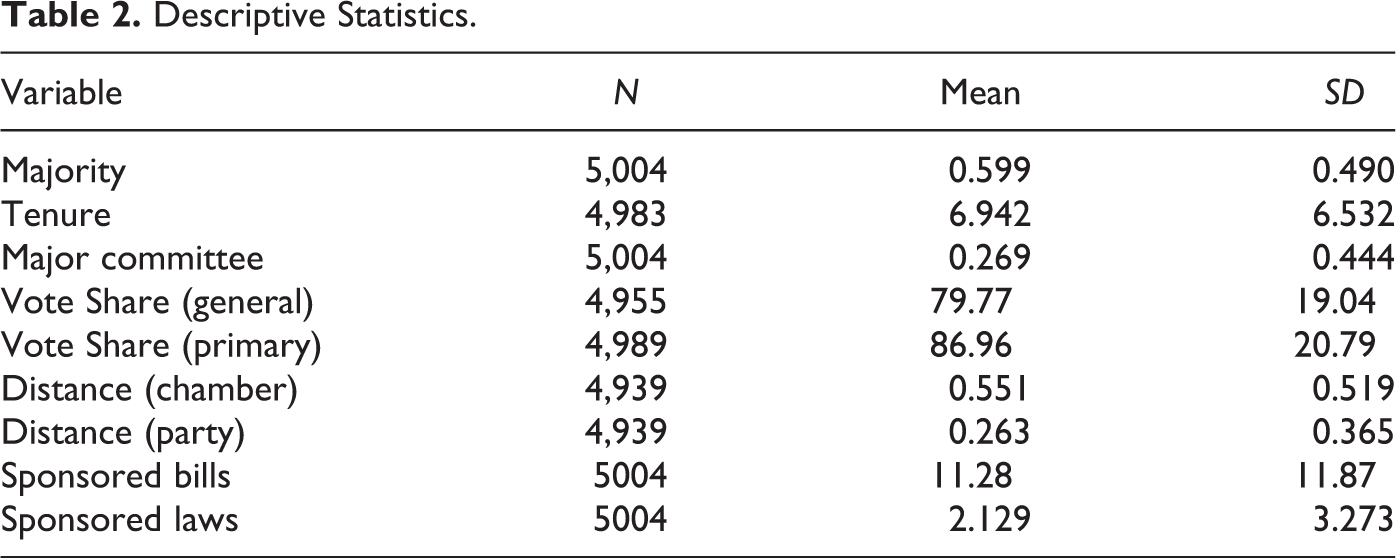
The legislator data include veteran status, gender, party, majority party status, whether the member is part of a major committee, number of years in the chamber, the percentage of vote they received in the previous general election, and the percentage of the vote in the previous primary election. Descriptive statistics for the legislator data are shown in Table 2. We also collected data on all of the roll call votes taken in the chambers from those years to calculate ideal point estimates using W-NOMINATE (Poole, Lewis, Lo, & Carroll, 2018). We coded these data from official state government websites, including the biographical pages of each of the legislators in the sample. Using the first-dimension W-NOMINATE scores, we calculated each member’s distance from the median and distance from the party median. We estimated regression models of ideological proximity to the chamber median. We found that in bivariate and multivariate models, veterans tended to be closer to the chamber median (bivariate p < .001, multivariate p < .1). While studies of veterans’ attitudes found that they were more likely to identify as conservative (Craighill, 2014; Holsti, 1998; Janowitz, 1960), legislators with military experience tend to have more moderate voting records.
Descriptive Statistics.
Legislative Productivity
Overall levels of legislative productivity are comparable for veterans and civilians. We have data on 62,108 bills and match each bill’s primary sponsor to the legislator-level data. Veterans occupied 17.0% of the seats and sponsored 16.8% of the bills. Narrowing our focus from introduced bills to those that become law shows veterans account for a slightly greater share of enacted laws (18.1%).
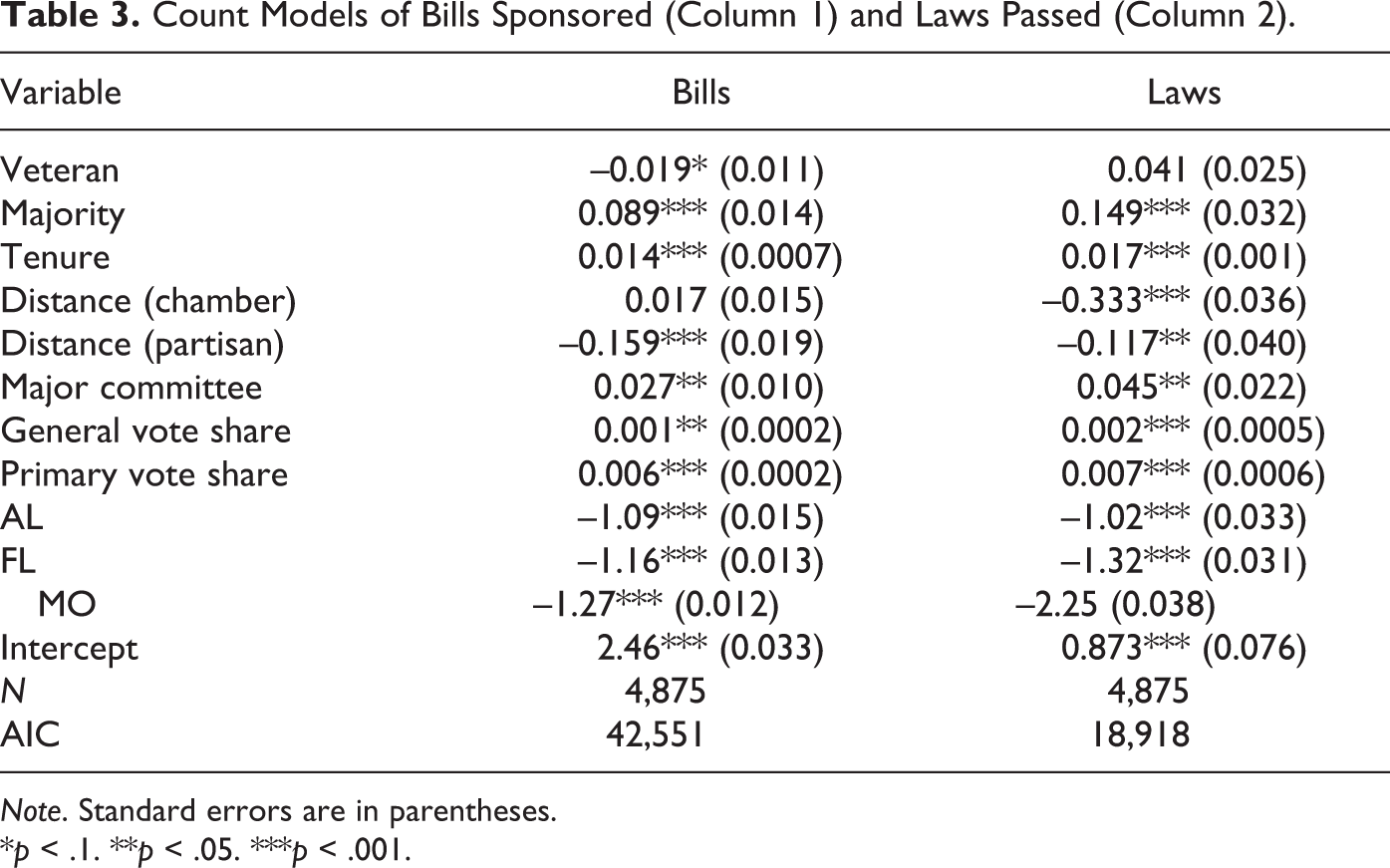
Estimates shown in Table 3, from a legislator-level analysis, show that veterans sponsor somewhat fewer bills when controlling for other political variables. These results are estimates from a Poisson model, in which the dependent variable is the number of bills introduced in a session, and the units of analysis are legislators. On average, veterans sponsor 9.45 bills per session compared to 9.62 for civilians. The second column shows estimates from a count model of total bills that become law. These estimates show that military experience is not associated with a change in the total number of laws. Taken together, these results show that veterans do not have a significantly higher or lower level of legislative output, controlling for other factors. We do not interpret these estimates causally. Military service is antecedent to ideal point scores, joining a party caucus, and representing more or less competitive districts. This means that the control variables are all intermediate outcomes. Veteran status could therefore affect the control variables as well. What the analysis does reveal is that military experience is predictive of sponsorship success, although not independent of other political variables. This supports possible second- or third-order effects, but not first-order effects. If there were strong first-order effects, we would expect to see lower output for veterans. If veterans were narrowly focused on security issues, they would legislate less as states have a limited role in security policy.
Count Models of Bills Sponsored (Column 1) and Laws Passed (Column 2).
Note. Standard errors are in parentheses.
*p < .1. **p < .05. ***p < .001.
What Are the Bills About?
Each bill contains a numeric citation to the state code that reflects the content of the bill. This study analyzes bill contents separately for each state. Code structures and systems evolved organically in each state in different ways and different times (Author, 2017, 2018). There is no universal taxonomy of state codes, which precludes pooled cross-state analyses. For example, the codes in these states have different ways of categorizing statutes. Texas has 29 categories, Missouri has 41, Alabama has 45, and Florida has 48. 7 The median across all of the state codes is 49.5 code titles, and the middle 50% of state codes have between 38 and 71 main titles (Author, 2018).
To examine the content of bills from veterans and civilians, we calculated the share of total legislative output related to each topic for every legislator. For example, veterans proposed 232 total changes to the Florida Statutes in 2011. Of those, 9.5% (n = 22) proposed changes to the Taxation and Finance code. Thus 9.5% of their legislation addressed issues of taxation and finance. We calculated the percent of bills sponsored by veterans that addressed the Insurance Code, Education Code, Criminal Code, and so on. We then compared how legislators allocated their attention across the different legislative domains. Table 4 shows the correlation coefficients. We also analyzed partisan differences to provide a baseline comparison.
Correlation Coefficients for Policy Agendas.

These results show strong and positive correlations between the bills sponsored by veterans and civilians. The overall correlation is 0.85 and ranges from 0.78 in Alabama to 0.94 in Texas. This means that as civilians focus more attention on one particular policy domain, veterans also focus more attention on that policy domain in nearly equal measure. At first, this suggests that there is no connection between military experience and legislative agendas at all. The policy agendas of veterans and civilians are highly correlated. The high correlation limits the degree of association between military experience and policy agendas, and it would be an exaggeration to conclude that military experience is associated with any strikingly distinct legislative profile. However, we also estimated partisan differences for comparison. We found that correlation between Democratic and Republican agendas is even higher (0.88). While the policy agendas for veterans and civilians are highly correlated, there are still some differences, and the gap is slightly larger than the gap between Democrats and Republicans.
Where are those divergences? What laws are veterans likely (or unlikely) to address? We estimated multinomial logit models separately for each state. The units of analyses are bills introduced in the lower chambers and the dependent variable is the topic of the bill. We measure bill topics by code citations. For example, Florida CS/HB 3 created F.S. 409.147 pertaining to children’s zones (promoted various child welfare programs). Florida Statutes 409.147 is organized under Title XXX: Social Welfare. We use the code titles to classify bills, so in this instance CS/HB 3 is categorized as a social welfare bill. Since the dependent variable is categorical, we estimate multinomial logit models. The categories, however, are not uniform across states. Different states evolved different codification taxonomies, so we estimate multinomial logit models separately for each state. By matching bill topics to their primary sponsors, we can determine whether veterans are more or less likely to sponsor legislation relating to certain topics. We include controls for partisanship, ideological distance from the chamber median, ideological distance from the party median (based on W-NOMINATE estimates), general election competitiveness, and primary election competitiveness (from the most recent election). Running separate estimates for each state also allows the coefficients to vary across chambers based on state or chamber characteristics. We do not separately report the estimates due to their volume (over 1,100 parameters).
The estimates reveal modest differences in legislative agendas for veterans and civilians. Across all of the parameter estimates in all of the states, 26.4% are statistically significant for veterans, and 29.4% are significant for party. This means that military experience is associated with more or less attention to over one fourth of the code titles (i.e., policy domains) in this study and is similar to the differences for partisanship. These are well above the 5% that would occur by random chance alone. Where are the differences? Table 5 shows the policy domains and first differences for the five largest effects for each state. For example, veterans are 2.4% less likely than civilians to sponsor insurance bills in the Texas House.
First Differences from Multinomial Logit Model of Bill Subjects.a

Note. Baseline columns show the overall legislative attention.
aFor example, Republican bills in Texas were 2.6% less likely to address education. Veteran’s bills in Missouri were 1.9% more likely to address education and libraries.
The results show that policy agendas differ somewhat by veteran status and party, all else held constant. The specific nature of these differences provides very little support for first-order effects. Veterans in Missouri are more likely to address the Military Affairs and Police code, but this only the fourth largest effect of military experience in Missouri. The three larger effects have no particular connection to security issues. Security issues do not appear in any of the other states.
There is also no evidence for second-order effects. The Criminal Procedure Code is significant in Texas, but the effect is negative, meaning that veterans are less likely to address it than civilians. This contradicts the second-order effects. No other state shows a significant connection between military experience and criminal, civil, or correctional codes.
Table 5 shows that the specific differences are context-dependent, supporting third-order effects. There are not universal patterns across the states that indicate legislators with military experience everywhere and always share fixed legislative priorities. Veterans are more likely to address elections in Florida (relative to their civilian counterparts) but significantly less likely to do so in Alabama. In Alabama and Missouri, they are especially likely to address occupational and professional regulations, which is likely due to the particular way in which management of professions and licensure, as well as leaves of absence, affects military families and members of the National Guard. Bradbard, Maury, and Armstrong (2016) report that more than a third of military spouses work in a field that requires licensure, and most military families relocate across state lines at least once during an active duty career. The National Conference of State Legislatures has noted that variations in licensure requirements across states, the time involved in acquiring a state professional license, and state licensure programs that do not credit military training hinder the ability of military spouses to maintain their careers and of veterans to find a job quickly upon their reintegration (http://www.ncsl.org/research/labor-and-employment/barriers-to-work-veterans-and-military-spouses.aspx). To address these challenges, state legislatures have begun to take up bills that specifically relate to licensure requirements for veterans and military spouses. For example, in 2018, the Arizona legislature enacted House Bill 2421, introduced by Air Force veteran Richard Andrade, which protects the rights of workers who take a leave of absence for duties related to service in the National Guard or reserves. Similarly, in the same year, Delaware’s Air National Guard Chief of Staff and state representative Earl Jaques proposed House Bill 112, which allows professional licensing boards in the state to recognize military training for all current and former military personnel.
Conclusions
Our analysis evaluates four ways in which veteran status might influence the policy agendas of state legislators. Because military service is an intensive experience that generally occurs during an individual’s formative young adult years, we anticipate that it will be an important characteristic shaping the beliefs, principles, and values of those who serve. Gyroscopic models of representation therefore would suggest that veteran legislators’ policymaking behavior will differ from that of nonveterans. We find several differences, albeit modest, in the policy agendas of state legislators with military experience. These results are based on an analysis of every bill introduced in the lower chambers of four state legislatures over approximately a 10-year period. This original data set includes observations for over 60,000 bills and 3,000 legislatures. Our approach allows us to categorize the substance of each bill using the official taxonomic structures of each state’s statutory code.
These differences do not conform to first-order expectations, regarding veterans focusing more on defense and security issues. We find very little evidence that veterans in state legislatures disproportionately focus on defense and security issues. The results also do not support second-order expectations that veterans focus on social order and state legal codes. Rather, the differences depend on the particular legislative context, suggesting support for our third-order expectations. The biggest difference across all four states is that veterans pay more attention to the Profession and Business code in Alabama. They propose 3.6% more changes to professional regulations compared to civilians. In Florida, military experience is associated with more attention to trade and commerce. In Missouri, it is associated with significantly more education bills. In Texas, it is associated with significantly fewer insurance bills. We conclude that while veterans do seem to legislate differently from other members, they do not do so in ways that are strikingly large or easy to predict. Instead, veteran identity and experience seems to have an interactive effect with the political and legislative context in which lawmakers find themselves. These findings suggest some support for the gyroscopic model of representation as opposed to the anticipatory model. While the anticipatory model of representation would predict no effect of veteran status, we find that veteran status is linked to legislative agendas.
The military provides a path to public office for a number of state officials. As the military incorporates more women and remains racially and ethnically diverse, understanding the connection between previous military service and the policy agendas of public officials can provide an additional perspective on descriptive representation. Future work to examine how prior military service impacts the legislative service of women and minorities as compared to other groups will allow us to determine whether there are interactive effects at work. At present, our ability to evaluate such interactive effects is limited by the small number of veteran women and minorities who have served in state legislatures. However, these numbers continue to grow. In particular, as more women join the ranks of veterans, we expect to see more female veterans in office and, it is worth noting that female veterans are far more diverse than their male counterparts (https://www.cfr.org/article/demographics-us-military), a statistic that may further increase the diversity of future veteran politicians. To the degree that the military experiences of women and minorities differ from those of their male counterparts, we may see that race and gender interact with veteran status. Additionally, as more women and minorities join the ranks of veteran legislators, we may see that their presence influences the policy priorities of their fellow veterans, much as the inclusion of women and racial minorities into the U.S. Congress increased responsiveness to those populations (e.g., Minta & Sinclair-Chapman, 2013).
If, as might be expected, other personal characteristics of legislators interact with veteran status, then we are likely to see different third-order effects both across states and across time periods. This is due not only to changes in the issues that effect veterans in a given context but also to changes in both the demographic profile of the veterans in state legislature and the proportion of legislators who are veterans. While future work may look to see how the numbers of veterans in legislatures impact the effect of veteran status on the types of bills legislators introduce, we also anticipate that there may soon be sufficient data to allow an evaluation of the interactive effects of veteran status with race and gender.
Footnotes
Declaration of Conflicting Interests
The authors declared no potential conflicts of interest with respect to the research, authorship, and/or publication of this article.
Funding
The authors received no financial support for the research, authorship, and/or publication of this article.
