




Abstract
Are Americans aware and concerned about White nationalism in the U.S. Military? Our large and demographically representative survey suggests that while most Americans suspect at least some presence of White nationalism in the military, many do not view it as a serious problem; particularly self-identified conservatives and respondents who hold highly favorable views toward military service members. However, in a between-/within-subjects experiment embedded in our survey, we show that providing information about the issue of White nationalism in the U.S. Military increases the public’s overall concern about White nationalism in the U.S. Military.
In late December 2019, the Republican-led U.S. Senate removed the term “White nationalist” from a measure designed to screen potential military enlistees as part of the vote on the National Defense Authorization Act (NDAA; M. Johnson, 2019). The Democratic-led U.S. House of Representatives had inserted the term “White nationalist” prior to the NDAA reaching the U.S. Senate. The move comes after growing concern among experts about White nationalism in the U.S. Military and a perceived lack of institutional attention the issue receives in the Pentagon (Harkins, 2019; Shane, 2019). These dynamics in the military are part and parcel of a broader concern of growing White nationalism in segments of U.S. society. Are Americans aware and concerned about White nationalism in the U.S. Military?
We fielded a survey in May 2019 to understand what the public thinks about White nationalism in the military. Additionally, we used a survey experiment to examine whether providing information about the issue of White nationalism in the U.S. Military increases the public’s overall concern with White nationalism in the U.S. Military.
We find that while most Americans suspect at least some presence of White nationalism in the military, many do not view it as a serious problem. In particular, self-identified conservatives and respondents who hold highly favorable views toward military service members are less likely to view White nationalism in the military as a serious problem. Encouragingly, in both between-subjects and within-subjects experiments embedded in our study, we find that respondents are significantly more likely to view White nationalism as problematic if provided with information from service members about its prevalence. The effects of this information are roughly equal for liberals and for conservatives, and somewhat stronger for those holding positive views toward the military, suggesting that this information helps “close the problematization gap” between those who hold positive and negative views toward the military.
White Nationalism in the U.S. Military
Military service has, traditionally, been a vehicle for marginalized individuals to make citizenship claims as a result of their military service (Burk, 1995; Krebs, 2004; Spindel & Ralston, 2020). Yet movements that run counter to integration and inclusion have also been attracted to military service, for a different reason. White nationalists and far-right groups have viewed military service as the perfect opportunity to hone their skills and to recruit others to their movements, particularly after serving (Belew, 2014, 2019; Kennard, 2012; McCausland, 2019; Shepherd, 2019; Simi et al., 2013; Southern Poverty Law Center, 2008). Moreover, the U.S. government has noted the desire of right-wing extremists to tap into the military population as a recruitment strategy. For example, a 2009 Department of Homeland Security (DHS) report assessed that: DHS/I&A assesses that rightwing extremists will attempt to recruit and radicalize returning veterans in order to exploit their skills and knowledge derived from military training and combat. These skills and knowledge have the potential to boost the capabilities of extremists—including lone wolves or small terrorist cells—to carry out violence. The willingness of a small percentage of military personnel to join extremist groups during the 1990s because they were disgruntled, disillusioned, or suffering from the psychological effects of war is being replicated today. (p. 7) about 35 percent saw the problem of White nationalism as a significant threat to the country. That’s higher than the total troops who see Syria (24 percent), Afghanistan (13 percent) or immigration issues (23 percent) as a serious national security issue (Shane, 2019).
White nationalism in the U.S. Military poses many threats and problems for U.S. national security. Most directly, White nationalists with military service have committed mass deadly violence after they leave the military. For example, the 1995 Oklahoma City bombings and the 2012 shootings at a Sikh temple in Wisconsin were both committed by former service members. In 2017, current and former service members were linked to a violent White supremacy group (Philipps, 2019). With respect to the effectiveness of the U.S. Military, the spread of violent ideologies undermines military cohesion when non-White service members witness or experience racism or racist ideology (Shane, 2019, 2020). Civilian leaders and the general public should be concerned if the military becomes a fertile recruitment ground for violent, extremist groups, and more research and monitoring is needed to track the issue (Holthouse, 2006; Levinson, 2019; McCausland, 2019).
Data and Survey Experimental Design
In order to ascertain whether Americans are aware and concerned about White nationalism in the U.S. Military, we fielded a survey experiment (see Supplementary Files for question wording and sample details). To our knowledge, this is the first attempt to measure the awareness and concern of the American public regarding this issue. The experiment was fielded in a national online survey of 1,702 U.S. adults from May 7 to 8, 2019 through Lucid’s “Fulcrum Academic Platform.” Respondents were invited to participate in the survey from Lucid’s large online opt in general population panel. The Fulcrum service used quota sampling to reflect known population benchmarks on age, race, sex, educational attainment, income, and geographic region. Although these data are not formally representative of the U.S. adult population, previous research has found that data from Lucid closely resemble Census population benchmarks and have been shown to replicate the results of well-known experimental studies (Coppock & McClellan, 2019).
The experiment features both a within-person and between-group design. Respondents in Condition 1 were first asked, “Which statement below comes closest to your view of White nationalism in the military?” Respondents were provided three options: There are “no,” “some,” or “many” White nationalists in the military. Respondents who answered “some” or “many” were then asked, “Which statement below comes closest to your view of White nationalism in the military” and offered respondents three choices: White nationalism in the military is not a problem; is a somewhat serious problem; or is a serious problem.
Note that we asked this question to just those indicating at least some White nationalism presence. This design avoids putting respondents in the conceptually tricky position of rendering a judgment about a phenomenon they just indicated does not exist. It also has the added benefit of posing a strict test of our treatment. Assuming that many, if not most, respondents would indicate that White nationalism is “not a problem” if they believe it does not exist, we score fewer respondents as expressing low levels of concern (i.e., and are instead considered missing data), thereby making it more difficult to detect treatment effects.
After asking Condition 1 respondents to rate the problem of White nationalism in the military, respondents were then presented with a third question that provided figures based on a recent Military Times Poll of service members: A poll in 2017 found that about 22% of service members have seen evidence of “White nationalism or racist ideology within the armed forces” (Shane, 2019). Given these findings, “Which statement below comes closest to your view of White nationalism in the military?” Our within-subject manipulation compares the results of the first and second set of questions in Condition 1.
Respondents in Condition 2 were given only the third question, which told them that 22% of service members have seen evidence of White nationalism or racist ideology in the armed forces. Our between-subject manipulation compares the results from Condition 2 to the pretreatment assessment of White nationalism as problematic in Condition 1.
This within-person and between-group experimental design is advantageous because it allows us to provide multiple estimates of the effect of information about White nationalism prevalence on attitude change. The within-subjects design enables us to track granular movement in prior attitudes in response to the Military Times poll but could inflate treatment effect sizes if respondents feel pressure to adjust their responses after being provided with new information. Consequently, we supplement this with a between-subjects comparison, which provides an unbiased and more general assessment of how the Military Times information influences mean levels of concern across treatment groups. We consider our treatments to be effective at shaping opinion if both experimental approaches converge on the same result.
Pretreatment Controls
The survey also asked respondents their age, gender, race, ideology, and feelings toward members of the military. With respect to ideology, respondents indicated their symbolic ideological attachments on a 7-point scale, ranging from very conservative to very liberal. Additionally, we asked respondents to register their favorability toward six different groups of people, in which one group was members of the military on a 0–100 “feeling thermometer” scale.
Results
Taken together, we find that respondents in our sample view White nationalism in the U.S. Military as problematic and that a majority of respondents believe that there are “some” or “many” White nationalists in the military. In this section, we first report our findings regarding how pervasive respondents in our sample believed White nationalism to be in the U.S. Military. We then discuss the experimental effect of the prevalence cue, whereby we told respondents that 22% of service members have seen evidence of White nationalism or racist ideology in the U.S. military. Finally, we discuss the correlates of viewing White nationalism as a serious problem in the U.S. Military as well as the differential treatment effectiveness across levels of ideology and positive affect toward members of the military.
Prevalence and Concern Assessment
First, we assess the views of respondents who received no information on the subject of White nationalism in the military. In this condition, 20% of respondents report that they believe there are “many” White nationalists in the military, while 70% of respondents in our sample think that there are “some” White nationalists in the military. Just 10% of respondents believe there are no White nationalists in the military. Additionally, we find that just under a third (30%) view the possible prevalence of White nationalism in the military as a “serious problem” (Figure 1).
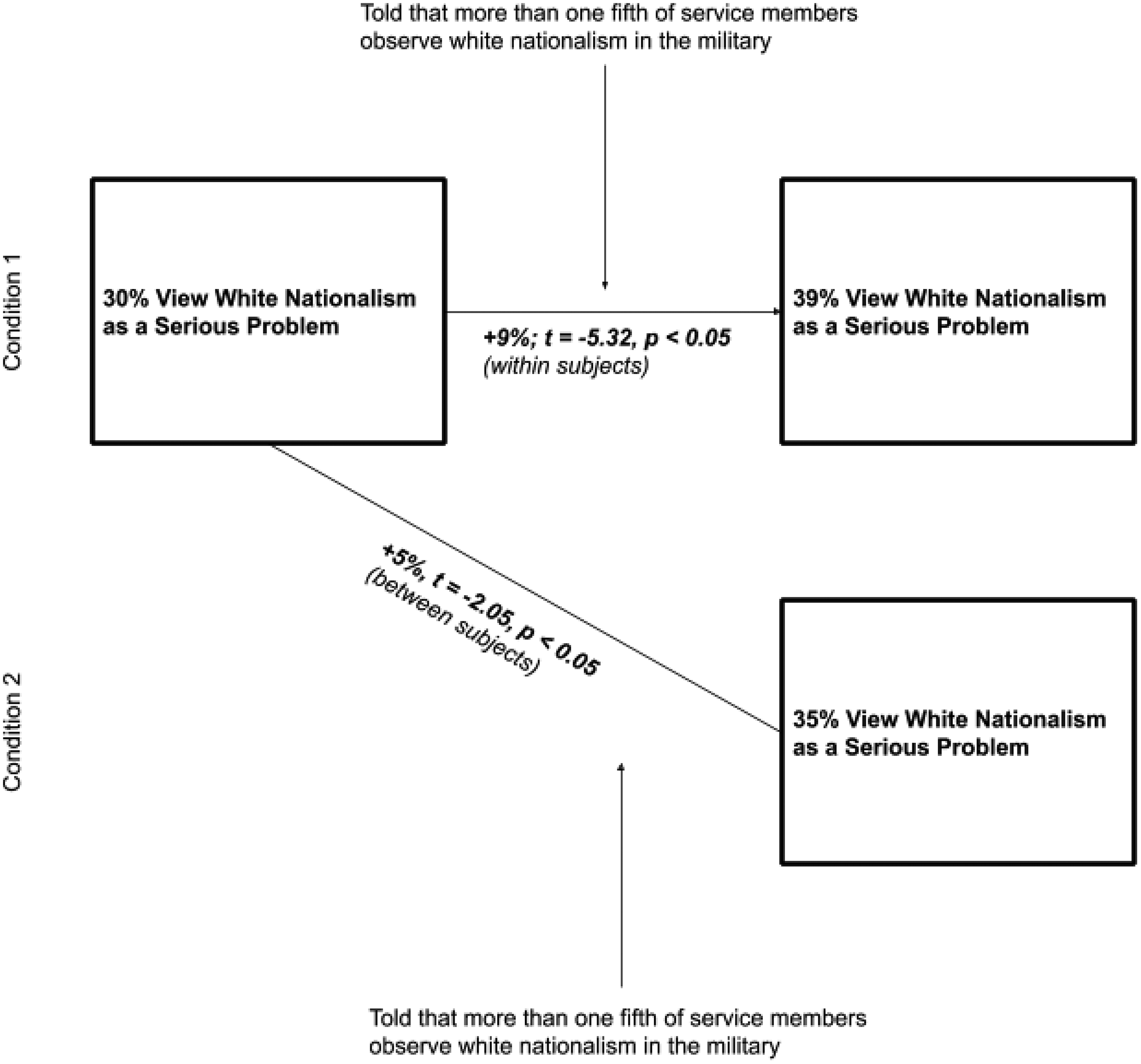
Summary of between- and within-subject’s experimental treatment effects on concern about White nationalism in the U.S. Military. Note. Grouped (horizontal line) and two-sample (diagonal line) differences in means presented with t scores and two-tailed p values in parentheses.
Experimental Results
With respect to the effect of the prevalence cue (the within-subjects portion of our experiment), we find that 37% of respondents who initially viewed White nationalism as not a serious problem (22% of the sample) reported that they viewed it as a somewhat or serious problem after being given the Military Times Poll treatment. Likewise, 28% of those who initially reported that White nationalism is a somewhat serious problem (47% of the sample) came to view it as a serious problem after being given the figure based on the Military Times Poll. Interestingly, while 82% of those who initially viewed White nationalism as a serious problem (30% of the sample) continued to hold that view after being given the Military Times Poll treatment, about 28% revised their opinion downward, suggesting that they, perhaps, expected White nationalism to be even more pervasive than has previously been reported.
The between-subjects portion of our experimental design documents a similar pattern of results. Whereas just 28% of respondents in Condition 1 viewed White nationalism as a serious problem prior to being provided with prevalence information from the MT poll, just over 35% of respondents in Condition 2 (who were provided with this information) felt the same way. This 7% difference between groups (t = −3.05) is statistically significant at the p < .05 level, two-tailed.
Correlates of Concern About White Nationalism in the Military
We find that strong conservatives and people who express strong positive affect toward the military are significantly less likely to view White nationalism in the military as a serious problem (Figure 2). While the predicted probability of believing that White nationalism in the U.S. Military is a serious problem if a respondent identifies as very liberal is 50%, the predicted probability of those who identify as very conservative believing White nationalism represents a serious problem in the U.S. Military is 15%. We find similar divergence between respondents who express low or high favorability with respect to members of the U.S. Military. The predicted probability of believing that White nationalism in the U.S. Military is a serious problem if a respondent expresses low affect toward members of the military is 46%, while the predicted probability of a respondent believing White nationalism represents a serious problem in the U.S. Military if the respondent expresses high affect toward members of the military is 27%.

Summary of between- and within-subject’s experimental treatment effects on concern about White nationalism in the U.S. Military. Note. Logistic parameter coefficients presented as hollowed circles, with 95% confidence intervals extending from each coefficient. Model estimates effects across the entire sample, adjusting for experimental condition assignment. For presentational simplicity, the constant term is not displayed. Please see the Supplementary File for additional models.
Black respondents are more likely than all other respondents to view white nationalism in the military as problematic: The predicted probability of Black respondents believing that White nationalism in the U.S. Military is a serious problem is 54%, while the predicted probability of non-Black respondents believing that White nationalism is a problem in the U.S. Military is 29%.
Given the findings presented above, we conclude examining whether our informational treatment closes the “concern gap” for ideological conservatives (compared to moderates and liberals) and for those who exhibit strong positive affect toward military service members (compared to those who do not). Because both ideological conservatives (Holsti, 1999; Mattis & Schake, 2016) and people who express positive affect toward service members tend to hold positive views toward the military, we might expect them to be particularly responsive to our experimental treatment.
To do this, we regress a pooled measure of whether or not respondents view White nationalism as a serious problem—combining pretreatment scores from Condition 1 with posttreatment (i.e., the only measured quantities) scores from Condition 2—on the interaction between a binary indicator of experimental treatment assignment and each of the above factors. To avoid excessive collinearity, we model these interactive quantities separately. Figure 3 expresses these results from these models as predicted probabilities. For reference, histograms denote the percentage of our sample earning different scores on the ideology (left-hand side) and service member affect (right-hand side) variables.

The predicted effect of the Military Times poll treatment, by ideology and views toward service members. Note. Predicted probabilities (expressed as 95% confidence intervals) presented.
The first panel in Figure 3 shows that, among conservatives, there is no statistical difference between those conservative respondents who were told that 22% of service members have seen evidence of “white nationalism or racist ideology within the armed forces (B = −0.35, p > .10). Put another way, the Military Times Poll treatment moves opinion roughly equally for both liberals and conservatives. However, the second panel in Figure 3 demonstrates that the Military Times Poll treatment significantly increases the likelihood that people who express high levels of positive affect toward military service members view White nationalism as problematic upon hearing about the issue (B = 0.95, p < .05). Put another way, the effect of service member affect is significantly less pronounced for those informed about the degree to which service members observe White nationalism in the military.
Given that the military receives overwhelming confidence (Johnson, 2018; Newport, 2017a, 2017b)—especially when compared with other institutions—in the United States, this result is encouraging: Greater awareness regarding the prevalence of White nationalism in the U.S. Military should, our experiment suggests, increase public concern for the problem. This is especially true for Americans who hold positive views toward service members—who are less likely to view White nationalism as problematic, but more likely to change their attitudes in response to information from service members drawing attention to the problem.
Conclusion
Experts are concerned about White nationalism in the U.S. Military, as are those with the most direct knowledge of the issue: members of the military. In this study, we have sought to examine whether the U.S. public is aware and concerned. The results of our survey provide some reason for optimism but also some reason for disquiet. While most Americans suspect at least some presence of White nationalism in the military, many do not view it as a serious problem. In particular, self-identified conservatives and respondents who hold highly favorable views toward military service members are less likely to view White nationalism in the military as a serious problem. However, there is some room for optimism in our experimental findings: The latter group, those who hold highly favorable views toward military service, grow more concerned about White supremacy in the U.S. Military when they are informed of the nature and scope of the issue.
The survey presents the first data on the U.S. public’s views on White nationalism in the military. However, we cannot generalize our results over time. Future research should continue to probe the public’s views on this important topic and, where possible, extend this research to probability-based samples. For example, future research should include questions that tap into attitudes toward White nationalism, and White nationalism in the military, more deeply. Civilian oversight of the military is a core tenant of civil–military relations (Feaver, 1999; Kohn, 1997; Lupton, 2017), and future research should explore the willingness of the public to understand and combat White nationalism in the military. Experimentally, future research could manipulate the source of the information from which respondents learn about White nationalism in the U.S. Military, whether its members of the U.S. Military themselves, other government agencies, press reports, watchdog groups, and so on. With respect to awareness building, our research suggests that simply making the public aware of the problem can lead to greater concern, and we speculate more pressure on lawmakers and the Pentagon to address the issue.
Supplemental Material
supplemental_information - When OK is Not OK: Public Concern About White Nationalism in the U.S. Military
supplemental_information for When OK is Not OK: Public Concern About White Nationalism in the U.S. Military by Robert Ralston, Matthew Motta and Jennifer Spindel in Armed Forces & Society
Footnotes
Declaration of Conflicting Interests
The authors declared no potential conflicts of interest with respect to the research, authorship, and/or publication of this article.
Funding
The authors disclosed receipt of the following financial support for the research, authorship, and/or publication of this article: This research has been generously supported by a College of International Studies Faculty Support Fellowship from the University of Oklahoma.

Supplemental Material
The supplemental material for this article is available online.
Author Biographies
References
Supplementary Material
Please find the following supplemental material available below.
For Open Access articles published under a Creative Commons License, all supplemental material carries the same license as the article it is associated with.
For non-Open Access articles published, all supplemental material carries a non-exclusive license, and permission requests for re-use of supplemental material or any part of supplemental material shall be sent directly to the copyright owner as specified in the copyright notice associated with the article.
