




Abstract
Traditionally, the military is seen as an unequivocally authoritarian organization. With survey data collected at the Royal Danish Military Academy, this study shows that that is a qualified truth. Thus, cadets enrolled directly from the noncommissioned officer corps—those most acquainted with the norms of the armed forces—do not weigh authoritarian leadership values over nonauthoritarian ones. Instead, their view reflects that for the experienced leader, the context, and not overt ideals, enables them to choose the leadership tools they expect will prove most effective. On the contrary, cadets enrolled based on their civilian merits clearly prioritize authoritarian values. This is particularly true among cadets returning to the military after a break, former professionals, and former draftees alike. Their view also reflects experience, but a different kind of experience, as they have primarily encountered the military hierarchy from the receiving end.
What values do you associate with military leadership—authoritarian or nonauthoritarian? Popular wisdom—as communicated in Hollywood blockbusters—clearly points toward authoritarian values, encompassing the rigor and discipline seen as distinguishing the military organization from the outside world. In popular culture, the drill instructor—whose task it is to safeguard the transition from the civilian to the military sphere—is often seen as representative of military norms. Certainly, neither “Gunny” Hartman (Full Metal Jacket, 1987), Lt. Sobel (Band of Brothers, 2001), nor D. I. Fitch (Jarhead, 2005) is a very lenient or understanding leader.
Granted, Hollywood also has a counterimage, represented, for example, by Captain Miller in the World War II epic Saving Private Ryan (1998) and Chris Kyle in the biographical Iraq War drama American Sniper (2014). These men earn the respect of others. They lead by example. They have the courage to make the tough choices through shared hardships. And by understanding the strengths and weaknesses of their subordinates, they know how to yield the best results.
So, which of these images is representative of the military today? In this article, we argue—theoretically—that the popular notion of the military as a rigid organization needs to be moderated. Military leadership values do not develop in a vacuum. They are affected by developments in the surrounding society, and they depend on the practical experiences of the men and women embodying the military organization.
Empirically, we substantiate this claim by comparing three groups of future military leaders with different enrollment backgrounds. This comparison is possible because of the implementation of the parliamentary Defense Settlement of 2012. Following this, 50% of future military leaders should be recruited from the outside, and all cadets should have a bachelor’s degree. This decision shook up the defense establishment by openly challenging the institution’s recruitment monopoly (Friedson, 1999). Now, the armed forces had to recruit a large proportion of its future leaders among people who—in the formative years of their youth—had not been socialized to the military world.
From a method’s perspective, this new recruitment procedure is interesting, because it enables a more balanced comparison of cadets recruited from the noncommissioned officer (NCO) corps with cadets recruited on the basis of their civilian merits. Before the 2012 Defense Settlement, a large proportion of the cadets also entered the armed forces from the outside. They were, however, enrolled directly from high school, as in the Sandhurst or West Point models. Accordingly, prior comparisons of cadets with a civilian background and cadets with a military background would have been difficult to interpret, as these two groups would have differed substantially both in terms of military experience and life experience. Although a large proportion of those recruited on the basis of their civilian education now have previous military experience–from deployment or NCO service—such a comparison will be more balanced, since all cadets today enter officer school at a later stage in life.
Accordingly, our aim is to compare different groups of cadets and answer the following overarching research question: Does military experience correlate with military leadership values? This research question is answered by addressing two hypotheses, each with three testable implications. These hypotheses are stated in the Theory section following this introduction. In Section 3, we describe the data and the methods used in this article. Section 4 reports the findings discussed in Section 5. Section 6 concludes the article.
Theory
Our research question relates to a long-standing discussion of how to evaluate effectiveness in professional organizations with a strong ethos. Drucker (1967/2006), the founder of modern leadership theory, saw effectiveness as essentially referring to the “ethics of action” (p. 169). What it means to be effective differs from one person to another, depending on their “ethics” or worldview.
In accordance with Drucker’s (1967/2006) initial claim, this coupling of leadership values and leadership practices has been fundamental in, for example, studies explaining the roots of transformational leadership (Bass, 1990) by referring to particular types of motivation (Jensen & Bro, 2018; Pandey et al., 2016; Vandenabeele, 2014). It also forms the basis of Quinn’s competing values framework (Quinn & Rohrbaugh, 1981), in focus on the following.
We use Quinn’s framework instead of Bass’ (1990), first because of the recently raised critique of transformational leadership measures (van Knippenberg & Sitkin, 2013). Specifically, although the multifactor questionnaire entails a number of subscales, Quinn’s framework more clearly maps how such subdimensions are interrelated, thus making the multidimensionality tangible. In that sense, the competing values framework is more context-sensitive.
Second, Quinn’s framework is not just multidimensional but also allows for multimodality, because leadership values that seem contradictory, in theory, can be interrelated in practice. Accordingly, this framework is both descriptive and entails a theoretical claim about what constitutes good leadership: the ability to combine different and seemingly incompatible practices (Cameron, 1981; O’Neill & Quinn, 1993; Quinn, 1988; Quinn et al., 2003; Quinn & McGrath, 1982; Quinn & Rohrbaugh, 1981, 1983). Contemporary theorizing on “paradox” in leadership builds on this interpretation of the competing values framework. As the importance of these theories is difficult to overestimate in recent leadership research, this is probably where Quinn’s influence has been strongest (Hargrave & Van de Ven, 2017; Johnson, 2014; Lavine, 2014; Lewis & Smith, 2014; Putnam et al., 2016; Smith, 2014; Vince et al., 2018).
Third, we use Quinn’s initial framework instead of applying a more recent reconceptualization of paradox theories for a simple, empirical, reason: The Danish military already uses a code of values inspired by Quinn. Accordingly, we can state testable hypotheses about what norms we expect to prevail in the Danish Army based on previous studies.
The Competing Values Framework
Quinn’s framework consists of two axes with apparently opposing concepts of effectiveness (Quinn & McGrath, 1982; Quinn & Rohrbaugh, 1981). One axis contrasts control with flexibility (Hellriegel et al., 1995, p. 51; Hunt & Fitzgerald, 2018: 66ff). This corresponds to the distinction between authoritarian and nonauthoritarian leadership types in focus here. The other axis contrasts a “system-internal” with a “system-external” focus on effectiveness. (If your focus is system-internal, you measure how successful your organization is by, for instance, the well-being of your employees or the achievement of your goals. If your focus is system-external, you measure organizational success by how it meets the demands of outside stakeholders. In the military, this could be politicians, local civilians, superior officers, or units you cooperate with).
Thus, four main domains—each representing a specific approach to effectiveness—can be identified: an openness approach (in the space between flexibility and a system-external focus) contrasted with a closedness approach (in the space between control and a system-external focus) and a rational approach (in the space between control and a system-external focus) contrasted with a relational approach (in the space between flexibility and a system-internal focus; Quinn & Rohrbaugh, 1983). The two axes, the opposing concepts of effectiveness, and the four established domains are illustrated in Figure 1.
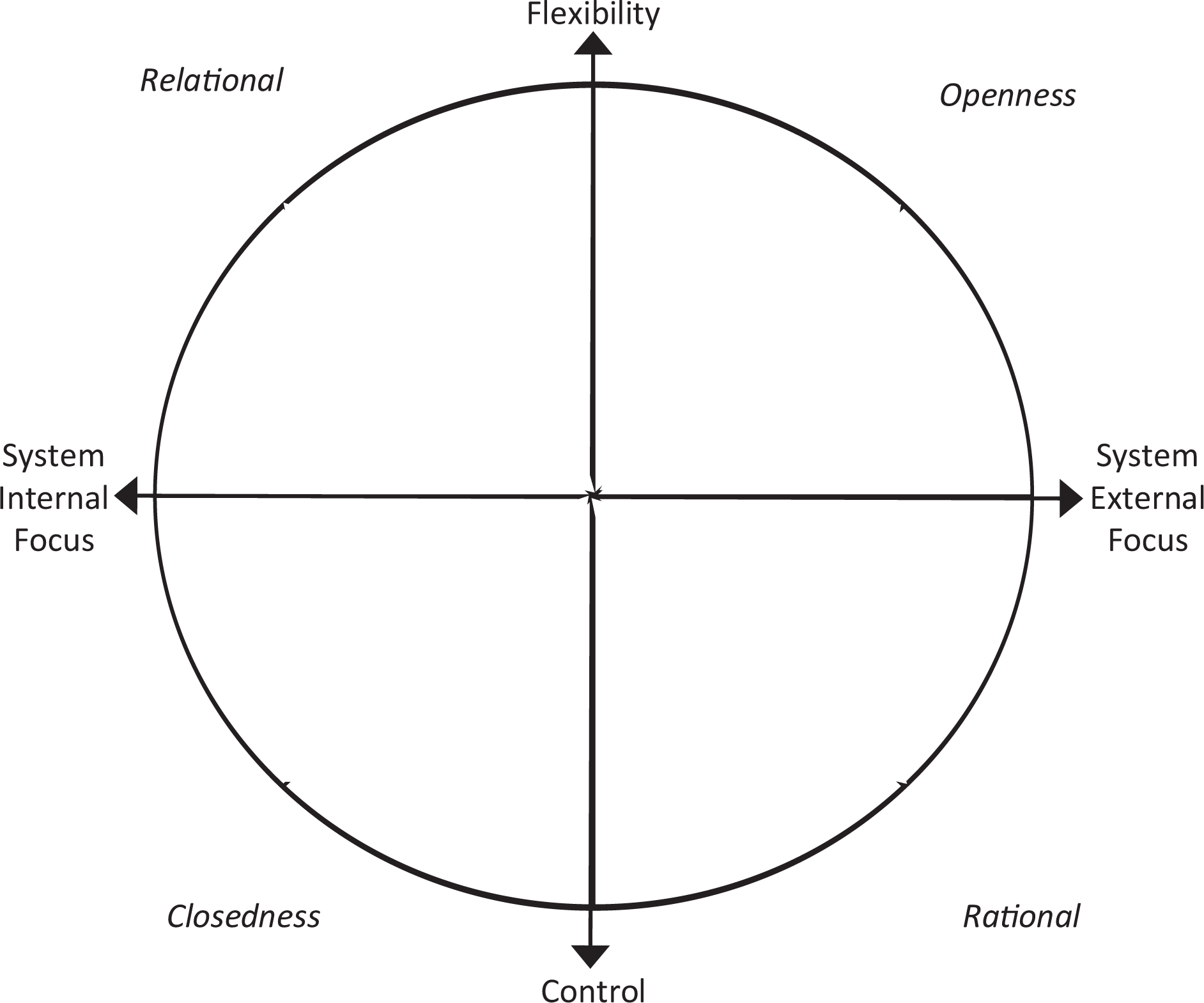
The basic framework.
Within each of these domains, Quinn identifies two leadership roles, distinguished by their proximity to either the vertical or to the horizontal axis. To illustrate, openness can be understood in two ways—either as openness toward changes (flexibility) or as openness toward other considerations (system-external focus)—signifying two different leadership roles: the “innovator” aiming at trying things in new ways and the “broker” aiming at maintaining good relations to outside stakeholders. This sums up to eight different leadership roles. Figure 2 and the table in Appendix 1 show how they are placed in the general framework.
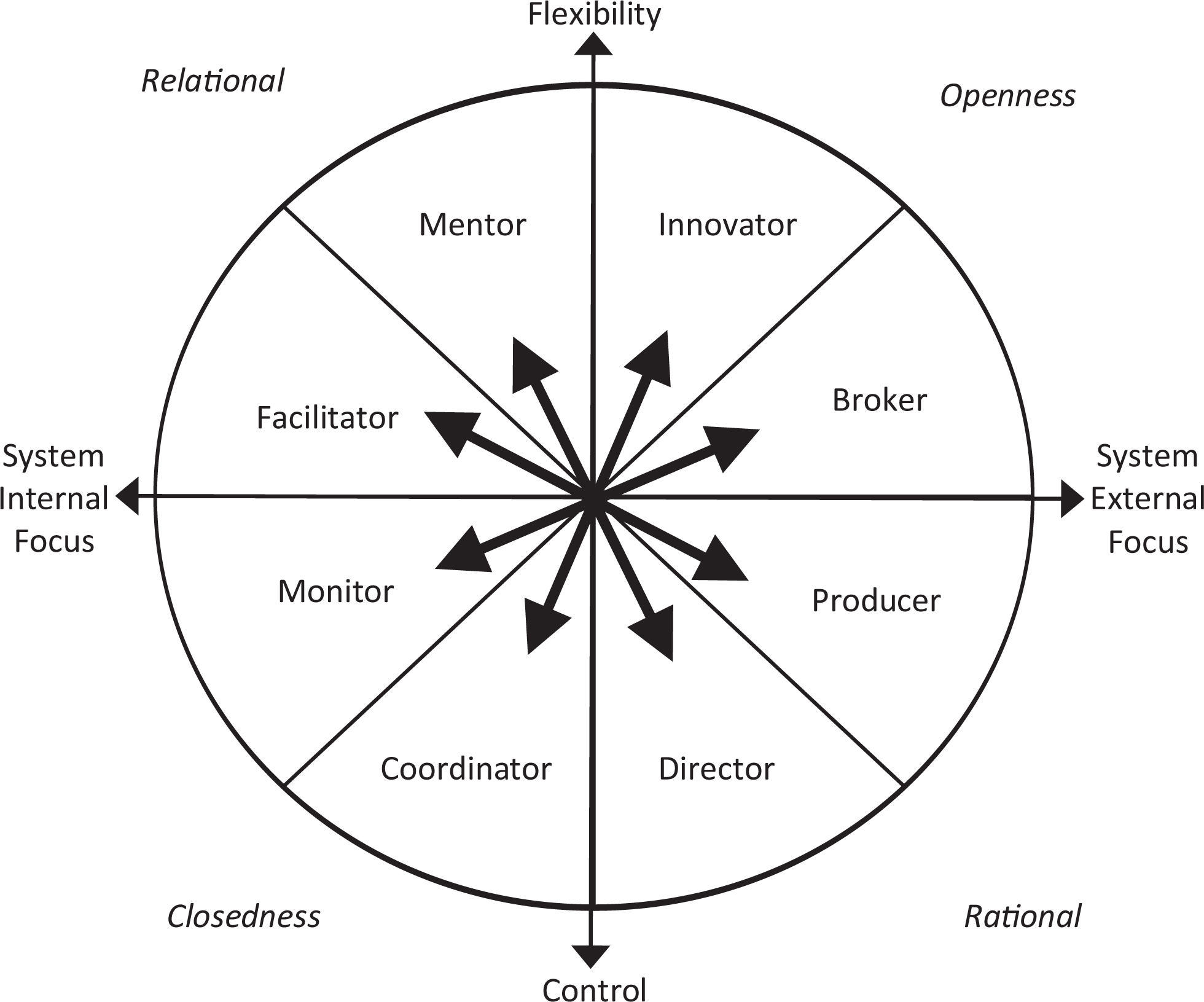
The competing values framework.
The Competing Values Framework in the Armed Forces
Below, we present each of the eight generic leadership roles in relation to the specific role of the junior officers. Each leadership role is presented along with the role it is perceived to be opposed to (as indicated by the bold black arrows in Figure 2). As already mentioned, perceived opposites may very well be combined in practice. The skilled leader recognizes that different situations require the inclusion of different—and sometimes apparently competing—leadership values.
Facilitator versus producer
Officers as facilitators are process-oriented. They encourage tolerance and synthesis of diverse views by seeking to resolve conflicts and by focusing on developing common codes of conduct and behavior. In contrast, officers as producers are task-oriented. They prioritize action and effort, often resulting in achievement by motivating and disciplining their units’ endurance and determination. Producer officers seek to optimize their subordinates’ skilled performance.
Mentor versus director
Officers as mentors are empathy-oriented. They prioritize taking care of their subordinates and are concerned about their subordinates' well-being and professional and personal development. Accordingly, the mentor officer is also responsive and attentive to their particular needs. In contrast, officers as directors are command-oriented. They prioritize transparent planning and goal-setting. During operations, the director officer adjusts objectives to ensure that everybody fulfills their role.
Innovator versus coordinator
Officers as innovators are risk-oriented. They are open-minded. They see new opportunities and are not afraid of challenging prevailing practices. In contrast, the officer as coordinator’s main concern is with the organization. Coordinators prioritize evidence-based methods and analytical tools in order to establish well-functioning and reliable structures and a smooth flow of operations. Coordinator officers see themselves as dependable, precise, and concise.
Broker versus monitor
Officers as brokers are concerned with the external reputation and legitimacy of their units. Furthermore, broker officers influence through negotiation with outsiders, ensuring that the units of which they are in charge get the resources they need. In contrast, officers as monitors are evidence-oriented. They prioritize formal structures and processes for problem-solving and focus on knowing exactly what is going on and to what degree tasks are successfully undertaken and accomplished. Monitor officers audits their subordinates to learn whether they comply with prevailing rules.
The Role of Leadership Values in the Military
Huntington’s (1957/1985) The Soldier and the State from 1957 contains the ideal, typical characterization of the leadership values traditionally prevailing in the military: “Military and civilian writers generally seem to agree that the military mind is disciplined, rigid, logical, scientific; it is not flexible, tolerant, intuitive, emotional” (p. 60). In this perspective, officers are bellicose and authoritarian (p. 15). Offhand, if such values were truly undisputed in the military, we should expect cadets recruited from the rank and file—already socialized to the organization’s mindset—to be more rational and goal-oriented and less flexible than those of their colleagues enrolled on the basis of their civilian merits only. Such an expectation would, however, rely on the assumption that the military has not changed since 1957.
Naturally, this is not the case. Not in America and not in Denmark either. Thus, a crucial point in Holsting’s (2017) study of top brass officer values in the Danish armed forces is that such traditionalistic leadership values have been challenged, as the military mindset has adapted to societal trends (p. 301–302). This is in accordance with Moskos’ (1977) prediction that following the shift from an “institutional” to an “organizational” model, core military values and external values will become balanced rather than regarded as mutually exclusive (Moskos & Wood, 1988, p. 13). Competing leadership roles coexist, the central claim of this article.
In Denmark, the process of aligning civil and military values took speed in the 60s and 70s, after an officer recruitment crisis triggered the development of a code of military leadership that introduced progressive pedagogical ideals and informal leadership approaches (Minister of Defense, 1966; Pedersen, 1979, p. 1). This leadership code, reflecting similar progressive reforms in the educational sector, was implemented in 1982 (Chief of Defense, 1982) and served as the normative foundation of officer education until 2008. Then, a new set of guidelines was implemented (Defense Command, 2008). This time, the code was inspired by the competing values framework (albeit in the rudimentary four-domain version presented in Figure 1). Focus group interviews conducted in the implementation process showed that military personnel, regardless of rank and branch, prioritized nonauthoritarian values over authoritarian values. Findings from these interviews can be seen in Appendix 2.
The hypotheses stated below draw on the person/organization fit theory (Kristof-Brown et al., 2005). Thus, given that nonauthoritarian leadership values seem to play an increasingly important role in the military, our overall expectation is that those most acquainted with the military system will be most likely to embrace these values. This is supplemented by an “attraction” and a “socialization” explanation (Leisink & Steijn, 2008; Schneider, 1983), according to which the specific fit is moderated by the cadets’ type of experience with the military system. The first set of hypotheses addresses how three groups of cadets, based on their enrollment qualifications, are expected to weigh leadership roles against each other. The second set compares cadet views across these groups.
Weighing Values Against Each Other
Formally, there are now two career tracks for future Danish officers. You can either enroll from the outside, as a civilian, or you can enroll from the inside, as a regular (NCO). Regardless of your point of departure, you must have a bachelor’s degree or an equivalent tertiary-level education. However, many of those who enter the ranks from the outside have professional military experience—NCO experience or deployment experience. In reality, we therefore distinguish between three types of cadets: those recruited solely on the basis of their civilian merits, those recruited from the outside with previous military experience, and those recruited solely from the inside.
Both cadets from the rank and file and cadets with previous military experience decide to pursue a career in an organization they already know. Moreover, anyone who has undergone NCO training will have learned, in theory, that the authoritarian view of the army does not prevail. Thus seen, following the attraction explanation, both groups should be expected to recognize the importance of nonauthoritarian leadership values. Yet as cadets from these two groups have acquired their knowledge about the military from fundamentally different perspectives, the socialization explanation implies that they are nevertheless likely to differ.
Those entering the Royal Danish Military Academy from the rank and file can draw on their actual leadership experiences. Their knowledge is practice-based. They have spent several years executing leadership tasks set by officers acknowledging the importance of nonauthoritarian leadership values. Furthermore, many of these servicemen have field experience as NCOs in Iraq and Afghanistan. Accordingly, they have learned, the hard way, that one of the hallmarks of a good military leader is their ability to choose between leadership roles (Rokos, 2006, p. 9). This is in accordance both with Quinn’s (1988) interpretation of the framework (pp. 25, 48) and with findings from research substantiating Moskos’ (1977) aforementioned prediction: Contemporary officers are “pragmatic professionals,” embodying the balance between apparently incompatible norms (Segal, 1986; Stahl et al., 1980; Woodruff et al., 2006). This notion forms the basis of Hypothesis 1a.
Cadets returning to the military after a break are expected to prioritize differently. For two reasons: Their knowledge of the prevailing values of the military organization is primarily theoretical and to a lesser extent founded on actual leadership practice. Moreover, the military experience they do have was acquired at the bottom of the organizational hierarchy. According to their experience, following orders gets you through boot camp and keeps you alive on the battlefield. The knowledge of this group differs substantially from the knowledge of those enrolled from the rank and file. Moreover, given that they now return with a civilian degree, they deliberately opt out of civilian career opportunities and instead choose the hierarchical structure of the military they know primarily from the receiving end. This forms the basis of Hypothesis 1b.
We also expect cadets recruited solely on the basis of their civilian degree to prioritize in this way. In terms of attraction, these cadets pursue a career path that they only know in theory. They are attracted to the military not because of the values actually prevailing within the organization but because of the values they think prevail therein. Due to budget cuts and fewer conscripts, general knowledge of the military is scarce. In spite of the armed forces’ recognition of the worth of flexible leadership values, the military is still seen as an authoritarian organization. We know that the public notion of other professions—of physicians and lawyers, for example—mirrors how these are represented in Hollywood blockbusters and not how they work in practice (Porsdam, 2005). Thus, if popular culture depicts the military as dominated by authoritarian values, this will also shape the public image of the organization.
Moreover, while Denmark has a long tradition of peacekeeping missions, Danish foreign policy has been increasingly “militarized” since the 1990s, culminating in Afghanistan, where public support remained strong in spite of heavy losses (Jakobsen & Ringsmose, 2015). This image of Danish soldiers as soldiers engaged in actual fighting instead of peacekeeping also adds to the notion that a military career requires a classical military mindset.
In terms of socialization, these cadets enter the military academy after NCO boot camp and short-term service. Some have been conscripts before. Still, their practical knowledge of military leadership values is nevertheless based on their encounter with the institutions created to ensure that newcomers appropriate the discipline and obedience necessary to fulfill their place at the bottom of the organizational hierarchy, a process that will only strengthen the notion of the military as a rigid system. Finally, we cannot rule out the possibility that this particular group seeks to “overcompensate” for their lack of practical experience when filling out a survey on leadership values. This would also enhance their likelihood of embracing authoritarian values. This is the basis for Hypothesis 1c.
To test Hypotheses 1a–1c, we will compare how authoritarian leadership roles are weighed against nonauthoritarian leadership roles for each group, expecting all cadets recruited from the outside to put most emphasis on the authoritarian ones. Our unit of analysis is not the groups, but the cadets. We therefore also expect enrollment background and leadership values to correlate at the individual level. Following the same line of reasoning as above—that experienced leaders draw on a broader repertoire of leadership values—we therefore formulate Hypothesis 2a as follows:
To test Hypothesis 2a, we will compare how all the cadets weigh specific leadership roles, expecting all cadets with a civilian background to score lower on nonauthoritarian values. Following the socialization explanation stated above, this is a result of the cadets’ very different experiences with military leadership in practice: Those who have only been at the receiving end of the military hierarchy will prioritize leadership values differently than those who have tried to lead. This forms the basis of the supplementary hypotheses, Hypotheses 2b and 2c, introducing measures to control for the different socialization processes the cadets have been through.
To test Hypothesis 2b–2c, we will examine how leadership experience and conscript service, respectively, correlate with Quinn’s leadership roles. Here, we expect leadership experience to be positively associated with nonauthoritarian values and the opposite to be the case for conscript service.
Data and Method
The analyses below are based on data from surveys conducted among three cohorts of cadets immediately after they arrived at the Royal Danish Military Academy. The surveys were conducted as group enquetes in 2017, 2018, and 2019. All cadets from the three cohorts participated. In that respect, our surveys can be regarded as population data. Any difference encountered herein will mirror actual differences among these cadets. Analytically, however, we expect our findings to be generalizable beyond this particular context: to subsequent Danish Army cohorts, to other Danish service branches, and, perhaps, to other countries—for example, the Netherlands—with similar enrollment traditions (Sarvas & Hodny, 1998) and undergoing similar enrollment reforms (Jansen et al., 2019). Assuming that residual responses are evenly distributed around variable means (Rubin, 1985), we treat the observations as sample data proper, reporting p values used to signify the robustness of the results within this data set.
Table 1 shows the characteristics of the survey respondents.
Respondent Overview.

Source: Cadets. Royal Danish Military Academy (2017, 2018, & 2019).
Note. Age, mean (standard deviation in parentheses), and median by enrollment year, enrollment type, and gender.
a In 2017, 10 respondents, six with a civilian background, three with a civilian and military background, and one from the rank and file, did not report their age. b In 2018, one male respondent, a civilian with a previous military career, did not report his age.
Rank and file cadets are older, and the female cadets are slightly younger than the men. As both age and gender may correlate with enrollment procedures (Tresch et al., 2007) and with leadership values (Belasen & Frank, 2012), we control for both variables when comparing the cadets.
The main independent variable—enrollment type—draws on self-reported answers from each cadet. Respondents with former military experience enrolled on the basis of civilian merits were placed in a separate group. Initially, this recategorization did not include conscript experience, as Denmark still has draft service. Instead, conscript experience is introduced in the test of Hypothesis 2 below, where we also control for the significance of practical leadership experience and of deployment service.
The dependent variable reflects scores on different leadership types in the competing values framework. Following Quinn, each leadership role was measured using two items. Our operationalization nevertheless differed in two ways. First, we revised the question wording to ensure that the items captured the conceptual breadth in the military context (Appendix 3). Second, in 2017, we sought to enhance the competing nature of the framework by asking cadets to prioritize leadership values two by two. While this, in terms of measurement, enabled a harder test than simply asking them to score values separately, the procedure also put severe limitations on the tests that could be conducted on the basis of such measures. In 2018 and 2019, we therefore returned to Quinn’s (1988) initial procedure and simply listed the items (Chapter 9). The subsequent analyses focus primarily on findings from these two cohorts.
Above, we distinguished between authoritarian and nonauthoritarian leadership roles, assuming that this distinction was aligned with the difference between the upper and the lower half of Quinn’s framework: with flexibility and control, respectively. To test the soundness of this distinction, we conducted a factor analysis of the competing values framework measures. The analysis reveals two dimensions with an eigenvalue above 1 with items falling into two groups, one associated with the authoritarian values in the lower half of Quinn’s framework (control) and another with nonauthoritarian values in its upper half (flexibility). Appendix 4 shows factor loadings and α scores for all values.
To test Hypothesis 1, we compare the means of these two factors for each of the three groups of cadets, using a one-sided t test. While we expect to see no difference for cadets with a military background (Hypothesis 1a), we expect the control dimension to score significantly higher than flexibility for both of the other groups (Hypothesis 1b–1c). To test Hypothesis 2, we use ordinary least squares regressions to analyze the explanatory strength of enrollment type for flexibility and control. We conduct these analyses in three steps, first focusing on the significance of gender and age, then on military socialization, conscript service, and leadership experience (Hypothesis 2b–2c), and finally on enrollment type (Hypothesis 2a). We expect to see those recruited from the rank and file to score significantly higher on leadership types associated with flexibility.
Observations
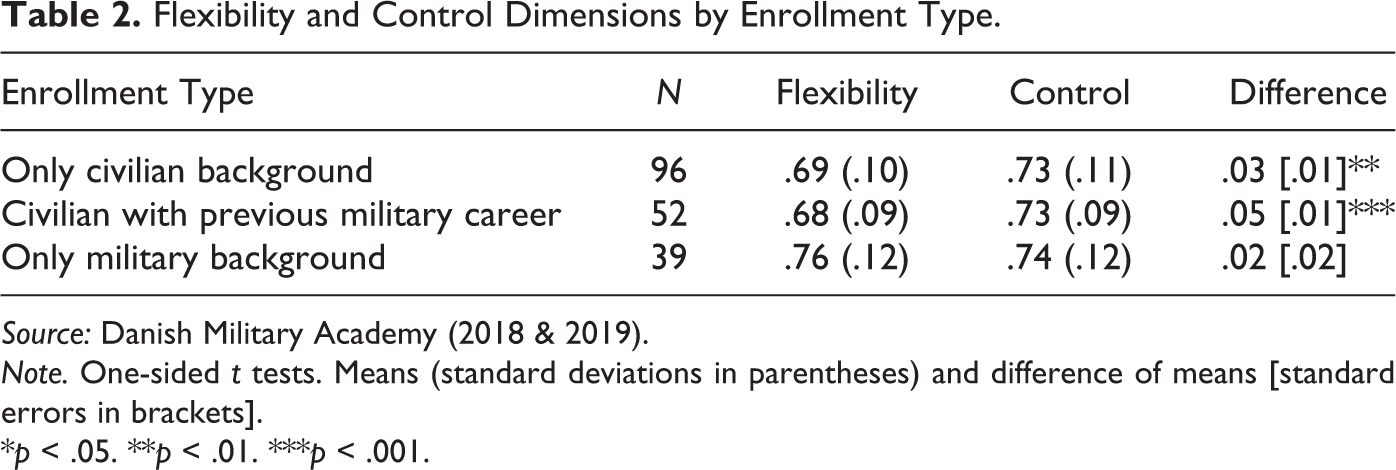
According to Hypothesis 1, rank and file cadets should prioritize between control and flexibility values (a), while all other cadets should rank control over flexibility (b–c). Table 2 shows mean scores for the two domains for each of the three groups.
Flexibility and Control Dimensions by Enrollment Type.
Source: Danish Military Academy (2018 & 2019).
Note. One-sided t tests. Means (standard deviations in parentheses) and difference of means [standard errors in brackets].
*p < .05. **p < .01. ***p < .001.
The t tests support the hypotheses. It should be mentioned, though, that the overall factor means conceal substantial differences between some of the specific leadership values and that cadets returning to the military seem to value control somewhat stronger than the two other groups. We return to these two points below.
Hypothesis1 focuses on within-group differences. Hypothesis 2 focuses on individual differences across the groups. Following Hypothesis 2a, cadets with a military background should associate more strongly with the flexibility domain than the two groups of cadets with a civilian background. Hypotheses 2b–2c specifically focus on the importance of past encounters with the military hierarchy: with practical leadership experience (b) and conscript experience (c). In order to test Hypotheses 2a–2c, we have conducted two stepwise regression analyses, one for each of the two overall factors, control, and flexibility. The results are shown in Table 3, below.
Control and Flexibility Dimensions by Gender and Age, Conscription and Leadership Experience, and Type of Enrollment.

Source: Royal Danish Military Academy (2018 & 2019).
Note. Stepwise OLS regressions. Coefficients [standard errors in brackets].
*p < .05. **p < .01. ***p < .001.
In Model I, we look at the isolated importance of the background variables, gender, and age. Model II includes military experience, conscription, deployment service, and actual command leadership. Finally, Model III tests the significance of the main independent variable, enrollment type. F tests, estimating the r2 increase, have been conducted for Model II and Model III in both analyses.
Neither gender nor age seems to play any role at all. And when looking at the first set of analyses (control), none of the models contributes to explaining the importance of control. In the second set of analyses (flexibility), however, there seems to be a clear correlation between leadership experience and the dependent variable in Model II. Thus, on a 0- to 1-point scale, those who have had command responsibility during deployment score .10 higher on the flexibility factor than other cadets. In Model III, the explanatory strength of leadership experience (Hypothesis 2b) is absorbed by that of enrollment background (Hypothesis 2a), as all rank and file cadets score .10 points higher, on average, than cadets recruited from the outside. Yet including the main explanatory variable also reveals that conscription (Hypothesis 2c) makes a difference. Thus, according to Model III, cadets who have only served as draftees are .05 points more negative toward nonauthoritarian values.
Discussion
To sum up, while Hypothesis 1 is unequivocally supported, the findings in regard to Hypothesis 2 reveal a more complex pattern. Enrollment background (a) appears to be the strongest predictor for leadership values. Yet whereas introducing enrollment background causes the initially observed significance of leadership experience (b) to disappear, it also reveals that conscript experience plays a role (c).
In the following, we will focus on three main points raised in regard to the analyses above: the differences between leadership types loading on the same overall factor, the role of practical leadership experience, and the significance of conscription service. Figure 3 illustrates how the three enrollment groups scored on each of the eight leadership types in Quinn’s competing values framework. This constitutes the point of departure for our subsequent reflections.
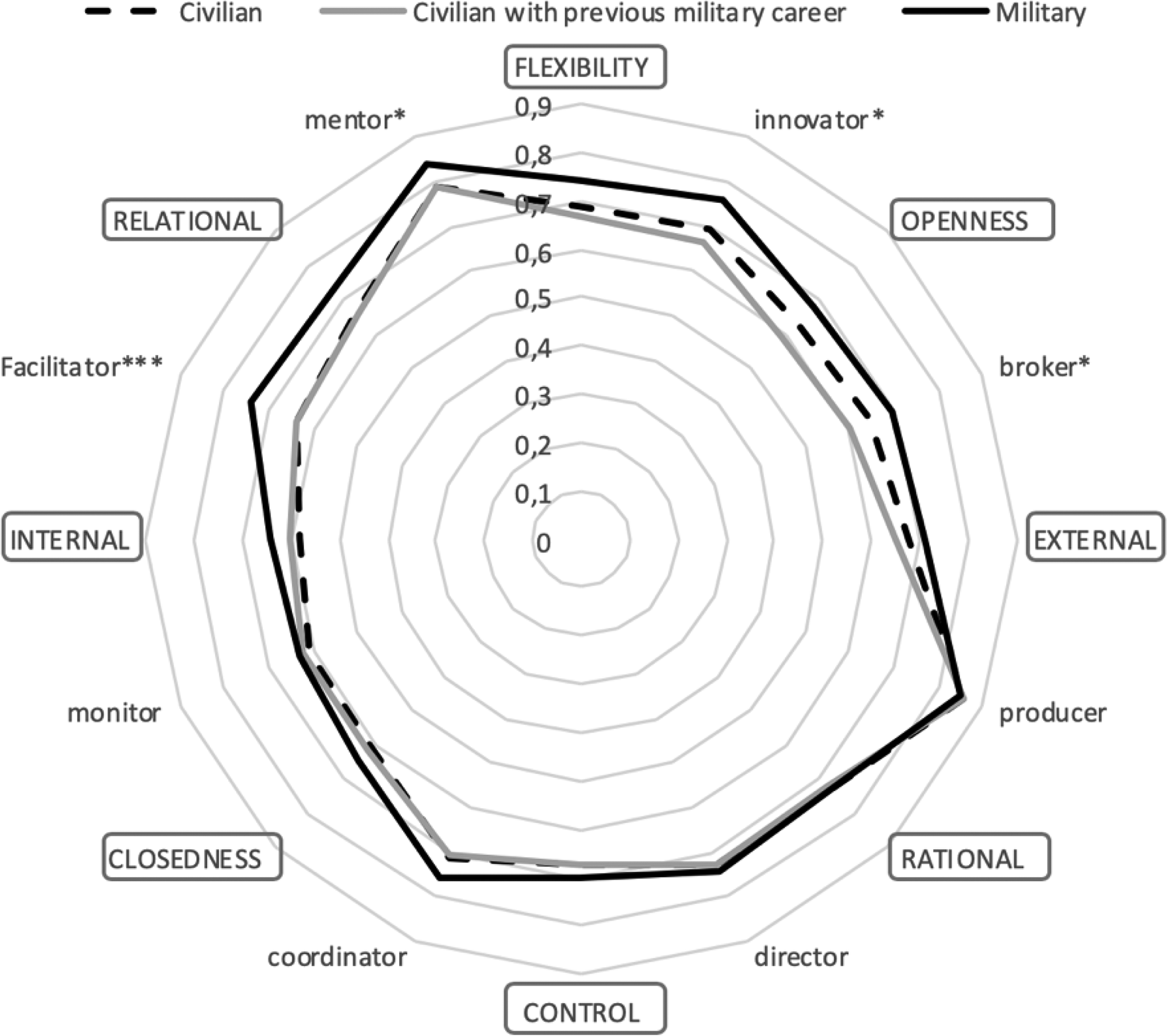
Radar. Leadership roles by enrollment type.
Figure 3 clearly reveals the role of enrollment background in regard to the values in Quinn’s framework. While the three enrollment groups are closely aligned when it comes to the authoritarian leadership values associated with the control factor, cadets recruited directly from the rank and file are significantly more positive when it comes to values associated with the flexibility factor. As mentioned in regard to Hypotheses 1a–1c, there are, however, notable differences underlying the scores of the two overall factors. Most remarkably, the officer as producer—the value placed in the lower right corner—scores significantly stronger than all other leadership types for all cadets, regardless of enrollment background.
This is not quite as surprising as the very general distinction between flexibility and control seems to imply. Conceptually, this probably reflects the fact that the main purpose of the military is to produce results. Politicians define the strategic goals. The military does what it takes, operationally and tactically, to reach these goals. Empirically, this hallmark of the military institution—the disciplined execution of legal orders and fulfillment of military objectives—has been presented as a key officer value since the birth of the territorial state (Holsting, 2017, p. 118). Leadership values are not acquired in a zero-sum game. The fact that officers today also emphasize the importance of other values—for example, those associated with flexibility in Quinn’s framework—has not caused the role of the producer to lose its significance. The producer can be seen as the master value, the one that defines the overall purpose of military service. And in that light, the other values constitute means set in place to reach that overall purpose. This may explain why all cadets value the producer role. In this way, our findings support Quinn’s theory of competing, but symmetric values. Unlike the values associated with flexibility, this is not a new skill set, and cadets with a civilian background recognize this rational value as fundamentally associated with the authoritarian perception of the military, which they pursue. What sets cadets with a military background apart is that they have learned that the new, auxiliary values represented by the mentor, the facilitator, the innovator, and the broker are also necessary in order to fulfill military objectives.
We now turn to the limited support for Hypothesis 2b. In Figure 3, most of those who have leadership experience from deployment are part of the group of cadets recruited directly from the military. Likewise, most of those formerly deployed without leadership responsibility are included in the group of cadets returning to the military. Thus seen, it is not surprising that the correlation between leadership experience and leadership values disappears when controlling for enrollment background. Furthermore, this is supported by the fact that within the group of cadets recruited directly from the military, there is no difference between those with practical leadership experience and those who have merely served as NCOs at home.
However, before rejecting the possibility that leadership experience plays any role at all, two things must be taken into consideration. First, the reason why Hypothesis 2b was initially supported is that there is a very strong correlation between leadership experience and leadership values if we only focus on the 47 cadets with former deployment experience. Those who have not served in leadership positions during deployment score .09 lower on the flexibility factor than those who have. Within this group, the difference is significant (p = .008), and leadership experience explains 15% of the variation on the dependent variable (Appendix 6). Second, although Model III shows that leadership experience and enrollment background strongly correlate, overall, a closer look at these 47 respondents also reveals that among those with deployment experience, leadership during deployment predicts flexibility scores better than their enrollment background. The small number of observations does not enable any statistical controls. In conclusion, we can reject Hypothesis 2b. Practical leadership experience does not make a difference in general. However, data does not exclude the possibility that practical experience may play a particular role under particular circumstances.
The last point we address regards the role of conscription. The reason why the role of conscription becomes negative when controlling for enrollment background is that only one of the three groups—cadets recruited without former professional military experience—includes respondents who have not been through draft service. Still, it is noteworthy that Hypothesis 2c is not only supported but also further supports the line of reasoning behind Hypotheses 1b–1c and Hypothesis 2a: If your encounter with military leadership primarily originates from serving at the receiving end, you are likely to view values associated with flexibility negatively. Moreover, this also indicates that we may have to clarify our distinction between enrollment background even further.
Figure 3 revealed that cadets who have not been employed by the military constitute a “middle category” when it comes to the openness domain. The support for Hypothesis 2c, however, indicates that if we split up this group, we should expect cadets who have served as conscripts to align with those returning to the military and cadets who have not served to align with those recruited directly from the rank and file. Figure 4 shows the scores for all cadets, where this middle group, “the outsiders,” is subdivided into two, depending on their conscript experience.
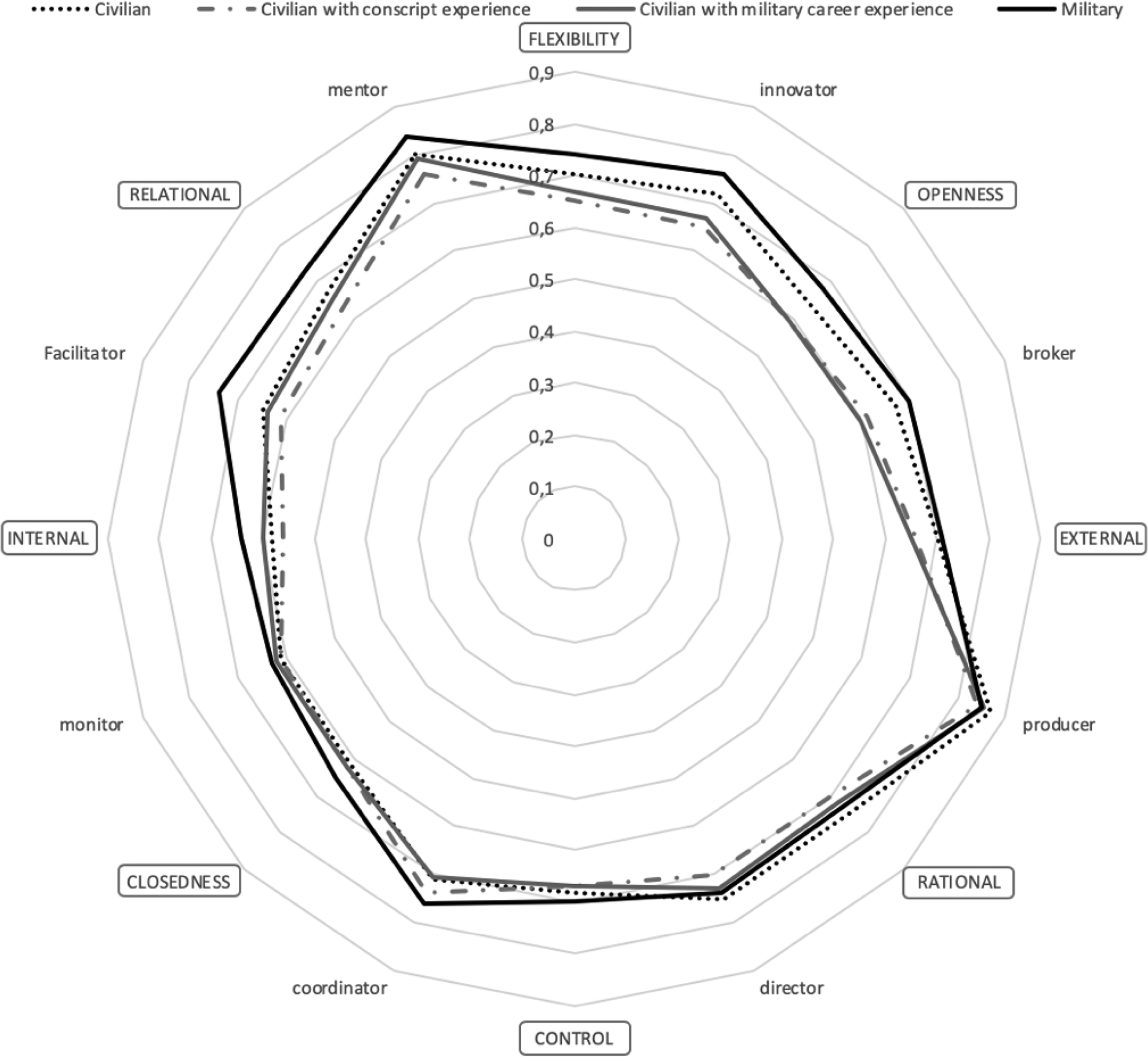
Radar. Leadership roles by enrollment type and conscript service.
If we only focus on the upper left corner, Figure 4 reveals the same pattern as Figure 3. Cadets recruited directly from the rank and file are still clearly distinguishable from the other three groups. Separating former conscripts from the rest of the group who have no military employment experience changes little. Thus seen, only these “true insiders” acknowledge the importance of relational values. Those less familiar with the organization do not. When turning our attention to the upper right corner, however, it is almost impossible to discern the values of those who have served as conscripts from the values of those who have previously been employed by the military. Moreover, the “true” outsiders, those entering the organization without any military experience at all, seem more similar to those who have enrolled directly from the rank and file. A simple regression analysis supports this visual pattern: When it comes to openness, former conscripts overlap with those returning to the military and they differ significantly both from cadets with a purely civilian background, the “true outsiders” and cadets who have never left the military (results not shown).
There is still a difference between the true outsiders and the true insiders. As in the case of those returning to the military, this can be explained both with reference to attraction (they know less about the reality of military leadership) and socialization (during their NCO training they have also mainly encountered the system from the receiving end). Nevertheless, as these outsiders still constitute a middle group, it should also be emphasized that differentiating between those who have and those who have not served as conscripts enables us to understand more fully the power of experience.
Enrollment is a proxy for military experience. Not only does it indicate whether you have previous military experience, it also reveals which type of experience you have. Cadets returning to the military seem more skeptical toward nonauthoritarian values. This is especially clear in regard to the openness domain, where both former employees and former conscripts score significantly lower than cadets from the two other groups (the true insiders from the rank and file and the true outsiders without conscript experience). Thus seen, it appears that those who return to the military do so because they long for something, perhaps a simplicity or a straightforwardness, which they have learned characterizes military life. If that is correct, the scores of the true insiders suggest that this hope is about to be shattered. By recognizing the importance of both authoritarian and nonauthoritarian values, the insiders seem to acknowledge the complexity of leadership and the necessity of being able to draw on different tools in practice. If this interpretation stands, it also implies that those entering from the outside—without any military employment or conscript experience to draw on—seem more suited for dealing with the complex reality of the officer’s calling than those returning to the service.
Conclusion
There is a clear and substantial difference between the leadership values held by cadets enrolled at the Royal Danish Military Academy, depending on their enrollment background. Cadets enrolled directly from the rank and file are much more likely to embrace leadership values associated with flexibility, openness, and human relations. This difference is particularly strong when comparing these insiders to cadets returning to the military with a degree from the civilian educational system. The third group of cadets, enrolled without previous military employment experience, constitutes a middle category. Yet if this group is subdivided, depending on conscript service, the overall pattern is repeated. Experience from the receiving end of the military hierarchy makes you more skeptical toward nonauthoritarian values.
The findings emphasize the importance of understanding Quinn’s competing values framework correctly. Although the producer role continues to hold a prominent position, the framework should not be seen as a compass where you can choose a heading and then uncritically stick to that. Instead, it should be seen as a toolbox or a manual telling you which part of the leadership repertoire you should draw on, depending on the demands of the context. Yet the experience you carry with you determines how you interpret the framework. Cadets whose knowledge of the military is based on following orders rather than issuing orders adhere to authoritarian values at the expense of nonauthoritarian ones. For those who know the system from within, however, the choice of leadership values is not a question of idealistic either-or, but of pragmatic both-and.
Supplemental Material
Supplemental Material, appendix_1,_table_a - The Power of Experience? Innovative and Authoritative Leadership Values Among Danish Army Cadets
Supplemental Material, appendix_1,_table_a for The Power of Experience? Innovative and Authoritative Leadership Values Among Danish Army Cadets by Morten Brænder and Vilhelm Stefan Holsting in Armed Forces & Society
Supplemental Material
Supplemental Material, appendix_2,_figure_a - The Power of Experience? Innovative and Authoritative Leadership Values Among Danish Army Cadets
Supplemental Material, appendix_2,_figure_a for The Power of Experience? Innovative and Authoritative Leadership Values Among Danish Army Cadets by Morten Brænder and Vilhelm Stefan Holsting in Armed Forces & Society
Supplemental Material
Supplemental Material, appendix_3,_table_b - The Power of Experience? Innovative and Authoritative Leadership Values Among Danish Army Cadets
Supplemental Material, appendix_3,_table_b for The Power of Experience? Innovative and Authoritative Leadership Values Among Danish Army Cadets by Morten Brænder and Vilhelm Stefan Holsting in Armed Forces & Society
Supplemental Material
Supplemental Material, appendix_4,_table_c - The Power of Experience? Innovative and Authoritative Leadership Values Among Danish Army Cadets
Supplemental Material, appendix_4,_table_c for The Power of Experience? Innovative and Authoritative Leadership Values Among Danish Army Cadets by Morten Brænder and Vilhelm Stefan Holsting in Armed Forces & Society
Supplemental Material
Supplemental Material, appendix_5,_table_d - The Power of Experience? Innovative and Authoritative Leadership Values Among Danish Army Cadets
Supplemental Material, appendix_5,_table_d for The Power of Experience? Innovative and Authoritative Leadership Values Among Danish Army Cadets by Morten Brænder and Vilhelm Stefan Holsting in Armed Forces & Society
Supplemental Material
Supplemental Material, appendix_6,_table_e - The Power of Experience? Innovative and Authoritative Leadership Values Among Danish Army Cadets
Supplemental Material, appendix_6,_table_e for The Power of Experience? Innovative and Authoritative Leadership Values Among Danish Army Cadets by Morten Brænder and Vilhelm Stefan Holsting in Armed Forces & Society
Supplemental Material
Supplemental Material, appendix_7,_table_f - The Power of Experience? Innovative and Authoritative Leadership Values Among Danish Army Cadets
Supplemental Material, appendix_7,_table_f for The Power of Experience? Innovative and Authoritative Leadership Values Among Danish Army Cadets by Morten Brænder and Vilhelm Stefan Holsting in Armed Forces & Society
Footnotes
Declaration of Conflicting Interests
The authors declared no potential conflicts of interest with respect to the research, authorship, and/or publication of this article.
Funding
The authors received no financial support for the research, authorship, and/or publication of this article.
Supplemental Material
Supplemental material for this article is available online at http://journals.sagepub.com/doi/suppl/10.1177/0095327X20951435 and 
Author Biographies
References
Supplementary Material
Please find the following supplemental material available below.
For Open Access articles published under a Creative Commons License, all supplemental material carries the same license as the article it is associated with.
For non-Open Access articles published, all supplemental material carries a non-exclusive license, and permission requests for re-use of supplemental material or any part of supplemental material shall be sent directly to the copyright owner as specified in the copyright notice associated with the article.
