



Abstract
The wide use of networks warrants a closer examination of network research in public administration. This article focuses on the methodological issues of network research and examines how social network analysis has been used and can be used to advance network research in public administration. Through a content analysis of 81 network articles, we found that the topics examined through network analysis have become more diverse in recent years. Yet relatively few articles have examined the intersection of policy networks, governance networks, and collaborative networks. The field needs more mixed-methods research designs and more research on the substructures of networks and multilevel networks.
Over the past few decades, the study of networks has become an important field of social science research. In recent years, we have seen a rapidly growing interest in networks in public administration (Isett, Mergel, LeRoux, Mischen, & Rethemeyer, 2011; Lecy, Mergel, & Schmitz, 2013; Provan & Lemaire, 2012). It is, “for many, the age of networks and collaboration” (McGuire, 2006, p. 34). This phenomenon has been driven by the practical need to address concerns that grew out of the “hollowing out of the state,” or collaborative governance (Frederickson, 1999; Rhodes, 1996), as well as the methodological advancements of network research in neighboring disciplines (Berry et al., 2004).
Collaborative governance, different from traditional bureaucratic approaches to government, is characterized by the engagement of nonstate stakeholders in public service and more horizontal interactions between the public, private, and nonprofit sectors (Ansell & Gash, 2008; McGuire, 2006). The wide application of networks to public management warrants a closer examination of network research in public administration (Popp, MacKean, Casebeer, Milward, & Lindstrom, 2013). Networks are used both as a metaphor to describe and explain intergovernmental, cross-sector, and interorganizational relationships (Koliba, Meek, & Zia, 2010) and as methodological tools to examine relational data (Choi & Kim, 2007; Kapucu, 2006a ; Kapucu & Demiroz, 2011; J. Lee & Kim, 2011; Wachhaus, 2009).
Laurence O’Toole (1997) recommended that researchers “treat networks seriously,” conduct a systematic assessment of various types of networks, and study the structural aspects of networks in public administration (p. 45). Over the past few years, scholars have published comprehensive reviews of network research in public administration (e.g., Berry et al., 2004; Isett et al., 2011; Lecy et al., 2013; Provan, Fish, & Sydow, 2007; Provan & Lemaire, 2012; Robinson, 2006). These review articles highlighted challenges facing network scholarship and offered recommendations about future research. Common recommendations in these studies indicate that researchers need to clearly define the key concepts, integrate qualitative with quantitative studies, conduct large-N network analysis and comparative network analysis, distinguish formal or contractual network relationships from informal social networks, and utilize appropriate network analysis methods and tools (Berry et al., 2004; Isett et al., 2011; Kapucu & Demiroz, 2011; Lecy et al., 2013; Provan & Lemaire, 2012). In this article, we review the methodological advancement of network research in public administration to examine the implementation of these recommendations and to consider what additional research work can be done to further advance the field.
Rather than broadly examining research on collaboration and networks in public administration, this article addresses how social network analysis (SNA) as a method has been used for analyzing the structural and relational aspects of networks in public administration. SNA refers to analysis methods for studying social processes, social structures, and interaction patterns within social structures (Scott, 2013). Unlike conventional statistical analysis, SNA allows researchers to examine the dynamic interactions between actors, the evolving nature of social process, and the complexity of social systems (Kapucu & Demiroz, 2011). SNA presents a set of qualitative and quantitative as well as descriptive and inferential approaches to analyzing relational data. It has been widely used in sociology, psychology, and anthropology to analyze social structures in various contexts (Knoke & Yang, 2008; Scott, 2013; Wasserman & Faust, 1994).
In the public organization context, researchers apply SNA to study social structures within an organization, interorganizational relations, and organizational relationships with their external environments. SNA has been used to examine a wide range of management and policy issues, including but not limited to, emergency management (Kapucu, 2006b), regional economic development (I. W. Lee, Feiock, & Lee, 2012), education performance (Schalk, Torenvlied, & Allen, 2010), transportation policy (Henry, Lubell, & McCoy, 2011; Weir, Rongerude, & Ansell, 2009), environmental management (Jasny, 2012; Robins, Bates, & Pattison, 2011; Weible, 2011), network performance (Kapucu & Demiroz, 2011), health and social service delivery (Milward, Provan, Fish, Isett, & Huang, 2009; Provan & Huang, 2012; Provan, Isett, & Milward, 2004; Valente, 2010), and nonprofit development and growth (Galaskiewicz, Bielefeld, & Dowell, 2006; Isett & Provan, 2005). The use of SNA has become more common and has been used to make significant contributions to public administration research.
Through extensive content analysis, this article reviews the state of network research in the field of public administration. This article first reviews the definitions of networks, research streams, and challenges in the field. Then, it examines the current status of social network research in public administration by addressing the following questions: What are the subject areas/key topics in which SNA has been used? What is the unit and level of analysis in these studies? What key network analysis measures and methods are used? This systematic analysis of existing literature on SNA includes a broad spectrum of journals in various subfields of public administration and policy. A total of 39 public administration journals were included for a content analysis on the use of SNA in public administration. This article focuses on the methodological issues of network research and explores how SNA as a method has been used to advance network research in public administration. This research addresses some of the methodological concerns of network research and further identifies areas where more research efforts are needed to advance network research in public administration.
We found that, although the topics examined through SNA have become more diverse over the past few decades, relatively few articles have examined the intersection of policy networks, governance networks, and collaborative networks. The field needs more mixed-methods research designs. Research on the substructures of networks and multilevel networks remains limited. The following sections begin with a discussion of the key definitions of networks and research streams, the applications of SNA, and a short review of challenges facing the development of network research. Then, the “Method” section details the selection of the 81 articles and the content analysis, followed by the “Results” section. The article concludes with the key highlights and proposes future research directions.
Networks and SNA in Public Administration
During the last two decades, there has been a clear surge of interest in networks and network science in the field of public administration (Agranoff & McGuire, 2001; Isett et al., 2011; Lecy et al., 2013; Provan & Lemaire, 2012). This section reviews the definitions of networks and SNA, network research streams in public administration, and challenges in network research.
Networks and Research Streams
There remains a wide disagreement on the definition of networks. A few scholars use networks as a metaphor to describe interorganizational relationships (Isett et al., 2011) or as organizational forms that are different from markets or hierarchies (Powell, 1990). Some scholars maintain that it is not even necessary to provide a universal definition of networks (e.g., Borgatti & Foster, 2003). Networks can be generally defined as a set of nodes or actors and relationships between these nodes in sociology, network sciences, and many other disciplines (Borgatti, Everett, & Johnson, 2013). In the field of public administration, networks are defined either as interorganizational collaboration arrangements or as new governance structures designed to achieve a common goal that cannot be achieved (or that cannot be achieved effectively) by one single organization (Agranoff & McGuire, 2001; Koliba et al., 2010; O’Toole, 1997). Despite the differences, most definitions of networks in public administration highlight the importance of collective action, common goals, and relationships between organizations (Provan et al., 2007). The majority of network studies in public administration are focused either on the interorganizational collaborations to achieve management or policy goals that are beyond the scope of a single organization, or on the network governance structure and process that differs from traditional bureaucratic structure and involves nonstate stakeholders in policy-making and implementation. Although some scholars use networks and SNA interchangeably, the latter refers to analysis methods for studying structures and interactions within social structures (Scott, 2013). The variations in defining networks connote the wide applicability and scope of the concept of networks in the field.
To further disentangle the complexity of networks in public administration, researchers categorize network research into different research streams based on the research foci. Rethemeyer and Hatmaker (2008) maintained that existing policy network research and collaborative network research are related but different. Policy network research focuses on networks involving traditional policy makers such as public agencies and legislative officials, along with nontraditional players such as private entities, interest groups, and nonprofits that have an interest in specific policy domains. Collaborative network research, however, concerns the provision and delivery of public goods and services or the implementation of public programs (Rethemeyer & Hatmaker, 2008). Isett et al. (2011) reflected on the current status of scholarship on networks in public administration and added governance networks to the two network research streams discussed by Rethemeyer and Hatmaker (2008). Governance networks focus on the coordination and governance processes to achieve common goals. Similarly, Lecy et al. (2013) identified three domains of network research in public administration: policy formation networks, governance networks, and policy implementation networks. Policy formation networks received relatively little attention compared with the other two domains and also noted that advanced network analysis remains limited in the field. Whole service delivery networks (Provan & Lemaire, 2012), or policy implementation networks (Lecy et al., 2013), are most prevalent in public administration.
Challenges in Network Research
Although network research has gained momentum in the past few years, some fundamental challenges remain to be addressed (Isett et al., 2011). More research is needed to reach a consensus on definitions of key terms, improve conceptual clarity, and clearly define theoretical frameworks of network research (Lecy et al., 2013). Isett et al. (2011) summarized the conceptual concerns facing public administration network scholarship. They noted a lack of agreement on the definition of networks and units of analysis, inconsistency in terminology, insufficient attention given to informal networks, and difficulty in defining network boundaries and collecting network data. Lecy et al. (2013) found that several articles failed to describe and define the networks clearly and that very few articles clarified their units of analysis and network boundaries. These issues may pose hurdles to advancing network scholarship within the discipline.
To address these challenges, most of these review articles highlight the need to advance network research methods and apply proper analytical tools and methods. Significant improvement has been made in understanding networks in public administration from theoretical and conceptual perspectives; however, more work is needed to enhance the methodological rigor of social network research (Robinson, 2006). The ensuing section reviews SNA in public administration.
SNA in Public Administration
SNA is an analysis method and tool used to analyze theoretical constructs and concepts that are defined as relational processes and outcomes (Wasserman & Faust, 1994). A social network consists of both nodes and ties. Nodes, or actors, within a network can represent individuals, groups, organizations, communities, and nations that make up the networks. The relationships between nodes or actors are linked through ties. These ties can indicate communication between nodes, information exchange, formal contractual relations, or friendship ties between nodes. The relationships between nodes or actors can be either formal (legal/contractual) or informal (based on trust and understanding, or interpersonal relationships; Binz-Scharf, Lazer, & Mergel, 2012; Borgatti et al., 2013; Provan et al., 2007; Scott, 2013). These various types of relationships can form different types of networks, including but not limited to affiliation networks, resource exchange networks, mentorship networks, advice networks, information exchange networks, friendship networks, shared belief networks, and formal coordination networks.
SNA presents ways to analyze dynamic relationships between various actors and to examine complex social processes and various types of interactions within social systems. Both intraorganizational and interorganizational relationships can be studied using SNA. In public administration, the unit of analysis can be government employees within a department or an agency, or organizations within a city or a county, or counties within a state, or even states. Networks are being studied using SNA to illustrate the collaborative, cooperative, and conflicting relations between actors involved in the policy process and in policy output (Ingold, 2011).
SNA has been applied to a limited extent in public administration when compared with other fields such as sociology. Yet, with a movement toward collaborative governance and management through networks, there is ample room for the application of SNA in theory and praxis. To understand collaborative processes, challenges of collective action, and evaluate network outcomes and performance, public administration researchers need to adopt both an egocentric micro approach (common in organizational science) and a macro approach to studying whole networks (Provan & Lemaire, 2012). The past few years have seen an increasing amount of network research and SNA use, in particular. Yet simpler measures of SNA are mostly utilized in the field, and advanced network measures and analytic methods remain underused when compared with neighboring disciplines such as sociology and political science (Lecy et al., 2013).
Berry et al. (2004) suggested that intellectual cross-fertilization between disciplines such as sociology, political science, and public administration is required to build strong theoretical and methodological frameworks for the understanding and application of networks. Recently, Provan and Lemaire (2012) have drawn lessons and ideas from social and business network literature to advance the network literature in public administration. A recent content analysis of network publications conducted by Lecy and his colleagues suggested that few articles that focus on networks actually utilize SNA methods and measures; those that did apply SNA usually used simple measures, such as centrality. Their sample of 82 articles was chosen from among frequently cited journal articles (Lecy et al., 2013). To further understand the status of SNA in public administration, a closer examination of SNA research is needed. This article focuses on methodological issues of network research and reviews a more comprehensive list of articles that apply SNA in public administration. This article describes the types of networks studied in public administration research, discusses methodological advancements and challenges, and identifies research gaps for future network research.
Method
There are a myriad of prominent journals that discuss topics related to public administration and policy issues. We used the list of 39 public administration journals developed by Bernick and Krueger (2010) and Forrester and Watson (1994) to identify relevant network research articles. In their comprehensive review of public administration journals, these authors selected the list of public administration journals based on the mission statements of the journals. They defined these journals as public administration journals in a broader sense. The selected journals publish research on broad topics in public administration or public policy as well as research covering the subfields of public administration, including public budgeting and finance, public personnel administration, and public organization studies (Forrester & Watson, 1994). Forrester and Watson (1994) ranked public administration and policy journals based on perceptions of journal editors and editorial board members. Bernick and Krueger (2010) provided a more comprehensive ranking of public administration journals by including citation-based rankings (by including ISI Thompson Impact Factor scores) along with the perception approach. Bernick and Krueger (2010) combined both objective and subjective measures of gauging quality and rankings of public administration journals. We adopted Forrester and Watson’s (1994) and Bernick and Krueger’s (2010) list of public administration journals, as their list is relatively comprehensive and their research was focused on the quality of public administration journals.
Articles for the study were identified in four steps. First, all 39 journals were searched by relevant keywords, including networks, network analysis, collaboration, and collaborative (to include articles discussing both collaborative governance and collaborative public management). Articles were selected based on what was found using the search terms either in article titles, abstracts, or keywords. Our first round of searching fetched 1,279 articles in relevant journals. Second, once these articles were identified, we read the abstracts to short list articles that focused only on networks. We excluded articles that used networks as metaphors and discussed the broader themes of collaborative governance and collaboration. Of these 1,279 articles, 677 focused on networks. The third step of screening was carried out by identifying articles that used SNA as part of their methods sections. A total of 141 such articles were identified. To make sure that no SNA article was missed, a full-text search for “network analysis” was conducted for each identified journal. Some SNA articles in journals such as Organization Studies, Journal of Management Studies, and Human Relations discussed topics and issues that fall outside the realm of public administration and public policy, such as interorganizational trust in private companies. In the last step, we excluded these articles from our final analysis, which left us with a total of 81 articles for further analysis. We reviewed each article carefully to ensure that each SNA article in these journals covered a topic relevant to public administration.
Table 1 includes the list of journals and the number of network-related articles in each of the four steps. The Journal of Public Administration Research and Theory has the highest number of SNA articles (15) short-listed for our further content analysis, followed by Policy Studies Journal (10) and Public Administration Review (8). Although we used a sophisticated method to search for network studies and SNA research in 39 journals, we might not have included all the relevant network articles in our discussion. To join recent conversations that review the status of network research in public administration (e.g., Lecy et al., 2013; Robinson, 2006), we reviewed articles that were published after 1997, when O’Toole (1997) published his influential article on “treating networks seriously” (p. 45).
Number of Relevant Articles Found in PA Journals.
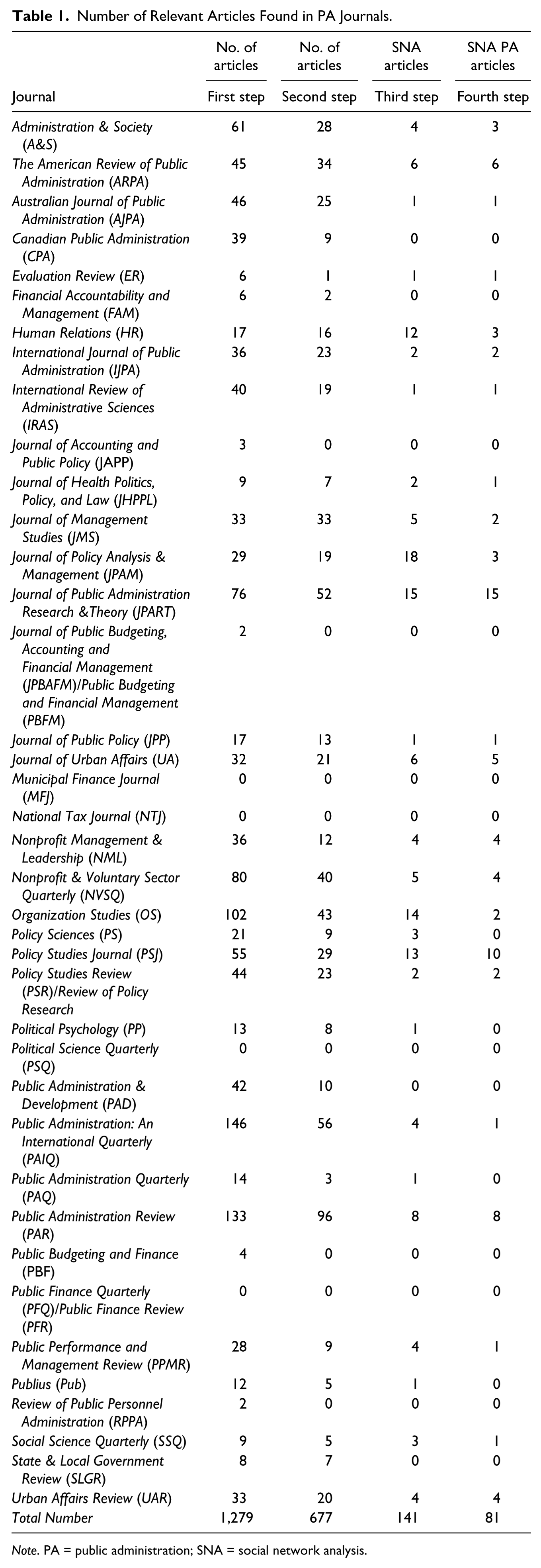
Note. PA = public administration; SNA = social network analysis.
Once the list of 81 articles was finalized, we read each of the articles carefully and conducted content analysis. There are several methods for qualitative data coding, such as open coding, axial coding, and selective coding (Saldaña, 2012; Strauss & Corbin, 2007). As the focus of this research is to review existing network research, rather than to develop a theory of networks, we used the open-coding process to explore and further categorize the key concepts of the network articles (Strauss & Corbin, 2007). Following previous research that reviewed the topical themes in the field of public administration (Bingham & Bowen, 1994; Lan & Anders, 2000), we integrated the open-coding process with the use of preestablished coding themes (Bowen & Bowen, 2008). We conducted open coding to identify the topics by examining research questions, hypotheses, and key findings. We also used preestablished categories and concepts from Borgatti et al. (2013) and Babbie (2012) to code the units and levels of analysis, data collection methods, network measures, and analysis. We applied the three network research streams developed by Rethemeyer and Hatmaker (2008) and Isett et al. (2011) to code the research streams. The coded data were organized and saved in spreadsheets for further comparison, categorizing, and analysis.
Results
This section reports how SNA has been used in the field of public administration. In particular, it identifies the public management problems and policy domains in which SNA is used and examines whether specific topics are clustered around a certain network research stream. Then, it discusses the units and levels of analysis, key measures, and analysis tools applied to study these particular problems and policy issues.
To provide an overall picture of the evolution of SNA research, the number of SNA-related publications was plotted against years in Figure 1. Over the past decade, public administration has experienced a rapid increase in network research (Berry et al., 2004; Kapucu & Demiroz, 2011; Provan, Veazie, Staten, & Teufel-Shone, 2005). More than 600 articles emphasize the role and significance of networks in public administration and related disciplines. Yet applying SNA in network research is a fairly recent practice in public administration. As shown in Figure 1, the application of SNA gained momentum in network research in public administration after 2005.
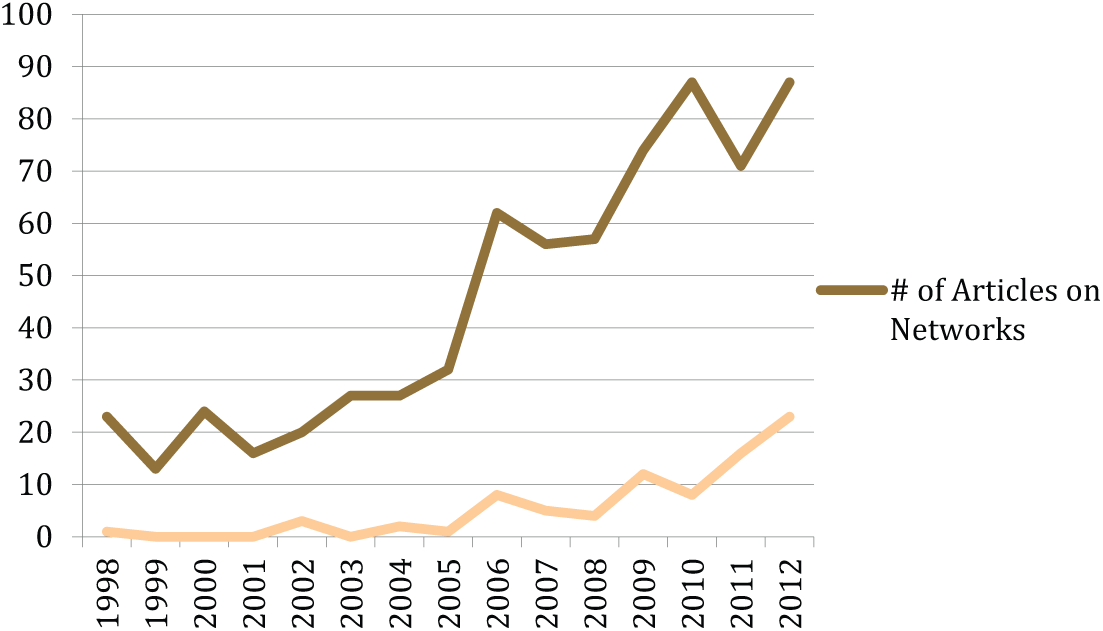
Number of articles on networks and SNA articles published since 1997.
Topics in Public Administration Network Research
Previous reviews of network research in public administration have grouped various types of networks into three categories: policy networks, governance networks, and collaborative networks (Isett et al., 2011). As Figure 2 suggests, our review of the 81 SNA articles shows that half of the articles fall under the governance networks research stream. Articles in the policy networks and collaborative networks streams each account for nearly one third of the total number, respectively. In addition, 7.5% of the articles fall under both policy and governance networks research, and approximately 9% fall under both governance and collaborative networks research.
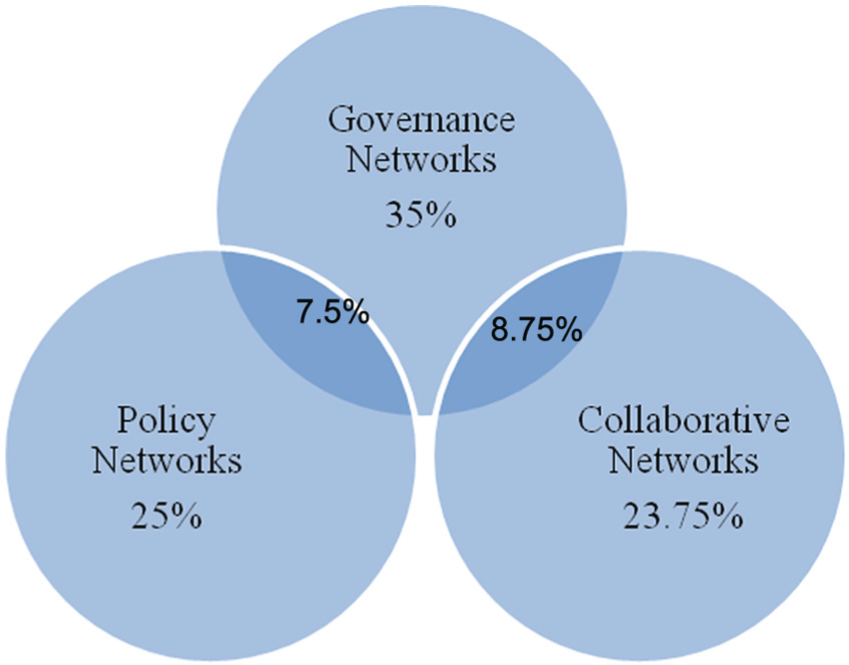
SNA utilization in network research streams in public administration.
In addition to examining the broad research streams, we took one step further to look closely at what specific management and policy issues are studied through the lens of SNA within each research stream. Nearly 85% of the 81 SNA articles (68) center on the following management issues or policy domains: health and human services, regional or community alliances, economic development, emergency management, environmental policy, education policy, urban planning and development (Figure 3).
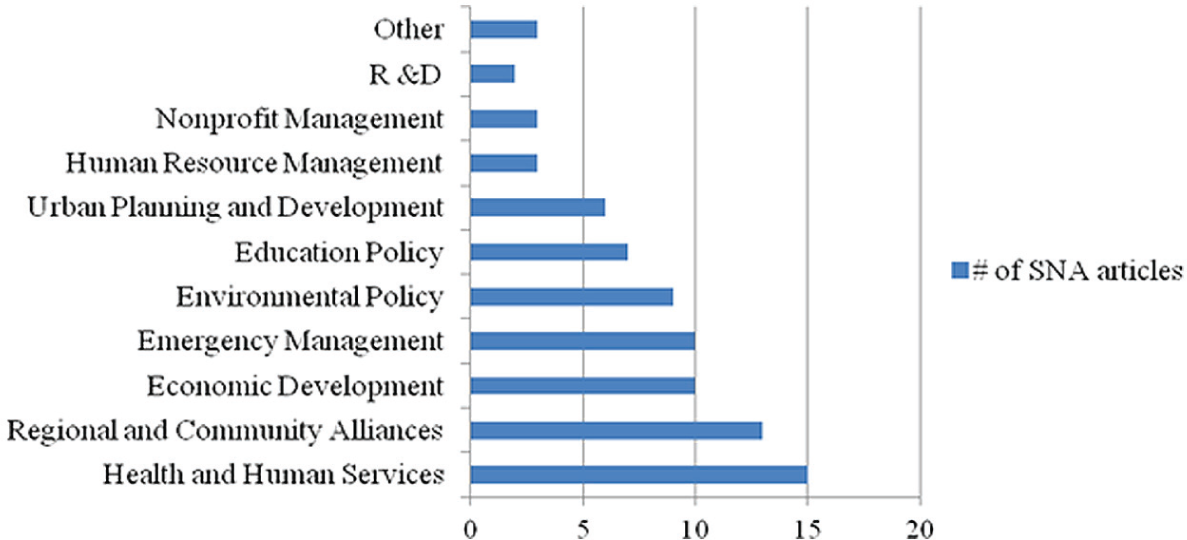
Management issues and policy domains of network research in public administration.
It is interesting to note that some of these management or policy issues are closely clustered around a specific network research stream identified in the literature. The network visualization of the 81 articles in Figure 4 shows that governance networks clearly stand out as the network research stream that is utilizing SNA. Moreover, the topic of regional and community alliances is the most popular topic addressed through governance network research. Within the policy networks research stream, economic development is the most popular policy area of study. Another important finding from this network is that SNA research on emergency management is restricted to collaborative and governance networks and does not currently fall under the policy networks research stream.
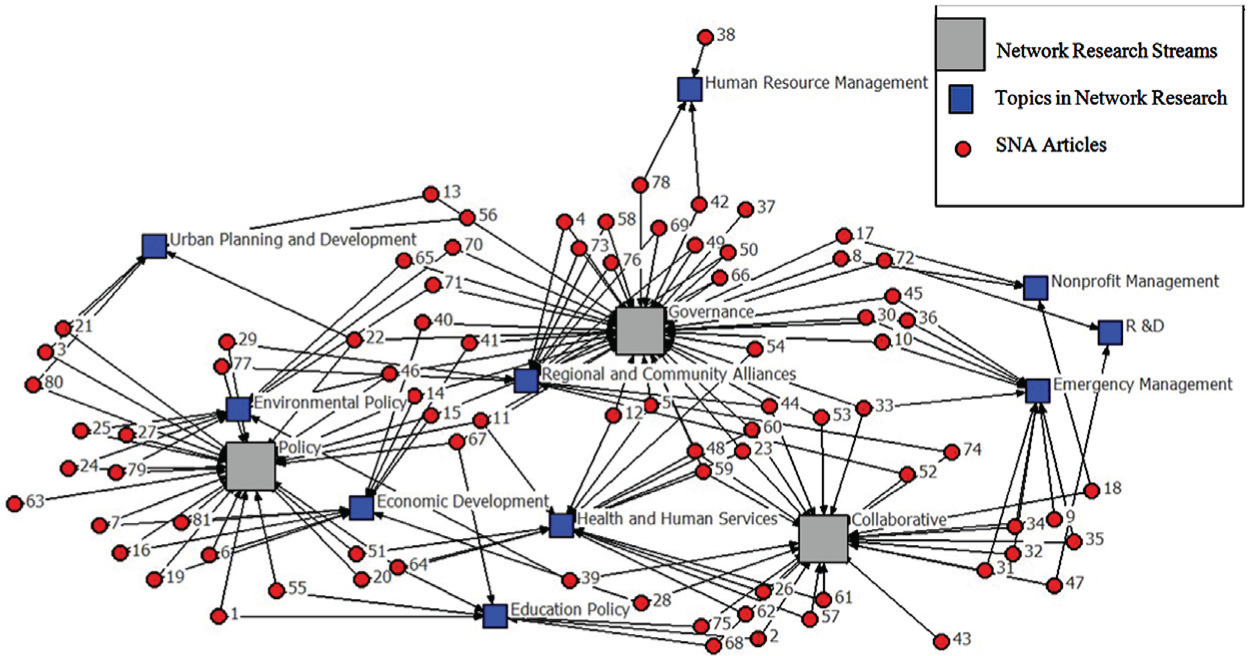
Network research streams and topics in network research.
A closer look at the specific topics shows that the topic in public administration that is most intensively studied through SNA has been health and human services. Among these 15 articles (18.5%), 6 are on community mental health service provider networks (Huang & Provan, 2007; Milward et al., 2009; Provan & Huang, 2012; Provan, Huang, & Milward, 2009; Provan et al., 2004; Rethemeyer, 2007). Provan and Milward’s research on collaboration networks of health service organizations has been widely recognized in the field. Besides community mental health networks, Provan, Beagles, Mercken, and Leischow (2012) have recently examined the network of a public smoking cessation program. Other topics covered under health and human services are relocation of the disabled (Poole, 2008), behavioral health of children (Bunger, 2012), federal health policy for Medicare prescription (Heaney, 2006), and public health cooperation on the U.S.–Mexico border (Collins-Dogrul, 2012). This research focuses on how health and human services are administered and managed through networks. Relevant policies and programs are studied, and their effectiveness is evaluated by the performance of service delivery networks.
The second most commonly researched topic utilizing SNA is regional and community alliances and collaboratives, with 13 articles (16%). This stream of research includes various subtopics such as interlocal agreements (ILAs; LeRoux & Carr, 2010), elite interaction and interlocal networks (Moore, Sobieraj, Whitt, Mayorova, & Beaulieu, 2002; Ruigrok, Peck, & Keller, 2006; Vidovich & Currie, 2012), community development and community collaboratives (Nowell, 2009; Pope & Lewis, 2008; Shea, 2011; Varda, 2011). Other subjects covered under this research stream include Danish mayor networks (Villadsen, 2011), NGO networks with government (Neal, 2008), European cohesion policy (EU partnership principle; Jordana, Mota, & Noferini, 2012), and local government contractual networks (Andrew, 2009).
Of the 81 articles that we reviewed, 10 focused on economic development issues. Five articles studied local economic development collaboration and networks (Feiock, Lee, & Park, 2012; Feiock, Lee, Park, & Lee, 2010; Hawkins, 2010; I. W. Lee, Feiock, & Lee, 2012; Y. Lee, Lee, & Feiock, 2012), while the rest explored subtopics of economic development, such as creation of employment avenues (Jokisaari & Vuori, 2010), regulation of markets (Fischer, Ingold, Sciarini, & Varone, 2012), innovation policy (Caloffi & Mariani, 2011; Cao & Prakash, 2011), and international sustainability networks (Zeemering, 2012).
Emergency management—in particular, disaster response networks—was discussed in 10 (12%) of the 81 articles identified as using SNA. Of the 10 articles, 6 were written by Kapucu and his colleagues. Besides discussing emergency response networks pertaining to certain events, such as 9/11 and Hurricane Katrina, some articles discussed the role of the public sector in emergency management (Kapucu & Van Wart, 2006), interstate partnerships in disasters (Kapucu, Augustin, & Garayev, 2009), emergency management at the local level (Choi & Brower, 2006), and communication networks (Kapucu, 2006a).
More recently, topics studied through SNA have become more diverse. Topics on environmental management and government climate policy are being addressed and described using a network approach. All nine articles on environmental management and climate policy using SNA were published in 2010 or later. Recent articles published in public administration journals on environmental management and climate policy are on the Swiss climate policy (Ingold, 2011; Ingold & Varone, 2012), watershed policy and partnerships (Jasny, 2012; Weible, 2011), and natural resource management (Robins et al., 2011). Other interesting and diverse topics using SNA include advocacy coalitions in carnivore management systems (Matti & Sandström, 2011), natural heritage areas (NHAs; Laven, Krymkowski, Ventriss, Manning, & Mitchell, 2010), and rural water supply and sanitation (Shrestha, 2012, 2013). Other topics identified through this research are education policy and reform (seven articles), urban planning and development (six articles), human resource management (three articles), nonprofit management (three articles), and research and development (two articles). Compared with network research in the 1990s or early 2000s, SNA research has been recently used in a much broader management and policy context.
Units of Analysis and Levels of Analysis
The unit of analysis in most of the SNA publications in public administration has predominantly been organizations and agencies. Approximately 72% of the articles that we reviewed use organizations as the unit of analysis. Some examples are disaster response agencies (Kapucu, Arslan, & Collins, 2010; Kapucu & Demiroz, 2011; Kapucu & Garayev, 2012; Kapucu & Van Wart, 2006; Marcum, Bevc, & Butts, 2012), agencies providing health and human services and serving SMI patients (Huang & Provan, 2006; Milward et al., 2009; Provan & Huang, 2012; Provan et al., 2004), and agencies and organizations working for economic development in metropolitan regions (Hawkins, 2010; I. W. Lee, Feiock, & Lee, 2012; Y. Lee, Lee, & Feiock, 2012). Among these studies, individuals or organizational representatives were often surveyed to collect organizational network data. For instance, Henry et al. (2011) surveyed key stakeholders to specify their partnerships involved in land use and transportation planning in four regions of California. Feiock et al. (2012) surveyed administrators and elected officials in four counties in Florida to understand the collaboration between city governments in economic development.
Relatively few network studies in public administration (14% of the 81 articles reviewed) have focused on individuals as the unit of analysis. Vardaman, Amis, Dyson, Wright, and Randolph (2012) surveyed public school teachers to understand how teachers’ position in a network influenced their perception of changes. Chen and Krauskopf (2012) examined how organizational merge affected the formal and informal networks within a nonprofit organization. As Isett et al. (2011) suggested, research on informal networks remains limited in existing literature. Even fewer network studies in public administration have communities or countries as the unit of analysis. There are, however, three exceptions (4%). Shrestha (2012, 2013) studied how internal and external social capital can influence the success of community water projects in Nepal. Cao and Prakash (2011) examined the policy diffusion of ISO 9000 Quality Standards across nations. The units of analysis in the remaining 10% of the 81 articles do not fall under single categories of individuals, organizations, communities, or countries. Some of the articles have mixed units of analysis, while other articles do not provide sufficient information to clearly specify their units of analysis. Overall, the number of studies with foci on individuals, communities, or nations is much smaller than the number of studies focusing on interorganizational networks.
Although the units of analysis are largely organizations, the levels of analysis can vary from individual nodes (ego), to ties between two nodes (dyadic) or three nodes (triadic), to substructures, and even to complete systems at the whole-network level of analysis (Borgatti et al., 2013). The SNA approach allows the researcher to examine the same management problem or policy issue across different levels of analysis (Provan & Milward, 2001). However, the node-level analysis (54%) and whole-network-level analysis (56%) are common in public administration to describe the power or position of an organization, to analyze interorganizational interactions, and to understand the performance, governance, and structural characteristics of a network (Kapucu & Demiroz, 2011; Provan et al., 2007; Provan & Lemaire, 2012). By contrast, triadic-level analysis and substructure-level analysis remain limited. Of the 81 articles reviewed, 17 included triadic measures in their network analysis and 23 had measures on substructures of networks. Future research can delve further into the substructures of networks to understand the subgroups within a network, the grouping of powers, or other clustering effects. Researchers can conduct more multilevel analysis of networks to fully take advantage of SNA.
Data Collection Methods
Data for SNA have been collected using both primary data collection methods (e.g., field surveys, online survey questionnaires, face-to-face structured and semistructured interviews) and secondary data (e.g., archival data from newspapers, news reports, situation reports, online company profiles, databases). The methods categories discussed below are not mutually exclusive. For instance, surveys, interviews, and documents may be used in the same article, which denotes a mixed-methods design.
Administering surveys is the most frequently used method of collecting network data in public administration research. Of 81 articles, 50 (62%) used surveys to collect network data. Twenty-nine articles (38%) used secondary data collection methods that involved archival data. Content and document analyses were conducted to analyze newspapers and situation reports, annual company reports, and government reports. Of the 29 articles that used archival data, 16 also used primary methods of data collection, such as surveys, questionnaires, and interviews, to obtain additional information on the networks being studied. In many cases, secondary data are used only as a means to develop a list of network actors to be surveyed or interviewed as part of the methodology. Of the 81 articles, 43 (53%) collected network data from interviews, 9 of which were specified as semistructured interviews. Interviews are commonly applied as a supportive method to achieve triangulation in network research or to get qualitative data and rich information about networks. Other data collection methods are rarely used. Four articles used observational data, and only one article used focus groups for data collection.
Overall, there is an increasing use of mixed methods of data collection. Of the 81 articles, 28 (35%) used both quantitative and qualitative methods to collect network data. However, the majority of articles relied mostly on survey data or qualitative interviews. Studies relying heavily on survey data require participants to recall information pertaining to networks and interactions before a policy change, an emergency, or the implementation of a program. As a consequence, researchers may face the challenges of selection bias and the internal validity of the results. On the other side, collecting secondary data and archival data may help produce less biased data; however, the challenge of getting information on the complete network datasets is difficult. Hence, more future research should consider integrating quantitative approaches with qualitative approaches. Another challenge in the field is to study the sustainability, maturation, and evolution of networks. Systematic longitudinal designs and analysis remain largely missing. These findings lend support to previous research that identified the need to integrate quantitative and qualitative designs in network research and to conduct more longitudinal analysis of network change and evolution (Berry et al., 2004; Provan et al., 2007; Provan & Lemaire, 2012). As the field continues to grow, more diverse approaches to collect network data are needed to further advance network research in public administration.
Key Measures and Analytical Methods
The content analysis further identified the key network measures used for network analysis. Most articles used both whole-network measures, such as density and centralization, along with node-level measures, such as degree centrality and betweenness centrality (see Borgatti et al., 2013, or Scott, 2013, for more information about these measures and advanced analytic techniques). Although most articles used measures that applied to both the node-level analysis and whole-level analysis, many authors did not clearly spell out the level at which analysis was carried out or the rationale behind using measures that belong to different levels of analysis.
The use of centrality measures is common in social network research in public administration. Of the 81 articles, 52 (65%) used some measures of centrality, the most commonly used being degree centrality, betweenness centrality, and eigenvector centrality. Degree centrality and eigenvector centrality measures are used to measure the position, power, or resource accessibility of individual nodes within networks (e.g., Choi & Brower, 2006; Huang & Provan, 2007). Betweenness centrality is used to understand how a node influences the flow of resources or information within networks (e.g., Ansell, Reckhow, & Kelly, 2009) or the brokering role of individual nodes (e.g., Ingold, 2011; Ingold & Varone, 2012; Jokisaari & Vuori, 2010). The second most commonly applied measure was network density (a measure of whole networks), which is found in 32 (40%) of the articles. A total of 15 (19%) articles also used network centralization. Network density and centralization are used to measure the cohesion or connectedness of networks (Borgatti et al., 2013) and describe the structural characteristics of networks (e.g., Milward et al., 2009).
Group-level network measures were applied to a limited extent. A few articles applied triad network measures (e.g., Andrew, 2009; Feiock et al., 2012; Feiock et al., 2010; Fischer et al., 2012; Henry, Lubell, & McCoy, 2012; Y. Lee, Lee, & Feiock, 2012; Oliver & Montgomery, 2008; Varda, 2011). The key measure used for analyzing triads is transitivity effect (for directed data, transitivity measures whether the connection between Nodes A and B and the connection between Nodes B and C can lead to a connection between Nodes A and C). Analysis of the subgroups in existing network studies has been limited. Three articles included clique analysis, and three included cluster analysis. Kapucu et al. (2010) and Kapucu et al. (2009) applied clique analysis to identify the subset of organizations that work closely within disaster response networks. Ansell et al. (2009) conducted clique analysis to identify the key stakeholder groups in the context of urban school reform. Cluster analysis is also used to classify communities into different groups according to the “similarity of network connections” (Shrestha, 2012, p. 15) and to cluster the stakeholders of environmental management into different groups based on their beliefs (Weible, 2011).
Another important measure for analyzing the network position and network substructures is structural equivalence. Structural equivalence examines “the direct connections of an actor to others in the network” (Borgatti et al., 2013, p. 207). For undirected data, two nodes are structurally equivalent when they are connected with the same other actors. For directed data, two nodes are structurally equivalent when they send ties to the same actors and receive ties from the same actors in the network (Borgatti et al., 2013). Eight articles applied structural equivalence/blockmodeling using CONCOR to understand the roles played by different stakeholder groups, to measure trade competition, to identify advocacy coalitions, and to evaluate the impact of similar network positions on the adoption of a new program, cooperative behavior, and individual perception about victimization at the workplace (e.g., Cao & Prakash, 2011; Ingold, 2011; Ingold & Varone, 2012; Jokisaari & Vuori, 2010; Lamertz & Aquino, 2004; Lambright, Mischen, & Laramee, 2010; Rethemeyer, 2007; Robins et al., 2011).
Besides descriptive network measures, researchers have begun to use more advanced statistical analysis techniques such as Quadratic Assignment Procedure (QAP; for example, Bunger, 2012; Chen & Krauskopf, 2012), Exponential Random Graph Modeling (ERGM; for example, Feiock et al., 2010; Robins et al., 2011), and Stochastic Actor-Oriented Models (SAOMs; for example, Andrew, 2009; Fischer et al., 2012). Table 2 provides a detailed list of research topics studied using these inferential network analysis models. Advanced SNA techniques such as QAP were used in nine articles that compare and analyze the relationships between different network datasets (e.g., Bunger, 2012; Chen & Krauskopf, 2012; Jasny, 2012; Lamertz & Aquino, 2004; Y. Lee, Lee, & Feiock, 2012; LeRoux & Carr, 2010; Matti & Sandström, 2011; Provan & Huang, 2012; Stephens, Fulk, & Monge, 2009). Based on the product–moment correlations of random permutations on the rows and columns of the network matrices, QAP can correct for autocorrelation (Borgatti, Everett, & Freeman, 2002). Multiple regression with QAP (MRQAP) enables researchers to test the level of association between interdependent network variables (Krackhardt, 1988; van Duijn & Huisman, 2011).
Statistical Network Analysis Models.
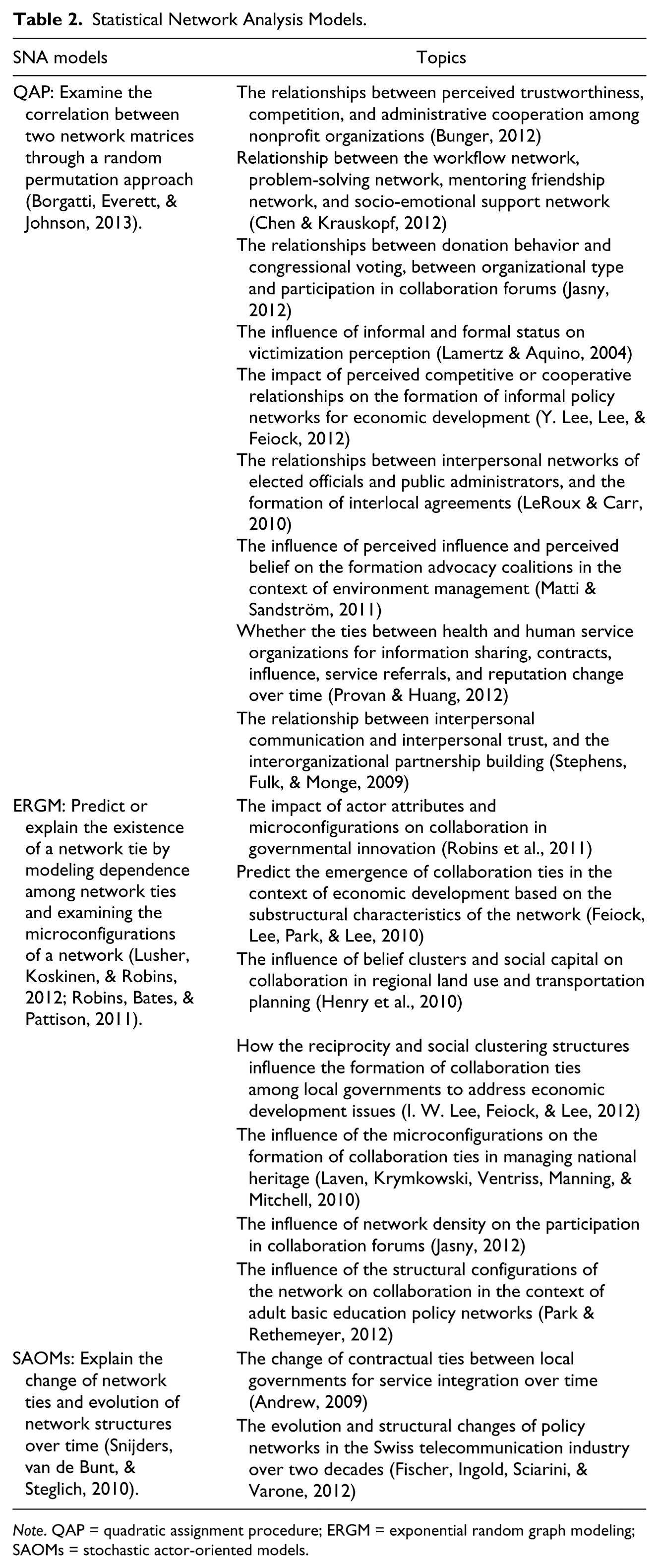
Note. QAP = quadratic assignment procedure; ERGM = exponential random graph modeling; SAOMs = stochastic actor-oriented models.
ERGM was used in seven articles to study the emergence of network ties or the stochastic process of network formation by examining the microconfigurations or structural characteristics of a network, such as reciprocal ties, in two-stars, out two-stars, two paths, three-cycles, and transitive triplets (e.g., Feiock et al., 2010; Henry et al., 2011; Jasny, 2012; Laven et al., 2010; I. W. Lee, Feiock, & Lee, 2012; Park & Rethemeyer, 2014; Robins et al., 2011). SAOMs are developed for analyzing longitudinal network data and explaining the evolution of network structures over time (Lubell, Scholz, Berardo, & Robins, 2012; Snijders, van de Bunt, & Steglich, 2010). Our analysis suggests that advanced SNA methods are mostly utilized in the study of policy and governance networks and are underutilized in the study of implementation or collaborative networks.
Recent years have seen a gradual movement from simple descriptive network analysis and visual mapping to more inferential analysis and theory testing. The increasing use of advanced analysis techniques implies that social network research in public administration is moving beyond the early stage that uses simple measures and analysis techniques to describe characteristics of nodes, subgroups, or networks. In fact, with recent advancement in statistical network analysis, multivariate techniques such as QAP, ERGM, and SAOMs have been built into the SNA package (Borgatti et al., 2013). With these tools, researchers can study the relationships between multiple network matrices, examine the influence of endogenous network structures and microconfigurations on the formation of networks, and explore the evolution of network structures. Researchers can conduct more theory-driven explanatory network research as well as comparative and longitudinal network research.
SNA Software Programs
UCINET (Borgatti, Everett, & Freeman, 2002) is the most widely used software for SNA in public administration. This is consistent with the finding of Knoke and Yang’s (2008) research that suggested UCINET, with its frequently updated and improved versions, is the most popular software for network analysis. Our results show that, of the 81 SNA articles short-listed, 50 (62%) used UCINET. Seventeen articles (21%) did not mention the software used in carrying out SNA. Two articles used the software VISONE (Brandes & Wagner, 2004). This software is used for interactive visualization of networks and sociograms and for analyzing whole networks. For visualization, the more common approach in the majority of the articles was to use the NetDraw subroutine in UCINET.
Three articles used the StOCNET software package for advanced statistical analysis of networks. This software is a comprehensive tool and includes higher level analysis for structural equivalence/blockmodeling using the BLOCKS and SIENA routine. SIENA (merged into R) is known as the analysis of repeated measures on networks and uses the same process as ERGMs. This package was developed by Stokman, Snijders, and van Duijn at the University of Groningen in the Netherlands (Ingold & Varone, 2012; Ripley & Snijders, 2011). SIENA is sophisticated software that allows multiple waves of longitudinal data in analyzing networks (Ripley & Snijders, 2011; Snijders, 2005). The development of these various software programs has allowed researchers to further explore social network research in public administration.
Discussion and Conclusion
As O’Toole’s (1997) call for more research on networks in public administration, the number of network research articles has greatly increased (Isett et al., 2011; Provan et al., 2007; Provan & Lemaire, 2012). However, more methodological advancements and rigor are needed. Previous reviews have suggested that researchers need to integrate quantitative methods with qualitative methods, explore large-N studies, apply multiple types of analysis approaches, and conduct advanced network analyses (Berry et al., 2004; Isett et al., 2011; Lecy et al., 2013; Provan et al., 2007; Provan & Lemaire, 2012; Robinson, 2006). Taking a methodological focus, this study reviewed 81 SNA articles in public administration journals and examined how SNA has been used. Built on the recommendations provided in previous review articles, findings reiterated below aim to identify the research gaps that need to be addressed. These findings can be helpful for future network research in public administration.
First, network research in public administration has covered an increasing array of management issues, governance challenges, and policy domains. The diverse subtopics examined range from human and health services to emergency management and economic development, and so on. However, relatively few articles have examined the intersection and linkages between policy networks, governance networks, and collaborative networks. The politics–administration divide in network research noted by Rethemeyer and Hatmaker (2008) still remains unaddressed. Future research can pay more attention to the impact of policies and/or governance structures on management networks or the influence of collaborative networks on the policy-making, policy implementation, or governance processes.
Second, the field needs more network research on individuals or communities as the units of analysis, more research on the substructures of networks, and multilevel network research. It is not surprising that in public administration, most of the network studies focus on organizations or agencies as units of analysis. Yet, to examine the untapped or understudied networks such as informal networks (Isett et al., 2011) and to understand the network content and context (Borgatti, Brass, & Halgin, 2014), we need to be more open to exploring interpersonal relationships or interactions between individuals and the dynamic relationships between communities. Furthermore, the majority of existing network research focuses on describing the relational characteristics at the node or network level. Compared with node-level or network-level analysis, substructure analysis of networks remains limited. The analysis of the substructures of a network can allow researchers to identify important stakeholder groups and examine clustering effects. More multilevel network studies are needed to fully take advantage of the nature of network research.
Third, more mixed-methods research designs are needed to further enhance the reliability and validity of network research in public administration. Currently, administering surveys is the most widely used method to collect network data. Yet, as noted by Henry et al. (2012), the hybrid method that combines the roster approach and the free-recall name generator is a more effective survey approach in identifying actors and capturing interactions between actors. In addition, qualitative network research can provide in-depth information that quantitative network research cannot capture, such as the barriers to or the rationale for collaboration. Each type of data collection technique has its own strengths and limitations. Our analysis of the 81 articles suggests that there has been an increasing use of mixed methods of data collection in network research. Future research designs should continue using multiple types of data collection methods to overcome the constraints of one method.
Finally, use of SNA, especially advanced SNA techniques, remains limited in network research within the field. Besides descriptive research and visual mapping of relational data, recent statistical advancements in SNA have allowed researchers to address complex explanatory questions. SNA is often combined with other statistical methods for advanced analysis of public policies (e.g., Ingold, 2011). Yet SNA can be used as a stand-alone statistical analysis method to examine a wide range of topics in the field. This research shows that scholars in the field have begun to use more advanced SNA techniques, such as QAP, ERGM, and SAOMs, to examine relationships between network matrices, network structures, and network development.
Future research may apply advanced network analysis to explore new research territory. A major body of network research in public administration concerns the performance of networks or the effectiveness of managing networks. Measures such as centrality and density remain useful for analyzing how public management networks change over time or due to an implementation of a service delivery program. Meanwhile, researchers may need to continue to explore other innovative approaches to measure network performance, as the nature of networks in different contexts may require different ways of measuring performance and effectiveness. Inferential network analysis can help address questions about the relationships between networks and the dependence of network structure, network formation, and the development of network relationships. For instance, QAP can be used to compare planned emergency networks and response networks of catastrophic disasters. Researchers can go beyond describing the similarity between and the structural characteristics of the two types of emergency networks. Researchers can explain whether the planned emergency network correlates with the actual response network and how the structural characteristics of the planned emergency network influence the performance of the actual disaster response network. A remaining challenge in the field is to study the design, development, maturation, evolution, and sustainability of networks. Most scholars have identified that cross-sectional research and temporary snapshots of networks are not enough for making generalizations and creating more dynamic models for their theoretical constructs (Choi & Brower, 2006; Lambright et al., 2010; J. Lee & Kim, 2011). The application of longitudinal analysis is largely missing in the field (Provan et al., 2007; Robinson, 2006). Using advanced network analysis tools such as QAP, ERGM, and SAOMs, researchers can conduct more comparative network studies and longitudinal network analysis to develop stronger theoretical frameworks and to bring conceptual clarity to the study of networks in the field.
This research has some limitations. The list of 39 journals may not have exhausted journals that published public administration–related network research. Future works may further expand the research by including nonpublic administration journals that publish network research related to public organizational contexts. Compared with the rapidly growing interest in collaborative governance and network research, empirical studies using SNA remain limited. This makes a quantitative meta-analysis less likely for now. Our future research will conduct co-citation analysis and multidimensional scaling to identify clusters of SNA research and to further analyze theoretical frameworks that are applied in the specific research clusters.
Footnotes
Declaration of Conflicting Interests
The author(s) declared no potential conflicts of interest with respect to the research, authorship, and/or publication of this article.
Funding
The author(s) received no financial support for the research, authorship, and/or publication of this article.