



Abstract
Attention is an important factor in the study of institutional agenda setting. It has been shown to influence the selection of issues to consider and the prioritization of these issues. This article brings theories of issue attention and prioritization to bureaucracy, focusing on how institutional factors affect bureaucracies’ prioritization of issues. Using quantitative survey data and statistical techniques, we assess the impact of institutional factors on the prioritization of competing issues in higher education. We find that these institutional factors significantly affect the prioritization choices of universities, beyond the influence of individual leadership traits.
Introduction
There is a wide array of literature within political science concerning the politics of attention and agenda setting (Birkland, 1998; Jones & Baumgartner, 2005; Kingdon, 2003). Much of the literature surrounding these topics has focused on Congress, leaving little scholarly attention for these dynamics within the realm of the bureaucracy. This article attempts to rectify this oversight by focusing on the factors influencing the agendas of individual bureaucracies. We utilize data from a survey of institutional leaders in higher education combined with structural data about each institution. We capitalize on the wide variation among these organizations to analyze the prioritization of issues on the agenda. The four issues compared in this analysis are equity, affordability, quality, and accountability, each of which represents a major concern of higher education institutions, as described in detail in Appendix A. Using a series of ordinal logistic regression models, we assess the influence of structural and managerial factors on the relative ranking of these priorities. This is supplemented by a test of whether these indicated priorities translate to related outputs, showing the relationships have important implications for higher education institutions as well as bureaucratic operations more generally.
Through these models, we find that several structural factors influence the prioritization of issues by bureaucratic leaders. The most impactful of these characteristics were its selectivity in choosing the population it serves, which significantly affected three of the four priorities measured. Administrative capacity of the institution also affected the ranking of priorities, specifically those concerning quality and accountability issues. Finally, sector of ownership and percent of revenue received from state appropriations influenced prioritization of quality and affordability, respectively. Individual traits of the university leader responding to the survey were less influential, with the exception of race. Moreover, the subgroup analysis reveals that there is substantial variation within and across public and private institutions of higher education in the prioritization of issues. Such results imply that structural factors matter in determining the priorities of bureaucratic organizations, perhaps more so than the leadership of particular public managers, which is often the focus of research on the bureaucracy. Finally, the differences in prioritization are shown to be important through the supplementary analysis, which reveals that the indicated priorities of bureaucratic leaders do translate into observed behaviors.
The remainder of this article will proceed in the following segments. The first section provides background on the literatures that inform our analysis, followed by our theoretical expectations for key variables. In the third section, we discuss the data being used to test the impact of structural and individual factors on the prioritization of agenda issues. After a brief statement of our empirical approach, we report the results of both our main and subgroup analyses using ordinal logistic regression and our supplementary analysis based on a series of difference of mean tests. These results show that structural factors are influential in determining institutional priorities, which in turn have an impact on related institutional behaviors. Finally, we discuss the implications of these findings for bureaucracy as a whole. We end by noting the limitations of this study and providing a roadmap for future research.
Background
There are a large number of works in political science detailing the limitations of human cognition in organizational settings, beginning with Simon’s Administrative Behavior in 1947. From these works, we have learned that human capacity for problem solving is highly limited. This is especially true when prioritizing among competing issues or priorities (Jones, 2003). Rather than spreading attention among several topics, people are largely limited to serial processing in which they focus on a single issue at a time before moving to the next.
This cognitive limitation is somewhat alleviated through the creation of institutions, which are able to achieve parallel processing through specialization of particular subunits (Jones, 2001; Simon, 1983). However, institutions eventually face the same scarcity of attention that plagues individuals. Institutions monitor a limited set of issues from those potentially relevant to problem solving, thereby leading to competition among issues for agenda space. This necessitates prioritization among issues even within institutions.
To date, much of the literature concerning the scarcity of attention and prioritization of information has been focused on the legislative branch of the federal government. While these studies have been immensely helpful in demonstrating the impact of attention limitations on government agendas (Baumgartner & Jones, 1991; Jones & Baumgartner, 2005; May, 1991; Mortensen, 2009), little research has been done applying these concepts to the bureaucracy. Furthermore, almost no attention has been paid to the dynamics of issue prioritization and agenda setting within the study of education. Instead, the focus in this policy area is on the implementation and outcomes of particular policies. The studies that have considered the influence of bureaucracy in determining government agendas have typically done so from an external perspective, maintaining the primary focus on the congressional agenda. While bureaucratic agencies have been shown to exert influence on congressional issue agendas through signaling in oversight hearings and regulations (Workman, 2015), there remains little analysis of factors determining the agenda of these agencies themselves. In this article, we focus on the latter concept, looking to discern the types of factors that influence the direction of an agency’s agenda from within the institution rather than external pressures from elected branches of government. Specifically, we consider structural factors—institutional selectivity, sector of ownership, proportion of public funding, governance structure, task environment, and administrative capacity—as well as characteristics of public managers, such as age, race, gender, and tenure in office.
Previous research gives reason to expect these types of factors will be important for prioritization of bureaucratic agendas. With regard to organizational structure, past research has proven it to have a definite impact on bureaucratic agencies and their operation in several ways. This influence is so strong that several scholars have considered structure a form of political control by legislatures and executives (Moe, 1995; Seidman & Gilmour, 1986). When creating a new agency, politicians have incentives to do so in such a way as to advantage their preferences in the future. This can be done in a variety of ways, one of the more significant strategies being manipulation of an agency’s structure. Such structure is reflective of the issue agenda assigned to an organization when it is created and in some ways is itself the agenda of the new bureaucracy (Bertelli & Lynn, 2006; Hammond, 1986). In addition, structure has been considered an institutionalization of problem definitions surrounding issues that led to the need for a new agency (Workman, 2015), which also suggests structure is a significant factor in determining bureaucratic agendas and priorities.
The influence of individual traits, meanwhile, stems from the simple fact that institutions are ultimately made up of individual decision makers. Therefore, these actors can clearly be expected to influence organizational decisions, including the issues that are prioritized on the agenda (Woodward, 1965). In fact, researchers have repeatedly found that public managers influence their organizations in a variety of ways. Most commonly addressed is their impact on policy implementation, as the management strategies used affect agency performance, although different organizations often respond differently to these strategies (Meier & O’Toole, 2003; Walker, 2013). However, the literature also shows public managers influence the organizations they lead by directing lower level employees, constructing expectations and incentives, and leveraging resources in accordance with specific goals (Riccucci, Meyers, Lurie, & Han, 2004). This is precisely the type of leadership role filled by college and university presidents in the realm of higher education. These individuals are ultimately responsible for all major decisions made by the institutions they lead. Prioritization among top-level issues undoubtedly fall within this purview, meaning presidents are positioned to have a significant impact on the direction their campus chooses to take.
To assess these factors, we utilize data from public and private institutions of higher education. Though these organizations may not be the first to come to mind when one hears the term “bureaucracy,” they share considerable characteristics with more traditional agencies. Colleges and universities often face the same constraints as other bureaucracies, including budgetary dependence on government, performance accountability requirements, and pressure from multiple principals (Whitford, 2005). Similarly, Palmer (2013) has shown college administrators experience varying levels of public service orientation just as other bureaucratic leaders might. At the most basic level, college and university presidents are responsible for the management of large bureaucratic organizations, meaning they easily fit into categorization as public managers along with their counterparts in other types of state agencies. Furthermore, our use of higher education data to support broader arguments about bureaucracy is not unprecedented (Rutherford & Meier, 2015; Schalk, Torenvlied, & Allen, 2010).
Higher education policy is ideal for testing theories of attention shifting and issue prioritization in bureaucracies due to the wide variability between institutions on a number of important structural factors. Colleges and universities differ in terms of institutional administrative capacity, research focus, and selectivity, all of which can be leveraged as factors affecting prioritization of agenda issues. Administrative capacity—measured here as spending on administration—varies dramatically across higher education institutions. While some universities enjoy substantial support from the state budget and are able to spend a considerable amount of resources on administrative needs, others must grapple with a very limited budget with which to administer their programs. These differences create institutions with a range of flexibility to devote attention to various priorities. A similar situation exists in terms of institutional emphasis on research productivity or undergraduate teaching, which ranges from heavy stress on publishing research to almost exclusive focus on student education. Selectivity in the admissions process for incoming students is yet again highly variable between institutions as some colleges accept a larger portion of applicants than others, sometimes by a dramatic margin. Each of these factors contributes to the usefulness of higher education institutions for this type of analysis.
In addition, the division of sectors within higher education allows us the opportunity to assess differences between the agenda influences of publicly and privately governed bureaucracies. Even among public institutions, there is a great deal of variation in governance, both in terms of the structure of an institution’s governance mechanism and in the amount of funding received from government sources. This variation is relatively unique to this type of organization as most public agencies have neither direct competitors in the private sector nor public counterparts operating under other funding and governance arrangements. The diverse structural environments of institutions within higher education thus make this type of organization a good test case for research into the prioritization of issues on bureaucratic agendas.
Theory and Expectations
The four priorities of higher education institutions used in this article to demonstrate the influence of structural factors are equity, affordability, quality, and accountability. These issues are drawn from the four-pronged higher education reform agenda set forth in a 2007 publication known as the Spellings Report, as described at length in Appendix A. This report encouraged institutions of higher education and their leaders to focus greater attention on increasing access for low-income students (equity), managing student costs (affordability), improving student learning outcomes (quality), and creating a culture of transparency (accountability; Miller et al., 2006). Based on the literature discussed above, surrounding the dynamics of attention, we expect to see trade-offs being made between these issues. It stands to reason that those issues being given the most attention will be more readily acted upon, while those being crowded out of the institutional agenda will be forced to remain at the status quo. This suggests the trade-offs between priorities will be most evident in their implementation as it represents an institution acting upon an issue that has been prominent on the agenda. This relationship is an important one as it means the much more tangible implementation of priorities can serve as an appropriate proxy for underlying attention dynamics. It should be noted that using output data to discuss attention dynamics in agenda setting is by no means unprecedented and is to a large extent standard practice within this literature. For an example of this approach, see Jones, Sulkin, and Larsen (2003). As such, our theoretical expectations are presented in terms of which priorities are most likely to be affected in practice by a given institutional or individual trait.
We first consider structural factors of the organization, which we expect to have significant influence on the prioritization of issues on the agenda both within higher education institutions and in the bureaucracy more broadly. Several scholars have found structure to have a definite impact on the operation of a bureaucratic agency, including as a means of political control (Moe, 1995; Seidman & Gilmour, 1986) and as a determinant of an agency’s agenda (Bertelli & Lynn, 2006; Hammond, 1986). The agenda influence is especially relevant for this study and gives the authors confidence that structural factors will indeed influence the prioritization choices of higher education institutions.
The first structural factor we consider is selection of population served. In the bureaucracy as a whole, this difference is seen most clearly between entitlement and discretionary programs. Whereas entitlement programs are charged with providing goods services to all who qualify, discretionary programs are given some level of choice and are able to screen applicants to determine who receives benefits. In this sense, discretionary programs can be seen as the more selective subset of bureaucratic agencies. A comparable process takes place when making admissions decisions in higher education. Selectivity in higher education refers to the amount of competition in the admissions process of a particular institution. Highly selective schools are those that reject large percentages of their total applicants, resulting in a carefully chosen student body based on metrics deemed desirable by the institution. Acceptance to these institutions typically requires students to have higher standardized test scores or to have participated in more extracurricular activities than does acceptance into less selective schools, which admit large portions of applicants. Though admissions decisions may seem flexible, most colleges and universities consider this a core part of their institutional identity. This tendency makes selectivity highly resistant to change in practice, so that acceptance rates remain within a limited range.
Research on this topic has largely focused on the academic and career returns for students attending more or less selective schools, but a few studies have also found a relationship between selectivity and institutional practices. Pascarella and colleagues (2006) observed a link between college selectivity and good practices in terms of educating undergraduate students, such as active learning and student–faculty contact. Their results lend support to the notion that highly selective universities generally provide a higher quality education. Because these perceptions are likely coveted by institutional administrators, we expect to see especially significant results for the impact of this variable on prioritization of quality.
Previous research suggests a bureaucracy’s location in the public or private sector will also have a sizable impact on the operation of the institution. Bozeman and Bretschneider (1994) assessed two conceptual definitions of “publicness,” finding both to have unique and significant impacts on organizational activities. In a review of literature on the topic, Rainey and Bozeman found scholarly consensus that sharp differences exist between public and private organizations. Furthermore, these differences tended to be even more pronounced “at the higher professional and managerial levels,” (Rainey & Bozeman, 2000, p. 461) such as that of university presidents.
Other scholars have shown sector to matter for the ways organizational leaders approach decision making. When choosing among alternatives, decision makers in public organizations were found to utilize different strategies than those in private sector organizations. This is due in large part to the need to defend decisions to other actors, namely, political leaders (Nutt, 1999). These findings provide strong reason to expect the presidents of public and private colleges and universities will behave differently with regard to the issues they prioritize on their institution’s agenda. Specifically, we expect the priorities of public institutions to be heavily influenced by the preferences of state legislators as their fates and funding are largely dependent upon legislative decisions. In many cases, these bodies are interested in accountability concerns—as evidenced by trends toward performance-based funding in higher education (Bell, Fryar, & Hillman, 2018)—suggesting public institutions will similarly value this priority.
The extent to which this is the case, however, is unlikely to be equal for all public institutions. The differences in political oversight described above can be more accurately described as a spectrum rather than a dichotomy. While some public colleges and universities receive a large portion of their funding from the state, others have faced dwindling appropriations for many years (Perna & Finney, 2014). Indeed, some institutions have begun to consider themselves “semipublic” due to these changes. Accordingly, these institutions are likely to feel less obligated to meet the demands of state legislators in the form of concentrating on accountability measures. Thus, we expect prioritization of accountability among public institutions to decrease along with the proportion of funding received from state government.
We also expect the structure of the state higher education governing body to affect the prioritization of issues by public universities. Most states utilize either a consolidated governing board or a statewide coordinating board to oversee the operations of higher education institutions within the state. In a governing board context, the statewide body makes operational and often budgetary decisions for all institutions in the system, while a coordinating board is largely limited to review of actions taken at the campus level. Scholars have repeatedly shown that the structure used in a state can have far-reaching implications, including impacts on tuition and financial aid policies, the cost of higher education, and even accountability policies (Hearn & Griswold, 1994; Hearn, Griswold, & Marine, 1996; Lowry, 2001). As such, we expect to see different priorities for institutions under different state governance structures. Specifically, we anticipate institutions in states with governing boards to prioritize accountability more than institutions in states with coordinating boards due to the higher degree of state control present in these contexts.
The task environment of a bureaucratic organization is also likely to affect institutional priorities. This idea was first implied by Theodore Lowi, who proposed a classification of policies as distributive, regulatory, or redistributive (Lowi, 1964). In his framework, each type of policy was implemented in different ways and with different goals in mind. It stands to reason, then, that bureaucracies charged with administering policies in distinct areas would operate in unique ways that aligned with such goals. The same can be said of institutions of higher education. In this context, colleges and universities are often divided into two main categories: those that focus heavily on research and those that focus more heavily on undergraduate instruction. Because the task environment remains the same regardless of the president in office, the focus of the institution forms part of the university’s structure and may in turn affect how presidents prioritize various conflicting goals or issues. Degree of research productivity has been shown to have influence across numerous aspects of higher education (Rabovsky, 2012), and we see no reason that prioritization should prove otherwise. Therefore, we anticipate results showing higher research focus at a particular college or university to be linked with lesser emphasis on quality concerns, as a greater portion of attention is focused on goals other than student learning.
Our final structural factor is the administrative capacity of the institution. As mentioned above, the scarcity of attention can be somewhat alleviated through parallel processing of information so that multiple issues may be addressed simultaneously (Jones, 2001; Simon, 1983). This arrangement involves an organization dividing its resources into smaller, more specialized subunits that then focus attention on different aspects of the organization’s responsibilities. This type of administrative structure essentially multiplies the number of priorities that an institution can consider at a given point in time through increasing the available venues where they can be addressed. As such, this element of organizational structure may have a substantial impact on issue prioritization. Bureaucracies with greater administrative capacity should enjoy the ability to focus on secondary problems rather than just those that interest their political principals. However, it is unclear which of these priorities may be considered primary or secondary, making it difficult to determine which of the priorities will be most affected by administrative capacity. This factor has the potential to expand the limits of attention within the institution, leading to a decrease in the necessary trade-offs and sustained attention to every issue being considered.
In addition to structural factors, we expect characteristics of institutional leaders to affect decisions regarding prioritization. Due to the influence bureaucratic leaders have been shown to have on agency activity in other contexts (Riccucci et al., 2004; Woodward, 1965), we expect to see a similar relationship in higher education. Specifically, we anticipate individual demographic factors such as age, race, and gender to influence prioritization decisions. We also include a measure of each president’s tenure in office, as greater experience can have important influences on decision making and prioritization (Juenke, 2005). We expect to see particularly robust results for the impact of president’s race and gender on prioritization of equity issues, given previous evidence of similar processes in the literature on representative bureaucracy by minority individuals (Hicklin & Meier, 2008; Keiser, Wilkins, Meier, & Holland, 2002).
By testing the impact of these factors, we hope to show that both institutional structure and characteristics of public managers matter in terms of bureaucratic agenda setting. When combined with prior research into the external influences on this type of prioritization (Rutherford & Meier, 2015), our results will provide a comprehensive look at the motivating factors for prioritization of issues within bureaucratic institutions. We now turn to the data and empirical modeling of these relationships.
Data
The data underlying this analysis are drawn from a 2008 survey of university presidents. The survey inquired into managerial practices, such as accountability efforts, time invested in communication with internal and external stakeholders, and, most importantly for the present analysis, prioritization of competing issues. The survey was administered to presidents 1 of both public and private-not-for-profit 4-year universities in the United States, with Carnegie classifications ranging from bachelor’s/associate’s to very high research activity institutions. Specifically, the survey was sent to a total of 1,534 institutions and had a 22% response rate, providing a sample size of 340 institutions. While a higher response rate among public institutions makes them slightly overrepresented, the sample reflects the observable characteristics of 4-year universities nationally in terms of region, selectivity, and Carnegie classification (Rutherford & Meier, 2015).
Though this survey included only university presidents as respondents, we are confident the preferences of these individuals align with the institutional agenda as a whole. Public administration scholarship has shown bureaucratic managers to influence the organizations they lead in a variety of ways, including directing resources to some policies over others (Riccucci et al., 2004). In higher education, this guiding role is fulfilled by the institution’s president, who is largely responsible for selecting the issues to which a college or university attends. Because of this influence, presidential perceptions have been and continue to be used as a proxy for institutional attention (Rutherford & Meier, 2015).
In addition to the data from the survey, we collected institutional-level variables from the Integrated Postsecondary Education Data System (IPEDS) maintained by the National Center for Education Statistics (NCES). These data were merged into the main survey data set, allowing us to capture variation in institutional structure based on Carnegie classifications, staffing levels, enrollment, and budget allocations. Some of these variables are included in the main analysis, while other variables facilitated our supplementary analysis linking self-reported prioritization to observed institutional priorities.
Table 1 displays the descriptive statistics of each variable used in this study. The main dependent variables of interest concern the prioritization of multiple competing issues. The presidents ranked the priorities of the university from 1 to 4 choosing between equity, accountability, quality, and affordability. Specifically, the presidents were asked, “If you had to rank the following goals in order of your university’s current priority, how would you rank the following?” This survey question was followed by a space in which respondents were asked to assign equity, accountability, quality, and affordability individual rankings of importance. Thus, presidents were not given the opportunity to rank different priorities at equal levels as the priorities were measured against one another from a holistic perspective. For each of the four issues, we have created a separate variable containing the numeric ranking indicated by each respondent. Initially, 1 reflected the highest priority but, for ease of interpretation, we reverse coded these variables so that 4 reflects the highest priority. It is also important to note that the respondents filled out this survey without precise definitions of each issue, under the assumption that many presidents had come in contact with the 2007 Spelling Institution report that defined these four issues as part of the reform agenda (Kinser & Hill, 2011). The definitions given in the Spelling report are reproduced in Appendix A.
Descriptive Statistics.

Note. Table 1 displays the descriptive statistics for each key variable in the empirical models. DV = dependent variable; IV = independent variable; IPEDS = Integrated Postsecondary Education Data System.
The primary independent variables reflect variation in institutional structure. First, we constructed a measure of selectivity on a scale of 1 to 4 with 4 reflecting the most selective based on the 25th percentile average ACT score at each institution. Based on our exploration of the densities at different points of the distribution, institutions with average ACT scores in the 25th percentile ranging from 1 to 17 are coded 1, 18 to 22 are coded 2, 23 to 27 are coded 3, and 28 to 32 are coded 4. To account for publicness, we utilize a binary variable indicating public and nonpublic universities. We also include a measure of the proportion of revenue obtained through state appropriations to consider varying levels of dependence on the state. To further distinguish between different structures underlying public universities, we include an indicator of whether the institution is governed by a consolidated governing board (coded 1) or a coordinating board (coded 0). In addition, we include a dichotomous indicator for research universities and an indicator that distinguishes between baccalaureate institutions, master’s institutions, and doctoral research institutions. We also include a variable reporting the percentage of university spending on institutional support, which IPEDS defines as mainly operational and administrative expenses. More specifically, institutional support spending is defined as “expenses for general administrative services, central executive-level activities concerned with management and long-range planning, legal and fiscal operations, space management, employee personnel and records, logistical services such as purchasing and printing, and public relations and development” (Delta Cost Project, 2011). This variable is our attempt to capture the differential ability of higher education institutions to engage in parallel processing based on staffing capacity. Finally, we include total revenue to control for the relative differences across institutions in terms of fiscal capacity.
We also include independent variables that reflect the individual characteristics of the university president. First is a measure of race, which is operationalized as a dichotomous variable indicating whether the president is not of Caucasian origin. Next, we incorporate the respondent’s self-reported age and a binary variable indicating whether the president is female. Finally, we include a measure for the number of years the president has been in office.
Finally, in a supplementary analysis, we evaluate measures of theoretically related outputs for each of the overarching issue categories. Inclusion of these measures allows us to assess whether the stated priorities of institutional presidents translate into behaviors at the university level. For two of the four issue areas, we utilize data on institutional spending because budgets are zero-sum, and thus provide a more tangible measure of prioritization. Specifically, we include the percent of institutional spending on scholarships for affordability and the percent of institutional spending on instruction for quality. 2 In general, institutional spending on scholarships is the amount of money spent on student scholarships/fellowships/grant aid, and instructional spending is defined as expenses related to “general academic instruction” that does not include expenses for administration, research, or public service (Delta Cost Project, 2011). In addition, we include the faculty to student ratio of each institution by dividing the total number of faculty by the total number of students to reflect another potential output of focusing institutional effort on quality instruction. Our measure of actual outputs related to accountability is the total number of administrators on staff at the institution, which includes both faculty and nonfaculty employees. Finally, because equity didn’t have an equivalent institutional spending category in IPEDS, we utilize two of the survey questions that presidents answered regarding student and faculty diversity initiatives. Presidents were asked whether their university currently pursues “initiatives to increase minority representation (e.g., African American, Latino, Native American)” for both students and faculty. These questions are coded as dichotomous variables with a value of 1 assigned to institutions indicating they pursued each type of initiative.
Empirical Approach
Based on the ordinal structure of the dependent variables of interest, we utilize a series of ordinal logistic regressions to estimate the impact of structural and institutional factors on the prioritization of each issue. Specifically, we regress these characteristics on the ranked score of affordability, accountability, equity, and quality separately. The variation in institutional structure is captured by variables indicating the selectivity, ownership of the university, revenue from state appropriations, governance structure, research status, Carnegie classification, and spending on administration. In contrast, the characteristics capturing variation in individual attributes of public managers are race/ethnicity, gender, age, and tenure in office of the current president. In addition, each of the models presented below includes a control variable indicating the wealth of the university, measured through total revenue reported to IPEDS. These covariates are parameterized as

In this model,
It should be noted that this model assumes parallel lines and thus the parameter of interest is the same for all values of
Results
The results of the ordered logistic regression analyses are summarized in Figures 1 through 4 and in tabular format in Appendix C. In these figures, the model results are presented as visualizations depicting the coefficient (x-axis) for each variable of interest (y-axis), which substantively displays the relationship between each structural or managerial factor on the ranked prioritization of issues. On either side of the point estimate for each variable, the figures also include 95% confidence intervals. We discuss the results in the following order: equity, affordability, quality, and accountability.
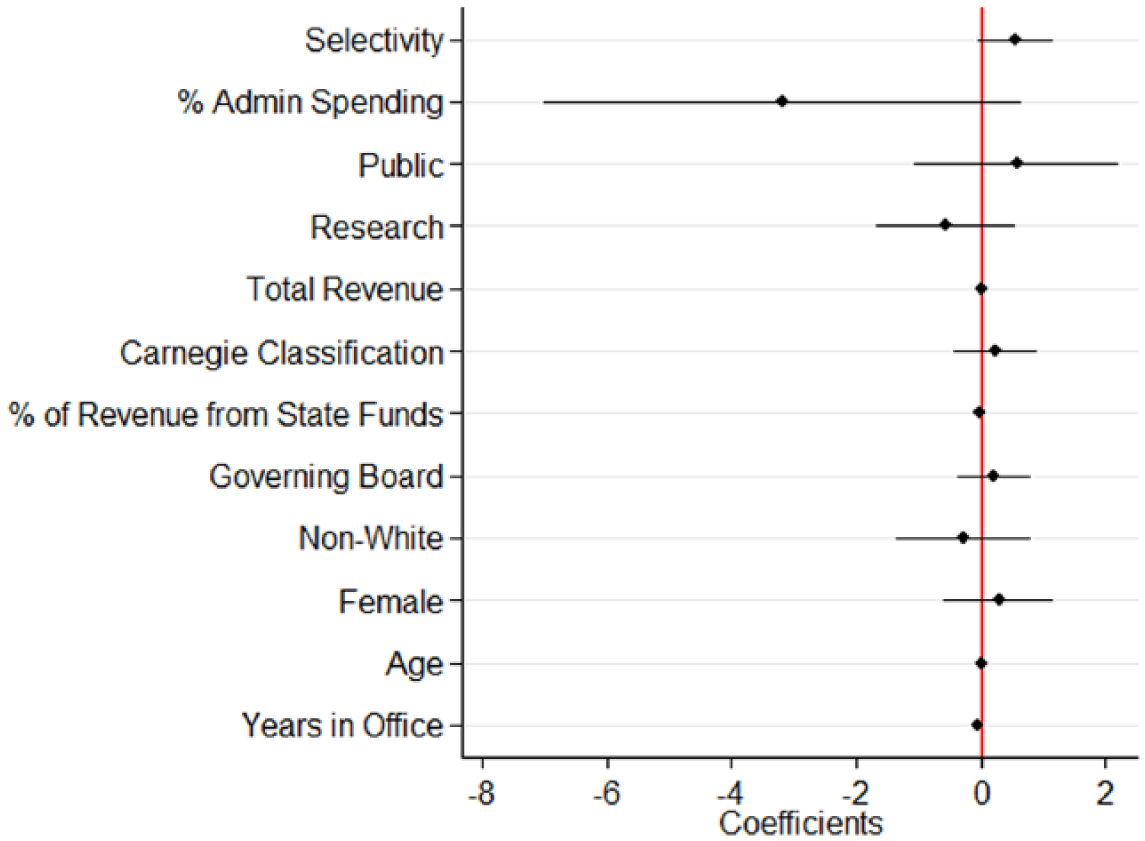
This figure displays the ordinal logistic regression results modeling the relationship between institutional structure and individual characteristics on the ranked prioritization of equity.
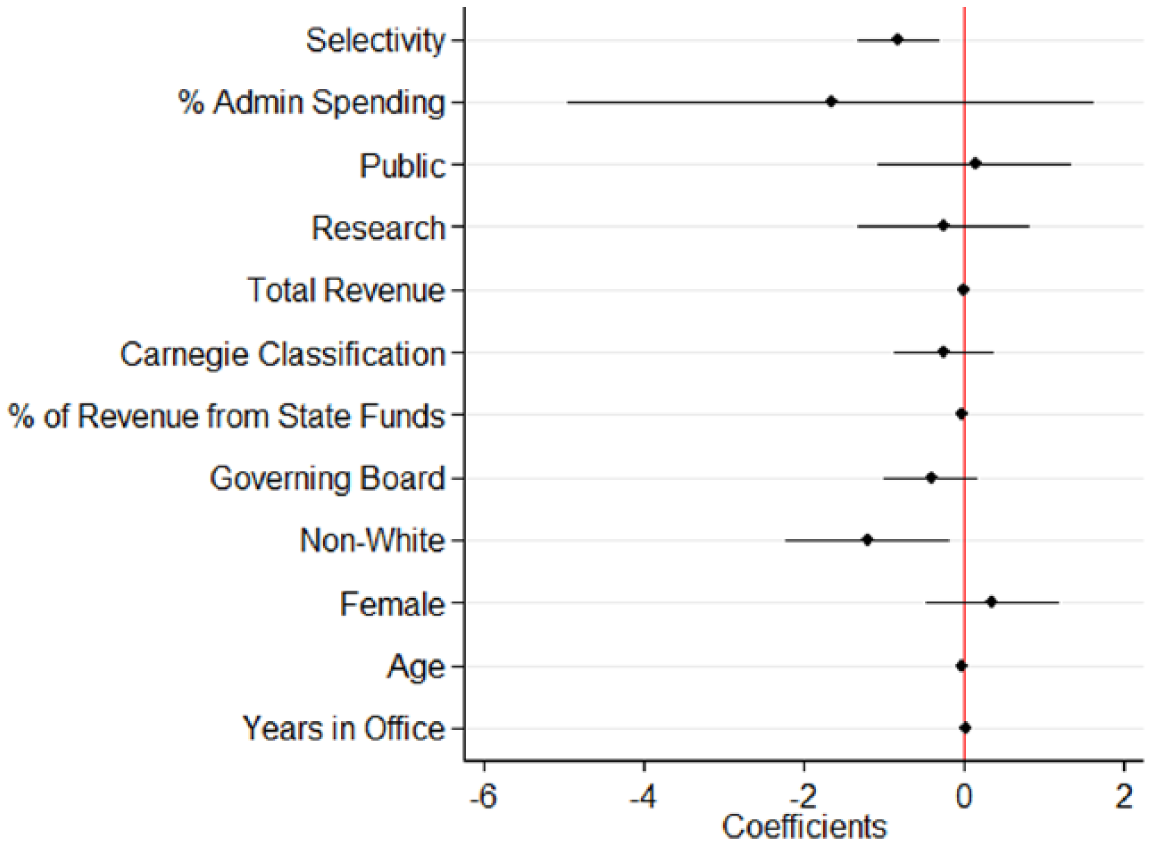
This figure displays the ordinal logistic regression results modeling the relationship between institutional structure and individual characteristics on the ranked prioritization of affordability.

This figure displays the ordinal logistic regression results modeling the relationship between institutional structure and individual characteristics on the ranked prioritization of quality.

This figure displays the ordinal logistic regression results modeling the relationship between institutional structure and individual characteristics on the ranked prioritization of accountability.
The results from the first model are displayed in Figure 1, which reveal the significant influence of institutional structure on the decision to prioritize equity. While none of the individual characteristics of the university presidents are significant, the selectivity of the institution substantially shifts the prioritization of equity. Specifically, presidents at more selective institutions are more likely to prioritize equity (p < .10). By their very nature, selective institutions may have problems increasing access for historically underrepresented groups, and thus may have to prioritize this issue more than less selective institutions. On the contrary, selective institutions also may be more adequately funded and have greater capacity for pursuing equity. Overall, this model suggests that structural characteristics of the university do play a role in shaping the prioritization of equity.
Figure 2 displays the results for our model of affordability. This model shows institutional structure significantly influences the prioritization of affordability. First, more selective institutions are less likely to prioritize affordability (p < .01). Along with selectivity often comes prestige, which may create an environment in which institutions do not have to worry about the willingness of families to pay because they know that these institutions are worth the investment. Moreover, more selective institutions likely do not have to prioritize affordability because the vast majority of students come from the top quintile of the income distribution (Chetty, Friedman, Saez, Turner, & Yagan, 2017). Next, we find that institutions with higher proportions of state appropriations revenue are less likely to pursue affordability (p < .10). This relationship makes sense, considering that institutions that receive the largest proportion of state appropriations are having more of their revenue needs met through state funding, which enables them to offer lower tuition to students. In this sense, such institutions may be more affordable without having to heavily prioritize the issue. Finally, this model indicates that the race and ethnicity of the president played a significant role in the decision to focus on affordability (p < .05). More specifically, it appears that racial and ethnic minority presidents were less likely to indicate affordability as a top priority of the institution. However, when this variable is interacted with a dichotomous variable indicating a historically Black college or university (HBCU) institutional type, heterogeneity in the relationship emerges. In an attempt to better understand whether this relationship stems from minority presidents being isolated at institutions with certain structures, we also reran the main models including an HBCU indicator (n = 16). The HBCU dichotomous variable was not significant in any of the models, and in fact did not change the relationship between any of the other variables and the outcome. However, the interaction of non-White presidents and HBCUs produced interesting results. Non-White presidents at HBCUs are less likely to prioritize affordability (n = 16), but this relationship is not significant for non-White presidents at non-HBCUs (n = 11). This suggests that while the race of the president did appear to be significant, this relationship may be mediated by structural factors.
The results for the prioritization of quality, shown in Figure 3, largely fall in line with expectations—selectivity and ownership of the institution significantly influenced the ranking of quality instruction. Specifically, public universities, as opposed to privately owned universities, are more likely to prioritize quality instruction (p < .10). This finding may reflect the more teaching-focused missions of many regional public universities. In addition, more selective institutions do appear to prioritize quality instruction, which is in line with our expectations based on previous research (Pascarella et al., 2006). We also find institutions that spend more on administration are more likely to prioritize quality instruction. This result is likely related to the ability of institutions with greater administrative capacity to allow administrators to specialize in certain areas. This effectively enables parallel processing in which the university focuses attention on several issues simultaneously. Finally, presidents who are from racial and ethnic minorities were significantly less likely to prioritize quality. This is a difficult relationship to interpret, especially given the limited amount of observations in the data set. However, to better understand this relationship, we interact the race variable with a structural characteristic (HBCU). Again, when we interact the race variable with the HBCU variable, heterogeneity emerges, which suggests structural factors are also at play. For non-White presidents at HBCUs the relationship was not significant, but non-White presidents at non-HBCUs were less likely to prioritize quality.
Finally, Figure 4 displays the results for prioritization of accountability. Similar to the previous models, accountability was affected by both institutional and individual characteristics. Institutions that spend more on administration are more likely to rank accountability high on the list of priorities. Once again, these institutions are structured in ways that are conducive to parallel processing, allowing them to dedicate administrative staff to accountability efforts. With more resources dedicated to administrative capacity, institutions are able to minimize the trade-offs that need to be made between competing priorities. In essence, these institutions are able to delegate tasks within their administrative structure, in this case allowing attention to be focused on accountability and other issues simultaneously. In terms of individual characteristics, non-White presidents were much more concerned with accountability relative to their counterparts. When interacted with the HBCU variable, this relationship holds. However, while this relationship is significant for non-White presidents both at HBCUs and at other institutions, there is heterogeneity in the magnitude of this relationship. The magnitude of this relationship for non-White presidents at HBCUs is significant at the p < .01 level while the relationship is only significant at the p < .1 level for non-White presidents at non-HBCU institutions. We are not certain what the cause of this relationship might be as it differs from our theoretical expectations. However, it is worth noting that it continues to hold even when interacted with the HBCU variable.
Subgroup Analysis
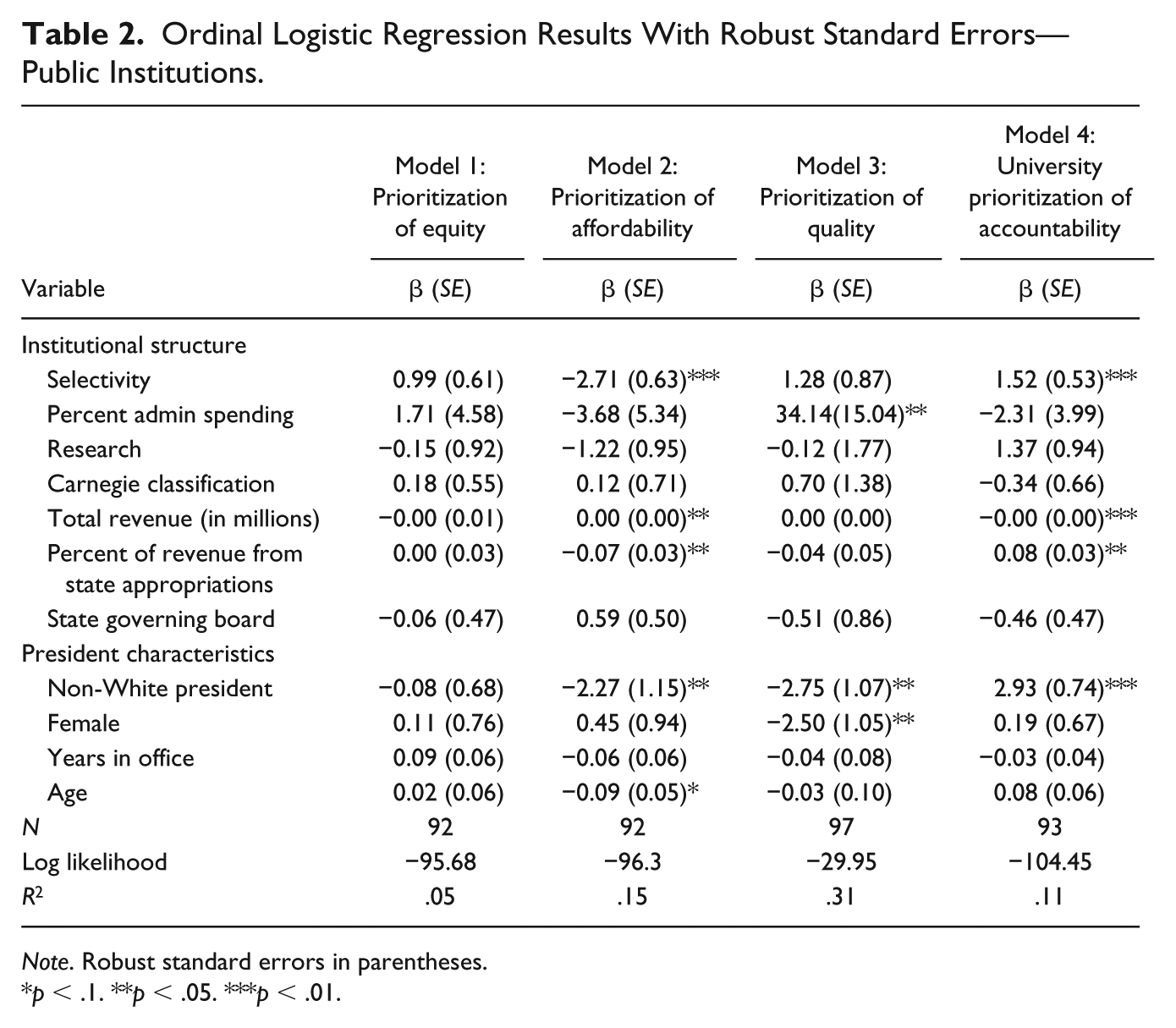
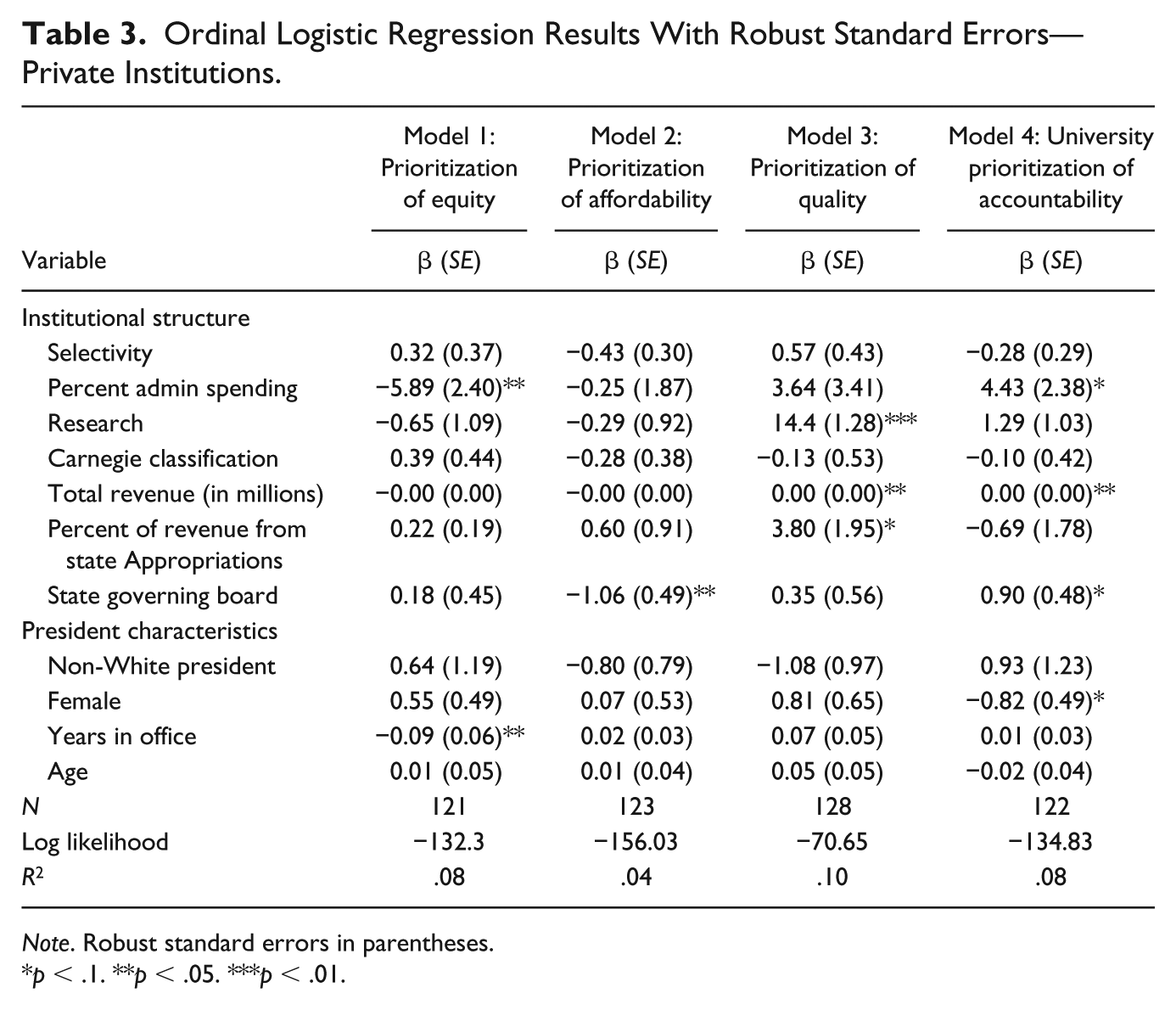
Next, we conduct a subgroup analysis to explore variation within and across public and private institutions in the influence of institutional structure and presidential characteristics on prioritization of issues. In this analysis, we subset the data and rerun the analysis separately for public institutions and for private institutions. This approach provides an additional level of nuance by capturing the variation across public and private institutions as well as the variation within public and private sector institutions on both sets of explanatory variables. This analysis, displayed in Tables 2 and 3, reveals that there is substantial variation in the influence of institutional structure and presidential characteristics that shapes the prioritization of issues within and across public and private institutions.
Ordinal Logistic Regression Results With Robust Standard Errors—Public Institutions.
Note. Robust standard errors in parentheses.
p < .1. **p < .05. ***p < .01.
Ordinal Logistic Regression Results With Robust Standard Errors—Private Institutions.
Note. Robust standard errors in parentheses.
p < .1. **p < .05. ***p < .01.
Table 2 displays the results for the analysis when restricted to public institutions. The most striking results in Table 2 center on the influence of revenue streams on the prioritization of affordability and accountability. First, public institutions with larger total revenue streams are more likely to prioritize affordability (p < .05) and less likely to prioritize accountability (p < .01). This suggests that public institutions that have more resources and capacity enjoy an increased level of autonomy from the pressures of compliance and accountability. This flexibility allows these institutions to pursue other issue priorities such as affordability for students. On the contrary, public institutions with higher proportions of revenue originating from state appropriations are less likely to prioritize affordability (p < .05) and more likely to prioritize accountability (p < .05). This makes sense because public institutions that are more reliant on state appropriations are likely mainly concerned with remaining in compliance with state and federal accountability standards to remain financially solvent and avoid losing funding.
Moreover, variation in other elements of institutional structure also reveals heterogeneity within the public sector in the prioritization of issues. First, more selective public institutions are less likely to prioritize affordability (p < .01) and more likely to emphasize accountability (p < .01). More selective public institutions are also more likely to be flagship universities, where there is no shortage of student applications, reducing the need for concern regarding affordability. At these selective public institutions, students and families may be more willing to pay for the cost of higher education because of the positive reputation of many selective public institutions. Moreover, more selective public institutions frequently overlap with flagship public universities, which often receive higher proportions of state appropriations revenue, likely accounting for the increased focus on accountability. Next, public institutions that spend more on administration are more likely to emphasize quality (p < .05). These institutions are likely able to engage more effectively in parallel processing and can address quality concerns without sacrificing concern for affordability, equity, or accountability.
It is also interesting to note that the race and gender of the presidents at public universities appears to influence the prioritization of issues. Non-White presidents of public institutions are more likely to emphasize accountability (p < .01) and less likely to place emphasis on quality and affordability (p < .05). Moreover, female presidents of public universities are less likely to prioritize quality (p < .05). This finding is in line with previous literature on representative bureaucracy, which has repeatedly shown minority and female bureaucrats to have different perceptions of their role (Hicklin & Meier, 2008; Keiser et al., 2002). These perceptions could reasonably be expected to influence prioritization of competing issues, though the causal mechanism behind this relationship is beyond the scope of our data and analysis.
The subgroup analysis of private colleges and universities, displayed in Table 3, also reveals variation between institutions in the factors affecting the prioritization of issues. First, this analysis reveals that private institutions that spend more on administration are less likely to emphasize equity (p < .05) and more likely to prioritize accountability (p < .10). The private institutions that are spending a larger proportion of the budget on administration likely reflect the institutions that are mainly concerned with compliance with state and federal regulations. Thus, equity may fall by the wayside as a result as it is not a strictly regulated element of university performance. Instead, private universities in particular are given flexibility in determining the central components of their mission, unlike many public universities that are required to incorporate equity as a priority.
Second, Table 3 reveals that private research universities and private universities with larger total revenue streams are more likely to emphasize quality instruction (p < .05). Moreover, private universities that receive funding from the state government are also more likely to emphasize quality instruction (p < .05). This relationship makes sense given that many of these universities’ reputation hinges on the quality of the instruction. Third, the analysis shows that private institutions located in states with consolidated state governing boards are less likely to prioritize affordability (p < .05) and more likely to emphasize accountability (p < .10). This suggests that in states with consolidated governing boards, private institutions face more pressure to align priorities with those of the state leaders and may have less of an opportunity to prioritize affordability as a result.
Fourth, private universities that have larger total revenue streams are more likely to prioritize accountability (p < .05). This suggests that higher profile colleges and universities with larger institutional budgets may attract more external attention to accountability issues and therefore be more cognizant of maintaining compliance with state and federal standards. Conversely, smaller institutions with fewer resources may feel unable to meet accountability standards and therefore choose to concentrate on other priorities that are viewed as more feasible to attain (Huber & McCarty, 2004). Finally, Table 3 reveals that female college presidents at private universities are less likely to emphasize accountability (p < .10) and that private university presidents who have been in office for longer are less likely to emphasize equity (p < .05).
The results of these subgroup analyses reveal there are substantial differences in the ways institutional structure influences the prioritization of issues for public and private colleges and universities. Furthermore, variation also exists within the public and private sectors that systematically affects the prioritization of issues.
Supplementary Analysis: Do Priorities Matter?
The analysis conducted above shows institutional structure and individual qualities of university presidents can have substantial impacts on an institution’s priorities. Having done so, it is worth establishing whether these priorities themselves matter, given that they are based on the perceptions of a single individual. To determine if this is the case, we now turn to a supplementary analysis testing the degree to which self-reported issue priorities reflect real-world behavior. Simple difference of means tests are conducted on outputs related to the issues in the survey based on whether the institution indicated the issue as a 1 or 2 versus 3 or 4 on the ranked scale. Table 4 below summarizes the results.
Difference of Means Based on Issue Prioritization.
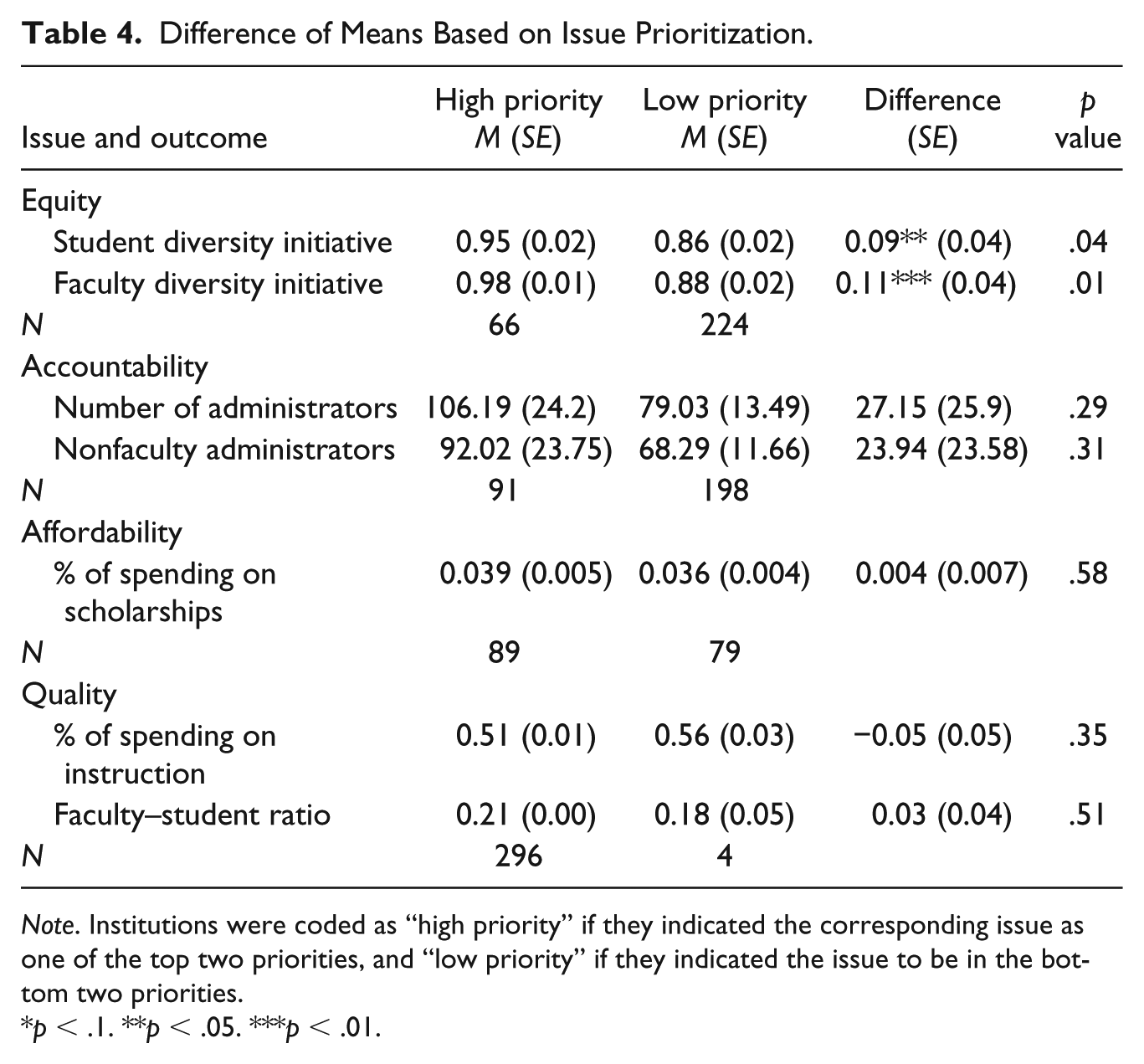
Note. Institutions were coded as “high priority” if they indicated the corresponding issue as one of the top two priorities, and “low priority” if they indicated the issue to be in the bottom two priorities.
p < .1. **p < .05. ***p < .01.
In general, the results support the notion that presidential priorities translate into real institutional outputs. As we would expect, the institutions that ranked equity higher on the list of priorities are significantly more likely to also have adopted both student and faculty diversity policies. Furthermore, while the t tests are not statistically significant, the relationships for the ranking of accountability and the number of administrators are both in the expected direction. Substantively, this suggests university presidents who ranked accountability higher also pursued policies that align with compliance. Likewise, the relationship between affordability and percentage of institutional spending on scholarships is not statistically significant, but is in the expected direction based on the indicated priorities. Finally, despite the lack of statistical significance, universities that ranked quality as a high priority had a substantively higher faculty to student ratio. Although the findings related to spending on instruction appear to not align with expectations, this result cannot be considered definitive due to the extremely small sample of respondents who indicated quality as a low priority.
Discussion and Implications
This analysis reveals that institutional structure shapes bureaucratic prioritization of political issues on the agenda, often more so than the management of individual bureaucratic leaders. In particular, institutional selectivity exerted considerable influence over the prioritization of issues, suggesting that the nature of the student population, or clientele, helps to determine the types of issues that are prioritized. Specifically, our results suggest universities that are highly selective in admissions prioritize equity and quality over affordability and accountability. These differences are similar to what might be found in the broader bureaucracy between entitlement programs, which are available to everyone who qualifies, and discretionary programs, which are more “selective.” Viewed through this lens, more selective discretionary programs can be expected to focus more on equity concerns. Whereas the populations served by entitlement programs are predetermined, discretionary programs have more flexibility in the assignment of resources, meaning equity is something that must be actively sought and monitored by these organizations. Furthermore, affordability in higher education is largely considered as an accessibility issue. Thus, these findings can be easily translated to bureaucracies in general. For entitlement programs to work as intended, they need to be accessible for citizens who qualify for their services, adding emphasis to the prioritization of accessibility or affordability in these less selective situations.
Administrative capacity for parallel processing was also highly influential in determining the ranking of priorities by bureaucratic leaders. Institutions that were better able to focus on multiple issues simultaneously due to higher levels of administrative capacity were more likely to prioritize quality of services and accountability issues rather than affordability or equity issues. With regard to the first of these findings, leaders of institutions with high administrative capacity may feel more able to emphasize quality in the knowledge that their institution has satisfactorily addressed the other issues. The accountability finding, meanwhile, is contrary to what most previous research would suggest and to our own expectations. However, at least one study found that institutions with less administrative capacity may focus on other issues due to feelings of futility with regard to meeting compliance standards (Huber & McCarty, 2004). In this sense, our results with regard to administrative capacity may reflect not additional focus of high-capacity institutions on accountability, but less focus on this issue by low-capacity institutions. Nonetheless, this finding demonstrates that higher capacity organizations are more concerned with accountability expectations than are lower capacity organizations. The reasons behind this relationship, though uncertain based on the present data, are one of several avenues for future research stemming from the present findings as this could have a substantial impact on principal–agent and political control literatures.
Another influential factor in determining the priorities of a particular bureaucracy was its location in the public or private sector. The significance of this characteristic comes as no surprise, given the consensus found in previous literature regarding “publicness” (Bozeman & Bretschneider, 1994; Rainey & Bozeman, 2000). According to this analysis, publicly operated bureaucracies are more likely to prioritize quality of services. One reason for this may be that private institutions in general enjoy a reputation of providing students with a higher quality education, which public universities must actively compete against by prioritizing quality concerns. Finally, our findings also show that a higher percentage of revenue obtained through state appropriations leads to less focus on affordability. The meaning of this result is fairly intuitive as institutions receiving more funding from the state are likely able to use these funds to limit the costs passed on to students in the form of tuition. Accordingly, such institutions may not need to actively prioritize affordability issues to maintain lower costs for students and families.
The only structural factors that were not significant in predicting institutional ranking of agenda issues were those related to the research activity of the university and the governance structure under which it operates. We included the research activity variables as a proxy for the task environment of an organization, although the lack of results may mean this was not the case. Prior research has shown agency focus to affect the action of bureaucrats in multiple contexts (Mahler & Regan, 2011; Weisbrod, Ballou, & Asch, 2008), as well as the importance of research productivity in a higher education setting (Rabovsky, 2012)—making these findings quite unexpected. This result could also be due to the nature of higher education itself, as many university presidents view themselves as educators rather than researchers regardless of the type of institution where they work. In this case, institutional structure on this point may not be varied enough for research productivity and Carnegie classifications to capture the difference.
In the case of governance structure, there does not appear to be a link between governing boards and institutional priorities. Though we initially expected this factor to be influential, based on previous research showing it has a variety of impacts on colleges and universities (Hearn & Griswold, 1994; Hearn et al., 1996; Lowry, 2001), governance structure had no impact on issue prioritization in the main analysis. Upon further reflection, however, this finding does seem to fit with an emerging line of research suggesting governance structure does not influence the perceptions of campus leaders (Bark & Fryar, 2018). According to this work, whether an institution is under the authority of a governing or coordinating board does not affect the relationship between the university president and its overseer. If this is the case, it stands to reason that a college or university president would not adjust institutional priorities based on this factor, which would explain the lack of significance we found here.
Our analysis also included individual characteristics of the survey respondents, specifically the president’s race, gender, age, and tenure in office. Only one of these factors was found to be statistically significant, again suggesting institutional structure is more influential than managerial traits in determining the priorities of bureaucracies. We find that presidents of minority race or ethnicity were less likely to emphasize affordability or quality concerns, and more likely to prioritize accountability. It should also be noted that this relationship was mediated by institutional structure; minority presidents at HBCUs behaved systematically differently from minority presidents at non-HBCUs. It is unclear why this would be the case in higher education or bureaucracy more generally. We forego speculation on this finding, instead choosing to allow future research to determine the reasons behind its significance.
In addition to these results from the primary analysis, we presented findings for public and private institutions separately through a subgroup analysis. These models revealed some similarities between the two institutional sectors as well as several stark differences. Among the similarities were largely the financial variables: administrative spending, total revenue, and percent of revenue received through state appropriations all influenced the prioritization of issues among both public and private colleges and universities. Presidential characteristics were also found to be significant in both of these models, although in different ways; while race, age, and gender of the president all mattered for public institutions, only gender and tenure in office were predictive of prioritization in private institutions. The largest difference between the two sectors came from selectivity, which affected two of the four models of public institutions but did not influence any of the issue priorities of private institutions. Similarly, research status and governance structure were significant predictors of the prioritization of quality and affordability (respectively) in private colleges and universities, but not in public ones. These results show that while the models including both sectors can provide a general overview of factors influencing prioritization in higher education, there are significant differences in the management strategies and issue priorities of public and private colleges and universities that cannot be ignored.
Limitations
As with any survey analysis, there are a few limitations to the results of the models presented. It should be noted that these data represent perceptions, and even though perceptions are important in the formulation of goals and the implementation of policy priorities, the results should be interpreted cautiously. In addition, although it would be ideal to have multiple years of data, the survey data is cross-sectional and only represents a point in time. The date of this point is also important to note, as the survey was administered at the beginning of the Great Recession. Accordingly, this point in time may not be generalizable to periods of economic surplus. Finally, university presidents are not the only important decision-making agents in universities. In fact, decision making in universities is rather decentralized, with a number of individuals involved in directing institutional policy. This dynamic is not captured by only considering the decision making of university presidents, meaning future research should include other actors such as university provosts and boards of regents and trustees.
Conclusion
Previous studies in political decision making discuss the implications of limited attention for the processing of information and formation of political agendas (Jones, 2001; Simon, 1983). However, much of this effort has been spent on understanding the prioritization of information and issues in the legislative branch of the federal government (Baumgartner & Jones, 1991; Jones & Baumgartner, 2005; May, 1991; Mortensen, 2009). In this article, we draw upon previous research on agenda setting in Congress to inform our investigation of the impact of institutional structure on bureaucratic leaders’ prioritization of competing issues. Specifically, our analysis builds on research highlighting the role of institutional structure or “friction” as key to understanding both policy change and the prioritization of issues (Jones et al., 2003).
Our research supports this notion by highlighting the significant role of institutional structure on the prioritization of issues in the context of bureaucracy. In fact, our findings suggest that structure plays the dominant role in prioritization, with individual managers playing a less influential role. More specifically, selectivity, administrative capacity, percent of revenue received from state appropriations, and location in the public or private sector substantially shifted the indicated priorities of competing issues by bureaucratic leaders.
Though we use higher education as our setting, each structural factor we examine has a corresponding aspect in more traditional bureaucracies. Selectivity of higher education can be mapped onto the operational differences between entitlement and discretionary programs. More selective colleges and universities correspond to discretionary programs in core bureaucracies as they share the ability to choose who receives benefits and services. A similar situation exists in the administrative capacity of an organization, measured here by the amount of spending on administrative issues under the assumption that such institutions will be better able to utilize specialized units to attend multiple issues simultaneously. Variation in ability to specialize is also seen in bureaucracies in other policy areas as they are organized with different levels of hierarchy and division of labor. Percent of revenue from state appropriations is also straightforward to apply to other types of bureaucracies, which vary in their dependence on government funding for their everyday operations. Finally, ownership sector of higher education, which was shown to have significant implications through our subgroup analysis, easily translates to public or private ownership in other types of organizations. Thus, our findings that structural factors have substantial impact on institutional agendas can be carried over to all types of bureaucratic institutions.
While the structural factors were highly influential in shaping agenda-setting behavior, individual characteristics of the bureaucratic leaders were not as strongly associated with variation in issue priorities. We should note that race did influence the prioritization of issues, while other individual factors remained insignificant. However, when interacted with structural factors, this relationship revealed heterogeneity by institutional type, suggesting that the individual bureaucrat may be less influential in some institutions than in others. Similarly, several of these factors were significant in the subgroup analyses of public and private institutions. This suggests that characteristics of presidents matter differently in each of the two sectors, again supporting our primary argument that structural factors are at play in these relationships.
These findings lead us to the primary contribution of this research to our understanding of bureaucracy. Not only have we shown that structural factors matter in defining the agenda for bureaucratic institutions through prioritization of issues, but also that these factors are even more influential than individual characteristics of bureaucrats. Given the strength of the representative bureaucracy literature, along with the relationships to outcomes discussed in our supplementary analysis, we believe our results hint at a different approach to studying bureaucratic operations. Rather than concern ourselves with the individual bureaucratic agents, our findings suggest scholars should pay closer attention to more static, structural factors that change the way bureaucracies conduct business.
However, much more research is needed in this area to corroborate our results and determine the mechanisms behind the relationships we find. In particular, research should explore these relationships in other bureaucratic agencies to see if the results are as robust to different policy areas as we expect. In addition, the interaction between individual and structural characteristics should be subject to further evaluation to fully discern the process of agenda setting in the bureaucracy. Despite the need for additional research in this area, our approach contributes to a broader discussion of the interplay of public management and institutional structure in determining issue agendas and policy change in bureaucracies and suggests that structural factors play a larger role in this process than previously believed.
Footnotes
Appendix A
Appendix B
Appendix C
Declaration of Conflicting Interests
The author(s) declared no potential conflicts of interest with respect to the research, authorship, and/or publication of this article.
Funding
The author(s) received no financial support for the research, authorship, and/or publication of this article.
