



Abstract
In representative bureaucracy research, the dominant view holds that passive representation leads to active representation. Much of the research to date has focused on the conditions that influence this process. In this research, we argue that more attention needs to be paid to the manifestation of active representation, rather than simply its presence. We find that although passive representation may indeed lead to active representation, the nature of this active representation is interpreted differently by those sharing a primary identity. We use the lens of representative bureaucracy theory, and Q Methodology, to understand how street-level bureaucrats in East Jerusalem use their discretion within the education system of a contested society.
Keywords
Introduction
Education systems provide an obvious vehicle through which to pass on cultural practices to the next generation of a community. Education therefore has long been used as a lens to measure active representation (Meier & Bohte, 2001; Meier & O’Toole, 2001; Pitts, 2007). The bureaucracy, too, “plays a major role in determining citizen’s political attitudes and behaviours” (Vigoda-Gadot et al, 2008, p. 79), particularly within contested societies. Within a vociferously contested society, we would expect street-level bureaucrats (SLBs) to demonstrate high levels of active representation on behalf of their primary identities, an environment, Eckstein (1975, p. 118) would have described as a case of the most likely variety.
Drawing on 20 in-depth Q Methodological interviews with SLBs (Palestinian school principals within East Jerusalem), and seven interviews with local educational experts and Palestinian policy-makers, this article explores the link between the primary identities of SLBs, within two publicly run school systems, and the conflict narratives delivered to Palestinian children between the ages of 12 and 16. Specifically, we investigate the narratives and discourses that school principals and deputy head teachers perpetuate within their schools to explore how active representation on behalf of a primary ethno-political identity is defined.
We draw on a representative sample from two Palestinian school types in East Jerusalem: Israeli run Municipal schools (12 interviews) and Palestinian run Awqaf schools (eight interviews), to examine the recurrent tensions surrounding funding, power, resistance, and identity to shed some light on the nature of active representation. The next section introduces our conceptual framework for measuring ethos at the street level and is followed by an introduction to our research methodology and a background to the case study. The findings emerging from the Q-sort are then presented, followed by a short discussion.
Reviewing Representative Bureaucracy
Discretion exists wherever the effective limits on power leave one free to make a choice among possible courses of action and inaction (Davis, 1969, p. 4). Discretion exists at all levels of the public service and can vary by policy typology (O’Connor, 2013), or by core task or function (Jensen, 2018). Lipsky (2010) reminds us that street-level bureaucracies are places where citizens experience directly the government they have implicitly constructed . . . [therefore,] citizen encounters with street level bureaucracies are not straightforward; instead they involve complex interactions with public workers that may deeply affect the benefits and sanctions they receive. (p. xi)
Hand (2018) goes further, describing an environment where SLBs actually co-produce policy with clients while Nisbet (2018) looks at the influence employers of agricultural workers have on SLB discretion. School principals are a prime example of SLBs working in this co-production environment, as they “work in situations that often require responses to the human dimension of situations . . . the accepted definitions of their tasks call for sensitive observation and judgment” (Lipsky, 2010, p. 15). What then does this discretion at the street level look like in our case study?
Although discretion exists among SLBs in East Jerusalem (Yair & Alayan, 2009), it is less certain how it manifests. In the absence of a dominant state narrative, it is expected that a bureaucrat’s latent narratives will come to the fore (Callahan & Olshfski, 2006). In our case, there is not one dominant narrative but rather two competing state and ethno-national narratives, and various iterations of these narratives. Research by Yair and Alayan (2009) has demonstrated that school principals in East Jerusalem have long been able to massage figures and employ a high level of discretion in how they interpret the demands of both competing authorities. This is a consequence of the political limbo that exists in East Jerusalem since Israel’s occupation and attempted assimilation of the city in 1967. Israel, as the occupying authority, is required to regulate and manage education through the municipal system yet the Palestinian Authority remains responsible for the school curriculum and examinations process. SLB discretion, in terms of how the curriculum is taught and how schools are effectively run, is a consequence of both Israeli underfunding and gross neglect (Maimon & Tatarsky, 2017) and the forced retreat of the Palestinian Authority from East Jerusalem. Principals therefore are left to navigate between the two political authorities with relative ease: the Palestinian Authority’s remit restricted and receding and Israel’s dominant but recalcitrant.
Conflict management and public administration literature therefore lead us to believe that a certain level of discretion is available to principals within East Jerusalem and that latent narratives will be used to guide decision making in these circumstances. What are these latent narratives that guide decision making? In other words, what type of school ethos (the contextual characteristics specific to the school that distinguish it from other schools; Gittelsohn, Haberle, Vastine, Dyckman, & Palafox, 2003; Rutter, Maughan, Mortimore, & Ouston, 1979) do these SLBs wish to instill within their pupils? Does passive representation translate to active representation uniformly across Palestinian head teachers? 1 To answer this question, we turn to three strands within the representative bureaucracy literature.
Traditional Representative Bureaucracy and Its Limitations
Kingsley’s (1944) representative bureaucracy, further developed by Van Riper (1958, p. 552), supposes that decisions made by the bureaucracy mirror the preferences, “ethos and attitudes” of the society which they govern. Passive representation occurs when “bureaucrats share the same demographic origins (race, sex, education, religion, etc.) as the general population” while a bureaucrat actively represents when he or she produces policy outputs that benefit the individuals who are passively represented (Meier, 1993, p. 393; Mosher, 1968). As the SLB (school principal) and bureaucratic elite within traditional Palestinian owned and run schools (the Awqaf system) would share similar values and life experiences, according to Kingsley (1944), we would expect the norms, beliefs, and values between politicians and bureaucrats to be harmonious. Hence, the expectation that in Awqaf schools we are more likely to see the prioritization of a Palestinian national identity. Passive representation translates to active representation due to a shared lived experience.
Within municipal schools (officially controlled by Israel but run by Palestinians), as elite-level bureaucrats are Israeli and SLBs (school principals) Palestinian, they do not necessarily share common life experiences. Kingsley’s traditional representative bureaucracy would therefore not expect representation of the principal’s (Israeli bureaucrat) beliefs by the agent (Palestinian principal). However, a second strand in the representative bureaucracy literature—studies by Dresang (1974), Brown (1999), and most recently by Johnston and Houston (2016)—have highlighted that the norms of an organization can influence bureaucrat behavior and that an ethnic group in society cannot rely on its co-ethnics within an organization to actively represent on its behalf. Drawing on evidence from Denmark and Sweden, Moller and Stensota (2017, p. 3) present two types of narratives among SLBs: “the statesperson” whose loyalty is to the citizen delivering a service to those “entitled” while denying it to those deemed ineligible and “the professional” who has carved out his or her own way of conducting a task within the boundaries of the law. Building on this research, could it be the case that organizational or professional norms have the potential to trump primary associations within a highly charged contested society? This would mean that in municipal schools, we would expect passive representation not to automatically translate into active representation.
Passive Representation Leads to Active Representation
The majority of representative bureaucracy research, particularly in education policy (Meier & Toole, 2006), would lead us to believe that SLBs can skew the policy of their elite level counterparts to attain their own particular goals—be these maintaining the status quo, limiting the impact of policy change, or skewing resources toward a particular group in society. Grissom, Nicholson-Crotty, and Nicholson-Crotty (2009) argue that Black communities in southern U.S. states are more likely to actively represent than Black communities in northern U.S. states. Environment therefore matters. Further to this, Andrews and Johnston (2013) find active representation by female police officers, only in instances where they are in frontline roles. Our school principals fulfill these criteria. This third strand of the literature would therefore lead us to hypothesize that municipal schools are not bound by their administrative elite and consequentially are equally as likely to promote a Palestinian national identity. For active representation to take place, however, Meier and O’Toole (2006) in their seminal work put forward that two conditions are necessary: (a) the issue must be of importance to those expected to actively represent and (b) they must comprise a critical mass of the organization. Both conditions are met within this case study. This dominant conception of representative bureaucracy would therefore lead us to expect that SLBs actively represent their primary identities within both school systems.
Summary
We start from the position, that in instances of discretion, identity guides behavior (Egeberg, 1999; Meier & Toole, 2006). First, we must determine the extent to which discretion exists. Formal independence, in respect of values, from the two authorities and boards of management must be measured, but we must also measure values-independence from more informal sources: societal organizations/interest groups/religious organizations. These may also curb the discretion of the principal. The most useful lens through which to simultaneously measure both (a) the extent of discretion and (b) how this discretion is exercised, is representative bureaucracy (Meier & Toole, 2006; O’Connor, 2017). See Kennedy (2014) in a previous issue of this journal for a comprehensive review of the representative bureaucracy literature.
Applying the Theory of Representative Bureaucracy
According to Smooha (2002), the dominant cleavages within Israeli/Palestinian society are ethnicity, nationality, religion, and citizenship (or indeed non-citizenship as is the case of Palestinians in East Jerusalem). The various possible permutations and combinations of these characteristics help generate individual perceptions about the conflict and society. We therefore probe school principals as to which combination of these traits they prioritize. As agents may also possess a professional association (Moller & Stensota, 2017; O’Connor, 2014) or technocratic mentality (Ferguson, 1984; Majone, 1994; Radaelli & Connor, 2009), or alternatively, an organizational attachment (March & Olsen, 1989) or organizational cultural identity (Rice, 2012), we probe the extent to which such associations are simultaneously represented. The conceptual framework is depicted in Figure 1. The ethos that the principal wishes to instill in the school is informed by the aforementioned dominant organizational and societal cleavages. If we can determine how the individual balances these competing cleavages, we will be able to understand the core values of the school principal/SLB that in turn will inform how they employ their bureaucratic discretion.
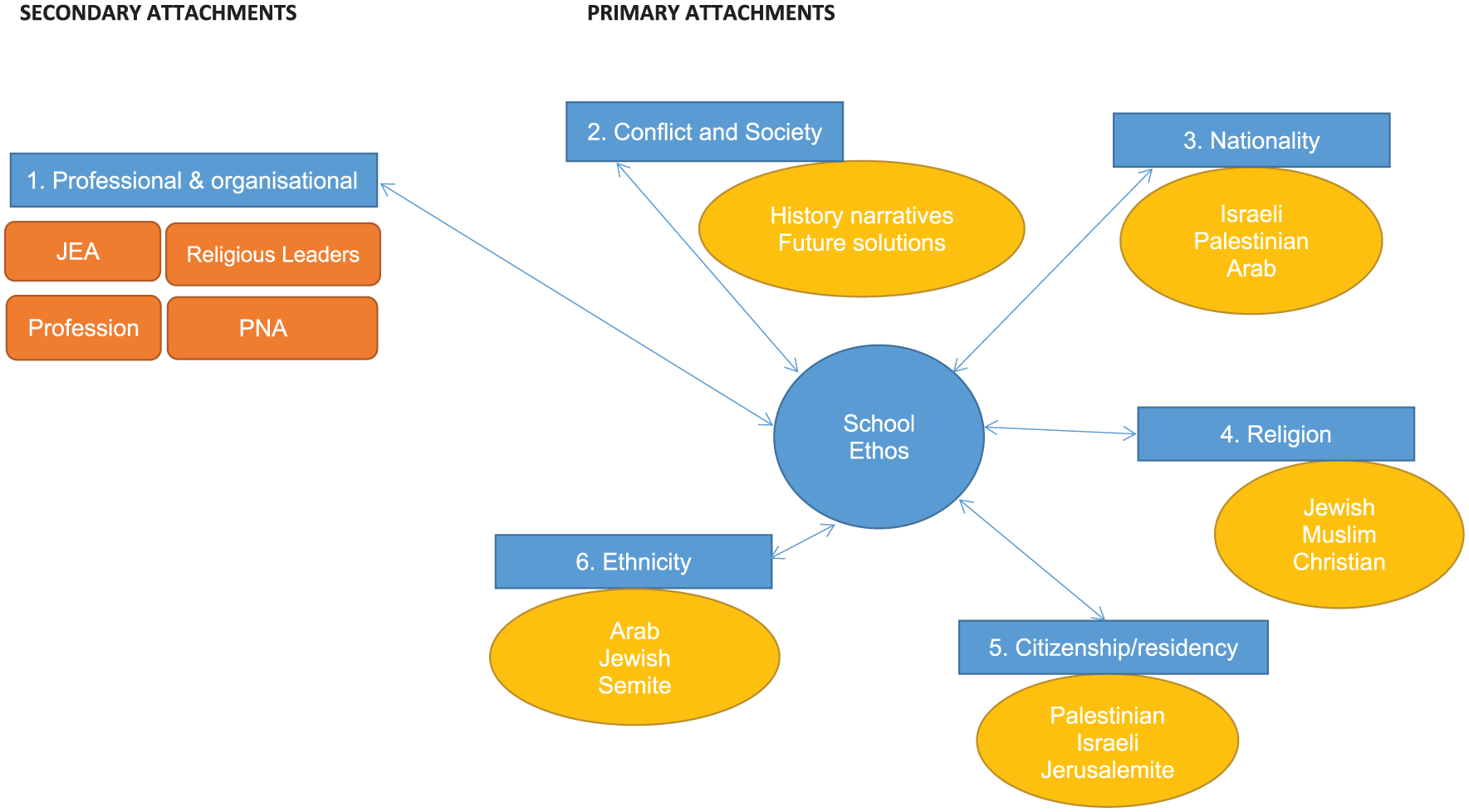
Conceptual framework.
Education Under Fire: Research Context and Methodology
Why Education?
The structural organization and management of education often demonstrates the way in which diversity is viewed by state authorities. Consequently, in divided societies, education can become party to conflicting political and ideological goals. The position of education in most societies allows it to take on an important role in the socialization of ethnicity. Schools can yield significant influence through curriculum content, providing the opportunity to reproduce the dominant language and culture, ensuring their transmission to future generations. Curriculum can teach history, religion, and even geographical interpretations of homelands through the channels of history and geography. In this sense, education offers a perfect mechanism for state assimilation projects, or, conversely, provides an ideal means of non-violent resistance when faced with threats to collective ethnic identity or territorial representation (Shanks, 2016). How communities choose to educate their children can reflect wider social-political environments and power dynamics. Education within the contested society is therefore the perfect venue to examine the relationship between passive and active representation.
The education system in East Jerusalem depends on a complex distribution of roles between four different providers: (a) Israeli municipal schools (39.4% of East Jerusalem students); (b) Awqaf schools, under the authority of the Jerusalem directorate of education, which itself is subordinate to the Palestinian Ministry of Education (14% of EJ students); (c) Private schools comprising not only independent historic religious schools but also the rapid growth of private sub-contractor schools licensed by Israeli Ministry of Education (2,000 students in 2001 to 46,875 students in 2016-2017 comprising 42.4% of EJ students); and (d) the United Nations Relief and Works Agency (UNRWA), in charge of schools in refugee camps (3%) such as Shufaat (Nuseibeh, 2016; Tatarsky & Maimon 2017).
East Jerusalem’s fragmented and bifurcated education provision is a direct consequence of Jerusalem’s ongoing disputed and contested political status (Dumper, 2014; Nasasra, 2018; Nuseibeh, 2016). Israel’s 1967 de facto annexation of Palestinian East Jerusalem and expansion of municipal boundaries (including 71 km of West Bank) lead to absorption of 66,000 Palestinians, afforded “residency rights” but not full Israeli citizenship (Ju’beh, 2007). Today 300,000 Palestinians live within the municipality of Jerusalem as defined by Israel. They pay city and state taxes and are considered “permanent residents,” although not citizens, of Israel (Association for Civil Rights in Israel, 2015).
Similar ambiguity surrounds education policy and provision in East Jerusalem where Israel have not been able to assert full sovereignty or control. While the Israeli Ministry of Education and Jerusalem Municipality are legally responsible to fund and operate schools in East Jerusalem, the Palestinian Authority (under 1993 Oslo Accords) also provides schools their own curricula and examination process (de Santisteban, 2002). This split administration between antagonistic actors, coupled with historic Israeli underfunding has led to severe classroom shortages, absenteeism, and the country’s highest drop-out rates (Alayan, 2018; Maimon, 2015; Shlomo, 2016). Such structural problems have been further exacerbated by the construction of the separation wall through East Jerusalem suburbs; leading to disruption, delays, and a lack of access to schools for thousands of Palestinian children (Dolphin, 2006). Against this chaotic and volatile backdrop, Israel’s education ministry is increasingly pushing for Palestinian syllabus reform and the adoption of the Israeli Bargut system (Grave-Lazi, 2017) in return for better school funding and resource allocation in East Jerusalem (Hasson, 2016; Shlomo, 2016). This coercive educational agenda is once more transforming East Jerusalem’s educational sphere into an arena for ethno-national struggle and resistance.
Since 2012, some East Jerusalem school principals, incentivized by municipal funding, and often Palestinian parent demand, began to provide students with the option of studying for the Israeli state exams (bagrut) instead of the Palestinian Authority–endorsed Palestinian exam (al-tawjihi). In 2018, it is estimated that around 7% of Palestinian East Jerusalemite students took Israeli exams (Hasson, 2018). Such schools have been accused of supporting the Israeli curriculum, Israeli propaganda, and the normalization of Israeli control in East Jerusalem. Condemnation has been delivered from some of the highest of religious authorities, with the former Grand mufti of al-Aqsa Mosque, Sheikh Ekrima Sabri delivering a sweeping condemnation of the education policy with a fatwa in September 2017: From the pulpit of the blessed Al-Aqsa Mosque, we clearly state that it is not permissible to teach the Israeli curricula in schools in Jerusalem, and that all those who teach them are guilty and all those who support and teach them are sinners and those who send their son or daughter to the school that studies these curricula are guilty.
The independence and autonomy of Palestinian education in East Jerusalem remains a vital component of community identity and solidarity. In the words of one interviewee, “Education is the last tool that remains under Palestinian control. If we lose it, we lose everything” (School principal in East Jerusalem, A1).
Our fieldwork, carried out in East Jerusalem between 2015 and 2016 was conducted amid heightened social and political tensions. Some Israeli commentators label this period the “knife intifada” due to the intensification of stabbing attacks and shootings, particularly throughout East Jerusalem and the Old City. Social unrest and heightened security invariably sensitized interviews and even limited access to schools and educators.
Q Methodology
Q methodology is most concerned with determining a community members’ principled and causal beliefs. The most common methods of measuring attitudes within the social sciences are the straightforward Likert-type scale and the semantic differential method. Q methodology, for Selden, Brewer, and Brundy (1999) provides “the most appropriate basis” for measuring individual norms and values. Q methodology therefore does not seek to answer r questions such as how many respondents agree with particular sentiments or courses of action. Rather, in Q, we seek to determine if the positioning of the statements by a respondent is related to the positioning of the statements by another respondent. Q has therefore been described as an inverted factor analysis, meaning, the questions are subjects and the respondents are variables. Individual respondents who have placed the statements in a similar fashion are then said to share perspectives. Q therefore seeks to determine a set of existent viewpoints—it does not seek to determine the extent to which these viewpoints are ascribed (Kitzinger, 1987). Furthermore, it focuses on who the interviews are as opposed to their number (O’Connor, 2014). The Q technique is therefore appropriate for our research question as it is particularly suited to measuring the dominant narratives conveyed by SLBs.
The Q sample
The Q sample is derived from a broad review of the literature in each of the conceptual areas highlighted in Figure 1. Initially more than 300 statements were identified, these being reduced to 30 statements that were considered to be most relevant (presented in Table 1). Statements were translated into Arabic and independently retranslated into English to ensure accuracy. A pilot study was also conducted, following which statement translations were finalized.
Factor Arrays.
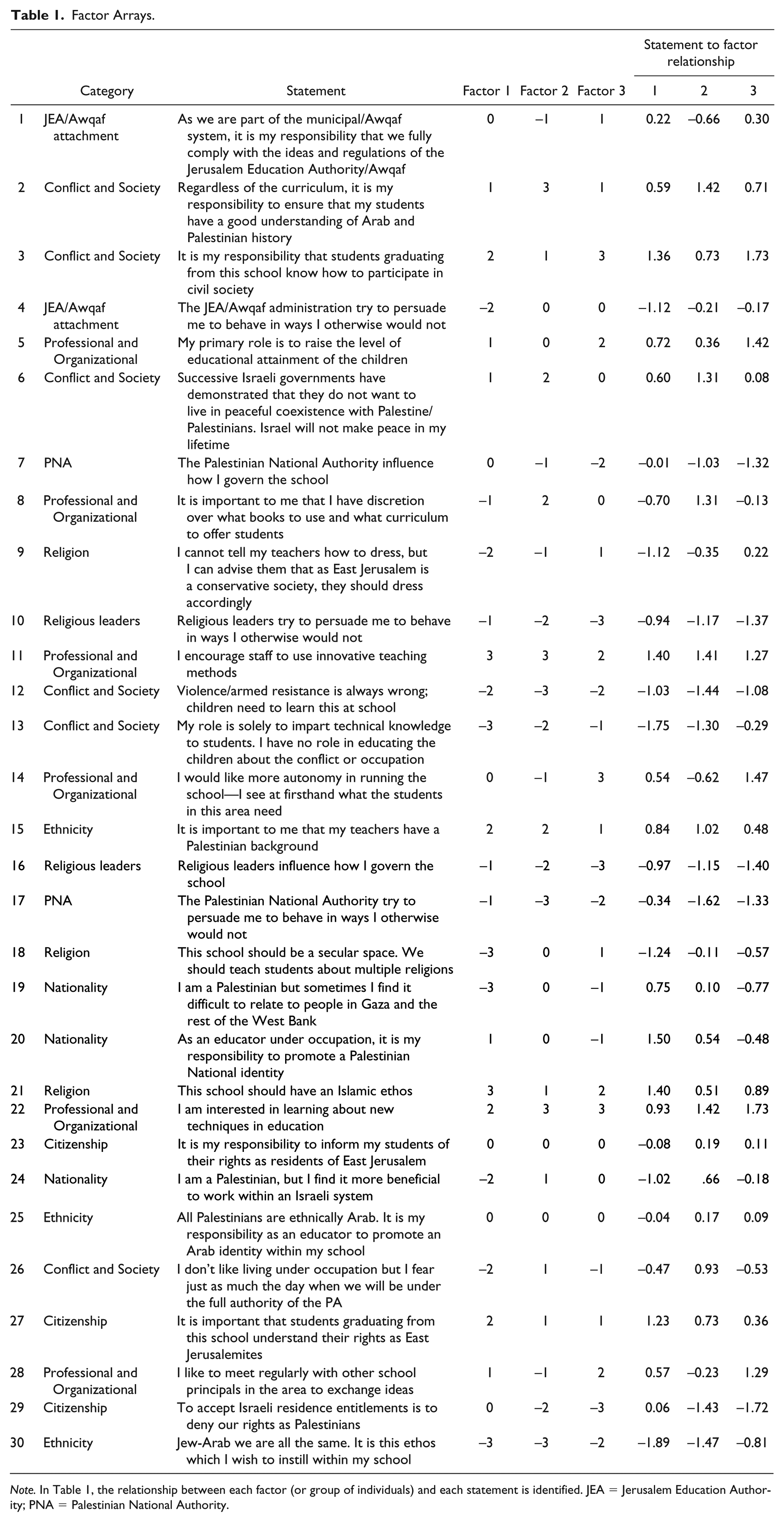
Note. In Table 1, the relationship between each factor (or group of individuals) and each statement is identified. JEA = Jerusalem Education Authority; PNA = Palestinian National Authority.
The P Sample
In Jerusalem, there are 46 Awqaf schools and 65 municipal schools. Of these, we targeted principals and deputy principals. Twenty-two interviewees from 22 schools were interviewed, of which, 20 completed the Q sorts: 12 from the municipal schools, referenced as M1, M2, and so on, and eight from the Awqaf sector, referenced as A1, A2, and so on. Of the 12 municipal respondents, three were female, and of the 10 Awqaf respondents, six were female. Interviewees in both cases were between the ages of 40 and 60. Interviewees from these schools were targeted on the basis of their geography (urban-rural), gender, school type (perceived socially conservative, liberal), and time in post. In all, 80% of those targeted for interview participated in the study. Those who declined were all from the Municipal Sector. In each case, a minimum of two members of the research team met with each interviewee. The interviewee was presented with the Q cards and asked to sort them into three categories: a category they agreed with, disagreed with, and those they were ambivalent about. They were then asked to further sort these cards into seven fixed predetermined categories—those they strongly agreed/disagreed with, those they agreed/disagreed with, those they mildly agreed/disagreed with, and finally those they were ambivalent about. While sorting the cards, each interviewee was encouraged to tell a story or elaborate on why they had placed the card in a particular fashion. Once the cards were sorted, the interviewee was asked further open questions, based on the positioning of the Q cards. All interviews were recorded, transcribed, and subsequently translated into English and analyzed. This gave a comprehensive picture of the respondent’s core beliefs and perceptions.
Data Analysis
The quantitative data were analyzed using PQ Method and the qualitative narratives were analyzed by the project team.
The Findings
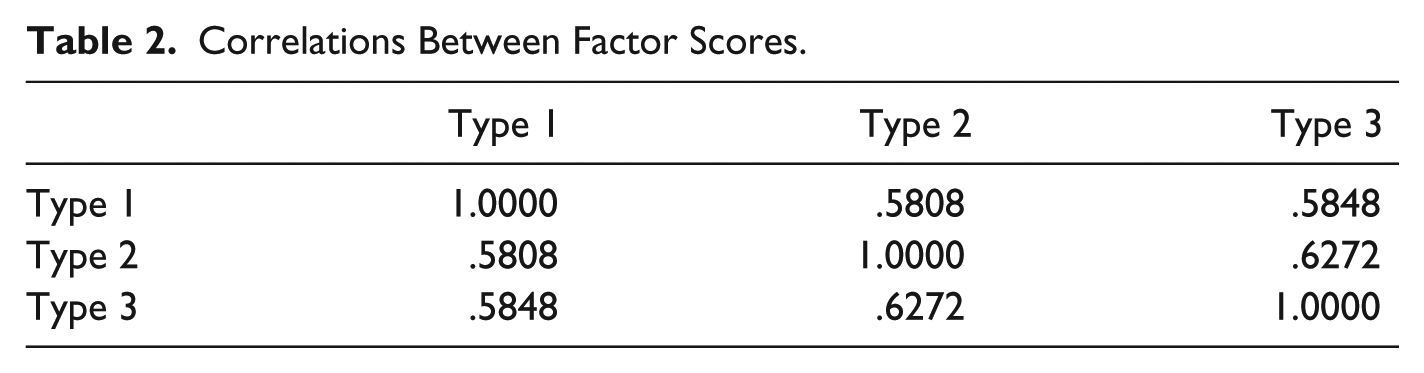
We correlated the Q sorts to create a 20 × 20 matrix. This in turn was subject to a principal components analysis and rotated by Varimax criteria to reveal three factors as outlined below. Each factor represents a conceptual template originating from where each respondent categorized the statements. Table 2 highlights that there is a noticeable difference between three types of school ethos evident in our East Jerusalem cohort.
Correlations Between Factor Scores.
The Factors
Table 3 displays the factor loadings of each of the three factors, showing that all but one interviewee from the Awqaf schools weighed significantly on Factor 1. (The qualitative part of the research revealed that this respondent was actively seeking employment in the municipal sector.) As previously mentioned, Q Methodology is particularly adept at measuring the range of views on a topic, not the extent to which they are ascribed—however, given (a) the consistent responses and (b) as our sample includes schools from the Old City of Jerusalem, modern expanding suburbs and surrounding conservative villages, we are therefore able to suggest that Awqaf principals are likely to share similar norms and values and seek to develop a common ethos in their schools. The table also highlights that municipal school principals also share norms and values; however, they weigh on two different factors. This would suggest that there are two dominant ethos(es) supported by municipal principals. Let us first look at what aspects of school ethos are common to all schools, before proceeding to differentiate between them. The numbers in brackets refer to the supporting statement as presented in Table 1.
Factor Matrix With an X Indicating a Defining Sort.
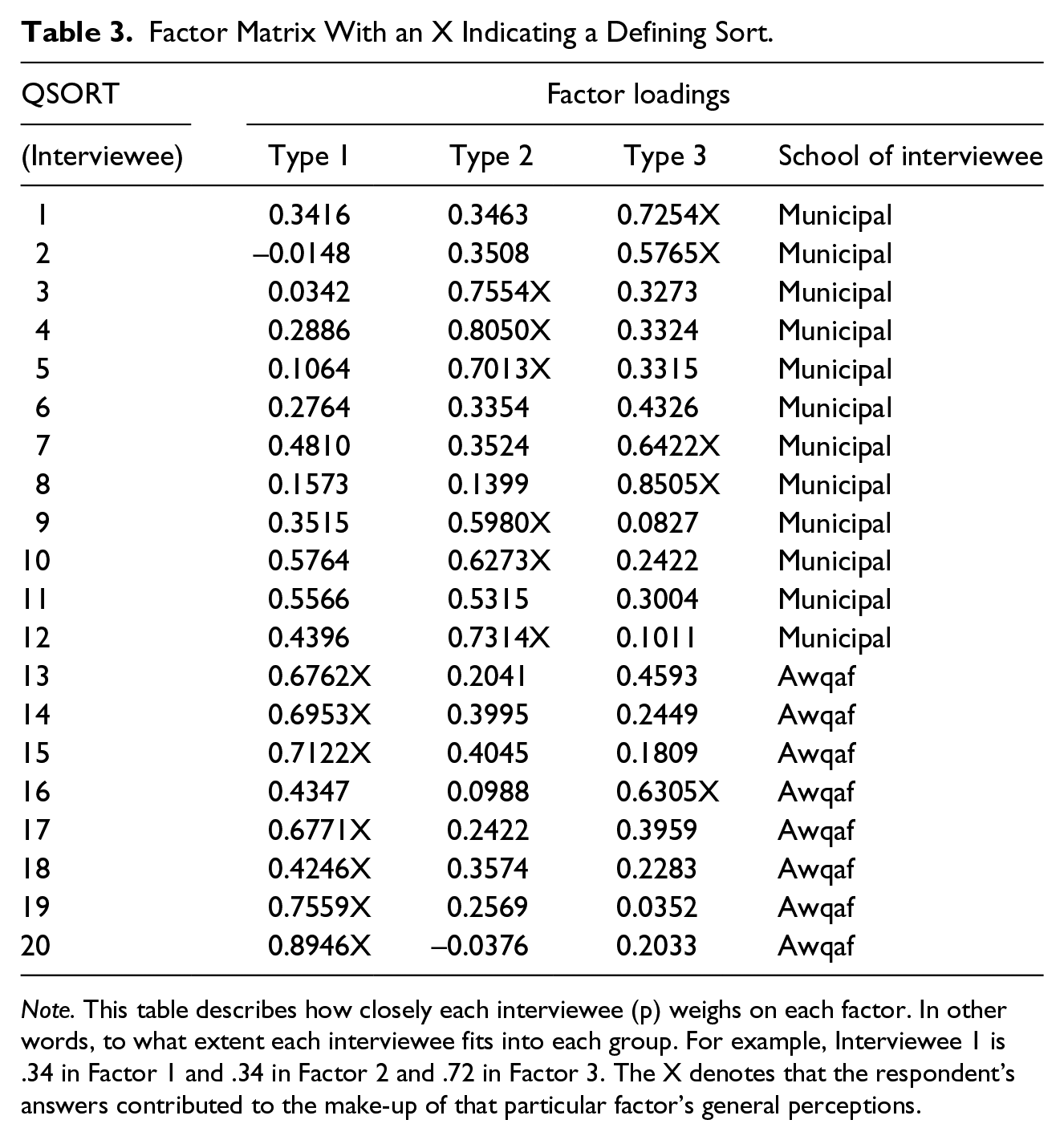
Note. This table describes how closely each interviewee (p) weighs on each factor. In other words, to what extent each interviewee fits into each group. For example, Interviewee 1 is .34 in Factor 1 and .34 in Factor 2 and .72 in Factor 3. The X denotes that the respondent’s answers contributed to the make-up of that particular factor’s general perceptions.
Common Aspects of School Ethos
In terms of conflict management, respondents are unanimous in their belief that it is not the school’s place to teach students that violent resistance is always wrong. All respondents were interested in the use of innovative teaching methods, suggesting the basis of a technocratic mentality. The interviews, however, revealed a complex relationship with the idea of resistance: interviewees did not explicitly oppose violent struggle (muqawama) yet many principals questioned its utility and achievements. Rather, greater emphasis, particularly in municipal schools, is given to the discourse of educational advancement as the most effective type of Palestinian resistance.
Second, the primary identity of teaching staff is important: They should be Palestinian (and in some cases Jerusalemite), not “just” Arab. Furthermore, there does not seem to be support for a pan-Arab ethos: Palestinian nationalism takes precedence. A number of respondents (particularly from al-Awqaf schools) favor hiring Jerusalemites as they understand the surrounding context and local sensitivities. Moreover, they are suspicious of the “invasion of 1948 Palestinian head teachers.” Arab-Israelis occupy a high proportion of municipal positions, usually as school inspectors, due to their Hebrew and Israeli recognized qualifications. As will become evident from the three emergent typologies, our results confirm that this fuels local resentment and suspicions that Arab-Israelis are complicit in Israel’s “Judiaising” policies in the sphere of education.
Although all respondents disagreed with the statement that religious leaders tried to persuade them to behave in ways they otherwise would not, the level of this agreement differed between typologies. Similarly, respondents felt, to variant degrees, that religious authorities did not try to interfere in the governance of the school. The qualitative results confirmed that religious authorities have little influence in education in East Jerusalem. Occasionally, they may be hired in al-Awqaf schools to provide Arabic teaching due to staff shortages. However, there is only one illustration of a cleric objecting to the teaching curriculum. This finding challenges Israeli discourses of increasing religious extremism in schools originating from the religious authorities (Burdman, 2003).
There is also unanimity in the belief that Arabs and Jews are different peoples: Respondents believe they are completely different races. Furthermore, respondents have no hope of integration or co-existence. They are committed to maintaining a separate identity (a composite of Muslim, Arab, Palestinian, and increasingly, Jerusalemite) that resists the Israeli occupation.
Delving further into the data, there is the basis of a distinct Jerusalemite identity (vis-à-vis a Palestinian/Israeli identity). Statement 23 (my responsibility is to teach students their rights as residents of East Jerusalem) is not disagreed with by any factor, while all factors prioritize teaching students their rights as East Jerusalemites (27). The second and third typology do not see taking Israeli residency as denying their rights as Palestinians, while Type 1 is neutral on the issue (29). The importance of maintaining and nurturing a Jerusalem identity at times trumps a religious affiliation/identity and Palestinian nationalism. This is maintained through educating about civil rights and familiarizing students with Jerusalem’s unique history, holy sites, and traditions—through tours, site visits, and local projects. This initial understanding would appear to confirm the traditionally held view that passive representation translates to active representation on behalf of a primary identity. However, when we delve deeper, we see there are a number of important characteristics that distinguish how active representation on behalf of this primary identity is manifest.
Type 1: Awqaf Traditionalist
Type 1 strongly identifies as a Jerusalemite and perceives Islamic teachings as part of their identity. They have a good relationship with the Awqaf administration. They have little interest in developing the Palestinian curriculum and book selection, but actively teach what they perceive as good citizenship (of EJ) and about the Palestinian–Israeli conflict. Those weighing on Typology 1 came from the Awqaf. This suggests that the range of viewpoints in Awqaf schools is fairly homogeneous. In other words, a distinct Awqaf educational culture exists. What then does this ethos look like?
Strong Focus on the Promotion of a Palestinian National Identity (20)
It is important that teachers have a Palestinian background (15). There is also, as expected, a differentiation between the Jerusalemite and Palestinians in the rest of the West Bank and Gaza (WBG) (19). Although Palestinian nationalism can be evoked by teachers to encourage religious unity and coexistence, or to stir resistance against Israeli occupation, ultimately it may not be strong enough to overcome geographical boundaries. These assertions are further supported by the quotes below: Our identity is Jerusalemite first, and Palestinian second. (A1) [Our role is to] strengthen the identity of students; their Jerusalemite, Palestinian, Muslim identity. Islam is our biggest pride. We have a religious mural painted on school’s wall. I also requested a drawing of a church (but without a cross on its top) to strengthen our affiliation to Islam but also respect for other religions. (A3) Currently, Israel is trying to erase the nationalistic poems [in our curriculum] and differentiate between the Palestinians inside [Israel] from the ones in Jerusalem and also in the west bank as if there were two states . . . The teachers are covertly teaching the original history and add-on to the books indirectly, they add information that doesn’t exist to deliver a nationalistic message to students. (A5) Since I started working in this school, I have tried to strengthen the nationalistic aspects [for students] and I have tried to explain to them the risks of leaving school and working in the Israeli settlements and markets and thus becoming subordinate to the [Israeli] occupation . . . It’s important for me to have teachers with Palestinian background who have nationalistic sentiment regarding the occupation. (A7)
The Jerusalemite Identity
Equal importance is given to the encouragement of a Jerusalemite identity among students, which is supported by increasing local knowledge of civic rights and employing local Jerusalemite teachers who know the context, city, and culture. The evidence points to suspicions of 1948 Palestinians taking local jobs and having a different agenda due to their integration within the Israeli and Arab educational system: Teachers are brought from the north to teach in schools in Jerusalem. They take the vacancies that were meant for Jerusalemites. People call this “the invasion of 1948 Palestinians.” (A2) At the beginning of the academic year, each classroom is named as one of gates of Jerusalem and each week we present new information on Jerusalem to strengthen their identity and affiliation. (A3) We always aim to teach them that they’re nationalistic Jerusalemites who should serve their country and their home city—Jerusalem. (A5) I educate the students about their rights as residents of east Jerusalem as well as their rights in school through the student council. I’m sure that my students understand their rights before they graduate from my school. (A7) It’s very important for me to teach my students their rights as residents of east Jerusalem. Being a resident in east Jerusalem allows you to have certain rights under the international law. (A10)
The School Should Have an Islamic Ethos
This typology has a conservative traditional attitude to religion and its role in school. They believe that school should not be a secular space where students are taught multiple religions (18) but generally should have an Islamic ethos (21). Overall, teachers support an Islamic ethos but they do not totally reject the teaching of other religions, especially Christianity: as they value co-existence and recognize its significance within Palestinian society and history. The teaching of good values and (religious) virtues are prioritized as this is believed to lead to good citizenship and better lives (3).
We don’t have a problem with religions but have a problem with distorting religious texts. I don’t believe in secular schools because we can never separate religion from daily life . . . The school doesn’t particularly need to focus on Islamic virtues and values. I don’t see a problem in values but in practicing religion. I support the Islamic values and virtues but not necessary the religious practices such as praying, dressing and others. (A10) We are Muslims and the curriculum we teach is Islamic. However, we teach the students the importance of coexistence with the Christians and Jews. (A5) Our school is operating according to the Islamic rules and there’s no need for clerical involvement . . . We learn about other religions through our own religion. (A6) We aim to teach and strengthen the good values of citizenship in our students. (A6) Our aims are not only to improve academic results but also to improve their values. (A7)
Relationship With Their Palestinian Administrative Authorities
They appear to have a good working relationship with the Palestinian administration and the PA in that neither the Awqaf in Jerusalem nor the PNA (Palestinian National Authority) in Ramallah persuade them to behave in ways they otherwise would not (4)(7)(17).
We follow the regulations setup by the Awqaf and according to the condition and location of the school. (A3) Our directorate is cooperating with us in an honest manner; we have departments that we can refer to easily, and our teaching plan in the school is a part of the directorate plan. (A5) As an education system: we work according to the Education Authority in Ramallah and no one can interfere [in this]. The textbooks are unified in all Awqaf schools in all areas . . . Each person can have his own beliefs and we can’t object to the curriculum but we try to organize workshops to update the curriculum every 5 years to accommodate the developments and students. (A6)
Conversely, they demonstrate much antagonism toward municipal schools and municipal teachers. For the Awqaf educators, Palestinian teachers from municipal schools have accepted Israeli authority and are part of the Israeli educational system in Jerusalem. Despite Awqaf-municipal school co-operation over Tawjihi examinations, there is no contact between staff through teaching forums, collaborative networks, or twinning of schools—This remains a very politicized and sensitive topic. Awqaf educators believe municipal schools are using a distorted syllabus which strips Palestinian students of their identity and national history and weakens communal resistance. Municipal schools, in their opinion, have sold out because of the lure of financial incentives (better pay) and better working conditions: Jerusalem is one of the most difficult places for teaching because some municipal schools have the willingness to teach the Israeli curriculum and thus teaching in Jerusalem became a kind of a challenge and steadfastness (sumud). (A1) Those schools that teach the Israeli curriculum receive additional benefits and funds, but it is dangerous as it could lead to the “Tahwid” (Judaisation) and challenging the Palestinian identity . . . We’re proud to have the Palestinian curriculum that represents our nationality, history, religious, unification and values. I support teaching the Palestinian curriculum. (A5)
Technocratic Attachment
Of the three typologies, this typology has the lowest technical interest—not finding it important to be involved in the selection of school books or choosing the curriculum to offer students (8). Nonetheless, they are interested in learning new teaching techniques (22) and encouraging staff to use innovative teaching methods (11) and tend to agree with Statement 5: that their primary role is to increase the educational attainment of the child.
Compliant to Teaching Curriculum and Books
The curriculum is the Palestinian curriculum internationally approved after Oslo accord. There should be scrutiny on the Israeli curriculum similar to the scrutiny applied on the Palestinian curriculum . . . (A2) The message of education is beyond just delivering technical knowledge; it’s a comprehensive effort that aims to enrich the students in every way . . . We feel we have adequate autonomy and we don’t need to demand more of it. (A5) We’re proud to have the Palestinian curriculum that represents our nationality, history, religious, unification and values. I support teaching the Palestinian curriculum. In a covert way, our curriculum encourages and strengthens Palestinian nationalism and this is something we teach the students on since they’re young children. (A5) We sometimes manoeuvre around the curriculum with activities we do. If each principal had freedom choosing his curriculum, they would have chosen their own curriculum according to their personal views. (A8)
Committed to New Teaching Techniques and Innovative Methods
We have modern teaching equipment provided by the department of education, such as interactive boards for which we needed training courses for the teachers to use. We always aim to make the teaching experience more interactive and for students to lead the class and encourage them to build their leadership characteristics, also when they prepare to present to the class, they never forget the information and become more creative. (A5) We try to encourage creativity and novel ways of teaching. (A7) The teachers have been trained for the last 3 years to improve teaching strategies. The teacher focuses on the student as the most important building-block of education, where they previously used to only dictate the students. (A10)
Primary Role Is Educational Attainment of Student
The message of education is beyond just delivering technical knowledge; it’s a comprehensive effort that aims to enrich the students in every way. (A5) One of my most important objectives is to improve the academic achievements among students. (A11)
Conflict and the Peace Process
In terms of future conflict resolution, they are pessimistic about peace with Israel during their lifetime (6). They vehemently disagree with Statement 13, instead arguing that it is their role to teach students about conflict narratives and the Israeli occupation: There is no hope in reaching peace, because [Israel] is a settler state. (A2) Anyone who claims that Israel will achieve peace is delusional. I don’t believe that Israel will achieve peace. (A6) I believe that Israel will not achieve peace. Netanyahu said that the Palestinians will never have their own state during my reign. My role is not only providing knowledge but also to teach the students about the occupation and the conflict. (A11)
The focus is not merely on occupation violence and the particular challenge of everyday life but inculcating an attachment to lost lands and Jerusalemite cultural heritage: We, as institutions, are keen to take the students on field-trips to teach them about the history of Palestine [e.g. tours to Palestinian destroyed villages] so it can become embedded in their memories and not only verbally. (A5) We educate the children about the occupation. We, in Jerusalem, are different from the rest of Palestine. Tension and contiguity in Jerusalem is very high and we have to educate the students about this. (A6) In my opinion, learning about the occupation is an important thing; this does not only include technical knowledge . . . We try to inform the students about what happens around us such as public executions and violent raids . . . It’s important for me to have teachers with Palestinian background who have nationalistic sentiment regarding the occupation. (A7)
Type 2: Municipal Pragmatist
The municipal pragmatist acknowledges the limitations of the PA in East Jerusalem and is therefore willing to work within the Israeli system, albeit reluctantly. They stress the importance of Arab Palestinian history and identity which trumps Islamic teaching. They emphasize the importance of residency/citizenship rights but believe that it is not the school’s place to discourage violent resistance. They prioritize school books and curriculum and individual autonomy and are not fully responsive to the Jerusalem Education Authority (JEA; their Israeli Administrative masters). These teachers and headmasters have a pragmatic approach to Palestinian education: in which they rely on the tawjihi, despite acknowledging its limitations.
Palestinian Nationalism
Typology 2 are the first of two cohorts from the municipality schools. They place significant emphasis on ensuring that their graduates have a keen understanding of Arab and Palestinian history. Teachers should have a Palestinian background (15) but like the other municipal cohort (Type 3), promoting a Palestinian National identity is understood within a broader Arab context.
I’m proud of my history as a Palestinian. I’m also proud of the Arab history and Arab leaders who led our nation to improvement. And I like to teach this to our students in an interesting way so they can better remember . . . We regularly do fieldtrips around the displaced Palestinian villages with the help of a tour guide who tells the students the real Palestinian story, and not the one that the occupation want to implant and teach it to our children to wipe out their Palestinian identity and make them ignorant. (M12)
Citizenship/Residency Rights
They strongly disagree that accepting Israeli residency rights denies their rights as Palestinians (29). This sentiment may be linked to the fact that some Jerusalem municipal school heads are Palestinian citizens of Israel and have therefore learnt to reconcile the tension between civic rights and national identities and affiliations. Rights are a form of not only resistance but also local empowerment and a means to legally challenge the Israeli system.
It’s important for me that my students know their rights and duties in society. Residents in Jerusalem are paying lots of money to the occupation. They also endure problems and difficulties. Thus, they have rights they need to demand and never gave up on. (M10) I always encourage students to demand their rights, even for simple rights and never be negligent about them. (M12)
Islamic Ethos and Good Citizenship
On religiosity, although the school should have an Islamic ethos, of the three factors, this factor believes this to be of least importance (21).
It’s important for me to see the students improve their ability to write and read and for me to successfully plant in them the values of good citizenship and the virtues of Islam. All which if we follow, our situation would become much better. We see today that the West is following our Islamic virtues more than we do; however, they rename these virtues as general ethics. (M12)
Critical of Awqaf Schools and PA Authority
These municipal school principals generally view Awqaf schools as underfunded, badly supported by the PA and delivering a poor level of education. Teaching appointments are due to patronage (wasta) and connections.
The [Palestinian] authority has no role and influence in the school administration and even in curriculum, we don’t follow the Authority. For sure, it’s more materially beneficial to work in the Israeli system. We currently see the strikes of the teachers in the schools of Palestinian authority and Awqaf to demand their rights. Even after getting their rights, they will still receive much lower salaries than those who work in the municipality schools. (M12) Schooling in east Jerusalem is relatively forgotten. This is because of several reasons among which is the parents’ neglect as well as the failure of almost 50% of the teachers. By failed teachers, I mean those teachers who were appointed through “wasta” their connections, which in turn, led to the general decline in student education. (M5)
Technocratic Mentality
On an epistemological level, they do not prioritize meeting with other school principals (28). Nonetheless, they do put forward that they do not see it as their responsibility to be responsive to the JEA (1). Together with their counterparts in the other municipal schools, they are most interested in learning new teaching techniques (22) and like both other factors encourage the use of innovative teaching methods (11). They are the only factor that prioritize the choosing of school books and curriculum (8). These teachers/schools fall between PA supervision/accountability and Israeli municipal authority—they are distanced and disenfranchised with the PA yet they are resistant to Israel’s municipal attempts to weaken Palestinian identity and culture. They see benefits of Bagrut (pedagogy over content, teaching style, employment prospects) yet they also recognize its instrumental political goal and are unwilling to countenance it.
The teaching system I follow in my school is a Palestinian system in general. Around 95% of the classes are being taught with Palestinian curriculum and the 5% left are being taught with the Israeli curriculum al-Bagrut. I think that once the classroom door is closed, only God knows what is being taught. The parents requested having Israeli curriculum, but I can’t include all of it. I only included Arabic, English, and Mathematics textbooks. And instead of including Israeli civil education, I added Palestinian national education. I know that the Israeli curriculum is better for students because it builds their thinking outlooks and does not depend on dictation. Thus, it makes it easier [for students] to be accepted in the Israeli universities and institutions. It also makes it easier for them to be accepted in job market much better than the students who studied the Palestinian system . . . However, we know that the ones who created the Israeli system [curriculum] have political objectives rather than academic. For this reason, I chose to include the textbooks that are standard and not related to politics, such as Arabic, English languages and Mathematics. All which are standard around the world. Meanwhile, for the social science textbooks such as national studies, history, geography, we need to have more flexibility. And we need to [help] the students to preserve their Palestinian identity while learning other skills from the Israeli curriculum. Because of this, I made the [curriculum] hybrid and picked the best for the students. The objective of including the Israeli curriculum in the Arab schools in Jerusalem is to Judify [Tahweed] the area and not to achieve the best interests of students. They impose it to achieve political goals . . . With regards of schools and curriculum, the PA is trying to reject something without providing an alternative. They claim they want to take away the Tawjihi but don’t propose anything instead. Because of this we feel ridiculed. And feel that the students are being lab rats for this curriculum. (M3)
M3 justifies his hybrid educational approach due to (a) parental demands, (b) Israel’s stronger syllabus and text books, (c) more choice and educational freedom, (d) higher educational attainment, (e) future job prospects, (f) the Hybrid approach still includes Palestinian nationalist components, and (g) awareness of Israel’s political objectives yet the PA have offered no viable alternative.
Regardless of the curriculum, it remains my responsibility to make sure to deliver all [information] to our students regarding our Arab Islamic Palestinian history. As long as this does not oppose Israeli law . . . (M5) I see that the Bagrut system helps the students to improve their creativity and critical thinking. However, we refuse to implement it as it is, because it pushes us away from our Palestinian identity. We want to teach the Palestinian curriculum in a Bagrut style and system. (M10) The Tawjihi system is very sterile and complicated. Even within the PA itself, the Palestinian minister of education requested the elimination of Tawjihi system because it doesn’t achieve the students’ requirements and doesn’t recognize the individuality of the students and their personal, academic, and social differences. The curriculum in general is good and preferable despite having few remarks on it. I prefer it, especially regarding History textbook of the 11th grade because it focuses on the Palestinian history. I give my opinion without restraints and we try to investigate and analyse [the books] with the students and give them examples to compare history with current time. (M4)
This cohort is not particularly interested in increasing their autonomy in the running of the school (14). However, this may be as they perceive themselves to already have it: Statements 10, 16, and 17 suggest that the JEA, PNA, and religious leaders do not make them behave in ways they otherwise would not but rather they have found sufficient discretionary space through the cracks of a fragmented system.
The Broader Peace Process
They are the most pessimistic typology about a peace agreement in their lifetimes (6). However, although they do not like living under Israeli occupation, they are the only typology to say that they fear living under the PA more (26). Although they regard themselves as Palestinian, they can see some advantages of living within an Israeli system (24).
I don’t like living under occupation, but I’m more afraid to live under the absolute rule of the Palestinian Authority. This statement represents how I feel. Although Israel is a colonial state, however, it’s an institutional state unlike the Palestinian Authority which is an individual state. (M3) I don’t like living under occupation, however the PA rule is not different from the Israeli rule and it also doesn’t function to benefit the Palestinian citizen. (M5) As a teacher, I seek to educate and plant the basic principles in my students. I don’t exactly follow the curriculum, I act upon what I see is more beneficial and valuable for the students. In the textbooks of municipal schools there are pages that been wiped out because it includes nationalistic lessons and poems. I always tell my students that their education and learning is itself resistance and perseverance, and the occupation always seek to demolish culture and education because it knows that education is the thing that leads to the development and progress of the nation. (M10)
Resistance
This typology does not believe that it is always the school’s place or responsibility to oppose violent resistance in certain contexts (12). Resistance may take multiple forms and expressions: “muqawama,” violent resistance; “muqawama silmiyya,” peaceful resistance (protests, demonstrations); and “sumud,” everyday steadfastness or resilience. Yet as educators, their role is to provide a broad and constructive concept of resistance in which education provides the hope for future liberation.
There is a difference between violent resistance (muqawama) and peaceful resistance (muqawama silmiyya). Resistance (sumud) is part of our daily lives, we need to be resilient and struggle against the occupation. How can we achieve freedom without resistance? Our role in this struggle is education. The Israeli Bagrut can never be imposed on us—this crosses twenty red lines. Put it another way, if the society of [conservative village] agree to introduce the Bagrut then I will agree—but I know they will never agree to this prospect . . . I always tell our students that the knife will never get us Palestine back, but education will. In my opinion, students have troubles in their homes between their parents, and not from the current political situation. (M1)
Type 3: Municipal Reformer
This final typology prioritizes educational advancement over nationalist discourse; they are willing to adopt the Bagrut if it improves academic attainment; they do not prioritize conflict management or Palestinian national identity; overall, they are less political but more integrationist toward the Israeli system. The final typology consists primarily of principals from the municipal sector (one Awqaf principal weighs on this factor too). This individual indicated in the qualitative interview that he or she would like a position within the municipal system because of the salary benefits and the stagnant tawjihi system.
Citizenship/Residency
Like Type 2, this type does not see having Israeli residency as denying their rights as Palestinians (29).
Students need to know their rights within the occupation situation—as East Jerusalemites they need to know their rights . . . We always promote the Palestinian identity, not only because we are under occupation. (M1) Important to understand our Jerusalem rights. We bring in a lawyer to teach the 11th grade their rights. The lawyer is a Palestinian from inside Israel working for an organisation called Qudsuna (Our Jerusalem). (M2) For me, it’s important that our students before learning their identities as Palestinians to know their identities as females, members in a family and Jerusalemites in terms of identity and culture, and all which would result to build their identities as Palestinians. (M6)
Jerusalem Identity Prioritized Over Palestinian Identity
Once again, we see a strong affiliation with Jerusalem vis-à-vis the other areas of the country.
I prefer to have Jerusalemite teachers because it makes it easier for him to communicate and understand the children. (A4)
Yet this is the only typology that is reluctant to promote a Palestinian national identity within their school (20). They do stress however that the school should not be a secular space (18) but should have an Islamic ethos (21). That said, religious leaders do not force them to behave in ways they otherwise would not (10), nor are they influential in the running of the school (16). This is the only typology to agree with the statement that as East Jerusalem is a conservative society, teachers should dress accordingly (9).
[Village name] is a very conservative village, it is different from the rest of East Jerusalem. The municipality sent us this year a female teacher from the village next to us who dressed inappropriately. I had to take the teacher aside after one week as she was getting hassle from students and explain the religious norms and customs of society in [village name]. (M2)
Relationship With Authority
This typology would like more autonomy in running the school (14). They are the cohort most likely to support the statement that their primary role is to raise the educational attainment of the child (5) and to ensure that graduating students are good residents of the city (3). They are also interested in learning new teaching techniques (22) and encouraging staff to use them (11). This interest in education attainment, together with an interest in meeting with other school principals, indicates that this factor may demonstrate some of the qualities of an epistemic community. They are the only factor that consider that they should take on board the ideas of their governing body (for all but one, this is the JEA). They are also more supportive of implementing the Israeli Bagrut.
We strongly need to learn the Hebrew language because it’s vital to our daily life and dealings with official institutions including the occupation state . . . The municipal schools are 90% funded by the municipality in terms of budgets, expenses for classrooms, buildings and utilities. In my opinion, we receive enough budget to fulfil all student needs . . . There are many private schools, such as the ones affiliated with Husni al-Ashhab,
2
which lack important things such as heating and utilities. Overall teachers’ salaries in the municipality are big compared to the teachers in other Arab states. The teachers are doing their jobs with integrity and honesty . . . I believe that, since I chose to work under the municipal system, then I need to abide with its regulations. (M8)
This typology is supportive of the municipal system which is regarded as well funded and remunerates fairly. Those who chose to teach in this system appear to abide by the regulations and are more compliant with the administrative authority (JEA) than other teachers. Together with their counterparts in the other municipal typology, they are broadly supportive of the Bagrut system.
I prefer the Bagrut system because it measures student’s long-term abilities. It’s a long-term and consistent measure unlike al-Tawjihi which only determines the fate of students through two-weeks of examinations . . . the Bagrut makes it easier for students to be accepted to university. Overall I support the Bagrut format over the Palestinian curriculum because it’s a better and stronger evaluation mechanisms. (M9) I see that the Israeli system is better materially for the Jerusalemites, because of the heavy living expenses and taxation they pay on everything, even their houses, and thus it’s better for them to work under the Israeli system that pays much better salaries than Awqaf schools; which also work in Arab schools and work hard to plant the nationalistic values in their students. (M11)
Violent Resistance and the Peace Process
In terms of the conflict, although principals in this category will inform students about the conflict and the environment in which they live, they are the typology that placed the lowest amount of emphasis on this (13, 20, 27).
We should not teach violent resistance (muqawama) in schools. What is currently happening in East Jerusalem is suicide not resistance, this will not help to liberate the land rather it is painful and futile. Recently I brought in a religious sheikh to explain the meaning of true jihad and to teach ethics and politics. Students need to understand that knife attacks which lead to being shot are not forms of martyrdom. There is frustration and tension in our school but we are left alone to deal with these problems. (M2) I consider myself to be part of the resistance with my knowledge and my job. In respect of the state, there are legitimate and illegitimate ways, I see that my students are also part of the resistance and the fight with their education. In my school, we don’t directly address the occupation and conflict. We only address them indirectly, to help our students in generally understanding the current circumstances in a way that doesn’t put them in fear and panic all the time. (M6) In my opinion, violence is always wrong and leads to wrong implications and doesn’t lead to any solution. We teach this in school. However, I support peaceful resistance (muqawama silmiyya). (M7)
Discussion and Conclusion: Implications of the Findings
This article has used the theory of representative bureaucracy to understand the behavior of SLBs. Shpaizman, Swed, and Pedahzur (2016) draw on evidence from the Holy Basin of Jerusalem to highlight how policy entrepreneurs can change policy outcomes through venue shopping, despite these outcomes being converse to government policy. This research has highlighted that education is fast becoming the key “venue” in the ongoing conflict between Palestinians and Israelis in Jerusalem. Both sides are jostling to ensure their frame is the accepted frame. What then do these frames tell us about (a) representative bureaucracy theory, (b) conflict management, and (c) education policy in East Jerusalem?
Key Finding 1: Representative Bureaucracy
In line with the dominant trends in representative bureaucracy research, active representation on behalf of a primary identity is demonstrated throughout all typologies, as initially hypothesized. Existing active representation research differentiates between the presence and absence of active representation (usually on behalf of a primary identity). Our research methodology allows us to highlight that active representation on behalf of a primary identity, where it exists, is a lot more nuanced. Although all typologies demonstrated high levels of primary ethno-national identity, how this manifested itself in terms of ethos/dominant narratives is significantly differentiated. It is no longer sufficient to argue active representation exists (be this on behalf of a primary or secondary attachment); for active representation studies to inform the policy process, we need to examine how active representation of the same primary identity is interpreted differently within ethno-political, and potentially gender or racial, groups. This research highlights, although passive may indeed translate into active representation, how active representation is defined can differ remarkably. If representative bureaucracy research is to maintain its relevance as a conceptual lens for determining bureaucrat behavior, future research designs need to accommodate the more fluid and dynamic realities of primary identity attachments. Active representation on behalf of a primary identity can be moderated by socio-economic variables, family politics, or indeed different primary identities may clash creating a multitude of schisms.
A Palestinian national identity is represented by all SLBs, however, how active representation on behalf of a national identity manifests itself is not uniform across SLBs. It is no longer sufficient for representative bureaucracy research to argue that “blacks represent blacks” (Mansbridge, 1999) or that women represent women; representative bureaucracy research must look closer at how representativeness is interpreted and identify what happens when primary attachments such as gender, race, class, nationality, and ethno politics collide.
Key Finding 2: Implications for Conflict Management
The article has presented evidence of educational narratives that help create a more accurate picture of what “judiasation” or “de-Palestinization” in East Jerusalem actually entails. While many Palestinian teachers remain strongly resistant to encroaching Israeli control, they are desperate for long awaited Palestinian educational reform to give them a realistic alternative. Our findings highlight, however, that what is meant by reform differs markedly among educators and therefore any prospect of substantive reform remains slim (see Nuseibeh, 2016, and recent reform efforts by Palestinian education minister Sabri Saidam 3 ). The findings demonstrate that a renewed sense of urban Jerusalemite attachment based on cultural and historic importance (situated within Arab, Muslim, and Palestinian rights and identities) has emerged. Our interviews suggest that this is a reaction to Israel’s “judaization” policies in East Jerusalem (settlement expansion, home demolitions, wall construction) which is undermining not only Palestinian presence but also the political vacuum and failure of the PA which has eroded hope and trust in a broader political solution. East Jerusalemites are caught within a complex and conflicted position—whether to remain under Israeli occupation and to fight for more residency rights and better educational provision—yet how to reconcile this pragmatic choice over ideological belief; to resist but at the same time exist within their city (Larkin, 2014).
Key Finding 3: Implications for Education Research
Education can provide an important space for resistance in divided societies, overt and hidden curriculums, school structures (assimilatory, separate or mixed), and school ethos can all serve a political or ideological purpose. Within East Jerusalem, we can see that curriculum and choice of examination board are central to the understanding of local resistance. Various strategies have been adopted in this respect, each reflecting a differing understanding of education’s role in resistance. Provision of supplementary texts, historical readings, and alternative syllabi; educating Palestinian students about civic/residency rights and national identity; and introducing students to concepts of non-violent resistance, civil disobedience, and how to challenge the system from within, have all been adopted to varying degrees.
When coupled with the choice of examination, the three typologies this study revealed, manifest contrasting understandings and interpretations of “education as resistance.” To some extent, they provide a sliding scale approach to the choice between Palestinian Tawjihi and the Israeli Bagrut examination:
Tawjihi and PA Syllabus Support it as benchmark of Palestinian identity, sovereignty, and rejection of Israeli occupation (Awqaf Traditionalist Type 1)
Tawjihi and JEA Municipal Syllabus (altered PA syllabus) Supplementary educational material added to counter Israeli erosions; focus on Palestinian history, identity, and so on (Municipal Pragmatist Type 2)
Tawjihi examination but use of mixed syllabus and materials Weakness of Tawjihi and use of other teaching approaches and materials; Tawjihi is only used for the final year examination period (Type 2)
Bagrut and Tawjihi—hybrid selection of syllabus materials and students can choose examination trajectory—most select Bagrut Tawjihi gives certain Palestinian ethos but Bagrut needed for educational advancement (Municipal Reformer Type 3)
Bagrut exclusively Rejection of Tawjihi and acceptance that Israeli system offers more educational opportunities (Type 3)
This spectrum demonstrates the diverging approaches to, and acceptance of, Palestinian educational provision in East Jerusalem. Invariably such choices are justified as attempts to frustrate what they perceive as Israeli designs to “keep our students ignorant and uneducated,” while guarantee a continuing Palestinian presence within East Jerusalem Resistance (muqawama), resilience (tahammul), or steadfastness (sumud) within this context remain highly contested and fluid concepts, tied to personal experiences, beliefs, and future visions.
Footnotes
Declaration of Conflicting Interests
The author(s) declared no potential conflicts of interest with respect to the research, authorship, and/or publication of this article.
Funding
The author(s) disclosed receipt of the following financial support for the research, authorship, and/or publication of this article: This research has been funded by the British Academy’s Council for British Research in the Levant.
