



Abstract
Although the study of positive psychology has flourished in recent years, most research has focused on White samples. There is, however, a growing body of research examining cultural factors that may contribute to the psychological health and well-being of African Americans. The present study examined the associations between racial/ethnic identity, religious commitment, satisfaction with life, and meaning in a sample of African Americans (N = 199). Racial/ethnic identity was positively associated with satisfaction with life and meaning, and these associations were partially mediated by high religious commitment. We conclude by discussing implications for the findings and areas for future research.
The empirical examination of constructs associated with positive psychology has expanded in recent years (Seligman, Steen, Park, & Peterson, 2005). The newly burgeoning field of positive psychology has caused a welcomed shift in focus from problematic behavior, deficits, and mental illness to examining the strengths and virtues that lead to optimal human functioning and flourishing. Areas of research have included constructs such as subjective well-being (Diener, Suh, Lucas, & Smith, 1999), mindfulness (Brown & Ryan, 2003), optimism (Scheier & Carver, 1985), hope (Snyder, 2002), forgiveness (Worthington, 2005), and meaning in life (Steger, Frazier, Oishi, & Kaler, 2006).
In recent years, the level of multicultural awareness in the positive psychology movement has been critiqued due to the lack of research that considers cultural factors that influence human virtue and optimal functioning. For example, positive psychology constructs such as forgiveness have been studied from a largely White American perspective, with little research focused on culture specific understandings and definitions (see Hook, Worthington, & Utsey, 2009; Sandage, Hill, & Vang, 2003). A second related critique of the positive psychology movement is the lack of racial/ethnic diversity in the samples studied. Namely, most studies have been conducted largely with White participants, and there have been few studies that have explored positive psychological constructs specifically with people of color. Some studies have compared positive psychological constructs cross-culturally, but the literature on these constructs in specific cultural groups is relatively small (Lopez et al., 2002). This is an important gap to address, given that the understanding of optimal functioning and relative ordering of values is one way that cultures differ.
To begin to address this need, Constantine and Sue (2006) outlined a theoretical framework describing factors that may contribute to optimal human functioning in people of color. They argued that the perceived value of any behavior is interpreted through a cultural lens, which guides assumptions about what optimal functioning means and how values should be prioritized. They also described two ways that belonging to a racial/ethnic minority community can affect one’s understanding of optimal human functioning. First, different cultural values (e.g., collectivism, racial and ethnic pride, religion and spirituality, interconnectedness of mind/body/spirit, and family and community) may promote optimal human functioning in people of color relative to White individuals. Second, experiencing discrimination may lead to unique strengths in people of color relative to White individuals (e.g., heightened perceptual wisdom, ability to understand nonverbal and contextual meanings, and bicultural flexibility).
Research has begun to accumulate supporting some of the hypotheses proposed in the Constantine and Sue (2006) model. Indeed, racial/ethnic identity has been linked with psychological well-being (Utsey, Hook, Fischer, & Belvet, 2008). Racial/ethnic identity refers to being involved, committed, and socially integrated into the traditions and practices of one’s racial/ethnic group and having positive thoughts and attitudes about one’s racial/ethnic group (Lukwago, Kreuter, Bucholtz, Holt, & Clark, 2001). Research suggests that actively embracing one’s racial/ethnic identity may be an important element in buffering against the deleterious effects of racism, and in promoting the development of a sense of self-worth and psychological well-being (Utsey et al., 2008). Individuals with a strong racial/ethnic identity show lower levels of psychological distress and tend to have better mental health (Neville & Lilly, 2000).
There are a variety of possible mechanisms for why racial/ethnic identity is associated with psychological well-being. Some scholars have proposed that religiosity—defined as “adherence to the prescribed beliefs and ritual practices associated with the worship of God or a system of gods” (Mattis & Watson, 2008, p. 92)—may be a key mechanism for African Americans. Indeed, religiosity has been linked with psychological well-being in African Americans in prior research (Crawford, Handal, & Wiener, 1989; Jang, Borenstein, Chiriboga, Phillips, & Mortimer, 2006; Reed & Neville, 2014).
Although studies have linked racial/ethnic identity, religiosity, and psychological well-being, we sought to uncover a more precise understanding of how these three constructs are related to each other. Specifically, we reasoned that African Americans with a strong sense of racial/ethnic identity might tend to become more socially embedded with others sharing a similar identity. Given that many African Americans are religiously involved (i.e., 89% are religious, 78% attend services regularly, and 90% pray, meditate, or use religious materials; Taylor, Chatters, & Levin, 2004), one’s religious involvement is a potent way to do this.
Prior work in this area has used various measures of religiosity, but we were specifically interested in how racial/ethnic identity might affect religious commitment—“the degree to which a person adheres to his or her religious values, beliefs, and practices and uses them in daily living” (Worthington et al., 2003, p. 85). Indeed, we posit that religious commitment provides a vital avenue for consolidating racial/ethnic identity in African Americans (Mattis & Grayman-Simpson, 2013).
First, beliefs about God may involve one’s highest ideals and values. Thus, for African Americans, religious beliefs provide a strong alternative to values lauded by the dominant culture. Second, religious communities provide consensual validation of beliefs. Thus, for African Americans, increasing religious commitment may weaken the influence of alternative narratives of the dominant culture. Third, religious communities encourage various personal and social habits in alignment with these values, and acting in line with one’s understanding of one’s values is theorized to promote meaning and psychological well-being (Van Tongeren, Hook, & Davis, 2013). For example, in a study of 140 African American adults, religiosity was positively correlated with helping behavior as well as the level of satisfaction felt from helping behavior (Grayman-Simpson & Mattis, 2013). Fourth, religious groups provide a regular opportunity for individuals to gather with others committed to similar values, share their experiences, and receive support and validation from others with a similar worldview. For example, in a qualitative study of 23 African American women, religion and spirituality were important factors that helped African American women construct meaning in times of adversity (Mattis, 2002). Thus, it stands to reason that religious commitment may at least partially explain how identifying more strongly with one’s racial/ethnic identity may lead to increases in psychological well-being.
Overview and Hypotheses
The purpose of the present study was to evaluate initial evidence for the links between racial/ethnic identity, religious commitment, and psychological well-being. Accordingly, we assessed cognitive and affective components of African American racial/ethnic identity, which included the understanding of, commitment to, and affirmation of, one’s racial/ethnic identity (Roberts et al., 1999). Given the prominent role of religion in African American culture, we assessed religious commitment (Worthington et al., 2003) with a measure that incorporates intrapersonal (e.g., prayer) and interpersonal (e.g., church involvement) aspects of one’s religious life. Psychological well-being was assessed with measures of (a) life satisfaction and (b) meaning in life. Our primary hypothesis was that racial/ethnic identity would be positively associated with psychological well-being, and this association would be mediated by religious commitment.
Method
Participants
Participants were 199 self-identified African Americans recruited from (a) a large university in the southeastern United States, (b) a large university in the southwestern United States, and (c) Amazon’s Mechanical Turk website. Participants included 65 (32.7%) males, 133 (66.8%) females, and 1 (0.5%) gender queer individual. Their ages ranged from 18 to 64 years (M = 27.76; SD = 9.71). The mean yearly income was $47,610 (SD = 36,271). The mean yearly income from one’s family of origin was $55,158 (SD = 43,939). Most (148, 73.4%) participants were Christian, 18 (9%) identified as nonreligious, 11 (5.5%) as Agnostic, 5 (2.5%) as Buddhist, 4 (2 %) as Atheist, 3 (1.5%) as Muslim, 1 (0.5%) as Hindu, and 11 (5.5%) as Other.
Measures
Racial/Ethnic Identity
Racial/ethnic identity was measured with the Multigroup Ethnic Identity Measure (MEIM; Phinney, 1992). The MEIM is a 12-item rating scale that measures overall racial/ethnic identity. Participants indicate their degree of agreement or disagreement with each item using a 4-point rating scale (1 = strongly disagree to 4 = strongly agree). Example items include “I have a clear sense of my ethnic background and what it means to me” and “I am happy that I am a member of the group I belong to.” Scores on the MEIM range from 12 to 48, with higher scores indicating greater levels of racial/ethnic identity. Scores on the MEIM have shown evidence of good reliability as well as construct and criterion-related validity. The MEIM has shown evidence of internal consistency, with Cronbach’s alphas ranging from .81 to .92 (for a review, see Ponterotto, Gretchen, Utsey, Stracuzzi, & Saya, 2003). The MEIM has also shown evidence of reliability and validity in African American samples (Espinosa-Hernández & Lefkowitz, 2009). For the current sample, Cronbach’s alpha for the MEIM was .91 (95% CI [.89, .93])
Religious Commitment
Religious commitment was measured with the Religious Commitment Inventory (RCI-10; Worthington et al., 2003). The RCI-10 is a 10-item rating scale that measures intrapersonal and interpersonal religious commitment. We chose to measure religiosity using the RCI-10 because the RCI measures participation in a variety of religious activities that reflect both intrapersonal and interpersonal dimensions of religiosity. Participants indicate the degree to which statements are true of them using a 5-point rating scale (1 = not at all true of me to 5 = totally true of me). Example items include “I spend time trying to grow in understanding of my faith” and “My religious beliefs lie behind my whole approach to life.” Scores range from 10 to 50, with higher scores indicating higher levels of religious commitment. The RCI has shown evidence of internal consistency, with Cronbach’s alphas ranging from .92 to .98 (for a review, see Worthington et al., 2003). The RCI has also shown evidence of reliability and validity in African American samples (Kliewer et al., 2006; Worthington et al., 2003). For the current study, Cronbach’s alpha for the RCI-10 was .97 (95% CI [.96, .97]).
Satisfaction With Life
Satisfaction with life was measured with the Satisfaction With Life Scale (SWLS; Diener, Emmons, Larsen, & Griffin, 1985). The SWLS is a five-item rating scale that measures overall satisfaction with life. Participants indicate their degree of agreement or disagreement with each item using a 7-point rating scale (1 = strongly disagree to 7 = strongly agree). Example items include “In most ways, my life is close to my ideal” and “So far, I have gotten the important things I want in life.” Scores on the SWLS range from 5 to 35, with higher scores indicating greater life satisfaction. The SWLS have shown evidence of internal consistency, with an average Cronbach’s alpha of .83 (for review, see Pavot & Diener, 1993). The SWLS has also shown evidence of reliability and validity in African American samples (Barnes & Lightsey, 2005). For the current study, Cronbach’s alpha for the SWLS was .88 (95% CI [.85, .90]).
Meaning in Life
Meaning in life was measured with the Meaning in Life Questionnaire (MLQ; Steger et al., 2006). The MLQ is a 10-item rating scale that measures two dimensions of meaning in life: (a) the presence of meaning and (b) the search for meaning. In this study, we used the presence of meaning in life subscale (MLQ-P). Participants indicate their degree of agreement or disagreement with each item using a 7-point rating scale (1 = absolutely true to 7 = absolutely untrue). Example items include “I understand my life’s meaning” and “I have discovered a satisfying life purpose.” Scores on the MLQ-P range from 5 to 35, with higher scores indicating greater levels of meaning in life. The MLQ-P has shown evidence of internal consistency, with Cronbach’s alpha ranging from .81 to .88 (for a review, see Steger et al., 2006). The MLQ has shown some evidence for reliability and validity in non-White samples (Steger & Shin, 2010). For the current study, Cronbach’s alpha for the MLQ-P was .91 (95% CI [.89, .93]).
Procedure
The study was approved by the institutional review board. Participants were recruited from undergraduate classes or via the Amazon Mechanical Turk website. Participants recruited from undergraduate classes were given a small amount of course credit. Participants recruited from Mechanical Turk were given a small amount of monetary compensation ($0.20). All participants, prior to completing the questionnaire, were briefed on the study’s procedures and their rights as participants, and their consent was obtained. After giving consent, participants completed the questionnaires. Following the completion of the questionnaire, they were given the contact information of the researcher should they have any questions regarding the study.
Results
Means, standard deviations, and correlations between study variables are in Table 1. Prior to conducting the primary analyses, we checked the data for assumptions, including outliers and normality. There were a small number of outliers (fewer than 3% per variable), which we recoded to three standard deviations from the mean. There were no problems with normality. All regression analyses controlled for age, gender, current income, and family of origin income.
Means, Standard Deviations, and Correlations Among Study Variables.

Note: Male = 0, female = 1.
p < .05. **p < .01.
Racial/Ethnic Identity and Satisfaction With Life
Our first hypothesis was that racial/ethnic identity would be positively associated with satisfaction with life, and this relationship would be mediated by religious commitment. This hypothesis was supported. The direct association between the predictor variable (racial/ethnic identity) and the criterion variable (satisfaction with life) was significant (β = .17, p = .026; see Figure 1). Also, the direct association between the predictor variable (racial/ethnic identity) and the mediator variable (religious commitment) was significant (β = .32, p< .001). Finally, controlling for the predictor variable (racial/ethnic identity), the association between the mediator variable (religious commitment) and the criterion variable (satisfaction with life) was significant (β = .30, p< .001). In this final regression analysis, there was no longer a significant association between the predictor variable (racial/ethnic identity) and the criterion variable (satisfaction with life; β = .07, p = .351), indicating mediation.
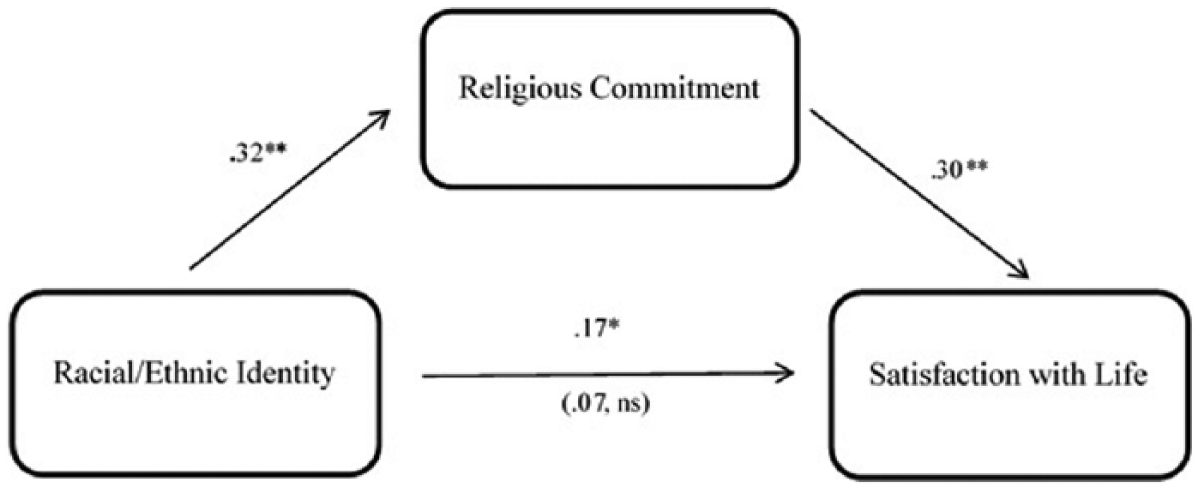
Mediator effects of religious commitment on the relationship between racial/ethnic identity and satisfaction with life.
To test whether the mediated effect of racial/ethnic identity on satisfaction with life through religious commitment was significant, we used the bootstrapping procedure outlined by Preacher and Hayes (2008). Using a bias-corrected bootstrapping procedure based on 5,000 resamples, we found that the indirect effect of racial/ethnic identity on satisfaction with life through religious commitment was significant (est. = .09, SE = .03, 95% CI [.04, .18]). Using the R2 effect size measure for mediation analysis (Fairchild, MacKinnon, Taborga, & Taylor, 2009), about 2.2% of the variance in satisfaction with life was explained by the mediated effect of racial/ethnic identity through religious commitment (a small effect size).
Racial/Ethnic Identity and Meaning in Life
Our second hypothesis was that racial/ethnic identity would be positively associated with the presence of meaning in life, and this relationship would be mediated by religious commitment. This hypothesis was also supported. The direct association between the predictor variable (racial/ethnic identity) and the criterion variable (presence of meaning in life) was significant (β = .28, p< .001; see Figure 2). Also, the direct association between the predictor variable (racial/ethnic identity) and the mediator variable (religious commitment) was significant (β = .32, p< .001). Finally, controlling for the predictor variable (racial/ethnic identity), the association between the mediator variable (religious commitment) and the criterion variable (presence of meaning in life) was significant (β = .34, p< .001). In this final regression analysis, the association between the predictor variable (racial/ethnic identity) and the criterion variable (religious commitment) remained significant but was reduced in magnitude (β = .17, p = .018), indicating partial mediation.
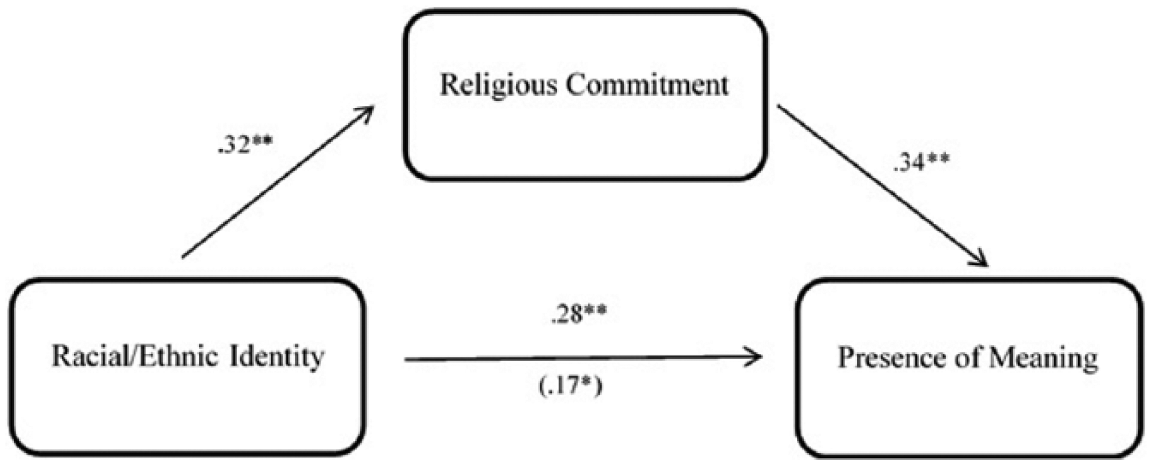
Mediator effects of religious commitment on the relationship between racial/ethnic identity and the presence of meaning in life.
To test whether the mediated effect of racial/ethnic identity on the presence of meaning in life through religious commitment was significant, we used the bootstrapping procedure outlined by Preacher and Hayes (2008). Using a bias-corrected bootstrapping procedure based on 5,000 resamples, we found that the indirect effect of racial/ethnic identity on meaning in life through religious commitment was significant (est. = .11, SE = .04, 95% CI [.05, .20]). Using the R2effect size measure for mediation analysis (Fairchild et al., 2009), about 5.7% of the variance in meaning in life was explained by the mediated effect of racial/ethnic identity through religious commitment (a medium effect size).
Discussion
The present study adds to the small but growing body of research that has examined the importance of cultural variables in positive psychology (Constantine & Sue, 2006). The purpose of this study was to determine the relationship between cultural values and well-being in African Americans. Specifically, we assessed how one’s racial/ethnic identity and religious commitment were related to satisfaction with life and meaning in life in an African American sample. The results show that both racial/ethnic identity and religious commitment were positively related to satisfaction with life and meaning in life. Furthermore, religious commitment mediated the relationship between racial/ethnic identity and satisfaction with life and partially mediated the relationship between racial/ethnic identity and meaning in life. These findings support Constantine and Sue’s (2006) model in which cultural values can predict aspects of optimal human functioning. Specifically, religious commitment, one aspect of the model that was hypothesized to be important for positive psychological functioning in people of color, played a role in mediating the positive effects of racial/ethnic identity on satisfaction with life and meaning in life.
The findings from this study support prior research that has found that constructs related to having a strong racial/ethnic identity may be important for the well-being of African Americans (Utsey et al., 2008). For example, research has shown that racial/ethnic identity may serve as a protective factor in African Americans by moderating the relationships between the experience of discrimination and psychological well-being in populations with anxious and depressive symptoms (Williams, Chapman, Wong, & Turkheimer, 2012). Specifically, in African American men, having a positive view of one’s own racial/ethnic group served as a buffer against the psychological effects of racism and gender role conflict (Wester, Vogel, Wei, & McLain, 2006).
The findings from this study also support prior research that has found that religiosity may be an important factor in the well-being of African Americans (Crawford et al., 1989; Jang et al., 2006; Mattis & Grayman-Simpson, 2013; Reed & Neville, 2014). Specifically, religiosity, which is likely to be more important for African Americans who strongly identify with their racial/ethnic background, is likely to provide African Americans with an important source of happiness and meaning in their everyday lives. For example, religion may provide its adherents with an important sense of structure in their social world, as well as allaying existential concerns by providing individuals with a sense that their lives have significance and purpose (Van Tongeren et al., 2011).
Limitations and Suggestions for Future Research
There were several limitations to this study. First, the study used a correlational design, which prohibits causal inferences. Although the data are consistent with our theoretical model (i.e., racial/ethnic identity leading to religious commitment, which in turn leads to satisfaction with life and meaning), there may be alternate models that fit the data as well. Longitudinal or experimental research is necessary to further explicate the causal relations among these variables. It would be interesting to assess how racial/ethnic identity and religious commitment change over time, and how these changes influence satisfaction with life and meaning in life. Second, this study was based exclusively on self-report data, which have several limitations, including response biases and social desirable responding. Although it a relatively common problem for positive psychological constructs to be assessed solely with self-report measures (Dorn, Hook, Davis, Van Tongeren, & Worthington, 2014), it would be interesting to use other types of measures as well (e.g., behavioral measures).
In addition to using more sophisticated research designs and measurement strategies, future research could examine these ideas using more heterogeneous samples of African Americans. It would be interesting to assess whether these associations held across the life span (e.g., older adults). Also, future research could further explore the construct of religion to identify which aspects of religion are most helpful to African Americans. Perhaps there are some versions of religion that are more or less helpful in African American communities. Furthermore, future research could explore the specific mechanisms by which religion influences well-being in African Americans, such as social support or self-regulation. Finally, the current study focused primarily on one cultural factor that was thought to be important to African Americans (i.e., religion). Future research could assess other aspects of African American culture (e.g., collectivism, interconnectedness of mind/body/spirit).
Practical Implications
The results of this study hold several implications for clinicians or community psychologists who are working to help African American clients or communities. Namely, the study found that having high levels of racial/ethnic identity and religious commitment were positively associated with satisfaction with life and meaning for African American individuals. Counselors working with African American clients may want to assess the client’s racial/ethnic identity to see if the client’s views toward his or her cultural background could be helping or hindering working toward one’s goals in counseling. Counselors should also assess for religious commitment and inquire whether that is a topic that clients may want to address. If the client identifies one’s racial/ethnic identity or religion as an area of interest or struggle, counselors could design interventions targeting those areas. For example, counselors could consider how racial/ethnic identity and religion affect the client’s functioning and consider how they may help promote optimal functioning in the client. Incorporating positive images of African Americans may help buffer against the negative images and stereotypes propagated in the media (Utsey et al., 2008). Similarly, the inclusion of religion in therapy may help aid in the therapeutic process (Tjeltveit, 2012).
Conclusion
The rise of the positive psychology movement has allowed researchers to focus on questions related to human strengths and virtues. However, little theory and research have examined cultural factors that may contribute to positive psychological functioning, and research on positive psychology has generally used White samples. The present study adds to the small but growing body of research examining how culture can be an important resource that may contribute to healthy psychological functioning and well-being.
Footnotes
Declaration of Conflicting Interests
The authors declared no potential conflicts of interest with respect to the research, authorship, and/or publication of this article.
Funding
The authors received no financial support for the research, authorship, and/or publication of this article.