




Abstract
Race-related stress is defined as perceptions of racial inequalities and personal experiences of racial bias that tax one’s psychological resources (Harrell, 2000; Jones, 1997). Black individuals living in the United States, including Black immigrants, who experience race-related stress are vulnerable to psychological distress in the form of depressive symptoms such as feelings of sadness, hopelessness, and worthlessness (Pieterse, Todd, Neville, & Carter, 2012; Williams & Williams-Morris, 2000). Understanding the relationship between race-related stress and depression symptoms in Black immigrants is crucial for two reasons. First, while Black individuals are diagnosed with depression at a rate lower than White individuals, they report greater and more persistent subclinical symptoms of depression that ultimately affect family relationships, life satisfaction, and physical functioning (McGuire & Miranda, 2008; Schiller, Lucas, Ward, & Peregoy, 2012; Williams et al., 2007). Second, despite the growing recognition that the Black racial group is a heterogeneous group, research on the relationship between race-related stress and depression symptoms has focused almost exclusively on African Americans (i.e., individuals born in the United States who do not have recent immigrant ancestry and identify as Black).
This study sought to address these gaps in our knowledge of Black immigrants’ depression symptoms by exploring race-related stress and potentially attenuating identity factors. In terms of the latter, we ground the present study in Black immigrants’ intergroup relations with African Americans. We explored the unique effects of two identity factors and their relationships to depression symptoms: (a) shared racial fate, defined as perceptions of commonality in the way racial group members are treated in society and (b) a sense of belonging and connection, defined as feelings of closeness with African Americans. We also examined whether each identity factor interacted with race-related stress to affect depression symptoms in different ways. This study adds to current literature on Black immigrants’ race-related stress and depression symptoms through the role of intergroup relations with African Americans.
Race-Related Stress and Depression Risk
Individual race-related stress is important to study, given the frequency and prevalence of interpersonal experiences of discrimination resulting in individual stress (R. Clark, Anderson, Clark, & Williams, 1999; Essed, 1991; Harrell, 2000; Jones, 1997; Utsey, 1999; Utsey & Ponterotto, 1996). Black immigrants encounter individual race-related stress in the form of poor treatment during interactions with members of the dominant group (Pierre, 2004). These interactions may be blatant (being refused service) or subtle (being ignored by customer service representatives). The biopsychosocial model of race-related stress posits that such interpersonal stressors trigger psychological and physical stress responses that in turn affect health outcomes, for example, increased frequency of depression symptoms (R. Clark et al., 1999).
Depression, diagnosed or subclinical symptoms, is one psychological consequence of race-related stress that has been documented among ethnic minorities and is a growing area of research in immigrant populations (Alderete, Vega, Kolody, & Aguilar-Gaxiola, 1999; Finch, Kolody, & Vega, 2000; Flores, Tschann, Marin, & Pantoja, 2004; Salgado de Snyder, 1987). Depression symptoms have costly consequences, including strained interpersonal relationships, low productivity, and employment challenges (Joiner, 2000; Weng et al., 2014). The relationship between race-related stress and increased depression symptoms has been examined in studies with combined samples of Black immigrant and African American adolescents (Seaton, Caldwell, Sellers, & Jackson, 2008, 2010) and Black immigrant and African American adults (T. T. Clark, Salas-Wright, Vaughn, & Whitfield, 2015). Findings from the aforementioned studies indicated that greater race-related stress was associated with increased depression symptoms. However, there is a dearth in our knowledge of the factors, along with race-related stress, that lessen or increase depression symptoms.
Shared Racial Fate and a Sense of Belonging With African Americans
Empirical focus on intergroup relations between minority members is increasing (Craig & Richeson, 2012). A portion of this research has focused on Black immigrants’ intergroup relations with African Americans—a group with whom Black immigrants are categorized because of race, but differ from with respect to ethnicity and perceived model minority status (Benson, 2006; Joseph, Watson, Wang, Case, & Hunter, 2013; Tormala & Deaux, 2006). In the case of Black immigrants, the notion of group membership is complicated (Smith, 2014). Upon emigrating to the United States, many Black immigrants emphasize their ethnic identities, which numerous scholars have argued provide psychological benefits in that it minimizes their perceptions as members of a disadvantaged racial minority (Benson, 2006; Stephenson, 2004; Vickerman, 2001; Waters, 1999). Likewise, some Black immigrants behaviorally distance themselves from African Americans (Tormala & Deaux, 2006) and socialize their second-generation children to be mistrustful of African Americans (Joseph & Hunter, 2011), suggesting that African Americans are perceived to be out-group members who possess a disadvantaged racial minority group status. Indeed, research findings by Deaux et al. (2007) suggested that such in-group and out-group perceptions were beneficial: Black immigrants, when compared with African Americans, did not experience performance declines on a test of intellectual ability when they were exposed to stereotype threat. In fact, Black immigrants exposed to stereotype type threat demonstrated performance increases especially when the individual administering the test was White. Considered within an intergroup relations framework, Deaux et al.’s (2007) findings suggest that these differences in performance reflect Black immigrants’ rejection of a common in-group identity with African Americans and a rejection of a disadvantaged racial minority group status.
Social psychologists, however, have also demonstrated that in-group (“us”) and out-group (“them”) boundaries can be flexible and form an inclusive “we” identity that does reflect the common in-group identity (Gaertner, Dovidio, Anastasio, Bachman, & Rust, 1993; Gaertner, Dovidio, & Bachman, 1996; Gaertner, Rust, Dovidio, Bachman, & Anastasio, 1994). Indeed, recent empirical evidence suggested that Black immigrants’ in-group and out-group boundaries are not strict and when a common in-group identity develops, perceptions of common fate and a sense of belonging with African Americans increases. For example, Benson’s (2006) findings demonstrated that Black immigrants perceived that they, similar to African Americans, experienced race-based discrimination that could result in similar life consequences, for example, loss of employment. In a separate study, Thornton, Taylor, and Chatters (2013) highlighted that Black immigrants reported experiencing feelings of closeness with African Americans, which challenged typical conceptualizations of their intergroup relations as strained and conflicted. These findings considered as a whole suggest that when group boundaries become flexible, a “we” identity emerges and perceptions of a common fate and a sense of belonging with African Americans increases. Shared racial fate and a sense of belonging, two identity factors that reflect the common in-group identity, have been examined in the intergroup relations literature, but Black immigrants’ relations to African Americans have not been a central focus nor have these identity factors been examined simultaneously. Given the importance of intergroup relations to immigrants’ well-being (Padilla & Perez, 2003; Schwartz, Montgomery, & Briones, 2006), we sought to extend the research in this area and examined whether Black immigrants’ intergroup relations with African Americans or the “we” identity affects well-being, for example, depression symptoms.
The current study focused on two identity factors that emerged in research focused on Black immigrants’ intergroup relations with African Americans: (a) shared racial fate and (b) a sense of belonging with African Americans. The first identity factor, shared racial fate, highlights the perception that individuals hold regarding their treatment in the United States as members of a racial group. For example, Black individuals—U.S. born and immigrants—are considered to be part of the same racial group in the United States and because of this have the potential to be similarly discriminated against during their everyday experiences (Benson, 2006), thus experiencing a shared racial fate. Benson’s research findings illustrated several factors associated with high shared racial fate (e.g., skin tone, region of immigration, perceived racial discrimination), but no studies to date have explored the effect of shared racial fate on the frequency of symptoms associated with depression. We suggest that increased perceptions of shared racial fate (e.g., discrimination against all Blacks, irrespective of ethnic background) will be associated with greater symptoms of depression.
The second identity factor that was a focus in this study is referred to as a sense of belonging with African Americans, and reflects feelings of closeness that Black immigrants have with African Americans (Thornton et al., 2013). A handful of studies have documented Black immigrants’ (Thornton et al., 2013) and ethnically diverse minority group members’ (Craig & Richeson, 2012) feelings of belonging with African Americans, but none of the these studies examined whether a sense of belonging had well-being implications. In racial identity research, a sense of belonging had protective effects against psychological distress, even in the presence of race-related stress (Sellers, Copeland-Linder, Martin, & Lewis, 2006). We hypothesized that Black immigrants’ high sense of belonging with African Americans will be related to low depression symptoms.
Exploring whether shared racial fate or a sense of belonging interact with race-related stress to increase or lessen depression symptoms is another way of investigating the effects of these identity factors on well-being outcomes (Sellers et al., 2006; Sellers & Shelton, 2003). When Black immigrants experience race-related stress and they perceive that their racial destinies are intertwined with the history and racial struggles of African Americans, they should experience greater symptoms of depression. In sum, shared racial fate would interact with race-related stress to exacerbate depression symptoms.
Feelings of belonging with African Americans, however, may attenuate the relationship between race-related stress and depression symptoms. That is, a sense of belonging has been shown to buffer the negative effects of race-related stress on African Americans’ well-being (Banks & Kohn-Wood, 2007; Sellers & Shelton, 2003). Scholars have suggested that the social support and validation that comes from identifying with a larger group can ameliorate the distress associated with discrimination (Branscombe, Schmitt, & Harvey, 1999; Case & Hunter, 2012; Tajfel & Turner, 1986). Thus, greater sense of belonging with African Americans would interact with race-related stress to buffer depression symptoms.
Overview of the Study
The purpose of the present study was to investigate the unique and interactive effects of race-related stress and two identity factors—shared racial fate versus a sense of belonging with African Americans—on depression symptoms in a sample of Black immigrants. Evidence has accumulated that demonstrates the negative effects of race-related stress on Black immigrants’ well-being, specifically increased depression symptoms (T. T. Clark et al., 2015). Identity plays an important role in well-being, even in the presence of race-related stress (Cruwys, Haslam, Dingle, Haslam, & Jetten, 2014; Sellers et al., 2006). But, no studies to date have investigated the well-being implications of identities that emerge from Black immigrants’ intergroup relations with African Americans (Benson, 2006; Smith, 2014; Thornton et al., 2013). Thus, examining the role that shared racial fate and a sense of belonging, along with race-related stress, play in alleviating or exacerbating depression symptoms is relevant given that Black immigrants are an understudied population.
Based on the existing evidence, it was expected that (a) greater race-related stress would be related to higher depression in Black immigrants. Additionally, (b) greater endorsement of shared racial fate would be associated with higher depression symptoms, whereas greater endorsement of a sense of belonging with African Americans would be associated with lower depression symptoms. Furthermore, (c) shared racial fate would interact with race-related stress, such that the deleterious effect of race-related stress on increased depression symptoms will be greatest for individuals who also endorse high shared racial fate. Finally, (d) greater endorsement of a sense of belonging with African Americans would interact with individual race-related stress, such that the deleterious effect of greater race-related stress on depression symptoms will be mitigated for individuals who endorsed a high sense of belonging.
Method
Participants
Participants included 110 individuals (41 males, 69 females) who self-identified as Black. Participants were between the ages of 15 and 72 years (M = 34.2, SD = 13.7); six individuals did not provide their ages. Parental consent and youth assent were obtained from all participants younger than 18 (n = 4) years. Over half of the participants were categorized as first generation (n = 69) if they were born outside the United States or immigrated to the United States after the age of 13 years. Of the participants categorized as first generation their regions of birth were Caribbean (n = 64), African nation (n = 3), or Canada (n = 2). Close to a third of the participants (n = 36) were categorized as second generation if they were born in the United States (n = 33) or migrated to the United States before age 13 (n = 3). Five individuals did not provide their countries of birth and we were unable to categorize their generation status. Close to three quarters of the full sample of participants indicated that their parents were born in Haiti, a handful indicated that their parents were born in Caribbean countries and African nations. Fifteen individuals did not provide information about their socioeconomic status.
Measures
Participants completed a demographic sheet that provided information on age, gender, country of birth, parent’s country of birth, length of residence in the United States, racial group membership, and socioeconomic status. Participants’ responses to each question were forced-choice except age, country of birth, parent’s country of birth, length of residence in the United States, and racial group membership, which were open-ended questions where participants could write or type in their responses.
Race-related stress
Race-related stress was assessed using the Index of Race-Related Stress–Brief Version (IRRS-B; Utsey, 1999). The IRRS-B consists of 22 items and represents a multidimensional measure of psychological distress related to racial discriminatory experiences (Utsey, 1999). The IRRS-B evaluates three domains: individual, institutional, and cultural race-related stress. The items utilized a 4-point Likert-type scale (0 = this never happened to me, 1 = this event happened and I was upset, 4 = this event happened and I was extremely upset). A score greater than zero indicates that the event occurred and higher scores indicate greater levels of distress. The individual race-related stress subscale, the focus of the present study, assessed interpersonal experiences with discrimination. An example item is “You were treated with less respect and courtesy than Whites and other non-Blacks while in a store, restaurant, or other business establishment.” Reliability estimate for the current sample was at acceptable levels and similar to Utsey (1999)—.84 (individual race-related stress).
Intergroup relations with African Americans
The Scale of Attachment and Interdependence with Black Americans (SAIBA-2; Hunter, Joseph, Case, & Bokhari, 2012) examined Black immigrants’ shared racial fate and belonging and connection with U.S.-born Black Americans. The SAIBA-2 is a 22-item measure with a 5-point Likert-type scale ranging from 1 (strongly disagree) to 5 (strongly agree). The shared racial fate subscale consisted of six items that assessed perceptions of a common fate with U.S.-born Black Americans (i.e., “My destiny in the United States is very connected to that of Black Americans”). The sense of belonging and connection subscale contained five reverse-scored items that assessed feelings of closeness with African Americans (i.e., “I do not feel a sense of belonging with Black Americans”). Items comprising each subscale were summed and then averaged. Higher scores indicated stronger endorsement of each subscale. For the current study, (a) the alpha coefficient for the shared racial fate subscale was .77 and (b) the alpha coefficient for the sense of belonging subscale was .85.
The SAIBA was created to capture the multidimensional nature of Black immigrants’ intergroup relations with African Americans. A maximum likelihood factor analysis was performed on the 22-item SAIBA measure for 91 participants (after casewise deletion for missing values). Five eigenvalues were larger than 1.00, and in addition to this information, we used Akaike information criterion for factor models up to 14 factors to determine an optimal factor model. Based on this criterion, the three-factor solution was clearly the best choice. There were no a priori reasons to force the factors to be orthogonal, so a nonorthogonal rotation was used to better interpret the solution. The rotation method used was promax with the power set to 4. The three-factor solution accounted for 45.3% (16.6%, 14.5%, 14.1%, respectively, for the first, second, and third factor) of the variance. Among the three factors, items with unique factor loadings greater than .40 were retained, eliminating a total of three items (they had factor loading of less than .40 for all three factors) from the initial 22-item SAIBA measure resulting in a revised 19-item measure. The reliability of the three factors ranged from .75 to .84, which is acceptable by conventional standards.
Each factor was named because of the item content and to the extent that the dimension reflected common in-group identity. The first factor, a sense of belonging (seven items) accounted for 16.6% of the variance. The second factor, interconnection of race and ethnicity (six items) accounted for 14.5% of the variance. This factor reflected participants’ notions of interconnectedness between their racial and ethnic self-concepts. Finally, the third factor, shared racial fate (six items) accounted for 14.1% of the variance. This factor reflected participants’ attitudes about commonality in how members of the racial group are treated in society. Participants’ attitudes reflect the belief that their fates were intertwined with and similar to that of African Americans.
Depression
The Center for Epidemiologic Studies Depression Scale (Radloff, 1977) is a 20-item measure that assessed whether participants experienced symptoms associated with depression during the past week. Symptoms assessed included, depressed mood, feelings of guilt and worthlessness, helplessness and hopelessness, psychomotor retardation, loss of appetite, and sleep disturbance. Example items are “I felt depressed” and “I had crying spells.” Participants rated the frequency of symptoms in the past week using a 4-point Likert-type scale ranging from 0 (rarely or none of the time, less than 1 day) to 3 (most or all of the time, 5-7 days). Scores range from 0 to 60, higher scores indicate greater frequency and number of symptoms of depression. The Center for Epidemiologic Studies Depression Scale has been used to assess symptoms of depression in community, psychiatric, and immigrant samples (Radloff, 1977). A score of 16 has been established as the cut-point for clinical depression (Radloff, 1977). The reliability estimate for the current sample was .91.
Procedure
Participants were recruited both in person and online. In-person participants (n = 61) were recruited from business and community events (i.e., hair salons, barbershops, churches, and festivals) located in a major Midwest metropolitan city and a university community, also located in the Midwest. Online, participants were recruited through Facebook pages and e-mail listservs of African and Caribbean organizations (n = 49). Permission to carry out the research was obtained from the local university’s institutional review board prior to the start of the research study.
For participants recruited in person, members of the research team approached gatekeepers (i.e., pastors, business owners, leaders of ethnic organizations) to request permission to discuss the study with their members at an agreed upon time at their establishments. At the agreed time, the research team utilized large poster boards indicating the need for participants who identified as Black and who were immigrants (i.e., inclusion criteria). If participants approached the research area, they were provided with a brief overview of the study and if they expressed interest, they were then provided with questionnaire packets that included all measures of the study.
Participation in this study was voluntary, which was made clear to participants during the process of informed consent. Participants who completed paper-and-pencil surveys signed two institutional review board–approved informed consent forms (one for the participant, the other for the research team). Signed informed consent documents were stored separately from deidentified research data. Participants who completed the questionnaire packets in person were compensated with a $10 Target gift card. Participants recruited online completed an electronic version of the informed consent process and completed all measures on SurveyMonkey, an Internet survey domain. Participants who completed the study online could select the option to be entered into a drawing to win a $50 gift card. The option to take part in the lottery was stored separately from completed survey data. Participants’ deidentified data were downloaded from SurveyMonkey at the conclusion of the study and entered into SPSS.
Results
Preliminary Data Analyses
First, we determined the magnitude of missing data. The proportion of missing data that is considered typical, ranges from 10% to 20% (Schlomer, Bauman, & Card, 2010). Schlomer et al. (2010) suggest reporting missing data as proportions. Missing data ranged from 1% to 5% for race-related stress, 1% to 6% for shared racial fate and a sense of belonging, and 1% to 8% for depression symptoms. Second, Little’s missing completely at random (MCAR; Little, 1988) test was performed to determine whether variables were missing because of the types of questions being posed in the current study or were missing completely at random. Little’s MCAR test was not statistically significant, which suggests that the data were missing completely at random.
Schlomer et al. (2010) demonstrated that Little’s (1988) MCAR is an omnibus test that assesses the overall pattern of missing data in the data set and not whether missingness is associated with particular variables. Following Schlomer et al.’s (2010) recommendations, we created a dummy variable with two values, missing and nonmissing, to ascertain the pattern of missing data (i.e., MCAR, missing at random, or not missing at random). We then conducted an analysis of variance to assess whether our variables of interest significantly differed by participants whose data were missing. The results demonstrated that the outcome variables of interest did not differ by whether the data were missing for a sense of belonging, F(1, 108) = 2.83, p = .10; shared racial fate, F(1, 107) = 2.22, p = .14; race-related stress, F(1, 107) = 0.53, p = .47; or depression symptoms, F(1, 107) = 0.45, p = .50. We then included the dummy variable for missingness in a Pearson correlation with our demographic variables and outcome variables. 1 Based on the pattern of associations between data missingness and our outcome variables of interest and following recommendations of Schlomer et al. (2010), we concluded that our data were missing completely at random. Thus, mean substitution is an appropriate method to impute our missing data.
Last, we conducted a multivariate analysis of variance to assess whether the variables of interest differed by site, generation status, gender, and socioeconomic status. The main effects were not statistically significant suggesting that race-related stress, shared racial fate, a sense of belonging, and depression did not differ by (a) site, Wilks’s Λ = .98, p = .77; (b) generation status, Wilks’s Λ = .92, p = .18; (c) gender, Wilks’s Λ = .99, p = .87; or (d) socioeconomic status, Wilks’s Λ = .86, p = .85.5.
The means, standard deviations, and intercorrelations among the main variables of interest can be found in Table 1. These zero-order correlations indicated statistically significant positive correlations between individual race-related stress and depression (r = .28, p = .003). The correlation between shared racial fate and depression was not statistically significant (r = .17, p = .09), while the correlation between a sense of belonging with African Americans and depression was negative and statistically significant (r = −.42, p = .000). According to Cohen’s (1992) recommendations, the statistically significant correlations are considered medium to large effect sizes.
Summary of Intercorrelations, Means, and Standard Deviations Among Variables.

Note: SES = socioeconomic status; SAIBA BC = Scale of Attachment and Interdependence with Black Americans Sense of Belonging with African Americans; SAIBA SRF = Scale of Attachment and Interdependence with Black Americans Shared Racial Fate. High scores for each variable indicate greater endorsement.
p < .05. **p < .01.
The pattern of associations between the demographic variables along with the results of the multivariate analysis of variance suggested that participants who completed web-based surveys were more likely to endorse greater shared racial fate, be second generation, and report higher socioeconomic status than those who completed paper-based surveys. Site, generation status, gender, socioeconomic status, and age were treated as covariates in the regression analyses.
Regression Analyses
A multiple regression model was employed to analyze the data. To prepare the data for analysis, all predictor variables were centered prior to entry into each regression model (Aiken & West, 1991). Recruitment site, generation status, gender, socioeconomic status, and age were entered in Block 1. Individual race-related stress was entered in Block 2 to determine its relationship with depression symptoms. Block 3 was used to assess the amount of variance in the criterion variable (i.e., depression symptoms) accounted for by the two identity factors, shared racial fate and a sense of belonging, over and above individual race-related stress. The fourth block assessed the following two-way interactions: (a) shared racial fate × individual race-related stress and (b) a sense of belonging × individual race-related stress.
The overall model was statistically significant and accounted for 33% of the variance in depression (see Table 2). The demographic variables were not statistically significant and accounted for approximately 4% of the variance in depression, a small effect (Cohen, 1992). Individual race-related stress, entered in the second block, accounted for an additional 10% of the variance in depression, a medium effect (Cohen, 1992). The association was positive and statistically significant (β* = .32, p = .001), indicating that greater endorsement of individual race-related stress was associated with high frequency of depression symptoms.
Hierarchical Regression Analyses Predicting Depression.
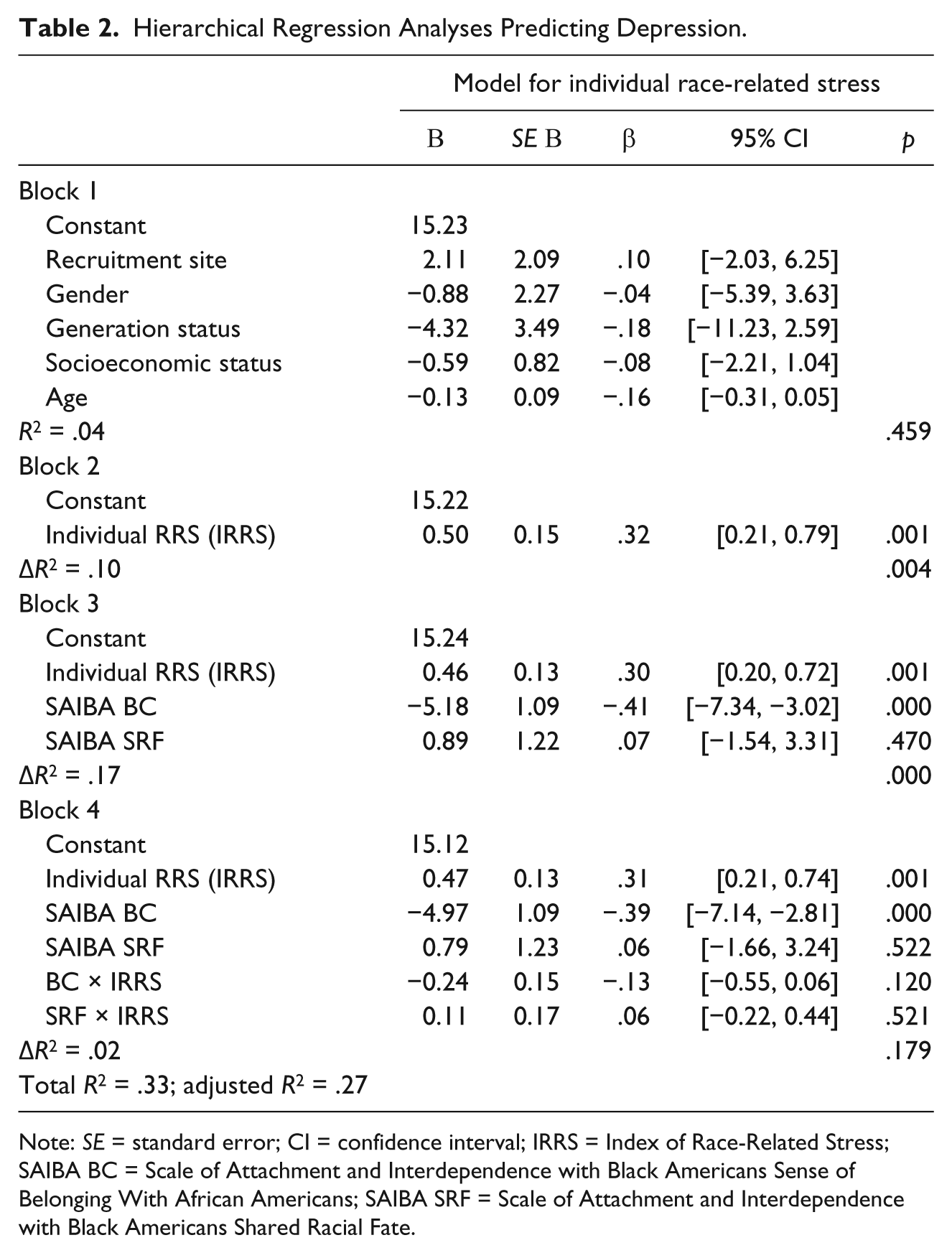
Note: SE = standard error; CI = confidence interval; IRRS = Index of Race-Related Stress; SAIBA BC = Scale of Attachment and Interdependence with Black Americans Sense of Belonging With African Americans; SAIBA SRF = Scale of Attachment and Interdependence with Black Americans Shared Racial Fate.
Shared racial fate and a sense of belonging were entered in the third block. Even with individual race-related stress in the model, the addition of shared racial fate and a sense of belonging accounted for 17% additional variance in depression, a medium effect size (Cohen, 1992). The results indicated that greater belonging was associated with lower frequency of depression symptoms (β* = −.41, p = .000). The relation between shared racial fate and depression was not statistically significant (β* = .07, p = .47).
Two two-way interaction terms were entered in the fourth step to examine the interactive effects of the identity factors and race-related stress on the criterion, depression. The change in R2 was not statistically significant. The interaction between shared racial fate and individual race-related stress (β* = .06, p = .52) was not statistically significant. The interaction between a sense of belonging and individual race-related stress (β* = −.13, p = .12) was not statistically significant.
The results, considered as a whole, illustrated a positive relationship between race-related stress and depression and a negative relationship between a sense of belonging with African Americans and depression, over and above race-related stress. However, identity factors did not interact with race-related stress in relation to depression.
Discussion
Scholars have suggested that race-related stress undermines African Americans’ well-being as evident in the positive relationship between race-related stress and depression symptoms (R. Clark et al., 1999; Read & Emerson, 2005; Seaton et al., 2010; Williams et al., 2007). As observed in other research studies, findings from the present study indicate that greater race-related stress is associated with increased depression symptoms in Black immigrants. New to the extant literature, we found that one identity factor, a high sense of belonging with African Americans, is related to lower depression over and above the negative effects of race-related stress on depression. Using Cohen’s (1992) criteria as a guide, the change in variance is a medium effect. This result is meaningful in illustrating that intergroup relations, specifically Black immigrants developing a common in-group identity with African Americans, may have well-being benefits. The association between shared racial fate and depression was not statistically significant. This pattern of results extends our knowledge of the psychological implications of Black immigrants’ intergroup relations with African Americans and its role in depression symptoms. Unfortunately, factors that mitigate the association between race-related stress and depression were not discovered; shared racial fate or a sense of belonging with African Americans did not attenuate the negative association between race-related stress and depression.
Race-Related Stress and Depression
The current study demonstrates that individual race-related stress is associated with increased depression symptoms, most likely because of the personal and interpersonal nature of such experiences (Harrell, 2000; Jones, 1997; Utsey, 1999; Utsey & Ponterotto, 1996). For many, stress is activated by observations of negative treatment of others, one’s own negative experience, and the request for proof that the incident occurred when it is ambiguous (Harrell, 2000). Furthermore, consistent with the biopsychosocial model of racism as a stressor, the findings highlight the effects of these stress responses on depression symptoms. Individual race-related stress is especially salient because research findings suggest that ethnic minorities are more likely to attribute discriminatory behaviors to their racial group rather than to themselves personally (Operario & Fiske, 2001). Important for the present study, scholars suggest that this tendency may be especially salient for Black immigrants who initially perceive themselves as individuals who are not directly affected by discrimination (Deaux et al., 2007; Tormala & Deaux, 2006; Waters, 1999). Experiencing discrimination or witnessing it may directly challenge the narrative that immigrants hold and in turn triggers a stress response that has harmful outcomes on health, specifically, greater symptoms of depression.
Sense of Belonging With African Americans and Depression
Numerous research findings suggest that depression may be stymied by a sense of belonging (Baskin, Wampold, Quintana, & Enright, 2010; McLaren & Challis, 2009). The findings from the present study extend our understanding of the potential well-being benefits of Black immigrants’ high sense of belonging with African Americans, an ethnically distinct group. There are many possible ways to explain the inverse association between sense of belonging with African Americans and depression. A sense of belonging with a stigmatized group decreases feelings of alienation and isolation (Case & Hunter, 2012; Cruwys et al., 2014). It is also possible that a sense of belonging with African Americans provides a logistical benefit. Specifically, belonging is associated with network ties that facilitate positive intergroup relations with African Americans who may offer advice and strategies for navigating the United States and its accompanying racial dynamics (Craig & Richeson, 2012; Thornton et al., 2013). A sense of belonging is also associated with recategorization of in-group boundaries, which Gaertner and Dovidio (2012) argue increases in-group favoritism and “positive feelings, beliefs, and behaviors toward others who were previously regarded primarily in terms of their outgroup memberships” (p. 2). The current findings suggest that feeling good toward African Americans may in turn lead Black immigrants to feel good about themselves, which lowers depression symptoms even in the presence of race-related stress. Such a conclusion is supported in the research literature by numerous studies that have demonstrated that increased social identification among group members has beneficial well-being outcomes (Cruwys et al., 2014; Haslam, Jetten, Postmes, & Haslam, 2009) and that social identity is associated with a positive attribution style, which in turn lowers self-blame and reduces negative mood (Cruwys, South, Greenaway, & Haslam, 2015). The findings from the present study are among a growing body of research to highlight that intergroup relations, specifically a sense of belonging between minority group members has psychological benefits (Richeson & Craig, 2011; Thornton et al., 2013).
Shared Racial Fate and Depression
Shared racial fate, a second dimension of identity, captures the perception that what happens to members of the racial group, broadly, has implications for all members of the racial group. In previous research, shared racial fate was associated with Black immigrants’ greater perceptions of racial discrimination (Benson, 2006). Thus, we hypothesized that perceiving a common destiny or worrying about the systemic consequences of discrimination may lead to declines in well-being. In the current study, however, shared racial fate was not associated with race-related stress or depression symptoms. It is possible that these associations are present, but this study was underpowered to detect statistically significant effects. This is the first study to examine the psychological implications of shared racial fate, and as such, more research is necessary to identify whether shared racial fate operates similarly as do other aspects of identity on well-being. Given the pattern of associations in this study, one hypothesis to explore is whether shared racial fate interacts with sociodemographic variables such as age and socioeconomic status, for example, to facilitate the recategorization of group boundaries, but does not play a role in well-being directly. Future research will be needed to replicate the present findings and to investigate the function of shared racial fate.
Moderating Effects on Depression
We hypothesized that each identity factor would have a direct effect on depression and interact with race-related stress to moderate depression, which is consistent with findings in the extant literature (Sellers et al., 2006). Our findings did not support the hypotheses: Neither shared racial fate nor a sense of belonging with African Americans moderate the association between race-related stress and depression. Considering our findings in the context of the extant literature on African Americans’ identity and the identity literature in general, one conclusion we offer is that the dimensions of identity in this study may be functional and part of a fluid process of adjustment rather than stable aspects of Black immigrants’ self-concepts (Cruwys et al., 2014). Evidence for this conclusion is consistent with the results of a comparative study of perceptions of racial discrimination. Case and Hunter (2014) used the same measure of identity to assess Black immigrants and African Americans’ perceptions of racial discrimination. They found that identity was positively related to African Americans’ perceptions of racial discrimination, but was not significantly related to Black immigrants’ perceptions of racial discrimination. They suggested that their results may reflect that identity serves different functions in the two ethnic groups. Following this conclusion if certain identities function differently for Black immigrants than they do for African Americans may in part explain why moderating effects on depression did not emerge in this study. The identity factors measured in this study emerge from intergroup relation processes and may be experienced as fluid aspects of identity. Future research is needed to replicate the findings and to collect data from large samples so that two- and three-way interactions can be examined. Given the research findings accumulating in the extant literature on the negative impact of race-related stress on depression, understanding the factors that moderate this association is a critical area for future research.
It is also possible that our sample size does not provide sufficient power to detect moderating effects. Power does decrease when reliabilities are less than perfect (Cohen, Cohen, West, & Aiken, 2003). It is relevant to consider that research studies that focus on African Americans’ identity and well-being typically produce medium to large effect sizes (e.g., Sellers et al., 2006). Cohen (1992) suggests that sample sizes of 97 have sufficient power to detect medium effect sizes; based on this guideline, our sample size of 110 has sufficient power to detect moderating effects. Still, future research with precise measurement and larger sample sizes are needed to replicate these findings.
Limitations of the Present Study
These findings must be evaluated in light of several limitations. First, this study is cross-sectional. The direction of the relationship between race-related stress and sense of belonging with African Americans could not be determined and needs to be explored further. For example, it is reasonable to conclude that as individuals experience greater depression, they experience greater race-related stress and a lower sense of belonging with African Americans. Second, we collected data from first-generation Black immigrants and second-generation descendants, who overwhelmingly identified as having Haitian descent. Thus, the results are not generalizable to other Black immigrants. It is also likely that the sample characteristics contributed to our findings, but due to the small sample size, generation differences were not systematically explored. Furthermore, several variables not assessed in this study affect the generalizability of the results across generational status. While method of immigration (e.g., type of visa, refugee status) was not assessed, it affects individuals’ experiences with and perceptions of the United States and African Americans specifically. The nature of one’s migration experience can be stigmatizing and heighten the likelihood of experiencing race-related stress and depression, respectively. Additionally, migration-related life stressors contribute to participants’ experiences of race-related stress and serve as a potential covariate; however, these distinct forms of stressors were not systematically investigated in this study. Third, these data were collected from Black immigrants living in the Midwest. We cannot be certain how region of the United States and density of the Black immigrant population have affected our results. These results will not be generalizable to other regions (e.g., West Coast) of the United States where Black immigrants also live, but are more or less populated with other immigrant groups.
The SAIBA was created to assess individual differences in first- and second-generation Black immigrants’ perceptions of common in-group identity with African Americans, which is relevant to understanding the role of intergroup relations in immigrants’ well-being. Other measures exist that assess factors associated with a common in-group identity, specifically measures of racial identity and ethnic identity. However, the intergroup identity factors (i.e., shared racial fate and a sense of belonging) assessed in this study are absent from traditional measures of racial and ethnic identity, but most likely overlap with several racial and ethnic identity dimensions. Future research will be needed to assess whether the SAIBA intergroup identity factors are associated with racial and ethnic identity dimensions (i.e., racial centrality, public regard, ideologies, affirmation, and belonging) in Black immigrant populations. Ongoing research with a larger and more diverse sample size is critical to further test the construct validity of the SAIBA measure.
Conclusions
The results, considered as a whole, advance our understanding of Black immigrants’ experience of race-related stress and depression in at least two ways. First, the results suggest that intergroup relations—how Black immigrants conceptualize their sense of belonging with African Americans—may have benefits in which it lowers depression (Joseph et al., 2013; Joseph & Hunter, 2011; Viruell-Fuentes, 2007). This finding is among the growing body of research that examines ethnic heterogeneity and identity within the racial group (Benson, 2006; Case & Hunter, 2014; Hall & Carter, 2006; Thornton et al., 2013). It is also the first to examine whether the identity factors have well-being implications. Importantly, these findings demonstrate that a sense of belonging with African Americans lowers depression over and above the negative effects of race-related stress on depression and adds new knowledge to our understanding of identity and intergroup relations within the Black community (Thornton et al., 2013).
Footnotes
Authors’ Note
Andrew D. Case is now at Department of Psychology, University of North Carolina, Charlotte. Nancy Joseph is now at Franciscan Hospital for Children, Community Based Acute Treatment Program. Ehsan Bokhari is now at Los Angeles Dodgers.
We would like to thank Edelyn Verona, Christina DeNicolo, Helen Neville, Nicole Allen, Zhenni Wang, Natalie Watson, and Julian Rappaport for their comments on earlier drafts of this manuscript. Thank you to Ciera Lewis, Alyssa Raggio, and Michelle Naese for assistance with manuscript preparation.
Correspondence concerning this article should be addressed to Carla D. Hunter, Department of Psychology, University of Illinois at Urbana-Champaign, 603 E. Daniel Street, Champaign, IL 61820. Email:
Declaration of Conflicting Interests
The authors declared no potential conflicts of interest with respect to the research, authorship, and/or publication of this article.
Funding
The authors received no financial support for the research, authorship, and/or publication of this article.