



Abstract
Around the turn of the 20th century, two sociologists, W. E. B. Du Bois, and E. Franklin Frazier, produced separate narratives depicting the legacy of slavery. Du Bois documented both the apparent negative consequences as well the way many ex-slaves achieved “uplift” within a short period of time, following Emancipation. Frazier claimed that exiting slavery the ex-slaves were a broken and damaged community in dire need of assimilation. In the 1930s, when Black psychologists entered the picture, their contribution tended to favor and extend Frazier’s work, resulting in a series of studies documenting racial self-hatred and damage to the self-concept. Inspired by contemporary biological and genealogical research showing trauma can become embedded in DNA structures and transmitted from one generation to another, Joy DeGruy theorized that most African Americans suffer from a Post-Traumatic Slave Syndrome [PTSS]. Missing from DeGruy’s theorizing was mention of theory and research on the way trauma can result in positive psychological outcomes or Post-Traumatic Growth [PTG]. The current work attempts to summarize theory and research for both PTSS and PTG, as each may apply to an analysis of the psychological legacy of slavery.
In 2005, Joy DeGruy published her work on the intergenerational legacy of slavery titled Post Traumatic Slave Syndrome, America’s Legacy of Enduring Injury and Healing. However, decades before, and in the context of Black intellectual history, two academic giants, while never participating in a formal debate, nonetheless, came to radically different conclusions about the effects of slavery—legacy of slavery—on the behavior, thinking, emotions, aspirations, family life, and future plans displayed by the ex-slaves in the aftermath of Emancipation. Du Bois (1935), based on research, supported the view that the ex-slaves exhibited, what in modern parlance is called, a model-minority mindset (Osajima, 2005). Frazier (1939), on the other hand, viewed the ex-slaves as a culturally rudderless and thoroughly damaged community that faced the daunting task of assimilation.
Both Du Bois (1935) and Frazier (1939) understood the movement of captive Africans from their existence on forced-labor camps or “plantations” to freedom was a “natural” social experiment that invited interest and investigation (Cross, 2021). DeGruy’s (2005) theorizing seems to be more in line with Frazier than Du Bois, as DeGruy and Frazier perceived Blacks to be a group suffering from wide-spread psychological damage that interfered with family life and personal psychological well-being, culminating in a culture, which under played academic achievement and nudged its youth, instead, toward a life of crime and inevitable incarceration.
Scholars’ Position on Post-Traumatic Stress or Post-Traumatic Growth.

W. E. B. Du Bois
Du Bois was from an earlier generation and his study on the Philadelphia Negro (Du Bois, 1899) appeared forty years ahead of Frazier’s (1939) study of Negro family life (Frazier, 1939). Following his work on the Philadelphia Negro community, Du Bois was drawn to Atlanta University where he established one of the earliest departments of sociology in the history of sociology within the United States (Rabaka, 2010). There he conducted a series of empirical studies on a broad range of topics covering Black life (Du Bois, 1908). The Atlanta papers and especially his monumental achievement, Black Reconstruction (Du Bois, 1935), reported on several groundbreaking findings. One, exiting slavery Blacks were highly motivated, focused, and agentic (Du Bois, 1935); Du Bois concluded the ex-slaves showed the psychological wherewithal to succeed in freedom, given the Union army provided protection from southern militias who were forerunners of the Klu Klux Klan. Two, Du Bois found the ex-slaves aspired to the life of elites—the owners of the forced labor camps, their wife, and children—rather than poor Whites, not in the sense of identification with one’s oppressor, but in understanding that one group was poor, illiterate, and culturally underdeveloped, while the other was mentally refined, educated, and literate. Three, Du Bois showed the ex-slaves understood that education led to literacy, which when met with opportunity, resulted in success (Du Bois, 1935); Du Bois tracked the way the ex-slaves enacted a full-scale social movement for education to benefit Black adults and their children (Du Bois, 1935).
In Black Reconstruction, Du Bois (1935) showed that ex-slaves, inclusive of both laborers as well as Blacks from free Black communities—women as well as men—were “ready” for freedom and that those who did not advance or experience “uplift” were the victims of a new form of wage-labor-slavery involving (a) sharecropping; (b) the abuse of vagrancy laws that made chain-gangs possible; (c) Supreme Court decisions that nullified the 13th, 14th, and 15th amendments; and (d) the creation of state-militias dominated by members of the Kl Klux Klan. This multi-tiered contrivance made it possible for elites and propertied landowners, almost all of whom were former traitors to the union, re-establish their dominance and subject Blacks—especially wage laborers—to a form of neo-slavery. For Du Bois, the new turn of events was guided by the philosophy of racial capitalism, where economic policies and instruments are used to allow property and wealth to accumulate in one group and block or diminish its growth in another, found legitimacy in Supreme Court decisions, was supported by presidents of the United States as well as both houses of the Congress, dominated the teaching of American history, and glamorized in a new communication platform—movies—as in the infamous 1919 film, Birth of a Nation. The content of Black Reconstruction was Du Bois’s counter narrative to the film and the distorted historical writings supporting racist narratives meant to explain the lack of Black progress (Rabaka, 2010).
E. Franklin Frazier
By comparison, E. Franklin Frazier made the case about the Black family in The Negro Family in the United States—published in 1939 by the University of Chicago Press—that slavery stripped the captive Africans of their African cultural moorings, blocked their ability to assimilate to the new culture, and weakened the Black family to the point that Black children born in freedom disproportionally evidenced inadequate socialization, resulting in their dropping out of school, becoming delinquents, and eventually leading to a life of crime, gangsterism, drug addiction, and prostitution. He thought Blacks were in need of civilizing. His use of civilization and assimilation tropes are found first in his 1932 study of The Negro Family in Chicago (Frazier, 1932): “The widespread disorganization of Negro Family life must be regarded as an aspect of the civilizational process in the Negro group” (p. 252).
The terms assimilation, acculturation, and civilization are of central focus in the last paragraph of the first edition of his famous work on The Negro Family in the United States (Frazier, 1939). Nine years later in 1948, Frazier published a revised edition and the concepts assimilation and civilization continued to anchor his thinking (see final paragraph, p. 368). Frazier’s perspective won out over DuBois’s (1935) and subsequently was referenced with these sobriquets (Cross, 2021): (a) the negative legacy of slavery; (b) the deficit perspective on Black life and culture; (c) the Black culture of poverty; and (d) the Black underclass. Frazier’s (1939) book was based on his 1932 dissertation from the University of Chicago and his committee consisted of White men—Robert Ezra Park was chair of his committee (Lyman, 1990)—who publicly favored eugenics theory and the belief that Blacks were an inferior race, which may explain, in part, why his legacy of slavery theory represented such a departure from Du Bois’s. That said, when he had the chance, Frazier never revised his model (Cross, 2021), as this statement is pivotal to Frazier’s concluding remarks for the 1948 edition of his work: “The gains in civilization which result from participation in the white world will in the future as in the past be transmitted to future generations through the family” (p. 368).” Although trained as a sociologist, time and again Frazier employed culturally loaded descriptors, instead of terms explicating social class. The role of social class in the shaping of Black lives would have to wait for the scholarship of Davis (1948; Davis et al., 1941; Davis & Dollard, 1940) to enter the picture. At the time Frazier wrote, the concept of post-traumatic slavery syndrome was not in use; however, from this brief review of his thinking, Frazier’s perspective seems to be a precursor to modern theories on the negative and traumatic effects of slavery, such as DeGruy’s (2005) Post-Traumatic Slave Syndrome.
Given that Du Bois (1935) carefully documented examples of both struggle and uplift in the aftermath of Emancipation, it is somewhat surprising how little of Du Bois’s work was incorporated into Frazier’s (1939) narrative. Although Frazier had access to Du Bois’s publications, Frazier, relied more heavily on the work of the historian Phillips (1929). Phillips wrote that Africans were primitive and arrived without a coherent culture and that slavery “civilized” them. Phillips thought the central question of Emancipation was how to continue civilizing Africans, although he questioned whether Africans could ever become Americans.
Frazier’s (1939) slavery-legacy-damage model operated in the background of theory and research on Black culture between 1940 and the 1960s (Cross, 2021) and received renewed emphasis in the mid-1960s, when Daniel Patrick Moynihan (1967) incorporated Frazier’s legacy of slavery and broken Black family concepts to “explain” how and why Black families faced monumental adjustment problems during the 1960s. Although Moynihan seemed to understand America had entered a period of deindustrialization and the loss of good paying factory jobs, he tried to show that certain attitudes held by Blacks had a great deal to do with the high rate of Black unemployment. Eventually, such theorizing led to the idea of an invincible permanent Black underclass not subject to social change or intervention (Rainwater, 1986; Wilson, 1984). Wilson stated the following: While rising rates of crime, drug addiction, out-of- wedlock births, female-headed families, and welfare dependency have afflicted American society generally in recent years, the increases have been most dramatic among what has become a large and seemingly permanent black underclass inhabiting the cores of the nation's major cities. (p. 88)
Psychology and the Origination of Slavery Legacy
Over time psychologists and psychiatrists contributed research in alignment with Frazier’s (1939) perspective. Two examples stand out. Kardiner and Ovesey (1954), in The Mark of Oppression, reported on the results of psychiatric cases with both working class and middle-class “Negroes,” where widespread psychological injury and poor psychological functioning dominated the results. From experimental psychology came the racial preference doll studies showing Negro children favoring dolls that were White rather than dolls reflecting their own color (Clark & Clark, 1939). The narrative provided by both studies argued that the psychological damage revealed in their research originated in slavery. Eventually, these two pillars of the victim blame thesis were shown by Cross (1991) to be greatly flawed but his analysis came long after the “Negro” self-hatred thesis was accepted as an accurate portrayal of the contemporary Negro psyche.
In tracking down those scholars who first used the phrase post-traumatic slave-syndrome, Hicks (2015) provided a literature review, as part of her doctoral dissertation, which proved invaluable in terms of scope, relevance, and erudition. Hicks titled her study, A Critical Analysis of Post Traumatic Slave Syndrome – A Multigenerational Legacy of Slavery. According to Hicks, statements incorporating the exact wording of the trope can be found on pages 14–15 in the text Lay my Burden Down, a collaborative between renowned Black psychiatrist Alvin Poussaint and award-winning journalist, Alexander (2000). At the time, Joy DeGruy (Leary, 2001) was completing her doctoral studies at Portland State University and in her 2001 dissertation, Leary referenced and then expanded on Poussaint and Alexander (2001, pp. 39–40). However, there is an important difference about the way Poussaint and Alexander define the trope as compared to DeGruy’s definition. Poussaint and Alexander explored the physiological stress that Black people experienced in having to negotiate discrimination and oppression in everyday life. They argued that the stress-risk syndrome originated in slavery and that as racial discrimination remained a fact of life for most African Americans, this added stress, not found among Whites, placed Black people at risk for high blood pressure and other physiological ailments related to elevated stress: The fact that African-Americans suffer from cirrhosis of the liver, heart ailments, sexually transmitted diseases, and obesity-related illnesses in disproportionally higher numbers than whites may be evidence that some African-Americans turn to food, drugs, alcohol, or even sexual activity as a form of medication to ameliorate stresses resulting from racism, discrimination, and other social pressures. (Poussaint & Alexander, 2000, p. 15)
Poussaint and Alexander’s (2000) use of the trope has nothing to do with intergenerational trauma transmitted through brain mechanisms; rather their discourse centers the connection between racism and physiological stress in the present. “We call this post-traumatic slavery syndrome. Specifically, a culture of oppression, the byproduct of this nation’s development, has taken a tremendous toll on the minds and bodies of black people” (Poussaint & Alexander, 2000, p. 15).
Joy DeGruy
By the time Leary published her now famous book, she wrote under the name Joy DeGruy, with the first edition appearing in 2005 and a revised edition in 2017. DeGruy starts with the perception that slavery was an extremely traumatic experience and the captive African’s reaction to trauma was repressed and lodged in the unconscious only to be “triggered” in later generations, that is, the intergeneration transfer of trauma (Alhassen et al., 2021; Conching & Thayer; 2019; DeGuy, 2005, 2017; Yehuda & Lehrner, 2018). When the repressed trauma is activated in the present, the person will experience rage, anger, anxiety, and depression, but because the person experiences the trauma as something that appears out of the blue, the person’s life will be disrupted. DeGruy links PTSS to current mental health problems faced by Blacks and claims that repressed rage and anger helps explain Black violent and criminal behavior in the present. Understanding the dynamics of PTSS is said to allow individuals to gain self-awareness about what is happening to them and will lead to better self-control and healing.
DeGruy (2005) has become a Black cultural phenom, known for a writing style that both working class and middle-class readers find easy to comprehend, and her talent as a public speaker is exceptional. The degree to which DeGruy’s work has stirred excitement, interest, and case studies among the Black practitioner and clinical communities is phenomenal (see the literature review by Hicks, 2015). DeGruy has turned her work on the legacy of slavery into a thriving business involving the publication of books, videos, and a handbook, all designed to promote the legacy thesis and reach a broad audience. While her theory clearly stresses the power and intensity of trauma experienced during slavery, the narrative found in her text and in her speeches/videos, reviews racial oppression over time and space—from slavery of to the present—with the likely effect of raising audience awareness about the history of racism, from a Black nationalist perspective, where race overrides all other factors. In presenting the Post-Traumatic Slave Syndrome model, DeGruy believes she is helping Black people understand that what may appear as irrational self-immolation can be traced to “unresolved” intergenerational trauma. The final part of her model is about healing for which she has prescriptions (DeGruy, 2017; Chapter 6, pp. 155–219). DeGruy has received endorsements from Black cultural celebrities as well as figures from the academy. The PTSS model on repressed intergenerational trauma was the focus of an international academic conference held in Martinique and Guadeloupe in October of 2016. The conference attracted Black scholars from across the globe, resulting in two books, the first by Charles-Nichols and Benjamin Bowser (2018) printed in French as L'esclavage: Quel Impact sur la Psychologie des Populations and the English version followed soon thereafter (Bowser & Charles-Nicolas, 2021): The Psychological Legacy of Slavery: Essays on Trauma, Healing and Living the Past.
DeGruy’s (2017) point of departure are studies conducted with WWII Jewish Holocaust survivors said to show that trauma experienced by survivors changed the epigenetic function of their DNA methylation such that the survivor’s reaction to trauma is passed on to future generations, thus the phrase the intergenerational transfer of trauma (Bhattacharya et al., 2019; Van der Kolk, 2015). In both editions of her book (DeGruy, 2005, 2017)—as was true of the Martinique and Guadalupe conference—the neuro-biological evidence supporting the intergenerational transfer trope is treated as settled science, even though it is the object of scientific debate (Maxwell, 2014), with several observers claiming the intergenerational transfer of trauma theory has been debunked (Galves & Walker, 2012). Finally, the intergeneration trauma model has been applied to other groups whose history has been marked by traumatizing oppression: Native Americans (Bombay et al., 2009); Latinas (Cerdeña et al., 2021); Australian Aboriginal (Menzies, 2019); and Cambodian, Laotion, and Hmong communities (Sangalang & Vang, 2017).
Given one assumes the science is not in question, DeGruy’s (2017) version of the theory expands on what it is that can be inherited and transferred. Typically, post-traumatic damage is captured as a single and easily described psychological trait or emotion, such as depression, anxiety, or anger (Briere & Scott, 2014; Williams & Poijula, 2016). Should one of these suppressed traits be activated, it can trigger elaborate thinking, as when feeling depressed might lead to suicidal ideations. Thus, the string of social cognitions required to complete the suicidal thought is not embedded within the suppressed memory; rather it is a mood or trait, a “trigger.” DeGruy’s (2017) observations on internalized trauma depicts several triggers—anger and vacant-esteem; however, her third factor, racist socialization, rather than a trigger captured by a single word or short description, references a way of thinking about a complex concept, as in this statement: “One of the most insidious and pervasive symptoms of Post-Traumatic Slave Syndrome is our adoption of the master’s value system” (DeGruy, 2017, p. 116). DeGruy appears to theorize that thinking, that is, complete thoughts, can be internalized or embedded in one’s psyche, as part of PTSS. Lastly, I note that Degruy, as well as the scholars at the Martinique and Guadalupe conference, have yet to present a replication of the Jewish holocaust study with a large representative sample of Black respondents. Finally, PTSS provides a model that focuses on the “damage” caused by slavery and how this damage is connected to Black self-destructive behavior in the present. Generally speaking, the model is not centered—nor does it seek to explain—psychological, cultural, or family “strengths” captive Africans exhibited following Emancipation, such as the creation of 50–60 all-Black villages (Cha-Jua, 2000). This counter finding means that in addition to damage, trauma can also inspire positive outcomes.
Post-Traumatic Growth
Du Bois (1935) found the ex-slaves suffering in the aftermath of slavery; however, he anticipated by over 100 years the discovery that trauma can also be followed by growth, positive outcomes, accomplishments, uplift, and positive psychological states (Bonanno, 2004; Cross, 2021). Earlier I spoke of the social movement for education led by the ex-slaves upon their immediate release from slavery and the historian Sundiata Cha-Jua (2000), along with others (Jessee, 2006; McAuley, 1998), recorded how 50–60 all-Black towns were formed by the ex-slaves, after Emancipation. The recent murders of George Floyd and Breonna Taylor energized the Black Lives Matter social movement (Cross, 2021). Nigrescence theory, the Black Power Movement, and the push for Black studies emerged in the aftermath of the murder of the Reverend Martin Luther King, Jr. (Cross, 1991, 2021). Rabaka (2013) has shown how the Blues, Jazz, and Hip Hop are counter narratives to pain and sorrow. At the level of individuals, the likes of Angelou (1983) and Marian Anderson (Cooper, 1988), among others, each wrote about the way horrific personal experiences stirred in them the determination to succeed and be heard. Malcom X and numerous members of the Nation of Islam first fell from grace, were subsequently imprisoned, and thereafter used the negativity of their past as a platform for self-healing and self-revitalization (Lee, 1996; Marable, 2011). The late Congressman John Lewis described how the murder of Black teenager, Emmett Till sparked his commitment to social justice (Lewis & D’orso, 2015; Schwabauer, 2010). In summary, the Black historical record is replete with examples of both collective and individual examples of post-traumatic growth.
The theory of post-traumatic growth is well documented (Butler et al., 2005; O’Leary et al., 1998) and has been the focus of a great deal of empirical research along with the production of a handbook (Calhoun & Tedeschi, 2014) and journal: Journal of Positive Psychology. If the intergenerational trauma trope captures human vulnerability, the trauma-growth model is a reminder of human placidity, flexibility, and unpredictability. It is this yang/yang quality of Black life that eventually led Du Bois (1903) to put forth his double consciousness thesis (Bruce, 1992). Findings of trauma-growth does not distract from damage models, but it shows that the post-traumatic slave syndrome is limited in its ability to capture all the complex patterns that make up Black psychology.
Slavery and Post-Traumatic Growth
Studies of Post-Traumatic Growth have showed that the level of psychological strength the person’s brings to the trauma may determine whether a person will react with dysfunctionality or experience growth. That is, preexisting personality strengths mitigate encounters with trauma (Bonanno, 2004). While the historical literature on slavery draws a picture of slavery as hell on earth—rape, torture, brutal whippings, sexual abuse, coerced pregnancies, etc.—the literature also reveals, paradoxically, that slave children may have reached late childhood having compartmentalized a positive sense of self (Berry, 2017; Jones-Rogers, 2019; King, 2011). After the slave trade was outlawed in 1808, slave owners could not replace or expand the number of slaves through importation of new captive Africans. As noted by the historian Stephanie Jones-Rogers (2019), in the Colonial Period, “slave owners considered infants a time-consuming financial burden” (p. 20). After the slave trade was made illegal in 1808, breeding of slaves became of central concern: “By the third and fourth decades of the nineteenth century, slave owners prized enslaved females of childbearing age… (Jones-Rogers, 2019, pp. 20–21).”
Ironically, between infancy up to about age 8 or 10, the socialization of slave children was practically the sole province of the slave community (Berry, 2017), which made it possible for the community to replace the owner’s concept of human-husbandry, that is, the White pseudo-science of breeding humans, with the community’s understanding of human birthing and infant-youth socialization, inclusive of infant-mother attachment and early childhood personality development (Cross, 2021). In her groundbreaking historical book titled Stolen Childhood: Slave Youth in 19th Century America, King (1995) noted that on large slave-labor camps, that is, plantations, the slave community organized what in modern terms are day care centers, run generally by elderly or infirmed Black women. Most importantly, Gutman (1976), as anticipated by Blassingame (1972), produced evidence showing the slavery enterprise was organized around Black family life. Furthermore, the historian Daina Ramey Berry reports that the slave community took part in the raising of slave children, and should the mother die or be sold, “fictive” kin stepped in and provided much of the love, comfort, and support children needed and required. The fictive-kin dynamic remains an important component of modern Black life (Perry, 2019).
Born immersed within the slave community, it is not until around age 10, that the full meaning of one’s existence as a slave took front and center in a slave youth’s life. According to Berry (2017), before age 10, slave children had low monetary value, but around age 10, children began to exhibit the physical strength required of the grueling forced-labor-camp regiment; at age 10, the sexual differentiation between boys and girls was more evident, and such differentiation sometimes played to the amoral drives of some owners; finally, children under age 10 were rarely separated from their families (Berry, 2017, p. 47). From the perspective of the science of child development, the period covering their infancy up to about age 10 [i.e., or 87,600 hours of child-caretaker interactions], slave children found their development was initially molded, not by the owners of the forced-labor-camps, but by members of family and fictive kin. This period was more than enough time for the foundations of certain personality qualities—pro-social attitudes, personality traits, a sense of agency—to take hold such that when she/he experienced traumas in the future, these psychological qualities may have determined whether the person reaction to trauma were that of dysfunctionality or resilience.
This socialization was complicated and multidimensional but here I turn the spotlight on preparing the youth for the unfathomable—life as a slave—as well as the construction of what Du Bois would later call a Black person’s “veil” or private and hidden sense self. Slave children were taught to expect the worse from Whites, and, as a counterbalance to what Whites said, did, felt, or believed, the children were encouraged to develop a private, personal, and hidden sense of self, based on an understanding that they had value in the eyes of God, parents, community, and, most of all, themselves. The historian Daina Ramey Berry (2017) named this hidden sense of self, “soul value,” a term, “Enriched through inner spiritual centering that facilitated survival” (p. 61). Berry could have named it self-esteem (Cross, 2021), where esteem is a proxy for personality strength, pro-social attitudes, and a general sense of agency.
Once the children grew to about age 10, they were subject to all the horrors of slavery and, by adulthood may have experienced multiple traumas. However, in the aftermath of Emancipation, as documented, by Du Bois (1935), many ex-slaves evidenced uplift within the first 10 years of freedom, as they became teachers, farmers, students of religion, created 50–60 all-Black towns, formed a social movement for education, etc. (Cross, 2021). In line with the purpose of this work, DuBois unknowingly documented what today is known as positive growth—not trauma or dysfunctionality—in the aftermath of slavery, as experienced by many, rather than an insignificant few. It is this amazing productivity of ex-slaves that allows for the conclusion that many slaves experienced something profoundly human the first 8–10 years of their social development (see Cross, 2021; chapter six) and their soul-value or self-esteem mitigated their encounters with trauma. It took a great deal of psychological sophistication to “service” the wants and needs of the owners of the forced labor camps. However, these same psychological strengths were now “portable” in the sense that in the context of Emancipation, one’s talents, gifts, and psychological strengths could be employed by the ex-slave in the construction of one’s life as a free person (Cross, 2021), or in collaboration with many, the formation of an all-Black town (Chau Jua, 2000). The point being, that the psychological strengths embedded in a youth’s psyche at the hands of one’s parents and the broader slave community, between infancy and age 10, remained hidden and “compartmentalized.” The life stories of Frederick Douglas, Booker T. Washington, Harriet Tubman, and others are persons born and raised as slaves who, as adults, showed evidence of positive and strong socialization.
In accordance with developmental theory, positive psychological traits found in the psychological make-up of adults are generally a sign that they experienced good-enough attachment and generally positive socialization as children. Their profiles can only be explained by the way they were raised by slaves within the slave community (Cross, 1991). This last point requires emphasis, as I am speaking of strengths resulting from socialization by the Black community, for which Whites were not involved. Psychological integrity found in adults is not the function of happenstance. That dysfunctionality and debilitating trauma were “not” the dominant themes of the ex-slaves, during early experiences with freedom, is probably indirect evidence that positive psychological strengths shaped—during early childhood—protected many from the full force of their experiences with cruelty, sexual abuse, and violence.
During the Great Depression (1929–1939), narratives of still-living ex-slaves were collected and embedded in their stories are examples of horrific treatment during slavery; thus, the power of post-traumatic memories are, in fact, confirmed within this collection of stories told by former slaves (Ernest, 2014; Litwack, 1999; Yetman, 2012). However, the historical record shows that rather than debilitating post-traumatic dysfunctionality, a good many ex-slaves evidenced attitudes, behaviors and accomplishments or signs of post-traumatic growth at the termination of slavery. It is a complicated story because humans are complicated and this complexity was played out by captive Africans as they negotiated hell on earth; some were crushed and made invisible, others defied the impossible and did more than survive. It is only when one is made cognizant of both the Post-Traumatic-Slave-Syndrome in addition to the Post-Traumatic Growth model that the full picture is revealed. Both perspectives are viable.
To discover that PTG played a role in the behavior and experiences of ex-slaves is not romanticism. Similar outcomes reflect the story of the way Korean comfort women lived to tell their stories (Soh, 1996). It is related to the way Nelson Mandela walked out of prison with his humanity intact (Meredith, 2019; Sampson, 2012). It explains how after being nearly beaten to death; Fannie Lou Hamer never lost her sense of commitment to the Voting Rights Movement (Asch, 2011). It helps understand how under horrific conditions the Reverend King Jr. (1994) could compose his letter from the Birmingham jail. To borrow a phrase from Maya Angelou (1983), as a caged bird, some slaves kept silent and only revealed that they could sing, when Emancipation opened the cage door. They were “ready” for freedom and their agency shook White southern elites to the core who subsequently met that agency with the horror show known as the lynch mob and the Klu Klux Klan.
Summary
The discussion of the legacy of slavery was traced back to 1899 and publications by W. E. B. Du Bois; then jumped to 1939 with works by E. F. Frazier, whose slavery-damage thesis held favor, until DeGruy (2005) resurrected it via the slavery-post-trauma-damage syndrome. Judging by the vast clinical/practitioner literature it has spawned, Joy DeGruy’s theorizing on the legacy of slavery represents important contributions to the psychological discourse on Black identity.
It is important to recall a work cited earlier that takes a more direct route in theorizing the negative effects of slavery, as Poussaint and Alexander (2000), in their book Lay my Burden Down theorized that a central consequence of slavery was psychological and physical stress. They wrote that for the period covering Emancipation and up to the present, racism was part of the lived experience for all African Americans and having to live with racism in modern everyday life results in physical and psychological stress that makes members of the Black community vulnerable to a range of physical ailments (kidney disease; diabetes, heart illness, negative pregnancy outcomes, etc.,) and negative psychological tendencies (suicide, partner violence, abuse of children, drug and alcohol additions, etc.). The result is the overall shorter life span for Blacks, as a social group (Sasson, 2016). The link between racism induced stress is well documented by Villarosa (2022) in her work appropriately titled Under the Skin: The Hidden Toll of Racism on American Lives on the Health of our Nation. Future research in Black psychology will determine whether contemporary race related stress has a hidden unconscious trigger, as proposed by DeGruy (2005, 2017), or follows a more direct path as suggested by the racism-stress model.
The challenge facing Black psychology is to understand the damage caused by slavery and to explain, as well, how accomplishments observed immediately following Emancipation reveals a level of Black psychological integrity easily overlooked, when the focus is solely on damage. An exemplar of this post-slavery growth pattern is the life of Hamilton Hatter (1856–1942) whose life in slavery and freedom exemplifies the trauma-growth model (see Figure 1, a photograph of Hamilton Hatter; retrieved from public domain; Gray, 2015). Photograph of Hamilton Hatter (1856–1942). Note: Exemplar of Trauma Growth Model. Born slave, later educator, inventor, and first principal of Bluefield Colored Institute in Bluefield, WV. Image courtesy. Public domain (Joyceann Gray, February 19, 2015). https://www.blackpast.org/african-american-history/hatter-hamilton-1856-1942/.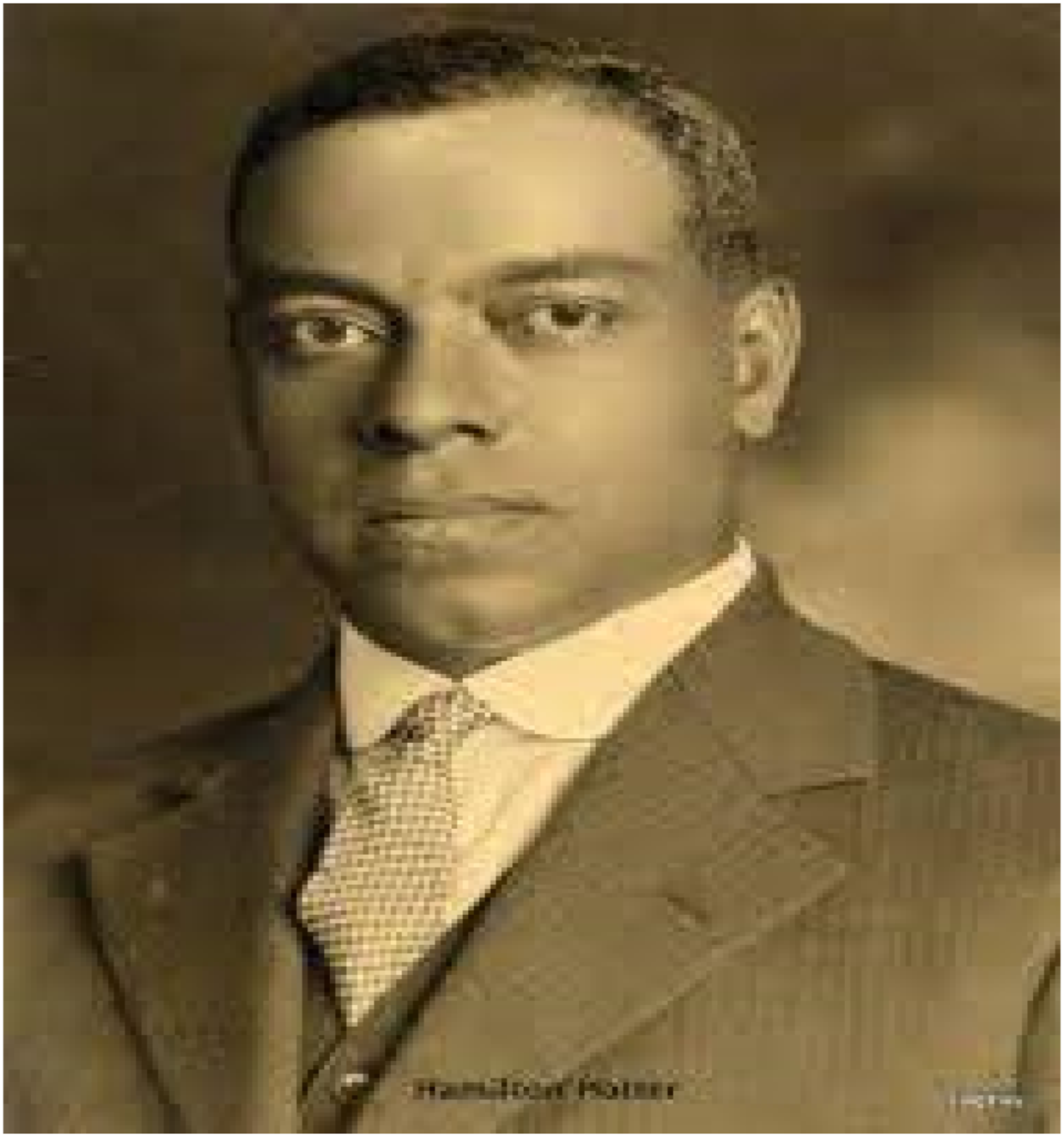
Hatter, a distant cousin to the author, was born in slavery nine years before Emancipation and it is likely he observed, as a child, many horrific experiences (Caldwell, 1923; Gray, 2015; Miller, 1904). Hamilton interacted and was surrounded by his parents as well as both maternal and paternal grandparents. In effect, his birth and early childhood development are consistent with the picture of the way slavery was organized around slave family life, as depicted by Gutman (1976). At age nine, he was on the cusp of being turned into a laborer, with its accompanying horrors. Emancipation made it possible for him to “drop” the slave presentation of self, and enact instead, the other side of his dual consciousness, the foundation for which was his soul value. Not surprisingly, he was an ex-slave who experienced rapid social uplift, following Emancipation.
After completing high school, he attended first Storer College in West Virginia and then Bates College in Maine. Upon graduation from Bates, he returned to Storer College and taught Latin, Greek, and mathematics. It is this pattern of former slaves embracing education as a vehicle for moving from being enslaved to becoming a citizen that shows them exhibiting a “model” minority mindset long before that descriptor was used in modern times (Cross, 2021). His career progressed and after the passage of the Second Merrill Act of 1890, he was selected as the first principal of the newly developed Bluefield Colored Institute renamed Bluefield State Teacher’s College in 1931 and further changed in 1943 to simply Bluefield State College (Poole, 1989). Immediately following the 1954 Brown Decision that led to school integration, the state of West Virginia acted to integrate all colleges, including Bluefield State. Ironically, this decision meant the closing or racial transformation of Blue Field from an all-Black college to a mixed and, subsequently, predominantly White college. The erasure of blackness was not complete, and an important building on the campus—The President’s House—carries the name Hamilton Hatter Hall.
Although born a slave and raised by slaves, Hatter evolved into a person with strong personality characteristics, pro-social attitudes, and an abundance of personal agency. The author’s genealogical connection to Hatter provided part of the motivation to produce this work. Discovery of Hatter’s existence generated this question: How did ‘some’ Black people, raised to be slaves and having witnessed and/or been the recipient of much pain and suffering, exit the forced labor camps and reach adulthood exhibiting positive and strong personality characteristics that made it possible for them to experience unexpected levels of success, as free persons, within a decade of Lincoln’s Emancipation Proclamation?
The only possible explanation is that the slave parents, slave fictive kin, and the slave community shaped their “veil” or double-consciousness to hide or disguise an alter-ego only Emancipation made safe to reveal. It is their otherwise hidden sense of self that provided the psychological platform upon which “some” ex-slaves accomplished the impossible a short period into freedom. The presentation of their humanity and gifts to the south was met with White hatred and violence. Not to be lost is the fact that the life and times of Hamilton Hatter is a historic and important example of post-traumatic growth.
Footnotes
Declaration of Conflicting Interests
The author(s) declared no potential conflicts of interest with respect to the research, authorship, and/or publication of this article.
Funding
The author(s) received no financial support for the research, authorship, and/or publication of this article.
