




Abstract
After the Second World War, city halls and local business communities cooperated to forestall urban decline in the face of population, industry, and retail loss to the suburbs and the Sunbelt. Before the U.S. Congress passed laws that established national housing programs, pro-growth coalitions in threatened cities launched programs designed to revitalize central business districts and lobbied in state capitals for legislation authorizing redevelopment efforts. In some notable cases, path-breaking measures crafted at the local and state levels served as models for the national initiatives that followed. Believing in the centrality of improved automobile access to their downtown redevelopment efforts, city leaders and business interests followed the same path in transportation as they had in housing. The case of Detroit illustrates how the drive for downtown renewal began before the federal government assumed the primary role with the passage of the 1956 Interstate Highway Act.
After 1945, large industrial cities in the U.S. faced a host of complex problems left over from the Great Depression and World War II. Concerned with the spread of blight and the rapid flight of population, industry, and retail to the suburbs and the Sunbelt, defenders of these embattled cities devised a series of plans to revive declining central business districts. In the postwar years, city halls and local business communities worked collaboratively to launch an urban renaissance and eagerly welcomed assistance from federal agencies that eventually contributed money and counsel in unprecedented quantities. In response to a critical shortage of affordable housing, Congress passed landmark legislation—the Taft-Ellender-Wagner Housing Act of 1949 and the Housing Act of 1954, most notably—that set ambitious goals for the construction of low- and middle-income housing units and created the urban renewal program designed to redevelop declining downtowns. Before federal agencies launched these national programs, however, pro-growth coalitions composed of business elites, mayors, and other city officials took action by launching programs designed to resuscitate struggling central business districts and by lobbying in state capitals for legislation authorizing redevelopment efforts. Following the example of the famed Pittsburgh Renaissance, where a joint effort by big business and city hall replaced an unsightly rail yard and seedy warehouses downtown with a state park and gleaming office towers in what became known as the Golden Triangle, a number of cities followed suit with ambitious efforts to resuscitate the urban core. In short order, such business–government alliances as the Greater Philadelphia Movement, the Greater Baltimore Committee, the Cleveland Development Foundation, and Civic Progress, Incorporated, in St. Louis, initiated sweeping redevelopment programs. In some instances, path-breaking measures crafted at the local and state levels served as models for the key national legislation that followed. In Chicago, for example, urban redevelopment commenced after the state legislature passed measures drafted by local businessmen to save the downtown; two laws passed in Illinois, the Blighted Areas Redevelopment Act of 1947 and the Urban Community Conservation Act of 1953, served as models for the legislation passed by Congress in 1949 and 1954 respectively. 1
Determined to improve transportation as an important component of halting decentralization and saving downtowns, city leaders heartily endorsed the 1956 Interstate Highway Act that obligated the U.S. government to fund 90 percent of the cost of the expansive highway system (including urban expressways). But as in the case of housing and urban redevelopment, where local efforts pre-dated federal involvement, the construction of an extensive network of multilane, high-speed expressways commenced in many cities a full decade before the landmark national legislation. In Detroit, for example, local officials acted immediately after the war to ease local traffic congestion and revive the central business district by building a number of expressways. In doing so, they encountered challenges that recurred repeatedly in the postwar years and made crucial policy decisions that presaged later developments. Federal aid increasingly expedited matters, but policy makers in Detroit (and elsewhere) moved decisively ahead before the U.S. Congress acted in 1956 and accordingly established important precedents for the interstate era. 2
By the time that World War II ended, business and political leaders in the nation’s largest cities had conducted extensive discussions about building more highways and a handful of these municipalities (New York City, Chicago, Detroit, Los Angeles, and a few others) had completed plans to construct extensive expressway systems. Although policy makers in Washington, D.C., initially provided only limited financial support and took a back seat to state and local governments, federal officials proved supportive in other ways. Engineers at the U.S. Bureau of Public Roads (BPR) lent their expertise to state and local highway departments, conducting traffic needs studies and drafting detailed plans specifying proposed routes, including the location of interchanges. In the last years of the war, bureau engineers supervised studies in 30 major metropolitan areas and 135 communities with populations below fifty thousand. Contrary to the arguments urging more federal aid for urban roads repeatedly advanced by mayors, planners, and civil engineers, Detroit Mayor Edward J. Jeffries, Jr., introduced a note of concern in his remarks to a congressional committee in 1944. The mayor presciently warned that expressway networks would improve transportation throughout entire metropolitan areas—not just increase access to the central business district—and thereby enhance suburbanization and eventually lead to a situation where “there is nothing left [in Detroit] but industry.” Congress ignored Jeffries’s musings and passed the Federal-Aid Highway Act of 1944, which provided funds for highway construction during the three years following the war, with one-fourth of the total allocation designated for urban primary roads. By 1948, the BPR had underwritten surveys in sixty cities and detailed preliminary engineering plans in one hundred metropolitan areas. The amount of federal funds allocated for the construction of urban highways rose from $68 million in 1947 to $376 million in 1950, by which time 116 cities had completed plans for the construction of new highways. In 1951, with 65 percent of federal urban funds being spent on limited-access highways, the BPR found that work on highway improvements or construction was proceeding in every major American city. 3
While municipal officials benefited from the provision of expertise proffered by the BPR and eagerly accepted the modest sums of financial aid from Washington, D.C., federal aid fell short of the amount necessary to pay for costly expressways. Judging the new roads crucial for urban rebirth, civic leaders in a number of cities pushed ahead immediately after the war with alternative sources of funding. In Chicago, for example, excavation for a superhighway network began in the late 1940s with the conclusion of an agreement involving state, county, and local officials. In 1955, Cook County Chairman Dan Ryan engineered passage in the state legislature of a multimillion-dollar bond issue that increased the pace of highway construction. The Congress Street Expressway (later renamed the Dwight D. Eisenhower Expressway) opened in stages between 1955 and 1960, quickly followed by the Northwest Expressway (later renamed the John F. Kennedy Expressway) in 1960, the Dan Ryan Expressway in 1961–1962, and the Adlai E. Stevenson Expressway in 1964. Moving quickly after the war to take advantage of the increased federal aid provided by the 1944 federal highway act, legendary builder Robert Moses constructed two freeways in New York City (completing the Van Wyck Expressway in 1950 and the Prospect Expressway in 1955). Moses’s “Arterial Plan for Pittsburgh,” completed in 1939 for the Pittsburgh Regional Planning Association, formed the basis for post–World War II expressway construction in that city. The first portion of the Penn-Lincoln Parkway, which funneled traffic from the Golden Triangle to the Pennsylvania Turnpike, opened in 1953. In Los Angeles, local officials and downtown merchants successfully lobbied the state legislature to raise gasoline taxes and motor vehicle registration fees to pay for the construction of a series of freeways. In 1947, California Governor Earl Warren signed a law appropriating $76 million annually for the next ten years to build roadways, 55 percent of which was allocated to the state’s thirteen southernmost counties. According to the Los Angeles City Planning Commission, the city would receive $300 million during the next decade to build an estimated 105 miles of freeways. That same year, when the state legislature balked at raising taxes for new highways, Kansas Citians approved a $12-million bond issue for freeway construction. In the early 1950s, Boston commenced work on the Central Artery to improve traffic flow on its sclerotic downtown streets. 4
At the forefront of large U.S. cities pursuing extensive expressway construction in the immediate post–World War II years stood Detroit, the self-styled “Motor City.” The business elite and city officials in Detroit began systematic discussions during World War II of how to revitalize the declining central business district, invariably mentioning the need for better roads. Their conversations about urban redevelopment addressed the urgent need to repair aging infrastructure, replace dilapidated structures with attractive new buildings, and impose zoning restrictions, but also strongly emphasized the need to improve transportation as one of the key elements in arresting downtown deterioration. In a 1942 report prepared for the Urban Land Institute, a local consulting firm highlighted the city’s many problems—increased vacancy rates, the spread of slums and blight, population loss, the proliferation of outlying shopping centers, traffic congestion, and inadequate parking—responsible for the worsening situation in the central business district. A section of the report carefully documented the decline in the number of people and vehicles (automobiles, taxicabs, and buses) entering and leaving the downtown daily. From 1925 to 1940, while Detroit’s population increased from 1,246,044 to 1,623,452, the number of persons leaving the central business district between 5:00
The continued viability of downtown, according to the 1942 report, depended upon the availability of adequate parking as well as the ability of motorists to negotiate their daily commute in a timely fashion. With curb space on downtown streets providing less than 5 percent of the area needed to accommodate the number of automobiles in use on weekdays, the dearth of parking lots and garages proved to be a constant source of irritation for office employees, building owners and operators, merchants, shoppers, and city workers; the untenable situation could only be addressed successfully by adding a copious amount of off-street parking. In the short term, suggested the consultants, private companies, downtown merchants’ associations, or the municipal government should establish temporary parking facilities on the edge of the central business district with shuttle buses ferrying commuters through downtown streets to and from their destinations. The inefficiency and inconvenience of having to change modes of transportation at peripheral locations would likely displease commuters, the authors of the report acknowledged, so a permanent solution would likely entail the construction of terminal off-street parking structures in the heart of the city. The provision of ample parking would have to accompany the improvement of roadways in a city tied inextricably to motor vehicles. 6
The drive to expedite the flow of automobile traffic accelerated in 1942 because of the urgent need to improve transportation for Detroit residents who worked in the massive Willow Run Bomber Plant west of the city. Built three miles east of Ypsilanti and twenty-eight miles west of downtown Detroit on land recently purchased by auto magnate Henry Ford, the Willow Run facility became the world’s largest factory when it opened in September 1941. The number of airplane workers assembling B-24 Liberty bombers there increased from 2,500 in the early months of 1942 to a peak of 42,000 in mid-1943; on a single day in July 1943, plant officials hired more than 3,000 job applicants. The United States Housing Authority surveyed land for the construction of workers’ housing in the vicinity, and architect Oscar Stonorov drew up plans for “Bomber City,” a massive housing complex for 100,000 workers. When the citizens of Washtenaw County vigorously objected to the implementation of Stonorov’s plan and Ford refused to sell the land, the government settled for enough dormitories to provide shelter for seven thousand workers and looked to nearby Detroit as its principal labor source. To offset the massive traffic jams on isolated rural roads that had been built only to accommodate the movement of Washtenaw County produce to market, officials in Washington, D.C., hastily began work on a new highway linking the factory to the nearby population center. Completed in stages between September 1942 and August 1945, the four-lane Willow Run Expressway contained a few cross-road intersections but prohibited residential or commercial access. The hastily built roadway served solely to link the factory with worker residences in the neighboring metropolis. Just as the war ended, the easternmost section of the expressway reached the Detroit city limit. 7
Following passage of the 1944 federal highway act, planning began in Detroit for the construction of two expressways that would intersect at a right angle north of downtown—one that extended the Willow Run Expressway (later renamed the Edsel B. Ford Expressway) eastward across the length of the city and the other (the John C. Lodge Expressway) linking the Detroit River with the distant northern suburbs of Oakland County. In 1945, in a letter to the common council on the necessity of urban redevelopment after the war, City Treasurer Albert E. Cobo made the case for expressway construction as a key element in enhancing downtown real estate values. In turn, members of the Common Council authorized the Department of Public Works to begin acquiring rights-of-way in 1946, and construction on the two expressways began the following year. The Detroit Plan, a comprehensive design for postwar development issued by the city in 1947, underscored the importance of downtown revitalization (including the prominent role played by improved transportation) through the elimination of blight in and around the urban core. Endorsing the plan, Mayor Edward J. Jeffries, Jr., pledged that the city would devote its own resources to redevelopment efforts regardless of the amount of support garnered from the state and federal governments. Glenn Richards, general superintendent of the city’s Department of Public Works, argued strongly for increased federal aid and recommended increased lobbying efforts in Washington, D.C., for transportation legislation. In the meantime, Richards and other city officials argued that the urgent need for more and better highways in Detroit dictated that the city should continue its own building program without delay. Work on the two expressways proceeded briskly. 8
To initiate construction of the Ford and Lodge Expressways, Detroit relied upon an innovative funding formula that soon attracted considerable attention among city officials, civic engineers, and urban planners nationwide. Half of the revenue collected on gasoline tax and license fees by the state of Michigan was allotted to counties, which in turn used about half of that sum to maintain rural roads and distributed the remaining half to municipalities within each county. Shortly after passage of the Federal-Aid Highway Act of 1944, Detroit entered into a compact with the State Highway Department and the Wayne County Road Commission to construct the two expressways. Under the auspices of this so-called Tri-Party Agreement, each year the city would contribute $1.5 million, the county would contribute $1.5 million, and the state would contribute $3.0 million, with the total of $6.0 million to be used to supplement whatever federal funds were available. The annual federal allocation of $4.0 million, along with the dollars from the Tri-Party Fund, initially freed up $10 million a year – an impressive sum in the late 1940s but hardly adequate for the timely completion of twenty-two miles of expressway construction at an average cost of $7.0 million a mile. At that rate, lamented city officials, the road building project would not be completed until the mid-1960s. 9
Such a dilatory pace seemed wholly unacceptable to Albert Cobo, who was elected mayor in 1949 on a platform that stressed extensive expressway construction as an integral part of downtown redevelopment (see Figure 1). A successful entrepreneur who became known as “Little Al the Big Builder” during his mayoral tenure, Cobo led an ambitious campaign to remake Detroit’s struggling downtown. Under his guidance, the city built a $112-million Civic Center overlooking the Detroit River, a mammoth convention center (Cobo Hall) and adjoining basketball venue (Cobo Arena), a new city-county office building, and the Henry and Edsel Ford Auditorium (home of the Detroit Symphony Orchestra). At the same time, he worked tirelessly to aid merchants by improving access for shoppers and workers traveling in and out of downtown. As commuters grumbled about rush hour traffic that permitted speeds of only fifteen miles per hour, the mayor proposed yet another financial innovation to expedite freeway building. Denouncing the cautious “pay-as-you-go” formula being used at the time, he championed a bill in the state legislature that would allow the state, county, and city to issue thirty-year revenue bonds based upon the future collection of gasoline taxes and other user fees paid by motorists. With the additional revenue generated by the bonds, Cobo advised Michigan Governor G. Mennen Williams in 1950, the expressways could be completed within four years—a full decade earlier than under the prevailing arrangement. Governor Williams supported the measure, which the state legislature passed later that year. 10

Mayor Cobo.
In 1950, Mayor Cobo also affirmed the city’s decision to favor automobiles instead of mass transit—that is, to build multilane, limited-access expressways rather than a fixed-rail public transportation system. Five years earlier, outside consultants had recommended to the Mayor’s Transportation Committee inclusion of rapid transit rails in the median strip of the Edsel B. Ford Expressway, but the State Highway Department and municipal government refused to pay the additional right-of-way and construction costs. In 1949 another consulting firm urged that fixed rails for mass transit be added to the medians of all new expressways, but again both the state highway commissioner and the president of the local rapid transit commission refused to endorse the report. In both 1945 and 1949, transportation officials termed the cost of providing mass transit facilities prohibitively expensive. Furthermore, they argued, state law mandated that revenue collected from taxes and fees paid by motor vehicle owners could be used only for the construction and maintenance of roads and not diverted to ancillary purposes such as busses, fixed-rail mass transit, or even schools. Given the clout of road engineers and their allies in the trucking industry, Detroit would remain a “rubber-tire town.” 11
City leaders confirmed their commitment to improved automobile access to the central business district with the release of the Master Plan of 1951. After the city commissioned internationally renowned architect Eliel Saarinen to fashion a blueprint for remaking the urban core, the Detroit City Planning Commission revised the design he and his son (Eero) submitted to update the Detroit Plan of 1947. Echoing the goal of reviving the downtown commercial sector espoused four years earlier, the Master Plan of 1951 explicitly tied the extensive construction program engineered by Mayor Cobo to the need for better transportation. Again forthrightly eschewing the option of public transit, the city determined to provide commuters, shoppers, and visitors attending special events easier access to the riverfront and surrounding area by building expressways. Cost considerations and land acquisition disputes later caused city engineers to modify the highway routes drawn in 1951, but the fundamentals of the detailed expressway network sketched by the planning commission that year remained largely unchanged in subsequent decades. The expressway, rather than the trolley, became an immutable fixture of the Motor City’s political and social geography (see Figure 2). 12
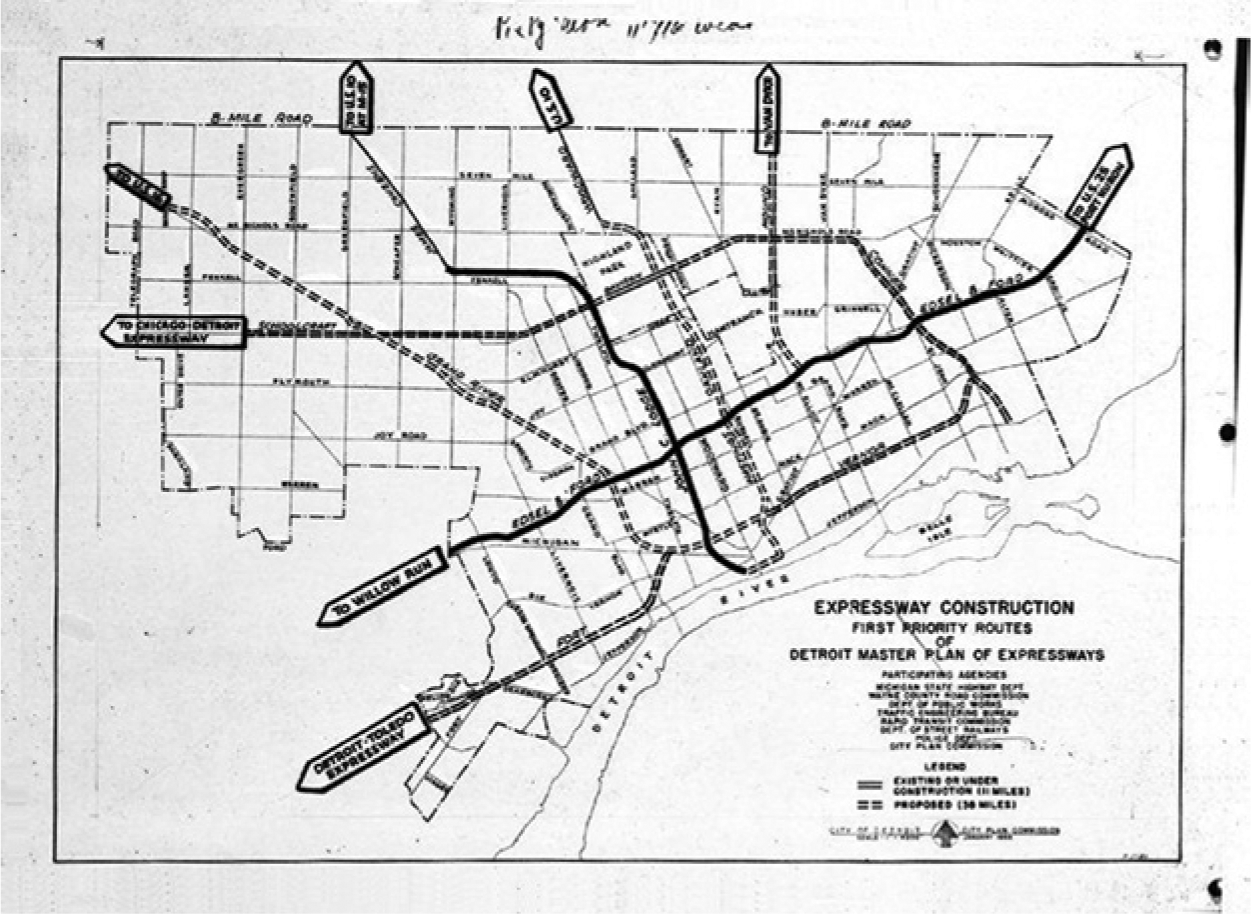
Detroit master plan of expressways.
While local plans crystalized for an elaborate expressway system, Cobo and other Detroit officials lobbied in Washington, D.C., for the passage of a new transportation bill that would increase federal aid for highways. In a 1950 letter to Michigan Senator Homer Ferguson, Cobo detailed the inadequacies of existing federal legislation and reported that Flint, Grand Rapids, Battle Creek, Muskegon, and other municipalities in the state sought to join Detroit in building limited-access highways but found it impossible to do so because of inadequate funding. Working in tandem with the American Municipal Association, the Detroit mayor proposed an amendment to a bill under consideration in Congress that would authorize federal funding to be used by local and state governments to reduce bonded indebtedness. Mayor Cobo and Glenn Richards, who had been named Detroit’s expressway coordinator, testified before Congress on behalf of the amendment. The Federal-Aid Highway Act of 1950, passed shortly after President Harry Truman ordered U.S. forces to Korea and requested that Congress curtail spending on such domestic programs as highways, disappointed expressway partisans. The law provided only $125 million for urban projects during the two years beginning on July 1, 1951. As well, the bill’s authors refused to increase the federal government’s financial role (leaving the federal and state contributions at a 50–50 ratio) and once again disallowed the use of funds for highway maintenance and toll road construction. But the measure still constituted a valuable tool for road building, the mayors and their allies believed, because it included a crucial amendment allowing state and local governments to use federal funds to pay off bonds on new road construction. To the expressway builders and their supporters, the ability to use state and local government bonds in this fashion meant more than the future promise of increased federal largess. 13
As increased funding allowed the pace of expressway construction to quicken in the late 1940s and early 1950s, Detroit officials confronted the delicate problems of land acquisition and condemnation. From the outset, the city maintained that the routes of the new roadways would be selected carefully so that minimal disruption of existing neighborhoods would occur. In his 1945 missive to the common council, Treasurer Cobo had outlined a plan whereby “an area should be condemned only when its buildings are actually ready for demolition . . . where some of the buildings have already been removed and where others are actually falling.” The section of the 1947 Master Plan of Detroit dealing with expressways went even further, saying: “Whenever possible, the expressways will be routed along belts of industry. Thus they will avoid carrying heavy traffic through residential neighborhoods, and at the same time serve as buffer strips, separating industrial installations from residential areas.” As in many other cities, planners in Detroit prescribed these routes in order to separate non-continuous land uses. Indeed, promised city officials, the new expressways would actually improve the quality of life in affected residential neighborhoods while at the same time remaking downtowns as attractive places where affluent residents could live, shop, and enjoy a variety of entertainment options. 14
The reality proved to be much different, however, as site selection for expressways invariably spared middle-class enclaves, uprooted residents of less affluent neighborhoods, and sparked a series of protests from angry homeowners and small businessmen who had no desire to relocate and who often felt that they were being unfairly compensated for their property. As in other cities where bulldozers tore relentlessly through targeted neighborhoods to clear paths for expressways, local officials perfunctorily listened to citizen complaints and then proceeded to implement their original plans. In a letter to Governor Williams, State Highway Commissioner Charles M. Ziegler reported that there existed an “organized and concerted effort to resist . . . expressway construction, and particularly the right-of-way acquisitions.” Further, Ziegler acknowledged that uprooted residents experienced great difficulty finding suitable lodging in the tight Detroit housing market—a situation affecting more people displaced by the Edsel B. Ford Expressway, which destroyed densely populated residential neighborhoods, than by the John C. Lodge Expressway, which cut primarily through commercial areas. Nonetheless, the commissioner maintained, city officials deemed such draconian measures necessary. “It was highly important that right-of-way acquisitions be speeded up in the interest of expediting actual construction on the expressways, as the demand for facilities had become very acute because of greatly increased traffic in Detroit,” he concluded. Additionally, Ziegler explained to the governor, “On both the John Lodge and Edsel Ford, unforeseen construction difficulties or sequences of operations made necessary the immediate acquisition of certain properties in order to avoid construction delays.” In other words, as the displaced residents quickly realized, expediency trumped the earlier assurances given about fairness and due process. 15
The devastation proved to be especially acute in the densely populated areas near downtown that housed much of the city’s African American community. By 1958, construction of the John C. Lodge Freeway resulted in the destruction of 2,200 buildings (residences, shops, and factories) on the Lower West Side and largely African American neighborhoods bordering Highland Park. By the end of the 1950s, bulldozers leveled approximately 2,800 buildings through the black West Side and the northernmost edge of the city’s most infamous ghetto, Paradise Valley, to make way for the Edsel B. Ford Expressway. Because years sometimes elapsed between the announcement of condemnation and the demolition of the designated structures, property values plummeted long before city crews took action. Moreover, once the city proclaimed its intention to exercise eminent domain, demoralized homeowners and businessmen lost all incentive to make repairs. As the quality of targeted neighborhoods declined, the remaining residents found it impossible to sell their devalued property and thereby often lacked the wherewithal to purchase homes elsewhere. Surveying the denuded cityscape—what one black businessman glumly called a “no man’s land”—many of the residents and shopkeepers whose land had been spared departed and, believing that the area would never recover its former vitality, sold their property at considerable losses. 16
African Americans in neighborhoods singled out for elimination protested their fate to state and local officials, dispatching petitions to Governor Williams and Mayor Cobo, but received no satisfaction. The Detroit Urban League and the local chapter of the National Association for the Advancement of Colored people (NAACP) doggedly opposed the city government’s callous actions but found no succor in city hall. To document the disastrous effects on the black population caused both by urban renewal projects and expressway construction, the Urban League interviewed dozens of displaced residents and forwarded the case studies to federal housing officials in Washington, D.C. The interviews described how much difficulty uprooted African Americans had finding safe and sanitary lodging, recounting how the local housing commission sometimes failed to seek adequate replacement housing and how the dwellings the city identified often proved to be even more dilapidated and hazardous than the structures razed to make way for highways. With their singular focus on speeding up traffic, local officials cared only about clearing land for expressway construction. 17
Racial politics guided these unfortunate developments. Mayor Cobo, a pro-business Republican who won election with minimal support from African American voters, offered little sympathy to the aggrieved residents. Widely known as a tireless champion of the city’s business elite, Cobo saw his election in 1949 over liberal city councilman George Edwards as a mandate for downtown redevelopment at all costs. A New Deal Democrat and former public housing administrator with strong ties to the United Auto Workers (UAW), Edwards campaigned in 1949 on a platform espousing racial desegregation and construction of low-income housing in all areas of the city. By contrast, Cobo earned the backing of white homeowners’ associations through his sturdy opposition to “Negro invasions” of the city’s all-white neighborhoods. His sustained advocacy of private enterprise, anti-communism, and residential segregation appealed to many of the residents of blue-collar precincts in Detroit’s populous ethnic neighborhoods. City treasurer Cobo won a surprisingly easy victory as white working-class voters ignored the endorsement of Edwards by union locals. (Cobo defeated Edwards, 313,136 to 206,134.) Ordering bulldozers into African American neighborhoods in advance of the road-building crews, Cobo brusquely dismissed calls for more humane policies. “Sure there have been some inconveniences in building our expressways and in our slum clearance programs, but in the long run more people benefit,” the mayor remarked. “That’s the price of progress.” 18
That progress continued despite the protests of displaced homeowners and merchants. After a new federal highway bill in 1952 appropriated more funds for urban roadways in 1953–1954—and continued to authorize the use of that funding to retire bonded indebtedness—Detroit leaders announced plans for the construction of two additional expressways. The Oakland-Hastings Freeway (later renamed the Walter P. Chrysler Freeway) would proceed from Jefferson Avenue along the Detroit River northeast to Six Mile Road, and the Vernor Expressway would link the Lodge and Hastings Expressways and extend eastward to Gratoit Avenue. In 1954, testifying before the President’s Advisory Committee on a National Highway Program chaired by Lucius D. Clay, Mayor Cobo enthusiastically characterized the new expressways being built in his city as “a picture of beauty.” More importantly, he asserted that Detroit and other cities could complete their expressway networks without the federal government altering its funding formula with the states, as long as the BPR continued to guarantee all local and state bond issues. Cobo made no plea to the Clay Committee that the federal government assume 90 percent of the cost of highway construction, which the committee eventually recommended and which the 1956 interstate law authorized, because Detroit was fully prepared to proceed under less generous conditions. By 1958 the state highway department, city of Detroit, and county board of road commissioners had signed contracts for the building of the Southfield Freeway on the city’s west side, along with extensions of the Vernor, Chrysler, and Lodge Expressways. By the end of the decade, construction crews in Detroit were hard at work pouring concrete for the expressways (collectively known as “Cobo’s canyons”) that were completed in the 1960s. 19
Albert Cobo and his successors in Detroit’s city hall welcomed the cornucopia of federal dollars provided for expressway construction by the landmark 1956 highway act because the largesse allowed much quicker completion of the costly construction projects they had launched a decade before. Dedicated to providing easier access to their central business districts, a vital part of the central city redevelopment agenda they pursued after World War II, mayors in Detroit and elsewhere began work principally with state and local funding, a modicum of federal resources, and the hope of acquiring more dollars from Washington, D.C., in the future. In the late 1940s and 1950s, municipal governments spent their own tax dollars and incurred substantial debt on behalf of a program they deemed essential to their cities’ future prospects. Convinced of the importance of highway improvement, local officials initiated ambitious road-building programs without assurances of extensive federal funding; they accepted the need to rely on local and state revenue streams as the price of central business district refurbishment. At the same time, they ruthlessly uprooted residents and businesses to make way for highways and interchanges in a manner that became familiar in the late 1950s and 1960s—and that would lead to a series of citizen revolts against freeways in countless communities in later decades. As the case of Detroit illustrates, the contours of the post-1956 expressway construction frenzy became clear shortly after the end of the war—a testament to the effort by urban growth machines such as Mayor Cobo’s to improve the flagging fortunes of their declining downtowns.
Footnotes
Acknowledgements
I would like to express my appreciation to Mark Rose, Ray Mohl, Edward Muller, and Owen Gutfreund for their thoughtful comments on various versions of this essay.
Declaration of Conflicting Interests
The author(s) declared no potential conflicts of interest with respect to the research, authorship, and/or publication of this article.
Funding
The author(s) received no financial support for the research, authorship, and/or publication of this article.