




Abstract
Ed Ruscha’s photo book Then & Now: Hollywood Boulevard, 1973-2004 consists of two continuous photographic panoramas of the north and south sides of the eponymous street taken thirty years apart. The juxtaposition of these two time periods depicts a dramatic transformation of the neighborhood, a result of the ongoing Hollywood Redevelopment Project (HRP). From its inception in 1986, the HRP has enlisted a nostalgic image of the city during the heyday of the film industry to mobilize redevelopment efforts. At first glance, Then & Now seems complicit in the HRP’s nostalgic enterprise. However, Ruscha’s book provides a device for rethinking the city’s renewal and the historical narratives that drive it. “Reading” this unusual text disrupts our relationship to “now” and “then,” problematizing nostalgia’s function as a condition of Hollywood’s revitalization and urban redevelopment more broadly.
In the early 1960s, Ed Ruscha produced a series of influential artist books that depicted the physical environment and vernacular architecture of his adopted city of Los Angeles. His most famous book, Every Building on the Sunset Strip (1963), features two continuous photographic panoramas of this infamous stretch of Sunset Boulevard (Figure 1). The book consists of a single page folded accordion-style that reaches twenty-seven feet when stretched to its full length. Just as the title says, an image of every building on the north side of the street appears at the top of the page. Photographs of all the buildings on the south side of the street are aligned with their counterparts, flipped upside down, and placed along the bottom of the page. The layout of the photographs leaves a wide blank space in between the two strips of images.

Ruscha, Every Building on the Sunset Strip, 1963, accordion fold and double page view.
Three decades later, Ruscha published Then & Now: Hollywood Boulevard, 1973-2004, a work that revisits the format of Every Building on the Sunset Strip (Figure 2). 1 Like the earlier book, the pictures of the north side of the street are arranged along the top of the page, while the south side images are flipped upside down and situated along the bottom. The difference is that there are four photographic panoramas juxtaposing two separate time periods—1973 and 2004. The more recent set of images are printed in color and aligned underneath their black and white counterparts. This contrast reveals a dramatic transformation of the built environment along Hollywood Boulevard, a direct result of the ongoing efforts of the Hollywood Redevelopment Project (HRP).
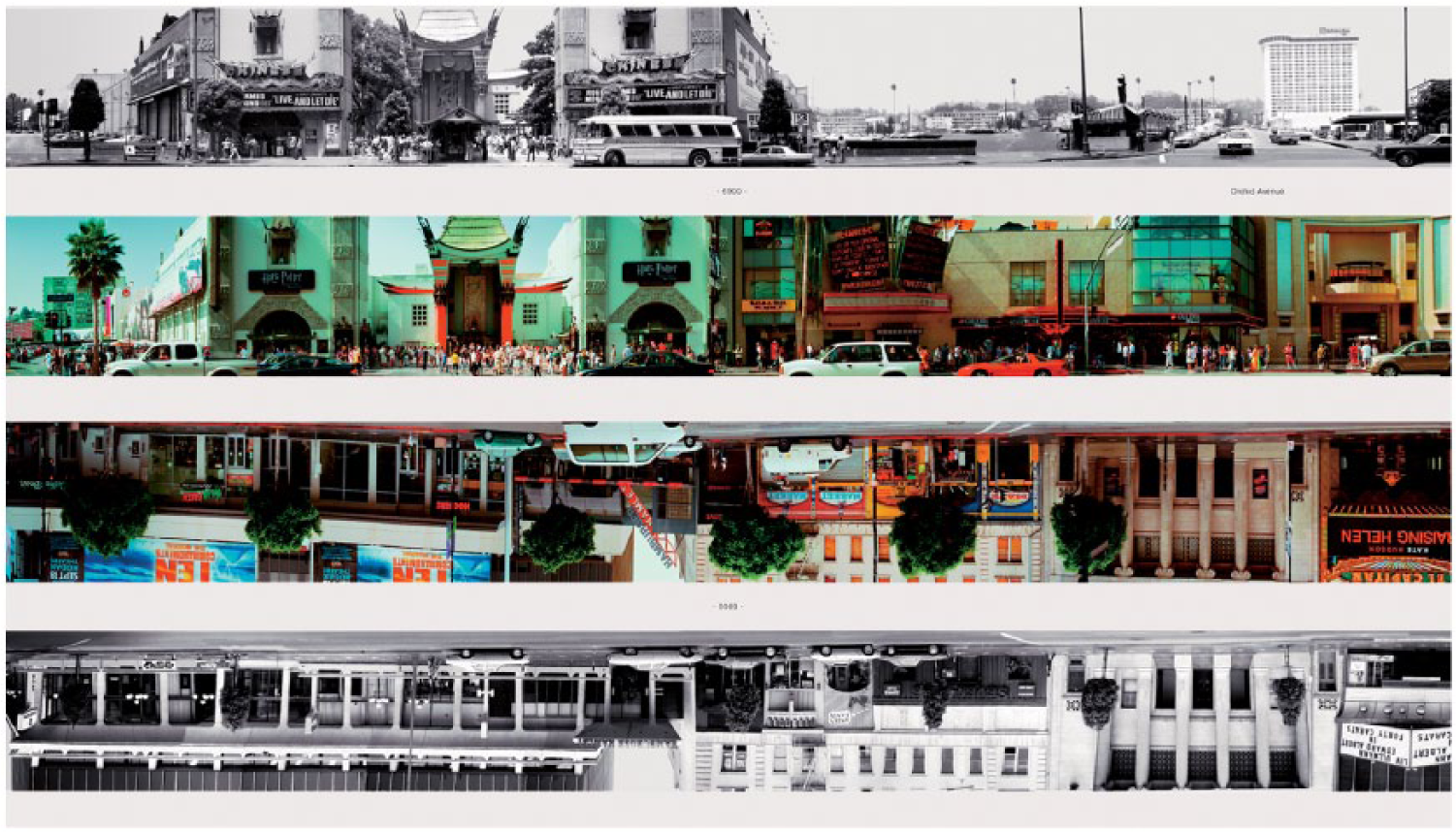
Page view of Ed Ruscha’s Then & Now: Hollywood Boulevard, 1993-2004, Steidl Press, 2005.
Begun in 1986, the HRP is a forty-year, multi-billion dollar urban revitalization program founded to facilitate the construction of mixed-use buildings, luxury condominiums, restaurants, clubs, and retail centers. 2 The project area spans 1,107 acres, but the majority of the energy and money is funneled toward the downtown business core along Hollywood and Sunset Boulevards in between Vine Street on the east and La Brea Avenue on the west (Figure 3). Hollywood’s redevelopment came as a response to the perception of the city as a once idyllic land of palm trees and movie stars turned blighted, derelict, and dangerous. From its inception, developers and civic leaders have been explicit about their attempts to return Hollywood to an idealized past, enlisting a nostalgic image of the city during the heyday of the film industry to mobilize redevelopment efforts. 3
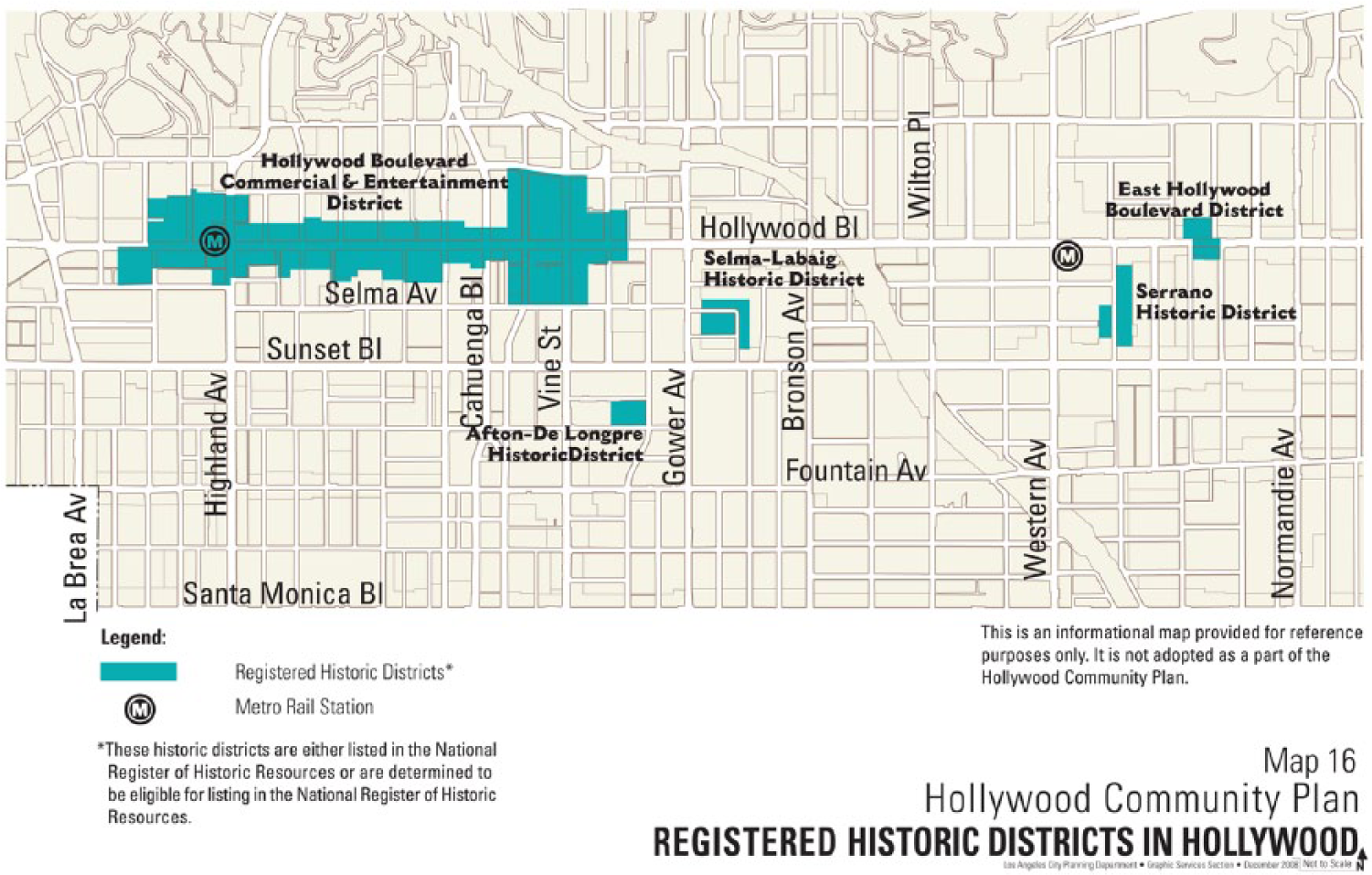
Los Angeles City Planning Department, Hollywood Community Plan, 2012.
At first glance, Then & Now seems complicit in the HRP’s nostalgic enterprise. The historical authenticity of the black and white panorama contrasts sharply with the color photographs of Hollywood. The latter depict a built environment that shares more in common with the recently revitalized Times Square while the earlier photos show a quirky yet fairly typical Southern California main street. Critics have accused the artist’s work of promoting reverie for a lost time and place. “Ruscha is our preeminent nostalgia artist . . . The distances of even his dimmest works hum or blister regularly with declarations of yearning for some disjunct point.” 4 Ruscha himself acknowledges a nostalgic dimension to his photography: “That’s the one thing I regret about any photograph: that eventually it becomes historical, nostalgic, out of date. It begins to look like the age it came from.” 5
The idea that Ruscha’s work merely represents a longing for a lost time and place, however, is to overlook the ways in which Then & Now can be used as a device for rethinking the city’s renewal and the historical narratives that drive it. Nostalgia is predicated on a kind of misremembering of history; it presents a static, idealized image of a time and place that tells a distorted narrative about the past. Ruscha’s book and its depiction of this famous street elicit significant questions about how art can be used to address urban redevelopment in Hollywood: how does the city’s association with a bygone period of the American film industry’s hegemony—the so-called “Golden Era” from the 1920s to the early 1950s—determine the character of its renewal? What role does nostalgia play in shaping our perceptions of Hollywood? And how does nostalgia’s “longing for a pure, but lost, moment” construct a static image of history? 6
An analysis of Ruscha’s body of work demonstrates how Then & Now repositions the viewer in relation to historical representations of the city. The book inhabits uneasy historical and interpretive terrain. It depicts a streetscape, but it is not an example of “documentary photography”; it is an artistic interpretation of a specific space, but the artistry is carefully concealed through digital technology; it comments on nostalgia while preserving an ironic distance from that nostalgia’s uncritical longing. By “reading” Ruscha’s book alongside a history of Hollywood Boulevard’s development, Then & Now provides an opportunity to reflect on nostalgia’s function as a condition of Hollywood’s “renewal” and urban redevelopment more broadly. The book’s design and its unusual double panoramic format is Ruscha’s attempt to overcome the nostalgic staticness of historical photography. Ultimately, this format disrupts our relationship to “now” and “then,” problematizing the very notion of an idealized past and its deployment as a tool for Hollywood’s revitalization.
Ed Ruscha Knows Hollywood Forward and Backward
Ed Ruscha is among the most famous living American artists. His paintings, prints, and photographs continue to be critically well received and highly sought by top collectors and major museums more than fifty years after his career began. Ruscha moved to Los Angeles from Oklahoma in 1956 and enrolled at the Chouinard Art Institute to study graphic design. A few years later, he began painting in a Pop style that was a reaction to the dominance of New York–based Abstract Expressionist artists such as Jackson Pollock, Mark Rothko, and Barnett Newman. His work was characterized by the incorporation of graphic images, commercial products, and written text, and he quickly established himself among other emerging artists such as Robert Irwin, Ed Kienholz, Larry Bell, and Billy Al Bengston, all of whom were associated with LA’s Ferus Gallery on La Cienega Boulevard. In 1962, Ruscha’s work was included in the landmark exhibition New Painting of Common Objects curated by Walter Hopps for the Pasadena Art Museum, widely acknowledged as the first show of Pop art in the United States.
Art historian Alexandra Schwartz argues that Ruscha’s work is deeply imbricated with Los Angeles as a space of cultural production tied to the entertainment industry and Hollywood.
There exist numerous affinities and connections between Ruscha’s art and both films and filmmaking . . . Just as the era in which Ruscha came of age was a critical one for L.A. visual art, it was also a vital, transitional time for the Hollywood film industry, when the “old guard” of the 1940s and 1950s began to give way to the “New Hollywood” of the late 1960s and 1970s.
7
The 1960s and 1970s was a transitional period for the neighborhood as well as the industry. As studios closed or moved production to less expensive facilities, middle- and working-class residents fled to the suburbs. Hollywood, like other urban areas during this period, was characterized by a decaying infrastructure, high crime rates, and vacant storefronts.
The blight and decay of Hollywood have been recurring motifs throughout Ruscha’s career, and he has spoken about being attracted to the “remnants of old Hollywood and the historic city.” 8 He lived and worked in the city for decades. In the late 1950s, he and fellow artist and Oklahoman Joe Goode shared an apartment with a darkroom at the neighborhood’s eastern edge. Beginning in 1974, he kept a studio on Western Avenue a few blocks from both Sunset and Hollywood Boulevards, where he stayed for nearly twenty years. 9 His physical presence there has informed the subject matter of his work throughout his career (Figure 4). The sweeping klieg light effect found in his rendition of the Twentieth Century Fox logo in 1962’s Large Trademark with Eight Spotlights, Hollywood (1968), one of numerous studies he made of the iconic sign, and Hollywood Is a Verb from 1983 are just a few examples of his preoccupation with the iconography of Hollywood.

Ruscha, Hollywood, 1968.
While his paintings brought him some fame, it was his photo books that cemented Ruscha’s critical reputation and elevated him to a level of respectability greater than many of his peers at Ferus Gallery. Ruscha published his first photo book, Twentysix Gasoline Stations, in 1963. Over a sixteen-year period, he produced sixteen books, including Every Building on the Sunset Strip, Various Small Fires and Milk (1964), Some Los Angeles Apartments (1965), Thirtyfour Parking Lots (1967), Royal Road Test (1967), Nine Swimming Pools and a Broken Glass (1968), Real Estate Opportunities (1970), and A Few Palm Trees (1971), to name only a few. Ruscha has continued to shoot other major boulevards and avenues of Los Angeles—Sepulveda Boulevard, Pacific Coast Highway, La Cienega, and so on—using equipment and methods similar to those he employed along Sunset Boulevard. 10
Every Building on the Sunset Strip, as predecessor to Then & Now, provides insight into the creative decisions that ultimately shaped Ruscha’s representation of Hollywood Boulevard. The photographs were taken with a motorized 35 mm Nikon camera mounted on a tripod in the back of a truck. The buildings were shot from approximately thirty feet away, across three lanes of traffic, and the camera was fitted with a perspective control lens “set at infinity” (Figures 5 and 6). The infinity setting is used in commercial photography primarily for capturing distant landscapes. But the relatively close proximity to the structures of Ruscha’s images resulted in a “snapshot” aesthetic in which buildings and streets are characterized by a lack of depth. The flatness of the photographs makes the spaces appear artificial, as if they were façades built for a movie set. The resulting prints were then meticulously pasted together to present the illusion of a single uninterrupted image.
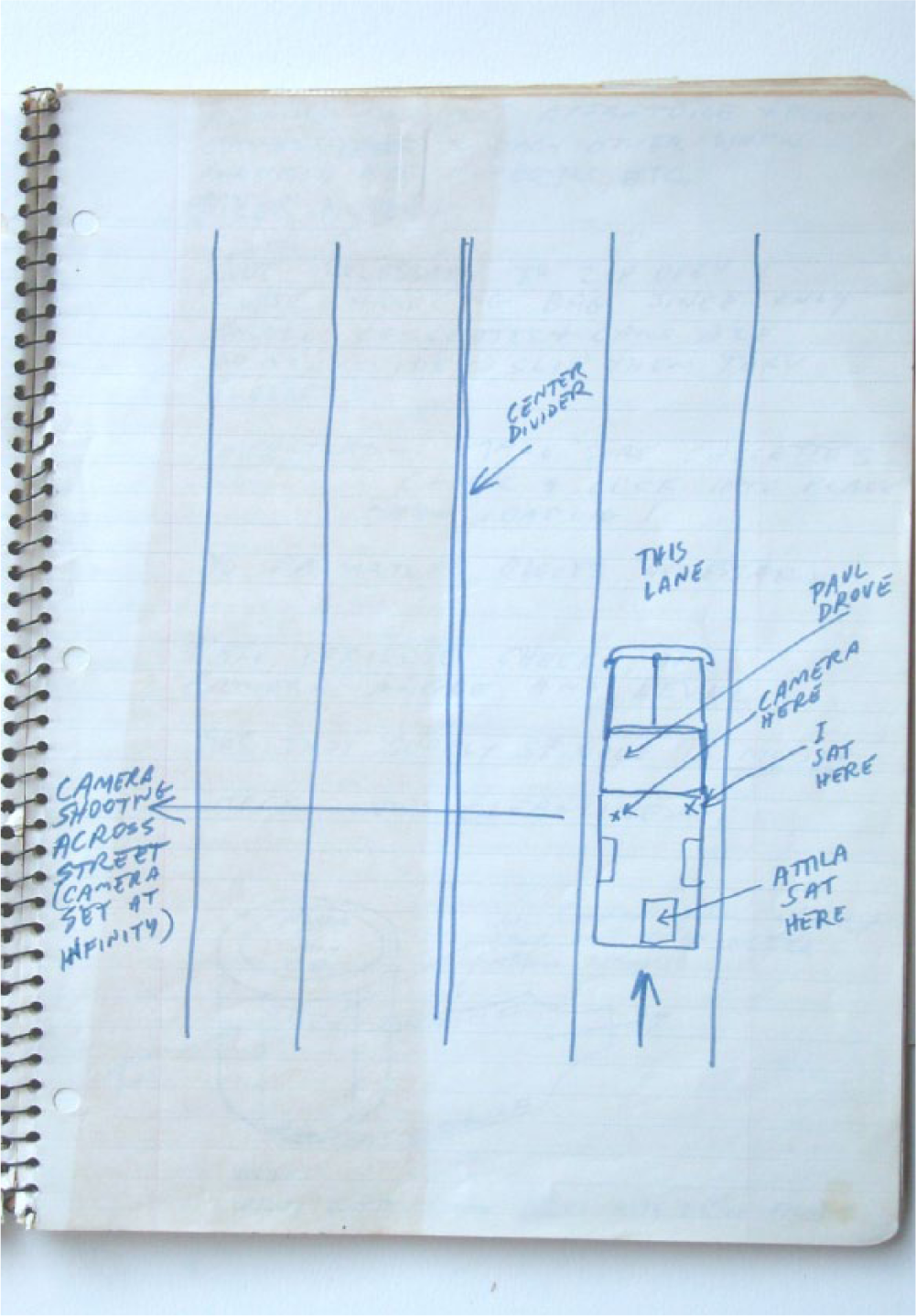
Page showing position of camera mounted in truck bed from Ed Ruscha’s notebook used to diagram the street photographic process.

Page showing position and height of camera during shooting from Ed Ruscha’s notebook.
The accordion fold is reminiscent of other collectible depictions of urban space, such as the booklet of Hollywood souvenir postcards from the 1940s pictured here (Figures 7 and 8). The cards are attached to each other at the top and bottom and, when unfolded, reveal color tinted photographs of iconic locations including Hollywood and Sunset Boulevards, a movie premiere at Grauman’s Chinese Theatre, a newly completed Cahuenga Pass, and klieg lights over the Hollywood Bowl at night. It is interesting to note the differences between the postcard of Hollywood Boulevard and Ruscha’s photographs of the Sunset Strip buildings. The view on the postcard uses classic linear perspective. The image is captured from an oblique angle making the road seem to disappear near the middle of the picture plane. The diagonal lines converging at a vanishing point create the illusion of depth. This kind of angle appears frequently in a number of Ruscha’s paintings (see again Large Trademark with Spot Lights and Hollywood). By contrast, his photographs of buildings on Sunset are shot head-on and lack the illusion of depth and the appearance of realism conveyed in the postcards.
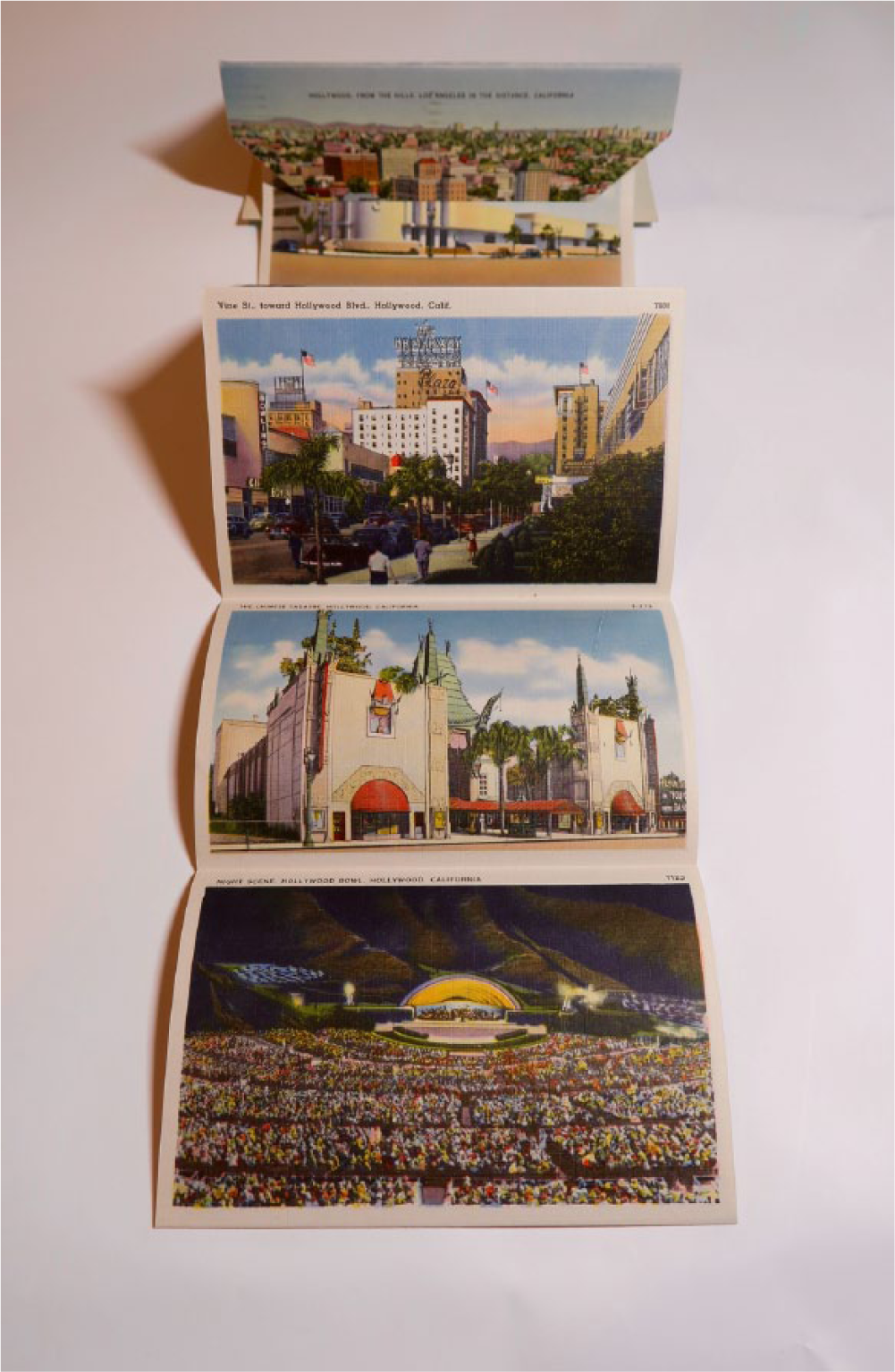
Hollywood souvenir postcard booklet (ca. 1930) with pullout accordion fold.

Detail, Hollywood souvenir postcard showing movie premiere at Grauman’s Chinese Theatre (ca. 1930).
Every Building on the Sunset Strip has also been compared with a “leporello,” a term used in German publishing for tourist maps featuring urban panoramas printed on a long sheet of paper and folded accordion-style. 11 The cumbersome process of reading and looking at the book requires real commitment to its careful handling. Ken Allan argues that Every Building on the Sunset Strip has a corporeal, as well as visual dimension. To read the book is to handle it, unfold and refold it, walk around it, tilt your head, and crane your neck. (The experience is not unlike that of reading a foldout roadmap such as the kind rapidly becoming obsolete as a result of GPS technologies and smartphones.) The eye “shifts up and down, moves between the horizontal and the vertical, and turns around” the large blank area between the panoramas. 12 Reading the book ultimately demands a constant adjustment and readjustment of one’s proximity to, and perspective of, the text. This constant comparative exercise is important to understanding the double panorama effect of reading Then & Now.
Like Every Building on the Sunset Strip, Then & Now is a continuous photographic panorama of the streetscape along Hollywood Boulevard. In 1973, Ruscha and a crew repeated the procedure they used on Sunset: Datsun pickup truck, motorized Nikon mounted in the bed, 250-exposure cassettes, lens set to infinity. They traversed the six-mile stretch of Hollywood Boulevard from the curvy residential hillsides of the West to the flatlands of the East, turning around at Hillhurst Avenue, retracing their route and shooting the opposite side of the street. Along the way, they took one photograph approximately every ten to fifteen feet. Ruscha planned to use these images in a book similar in form to the Sunset Boulevard publication. But the negatives, prints, and contact sheets stayed in storage for decades until 2002 when the artist was approached by master printer Gerhard Steidl about publishing the images in book form.
From 2002 to early 2004, Ruscha, photographer Gary Regester, and the artist’s brother Paul Ruscha experimented with different techniques to reshoot the boulevard, including digital video. Eventually, they decided to use the same model Nikon camera but with color stock. The negatives from both periods were then scanned, and image composites were “sewn” together using digital software (Figure 9). The process of digitization erased the seams between individual photos that were prominent in Every Building on the Sunset Strip, enhancing the panoramic effect of Then & Now and creating a greater sense of visual continuity. 13
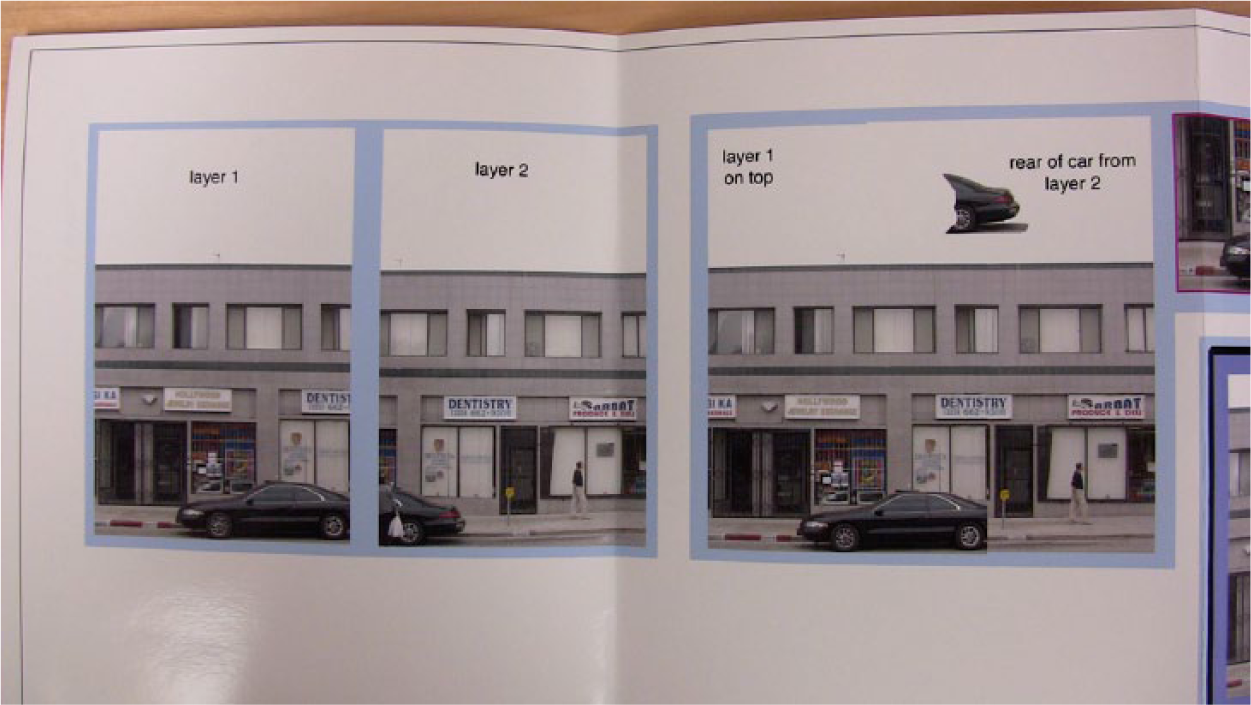
Then & Now digital proofs demonstrating layering and superimposition.
While the similarities between Then & Now and Every Building on the Sunset Strip are apparent, it is important to note the differences. In Then & Now, the images taken in 1973 are arranged along the top of the page above their 2004 counterparts. As in the earlier work, the panoramas are aligned and flipped upside down so that the north side of the street appears at the top of the page and the south side appears at the bottom. Instead of just two strips facing one another, Then & Now contains four strips that juxtapose two distinct eras of the street taken thirty years apart. The changes to the landscape, storefronts, houses, and façades along Hollywood Boulevard become the subject matter of the work. Whereas Every Building on the Sunset Strip is small when folded and placed in its shell, Then & Now is folio sized, hardcover, and sewn through the fold to create a more traditional binding. Unlike his other books, Then & Now has inspired little critical assessment. 14 It is, however, the uncanny doubling of the boulevard in Then & Now that provides important commentary on the urban space of Hollywood.
Urban Redevelopment in and around Los Angeles
The mid-twentieth century saw dramatic transformations of urban form in numerous cities across the United States. The efforts of Robert Moses in New York City to rebuild public transportation and housing and to oversee construction of monumental cultural venues such as Lincoln Center and Shea Stadium set the template for other large-scale renewal plans in places such as Chicago, St. Louis, and Los Angeles. The character of these transformations took on what would become a painfully routine formula of social engineering gone bad: a poor yet vibrant community of residents, living and working in a historically important, architecturally diverse built environment, gets targeted for removal because of the neighborhood’s proximity to a downtown core “better suited” to facilitate expanding industries of finance capital and tourism.
Los Angeles has a particularly problematic history of urban redevelopment gone sour. The legacy of Bunker Hill’s transformation is still a strong one in the region. This once toney neighborhood at the edge of downtown featured glorious and stately single-family Victorians in the early part of the twentieth century. The large houses were converted to single-room occupancy hotels during the Depression. Bunker Hill served as a haven for immigrant communities and lower income elderly groups in the aftermath of the postwar suburban housing boom. Later, this prime real estate became the object of a vast and dramatic redevelopment plan drawn up by civic leaders in the 1950s and carried out by James M. Wood, the director of the Community Redevelopment Agency in the 1970s and 1980s. What resulted was a wholesale displacement of those indigent communities by giant corporate office towers, condominiums, and cultural palaces such as the Music Center and the Museum of Contemporary Art (MOCA).
While this change took place over more than two decades, it coincides with the period when Ruscha started photographing the urban landscape of Los Angeles. According to Schwartz, his photographs “resonated” with a broad range of concerns, including but not limited to urban and suburban sprawl, car culture, an emerging ecological consciousness, and commercial development.
The architectural and urban theorists who wrote on Ruscha’s books brought to light an aspect of them that many art critics of the time overlooked: that they engage intimately with the everyday built environment and its transformations during a period of extraordinary flux.
15
In other words, Ruscha started producing thousands of pictures of LA’s vernacular architecture just as “The City” was becoming an object of renewed inquiry in the work of critics and theorists such as Jane Jacobs, Kevin Lynch, and Denise Scott Brown and Robert Venturi.
Only a few years after Ruscha’s first photographs of Hollywood Boulevard were taken, Time magazine wrote that,
the illusion of celluloid glamour has turned into the tawdry reality of a Los Angeles neighborhood of 250,000 people harassed by crime and vice, mired in the flesh and drug trades and fast fading into the sunset of American cultural history.
16
Such accounts, while not inaccurate, overlook Hollywood’s history as a site of itinerant lifestyles and marginal communities in favor of an idealized depiction of the city’s past. They also disregard the failure of previous efforts to revitalize Hollywood. Easily, the street’s most famous feature, the Walk of Fame, was itself an effort to revitalize the commercial shopping district and clean up the street. The first bronze plaques featuring the names of renowned entertainment industry figures were embedded in the sidewalks along Hollywood Boulevard in 1953 and were meant to draw attention away from the street’s increasingly rundown character.
From the HRP’s inception, developers and civic leaders made explicit their attempts to restore Hollywood to its fabled golden era. In a statement made following the initial adoption of the Redevelopment Project Plan, city councilman Michael Woo, an important advocate of redevelopment, urged developers and business owners to look to Hollywood’s legendary history for inspiration: “While we cannot turn back the clock to the 1920s, 1930s and 1940s when Hollywood was the motion picture capital of the world, we can recreate an aura of the glamorous past within the context of a new community.” 17 More recently, Eric Garcetti, Los Angeles’s newly elected mayor and a onetime city council member representing the district of Hollywood, has spoken of a “second golden era” for the neighborhood. 18 These more current efforts to rebrand urban renewal by locating and isolating the city’s heyday overlook the cycle of nostalgic longing that has characterized perceptions of Hollywood from its founding.
Avenue of the Stars, Boulevard of Broken Dreams
It is a striking paradox that two competing images of Hollywood Boulevard—glamorous playground of the stars and seedy haven to drug dealers and prostitutes—function alongside one another; it is the Avenue of the Stars and the Boulevard of Broken Dreams. Because myth and reality operate in tandem, Hollywood is a space perpetually haunted by its own phantom double. Historic descriptions of the street and surrounding neighborhood invariably communicate a compulsive longing for a mythical past. In Hollywood, the present is never satisfactory because the past was always better, easier, more fulfilling, more glamorous.
The Boulevard’s development demonstrates how nostalgia for a lost era motivated developers to inscribe the signifiers of the industry’s golden era onto the built environment of the contemporary city. Historian Gregory Paul Williams described Hollywood Boulevard (then named Prospect Boulevard) at the turn of the twentieth century as a
quiet country road with blocks of orchards, open vegetable fields, and an occasional clapboard cottage next to a garden . . . pepper trees, nearly full grown, dappled the dirt streets with shade. Deer foraged on the avenue in the early mornings. Quail and doves were plentiful. Over everything floated the perfume of lemon blossoms.
19
By 1910, Hollywood Boulevard was no longer an Edenic place of picturesque flora and nonthreatening wildlife. Over the span of a decade, it had quickly become a street characterized by large residential homes, a rail line, a few small banks, and a library.
The city began attracting tourists and celebrity seekers even before the film industry arrived, establishing an association between celebrity and Hollywood that lasts to this day. French Salon painter Paul de Longpré’s watercolor peach blossoms, poppies, and roses, along with his stately home and beautifully landscaped gardens drew huge crowds to the neighborhood a decade before the arrival of the first movie studios. And L. Frank Baum, the author of The Wonderful Wizard of Oz, moved to a large residence just off Hollywood Boulevard in 1911, where he briefly became the area’s most famous resident until movies began to flourish that same year. 20
Hollywood during the 1910s and 1920s witnessed dramatic growth along what had become its main thoroughfare. Southern California’s booming industries of oil and real estate fed this expansion, but the movies provided the major economic infrastructure for the neighborhood. Hollywood Boulevard now featured graded and paved streets, subdivisions, restaurants, sidewalks, and street lamps. Studios large and small began operation within the neighborhood’s boundaries, as well as further afield in Culver City and Universal City.
The very early 1920s were a time when visitors and residents could, in fact, see movie stars along Hollywood Boulevard. Local businesses, civic leaders, and boosters were quick to market the street’s reputation as a site of encounter between ordinary folks and famous screen personalities. But by 1923, the trope of a street and neighborhood in decline was firmly established. Articles in industry trade papers chronicled the tales of the “odd folks of Hollywood,” and the “drifters of the [Hollywood] Boulevard.” 21 “The easy money of Hollywood drew pimps, gamblers, racketeers, and confidence men,” historian Carey McWilliams concluded. 22 In 1925, Photoplay ran a series of exposés describing an “underworld of Hollywood” and warning would-be starlets to stay home or risk falling victim to conmen and their come-ons. 23 By 1927, the Boulevard was known to locals as a place to avoid. 24 Accounts such as these contradict the very notion of a Golden Era for the city of Hollywood. 25
McWilliams noted that even the first generation of silent actors, producers, and directors “found themselves as nostalgic about old Hollywood as original residents.” 26 A 1928 advertisement from the Hollywood Boulevard Association provides an indirect but telling example of this phenomenon. As a result of this perception of the Boulevard’s decline, it became imperative to link celebrities with the street. In the ad, the Boulevard itself is withheld from view and replaced with the visages of famous screen personalities (Figure 10). This metonymy between Hollywood and movie stars is reinforced at the precise moment when actual encounters between screen idols and ordinary folks were becoming increasingly rare. The birth of “talkies” in 1927 required sound stages and secured production facilities. Stars vanished behind the gated fortresses of movie lots.
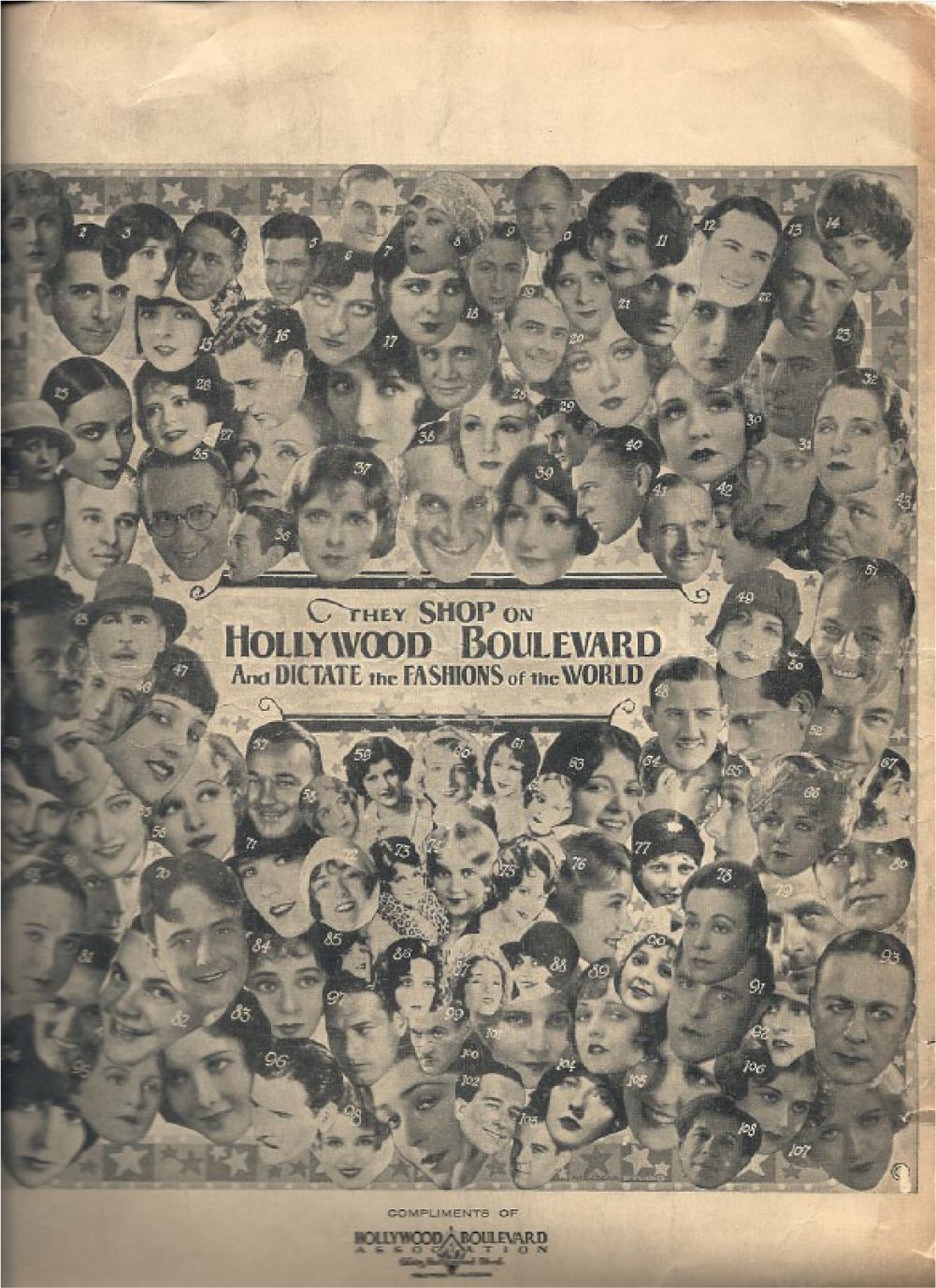
“They Shop on Hollywood Boulevard . . . And Dictate the Fashions of the World.” An advertisement from the Hollywood Boulevard Association that appeared in a 1928 issue of the Los Angeles Times.
Hollywood Boulevard’s development over the next fifty years continued to be framed as one of decline by each successive generation. During the Depression, businesses and banks went bust, and unemployment was high, but because the movies fared better than other major industries, the Boulevard managed to construct much of the character of the built environment that Ruscha would photograph in the 1970s. There were two and three-story commercial structures, apartment houses, hotels and nightclubs, movie theaters and playhouses, car dealerships, and department stores. Following World War II, the Boulevard’s first skyscrapers went up, but by that time, most of the studios had moved outside of Hollywood proper. Studio divestiture and the rise of television coincided with the construction of commercial towers, high-density apartment units, and strip malls surrounding the core commercial stretch of Hollywood Boulevard.
The 1970s and early 1980s saw a drastic rise in drug use, prostitution, and gang violence. Crime rates, including incidents of burglary and homicide, were nearly double those of Los Angeles as a whole, and arrests for prostitution and solicitation were ten times as high. Descriptions of the city such as the following were common in the local and national press: “The streets teemed with whores, transvestites and the S-M crowd dangling slave bracelets and chains.” 27 It is significant to note that in 1972, one year before Ruscha began photographing the Boulevard, Columbia Pictures, “the last major movie studio within walking distance of Hollywood and Vine, moved out of Hollywood.” 28 In 1983, a riot between punk rockers and police at a club near Sunset Boulevard and Gower Street spilled over into the surrounding neighborhood and resulted in further negative media attention. 29 The collective impact of these events catalyzed the revitalization movement that would take shape three years later as the HRP.
Panorama Palindrome: Reading Ruscha
The panorama and the palindrome are two devices used by Ruscha that provide valuable clues to deciphering Then & Now and the book’s engagement with Hollywood’s revitalization. The panorama was most often used as a technology that rationalized and justified the development of the landscape for fortune and profit. By contrast, the palindrome is a playful, often nonsensical trick in which words or phrases can be read the same way forward or backward. The panorama is a visual medium while the palindrome is largely associated with writing. Ruscha’s insistence on exploring the slippages between words and pictures mean that the two frequently play off one another. Panorama and palindrome demand a particular kind of engagement from the viewer or reader. The panorama format encourages an active form of looking while the palindromic reading (scanning back and forth) defamiliarizes the landscape. This optical trickery ultimately holds the key to understanding how Ruscha simultaneously embraces and undermines nostalgia, thereby allowing us to see Hollywood in a new light.
“Most of my proportions are affected by the concept of the panorama,” Ruscha has stated. 30 Adjectives such as “wide-screen,” “billboard,” or even “Cinemascope,” terms that are often synonymous with panoramic dimensions, denote how his paintings and drawings emphasize sweeping planes and horizontal lines. The panorama is a genre common to both painting and photography, frequently used to portray a landscape. Unlike its counterpart, the portrait, a genre of intimacy and detail, panoramas and landscapes encourage the viewer’s gaze to roam around the image. As the eye travels over the work, the panorama’s presentation of an all-encompassing view asserts a deceptive mastery over time and space.
Angela Miller argues that, during the nineteenth century, panoramas “satisfied the craving for visual—and by extension physical and political—control over a rapidly expanding world.” 31 Photographic panoramas such as those made by Eadward Muybridge and Carleton Watkins frequently portrayed scenic vistas or burgeoning cityscapes. In Europe, panoramas often featured the exoticized colonies of Africa and Asia then being plundered for their natural resources and human capital. Around the middle of the nineteenth century, battle scenes that depicted the conflicts between colonialists and indigenous peoples became a popular subject. These awe-inspiring scenes of heroism, conquest, and devastation were used to bolster national identity or justify imperial expansion.
Because it is so often used to represent space, the panorama is irrevocably linked to the genre of the landscape painting or photograph. Landscapes, Deborah Bright argues, celebrate property and ownership, whether they are Ansel Adams’s majestic photographs of national parks owned by the “people” or the seventeenth century Dutch views of farmland, estates, or commercial trade vessels anchored in harbors.
Landscape is not the ideologically neutral subject many imagine it to be. Rather, it is an historical artifact that can be viewed as a record of the material facts of our social reality and what we have chosen to make of them.
32
Writing in the 1980s, Bright was trying to account for the popularity of the “New Topographics” photographers, a group that included Robert Adams, Lewis Baltz, and Bernd and Hilla Becher. Their collective output marked a revival in landscape photography. Working mostly in black and white, their images depict bird’s-eye views of housing tracts, warehouses, aqueducts, water towers, factories, and street corners.
These artists were frequently compared with Ruscha for sharing an interest in vernacular architecture and for representing their subject matter “without style,” in a seemingly neutral or matter-of-fact manner. Bright demonstrates instead how these seemingly affectless images are “also a record of human values and actions imposed on the land over time.” 33 She criticizes many of these artists for eschewing issues of race and gender. Despite “its cultural dominance, [theirs] is a landscape in which the major portion of the nation’s populace—its urban natives and refugees (including blacks, Latinos, queers, Jews)—finds no positive reflection but instead repression.” 34 Ruscha’s art reflects a similarly ambivalent relationship to direct representations of human figures or agency. His photographs and paintings, with few exceptions, are eerily devoid of people. 35 About Twentysix Gasoline Stations, Andy Warhol is said to have asked Ruscha, “How do you get all those pictures without people in them?” 36 Social interaction, conflict, or views of the diverse and disparate populations of Los Angeles are literally “behind the scenes” in his work.
It is crucial to account for this representational strategy, especially as it is used to depict a place such as Hollywood. Despite a steady, creeping gentrification, the neighborhood continues to be a vibrant home to immigrant communities, businesses, and subcultural practices. Ruscha is certainly aware of Hollywood’s economic and ethnic diversity, and he has expressed concern about the overdevelopment of Los Angeles in general. 37 However, the inclusion of human figures would provide a focus point for the eye and promote identification and absorption in the image. Instead, Ruscha encourages the viewer to scan the landscape by emphasizing its horizontal properties, its surface and flatness.
This phenomenon is reinforced by his incorporation of language as a visual, pictorial element into the work. Ruscha uses the palindrome to draw attention to the artificiality of the panorama and the landscape. Starting in 2001, he produced a series of mirrored landscape paintings and photographs that juxtapose mountain or desert scenery with words or phrases. Sometimes, he inserted small blank spaces over parts of the scenery. In these works, the canvas or photograph is bifurcated. One side of the image appears to be a direct reflection of the other, its mirror image. For example, a work like Bow-Tie Palm Springs (2003) seems as if the photographic negative and its reversed image are printed on the same sheet of paper and folded in half. A triangular-shaped hole is then cut into the print, a technique similar to that of a child when cutting foldout paper dolls. When unfolded, the shapes seem to depict a bowtie on the surface of the arid desert location. The result is that the mirrored halves and blank spaces self-reflexively foreground the mechanical reproduction of nature, implicating the photographic apparatus’s role in the very manufacture of nature itself.
While the panorama has been a career-long obsession, Ruscha’s infatuation with palindromes marks a more distinct phase of his career. Most of the palindrome paintings were completed around the year 2002—itself a numerical palindrome. Tulsa Slut (Figure 11), Level as a Level, Porch Crop, and Lion in Oil, to name just a few, are paintings of mountainous peaks over which he superimposes the palindrome phrase. Ruscha also used many of these same titles in a series of graphite drawings of open books with blank pages. The palindrome is the title of the drawing and is printed underneath the book.
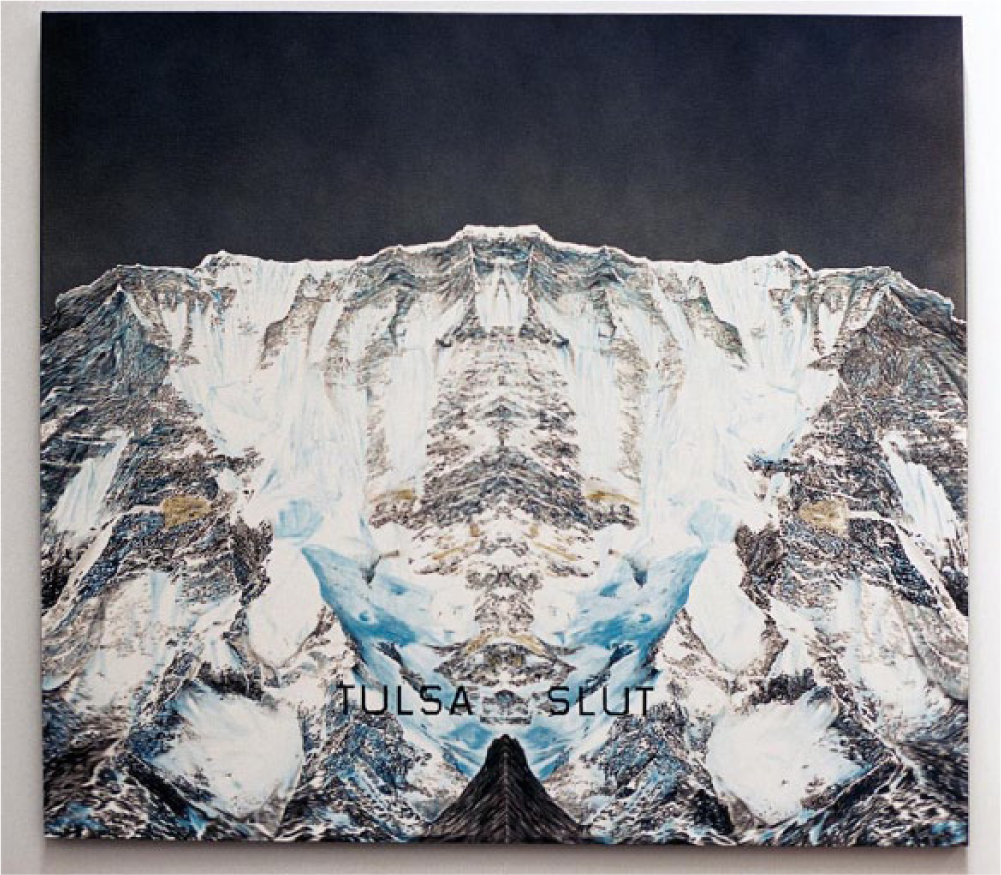
Ed Ruscha, Tulsa Slut, 2002.
At the time he was working on Then & Now, Ruscha returned again and again to the subject matter of mirrored landscapes and palindromes. These works therefore provide an important clue to understanding what is at stake in his representation of Hollywood Boulevard. The landscape as depicted in the typical panoramic tableau readily presents space as organized and comprehensible, therefore consumable. But the disorientation of space that happens in Ruscha’s landscape palindrome paintings and photographs defamiliarize his subject matter, rendering it flat, abstract, and more difficult to cognitively process. In these works, space is unnatural because it is perfectly symmetrical. It is no longer an object or a piece of property to be purchased or exchanged. Instead, space is imaginary, built as much through subjective experience and perception as it is through actual, physical structures and locations.
The manner in which Ruscha organizes and represents space in his paintings and photo books disrupts a nostalgic relation to those same spaces. Or, perhaps more accurately, the panoramic palindrome effect of Then & Now opens up the possibility of recognizing nostalgia’s relationship to historic photographs of urban space. The “disjunct point” required for nostalgia to function is dispersed by the synchronic and diachronic layout of Then & Now creating a dynamic experience for the eye. There is no detail that grabs and holds our attention for any length of time; no human figure on which to fix our gaze. Instead, the act of looking requires telescoping in and out, constantly taking in parts within the whole and zooming back out again to assess the page itself. The effect of this active looking is that “before” and “after,” “then” and “now” become relative terms, constantly in flux. Is “before” 1973? Or is it the “7000” block that comes before the “8000” block if you are reading left to right (or east to west)? Does “now” reference the present moment during which you are encountering the text, or is it 2004 (Figure 12)? And, of course, if 2004 is the “now” referred to by the title, that now is already past. Now is then, and then is now.
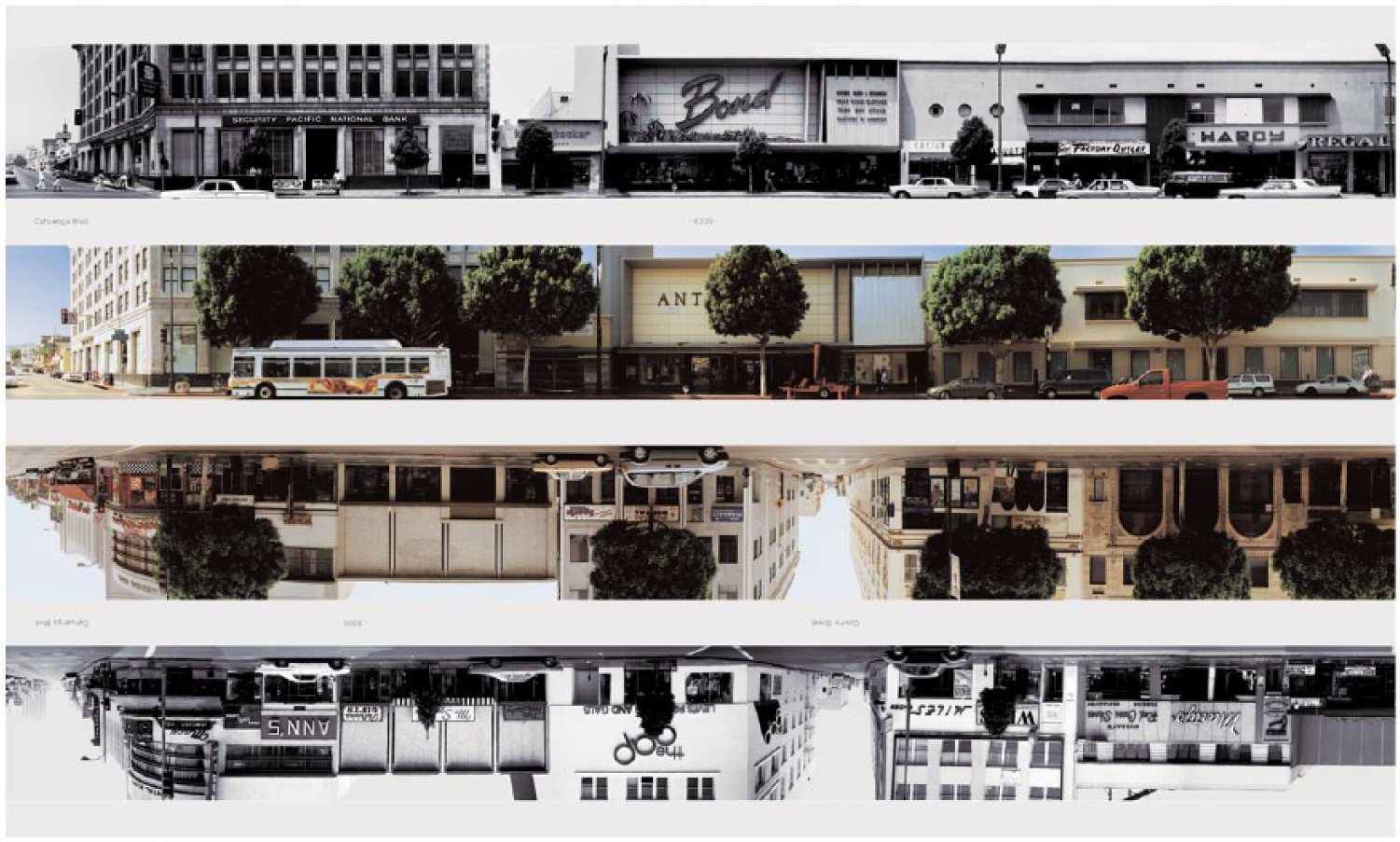
Page view of Ed Ruscha’s Then & Now: Hollywood Boulevard, 1993-2004, Steidl Press, 2005.
Then and Now and Now and Then
As stated, Ruscha himself seems to view nostalgia in negative terms; he is concerned that all photographs “eventually” become nostalgic. But the idea that Ruscha’s work, and Then & Now in particular, represents a longing for a lost time and place is to overlook the ways in which the book provides a method for rethinking the city’s renewal and the historical narratives that drive it. Literary scholar Ian Baucom argues that nostalgia operates in two registers. There is “recollective nostalgia” that “identifies the present solely as a receptacle for the memories of the past, to evacuate the present as a valued space of cultural habitation.” By contrast, he defines an anticipatory or “proleptic” form of nostalgia:
This proleptic nostalgia, in which the traveler anticipates the bitter pleasure of occupying the present only in memory and thus begins the work of forgetting or evacuating the present in order that it might later be remembered or imaginatively reoccupied, finds its most common moments in the practices of tourism, in the buying of the souvenir or the taking of the photograph, moments in which the present begins to annul itself by anticipating its re-presentation as an artifact or memory.
38
Ruscha’s use of the double panorama along with the book’s unusual design is clearly his attempt to disrupt photography’s nostalgic dimension. But it also serves a proleptic, anticipatory function. Then & Now is a tacit acknowledgment that Hollywood is perpetually afflicted by a present moment that anticipates future nostalgia.
The proleptic nostalgia of Ruscha’s work and its relation to Hollywood might be better understood through a comparison with another photo book bearing a nearly identical title. In an odd coincidence of timing, Ruscha’s book came out only a year after Hollywood Then and Now published by Thunder Bay Press in 2003 as part of their popular Then and Now series. 39 Thunder Bay began releasing the series in the early 1990s, and there are now more than seventy titles. Each book focuses on a specific city or geographical location. Most major American cities are represented, including New York, Chicago, and Los Angeles, along with international locations such as Berlin, Paris, and Beijing and less populated but no less significant metropolises such as Seattle, Phoenix, and Albuquerque.
The design of the books is consistently formulaic: an old black and white photograph of an iconic location or building associated with the city is displayed alongside an updated color photograph. An accompanying explanatory text of a few short paragraphs elucidates the historical significance of the site and a condensed summary of its transformation over time. Care is taken to rhyme the newer photograph with its distant twin. Times Square, the Eiffel Tower, Marshall Field’s department store, or Potsdamer Platz are framed to approximate the orientation and angle of the original photograph so that, if the building or space still retains some identifiable feature, the changes will be immediately recognizable.
In 2003, Thunder Bay produced its own take on Hollywood’s past and present. The similarly titled Hollywood Then and Now was written by Rosemary Lord and hews closely to the publisher’s template. 40 Photographs of Grauman’s Chinese Theatre taken in the 1920s are shown side-by-side with a color image shot in 2001. Invariably, the newer color photos, made with a digital camera and often haphazardly framed or cropped, lack the charm and glamour of the black and white images. Accompanying text highlights a sense of loss and melancholy. In an entry on The Brown Derby restaurant, Lord writes, “Clark Gable proposed to Carole Lombard here in booth 54.” 41 In the caption below the color photograph of a drab parking lot, she notes, “Sadly, [the restaurant] was demolished in 1994 . . . .”
Elsewhere, a photograph of the façade of Sardi’s (designed by famed modernist architect Rudolph Schindler) shows a crew shooting on location for the 1936 film Hollywood Boulevard. It is paired with a contemporary view showing the same building occupied by a tattoo parlor and businesses catering to adult entertainment such as Le Sex Shoppe, The Cave (a strip club), and the Hollywood Cabaret featuring “Totally Nude Girls,” “Peep Shows,” and “V.I.P. Rooms” (Figure 13). Lord writes,
After the golden era melted away, the center of Hollywood changed and adult movie theaters and discount shops moved into the deserted buildings. The site where Sardi’s once stood housed a popular dance hall during the 1960s and 1970s, and now has a topless bar, surrounded by adult stores.
42
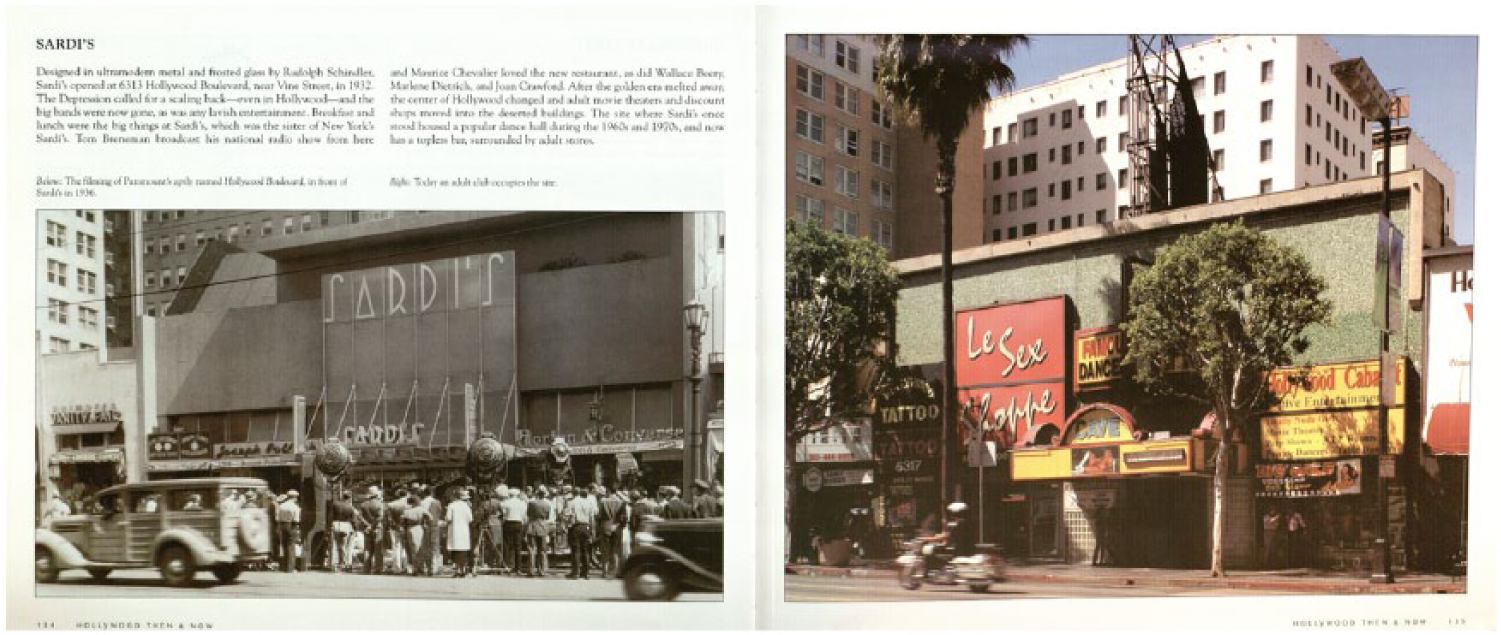
Verso and recto page view of Rosemary Lord’s Hollywood Then and Now, Thunder Bay Press, 2003.
Although Ruscha’s book is an artistic rendering of the neighborhood, it also possesses a documentary function. In this instance, it contradicts Lord’s statement that the buildings were deserted. The Cave Theatre appears in the 1973 panorama, along with King’s Camera Store, Wide World Import Bazaar, and the Vine Movie Theatre whose marquee features The Man Who Loved Cat Dancing, a Western released that same year starring Burt Reynolds. My point is not so much to call attention to Lord’s factual errors or slippages. Rather, it is to emphasize how easily the myth of a golden era “melted away” enters into the historical record.
Who is the author of then and now? Put another way, who writes the present and the past? And, in these two different books, for what purposes are history and nostalgia mobilized? Ruscha’s double panorama makes visible the ways that nostalgia is associated with a space such as Hollywood and ultimately deployed by the forces of redevelopment. Nostalgia, as Linda Hutcheon argues, is a desirous “distortion and reorganization” of the past and, as such, is “less about the past than about the present.” 43 Nostalgia represents the past as authentic, the present as imperfect. But this presupposes that there is an originary moment of perfection. 44 Recall that early Hollywood movie figures were nostalgic for a city of clapboard houses and orange groves. And yet it is the glamorous image that the city now constructs as “real” and that it uses to market and brand its continued redevelopment. No doubt, the Spanish settlers and Californios would experience their own nostalgia for a different era of this particular space, as might indigenous peoples and native communities before them.
Here is where the doubling-up of the two different eras creates an opportunity for critical reflection. The juxtaposition of 1973 and 2004 invites nostalgic comparison. It may be that Ruscha himself is nostalgic for 1973 when he was a younger artist living in the neighborhood. The irony is that 1973 was a time when the city of Hollywood was said to be at its most derelict and blighted. However, the pairing of the images and the activity of handling the book invites an ironic relationship to nostalgia and the transformation of the street over time. The doubling-up and juxtaposition of these two different periods allows the viewer to recognize the irony of privileging the past over the present. Comparing the two time periods, flipping the book, engaging its corporeal dimension “activates” the blank space between the images in the middle of the page, as Allan asserts. In this way, this empty space makes room for future photographic panoramas of a Hollywood in 2034 or 2064. By then, Ruscha seems to imply, someone else will feel nostalgic for 2004.
Finally, Then & Now asks us to read between the lines and recognize nostalgia’s ahistorical dimensions. Origins, beginnings, and endings are all a matter of perspective. They are relative terms. The words “redevelopment” or the less fashionable “revitalization” presuppose an originary moment—a “golden era” now “melted away.” Redevelopment implies a desire to return the city to the way it was before everything went bad. Ruscha’s refusal to locate an origin of Hollywood Boulevard in time or in space provides a telling commentary on redevelopment. The “bad old days” that the HRP seeks to eradicate—the 1960s and 1970s—are those same decades that witnessed the decline of the studio system and the appearance in the neighborhood of those more visible signs of wear and tear associated with blight. Hutcheon insists, “If the present is considered irredeemable, you can look either back or forward. The nostalgic utopian impulses share a common rejection of the here and now.” 45 Ruscha’s book compels us to confront nostalgia’s “utopian impulse” by positioning us in relation to these very terms—past and present, here and now, now and then.
Footnotes
Acknowledgements
My thanks to Aaron Shkuda and Julia Foulkes for the invitation to participate on the Art and Urban Renewal panel at the 2013 American Historical Association conference, and for their helpful comments on earlier drafts of this essay. All Ruscha images are courtesy of Ed Ruscha Studios and Gagosian Gallery. I want to thank specifically Mary Dean, Susan Haller, Paul Ruscha, Gary Regester, Gregg Heine, Zoë Roché, and Ben Handler for their collective generosity, time, and assistance. Mary Mallory graciously shared her Hollywood Boulevard Association advertisement and granted permission for its reprinting. I am especially grateful to Olivia Mitchell and Stefanie Barrera Aguila for their invaluable contributions to this project.
Declaration of Conflicting Interests
The author(s) declared no potential conflicts of interest with respect to the research, authorship, and/or publication of this article.
Funding
The author(s) disclosed receipt of the following financial support for the research, authorship, and/or publication of this article: Research for this essay was supported by a Louis B. Perry Award from Whitman College.