



Abstract
In Tokyo, the traditional role of streets as children’s play spaces has been largely replaced by designated spaces such as parks. Based on two case studies, this article demonstrates how carfree streets provide an opportunity for residents to reinvent and domesticate street spaces for children’s play. The declining heterogeneity in Japanese streets and the government’s rigidity in restricting informality are explored through literature review, while participant observation and interviews with key stakeholders are used to explain the evolution of streets and street activities, and the intricacies in appropriating spaces reclaimed from cars. The article concludes that these activities give texture to the street spaces, and the emergent camaraderie produces a “placeness” that is unique to each location. Moreover, the long-standing rapport that community organizations have with residents and authorities has empowered street-based activities to transgress the boundaries that limit the heterogeneity of streets as public open spaces.
Introduction
Why are children disappearing from neighborhood streets in Tokyo? Although the safety concerns related to vehicular traffic remain uncontested, attempted solutions have put two schools of thought at loggerheads: advocates of designated play spaces such as parks against those who view the street as a public open space for activities such as children’s play. Meanwhile, hundreds of streets across Tokyo continue to have designated carfree hours in the evenings and on weekends. Unfortunately, as the traditional role of streets as a communication platform for play is replaced by parks, a singular role of the street is left in people’s minds—mobility. Even the utilization of space reclaimed from cars for stay activities such as children’s play remains minimal.
The replacement of spontaneous informal play by supervised play in designated places disconnected from home is also a global phenomenon. 1 An increased number of public parks has been associated with decreased vehicle-related mortality rates among pre-school children in Japan: increased parks reduce the journey to play areas while also reducing the number of children playing on the street. 2 Furthermore, indoor play at home offers more technologically sophisticated play opportunities compared with previous generations but with less active physical engagement with the material world and potential new risks such as those associated with online predators. 3 In sum, there is a duo problem: some children are withdrawing from outdoor play, while others are pushed to segregated spaces such as parks. So, how does the management of street spaces in Tokyo affect the flexibility of space and informal coexistence of differing stay activities such as children’s play?
Informality and ambiguity are two inherent attributes of streets in Tokyo as evidenced in their layout and patterns, treatment of facades, and the mix of human activities. Japanese cities have often been conceptualized as informal and chaotic, but lively, a phenomenon partly attributed to high population densities and the variety in the physical environment. 4 Japanese neighborhood districts are, however, regarded as charming due to their human scale and efficient use of space. 5 This atmosphere has been a critical component in the unrivaled liveliness and authenticity that separates Tokyo from its Western counterparts. It also presents a unique opportunity in current efforts of using carfree streets to reinvent people-centered open spaces as Japan’s population continues to shrink, with a record decrease of children and an increasingly elderly population. Referring to a foreigner’s experience of Tokyo in a short-term visit, Botond Bognar narrates how “everything is surprising, strange, and confusing . . . the density and infinite variety of sights, forms, colors, and materials, in addition to the crowd of vehicles and people, add up to the turbulent visual and sensory overload.” 6 André Sorensen attributes this liveliness to the implied intimacy derived from narrow streets and the lines of low-rise shophouses, the rarity of cars, and the acquaintanceship of many residents who have lived in the same area for generations. 7
In contrast to other contemporary cities such as New York and London, Tokyo is a germane case on the proclivity of urban areas to adapt informal, human-scale street spaces: repeated attempts to institute Western urban planning systems have not been successful in erasing the intricate mesh of modern and traditional elements that have coexisted for centuries. For example, Carola Hein notes that Tokyo has unique patterns of change in the urban form that blends the traditional and the modern with the ostensible discontinuity of urban space. 8 Maude Richards also describes the lack of patterns in the layout of streets, the lack of street names, and the lack of consistency in street direction: “No street looks complete—half is old, half new . . . Tokyo, more than any city imaginable, is an agglomeration of tiny villages, and village life goes unchanged in the backland behind even the most central modern blocks.” 9 Furthermore, Botond Bognar associates the informality and heterogeneity in Japan to the two religions dominant in Japan: Shintoism which upholds the divinity of people and their physical surroundings without reference to a transcendental absolute spiritual power, and Buddhism which upholds the interchangeability of the new and the old, the de-emphasis of permanence and perfection. 10 To him, the coexistence of the two religions is also a demonstration of this relativity in Japanese culture that has absorbed bits of Western urban planning techniques without abandoning the traditional ones. 11 Additionally, since many public streets are so narrow as to prevent car access, and many other access lanes and gathering places are on private land with customary shared use, the normally sharp distinction between public and private is blurred. 12
This article utilizes carfree streets in Tokyo to demonstrate the ability of residents to reinvent the historical role of streets as community spaces by providing a platform for stay activities such as children’s play. I hypothesize that Japanese society’s unique regard for community order and respect for set structures is an asset in efforts to entrench heterogeneity and flexibility in streets; social ties, cohesive communities, and the consequent social capital foster an amiable ambiance for accommodating “otherness.” For example, Japanese drivers’ have a general positivity for the 30 km/hr speed limit imposed in residential areas to protect vulnerable street users such as pedestrians and cyclists even though only 24 percent think that residential activities are more important than mobility. 13 The interaction between stay activities such as children’s play and the need for automobile access in neighborhood streets is nevertheless laden with contestations. Many community members are also uncomfortable with difference and uncertainty, the “unconforming other” in the day-to-day use of city streets. 14 This article, thus, explores the historical role of streets and the flexibility of current carfree schemes in enabling children’s activities in residential areas. It applies situated knowledge as an epistemological approach; interviews and participant observation are used to learn about the daily experience of residents and community leaders, the levels of citizen participation, the use of experts in organizing activities, and the continued domestication of local space. 15
Social spaces, such as streets used for children’s play, are products and processes shaped by both the immaterial and the material factors of the past, therefore history is critical in explaining any contemporary action. 16 Hidenobu Jinnai argues that although Tokyo seems to have lost its identity when viewed through current railway and road systems and for people accustomed to searching for history through prominent city elements such as old buildings, a more leisurely exploration can reveal the diversity in elements such as alleys and shrine gloves that preserve the history of the city. 17 To him, modern Tokyo should be conceptualized as a continuum rather than examining discrete eras or events with massive transformations such as the 1923 earthquake and the Second World War since even the adaptation of Western styles in the early Meiji era (1868-1912) was patchy and was later riddled with Japanese interpretations that produced a unique city. The article points to the historical connection between current children’s activities on streets with general past lifestyles, traditional recreational activities, and the significance of streets in the past. In this article, the evolution of streets and street-based activities, and the background of participants is linked to current patterns in the appropriation of spaces reclaimed from vehicular mobility. Although it focuses on streets capable of accommodating cars, references to roji (narrow alleys) recur. Roji was historically a central place of everyday life and social interactions in a neighborhood as shared spaces for daily life aspects such as children’s play while also hosting facilities such as communal latrines and wells. 18 Remaining roji in Tokyo continue to offer intimate spaces where children play without the fear of vehicular traffic.
Projects to reclaim street spaces from cars enhance children’s play and independent mobility, improve environmental learning and competence, and offer children an opportunity to experience the life and activities of their neighborhood. 19 Children’s play as “otherness,” however, faces many obstacles from existing views of public space use that prioritize mobility and safety. In addition, children as social actors in their own right are not accorded opportunities to contribute to the making and remaking of urban spaces that affect their lives. 20 These tensions between decision-makers and those most affected by space management point to more fundamental questions of “who owns the city?” and what constitutes the successful domestication of public space. This article, thus, first builds an argument for allowing “otherness” and promoting domestication of local street space through children’s activities. After exploring the historical multifunctionality of street spaces in Japan, the article applies two cases in Tokyo to illustrate how local residents and community associations use carfree streets to reinvent local spaces for children. The final discussion places current ambitions for domesticating local street spaces and the challenges therein within the global discourse on the role of children’s play in urban streets.
Domestication of Local Street Space
In Japan, the neighborhood unit offers a superior identity to residents more than they draw from the city scale; the Japanese neighborhood is often associated with a lifestyle and social community. 21 In addition, Machizukuri (community-based town making) has been a way of ensuring the involvement of residents in local affairs and has been vital in the management of streets in Tokyo through associations such as jichikai or chonaikai (neighborhood association) and shotengai (shopping street association). Even though participation in neighborhood associations is on the decline, 22 their social capital is significant in gathering communal impetus for emerging forms of civic participation. These associations are also involved in activities such as organizing festivals, neighborhood patrols, and waste management. Japan has more than eight thousand neighborhood associations with varied forms of legal status, while more than two hundred thousand others are not legally recognized. 23 The character of these communal activities provides a unique identity to each neighborhood. Furusato (Japanese rural village) denotes an ideal life where all residents are friends with each other, engage in communal activities, and the whole village is a giant playground. Consequently, attempts at reproducing popular memories of the past are conceptualized as furusato-zukuri (native place-making) in creating a social transformation in the present for an authentic taste for the future. 24 Nonetheless, there have been contemporary approaches that redefine native place-making activities beyond traditions associated with the history of a place. For example, Taylor Atkins observes that although enka music and other native Japanese elements have often been utilized in recreating memories of furusato for urban dwellers, there have been attempts at applying other alien cultures such as Jazz in place-making for those in urban Japan who have no connection to rural villages, those who view “native place” as the place where their exoticism is celebrated. 25
Streets are crucial urban open spaces for the prosperity of cities in addition to being mobility channels for moving people and goods; their effectiveness is, thus, pegged on a proper reflection of the ideals of the city dwellers rather than the normative approaches of planners, architects, and city authorities. 26 Particular to residential streets, the multiplicity of functions, heterogeneity of users, and the nuisances of vehicular traffic have wider ramifications on children’s play and the social capital of the surrounding community. This article is, thus, conceptualized within a framework of socio-spatial dimensions that extend past the customary technical fixes and environmental modifications. The framework positions children as the key fiber in the heterogeneity of informal activities in residential areas. I argue that since streets are the most critical platforms for public life, and the lifeline of urban areas, the well-being of the local community supersedes the efficiency of traffic flow and directed economic empowerment in neighborhoods. 27 In practice, when superimposed against other competing interests such as trading and transport, marginalized groups and the activities they embody tend to be dismissed as the unwanted “other.” There is a need to promote the “otherness” inherent in marginalized activities and actors by using positive terminology to counter the instrumental “rightness” of authorities that is the basis for their exclusion in public spaces. 28 Street reclaiming practices, thus, illustrate the varied ways in which daily experiences provide an avenue on which the boundaries set for the use of space are transgressed and “otherness” is seen positively. 29 The introduction and survival of these discordant activities nevertheless vary depending on the grip that authorities have on the operation of society, and the flexibility of social space in allowing contradictions to self-express and localize as a communal or public space. 30
Jane Jacobs insisted that cities hold city life, and focus should be on the order of life instead of visual order. 31 Humans are not mere occupiers of space but active participants in producing the space around them, a space that is not an innocent container for human activities but rather shapes and is shaped by them in a process that is also a result. 32 Urban design, thus, needs to focus on how people use and colonize space based on context in the sense of experiences and historical connections. 33 Moreover, the city’s continuing transformation cannot simply be defined by the built form that is planned and managed by an elite group of professionals. 34 Consequently, scholars have to expand their analysis about urban spaces by exposing how spaces are being reinvented in subtle ways in particular locations beginning with how people get to inhabit the urban spaces and how they continually domesticate the spaces and assert a claim. 35 The amount of stay activities, such as children’s play, is an indicator of the quality of streets as urban open spaces. 36 Meanwhile, contestations between various stay activities, and between stay activities and vehicular traffic, are often used by authorities as the basis for attempts at unnecessary sterilization of urban open streets into homogenous public spaces. I aver that working with these contestations rather than seeking to flatten them, scholars and planners can identify the positive aspects in intra-community interactions that enable the production of spaces that edify diversity in daily life.
The Declining Heterogeneity in Tokyo Streets
Tokyo (known as Edo until 1868) started as a castle town whose organic planning followed the natural topography in weaving the system of roads and canals as well as delineating the living quarters into classes (warriors, commoners, and farmers), but the Meireki fire of 1657 and other events in the Edo era (1603-1868) caused the extension of the city into peripheries away from the initial castle town. 37 Carola Hein observes that planning of the entire city as whole was never a concept in Japan’s Edo era and the concept of urban planning was only popularized in early twentieth century with reference to large-scale urban planning done in the 1960s and 1970s in the peripheries of key cities. 38 With the exception of the grounds in temples and shrines, Japan does not have a splendid history of public spaces in the same way as Western countries such as Italy. 39 Many of the existing small parks in dense residential areas were created in the 1920s and were mostly a mitigation to fire hazards; many of the bigger open spaces were reclaimed from feudal lords (daimyo) in mid-nineteenth century. 40 In the absence of designated spaces such as parks and plazas, streets were primarily communal open spaces for trade and family undertakings while mobility was secondary, thus it was Edo lifestyle for children to play on backstreet alleyways. 41 However, the cleanliness, order, and civility upheld today were aspects that impressed even fifteenth-century European visitors when comparing with their home cities. 42
The space resulting from the Meiji restoration in 1868 into the late-nineteenth century flattened class differences in the planning and the general abstract political system, but the resultant spaces were full of heterogeneity such as through reimagined architectural forms influenced by the Western world and creation of public parks; many establishments and spaces left vacant by feudal lords took new urban functions in the modern state with prominent westernized elements within the limits of the Edo framework. 43 However, Taisho era (1912-1926) and early Showa era (1926-1989) not only affected renowned assets but also transformed everyday spaces including avenues, street corners, and parks. 44 With these alternative recreational spaces and the widening of many streets, the significance of streets as platforms for daily life reduced. The transition from an industrial-based to a knowledge-based economy has also been key in the adoption of a globalized personality for Tokyo with mixed-use redevelopments hosting parks, promenades, streetscapes, and plazas, with an extensive central lawn replacing the tradition of intimate green spaces. 45 Designs with more deliberate “theme park” approaches disconnected with local history have also become more prominent in attempts to offer experiences of distant places or different times. 46 Unfortunately, population decline has led to reduced underuse of these public spaces. 47
Today, many Japanese traditions are still part of children’s play in streets. For example, kamishibai is a street style of storytelling whereby children sit in a small group while listening and reacting to a pictorial story telling performance with illustrations on the front and passages for narration at the back of the previous board. Kamishibai was common from 1920s to the early 1950s when sweet sellers and storytellers traveled by bicycle; children who bought sweets would sit at the front, and ending the story at a cliffhanger meant that children would return to buy more sweets. 48 Another tradition that has endured is goldfish scooping (kingyo-sukui), a game originating from late Edo era whereby children as well as adults attempt scooping up goldfish from a shallow container and putting them in a bowl of water. 49 The shared experience allows for intergenerational interaction and a connection between residents, business owners, and children on shopping streets.
Aisome and Kyu-Tokaido Streets: The Rationale
Since 2016, I have been participating in weekend carfree street activities, helping community leaders and play leaders in Tokyo to conduct programs that edify the role of streets as play spaces. Participant observation was a key pillar in this study: playing and interacting with children helped to build relationships with local people and understand their perception of street spaces. Throughout, field notes and photography helped to give a more nuanced view of reality regarding the nature of activities and the peculiarities of the physical environment. As Jan Gehl and Birgitte Svarre assert, onsite observation using the senses, common sense, and simple recording on paper is very useful in exposing the realities, details, and trends in how people appropriate space in their daily life. 50 The mix of activities in Kyu-Tokaido street in Shinagawa ward and Aisome street in Bunkyo ward are excellent examples of residents’ appropriation of nearby street spaces.
Kyu-Tokaido is a six-meter-wide shopping street that derives its charm from the preservation of Edo era history: it is lined with traditional shops such as restaurants, a cake shop, confectionery shops, as well as a few modern establishments such as the Super Hotel and the Maruetsu Petit supermarket. The street is carfree on Sundays and public holidays from midday to six o’clock and from four to six o’clock on weekdays when it hosts stay activities under the leadership of local organizations. Small-scale activities include children drawing on the pavement using chalk, tabletop games, as well as a tea ceremony that involves a group of women learning the rituals of traditional Japanese tea-making outside one of the shops, led by the shop owner. Other activities are more elaborate, some involving the entire neighborhood. For example, the nagashi somen event in summer is centered around a communal meal on the street, but with other fridge activities such as a music performance and children’s play (Figure 1). Noodles flow down fifteen meters of a water slide made of bamboo while children and adults “fish” using chopsticks onto their bowls and eat. Even more extensive, during Ninja Play (literally translates to Ninja Training Journey) events, small ninjas walk around the neighborhood, encountering ninjas (volunteer actors in costumes) on their way through various stations such as magic performances, and getting stamps from shop owners; in between, children have to interact with good ninjas and escape from bad ninjas as a way to learn about safety and situational awareness. The events held twice a year, in April and October, aim to make children visible in an aging society and to make them well acquainted with their neighborhood by interacting with adults. Another example of a neighborhood scale event is the annual Kids Halloween Parade. Under the guidance of volunteer community members and the shopping street association, more than fifty children enjoy making processions along the street in Halloween attires while receiving gifts of confections from shop owners.
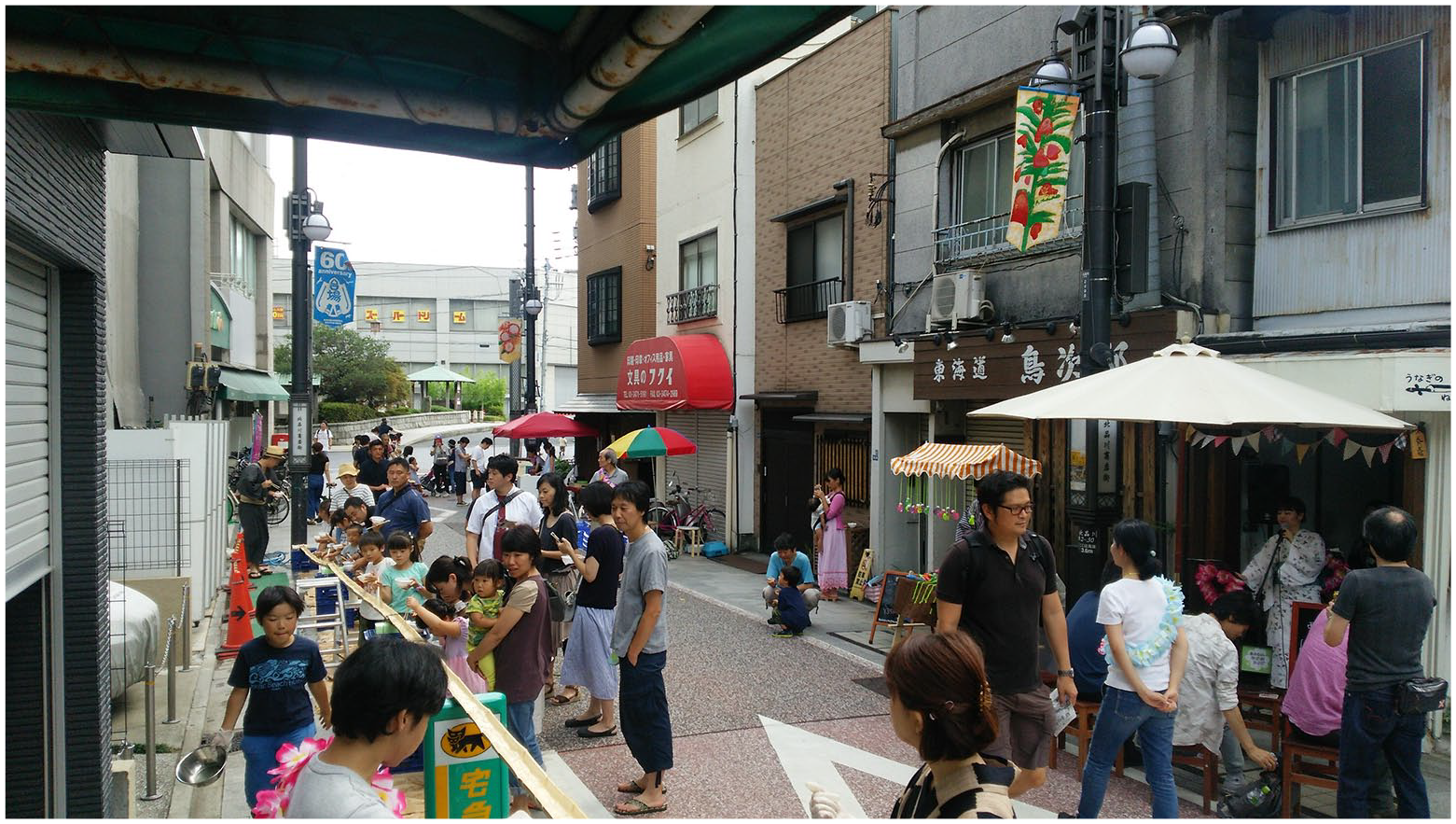
Children eating nagashi somen while a singer performs at a storefront in Kyu-Tokaido.
Aisome street used to be a typical shopping street but only a few shops remain. It has a width of eleven meters and a length of hundred meters. Restriction of cars has continued for many decades on Sundays and public holidays from midday to four o’clock, although the intensity of activities has varied over time. Playstreet is the key communal activity on the street spearheaded by the jichikai (neighborhood association). Unconventional children’s play is encouraged, including makeshift water slides as well as children carrying makeshift mikoshi (portable shinto shrine) in mock festivals (Figure 2). Street movies are the most radicle and unique initiatives in Aisome: children accompanied by their parents sit on the street and watch a movie on a screen fastened on lighting poles. During the movie sessions, I serve kakigori (shaved ice dessert) to the children while chatting with the locals about their neighborhood. Before the movie, some young children enjoy kamishibai, a picture-story show, usually conducted by a female storyteller while changing illustrated boards in a small TV-like box open at the front. Once a month, a play truck owned by a Not-for-profit Organisation, NPO, Kodomo Wakamono Matching, visits Aisome street: children and community volunteers help to assemble and disassemble various play items. Market streets (flea market) are also famous events in this street: locals bring out items they have no use for and sell to passers-by while other community members engage in games and chitchat with each other and with tourists.
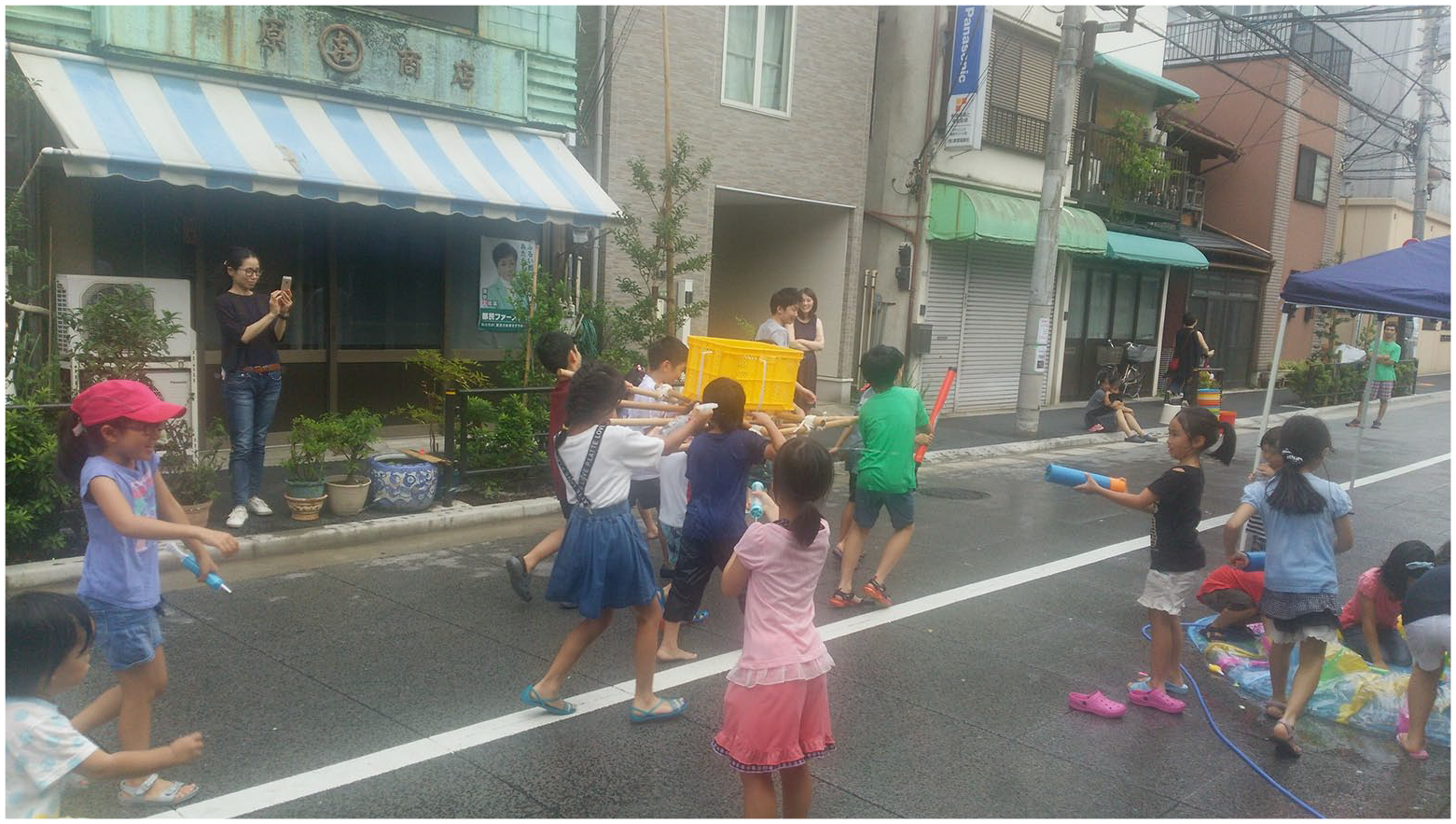
Children carry a makeshift portable shrine in a mock religious procession.
The relationships built with organizers and participants during these activities were very instrumental for structured interviews that I did to get a deeper understanding of the perceptions, motivations, and hidden conflicts in the use of street spaces. A total of fourteen interviews were done at an average of fifty-six minutes per interview; the shortest interview was twenty-eight minutes and the longest took one hour and twenty-five minutes. Interviewees included three professors with experience in street activities. The interviews were done in both Japanese and English depending on the interviewee’s language abilities and tape-recorded with full consent from the interviewees. Eventually, pseudonyms were used to ensure the anonymity of participants. Moreover, documents such as the Road Law of 1952, the Road Traffic Act of 1960, and the Tokyo Road Occupation Rule of 1972 were consulted at this stage to further understand relevant issues arising from the interviews.
Extending the Boundaries of Public Space: Proximity of Streets and the Informality of Activities Therein
In the absence of cars, street activities in Tokyo rekindle the authenticity of Japan’s outdoor culture and community bonds that remain in the background of daily life of the globalized metropolitan. Whether it is children and adults playing beigoma (spinning top toys) in Aisome street or neighbors along Kyu-Tokkaido eating nagashi somen in summer, a local identity and liveliness are produced in a way that cannot be replicated in other urban open spaces. The emergent camaraderie strengthens community bonds and has boundless potential in building social capital necessary for the efficient functioning of neighborhoods. For instance, field notes from July 29, 2018, in Aisome note that “Sakada, a community leader in Aisome Street is negotiating with a group of children on the timing for dinner and changing clothes, after playing with water, before returning for the evening street movie.” During street markets in the same street, children and parents bring out items from their homes; the sale of toys and household items creates an interactive environment between local children and visitors. This direct participation in directing the happenings of the neighborhood helps to establish an attachment to streets and is essential to children’s development, socialization and membership of their community. 51
The unique space contrasts with most streets in Tokyo, where the only visible evidence of carfree streets is the erection of boards stopping vehicular access. Nonetheless, even for Kyu-Tokkaido that hosts various activities, Haruko bemoans the lack of meaningful activities for long periods: “Every day in the evening, from four to six we stop cars, and also on Sundays from twelve to six o’clock. But there have been some periods of up to two years when they stopped cars but space was not used.” In Japan, people’s activities on streets cover for the lack of focus in architectural forms in streetscapes. According to Barrie Shelton, compared with many Western cities, streets in Japan are defined by content at the expense of architectural forms. 52 He cites their charm when people are occupying them and the emptiness of the urban experience when the people retreat. As Sakada reiterates regarding Aisome street, “The uniqueness of this street is that it is a kind of park on Sundays.” Gathering of children, and the diversity of activities, is a greater distinguishing factor than the physical environment.
The accessibility of street “commons” also encourages their use for spontaneous activities compared with parks. To Mia, an urban planner who organizes flea markets, streets are crucial platforms since they are an unavoidable part of day-to-day life: they are consistent with the randomness of items and buyers in the markets. To many residents, the street is a good platform for activities because of proximity and interlinkage to living areas, a continuity that integrates experiences on the street into daily life. This fact is also demonstrated, for example, when children can play outdoors away from parents, under the supervision of community leaders. Conversely, parks are seen as disjointed stand-alone spaces even when not very far from residences; they are also made for a single purpose—play. Moreover, to many interviewees, Tokyo’s parks are overly formalized and regulated by city governments, a platform for certain people and activities while at the same time excluding others. Carfree streets, thus, offer an opportunity for more adventurous activities. This is congruous with Jane Jacob’s insistence on the role of adults in aiding and protecting children on the street, a role nobody played in parks.
53
For example, while sketching, Prof. Yukihiro explains, “. . . The street is the common space adjacent to two individual houses or shops. Parks are common spaces but are standing alone. But streets are the spaces where people next to it can share.” The importance of proximity is particularly emphasized by Prof. Kita narrating how the street allowed parent’s oversight in her childhood years: I have two sisters and one brother . . . and if we are playing outside the house, my mother can take care of us, [and] can watch what kind of play we are doing. But in the park, my mother cannot care for me and my sisters so here is a really safe area for play, especially for very small children. It is very important to play in front of the house. If I am injured while playing here, it is easy to call my mum for help.
Streets are preferred for spontaneous activities such as getting toys from the house and playing outside, whereas designated spaces such as parks are fit for pre-planned play activities. The significance of proximity is particularly emphasized by the Japanese concept of mukosangenryotonari, a definition of the smallest unit of community including neighbors on the left and right along the street, as well as the three across. This constitutes niches within street spaces regarding issues such as where children play and the division of responsibilities for shoveling snow. In addition, many interviewees mentioned idobatakaigi, a term referring to housewives’ use of alley space for chatting as they fetched water and undertook other household chores on roji (narrow alleys). These two concepts assert the traditional flexibility of streets as a community space that is defined by content and accommodates diverse activities depending on time. This constitutes the subtle processes through which the boundaries of public space are constituted, where urban inhabitants transgress norms and appropriate public spaces through informal activities. 54 Elaborate events such as eating nagasu somen and street movies are livelier, enhance greater communication among participants, and have a greater impact on the functioning of their respective neighborhoods. In general, in streets with a lesser proportion of shops such as Kyu-Tokaido and Aisome, stationary activities tend to be small-scale, more unique, and have greater participation of local residents. However, for major commercial streets, commercial associations provide funding for less-frequent elaborate expert-led initiatives with more equipment.
In Kyu-Tokaido, the basic understanding of “public space” is often challenged as the line between “public” and “private” fades. For example, Haruko notes that “shop owners have special ownership and interest in the area just outside their shops. Even though the street is public, the frontage of your shop is almost like your private space. They have some level of control.” Depending on the function of the building, mutual understanding and negotiations among members of the shotengai (shopping street association), however, push these “ownership” contestations to the background in the eyes of mere participants. For instance, holding activities outside the Super Hotel creates minimal obstruction to the business compared with the immediate front of confectionaries and drug stores.
Order and the Rigidity of Authorities
The term public space implies democratic inclusiveness, but an overemphasis on order and safety often produces various forms of exclusions. 55 Many interviewees argued that Japanese society’s extreme regard for community order, mutual respect, and fear of conflict is a major hindrance to the appropriation of street space reclaimed from cars. Compared with other countries with a preponderance of literature on exclusion based on race, economic classes, gender, and age, discourses on socio-cultural dynamics in urban public spaces are rarely given prominence in Japan. Many residents believe that the street belongs to the car, and obstruction is meiwaku (disturbance) thereby avoiding activities that conflict with cars, car owners, and other forms of mobility.
Even the use of streets by children in carfree conditions is sometimes discouraged. For instance, Mura and Sakada worry that little children are unable to differentiate between ordinary and carfree days, hence may cause traffic accidents. This seems to be a consequence of lost environmental awareness in urban areas. Prof. Kita’s recollection of her childhood in Tokyo paints a different picture from current fears on children’s interaction with cars: “. . . sometimes a car would come, and we would stop, go back to the pedestrian walkway and return when the car passes.” Susan Elsley warns that although adults view the public space of the street as an unsafe place, young people feel that they are never consulted about their wishes concerning safety issues in the local community. 56 In addition, some of the outdoor behaviors either encouraged or tolerated in other societies are abhorred in Japan based on values often inculcated in childhood including prohibitions against sitting on the street. The street is seen by many as kitenai (dirty) for sitting, eating, or drinking. For example, Prof. Kita recounts that “. . . we [Japanese] have no custom to sit down on the street, so we need a chair. We sit down on the road with goza, some kind of seat . . .” The rationalism of designating specific spaces for specific activities is also evident in the ideology that street as a platform for activities can be replaced by building more parks. Hiro, a seventy-five-year-old city planner, supposes that he played on the street in childhood due to circumstances as evident in his comment: “. . . in those times there were no green parks, but these days we are planning parks within 200 meters.” The same sentiments are shared by Mura who mentions that he played on streets, not as a choice but a consequence of lacking air conditioners at home.
Surprisingly, due to perceived safety and security in Japan, criminal incidents have had a great dent on the public’s feeling of safety. As Ryuu and Misato note, outdoor life has been discouraged by major incidences that have been publicized in Japanese media in the past such as the Miyazaki incident where a man kidnapped and killed young girls and the Hayashi Curry incident where poison in a community meal caused deaths and hospitalization of people. In addition, in what Ryuu calls “dark history,” major restrictions on use of street space have been influenced by movements and protests in earlier decades. Many rules and attitudes toward street space were also crafted as a direct response to the mushrooming of informality after the Second World War, the student protests in the 1960s, as well as “public nuisance” such as bosozoku (motorcycle gangs). This “dark history” has shaped people’s perspectives on the use of street space, while authorities have capitalized on it to block possibilities for conflict, and to streamline the street space for the smooth flow of cars and pedestrians. Resultant laws, such as the Road traffic act of 1960, have hardened this viewpoint.
Government decrees do not create place; they ignore context whereas the individuality of a place is a conceptual fusion of space and experience, a relationship of people to their environment. 57 Many studies have shown how police in Japan have overwhelming control over the affairs of local streets when compared with other countries. 58 Street activities need a permit from the police unlike other open spaces such as parks. Consequently, stationary activities have been viewed as an intrusion to the order and peace on the streets. In the same vein, Christian Dimmer 59 regrets that the Road Act defines mobility-related spaces such as streets and promenades as spaces for smooth circulation while ruling out stationary activities unless with individual permits for each activity. To get a permit from the police, a well-reasoned explanation is of great essence. This frustration is expressed by Haruko commenting on the possibility of children’s play in carfree hours: “There are restrictions against cars in those hours, and a barrier to keep them off. . .However, the permit is primarily to stop cars, not to do anything on the space . . .” In addition to the permit for restricting cars, a permit is needed from the police for undertaking activities such as children’s play, while a public health permit is necessary if food is involved; an additional permit is also needed for street markets.
Leadership, Conflict, and Management in Carfree Streets
Although street activities cause conflict, people get comfortable if done consistently for many years as Misato, a senior citizen who has been a play leader for twenty years observes: “there are happy people, while others think that it is annoying. But because we had Ninja Play ten times, we got some understanding.” For volunteers, generators of interest are diverse: they include a request by peers, requests by local community leaders, and overseas experience. Others had a gradual intellectual awakening about social life in public spaces while working in other specialties such as civil engineering and urban planning. For Yumiko, though born in Shinagawa, she embraced carfree activities later in life for the conservation of history after securing an office on a traditional street with weekly carfree hours.
Commitment from community members often comes when individual objectives meet the broader community goals. For example, Haruko who helps to manage playstreet activities combines her hobby of teaching tea-making ceremonies on the street, outside her office, while helping the shotengai leadership to reach wider objectives such as increasing the liveliness of the street for business. Meanwhile, parents of small children committed to a better play environment are very supportive of the general welfare of all children in the community. The sacrifice of a few community members aligns with Wilbert Moore’s 60 observation that conflict is a positive way of rectifying existing social systems in peoples’ attempt to interpret reality and to model their environment led by a few innovative people. Sakada, for example, explains the struggle of dealing with opposition: “For the sake of children, sometimes I have to pretend like there is no issue even if I know that the person hates the street activities.” Moreover, the organization, Obachanchi, the association in charge of Ninja Play, is centered on child-friendly cities in Kita-Shinagawa by encouraging adventure and risk-taking among children. The name Obachanchi literary means “Auntie’s House,” alluding to the friendliness of aunties when children visit. Accepting the potential for conflicts, highlighting the importance of children, and being innovative have been key drivers for most leaders interviewed.
Community empowerment is greater when the community is engaging with professionals instead of professionals engaging with the community. 61 Meanwhile, some play leaders and consultants who seek to empower community groups in these two streets cannot recount experiences of organizing the same in the neighborhoods they live in. For example, Taku explains his non-participation as a consequence of living alone and not being rooted in his neighborhood. Most of the experts rarely experience the conflicts that arise among residents or with authorities; they also tend to be involved in special events with sufficient funding. They assist local communities to develop street activities but they have no experience of the daily realities of these neighborhoods. Their activities according to Mura who has been doing it for nine years are meant to raise sensibility that people can do them independently in their neighborhoods. In addition, many experts often assist well-funded shopping street associations as compared with ordinary residential streets that have limited financial capabilities.
Community Initiatives as Interventions to the State’s Rigidity
Japan has a weak civil society in the sense of well-funded and staffed giant organizations, but self-governance through community associations is powerful and claims over 90 percent membership among all Japanese residents. 62 Police generally trust these associations because of their positive history in society. Haruko, for instance, describes some of the activities in Kyu-Tokaido as “guerrilla,” but attributes their success to the flexibility and cooperation of the shotengai leader rather than the police. Some shotengai such as, in Kyu-Tokaido, are also involved in activities such as installation and maintenance of street lights. The influence of community formations, such as chonaikai (neighborhood association) and shotengai (shopping street association), enables communal activities that residents would not be permitted to undertake as individuals. Watanabe argues that machizukuri (community-based town making) is based on people’s desire to appropriate space in accordance with their desired lifestyles as compared with the ideals of the government and market forces. 63 Unfortunately, neighborhood associations are often led by the elderly and focus on disseminating information from the local authority to the citizenry; their role in organizing activities such as children’s play is rare. 64 Similarly, Sakada attributes the vitality of Aisome street to young members of the community who can bring new ideas. A major setback in encouraging the use of streets in daily life is that interpersonal conflicts such as those between parents with small children versus other adults, or between car owners and carfree enthusiasts, are avoided at the expense of enjoyment of streets as urban open spaces. Community leadership, thus, becomes pivotal in mediation. Moreover, when activities are organized by someone from outside the community, a leader must be present to solve any concerns raised by locals.
Community participation in recreational activities in Aisome and Kyu-Tokaido streets is minimal compared with necessary issues such as neighborhood patrols for children’s safety. Likewise, response to traffic dangers, abduction, and murder of school children in Japan has also been different from other countries such as America: mass volunteering of residents and collaboration with safety officials to ensure safety on routes to school in Japan is rampant. 65 Citizen movements are often a result of sudden changes in their places. 66 This largely explains the current lackluster attitude of citizens in negotiating for change in the interaction between cars and children compared with the rise of citizen participation against pollution and subsequent health problems in the 1960s 67 that led to among other things, evening and weekend restrictions on cars to allow for playstreet in neighborhoods. Nonetheless, neighborhood associations continue to be a crucial part of Japanese civil society and they have an important role in conserving Japan’s stock of social capital. 68
The involvement of children in carfree street activities is also a key tool for their contribution to the general community’s well-being. Apart from the key organized activities, such as street markets, festivals, and street play, children participate in spinoff activities, such as cleaning Aisome and Tokkaido streets using water and brushes after major events. Furthermore, safety drills by volunteer firemen in Kyu-Tokaido educate children and adults to be responsible members of society through issues such as operations of fire hydrants on the street (Figure 3). Meanwhile, Ninja Play and the Halloween parade are two examples of street activities that are used to get children acquainted with their neighborhood and to forge intergenerational communication by playing games that cover the entire neighborhood. Children also get a chance to interact with foreigners who are more likely to join street activities compared with activities in parks. Understanding how children appreciate spaces and places for play is important in countering the balance of adult agendas which may or may not have an accurate appreciation of children’s priorities. 69

Locals learning about fire hydrants from a volunteer fireman after a carfree street event.
Discussion and Conclusion
This study presents playstreet, Ninja Play, communal meals, and other activities that attempt to rekindle the traditional multifunctionality of streets in Tokyo. The activities texture the street spaces, and the emergent camaraderie produces a “placeness” that is unique to each location; carfree conditions are, thus, a canvas that allows residents to domesticate the spaces in their vicinity through tools underpinned by past connections to place. Children and adults take advantage of the proximity of streets for native place-making; they transgress set boundaries in subtle ways such as walking around and talking to residents and more radicle ways like street movies. Activities such as Ninja Play that encourage children to explore their neighborhoods are a great starting point when reinforcing community relations in neighborhoods. Taken together, these attempts produce public spaces that temporarily reflect the ideals of residents in Aisome and Kyu-Tokaido and bring to the forefront the different ways through which residents continually assert a claim on carfree streets. Direct connections such as street movies linked to kamishibai and indirect connections such as Ninja Play that abstracts historical ninja activities all uphold the role of history in the production of today’s street space.
The order, safety, and charm of streets notwithstanding, the study exposes how perceived informality and flexibility of streets in Tokyo has an underbelly of contestations, contradictions, and societal rigidity in accepting “otherness.” The effect of elaborate events in transforming daily life is still minimal, while only a few community members are volunteering; the affairs of the street as a public open space are, thus, confined in the minds of select citizens and community leaders. In Tokyo, community claim over public space is measured, conflicts are veiled, and the right to appropriate it is contested in amicable ways. But “public space” as a term is also loaded with ambiguities. For example, in Japan, due to the influence of interpretations dating back to the feudal era, the term “public space” is rarely understood in the Western sense of “people or civil society instead of government or officialdom” rather as a space owned or governed by the “ruling authority.” 70
Nevertheless, persistent activities slowly influence authorities and hesitant community members to accommodate the “otherness” that adds heterogeneity on streets in addition to their basic mobility functions. Even as police emphasize on order and safety, the influence of local organizations in negotiating for the heterogeneity of public spaces is eminent: it emanates from their deep roots in society that has solidified their approval among residents, and their long history in aiding government outreaches. The study confirms earlier observations that neighborhood associations in Japan are key in conserving Japan’s stock of social capital and gather their inherent social capital, while taking up tasks that are usually left to the government or are totally non-existent. 71 Although they are generally limited to linking the government to local residents and organizing very necessary tasks such as waste management, traditional activities as well exotic ones such as Halloween Parades add to the contemporary role of these groups in the making of local places in Japan. For example, Andre Sorensen has demonstrated how community groups in Yanaka are leading in celebration of local history, long-term residents, local businesses, and local historical assets as well as in planting flowers along alleys, and renovation of abandoned public facilities such as public baths. 72
The social spaces described in this study also allow for intergenerational communication, building relations between children and adults in the two neighborhoods, reducing stranger danger, and building social capital useful during disasters. The street activities also offer a chance for children to interact with foreigners such as student volunteers, an occurrence that is rare in parks. By allowing adults to have contact with children in a country with an aging population, such activities benefit adults by reducing their arrogance that sees children as a nuisance; it eventually builds a sense of community involvement that helps resolve other problems in the larger community context. 73 Elderly people with lesser interaction with children learn to appreciate the perspective of children and young families, a positive step in accommodating their needs in public open spaces.
In furtherance of what Catherine Burke calls “from children as subjects to research with children,” 74 participant observation in this study attempted to work with children through play, art, and community activities to figure out how they perceive their neighborhoods and to empower them as critical stakeholders in city-making. Innovative play ideas such as chalk art and mock community festivals on streets enjoin children in place-making traditions reserved for adults, activities that children were mere spectators. Observing life through children’s eyes offers insights on play opportunities that do not necessarily immediately serve adult interests and allay adult concerns. 75 Ultimately, with reducing numbers of children and an increasing elderly population in Japan, more studies in this field are needed to link the idea of the city as a large playground with the well-being of children and the elderly in public open spaces, tracking the intergenerational contestations, and experimenting with various approaches. The knowledge will be critical in enhancing implementation mechanisms and governance issues related to Goal 11 of the Sustainable Development Goals (SDGs) on sustainable cities and communities.
Footnotes
Declaration of Conflicting Interests
The author(s) declared no potential conflicts of interest with respect to the research, authorship, and/or publication of this article.
Funding
The author(s) received no financial support for the research, authorship, and/or publication of this article.
