



Abstract
This article investigates how political categories of class influenced mate selection and marriage practices in rural China in the Mao era. Based on qualitative and quantitative data collected in thirty villages in three counties in Hebei in summer 2005, it examines class endogamy/heterogamy; class, patriarchy, and gender; and class differentials in marriage practices. The main findings include the following: (a) Though marriages were formed predominantly within the same class category, cross-class marriages did occur, but marriages between opposite class categories were less likely during the Cultural Revolution than during the pre– and post–Cultural Revolution periods. (b) Women did not invariably marry up or within the class categories under the context of the class hierarchy and patrilineal inheritance of class labels. Women were likely to marry down the political ladder when they gained economically from marriage, or when they achieved some freedom and independence within the family sphere by not living with in-laws upon marriage. (c) Sons, not daughters, of landlords or rich peasants, if they got married, did so at an older age, with larger spousal age gaps; middle and upper middle peasants could better finance their children’s marriages in terms of bride prices and dowries; and the children of landlords and rich peasants did not tend to marry someone from a long distance away.
Since the end of the Cultural Revolution in 1976, numerous novels, memoirs, and autobiographies, some concerning the previous maltreatment of those labeled landlords and rich peasants and the difficulties of their children in marriage formation, have been published (e.g., Chang, 1991; Chen, 2001; Feng, 2004; Zhan, 1983; Zhu, 2010). Three decades have elapsed since the official renouncement of class labels in 1979, yet scholarly accounts of how class labels affected marriage in Mao’s China remain limited. Due to inaccessibility of the field for social science research in mainland China in the Mao era, previous works on class and marriage were based either on sporadic secondary sources or interviews of refugees in Hong Kong. Nevertheless, those studies embraced various important issues with regard to age at marriage, class endogamy, marital transfers of bride prices and dowries, and marital distances. While early studies demonstrated the importance of class categories in marriage, especially during the Cultural Revolution (Chan, Madsen, and Unger, 1984; Croll, 1981; Frolic, 1980; Parish and Whyte, 1978), recent studies (Diamant, 2000; Wang, 2006) have shown that class origin labels were, however, not particularly crucial in mate selection during the early years of the Mao era. Previous studies disagreed on marital distances in the sense of whether children of unfavorable class origins would marry far to escape personal stigma (Unger, 1984), or marry close for the families to gain badly needed support from their affines (Lavely, 1991). Furthermore, early studies tended to suggest that women would seldom marry down the class hierarchy (Salaff, 1973), but we do not know under what circumstances women would possibly marry down. Neither do we know much about the question of how marital transfers of bride prices and dowries were arranged along class lines. All this indicates that we still face an unfinished agenda of understanding class labels and marriage patterns in the Mao era. The present study joins in the debates and fills in remaining gaps using a randomly selected sample supplemented with rich qualitative data collected in rural North China. It investigates class endogamy or heterogamy, intersections of class categories, patriarchy and gender in marriage, and differentials in marriage practices across class categories.
Empirical Background and Theoretical Propositions
Briefly, in the land reform of the late 1940s and the early 1950s, which redistributed land and other properties such as agricultural tools, housing, and furniture among the peasantry, the evaluation of land and labor relations led to the political classification of people into classes (Crook and Crook, 1959; Friedman, Pickowicz, and Selden, 1991; Hinton, 1967; Potter and Potter, 1990). Class labels included those for the exploiting classes, “landlords” and “rich peasants” (dizhufunong), for the exploited classes, “poor peasants” and “lower middle peasants” (pinxiazhongnong), and for classes in between, “middle peasants” and “upper middle peasants” (zhongnong and shangzhongnong, hereafter referred as zhongnong). According to official policies, pinxiazhongnong essentially had no or little land and rented land from landlords or rich peasants; zhongnong had some land and might employ labor; and dizhufunong occupied a large amount of land and supposedly lived by exploiting the labor of pinxiazhongnong (see Crook and Crook, 1979: 47–48). 1 About 60 to 70 percent of the total rural population were classified as pinxiazhongnong; zhongnong accounted for about 20 to 30 % and dizhufunong about 5 to 10 percent. 2
Though land reform and later socialist transformation in the mid-1950s had eliminated the foundation of the property-linked concept of class, Mao maintained that the old class enemies were not resigned to socialism and new class enemies such as “revisionists,” “new bourgeois elements,” and “capitalist roaders” had emerged in the newly established socialist society (Kraus, 1981). Thus class conflict persisted and the revolution needed to continue (Dittmer, 1987; Wortzel, 1987). Following the commune movement in 1958 and the subsequent famine years during 1959–1961, Mao presented his directive “Never forget class struggle” in September 1962 to reignite the fight against old and new class enemies (Meisner, 1999). The subsequent Four Cleanups campaign (1963–1966) reinvestigated the “class” designations of each household in a bid to strengthen class struggle (Baum, 1975; Sharma, 1989). In the peak years of the Cultural Revolution, the “class line” reached its apogee (MacFarquhar and Schoenhals, 2006; White, 1976).
In the Mao era, individuals were often officially differentiated by their own class labels (jieji chengfen), or the class-origin labels of their parents (jiating chengfen, or family class origin, jiating chushen), and children from “bad” class origins should officially have been treated differently from their parents. Nevertheless, children of unfavorable family class origins faced discriminatory treatment, which impacted their life opportunities and paths, as this article will demonstrate. With the death of Mao and the rise of Deng Xiaoping, the Chinese Communist Party (CCP) finally announced a symbolic end to class struggle in late 1978. The official repudiation of the class-label system was followed by the removal of the “class cap” (zhaimao), starting in January 1979, with the elimination of class labels from official personnel documents (Su and Fang, 1994: 1711). The far-reaching impact of Mao’s class politics on family lives in the post-Mao era deserves much more attention.
One thread in regard to class origins and marriage in Mao’s China concerns the role of the state in class designations and the impact of state policies and class politics on marriage practices. In many ways, the power of Mao’s state was formidable. It not only redistributed land during the land reform, it also controlled the allocation of opportunities, giving the poor and the loyal chances for education, work, and political power, while restricting the mobility of dizhufunong, and excluding them from all forms of political participation. Evidence shows that the state at times discouraged, even banned, interclass marriages (Croll, 1981; Diamant, 2000; Zhou, 1976). 3
Previous research has seen family class origin as an important consideration in the choice of marriage partners, especially during the years of the Cultural Revolution (Croll, 1981; Parish and Whyte, 1978; Unger, 1984; Chan, Madsen, and Unger, 1984: 190, 193). Parish and Whyte (1978) maintained that people of pinxiazhongnong background tended to marry those with a similar background, and that dizhufunong children likewise married within their status group, if they were able to marry at all. Others have shown that even those with upper middle peasant labels would not be preferred mates for those with poor peasant backgrounds (Yan, 2002: 39). Nevertheless, the effect of class labels on marriage selection may have varied across various periods of Mao’s China, and as Diamant’s and Wang’s recent research indicates, class labels were not important in selecting marriage partners in the early years of Mao’s China (Diamant, 2000: 12; Wang, 2006: 69, 73).
The second thread concerns the intersection of the state, patriarchy, and gender in marriage. Class labels, once assigned, were inherited along patriarchal lines (Kraus, 1981). That is to say, children of dizhufunong fathers, no matter what the mother’s class designation was, would often be treated as dizhufunong; similarly, children of pinxiazhongnong fathers belonged to the pinxiazhongnong class. Previous studies assumed it was likely that dizhufunong daughters would marry pinxiazhongnong or zhongnong sons, and pinxia- zhongnong or zhongnong daughters would not marry dizhufunong sons; and pinxiazhongnong daughters would be at times reluctant to marry zhongnong sons. Those with good class labels did not wish to marry down the political category of class, as this would mean a reduction in their political status (Salaff, 1973; Croll, 1981: 181; Zhang Letian, 2005: 392).
The third thread concerns class differences in marriage practices. Marriage practices concerning age at marriage, age differences between spouses, marital transfers of bride prices and dowries, and marriage distances, may have differed across class lines. In Chan, Madsen, and Unger’s Chen village, for example, women with a bad class background preferred to marry outside their own village to escape the stigma attached to their family origins (1984: 191). Lavely (1991), and similarly Gao (1999), however, suspect that the less desirable classes were inclined toward commune endogamy to build affinal ties, because the stigma of their class status might have made such families more dependent on their affines for social and economic support. Other studies show that peasants used class labels as a bargaining tool in arranging marital transfers. For example, Frolic (1980: 91) discusses a situation where the bride’s family bargained for a high bride price since her family was classified as pinxiazhongnong while the groom’s family was zhongnong. Parish and Whyte’s (1978) study of Guangdong villages shows that those with bad class labels married at older ages, and the spousal age gaps were relatively large. Nevertheless, patterns of class differences in marital transfers and marriage distances remain largely unknown.
To summarize, the Chinese state, following the Marxist ideology of class struggle, reshaped social mobility paths by assigning class labels to individuals and their family members. Marriage, as an important societal mechanism for upward social mobility or maintenance of social status, was utilized by individuals and their families to respond to the new political and economic context. Class categories were intricately related to family formation in the Mao era, although such relationships varied in different periods of the Mao era, as the leaders sought to create a continuous revolution over the years. Ultimately, instead of eliminating the old system of inequality, class-based family-formation processes would be an important mechanism through which the state essentially consolidated a new form of social stratification.
Data
The present article is based on both quantitative and qualitative data collected in 2005 for a larger research project on family dynamics in three counties in Hebei, namely Fengrun, Zhaoxian, and Chicheng. The quantitative data of 600 families in 30 villages were drawn using a multistage stratified sampling strategy. In addition to family demographics and economics, the quantitative data include such marriage variables as age at marriage, bride price and dowry, marriage distances, and postmarital living arrangements.
During the survey, the interviewees frequently added comments on their marriages during the Mao era, which provided important qualitative materials for our analysis. We further conducted focus group discussions, nearly two in every village, lasting two to three hours each, covering topics regarding marriage processes: mate selection criteria, use of matchmakers, marriage cost, the wedding, and postmarital relations. The focus groups consisted of participants of various ages, usually with men and women in separate groups (two were mixed groups). Though marriage occurred many years ago for the older participants, I observed that all could vividly describe generally their marriage criteria and mate-selection processes. It is possible that participants may have forgotten particular details. But the mere fact that people could remember class labels and marriages that had occurred decades ago indicates the importance of class categories on mate selection in Mao’s China.
Briefly, Hebei, a province that closely followed the Maoist line in the Mao era (Friedman, Pickowicz, and Selden, 1991, 2005), is located in North China, and surrounds the two metropolitan centers of Beijing and Tianjin. Zhaoxian, which is situated in the North China Plain, has more per capita land than Fengrun, which is a semi-mountainous area, and Chicheng, which is a mountainous county. The land reforms started relatively early—all prior to the establishment of the People’s Republic of China—in the three Hebei counties. Fengrun and Chicheng began land reform in 1947, Zhaoxian in 1946. The proportion of individuals labeled dizhufunong ranges between 1.5 and 8.5 percent for men and between 1 and 8 percent for women in our sample (see Table 1). The class structure was comparable with that in other villages in Hebei. For example, in Wugong village, Raoyang county, in 1948, dizhufunong accounted for 1.2 percent of the total households, zhongnong 39.7 percent, and pinxia- zhongnong 58.9 percent (Friedman, Pickowicz, and Selden, 1991: 100).
Class Composition (in Percentage) in 30 Villages in Fengrun, Zhaoxian, and Chicheng.

Note. Class labels are missing for four individuals.
Results
In the following subsections, I will start with qualitative spousal selection processes, followed by a discussion of quantitative patterns regarding class endogamy, women hypergamy, and marriage practices.
Class Categories and Spousal Choice
Class labels as an important criterion in mate selection
In focus groups, we asked each participant about the criteria in mate selection. For those married during the 1950s to the 1970s, especially during the Cultural Revolution, class categories were frequently mentioned as a principal consideration in spousal choice, an element much more important than any other personal characteristic such as education, occupation, skills, height, beauty, personality, or family background, including economic situation, social networks, parents’ personality, and so on. As a 58-year-old man said,
The most important criterion, whether you looked for a wife or selected a pojia [a mother-in-law], was political class label. Even if you had good personal traits or a sound family economic background, people did not dare marry you simply because you came from a family with a bad class label. One might even prefer to remain unmarried [than to marry someone with a bad class label].
There was a sense that class label was a more important criterion for a woman seeking a husband than the other way around. A 54-year-old man who married in 1972, for example, said,
Class labels were extremely important for a man. It would be difficult to find a wife for a man with a bad class label. Women would not even go for those labeled as upper middle peasants. The wives would get stuck with [the husbands’] bad class labels too.
A few focus group participants whose family background was categorized as dizhufunong mentioned the difficulties they faced in choosing their marriage partners. A 62-year-old man from Chicheng, labeled a rich peasant, describes his criteria in mate selection in the 1960s:
My class label was high [chengfen gao]. I married in 1963, but later divorced. I managed to remarry. My second wife’s family belonged to zhongnong. There was no point in my thinking about whom I could marry. I couldn’t make a choice because of my bad family class label. It was up to others to choose.
4
Though class labels were important in mate selection during the Mao era, the importance varied across different periods and across households with different economic situations. Class labels were the most important criterion in mate selection during the peak years of the Cultural Revolution. A 57-year-old woman who married in 1968 said, “During the Cultural Revolution, people conducted class struggle every day. Those with bad class labels were struggled against. Nobody wanted to marry those with bad class labels.” A 54-year-old woman who married in 1976 characterizes the importance of class categories in marriage as “liangtou song, zhongjian jin” (The [periods at] both ends were lax, the middle [period] was tight), meaning that class labels were more important criteria in mate selection during the Cultural Revolution than before or after. One informant even distinguished the different role of class labels in marriage in the pre–Cultural Revolution period:
During the land reform when dizhufunong families were attacked, children of dizhufunong families had a difficult time finding spouses. After a while, particularly during the Great Leap Forward and the three difficult years, class was considered [in mate selection] but it wasn’t so important. Class labels became important considerations in marriage after the “four cleanups” even before the Cultural Revolution started.
A 63-year-old woman who married in 1963 says that “at that time [around 1963], class labels had not yet become as important [as during the Cultural Revolution].” A 61-year-old man, who had only a primary school education and who was extremely poor in the early 1960s, said,
My criterion [in selection of a mate] was looking for one who could work and who was not weak-minded. There was no requirement about being good-looking. Class labels were considered. But it wouldn’t be bad if you had somebody who would marry you.
At the same time, there is an indication that the effects of class labels on marriage choice continued until the late 1970s, even into the early 1980s, after the government eliminated class labels as a political category. A 47-year-old woman said, “At the end of the production team period [in the early 1980s], people still took into account political labels [when choosing a mate], though not as seriously as before.” 5
Qualitative information cannot easily distinguish regional differences in the impact of class categories on mate selection. But it is clear that such an impact was present in all three counties, particularly during the peak years of Cultural Revolution. 6 However, we might suspect that in a poor area like the mountainous county of Chicheng, class labels might have been less significant in people’s daily lives. On several occasions, participants indicated that the poorest families, who had difficulty finding spouses for their sons, did not take class labels seriously. A small number of participants indicated that they “did not have any criteria” in selecting spouses. “[For a poor man], one should be happy if you have a woman to follow [marry] you,” remarked a 63-year-old man.
In addition to focus group discussions, in-depth interviews revealed much about class labels as important criteria in marriage selection. The following story shows the disadvantaged position in the local marriage market that could occur because of a bad family class label.
Chun was born to a rich peasant family in 1944 in a small village in Zhaoxian. When he reached marriageable age, his household economic situation was not bad. It was above the average in the village, and the economic situation of the production team where he worked was also good by local standards. He had nine years of school education, and dropped out after junior high school, because of his bad class background. When asked if he had joined the army, he said: “How could you join the army with a bad class label?”
Chun was first introduced to a neighbor as a marriage prospect:
They didn’t like the match because of our class label. Later I was introduced to a person with medical problems who couldn’t easily get a spouse herself. She was the single daughter in the family, and had no education. She had heart disease and tracheitis. Her class label was good. Since I belonged to the rich peasant [class], I couldn’t compete in getting a desirable wife. I agreed to marry her even though I knew about her medical problems. At the time of our marriage, I never expected she would live long.
7
Chun added that his case was not exceptionally bad: “There was another man from a bad class family in the village who managed to marry a dumb girl.” He said, “It was just like that at the time.”
Class categories and exchange marriage
One solution for families with a bad class label was an exchange marriage in which families exchanged daughters in return for wives for their sons. Though exchange marriages usually occurred between two families, sometimes three were involved, which could be called a circular marriage (in the local idiom: tuimo hun, mill-pushing marriage). The two forms of exchange marriage are illustrated in Figure 1.
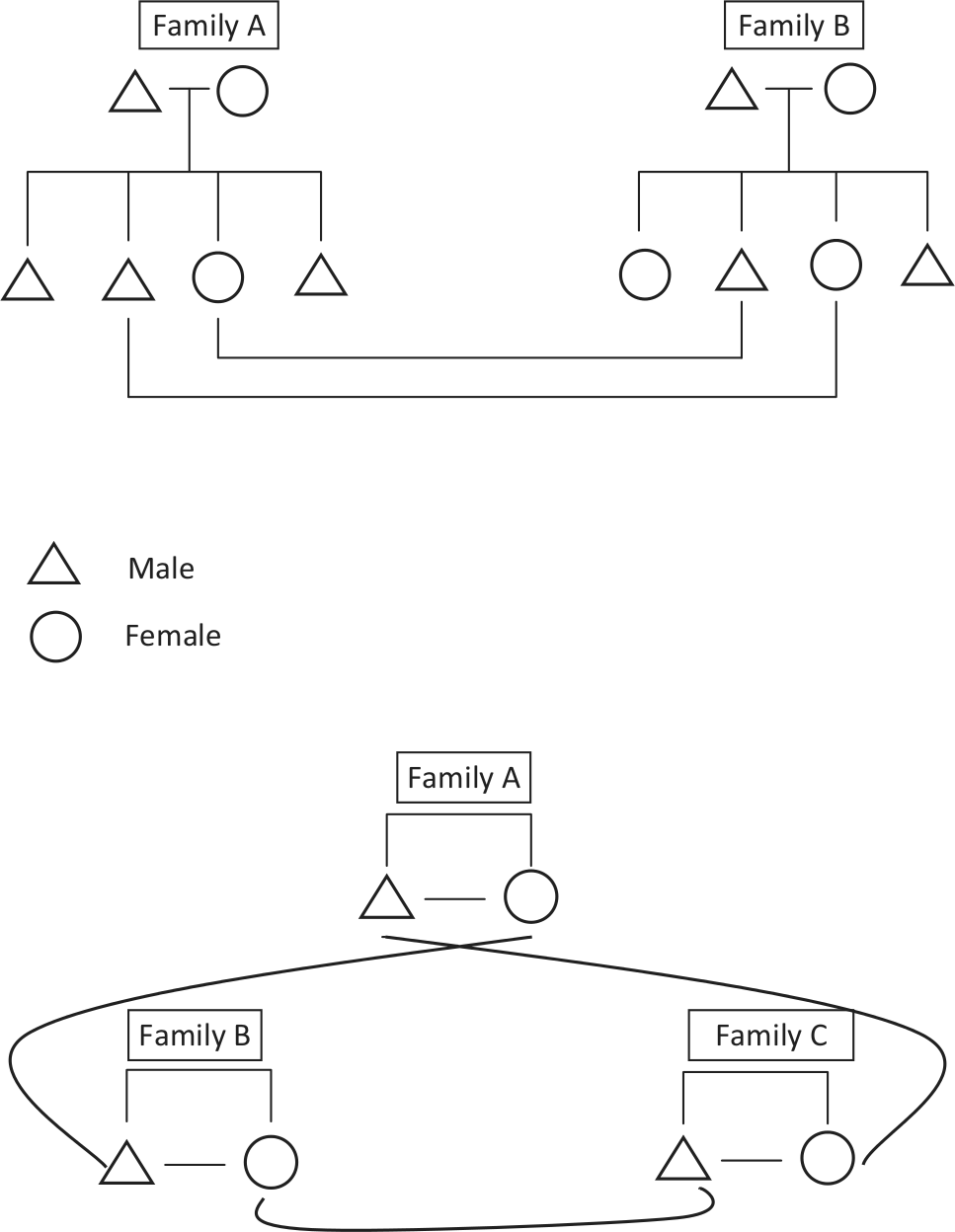
Two models of exchange marriages.
In pre-1949 China, exchange marriages usually occurred among the poor or disabled. In this system, to have a son married, one had to have a daughter to exchange. Landlord and rich peasant families, with better economic means, would not resort to exchange marriages before the Revolution. After the Revolution, the poor still resorted to exchange marriages. Dizhufunong families joined in as well. In addition, exchange marriages often crossed class boundaries between pinxiazhongnong and dizhufunong families (Salaff, 1973; Unger, 1984). There was a sense among the focus group participants that the frequency of exchange marriages for families with bad class labels was the highest during the Cultural Revolution when class struggle was stressed the most. Families with bad class labels who could not overcome class boundaries in mate selection could arrange exchange marriages of their children with children of other families with bad class labels as well. The following are two examples from our samples which illustrate cross-class exchange marriages and within dizhufunong class exchange marriages.
The first case concerns a poor peasant family (Family A in Figure 2) and a rich peasant family (Family B in Figure 2) in Zhaoxian. The parents in family A had three daughters and three sons. The two elder daughters married virilocally: the eldest daughter married into a neighboring village and the second within the village. The eldest son also got married, but died of liver disease when his wife was pregnant; she subsequently left the family. The youngest son committed suicide. The reason, I was told, was that he was ugly and simple-minded. He complained before committing suicide that his family was too poor to arrange a marriage for him. Family B, from a neighboring village, was labeled rich peasant. They had five children, three daughters and two sons. The first two daughters married outside their village. In 1968, the two families arranged an exchange of the youngest daughters so that the elder son could get married. The reason for the exchange marriage was straightforward. Family A was poor, and the sons of Family B were disadvantaged in securing a wife due to their unfavorable class label.

Exchange marriage, Case 1.
The two families in the second case who resorted to an exchange marriage for their children both belonged to the rich peasant class (see Figure 3). The children from Family A were good looking and capable. Nevertheless, the single son had difficulty getting a wife because of his class background. The family had to arrange an exchange marriage for him, by marrying off their third daughter to the second son of the other family. Although the daughter did not agree with the marriage, it went ahead. She was not happy, and hanged herself when she became pregnant. While alive, she complained about why she had been chosen for the exchange marriage when the family had five daughters. The only son from family A had a rather good relationship with his wife after marriage. “The wife was the only daughter in the family. She had to accept her fate,” the informants reasoned.
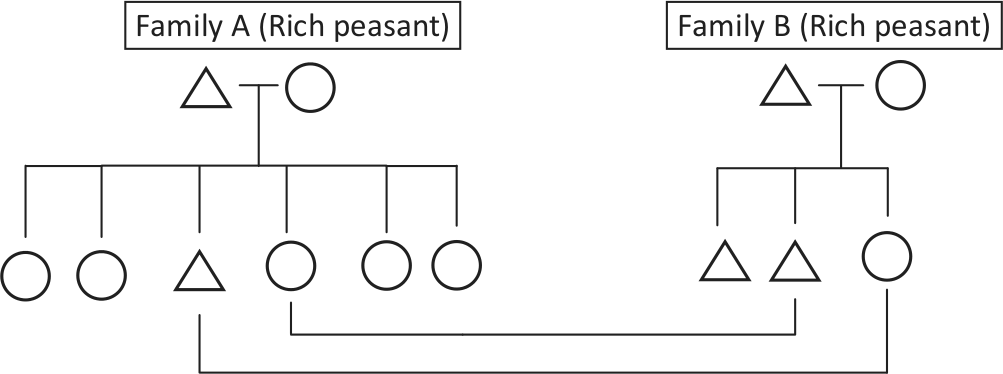
Exchange marriage, Case 2.
Class categories and “bare sticks”
Families with no daughters for exchange would be forced to leave their sons unmarried. These unlucky men were often pejoratively called “bare sticks.” The informants indicated that those who remained “bare sticks” either came from extremely poor families, or had “bad” class labels, physical or mental problems, or bad reputations. To cite just one example from frequent similar conversations during the focus groups to illustrate the point:
“Are there bare sticks in your village?”
“No, not many.”
“There are many, over ten!”
“How old are they now?”
“The oldest is 71 years old, and the youngest is over 50.”
“Why [did they remain unmarried]?”
“Their class labels were not good, some were poor, or they were not popular (renyuan buhao).”
“It was also because there were more men than women.”
Similarly, one woman said, “Most of those who remain unmarried were from families with bad class labels, or from families with less desirable personal characteristics. Class labels were more important than other personal traits or family backgrounds.” Informants added that families of political activists such as cadres and party members were privileged families who took up the available work and education opportunities in cities, and those families “did not lack qinjia [in-laws].”
Our informants indicated that some men who could not marry during the Cultural Revolution because of their “bad” class labels managed to get married in the 1980s after the official elimination of class labels. This was particularly so for men in Zhaoxian and Fengrun, where the local economy was better than in Chicheng. With no prospects of getting a wife from the local county because of their age, they managed to marry women from the poorer regions of southern provinces. Some of those women were trafficked, though others were introduced by women who came earlier. Usually the men had to pay a high “introduction” fee to “matchmakers” (traffickers). Paying such a fee would be impossible for many “bare sticks” in Chicheng, a poor mountainous county. For example, among the focus group participants there was a man of 53 with a bad class label who married in 1985 at the age of 34. The brother of the 53-year-old man also married in the 1980s, but his wife ran away later with their two young daughters. Informants indicated that those who managed to marry were the lucky ones. “There were those who couldn’t marry because of their bad class labels before they became too old to marry,” one village cadre commented when we asked about the “bare sticks” in the village. Though class labels ceased functioning officially since the late 1970s, their impact on marriages, however, has been long lasting.
Class origins and marriages in two families
Marriages in the families of two brothers with “bad” class labels, discussed below, can further illustrate the different effects of class labels on marriages in different periods of the Mao era. They also indicate that family demography played an important role in the form of marriage of different family members with the same “bad” class labels. 8
The first generation of the two families in Figure 4, consisting of two brothers and their spouses, were classified as rich peasants during the land reform in 1948. Family A had two sons and three daughters, and Family B had only two brothers. The eldest son of Family A was born in 1941 and married in 1959 at the age of 18. His wife was from a pinxiazhongnong family, and even had kin who were government officials. The eldest son of Family B was born in 1935 and married in 1952 at age of 17. His wife was from a poor family with a household economy below the village average. The fact that they could both marry around the “normal” marriageable age despite their “bad” class labels was because “class was not as important during that time as during later periods.” Furthermore, starting in 1958, during the Great Leap Forward, “people focused on production more than class struggle,” unlike during the “four cleanups,” which started in 1963.
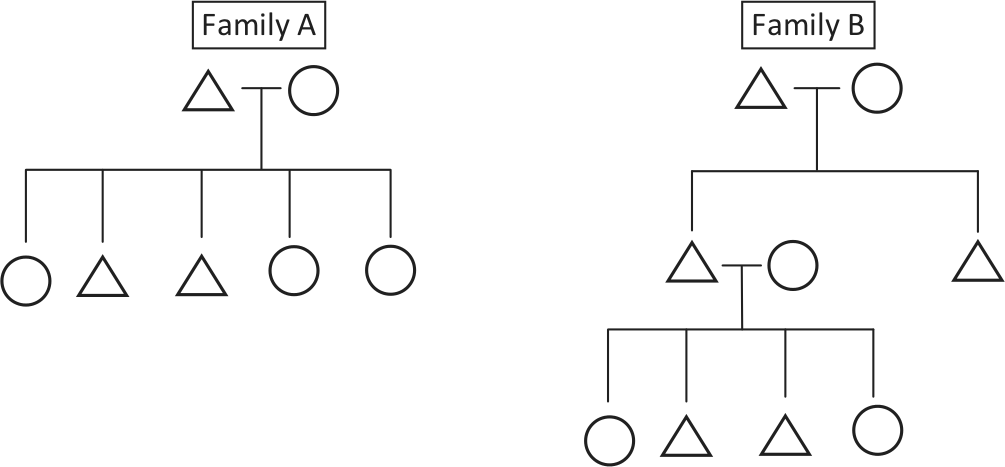
Class categories and marriages in two families.
The second son of Family A was born in 1946. He was 17 years old in 1963, when the “four cleanups” campaign started in the village. No woman agreed to marry him simply because he was the son of a rich peasant family and the household was poor. This was true for six years until 1969, when the peak years of Cultural Revolution had passed. Professional matchmakers introduced three families with “bad” class labels and arranged exchange marriages for them. His sister, three years younger than he, did not like the exchange marriage. She would have a better life if she married to a pinxiazhongnong family. The matchmakers, her parents, and her close friends all persuaded her to accept her “fate.” Her brother also promised that he would do whatever he could for his younger sister. He literally said that he would share “half a bowl of food if he had one” if she would agree to the marriage. She gave in. The three pairs of brothers and sisters from three “bad” class families all married on the same day in 1969.
The second son of Family B was born in 1949. He was 14 years old when the “four cleanups” started and 17 when the Cultural Revolution broke out. Unlike his cousin, he did not have any sister to be exchanged in order to marry. He was still unmarried at the age of 29, a so-called bare stick, when, in 1978, class labels were officially dropped. Even then, no woman would marry him since class labels were still considered an important criterion in marriage up to the early 1980s, because “people were not certain that class would be gone forever.” In 1992, at the age of 43, he cohabited with a middle-aged woman from Sichuan. She, presumably a trafficked woman, ran away a few months later. He again remained a bachelor till his advanced years.
The impact of class labels on marriages extended to the generation of the grandchildren of dizhufunong families. The eldest grandson of Family B was born in 1956. He was 20 years old in 1976, when the Cultural Revolution ended. With no prospects of marrying, his uncle arranged an exchange marriage, which also involved three families. In 1978 his elder sister was exchanged for him so that he could marry.
The second grandson was born in 1958. He was 20 years old in 1978 when class labels were officially eliminated. Still, he was unable to find a woman who would marry him until he was 25, a late age for marriage in the village. His younger sister—five years his junior—was born after the famine, in 1963. His mother tried to arrange an exchange marriage for him, but without success. Finally, in 1983, a matchmaker, the wife of a county government employee from the same village, found a woman who was willing to marry him. “Although the boy had only a primary school education and the family was economically below the village average due to the ‘bad’ class label, he was very smart. He liked learning new things, and he was honest,” the matchmaker said during the interview. The matchmaker did not believe class labels would endure forever after they were officially eliminated. The matchmaker introduced her sister-in-law’s sister, who trusted her, to the grandson, and in 1983 they married.
Class Endogamy or Heterogamy?
The 591 couples (out of our 600 sample couples) who married during 1952–1981 can provide us with quantitative information on class endogamy or heterogamy during this period. As Table 2 shows, the majority of the marriages, 410 of 591, or close to 70 percent of all marriages in the Mao era, were in-class marriages; 159 marriages, or 26.9 percent of all marriages, occurred between neighboring class categories. Those who married across opposite class categories between pinxiazhongnong and dizhufunong families were rare: they were 22 out of 591, or 3.7 percent of total marriages. 9
Marriage Endogamy and Heterogamy Over Time (Odds).
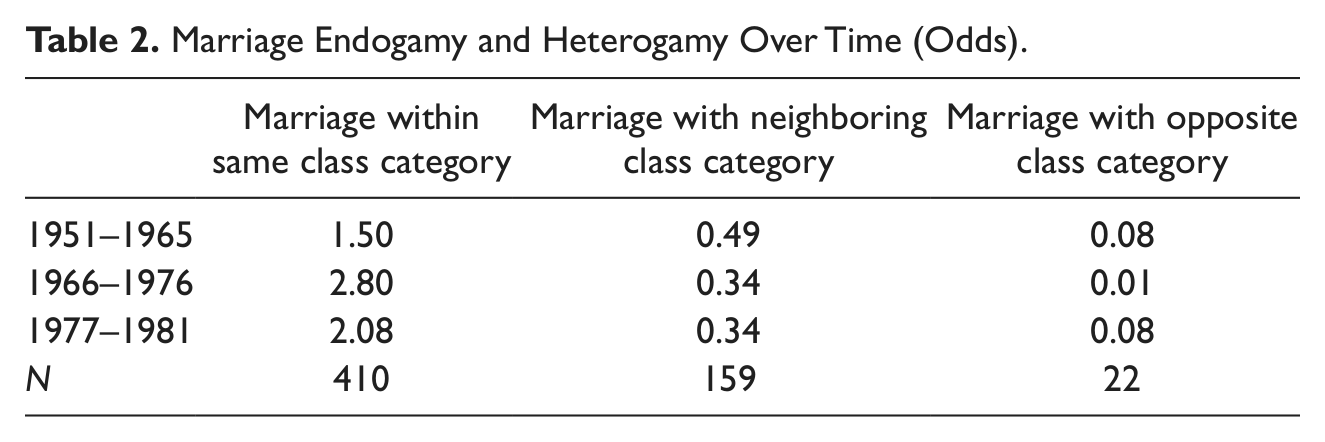
Table 2 also indicates that though the odds of marriages across class categories were low, they varied during different periods of the Mao era. During the Cultural Revolution, the odds of marriage between opposite class categories was the lowest, only 0.01. This stands in sharp contrast to the odds of cross-class marriages, which were eight times higher at other times. This corroborates the qualitative statement liangtou song, zhongjian jin mentioned above (i.e., the importance of class categories in marriage formation was relaxed in the early and late Maoist period and was more rigid in between). The likelihood of class endogamy was lower, and heterogamy higher, before the Cultural Revolution than during the Cultural Revolution and afterward. This indicates that considerations of political factors of class labels became more important during the later years of the Mao era.
Class Categories, Patriarchy, and Gender: Class Hypergamy for Women?
The next question is whether there were women who married down the hierarchical class ladder within the context of patrilineal inheritance of class labels, and what would be the considerations for women marrying down. 10 By marrying down, I am referring to pinxiazhongnong women marrying zhongnong or dizhufunong men, and to zhongnong women marrying dizhufunong men.
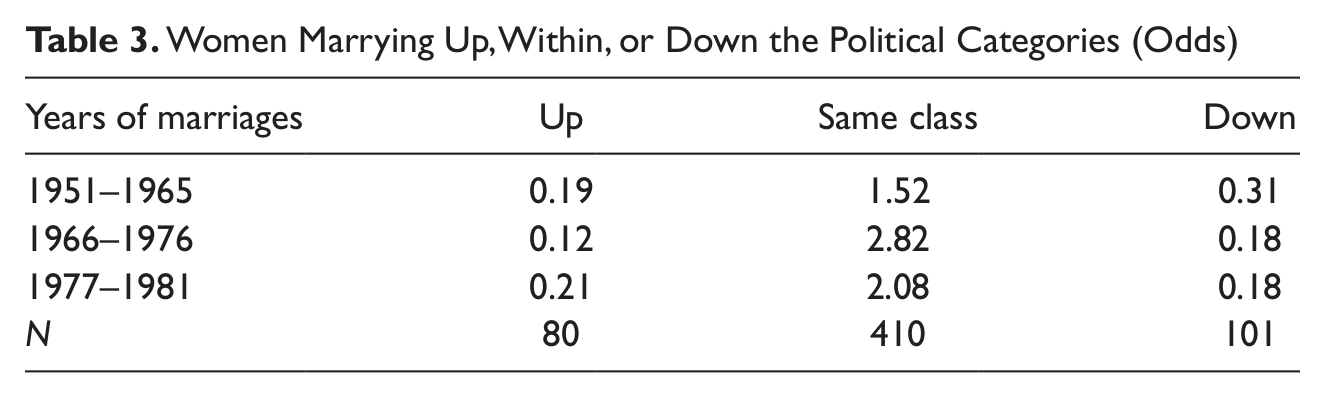
As Table 3 indicates, the number of women who married down the class ladder was greater than the number who married up. There were 80 women out of 591, or 13.5 percent of all women, who married up; 101 of them, or a bit over 17 percent, married down, with the rest, the majority, close to 70 percent, getting married within the same class category. The odds of women marrying down were 0.31 before the Cultural Revolution, then decreased to 0.18 during and after the Cultural Revolution. This demonstrates that it is not true, as previously believed, that women tended not to marry down because of the patrilineal inheritance of class labels.
Women Marrying Up, Within, or Down the Political Categories (Odds)
I postulate that women who married down the political ladder were from poor families. Poor women with “good class” labels might marry down politically in exchange for economic gains, for themselves or for their natal families. This hypothesis is confirmed by our logistic regression results (with women marrying down as a dependent variable). 11 This indicates that the odds of women marrying down the class ladder, when the economic situation of the groom’s family was better than their own, were 121 to 134 percent higher than the odds for women marrying down when the economic situations of both families were the same (Table 4). Women marrying down to economically better off families may have done so to improve their own postmarital material life, or it might also be possible that their natal families gained a higher bride prices by marrying down their daughters (regression result not shown). 12
Logistic Regressions: Which Woman Was More Likely to Marry Down? (Women Marrying Down as Dependent Variable).
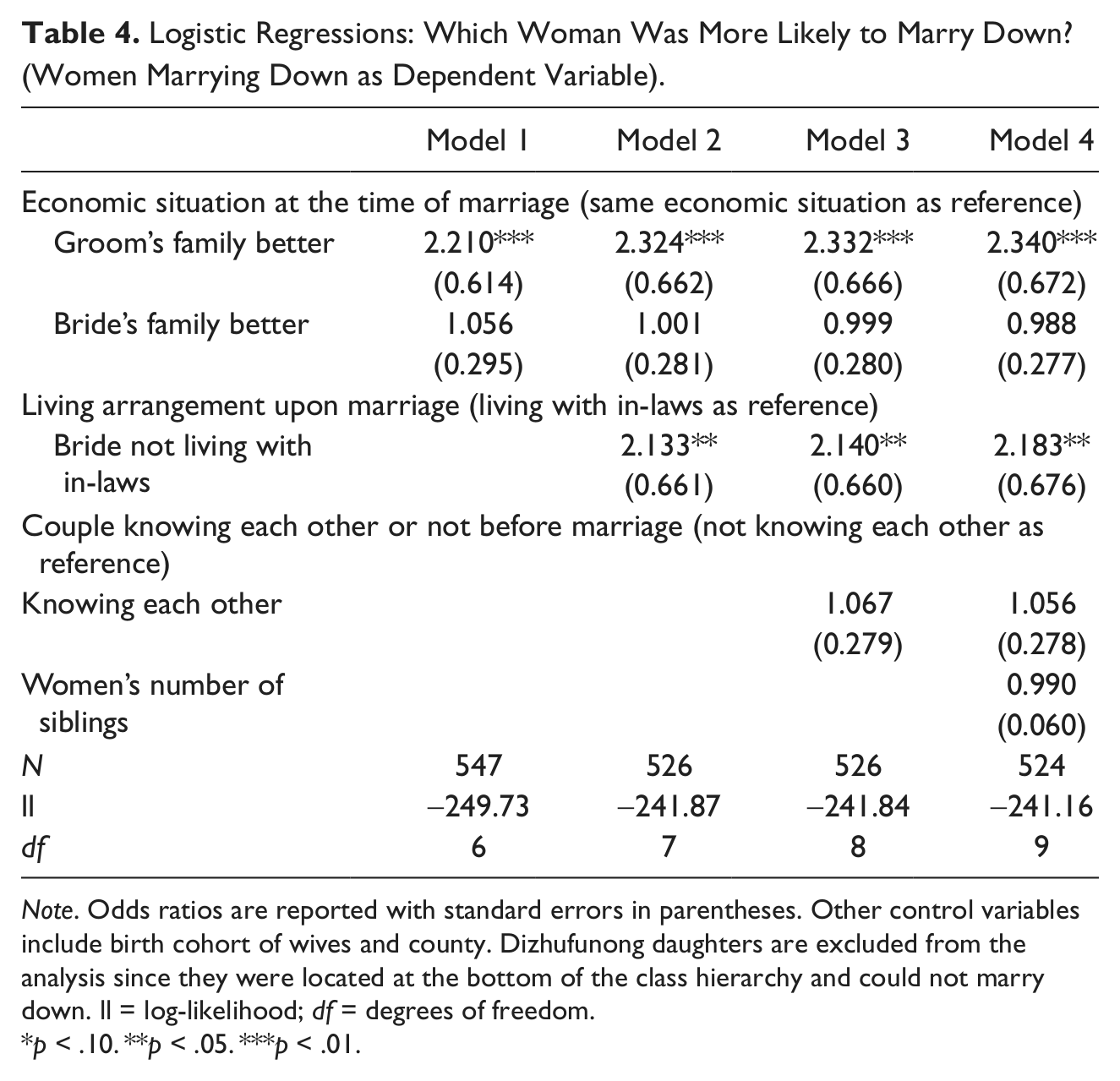
Note. Odds ratios are reported with standard errors in parentheses. Other control variables include birth cohort of wives and county. Dizhufunong daughters are excluded from the analysis since they were located at the bottom of the class hierarchy and could not marry down. ll = log-likelihood; df = degrees of freedom.
p < .10. **p < .05. ***p < .01.
The results reported in Table 4 also indicate that women, when they knew they would not live with in-laws after marriage, were more likely to marry down the political ladder compared to those who lived with their in-laws at the time of marriage. The odds for women marrying down were 113 to 118 percent higher for women not living with in-laws upon marriage than those living with in-laws. This result is surprising because our informants mostly indicated that the poorest women might marry down for economic survival, or women might marry down when they had physical disabilities or bad reputations and could not marry within the same or better class categories. Only one 61-year-old woman indicated that she would not put up with living with in-laws upon marriage. The regression results clearly indicate that, at least for some women, living with in-laws or not was an important consideration in marriage. Living with in-laws upon marriage in traditional families meant that young women had to adjust themselves to various pressures or stresses in dealing with in-laws in domestic matters such as household chores, fertility, education of children, and caring for the elderly. In post-1949 rural China, although young women had gained a certain degree of autonomy from family controls with the assistance of state power, and although living with in-laws would increase household income through intergenerational division of labor with the grandparents taking care of children while the parents worked in production teams, women living with in-laws would still continue to face the pressures imposed by their in-laws. Although women living independently still had to face the dominance of their husbands, and they would still have to deal with the influence of their in-laws living separately, the fact that women would marry down politically when not living with their in-laws upon marriage may well indicate that at least some women would take personal autonomy, even to a limited degree, seriously in a marriage decision.
Class Categories and Marriage Practices
Age at marriage and age gap between spouses
Unlike in the West or contemporary urban China, it could have been a general pattern in traditional rural China that children from better-off families married at younger ages. In pre-1949 rural China, for example, Gamble (1954: 59, table 8) showed that in Dingxian circa 1930, children from richer families with more land holdings usually married young. This class-based differentiation in marital patterns prior to land reform was also confirmed by Selden’s (1993) study of Wugong Village, and Wang’s (2006) study of Ci county, Hebei province. Telford (1992) also showed that in rural Anhui in the Ming/Qing period high social status families obtained early marriages for their sons. Our informants indicate that before 1949, rich families usually had their sons married young and some could marry older wives (as Gamble found in pre-1949 Dingxian). Having children married at younger ages (except child marriage) brings certain advantages to the family in the local marriage market, and it carries the connotation of high status. The question for marriages during the Mao era is: With the loss of property and a concomitant fall in social status, and being situated on the lowest rung of the political ladder, would children with “bad” class labels marry later (a reversal of the earlier pattern), if they managed to marry at all?
Our qualitative data described above show that families with “bad” class labels had difficulty finding wives for their sons, and they might have had to delay their marriages if they managed to marry at all. Our descriptive statistics do show that men from dizhufunong families married at older ages (Table 5). The regression results also show that men from families with “bad” class labels married on average when they were 1.8 years older than men from families with “good” class labels, while men from pinxiazhongnong and zhongnong families did not significantly differ in age at marriage (Model 1 in Table 6). This corroborates the findings of class-differentiated patterns by Parish and Whyte (1978: 166) in collective-era Guangdong. It is also in line with Selden’s (1993) study of Wugong, Hebei, where age at marriage did not differ among pinxiazhongnong and zhongnong men. 13 The age at marriage for women, however, did not show significant differences across various class backgrounds (Model 2 in Table 6). This indicates that class background did not influence women as much as men in marriage timing. The gendered pattern of class and age at marriage, in terms of dizhufunong men, rather than women, having difficulty marrying and having to postpone their marriages, might be due to demographic and political factors. Demographically, there might have been fewer women than men in the marriage market due to the historical preference for sons and gender differentiated mortality. Politically, patrilineal inheritance of class labels, as mentioned above, put more strain on dizhufunong men than dizhufunong women in marriages.
Class Categories and Marital Practices: Age at Marriage, Spousal Age Difference, Marital Transfers of Bride Price and Dowry, and Marriage Distances.

Class and Marital Practices: Age at Marriage, Marital Transfers, and Marriage Distances.

Note. All models were estimated using least square regression, except that models for marital transfers of bride price and dowry (Model 5 and Model 6) were estimated using tobit regression. Model 5 likelihood ratio chi-square is 69.37 (df = 10) with p < .001, and Model 6 likelihood ratio chi-square is 138.49 (df = 10) with p < .001. Other control variables include birth cohort of wives and county. Robust standard errors are given in parentheses.
p < .1. **p < .05. ***p < .01.
The age gap between spouses also shows a gendered feature. The spousal age gap for men with “bad” class labels is significantly different from that for men with other class labels (Model 3 in Table 6). Men with “bad” class labels married much younger wives, which is in line with Telford’s (1992) argument that the most likely match for dizhufunong men who were forced to delay marriages would be relatively young women who had just entered the chronically tight marriage market. The fact that the highest age gap between spouses for dizhufunong men occurred during the Cultural Revolution, and that there was a higher age gap in the post–Cultural Revolution than the pre–Cultural Revolution period, as shown in Table 5, may indicate that for men from dizhufunong families the most difficult time to find a spouse was during the Cultural Revolution, and that mate selection was more difficult in the post–Cultural Revolution period than in the pre–Cultural Revolution period. Women from “bad” class families, however, did not differ significantly in spousal age gaps (Model 4 in Table 6).
Class categories and marital transfers
There are indications that historically in China marital transfers differed by class. For example, Ebrey’s (1993) study shows that in the Song dynasty, upper classes provided generous dowries to their daughters, and Watson’s (1981) anthropological study in a village in Hong Kong shows that marriages in the first half of the twentieth century featured a dowry system among wealthy families and a bride price system among poor families. Economic inequality in post-1949 China was dramatically reduced, at least within the same village if not across villages (Walder, 1989), and family income inequality within a village was largely dependent on the labor-dependent ratio within a family (Li, 2005). With reduced economic inequality, together with official discouragement of bride price if not dowry (Johnson, 1983: 210), we might expect that differences in marital transfers of bride price and dowry across families would diminish.
The effects of bride price and dowry in the Mao era are reported in Tables 5 and 6. Bride price included a cash transfer from the groom’s family to the bride’s family. Dowries consisted of gifts mostly in kind, such as clothing, bedding, and kitchen utensils, and in a few cases cash, given to the bride by her natal kin. Some of the dowry items were purchased as gifts using the money received from the groom’s family, which Goody (1973) referred to as indirect dowry. The models show insignificant differences in bride prices and dowries among pinxiazhongnong and dizhufunong families, but zhongnong families paid significantly higher bride prices and dowries. The zhongnong provided on average 99 percent greater bride prices to their in-law’s families when their sons married, and on average 64 percent greater dowries to their daughters upon marriage, than pinxiazhongnong families (Models 5 and 6 in Table 6). The fact that zhongnong paid higher bride prices and dowries might reflect their better economic situation: they were able to pay to attract brides and finance their daughters’ marriages. Or as Frolic (1980) and Unger (1984) indicate, zhongnong families may have been bargained to pay higher bride prices by poor peasant families who had better class labels. On the one hand, the fact that zhongnong provided greater dowries earned them more prestige; on the other hand, they might have provided greater dowries to enhance the status of their daughters, with the hope that their daughters would be well treated in their marital families.
Although disadvantaged in the marriage market, families with “bad” class labels usually did not spend significantly more in bride prices to secure wives for their sons. Besides the small sample size for dizhufunong families in the models, economic and political status related to the dizhufunong families may have strongly influenced marital transfers. Some families with “bad” class labels, once deprived of their economic resources, could not pay large bride prices to get their sons married or give large dowries to their daughters, as they were able to do in the past. Furthermore, during the Mao era, bride prices were looked upon as elements of monetary marriage, which was officially prohibited. Families with “bad” class labels watched their words and deeds carefully when it came to marriage formation. They might have followed the official rules while others might have been able to violate them without having to pay an unacceptably high political cost. A certain number of dizhufunong families, even those that were economically capable, simply did not want to attract attention by providing generous bride prices or dowries to finance their children’s marriage.
The pattern of dizhufunong families not wanting to pay high bride prices especially during the Cultural Revolution might have been broken in the late 1970s and the early 1980s when the role of class categories in marriages was weakened (see Table 5). There was one family in our sample, for example, that paid a “substantial bride price” in order to secure a marriage in 1980. This family had two sons and one daughter. The elder brother and the sister had an exchange marriage in 1976. The younger brother, who had no sister available for an exchange, had no marriage prospects until he reached 28. Facing the risk of him becoming a “bare stick,” the family managed to accumulate sufficient funds to arrange a marriage with a daughter of a rich peasant family. The woman was six years younger and the family was desperately poor when her father passed away a few years earlier.
The dowries for women from dizhufunong families were smaller, though the difference is not statistically significant, than those for women from pinxiazhongnong or zhongnong families, particularly during and after the Cultural Revolution (see Table 5). This might have been because, in line with Parish and White’s (1978: 185) argument for the reduced dowries in collective-era Guangdong, it was no longer economically feasible nor politically advisable for dizhufunong families to provide generous dowries to their daughters upon marriage. Moreover, there might have been a weakening of ties between the affines, especially when women married outside their natal villages, in the Mao era.
Class categories and marriage distances
Wealthy families in pre-revolutionary China, who had relatively more contact with the outside world and wanted to establish alliances with families of the same class, might have had wider marriage circles with longer marriage distances than poor families, who might not even travel beyond the local community (Watson, 1985: 128). At the same time, we may expect that unfavorable male candidates in the local marriage market, who could not easily find local spouses, might have had to find wives from farther away. 14 Previous literature indicates that women from “bad” class families might wish to marry far away from their locality to escape the stigma (Chan, Madsen, and Unger, 1984: 191).
Descriptive statistics (Table 5) indicate that sons of dizhufunong families had rather short marriage distances. The regression results, though not significantly different in marriage circles across class categories, show a similar pattern (Model 8 in Table 6). Several factors lead us to believe that men from families with “bad” class labels tended to marry wives from the same or a close-by community. For one thing, unlike the young from poor peasant families who could meet potential mates outside the village community through political and economic activities, children from landlord families most likely worked within the village. Unlike dizhufunong families, pinxiazhongnong families, especially political activists, might have had larger social networks to access when searching for potential mates. Admittedly, however, peasant families who were poor but not political activists would not have had a large social network to access in the search for spouses.
Families with “bad” class labels might also have looked for spouses in the same or a close-by community because during harsh political campaigns, they might have received less severe treatment from more sympathetic members of the same community than from outsiders (Gao, 1999). This could have been true for women from “bad” class families who, as reported in earlier studies, did not choose to marry far away from their village of origin to escape the stigma of their label.
Discussion and Conclusion
The central concern of this study is the relationship between class categories and marriage choices in rural China during the Mao era. The study, based on an analysis of both qualitative and quantitative data from 30 villages in Hebei, corroborates earlier findings and reveals new and surprising patterns. It shows that marriage patterns and practices were clearly based on class categories. Nevertheless, within the context of periodic political campaigns, economic inequality despite the pervasiveness of poverty, and the cultural definition of gender, the importance of class labels on marriage changed over different periods of the Mao era, and the meaning of class labels for marriage also differed across class categories and gender groups. The study shows that the Maoist class classification and the continuous class struggle in postrevolutionary China put families labeled dizhufunong in a disadvantageous position in marriage formation, especially during the Cultural Revolution. The political economy of rural China under Mao reversed the previous advantages that well-off families had in the marriage markets. Dizhufunong families faced particular constraints in mate selection in the Mao era, especially for their sons if not so much for their daughters. The gender differences in marriage within dizhufunong families could be related to the demographic situation of the marriage squeeze for men and the patrilineal nature of political class struggle. Men from dizhufunong families might either have remained unmarried, or postponed marriage or resorted to unfavorable exchange marriages. As one would expect, dizhufunong families, once deprived of their family property by the communist revolution, no longer had the wherewithal to finance their children’s marriage. In fact, zhongnong families were able to pay more in the way of a bride price and dowry for their children’s marriage than dizhufunong families. They nevertheless did not marry far as a way for both sons and daughters to escape from the class label stigma in their communities, contrary to earlier studies.
Nevertheless, this study also reveals that, despite class labels discouraging interclass marriage and the government even periodically banning pinxia- zhongnong marrying dizhufunong men and women as class enemies, interclass marriages did occur in the Mao era, although it occurred proportionally less during the Cultural Revolution than during the periods before and after the Cultural Revolution. Interclass marriages sometimes occurred as exchange marriages or women’s class hypogamy, as discussed above, or they might have been based on other considerations, for which we do not have detailed information, ranging from personality, appearance, reputation, disability, love, etc.
The other surprising finding is that, contrary to the expectation that women would marry up in terms of class hierarchy because of the patrilineal inheritance of class categories, this study shows that a sizable number of women married down the class ladder. The analysis indicates that women who married down could gain economically for themselves or for their natal families, as social exchange theory would predict. Or, unexpectedly, women could marry down the political ladder of class labels when they expected not to live with in-laws after marriage. More research is needed regarding class categories and hypogamy, but the findings of this study would imply a tendency at least for some women to pursue individual autonomy at the family level, though limited, and view personal freedom as an important consideration in marriage decisions.
There was also evidence that not all who were labeled pinxiazhongnong benefited from Mao’s revolution in marriage formation. Though labeled as poor peasants, some pinxiazhongnong were not poor in local or relative standards when most were poor in this particular period of Mao’s China. The literature indicates that economic inequality existed among the pinxiazhongnong, with privileged cadres or political activists and their family members, more than others, enjoying access to rural society’s limited resources and opportunities (Huang, 1989; Whyte, 1975). Inequality within households of the same class labels would also be caused by household social demographic factors such as household dependency ratio and labor-earning capacity (Griffin and Saith, 1982). There were also inequalities among neighboring villages that did not follow class categories, but were related to villages’ initial geographic and landholding conditions as well as later mechanisms and processes (Perkins, 2003), which would create inequality within class categories. While pinxiazhongnong who were better off economically and politically had fewer problems in finding wives for their sons, poor men who remained poor after the revolution did not invariably benefit from the revolution in terms of family formation. Many of them remained unmarried or had no other choice but to marry those with “bad” class labels, sometimes through exchange marriages. Exchange marriages of poor peasant families with families of “bad” class labels occurred even when poor peasants knew it would impede their prospects of gaining opportunities in education and jobs, or in becoming cadres. The reality was that they might never get those opportunities anyway, which was one of the reasons why they remained poor. I maintain that those who ranked high up the political ladder among rural families, especially political activists, benefited in mate selection. This is consistent with Kelley and Klein’s (1977) prediction that revolution, in the short term, does not benefit the poorest.
Furthermore, I hold that pinxiazhongnong who benefited the most politically and economically from the revolution would likely stick to endogamy within their class category. This is because their marriage union with “class enemies” could jeopardize their political career and threaten possible economic gains. Our data do show that cadres in the village or higher levels were most likely to come from pinxiazhongnong families, and they were more likely to marry within pinxiazhongnong families (regression results not shown). Thus, in Mao’s China, where class categories dominated daily lives, class labels as a criterion in family formation may have been important for certain groups of people (e.g., cadres, and probably also party members or Youth League members, though we do not have relevant information), but less important for others (e.g., the extremely poor). Poor and lower middle peasants as an aggregate class category need to be differentiated, therefore, in an analysis of the effects of the revolution on marriage formation and the role of marriage and family in the process of stratification.
The present study, in view of the limited data available, does not focus on love as a mediator in class and marriage relationships. The subject nevertheless deserves a brief mention here. Though the CCP claimed that love relationships should be established on the basis of class standings, the power of love could overcome class boundaries. Cross-class love marriages did occur (see Frolic, 1980; Salaff, 1973; Yan, 2002). It was officially reported that families with “bad” class labels might adopt strategies to mitigate their politically disadvantageous position; for example, parents might renounce their children, or vice versa (Friedman, Pickowicz, and Selden, 2005: 98; Zhou, 1976). This allowed children to divest themselves of stigma and to gain personal advantages, including successfully finding a spouse. Renunciation initiated by parents, when it occurred, might have been out of consideration for their children’s welfare, as also occurred in the former Soviet Union (Geiger, 1968). 15 Though also rare, there were cases where parents with “good” class labels renounced their relationship with their adult children, or vice versa, when children insisted on marrying spouses with “bad” class labels. 16 It is clear that personal attachment could lead to cross-class marriage even under unfavorable political situations.
To summarize, the present study shows that class categories and marriage were intricately and complexly related in the Mao era, and that class categories and marriage relationships were mediated by economy and culture. Political categories of class had an important but differential impact on different economic and gender groups. The Marxist ideology of class antagonism, operative during the Mao era in regard to who married whom along class lines, might have been partially successful in molding some people’s marital choices. Political ideology would have been less effective among the poorest men who wanted wives more than class struggle. Marriage practices based on old class categories had far-reaching implications for societal stratification. This may suggest that the Chinese revolution reshaped the social stratification system as well as the pathways of intergenerational class mobility through such class-differentiated marriage practices. It would also indicate that far from promoting an egalitarian society, the pattern of rural marriages would consolidate social stratification. It would create new forms of social inequality through family formation processes with marriage serving as a primary segregating and interlinking mechanism (Haller, 1981).
Footnotes
Acknowledgements
The author thanks co-investigators Yuesheng Wang, Loren Brandt, and Aloysius Siow and fifteen students who were involved in data collection for a larger research project on family dynamics in rural China financed by the Social Sciences and Humanities Research Council (SSHRC) of Canada. The author is grateful for comments on earlier drafts of this article by Yuesheng Wang, Ping-Chun Hsiung, and Alana Boland, the two reviewers, Martin Whyte and Xiaogang Wu, and the associate editor, Yusheng Peng, and, for her editorial services, Elizabeth Thomson.
Author’s Note
Earlier versions of this article were presented at the Annual Meeting of the Association for Asian Studies, the Annual Meeting of the Canadian Asian Studies Association, and the Conference of the European Association for Chinese Studies.
Declaration of Conflicting Interests
The author(s) declared no potential conflicts of interest with respect to the research, authorship, and/or publication of this article.
Funding
The author disclosed receipt of the following financial support for the research, authorship, and/or publication of this article:
The research is funded by the Social Sciences and Humanities Research Council (SSHRC) of Canada.