



Abstract
This article examines the transformation of filial piety by probing disagreements between parents and children over marriage decisions. Based on field observations and in-depth interviews in Guangdong, this research shows that children’s responses to disagreements vary by gender, generation, and rural or urban background. Collective family economies and intergenerational moral imperatives create a strong patriarchal basis for filial obedience for older respondents and rural non-migrants. Rural migrants’ responses are the most diverse given the option to live separately from their parents, although they feel obligated to please their parents, who are morally and culturally constrained by their rural community. The resurgence of parental power is conflated with strong reciprocal emotional bonding in young urbanites, contributing to painful and prolonged negotiations with parents. Sons are more constrained by parental authority than daughters, given the continued importance of patrilineality. This study therefore illustrates the resilience and the multifaceted transformation of filial piety in China.
Chinese patriarchy is a system of family and kinship composed of two axes of authority: a generational axis, where elders are superior to juniors, and a gender axis, where males are superior to females (Watson, 2004). The generational axis is concerned mainly with the parent-child hierarchy, which takes precedence over the husband-wife relationship. Historically, this system of authority derived its strength and endurance from economic and institutional foundations based on the male elder’s control of productive property, the custom of patrilocal marriage, and the strict moral regulation of filial piety (Santos and Harrell, 2017). Ideationally, filial piety 孝顺 or 孝敬, which is institutionally, structurally, emotionally, and ethically embedded in Chinese patriarchy, requires children to take care of their elderly parents in recompense for their parents’ earlier material support (Hu and Scott, 2016). The words shun 顺 and jing 敬 express children’s obligation to respect and obey their parents, even when doing so entails “sacrifice[ing] one’s time, labor, wealth, and even life to make parents happy” (Yan, 2011: 37). Ultimately, children (especially sons) are expected to honor the family lineage and make their parents proud (Freedman, 2004 [1966]; Kulp, 1966 [1925]; Whyte, 2004; Yang, 1959a). The injunctions of filial piety are gendered under Chinese patriarchy, resulting in mothers (initially as daughters-in-law) often finding themselves unwelcome in their new home. Women’s economic and physical security depended on emotional attachments to their sons. Thus, when there was a conflict between a mother-in-law and a daughter-in-law, a filial son was expected to side with his mother. Sons also supported their parents in old age, continued the family line, and paid reverence to family ancestors (Watson, 2004). While filial daughters also owed unconditional obedience to their parents, they were expected to transfer their loyalty to their in-laws after marriage, to produce sons, and to contribute to a harmonious patrilineal household (Watson, 2004).
This notion of filial piety, however, is threatened as industrialization breaks up agricultural societies and releases children from economic dependence on their parents, prescribed social forms and commitments, and patriarchal norms. Families have become more “modern,” as seen in the increasing number of nuclear families, the end of arranged marriage in favor of romantic love, later marriage, more egalitarian spousal relationships, and fewer children (Lai and Thornton, 2015). Yan (2003: 189) notes that the transformed economic, institutional, and ideological bases of patriarchy have brought about “the disintegration and ultimate collapse of the notion of filial piety.” Jankowiak and Li (2017: 146) support this perspective and argue that “superiority of senior men and women over their offspring, [. . .] [and] a husband’s preeminence over his wife, can no longer prosper” because conjugal love and emotional bonds have become the dominant ideal and preferred practice in Chinese culture. However, this perspective remains controversial. Numerous studies argue that filial piety has endured due to the continued importance of filial values, intergenerational reciprocity, and commitments to extended family ties (Davis, 2014; Davis and Friedman, 2014; Hu, 2016). Instead of being eradicated, filial piety is becoming less gendered and more concerned with parents’ duties and responsibilities (Watson, 2004).
To make a more nuanced and multifaceted analysis, I build on Santos and Harrell’s (2017) conceptual distinction between power and prestige in understanding filial piety, while mapping out its transformation through the lens of intersectionality. Santos and Harrell (2017: 6) conceptualize “power” in terms of social realities and “prestige” in terms of the cultural values of what is considered socially worthy and morally good. “Power” and “prestige” do not necessarily coexist. For example, Santos and Harrell state that the elder generation still enjoys prestige in the family due to the resilience of norms of filial piety, but this prestige might not transfer to elders’ ability to control the lives of their adult children.
Whether prestige can be materialized depends on one’s social positionalities, such as gender, rural or urban background, and migration status (Santos and Harrell, 2017). Using intersectionality, this article explores the divergent expressions of filial piety in post-Mao China by revealing parental involvement in their children’s marriage decisions. Intersectionality takes the view that events and conditions of social life and the self can seldom be understood as shaped by a single factor (Collins, 2015). Gender, age, and rural or urban background, for instance, are categories of differences that vary in terms of individual lives, social practices, institutional arrangements, and cultural ideologies. These axes of social divisions influence each other and the outcomes in terms of power (Davis, 2008; Collins, 2015).
Aligning with postmodern feminist scholars who underscore changes and the fluidity of social experiences (Hancock, 2007), I adopt a historically contingent approach to intersectionality. As Walby, Armstrong, and Strid (2012: 231) put it, “changes in social institutions may be gradual [. . .] or they may be sudden, even revolutionary. It is important to note their historical dynamics, as well as temporarily stabilizing the categories for analysis at any one point in time.” Therefore, in understanding intersectionality across time, I analyze the expressions of filial piety for adult children who were born from the 1960s to the mid-1970s and from the late 1970s to 1990. 1 These two generations had different experiences of patriarchy under China’s changing economic and sociopolitical structure, which shaped family economy, welfare and daily labor, and local cultures. By capturing the changes between people in different social positionalities, I hope to do more than describe the transition from tradition to modern, or from institutionalized to deinstitutionalized and reinstitutionalized. 2
Assuming that filial considerations permeate Chinese life, I use respondents’ stories of mate selection as my anchor. Marriage remains socially desirable for all Chinese men and women (Ji and Yeung, 2014). Institutionally and morally, marriage is the only legitimate way to produce children, thereby continuing the patrilineal bloodline and “protecting against old age and frailty” 养儿防老. These functions fall under the auspices of filial piety. At the same time, marriage is important for emotional intimacy in the twenty-first century (Jankowiak and Li, 2017; Zavoretti, 2017). These two motivations for marriage can create tension between intergenerational and conjugal relationships, especially when the parents and an adult child disagree on the choice of spouse (Choi and Luo, 2016; Lui, 2018; Yan, 2013). Before the 1950 Marriage Law, parents tended to arrange their children’s marriages (Xu and Whyte, 1990). As children’s marriages would affect the well-being and social mobility of the entire natal family (Croll, 1981; Mann, 2011), defiance of parental decisions of when and whom to wed was considered unfilial (Whyte, 1990). 3 These notions, however, clash with the present value placed on life choices and with societal changes that have weakened elders’ institutional and economic control over their adult children. Paying special attention to the parent-child disagreements over whether and whom to marry thus makes the understanding of filial piety especially salient (Whyte, 1997).
I draw upon my ethnographic fieldwork and 125 interviews with urban residents, rural migrants, and rural non-migrants in two large Chinese cities—Guangzhou and Shenzhen—and a village in Maoming in southwestern Guangdong. According to seminal studies in social anthropology, South China’s “lineage organizations were more numerous, better organized, and more influential” than those in the north (Van der Sprenkel, 1964: 367; Yang, 1959b). Traditional ancestor worship and local folkways and mores, which reinforce filial piety, were also more predominant in Guangdong than elsewhere in China (Kulp, 1966 [1925]; Yang, 1959b). While rapid social and economic transformation has led to the decline of patrilocal residential arrangements, Guangdong has been more resilient than areas like Hubei, Shaanxi, and Shandong (Lavely and Ren, 1992). The resurgence of clans was also prevalent in Guangdong in the 1990s (Zeng, 2004). In addition, Guangdong has close social and economic links with Hong Kong, and has had access to Hong Kong’s popular television shows since the late 1980 (much earlier than other provinces), all of which might have introduced the residents of Guangdong to the importance of self-fulfillment and a more companionate and passionate version of love (Guldin, 1995). In terms of gender inequality, women’s occupational status in Guangdong is better than it is inland. The gender gap in occupational status is also smaller (Cai and Wu, 2006). Given Guangdong’s uniqueness—being more gender equal, while having a greater emphasis on intergenerational relationships—I explore how filial piety is expressed and transformed in the selection of marriage partners.
Family Structure, Filial Piety, and Mate Selection since Mao
The Maoist Period to the Early Opening Up of China
The older cohort of respondents grew up under Mao and entered adulthood during China’s early “opening up” in the late 1970s and the early 1980s. The Mao era has been termed a “patriarchal revolution” (Stacey, 1983: 203) in which the government attempted to abolish ancestor worship, 4 strip relations between the household and social production and intergenerational dependency, and elevate women’s social status. The 1950 Marriage Law stipulated that “neither party shall use compulsion and no third party shall be allowed to interfere.” The Marriage Law’s effects on rural and urban families were uneven, and so was the power of parents over the private lives of their children.
In rural areas, the abolition of family and lineage functions encountered strong resistance. During the Great Leap Forward (1958–1962), the regime confiscated private family plots and prohibited rural free markets. Domestic functions were replaced by collective dining halls, nurseries, sewing centers, food-processing centers, and old-age homes (Stacey, 1983). Women were encouraged to work in the fields and were rewarded with more work points than in the pre-Leap years, challenging the conventional sexual division of labor (Stacey, 1983; Yang and Chandler, 1992; W. Zhang, 2009). New wives were no longer expected to “act as a domestic servant” in the husbands’ families (Yang and Chandler, 1992: 433), although they were not economically independent because the male household head still pooled the earnings of all members (W. Zhang, 2009). Peasants’ resistance to government intervention in family life, combined with natural disasters, forced the regime to restore the authority of patriarchs to manage rural collectives. Thus, rural patriarchy was shared with male cadres at the village and upper echelons of government (Santos and Harrell, 2017; Yang, 1959b). After 1958, the prohibition of rural-to-urban migration kept rural young people in their villages, maintaining the virilocal marriage system and patrilineal household arrangement (Parish and Whyte, 1978). As the power of the older generation in rural areas remained intact, parents continued to control their adult children’s choice of spouse, although children did have greater say in the process (Stacey, 1983). Once a person married, filial practices continued to be patrilineal. A daughter-in-law’s visits to her natal family still required permission from her parents-in-law, who needed to prepare the gifts for her to take back home (W. Zhang, 2009).
During the early years of China’s opening up, the private sector of household production was legally restored with the household responsibility system and the peasant family economy was permitted to expand. While production teams continued to exist, they consisted of members of the same male lineage (Nolan and White, 1981). These changes strengthened the local male kinship-based solidarity groups. Some production teams declined, yet family entrepreneurial activities in the 1980s—run predominantly among patrilineal kin—made sons more economically dependent (Judd, 1994; W. Zhang, 2009). There was also an increase in stem and joint families (Selden, 1993). Given the limited influence of the market economy and urban culture, filial piety continued to be valued. The 1990 Survey on Women’s Social Status in China found that a quarter of the marriages between rural men and women born between 1960 and 1970 had been arranged (Tao and Jiang, 1993).
In urban areas, the traditional bases of patriarchal authority supported by corporate family estate and lineage structures were partially eroded when the Communists assumed power (Davis and Harrell, 1993). The regime’s reconstruction policies removed structural support for the authority of the patriarchal family. For example, private ownership of housing and industry was eliminated, and thus families ceased to be production units. Urban residents were remunerated individually for their work in units 单位 allocated by the government. During the Cultural Revolution (1966–1976), urban families were destabilized. Some urban youths rebuked or felt ashamed of their parents. Others were separated from their parents when the youths were “sent-down” to the villages; some parents protected their children from this by sending them to live with relatives in areas less affected by the Cultural Revolution (Zang, 2000).
Under Communist rule, young urbanites had more opportunities than rural residents to meet a partner outside the family. For instance, according to Jankowiak (1993), an underground dating culture in urban Hohhot existed alongside a formal, marriage-oriented courtship culture, in which couples initiated their own matches and then asked their parents for approval (Whyte, 1990). Patrilocal marriage was also less common than in the pre-1949 era, and living arrangements depended on the availability of housing and parent-child relationships. Urban daughters were also likely to inherit a share of the parental property (Stacey, 1983).
Some policies in urban areas continued to support patriarchal authority during the socialist and the early Reform years. Though patrilocal residence was not necessary, it was still likely due to the sexual division of labor in the workplace in which men held most of the “standard” jobs that came with housing units (Stacey, 1983). In 1978, the revival of the “practice in which each retiree from the state sector was allowed to pass on his or her job to a child” 顶替 reinforced patrimony (Stacey, 1983). Parents’ housing and job positions were also important elements of family estates. Such conditions continued into the Deng era despite government encouragement of entrepreneurialism. Against this background, the older cohort of urban respondents entered adulthood. Urban adult children were more eager than their rural counterparts to live separately from their parents (Unger, 1993). While some formed nuclear families, three-generation households remained common because of the housing shortage (Davis, 1993). In addition, using a marital choice scoring system, Whyte (1990) showed that although very few marriages were arranged, Chengdu’s urban women had not been freer since 1955.
Reform Era to the Present
The younger cohort of respondents reached adulthood in the late 1990s and early 2000s, when economic liberalization and internal migration intensified. The strict one-child policy in cities and 1.5-child policy in the countryside under Deng reduced the fertility rate and raised the value of children (Greenhalgh and Winckler, 2005). Along with the decline in the pension system and increased longevity, elder care became the responsibility of one or two adult children. This new family configuration resulted in what Hong Zhang (2017) has called “a crisis of filial piety.”
Villages saw massive out-migration, resulting in split households, the removal of rural people from the direct influence of family, kinship, and community, and the destabilization of the vertical hierarchy of power in family relations (Fan, Sun, and Zheng, 2011; Obendiek, 2017; Yan, 2010). By 2013, there were 163.63 million rural migrant workers in China’s cities, leaving 40 million elderly people (37 percent of the rural elderly population) in villages (National Bureau of Statistics, 2013). The migrants have salaried jobs, while their parents who are in the village rely on remittances (Hu, 2016). Intergenerational power was reversed as rural migrants became economically independent and earned more than their parents (Santos and Harrell, 2017). Hong Zhang’s (2017) study documented an increase in the number of reports of elderly abuse and abandonment. Daughters-in-law are also empowered, as the mothers-in-law try to maintain a harmonious relationship with them, rather than the other way around (Yang and Chandler, 1992). Meanwhile, these migrants have been exposed to values that celebrate individual freedom, self-actualization, and gratification. This exposure has given rise to a self that emphasizes not only material desires but also sexual and affective longings (Rofel, 2007).
Despite losing “power,” family-based moral obligations have remained important for identity construction for the self as shown in Oxfeld’s ethnographic study of rural Guangdong (2010). Rural-to-urban migration has not eradicated filial piety, as can be seen in the continued remittances from migrant daughters (Hu, 2016; Shen, 2016; W. Zhang, 2009), although Yang Hu (2016) has also asserted that there are many ways to express filial piety. In terms of mate selection, while romantic love is treasured, there is evidence that migrants who met their partner in the cities still valued filiality in their partner (All-China Women’s Federation, 2012) and factored parental care into the selection of a spouse (Hansen and Pang, 2008). When facing parental opposition to their marital choice, rural migrants have strived to fulfill their filial expectations, although there has been no adequate explanation of the negotiation strategies involved nor are the factors that contribute to the success or failure of these strategies understood (Shen, 2016). Since rural families typically have only one or two children, some rural migrant women prefer to marry someone in or near their parents’ village (Hansen and Pang, 2008). While this shows the continued importance of filial piety, it has become less patrilineal—married daughters are responsible to their husband’s parents, and to their own (Shen, 2016; W. Zhang, 2009).
As for the younger generation of urbanites, Farrer (2002) argues that with the neo-liberal economic model, the retreat of the state and the importance of the post-socialist marketplace foster a “fun” dating culture driven by personal desires and more permissive moral codes. Jankowiak and Moore (2017) also suggest that an entertainment-based dating culture has taken hold. At the same time, the new market economy has placed a contradictory pressure on young people’s aspirations to individual autonomy. First, the bonds between parents and adult children may not be weakened by the conjugal bonds because of reduced public support for housing, education, and health care. In particular, as the housing markets come to resemble the neo-liberal model, young married couples have found that they cannot afford a place of their own and end up moving in with parents (Davis, 2014; Fong, 2004; Logan and Bian, 1999; Zhu, 2013). Intergenerational reciprocity and their lifelong commitment to family ties give parents some leverage over their adult children’s mate selection (Davis and Friedman, 2014). Second, although some adult children who have graduated from college are independent of their parents, they maintain affective relationships and a sense of responsibility to them. The strong filial values despite elders’ loss of power in the family place many adult children under parental pressure to marry or to marry against their own wishes (Engebretsen, 2017). Some adult children also compromise on the choice of partner or delay marriage until they obtain parental approval (To, 2015; Zavoretti, 2017; J. Zhang and Sun, 2014, but see Sun, 2017).
In sum, there is a consensus among scholars about filial piety as a moral imperative. However, the literature paints a mixed generational and geographical picture of intergenerational relationships and the power parents have over children in the selection of a spouse. Conflicting research results could be interpreted as a result of ideational differences across generations and/or regional differences (Inglehart and Baker, 2000; Lai and Thornton, 2015). Yet, these explanations oversimplify individuals’ intersectional experience in the process of how people choose a spouse and its association with filial piety. To date, researchers seem more interested in rural migrants than in non-migrants (see Hu, 2016 for exceptions). There is also little attention to whether and/or how gender influences filial practices in mate selection. This oversight affects our understanding of gender differences in personal autonomy and parent-son versus parent-daughter relationships.
Research Methods and Background of the Participants
This article is part of a larger ethnographic study of mate selection in China. I interviewed 125 men and women (19 of whom were single) in Guangdong province (in the cities of Guangzhou and Shenzhen and a village in Maoming) between 2013 and late 2014, and three separate weeks between 2016 and 2017. My goal was to reach a diverse sample to allow for meaningful comparisons on the role of filial piety in mate selection. I recruited participants through snowball sampling. In addition to interviewing people in day-to-day encounters, some migrant respondents were recruited through acquaintances in factories, non-governmental organizations, the service and IT (information technology) sectors, universities, and the film industry. I followed three rural migrants from Maoming back to their villages on National Day, their vacations, and for their wedding celebrations. Sometimes I stayed in respondents’ homes and sometimes at a nearby hotel. Respondents recommended other villagers to me through their personal networks. Staying in the field helped me contextualize my respondents’ stories and experience of mate selection. 5
I designed the interviews to allow respondents to share their romantic experiences and to describe their mate selection process and marriage decisions in their own words. I avoided social desirability problems by not asking about filial piety, because respondents might have stated that they were devoted to their families out of an expectation that that was what I wanted to hear (Whyte, 1997). Using grounded theory, the topic of filial discussions of the relationship between filial piety and mate selection emerged organically from our conversations. The codes of being “filial” usually appear in (1) individual criteria for mate selection; (2) descriptions of parental involvement in mate selection (e.g., matchmaking, the importance of parental consent, and the interaction between parents and the prospective spouse); and (3) stories about the negotiations that took place when parents objected to their child’s prospective spouse.
Table 1 provides a detailed profile of the respondents’ gender, generational, and urban or rural background. This research groups people into rural non-migrants, rural migrants, and urban citizens based on their status before they got married. “Rural non-migrants” refers to those who have never left their village or left briefly because of the nature of their work. 6
Profile of Respondents.
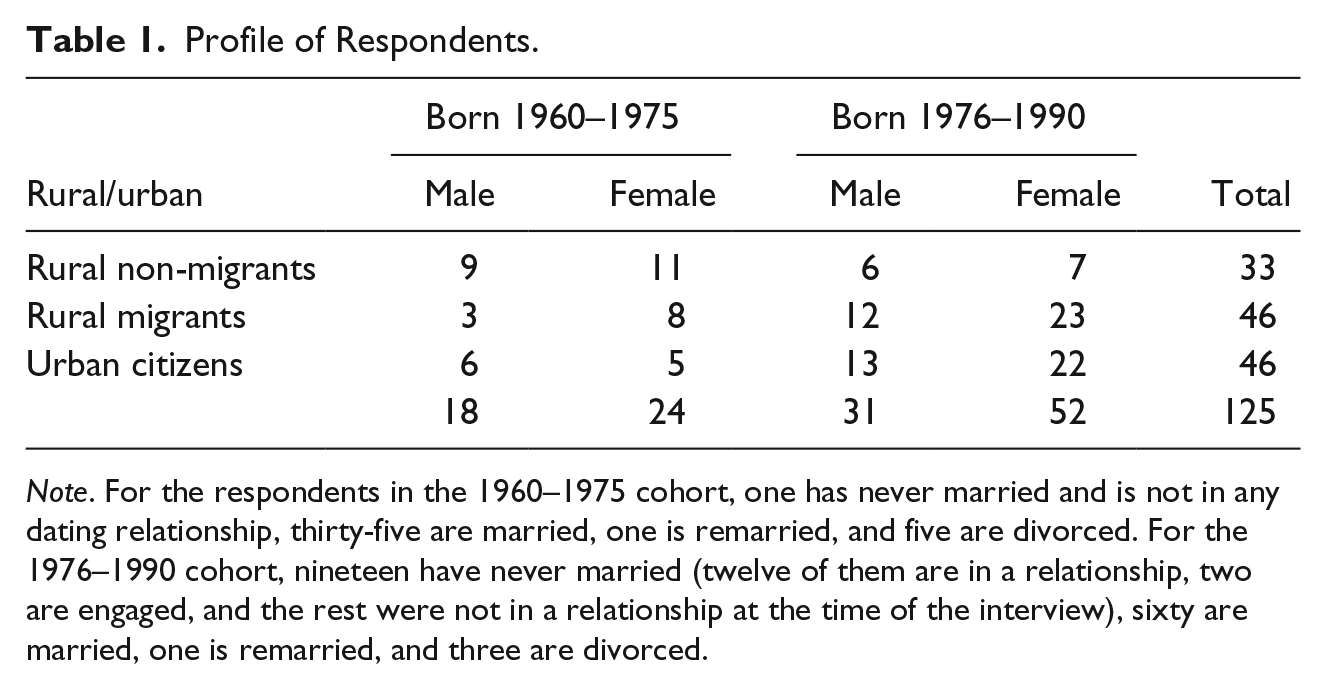
Note. For the respondents in the 1960–1975 cohort, one has never married and is not in any dating relationship, thirty-five are married, one is remarried, and five are divorced. For the 1976–1990 cohort, nineteen have never married (twelve of them are in a relationship, two are engaged, and the rest were not in a relationship at the time of the interview), sixty are married, one is remarried, and three are divorced.
The cutoff age between the two cohorts depends on the sociopolitical milieu and the shared experience they had, as emerged from the data. 7 Rural respondents who were born in the 1960s and early 1970s were teenagers or young adults when China began opening up. They remembered seeing production teams in their area. Some had dropped out after Primary 5 (equivalent to Grade 5) and followed their parents into the workforce. As many of them suggest, the working environment was segregated by gender, making it difficult to meet a potential mate at work. The female respondents had sideline occupations such as handicrafts, fishing, and working in the fields. Some were clerks at brick factories in the production teams. The male respondents were responsible for transporting and making bricks, driving tractors, and slaughtering pigs in a production team. One respondent was a carpenter. Some respondents with more years of education had not worked in production teams, but they did help with household sidelines such as fishing and farming. They recounted that work migration was rare because there were very few villagers 老乡 in the city. But many of them did migrate some years after they were married. The rural migrants were usually the first in their family to migrate for work. Unlike rural non-migrants, the migrants tended to meet their future spouse on their own, thus creating more conflicts between them and their parents. Rural migrants and rural non-migrants in the older cohort similarly dated around 1.3 to 1.4 people on average before marriage.
Most rural respondents who were born between the late 1970s and 1990 had migrated for work before their marriage. At least one son usually remained in the rural household to continue helping with the family’s economic activities such as fishing, farming, and construction work. Many jobs in the cities were unstable and without labor protection. Women worked as servers, salespeople, hotel receptionists, clerical staff, and blue-collar staff in factories. Many of the men were construction workers; a handful worked in factories or in sales. They usually visited their home in the village at least twice each year. Except for the construction workers, most of them had dated people in cities and some had met their dates online. On average, before marriage they had dated 2.2 people (men slightly more than women); rural non-migrants dated 1.5 people.
Urban respondents born in the 1960s and 1970s had a range of family experiences, depending on whether they were from a “bad class” such as landlords, pre-revolutionary elites, and intellectuals. Those whose parents were peasants and workers worked in units 单位 (scientific research departments, films, factories, food units, and nurseries) and some respondents inherited these positions in the 1980s until the early 1990s through the “inter-generational job substitution system” 顶替. A few parents who had been “struggled against” 批鬥 endured a few years of household split and family displacement. The parents relied on distant relatives in Hong Kong and villages in Guangxi to help the older cohort of urban respondents to escape. Some fathers were imprisoned.
Despite the propaganda that the people love Mao and should denounce their parents who had a bad class background, the respondents had maintained a strong sense of family unity and emphasized the importance of “showing filial piety to their parents because of their sufferings.” During the early opening up years, these respondents had dated on average 2.2 people before marriage, but like those older cohorts of rural people, they met their spouse through older relatives, parents, or senior colleagues in the work unit.
Urban respondents born from the late 1970s to 1990 came to adulthood when China’s economy was booming. They were exposed to the notion that love should be passionate and that they should follow the latest styles through the media, leisure activities, traveling, their daily encounters with people outside China, and studying abroad. 8 Instead of the practice of “self-sacrifice” that they often attributed to their parents, they emphasized personal desires and aspirations. Around half of these urban respondents had no siblings. They are more educated than the preceding generation and rural people (only two had not attended college). They work as support staff in companies, as teachers, and as workers in state-owned enterprises. Some are entrepreneurs. They also had more dating experience (2.3 people on average). Most had met their future spouse on their own. Only four of the thirty-five met their spouse through an older relative.
Respondents varied in their dependence on their families for housing. Both cohorts of rural non-migrants completely or partially depended on the men’s parents and relatives for housing at the time of their marriage. Couples live either in the paternal home or in rare cases, separately from the parents. For the older generation, the couples “split the family” 分家 (i.e., live independently from the men’s parents) on an average of four to five years after their marriage, often with the help of the parents, brothers, and friends.
In contrast, younger rural couples who have remained in the village have no plans to move out. They either need the parents for childcare or they have their own space on a separate floor. Rural migrants are not as dependent on their parents’ support for housing since they visit only twice a year. They are also in no hurry to move out of the parental home. Around half of the urbanites in the older generation had depended on the husband’s parents for housing; only a quarter of the younger generation does. Following the patrilocal norm, most parents do not need to provide housing for their married daughters, although for the younger cohort of urbanites, of those who have received parental support for housing, around a third got it from the wife’s parents.
Divergent Responses to Parental Disapproval
The respondents tended to look for partners who are “respectful to elderly people.” Male respondents preferred a filial woman who will “be able to please her husband’s parents” and be willing to perform domestic work (most of which is done by their mothers). They believed that filial virtue in a wife will reduce conflicts with her mother-in-law. Female respondents, in contrast, redefined “filial piety” in bilineal terms that maximized their emotional and/or financial support to their natal families, despite practicing a patrilocal household arrangement and investing in the men’s family. Thus, they looked for filial men who would or would allow them to demonstrate filial piety through providing care and financial support to their own parents. For families in which the daughter is the only child, this notion of filial piety is important. Before marriage, they often mentioned to their potential husband their expectation that their parents would move into their household or that the couple would move closer to them when their parents’ health began to decline.
The real test of filial piety comes when the adult child’s choice of spouse clashes with the preferences of his or her parents. A filial child would capitulate to the parents’ wishes. Yet not all respondents did. While some complied with the parents’ wishes, others resisted passively, vigorously, and/or negotiated with their parents. Slightly less than half of my respondents reported disapproval from their parents; younger cohorts, rural migrants, and urbanites faced disapproval more than did rural non-migrants and the older cohorts. 9 This finding sounds counterintuitive because of the popular wisdom that urban areas and the newer generation of parents are more liberal. However, the marriages in the latter two groups were often completely or partly arranged by parents. These respondents also had fewer chances to date and/or date someone outside their hometown, who might speak a different dialect and have different customs and practices. This minimizes the chances of parental disapproval.
Of those who faced disapproval, only a few of the respondents ended the relationship with the potential spouse. All except one were older respondents and/or rural people who never left or had returned or planned to return to the village. One averred, “unlike young people nowadays, we are more filial and we obey our parents.” Renshu (male, urban Guangzhou, born in 1964) inherited his father’s position 顶替 in a government film production unit in the 1980s. He had great respect for his father, who he claimed had made great contributions to the country. Once he introduced a woman from Beijing to his parents, but they disapproved of her because she was from another province and because his mother spoke only the local dialect, not Putonghua. Although the relationship was serious, the young couple decided that parental disapproval was too big an obstacle to their relationship, so they broke up. Although Renshu lived with his parents (but could have afforded to move out if he had chosen to) and loved his girlfriend, who he said “was as beautiful as Rosamund Kwan” (a popular Hong Kong actress), he valued obedience to his parents more. In addition, as a filmmaker who frequently made trips out of town, he was concerned about the possibility of family strife, given his expectation that if they married, she would move in with him and his parents.
Rural non-migrants share the moral imperative of obedience, especially in the closed rural communities, where rumors spread quickly. But in addition, household finances and economic activities make it difficult for them to defy their parents. Before marriage, most rural non-migrants work in their family’s business or sideline production. Most of those who have a salaried job in the village contributed all their earnings to the household budget. Since the household economy is headed by the father, rural non-migrants tend to give in to their parents. This is especially true when the parents of the man disapprove of the prospective bride, because custom requires the men’s family to pay for the bride price and for the wedding banquet with the whole village, and to provide for housing (the majority of the rural non-migrant respondents are patrilocal). 10
Among rural non-migrants, some women in the younger cohort seem more willing to defy their parents, although the daughters also rely on their family to provide a dowry and a small banquet in the natal village, according to village custom: [My husband and I] had dated for so many years, but my parents disapproved after they asked around and learned about his family background. He was poor and he has lost his father, while having four siblings and a mother. He didn’t own a house. But I couldn’t let go of him because he was really good to me. [. . .] My parents threatened not to pay for the wedding banquet or to give me a dowry if I married him. I insisted and I said: “I’m your only daughter. [She has three brothers.] You’re only shaming yourself if you don’t hold a banquet. It’s up to you” [laughs]. Eventually, the night before the wedding, my mother backed down and had everything arranged including the dowry. (Xiuwen, rural non-migrant from Maoming, Guangdong, born in 1981)
Xiuwen’s defiance seems to reflect her individualistic beliefs. She risked her parents’ loss of “face.” The “reciprocal obligations” of parents and daughters based on filial piety might not be as strong as the parent-son relationship. Before marriage, most members of the young cohort of rural non-migrant women either did not have a salaried job or had parents who encouraged them to keep their salary as “safe money” 旁身. Unlike the rural migrant daughters who send quite a substantial amount home in remittances (see also W. Zhang, 2009), rural non-migrant daughters give cash to their parents only occasionally. After marriage, they are also busy investing in their husband’s family and/or building their new house.
At the same time, some parents of daughters (like Xiuwen’s) mentioned, “My responsibility is over after you’re married. It’s your husband’s turn to control you.” Parent-daughter ties are not severed after marriage; daughters provide emotional and physical care for their parents and some grandparents take care of their grandchildren when the other in-laws cannot. However, instead of reciprocal obligations as among parents-sons, Xiuwen highlighted reciprocal bonding. This explains her confidence that her parents would back down: “I love my parents, and don’t want to make them angry. But they can’t stop me because they love me [in Cantonese, 好锡我].” In addition, daughters’ parents do not have real power over their daughters. Instead, in a practical sense, Xiuwen believed that as long as the husband’s family had a house and he had enough savings to start a small business, the couple should be fine. In sum, weaker reciprocal economic obligations, strong parental love, and the lover’s acceptable financial status allow some rural daughters to feel less obliged than rural sons to give in to parents who disapprove of their choice.
Rural migrants could be as submissive and obedient as non-migrants in response to parental disapproval, especially those who have a strong intention to return to the village. However, many are radical—sometimes even more so than urban people. Some eloped, others cohabited, some had children without marrying, and others had a falling-out with their parents. As Dingbang (male, rural migrant from Maoming, born in 1985) told me: Right from the beginning, my parents disagreed because my wife back then was too young—seven years younger than me. [Author: So what did you do?] I pushed for it. [Author: How?] We had a baby first. [. . .] They gave me no choice as we loved each other. At the end, they had to accept it.
Some of the respondents quoted an old Chinese saying: “The ripe rice is now cooked. What can the parents do?” Since Chinese society frowns on childbirth outside of marriage, and children are not legally registered unless their parents are married, these adult children hoped that having a baby would force their parents to approve their choice of spouse. 11 In China, a birth outside of marriage could be interpreted not as a personal choice but as an expression of resistance to parental authority over an adult child’s choice of spouse. Young adults believe that parents are more likely to approve of a partner when they are threatened with the loss of face.
Taking drastic steps to obtain that approval is particularly salient for rural migrants like Dingbang. He asserted that having worked in Guangzhou for seven years, he could afford the bride price and the wedding banquet without his parents’ help. Besides, distance from home and infrequent visits are an important factor in migrants’ radical responses. This is also true for the older generation of rural women and men who migrated for work for extended periods.
Among rural migrant daughters, one reason for parental disapproval is the daughter’s plan to marry someone from outside of the province, something that happens more often now that labor migration has expanded the marriage pool. Instead of worrying about the communication problem between the son/daughter-in-law and the wife’s/husband’s parents (like urban parents in Guangdong), parents of rural migrant women are concerned about the fraying of ties with their daughters who have moved to their new home in their husband’s village far away from theirs. This phenomenon is not found in rural migrant sons because men would not be expected to agree with a matrilocal arrangement anyway. Panyan told her story: My sister and father disagreed with our marriage [her mother died when she was young]. Sichuan is too far. We might need a few thousand dollars to visit one another. My sister was worried that if my husband’s family members treated me badly, they couldn’t offer help. My father even said, “If you marry and move to that faraway province, I will just pretend that you were never born.” (Panyan, rural migrant woman from Guangxi, born in 1983)
Panyan’s story reflects an expectation of intergenerational support and care after marriage, even though she is already living far from her natal home due to labor migration. She insisted on marrying her boyfriend (also a rural migrant) from Sichuan because he was a good man who had stayed in the relationship with her despite his own parents’ opposition. She took this as a sign of his love. Her defiance of her father, however, does not make her unfilial. Despite the damage to her relationship with her father and sisters, she continued to send remittances back home and to save money so that she could visit her natal family once a year.
In sum, adult children’s responses are shaped by the gendered situation—like many rural migrant men, rural migrant women tended to have their way (because they are geographically and emotionally more distant from their parents than the non-migrants) (Obendiek, 2017); however, they took compensatory measures to make sure the moral obligation of a filial daughter continued. In other words, while mate selection might be more outside of the control of rural migrants’ parents, moral and economic obligations are not. The rural migrants who had damaged their relationship with their parents expressed guilt and shame, describing themselves as “unfilial,” “too self-centered,” “regretful,” and that they “owed their parents a lot.”
Like rural migrants, young urbanities usually insist on their marital choice, although they seem to be averse to confrontation. They usually tried resolve this conflict by semi-complying while delaying marriage to save enough money to live independently and/or partly to lobby for their parents’ consent. Instead of rejecting their parents outright, most of these adults felt great empathy for them. Subing recounted her struggle with her parents: My mom worried that my partner wouldn’t be able to take care of me because he couldn’t afford an apartment. His family is also a bit poor. My mind went back and forth: My parents don’t like him, maybe I should just let go of this relationship. But I feel he’s the right guy. Should I give up because of my parents? My parents wanted me to find true love, but they also hoped that my life would be more secure. I considered this for so long that my mom began to worry that I was getting older and needed to marry soon. In the meantime, she recommended some boys to me through her friends. But I really didn’t like any of them. At last, my parents backed down. My parents have two apartments and my mom offered to sell the old one and bought [me and my husband] a new one. (Subing, married, Guangzhou urban woman, born in 1985)
Subing may not have intentionally delayed her marriage to compel her parents to back down, but she also did not marry someone that they would have chosen. Instead of shunning matchmaking arrangements, which most young people dismissed as “feudal,” “outdated,” and “ancient,” many of them participated in them dutifully; these failed matches helped convince their parents that they had chosen the right spouse. Subing’s indecision made her parents worry that she would marry late or perhaps become a “leftover” woman, so they conceded.
Sandy To (2015) has called these mate selection dynamics “filial negotiation.” This involves coming up with a decision that everyone is happy with—a type of negotiation that Zavoretti (2017) also found among the Nanjing couples she studied. Young urbanities might not reflect the strong moral sense of obedience that is common among the older generation and rural non-migrants (especially men). They argue that it is a shame to give up a soulmate because of parental disapproval, but they show respect for parents’ views by negotiating.
To return to Subing, first, she and her partner could not afford a decent place to live. She explained, “Based on the money he had, we could only afford a very small place like thirty or forty square meters, even if I pitched in. This type of housing is usually very old and pretty rundown. I really can’t accept this kind of life.” Given the high housing prices in Guangzhou, the couple had to borrow from her parents. Yet unlike the villages, where the men arranged for housing (and thus the parents of sons might have more leverage than they otherwise would over a daughter), support for housing is not unlikely for daughters. Urban parents, like Subing’s, who are financially stable could not bear seeing their daughters living in housing that they considered unacceptable. More importantly, Subing was an only child. As her mother said, “these properties will be passed on to [her] anyway.” Since urban parents’ support for housing (including for their daughters) is important, they have a say in their children’s choice of spouse. And unlike rural migrants, they are less likely simply to leave. Only one urban daughter, despite marrying a man with no money and cutting ties with her parents, managed to achieve a decent standard of living. 12 She was unique because she had held a good job for a long time and had been able to save a good deal of money. Economic dependency resulted in the practical need for the couple to negotiate their choice of spouse instead of going to great lengths to assert their independence.
Second, they understood that their parents’ interference was well-intentioned and rooted in their parents’ love for them. When faced with parental disapproval, they did not back down, but at the same time they did not want to upset their parents. Filial negotiation strategies did not seem to reflect blind obedience; instead the filial relationship was embedded in the emotional bond between parents and children (J. Zhang, 2017). This seems particularly strong because adult children in urban families, like Subing, tend not to have siblings. Thus, in urban areas, the expression of filial negotiations reflects both power (especially for middle-class parents) and the emotional side of the intergenerational relationship. For this reason, many urban couples delayed marriage, while bargaining with and maintaining a good relationship with the parents, their potential spouse, and his or her parents.
Not Marrying as an Unfilial Lifestyle Choice?
My parents urge me to marry anyone regardless, but this would just end up badly. Marrying for the sake of marrying is a huge mistake. Like the last guy I was with: he is good in all ways—not living with his parents, ambitious, responsible, successful, and a good provider. He doesn’t go to nightclubs. A perfect guy. Our parents also wanted us to be together. But something was missing [. . .] I didn’t feel we were there yet. [. . .] His life was too routine. If this was the life I chose, I would have married him. But obviously, that wasn’t for me. [. . .] I didn’t sense any sweetness in this relationship. There was no sense of joy coming from my heart when I was with him. I had no wish to get to the stage of marriage. (Ziwei, single, Guangzhou urban woman, born in 1982)
Across all generations and areas, single men and women who have passed the average marriage age consider themselves unfilial for worrying their parents (see also, Eklund, 2018).
13
Yet, strongly influenced by individualism, young urban women and men do not marry until they think they have found Ms. or Mr. Right. Ziwei had three serious relationships since her early twenties, but none felt right. She followed her heart and described her relationships as self-fulfillment projects, in which the relationships had helped her achieve personal growth. In each relationship, she learned about herself and the kind of partner and family life she wanted. She understood that women like her were stigmatized as “leftover women,” something that worries her parents. Tingting felt the same way, but with much more guilt: I just think it’s okay to be single. If I form a family with someone I don’t like, it does me more harm than good. But it’s such a hard decision. Should I marry? Or should I not? My parents are worried about me and I’m torn. And now my mom is gone. I feel sad that I’ll never get her recognition. It’s a big regret for me because I feel so unfilial. My parents want me to have my own family, but I can’t . . . [sobs] This society puts a lot of pressure on me. It’s like there is a rule telling me when I should date and marry someone . . . [long silence]. (Tingting, single, Shenzhen urban woman, born in 1974)
Tingting felt unfilial because her mother died without seeing her marry. She felt as if her mother cannot rest in peace. Despite their moral pangs, Tingting and Ziwei neither backed down in the face of their parents’ concerns nor rejected the possibility of marriage. Ziwei reflected upon and evaluated each romance, set goals, identified problems, and started over.
Beyond feeling guilty about worrying their parents, single urban men’s need to marry is stronger because they have a larger picture of patrilineality in mind: I’m not a filial son. [Author: Why?] In our tradition, we believe that there are three forms of unfilial conduct, of which the worst is to have no descendants. My parents are worried, and I’m the only son. Even my grandpa and my uncles all urge me to marry. They remind me that I’m the only grandson. My grandpa’s last words before his death were to carry on the family line. I feel so responsible. You know, if I die, my son is responsible for carrying my photo and placing the ancestral tablet alongside those of other deceased members. (Youxiao, single, Guangzhou urban man, born in 1978)
The responsibility for continuing the family line falls on sons, so staying single is not an option. Youxiao, a university graduate who was working as a web designer, had four online relationships; none worked out. Yet, he did not hurry. He moved out of his parents’ house to avoid arguments about his social life. Compared to Youxiao, the older generation of single men made a quick decision to obey their parents, reflecting a stronger sense of obedience. Renshu told me that despite having three more relationships (after breaking up with the woman that his parents objected to), he could not find the right person. When he turned thirty, he learned that his parents’ health was failing so he hastily married his pregnant ex-girlfriend, saying, “At least my parents could see their grandchild before they passed away.”
In the countryside, single men and women are under even greater pressure. Rural people marry at younger ages and villages are “communities of the familiar” 熟人社会, in which people have frequent interactions. Not getting married has never crossed the mind of older rural people. While staying in Maoming, I heard gossip among villagers about the “baresticks” 光棍 (bachelors) and why they were not married. A few older men who could not find a mate within Guangdong tried to save and/or borrow money from their friends so that they could buy a bride from Guizhou or Vietnam. According to my rural respondents, the pressure is real: My parents had to put up with being stared at for a long time. The neighbors accused my mom: You spoiled your daughter. You just let her pick this one and that one. You let her have her way. That gossip made me sad. I’ll compromise and get married because of my mother. She was raised in this environment, this culture, this atmosphere, . . . [pauses] and she has to bear all these things [sobs]. I don’t want to let her down [sobs]. (Meifeng, engaged, rural migrant woman from Maoming, born in 1982)
While marriage is important in Chinese society, rural people—migrants as well as non-migrants and both women and men—associate non-marriage with the shame that their parents must live with in the rural community. While non-migrants and the older generation tend to marry young, many long-term rural migrants, like many urban women, believe a bad marriage is worse than no marriage. Yet, Meifeng did feel unfilial for letting her mother down; but she distanced herself from parental influence by visiting her village home less frequently and not calling her parents on the phone until she found a partner, a manager in his thirties from Hong Kong. She took him back to her village to meet her parents right after their relationship was confirmed. Migrants, unlike rural non-migrants, can avoid the pressure to get married or delay their marriage, but when their parents are still living in a closed rural community, they are not as free as urban women.
Conclusion
This study examines the expression of filial piety in mate selection for two cohorts of Chinese people when their choice of spouse or their lack of interest in marrying clash with their parents’ wishes. Filial considerations involve upholding moral values, rational calculations about what is at stake (Yan, 2003), as well as parent-child emotional bonding (Sun, 2017). In Guangdong, filial responses to parental disagreement come with ambivalent emotions of sympathy and empathy, guilt, and love. Although gendered practices within the family continue to exist (as rural properties and their businesses are still managed and owned by sons, who continue to be responsible for extending the patrilineal line), parents have a strong emotional attachment not only to their sons but also to their daughters. Material support for daughters’ postmarital residence in urban areas is not uncommon. As the parent-child relationship becomes less gendered and more emotionally driven, the parent-child commitment (including between a parent and a married daughter) to reciprocity becomes vital. Such emotionally laden filial piety shapes the parents’ role in children’s mate selection, even in the most “rebellious” cases (despite its reflection of parents’ diminished authority).
Although filial considerations are prevalent, the actual response to disagreements—complying, negotiating, and/or resisting—differs by generation, gender, and rural or urban background. Using intersectionality, I highlight the complexities of the individual-society-state linkages in Chinese family relationships behind the multifaceted filial responses. Government policies—of urbanization, family planning, and welfare—interact with regional labor economics and culture and the family economy in shaping the power and prestige of elders in their children’s mate choices and whether to marry or not.
In rural Guangdong, echoing Stacey (1983), families were not disrupted in the Mao era; production teams were organized around clans, which acted as a corporate estate with social and economic functions. During the Reform era, when many rural people left the village, based on my observations and according to Oxfeld’s (2010) study of a village in Guangdong, each family still had at least one son and/or daughter-in-law who remained behind to continue running the family business. 14 They were bound by patriarchal norms and the authority of rural elders (Oxfeld, 2010). It was still expected that housing would be provided by the husband or his parents, and thus rural non-migrant men needed parental approval of a prospective spouse. The patrilineal corporate estate, despite its gendered practices, releases non-migrant women from parents’ power over their marital choice more than it does for non-migrant men. Given the lower stakes of disobedience and their parents’ love for them, rural non-migrant women are more willing to insist on their marital choice as long as the man and/or his family can provide basic support.
The situation is different for rural migrants, particularly for the young cohort for whom working in their families’ rural businesses is less profitable than taking a job in one of the coastal cities. Although filial values are still important for young rural migrants, couples are less dependent on their parents. When there is a conflict between their personal desires and those of their parents, they are bolder about just leaving with their lover and sometimes having a child outside of marriage. While these behaviors reflect rural migrants’ autonomy from their parents, the migrants were morally conflicted, prompting them to take compensatory measures and persistently seek their parents’ approval. Some rural migrants temporarily severed relations with their parents to avoid marital pressure; yet when they found a partner, they rushed to show him or her off to the village. These behaviors illustrate an eagerness to stop their parents from being shamed—emblematic of the sustained prestige of filial piety. This suggests that migration does liberate some rural migrants from the strictures of patriarchy (Obendiek, 2017), but since their parents remain in the rural community, they feel compelled to uphold their filial obligations.
My study has shown that urban patriarchy during the early years of China’s opening-up is still strong, reinforcing Santos and Harrell’s (2017) picture of the early Reform era. Although the generational axis of patriarchy was weaker among people with a “bad class” background, they still had great sympathy for their parents’ suffering during the Cultural Revolution, so they believed they should treat their parents well. Those with “good class” backgrounds took pride in their parents’ achievements. Some of them inherited their parents’ job and shared their apartment. Despite having dated more than their parents, the older cohort of urbanites complied with their parents’ wishes about when and whom to marry.
The younger cohort of individuals showed signs of being more individualistic and concerned with achieving a desired self. Although the element of “obligation” involved in filial piety is not as strong, filial piety in urban families is increasingly emotionally embedded (J. Zhang, 2017), partially shaped by the one-child policy. Echoing Chow and Zhao (1996: 41): “The future obligations (sole providers of old-age care for their parents), together with the fact of being the only child within a family, has encouraged parents to make these children the sole recipients of emotional support, affection, care, and economic resources.” Reciprocally, urban adult children also emphasized the emotional and affectional aspects in filial relationships. In addition, adult children also relied on their parents for housing (owing to the high price of housing in big cities), which gave leverage to urban parents (of daughters and sons) over their choice of spouse. Given the material and emotional bases of filial piety while insisting on their marital choice, urban young couples engaged in filial negotiations, something that could delay their marriage plans (see also To, 2015). Young urbanites were also more likely than rural people to see remaining single as a personal choice and were less likely to marry simply to please their parents. Women were less burdened than men in this regard because of the continued belief that, to be filial, a man ought to extend the patrilineal family line, although parents have little recourse if an adult child does not want to get married. This result resonates with Eklund’s (2018) finding that urban women have more leeway in negotiating filial obligations than men. Despite the intersectional experience of parental influence on mate selection, all respondents believed that they had more freedom in their choice of a mate than their parents or grandparents did in the years before the Marriage Law. Yet, no Chinese marriages are entirely “free,” as observed by Davis (2016). The most independent adult children felt pressure from their parents to get married and to take their advice on their choice of spouse. Parents also continued to be involved in negotiating the bride price, setting the wedding date, and making wedding arrangements.
The transformation of filial piety is therefore not necessarily consistent with the expectation of a straightforward relationship between modernization and parental power (i.e., urbanites being the freest and thus the least filial; rural non-migrants the least free and thus more filial; and rural migrants being in between). Instead, filial piety, as reflected in adult children’s responses to parental intervention in their marital choice, is multifaceted. That said, this study did not recruit rural people who differ significantly in social class. Rich rural migrants and non-migrants are difficult to recruit because they are rare (Chan, 2009). Future research would benefit from considering how social class intersects with other categories of differences to change expressions of filial piety.
Footnotes
Acknowledgements
This article has benefited from the excellent comments and suggestions by the anonymous referees of Modern China.
Declaration of Conflicting Interests
The author(s) declared no potential conflicts of interest with respect to the research, authorship, and/or publication of this article.
Funding
The author(s) received no financial support for the research, authorship, and/or publication of this article.