



Abstract
This article traces and analyzes the longitudinal changes in the operative structure, rules, and practices of the Chinese Communist Party’s disciplinary institution not for the purpose of appraising its performance in corruption control but to demonstrate how the party regulates its own enforcement agency through institutionalizing the disciplinary decision-making process. To that end, this article identifies and explains the exact measures the party has used to delegate authority to the party’s disciplinary institution in a systematic and institutionalized manner without losing control over disciplinary outcomes. It also identifies three features of the institutionalization process: concentration and centralization of disciplinary power and further depoliticization of disciplinary activities.
Keywords
After an eventful takeover of the leadership of the Chinese Communist Party (CCP), Party General Secretary Xi Jinping and his administration launched a high-impact anticorruption campaign at the end of 2012. As of January 15, 2015, this campaign has put thirteen members and alternate members of the Central Committee under investigation for corruption-related violations of party discipline (see Table 1). Xi and his colleagues have thus managed within two years to remove more high-ranking party officials from office than their predecessors had in the previous ten years combined. The highlight of Xi’s campaign has no doubt been the investigation against former Politburo Standing Committee member Zhou Yongkang. Over the past two years, dozens of Zhou’s associates in various sectors and locales have been thrown out of office, with Zhou himself convicted of corruption and other crimes and sentenced to life imprisonment in June 2015.
Complete List of Fallen Members and Alternate Members of the Central Committee, after 1989 (as of January 15, 2015).
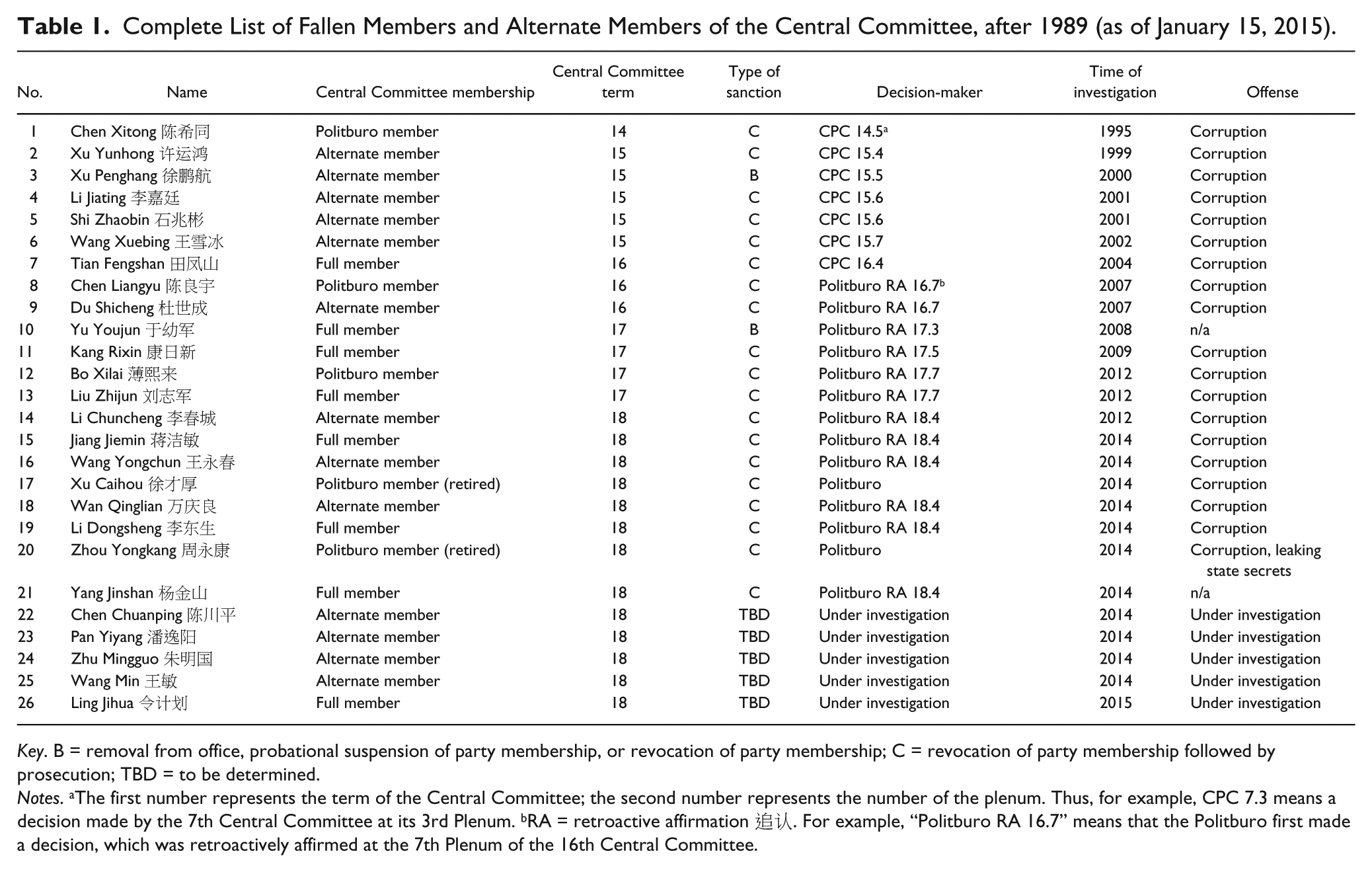
Key. B = removal from office, probational suspension of party membership, or revocation of party membership; C = revocation of party membership followed by prosecution; TBD = to be determined.
Notes. aThe first number represents the term of the Central Committee; the second number represents the number of the plenum. Thus, for example, CPC 7.3 means a decision made by the 7th Central Committee at its 3rd Plenum. bRA = retroactive affirmation 追认. For example, “Politburo RA 16.7” means that the Politburo first made a decision, which was retroactively affirmed at the 7th Plenum of the 16th Central Committee.
Launched with an unprecedented intensity and scale, the campaign has put the party’s Central Commission for Discipline and Inspection (CCDI, also referred to as CDIC in English language sources) under the spotlight both at home and abroad. The CCDI, currently led by Wang Qishan, one of the seven incumbent Politburo Standing Committee members, is known as the most powerful anticorruption organ in China. The CCDI, together with local discipline and inspection commissions (CDIs, also referred to as DICs) that have been established at various administrative levels in parallel with party committees, is responsible for policing the political order of the party and investigating individual violations of an expansive code of party discipline with coercive investigatory measures that are not available to any other party or state organ. As the CCDI has risen to prominence, its activities have also begun to draw attention from China scholars, which has resulted in scores of studies. These studies have informed us, for instance, of the local discipline and inspection commissions’ “first-move” advantage in anticorruption activities (Manion, 2004), their “extra-legal” investigatory power (Sapio, 2008), their dependence on the party (Gong, 2008; Sapio, 2008; Guo, 2014), and the limits of the campaign-driven anticorruption efforts (Manion, 2004; van Rooij, 2005). These findings have been repackaged and reiterated with varied emphases and make one wonder whether current studies on the party’s disciplinary institution have reached a plateau and exhausted the novelty of their findings.
In reality, however, the subject has not ceased evolving and its striking developments have frequently caught even the most discerning observers by surprise. In this article, I examine the topic from a different angle. Unlike the above-mentioned previous studies, which examined how the discipline and inspection commissions perform their anticorruption functions, I will examine how the commissions are regulated by the party. In other words, the focus of this article is not on evaluating the performance of discipline and inspection commissions in terms of corruption control but examining and analyzing how they, as powerful as they have become, operate under the control of the party.
To that end, I trace the institutional development of the party’s disciplinary organs from 1927 to 2012, with a focus on the allocation of decision-making power between party committees and the party’s disciplinary organs as well as the design of the decision-making process taking place between these two categories of institutions. This approach will clarify the full trajectory of institution-building by the party, using the discipline and inspection commissions as an example. This particularly expansive temporal coverage has the advantage of enabling a longitudinal study of party rules, regulations, and policies over time, which may reveal new clues and provide new interpretations of the often vague and abstract formulations in party documents. A thorough examination and analysis of these rules, regulations, and policies is valuable for two reasons. First, they are by far the most reliable and accessible sources of data for studying top-level decision-making in the party. Second, unlike state laws, which are often ignored or distorted in practice in China primarily because courts take a back seat to the party’s organs and hence cannot enforce the law when the party or other state organs are involved (Li, 2016), party rules, regulations, and policies are enacted and enforced by the party, the supreme authority of the land, and hence suffer less from a discrepancy between what is written in the books and what takes place in action.
Based on the findings of this research, I conclude that the historical development of the party disciplinary organs between 1927 and 2012 exemplifies how the party both empowers and contains its enforcement agency through a process of institutionalization. This institutionalization has delegated a considerable amount of authority to the discipline and inspection commissions and at the same time put in place a mechanism that allows the party to impose its will upon the commissions with a measured degree of engagement in the latter’s activities. The institutionalization process is characterized by three features: (1) a concentration of disciplinary power in the executive bodies of party committees, (2) a centralization of disciplinary power in the Party Center, and (3) a policy shift that designated the investigation and punishment of corruption as the primary disciplinary tool to consolidate power within the party.
The rest of this article consists of four sections arranged in chronological order. The first covers the period from 1927 to 1970s; the second, the critical phase of institutionalization of the party disciplinary system when the Party Charter, which functions as the constitution of the CCP, was amended in 1982; the third, the period from 1982 to 1992; and the last, from 1992 to 2012. The article employs mainly primary sources, such as party regulations, policies, decisions, and other archival documents.
Oscillating Early Development: 1927–1970s
While “party discipline” is characterized by rigidity, what the party’s disciplinary institution has demonstrated in its historical development is uncertainty, especially in its earlier years. Between 1927 and 1982, the party’s disciplinary institution underwent constant shifts, whether in its name, configuration, status, or mandate. Such indeterminacy reflected the top party leaders’ conflicted attitude toward the disciplinary system—to what extent should the party empower the disciplinary institution so that the institution would be powerful enough to keep the party’s subordinates in line but at the same time would not become so powerful as to tie the hands of the party’s superiors themselves?
Mandates and Activities
Contrary to the general understanding of its role as a specialized anticorruption institution, the party disciplinary system was and remains primarily a means for consolidating the authority of the Party Central Committee and preserving party unity. The first party disciplinary body, the Monitoring and Inspection Commission 监察委员会 (MIC, which is also known as the Central Control Commission), was enshrined in the Chinese Communist Party Charter at the Fifth National Party-Member Delegates’ Convention (hereinafter “Party Congress” for the sake of simplicity) in 1927, following the Leninist model (Gong, 2008: 140–4; Wu, 2009: 20). Its mandate was, however, unclear in the Party Charter. Soon after its establishment, almost all members of the Central MIC were wiped out by the Guomindang (Peng, 2010: 34). During the 1930s and 1940s, as the party gradually recuperated from the Guomindang’s attacks, a number of disciplinary bodies, under different names, were set up one after another, including the Inner-Party Review Committee, the Central Party Affairs Committee, and the Central Party Reviewing Committee (Wu, 2009). Their mandates ranged from reviewing members’ loyalty, auditing the party’s finances, and inspecting performance in terms of the implementation of the Party Charter, to indoctrination and the investigation and punishment of violations of discipline (Wu, 2009).
At the Seventh Chinese Communist Party National Congress in 1945, the MIC was reintroduced into the Party Charter, however, only as an optional unit, to be established at the discretion of the Party Central Committee. Article 56 of the 1945 Party Charter stipulated: “When the Party Central Committee deems it necessary, a Central Monitoring and Inspection Commission and local commissions may be established.” No MIC was established in 1945 because of the imminence of the civil war. After the war, the party’s disciplinary institution was revived, but its name was changed to the Commission for Discipline and Inspection (CDI) 纪律检查委员会 (Party Center, 1949). Mao personally edited the draft of the decision to establish the CDI. In his edits, Mao explained that the purpose of establishing the CDI was “to better implement the party’s political line as well as various policies and to preserve confidential information of the party and the nation,” which, apparently, had become a concern because the party had started to engage in more and more collaborative work with non-party members in the coalition government (Party Center, 1949). On this instruction, the first Central Commission for Discipline and Inspection was assembled, consisting of eleven members, led by Zhu De 朱德 (Party Center, 1949).
In practice, the CDIs seemed to have had little impact in the early 1950s, which was acknowledged by the party in the wake of the so-called Gao/Rao affair in 1955 (National Conference, 1955b). The incident was officially characterized as an “anti-party conspiracy” by Gao Gang 高岗, the vice-premier and chairman of the Central Government Planning Committee, and Rao Shushi 饶漱石, the director of the Central Party Organization Department (National Conference, 1955a). Both were expelled from the party. It was against this backdrop that the Central Committee quickly resurrected the local MICs, replacing the CDIs (National Conference, 1955a). The new MICs were authorized to investigate and sanction minor disciplinary violations on their own (National Conference, 1955b: Item 4). This was deemed necessary to fight these sorts of violations, in particular, to prevent anything similar to the Gao/Rao incident from recurring (National Conference, 1955c; Zhao, 2006: 21). From 1956 to the Cultural Revolution, the MICs functioned as an enforcement agency for the party’s successive political campaigns. It was also during this time that corruption investigation started to comprise a considerable portion of the MICs’ workload. However, none of the corrupt activities at the time, it needs to be pointed out, would, in terms of the value of the stakes involved, come close to the kind of corruption being investigated today. At this time, the MICs became exceptionally active. For example, in the first six months of 1962 alone, the MICs nationwide handled close to 250,000 cases and rendered disciplinary decisions against 58,000 party cadres (Zhao, 2006: 24). In 1969, the MICs were abolished in the process of institutional downsizing (Anonymous, 2014e).
Institutional Structure
Shifts in the party’s position on the institutional structure of the party’s disciplinary institution were the main reason for the repeated changes in its early years. This institutional structure involved three critical issues: the configuration of the party’s disciplinary institution; the relationship between the disciplinary institution and corresponding party committees; and the relationship between the central and local disciplinary organs.
Configuration of the Party’s Disciplinary Institutions
When the party’s disciplinary organs were first introduced in 1927, they were conceived of as organs whose members would be elected by the party congresses, the same electoral bodies that would elect party committees (Party Center, 1927: Article 61). Members of the disciplinary organs were prohibited from simultaneously serving on party committees (Article 62). They were allowed to attend party committee meetings but would have no right to vote (Article 63). This arrangement suggests that the designers of the disciplinary system intended to preserve a degree of autonomy for the party disciplinary organs from the party committees, as Lenin intended for the Soviet disciplinary system (Wang, 2010). When the Party Charter was amended in 1945, it provided that the members of the MICs would be elected by the party committee at the corresponding level. This meant that MIC leaders would owe their membership to the very institution which they would be expected to monitor, investigate, and discipline. As mentioned earlier, the 1945 Chinese Communist Party National Congress did not elect any MIC because of the civil war (Wu, 2009: 21). During the war, the disciplinary function was undertaken by party committees and organizational departments (Wu, 2009).
Relations with Party Committees
In the 1927 Party Charter, MICs enjoyed a more equal status with the party committees and the rules valued consensus- building between the two institutions. For example, according to Article 64, party committees cannot revoke decisions of MICs and at the same time decisions made by the MICs have to be approved by party committees. When disputes between the two arise, a joint committee consisting of members of both disputing institutions will arbitrate. When the joint committee cannot reach a decision, the dispute will be submitted to the corresponding party congress or the MIC at the next higher level for further mediation and resolution. In reality, this institutional arrangement had never been put into practice because the MICs ceased to function after the Guomindang’s purge. In 1949, when the discipline and inspection commissions were introduced to replace the MICs, Mao handpicked the members of the first Central Commission for Discipline and Inspection (Party Center, 1949). The CCDI was required to report to the Politburo every two months and also as soon as issues of importance arose (CCDI, 1950). Through his edits, Mao also placed the CCDI under the leadership of the Politburo instead of the Central Committee (Party Center, 1949). This modification is of great significance since it was the top party leaders’ first effort to move control over the CCDI from the more representative Central Committee to its executive body, the Politburo. As will be shown in later sections, this effort continued throughout the development of the party disciplinary system and was a key feature of the party’s institutionalization process.
Central-Local Relations
Before 1949, local party disciplinary organs barely existed because of the mobile and underground nature of the party itself. Therefore, the relation between the central and local disciplinary organs was not a concern until after 1949 when local disciplinary organs were established nationwide. In the Party Charter of 1956, Article 54 stipulated that higher-level Monitoring and Inspection Commissions are authorized to inspect the work of lower-level Monitoring and Inspection Commissions and to approve and change [disciplinary] decisions on cases made by lower-level Monitoring and Inspection Commissions; lower-level Monitoring and Inspection Commissions shall accurately report their activities to their superior commissions regarding disciplinary violations by party members.
In 1962, the party further centralized disciplinary power by authorizing local MICs to break ranks, bypass the local party committee at the corresponding level, and report violations by local party members directly to a superior party committee or MIC, and, if necessary, all the way up to the Central Committee (Central Committee, 1962).
The development of the MICs was eventually arrested by the Cultural Revolution, when the power struggle at the very top of the party leadership started to break down the institutional cohesiveness of the party (Peng, 2010: 35). Like many other party organs, the MIC had become a target in the political turmoil. For example, the Central (Party) Organization Department had once dissolved the MIC office embedded in it and subsequently sent many of its staff to labor camps (Fan et al., 2011: 43–44). During the turmoil of the Cultural Revolution, the entire party institution was under attack, which left the MICs paralyzed as well. Subsequently, the provisions regarding the MICs were also removed from the Party Charter following its amendment in 1969 (Party Charter, 1969). During the Cultural Revolution, many Central Committee members and alternate members were punished for political disciplinary violations, but these cases were mostly handled by an ad hoc “special investigation team,” not the MICs (Special-Case Small Group, 1968). The full restoration of the party’s disciplinary institutions did not begin until after the Twelfth Chinese Communist Party National Congress in 1982.
Institutional Framework: The 1982 Party Charter
The year 1982 is significant in the development of the party’s disciplinary system because it was in that year, at the Twelfth Communist Party National Congress, that the most comprehensive amendment of the Party Charter was promulgated, with a lasting impact on the operation of the party’s disciplinary system in the decades that followed.
Mandates
According to Article 44 of the Party Charter as amended in 1982, the CDIs perform three main tasks: “preserving [the authority of] the Party Charter and other important party regulations”; assisting party committees in rectifying “party style” 党风; 1 inspecting the implementation of the line, principles, policies, and decisions of the party. Article 44 also stipulated that the Central Commission for Discipline and Inspection and local commissions should conduct regular disciplinary education for party members; make decisions to preserve party discipline; investigate and handle more important and complicated violations of the Party Charter, party discipline, and state laws and regulations; impose as well as remove disciplinary sanctions against party members; and, finally, receive and process allegations and complaints from party members.
Compared with what was prescribed in previous versions of the Party Charter, Article 44 significantly clarified the role of the party’s disciplinary institution: it is the enforcement arm of the party—a specialized body authorized to take concrete disciplinary action. It has the power to investigate violations, impose sanctions, as well as remove sanctions if it believes rehabilitation is warranted. Article 44 also clarified that the CDIs’ disciplinary activities should focus on more important and complicated disciplinary violations and hence it distinguished the CDIs activities from those of the party organizational department, which is authorized to handle less “important” and less “complicated” disciplinary violations and to apply more lenient organizational sanctions (CCDI, 2009).
In his study, Graham Young captured the essence of the early debate within the party over the propriety of applying disciplinary sanctions instead of education and training as a means of preserving the authority of the party and rectifying “party style” (Young, 1984: 41–44). Whatever doubts had existed were dissipated by Article 38, which bridged the gap between the party’s discipline mechanism and state laws. Article 38 stipulated that (1) disciplined party members have to be investigated and sanctioned by state organs if their conduct also violates state laws and regulations, and (2) party members who have violated state criminal laws must be expelled from the party. As we will see below, the wedding of the party’s disciplinary system with the state criminal legal system has provided the party with a powerful tool to consolidate its power. This tool has been much needed after the promulgation of the state’s Criminal Procedural Law, which in effect meant that the party relinquished the direct use of violence, a practice it had frequently resorted to in political purges and class struggle before and during the Cultural Revolution.
Institutional Structure
The Party Charter of 1982 set forth the configuration of the CDIs, the relationship between them and party committees, and the relationship between the CCDI and the local commissions.
Unlike members of other functional units of the party, who are appointed by their superiors, members of party disciplinary organs are elected by party delegates. However, party rules have gone through various changes regarding who should elect members of the party’s disciplinary organs. As mentioned earlier, the 1927 Party Charter designated the party congress at the corresponding level as the electorate and the amended Party Charter of 1945 replaced the Party Congress with the corresponding party committee. In 1949, when the first CCDI was constituted, in fact there was no election by either institution. Instead, its members were handpicked by Mao upon the recommendation of, presumably, Zhu De, the appointed chief secretary of the CCDI.
When the Party Charter was amended again in 1982, it reverted to the practice of 1927 and stipulated that the discipline and inspection commissions are to be elected by the party congresses at the corresponding level (Article 19). At the same time, the amendment also authorized the establishment of a decision-making body within discipline and inspection commissions, namely a standing committee, led by a chief secretary and several vice-secretaries. Members of this standing committee, including the chief secretary and vice-secretaries, are to be elected by the CDI’s members; however, the results of elections have to be reported to and approved by the corresponding party committee before taking effect (Article 43). This new arrangement maintained the nominal electoral character of the CDIs and at the same time gave the party committees the power to control the outcome of elections.
The CDIs have never enjoyed the measure of autonomy vis-à-vis the party committees that was intended in the Party Charter of 1927. The role of the party committees, defined in the 1945 Party Charter, was to provide “advisory guidance” 指导 to the corresponding CDIs. Later, the 1956 Party Charter strengthened the supervisory power of party committees over their corresponding CIDs as the former’s role was changed to “direct” 领导 the work of the CDIs. This provision remained intact when the Party Charter was amended again in 1982 (Article 43). This means that any given CDI has no power to discipline members of the corresponding party committee. For example, the Party Charter required the CCDI to first report to the Central Committee if it detected violations by Central Committee members or alternate members (Article 44).
At the same time, the CDI enjoys a distinctive status compared with other party organs because unlike the latter its members are elected and not appointed. In addition, Article 43 of the 1982 Party Charter stipulates that candidates for the head of the Central Commission for Discipline and Inspection must be chosen from members of the Politburo Standing Committee. In other words, the head of the CCDI will have a seat in the highest executive body of the CCP. This rule has been followed closely in practice except in the case of Wei Jianxing’s 尉建行 first term in 1992–1997. In 1997, just after Wei’s first term, the “mandatory-seat” provision of Article 43 was removed from the Party Charter. The practice was, however, resumed as Wei was promoted to the Politburo Standing Committee during his second term and has been consistently followed since then.
Article 43 of the 1982 Party Charter introduced “dual supervision” as the governing principle for the operations of local CDIs. “Dual supervision” subjects local CDIs to the supervision of both the corresponding party committee and the superior CDI, that is, the CDI at the next higher level, with the former taking the primary responsibility for day-to-day supervision as well as for funding the CDI under its watch (Anonymous, 2013b). In principle, a local CDI can dispute a decision made by the corresponding party committee and submit a complaint to the superior CDI for reconsideration (Article 45). But in reality, local CDIs rarely challenge decisions of their corresponding party committees because getting elected depends on the latter’s recommendations and the local CDIs depend on the party committees for funding (Anonymous, 2013a).
Nonetheless, “dual supervision” allows a superior CDI to exert considerable influence over lower-level CDIs in some circumstances. According to Article 45 of the Party Charter of 1982, superior CDIs enjoy the power to approve and change decisions of lower CDIs, but with one exception: if a superior CDI intends to change a lower CDI’s decision that has already been approved by the latter’s corresponding party committee, the motion to change has to be approved by the superior CDI’s corresponding party committee (Article 45). In other words, a superior CDI has direct authority over a lower CDI but not the lower party committee. This is because local party committees assume responsibility for all party affairs within their territorial jurisdictions and answer only to the party committee above, not its component. The CDI is a specialized component of the party and a “component” cannot override the authority of a “whole (party committee).” This is an important organizational principle that is intended to help maintain the linear structure and institutional cohesiveness of the party as a whole.
Disciplinary Decision-Making Structure
In previous Party Charter amendments, the few rules concerning the party’s disciplinary system focused on its mandates and basic institutional structure. The Party Charter of 1982 articulated the mandates, modified the structure of the party’s disciplinary organs, and for the first time identified key procedural requirements for disciplinary decisions.
According to Article 40 of the 1982 Party Charter, disciplinary power is assigned to different decision-approval authorities based on the membership status of the accused party member and the severity of the sanction. Membership status is classified into two categories: party committee members and alternate members, and party members who have not been admitted to any party committee (in other words, rank-and-file party members). Disciplinary sanctions are classified into three categories based on the severity of the punishment: (A) warning or serious warning; (B) removal from office, probational preservation of party membership, or revocation of party membership; and (C) revocation of party membership followed by prosecution.
Article 40 establishes three procedures regarding the disciplinary decision-making process. The first is peer decision. That means that all decisions to impose sanctions on party members have to be reached by their peers. According to Article 40, this procedure applies to disciplinary sanctions in all categories against all party members. The underlying principle of this procedure is that a party member cannot be punished unless the sanction is imposed by the majority of his or her peers. For example, a rank-and-file party member cannot be punished unless the sanction is imposed by the party cell 支部 where the party member under investigation has registered his or her membership. Similarly, a member of a party committee cannot be punished unless the sanction is imposed by the majority of the party committee on which he or she serves.
However, peer decision-making is subject to an exceptional procedure, which I call “executive decision,” meaning the imposition of a sanction directly by the executive body of one’s peers. This procedure applies in two circumstances. The first concerns members or alternate members of the Central Committee or local party committees whose disciplinary violations are considered to have constituted serious criminal offenses. For example, if a Central Committee member is believed to have committed serious criminal offenses, it will be the Politburo, not the Central Committee, that imposes the sanction to expel and initiate a criminal prosecution against the party member concerned. Similarly, it will be the local party standing committee, not the local party committee, that decides to expel a member or alternate member of the party committee concerned. The second circumstance concerns rank-and-file party members. In normal circumstances, it is the party cell that imposes sanctions. However, according to Article 40, in “exceptional circumstances” a sanction can be imposed directly by the party committee or party disciplinary organ at the county level or above. What constitutes “exceptional circumstances” is not specified in the 1982 Party Charter.
The third procedure is “supervisory approval,” which is attached to both procedures mentioned above. This procedure means that a sanction, regardless of whether it is imposed through a “peer decision” or “executive decision,” will not take effect until the party organization at the next higher level has given its approval. For example, a party cell’s decision to impose a sanction needs to be approved by the party committee of the institution in which that party cell is embedded. Similarly, a decision to impose a sanction directly reached by a party standing committee needs to be approved by its immediate supervisory party committee.
The disciplinary decision-making structure described in Article 40 can be summarized as follows. First, the CDIs have the authority to apply the lighter sanctions but not the more severe ones, that is, sanctions in categories B and C. Second, the more democratic “peer decision” procedure is the main decision-making approach and should be the general rule. Third, the authority to initiate disciplinary sanctions becomes concentrated in the executive bodies of concerned party organizations (“executive decision”) as the sanctions to be imposed become more severe and involve party members of higher status. Fourth, disciplinary decision-making power is centralized through the “supervisory approval” procedure.
As will be shown below, this decision-making structure has been the foundation of the disciplinary decision-making system since 1982. At the same time, the party has constantly made adjustments to delegate significant disciplinary authority to CDIs in order to meet the growing workload associated with the increasing volume of disciplinary violations. In particular, during 1982–1992, the focus of the next section, the party adjusted the decision-making structure in three ways: it (1) expanded the “executive decision” procedure, (2) refined the “supervisory approval” procedure, and (3) delegated more authority to the CDIs.
Institutional Consolidation: 1982–1992
Throughout the 1980s, the CDIs actively engaged in the disciplinary investigation of “capitalist liberalization” 资本主义自由化 (CCDI, 1987d) and “unhealthy tendencies” 不正之风 (CCDI, 1987a) as the newly launched economic reform had created new opportunities for corruption. During this time, the party expanded the scope of disciplinary violations to include various new forms of corrupt conduct that fell under the purview of the party’s disciplinary system. At the same time, the party also introduced a number of important regulations concerning the disciplinary decision-making process, among which three had the greatest impact.
Disciplinary Decision-Making Structure
In 1983, one year after the promulgation of the amended Party Charter, the CCDI issued “Rules on the Jurisdiction to Approve Sanctions against Party Members in Violation of Party Discipline” (CCDI, 1983). This regulation (hereinafter, Jurisdiction Rules), together with its amendment in 1987, is of great importance for the party’s disciplinary activities for three reasons. First, it further moved disciplinary decision-making power from the more representative party cell or party committee to its executive body by expanding the scope of the application of “executive decisions.” Second, it added one more tier of top-down scrutiny of disciplinary decisions by expanding the “supervisory approval” procedure. Third, it made the CDIs an intermediate decision-making tier in the disciplinary decision-making process, which alleviated the increased workload on the party executive body that resulted from the first two changes.
As explained above, the 1982 Party Charter stipulated that “executive decisions” apply to disciplinary decisions against members and alternate members of party committees who are found to have committed category C violations, namely violations punishable with revocation of party membership followed by prosecution. The 1983 Jurisdiction Rules expanded the application of “executive decisions” to include category B sanctions as well, namely violations leading to removal from office, probational suspension of party membership, and revocation of party membership (not necessarily involving criminal punishment), as long as special circumstances are found in the cases concerned. Specifically, Article 1(a) of the Jurisdiction Rules states: To impose a category B sanction on a member or alternate member of the Central Committee, Article 40 of the Party Charter is to be followed. In special circumstances, the decision to apply a category B sanction on a member or alternate member of the Central Committee is to be made by the Party Center. The decision to apply a category B sanction to a member or alternate member of a local party committee is to be made by the local party standing committee, which is subject to approval by the superior party committee and retroactive affirmation by the [local] party committee when it convenes.
This practice departed from Article 40 of the 1982 Party Charter in two respects. First, for category B sanctions against Central Committee members or alternate numbers, Article 40 stipulated that the decision should be a “peer decision,” namely, a decision that required a two-thirds majority of the Central Committee. The Jurisdiction Rules replaced the “peer decision” approach with “a decision by the Party Center” when special circumstances occur. The exact identity of the “Party Center” was not spelled out. According to the Party Charter, the Chinese Communist Party National Congress and the Central Committee are the highest decision-making bodies of the party. Meanwhile, the Politburo and its Standing Committee can both act on behalf of the Central Committee. In the amendment of the Party Charter in 2002, the “Party Center” was replaced with the “Politburo.” For local disciplinary decisions, the 1983 Jurisdiction Rules also replaced “peer decision” with “executive decision” for cases involving “special circumstances” by transferring disciplinary authority from plenary sessions of local party committees to local party standing committees.
Associated with the expansion of “executive decisions” has been the creation of a “retroactive affirmation” 追认 procedure that combines the “executive decision” and “peer decision” procedure. The retroactive-affirmation procedure allows a party executive body to make a decision first and then have it “retroactively affirmed” by the plenary party committee when the latter convenes. There is no publicly available information on whether there has ever been a case where an executive decision was disapproved and if and when that happens what the consequences would be for the party member concerned. Even if members of party committees are not prohibited from casting a negative vote on the decisions put forward for their endorsement, the switch from “peer decision” to “retroactive affirmation” has made it much easier for party executive bodies to shape the outcome of the decision-making process in selected cases.
As mentioned earlier, “supervisory approval” is an approach that centralizes decision-making by subjecting disciplinary decisions reached by local party organizations to the approval of superior party organizations. The 1983 Jurisdiction Rules expanded the application of this approach by adding an additional layer of approval procedure known as “filing for the record” 备案. In essence, “filing for the record” involves conducting an ex post review of decisions made by subordinate organs. According to the “Rules on Filing for the Record Regarding Party Laws, Regulations, and Normative Documents,” lower-level party decision-making bodies are required to submit their decisions that are subject to the “filing for the record” requirement to their designated superior authority on the day the decision is rendered (General Office, 2012: Article 4). On receiving the submitted decision, the higher-level authority is to review the decision within a specified period of time (General Office, 2012: Article 9). In principle, this procedure should not affect the validity of the decision unless the higher-level authority finds serious problems with it and decides to revise or rescind it. 2 In essence, the filing for the record procedure provides the superior party organizations with another layer of safeguard measures to keep them informed of disciplinary activities in subordinate organs and gives them an opportunity to detect and rectify problems. Compared with the approval procedure, which is ex ante and a precondition for the effectuation of a decision, the filing for the record procedure requires a lesser degree of engagement from the superior party organization and consequently is less intrusive in the exercise of authority by subordinate party organs.
Regarding the application of the filing for the record procedure, Article 1(c) and (d) of the Jurisdiction Rules stipulated: (c) The decision to impose a category A sanction [i.e., the least harsh] on a member or alternate member of the Central Committee must be reported to and approved by the Party Center and the Central Commission for Discipline and Inspection. Decisions approved by the Central Commission for Discipline and Inspection must be reported upward to the Party Center for the record. (d) The decision to impose a category A sanction on a member or alternate member of a local party committee must be reported to and approved by the superior Commission for Discipline and Inspection. [The latter] is responsible for reporting the decision to the corresponding party committee for the record.
With the introduction of the filing for the record procedure, the Jurisdiction Rules identified three tiers of authorities who are involved in the disciplinary decision-making process at various stages and with various degrees of engagement: a decision-making authority 决定机关, an approval authority 批准机关, and a filing for the record authority 备案机关. Usually, these three authorities are the local CDI, the corresponding party committee, and the superior CDI. If the decision-making authority is, for example, a county-level party committee, then the approval authority will be the city-level CDI and the filing for the record authority the city-level party committee. Both scenarios suggest that CDIs have become an important intermediate-tier decision-making body in the disciplinary decision-making process.
According to the 1983 Jurisdiction Rules, the CDIs not only conduct all the disciplinary investigations but are also directly involved in disciplinary decision-making either as a decision-making authority, an approval authority, or a filing for the record authority. Associated with this is a more refined classification of the membership status of party members, which has led to finer gradations of disciplinary authority. Previously, the 1982 Party Charter identified only two categories of membership status: members and alternate members of party committees, and rank-and-file party members. The classification introduced in the Jurisdiction Rules is much more finely graded, more or less matching the nomenklatura introduced in 1984. For example, Article 3 of the Jurisdiction Rules stipulates: Decisions to apply category A sanctions to ministers, vice-ministers, directors, vice-directors, party-group secretaries and vice-secretaries of the Supreme People’s Procuratorate, the Supreme People’s Court, each ministry, committee and office of the State Council and party-group secretaries and vice-secretaries of bureaus and general bureaus directly affiliated with the State Council must be approved by the Central Commission for Discipline and Inspection and reported upward for the record to the Party Center. Decisions to impose disciplinary sanctions [in any category] on middle-management-level directors and vice-directors of the aforementioned institutions and cadres of enterprises and nonprofit public institutions affiliated with the aforementioned institutions and now managed by the Party Center must be approved by the Central Discipline and Inspection Commission and reported upward for the record to the Party Center.
In 1987, the Jurisdiction Rules were amended because of a large-scale cadre management reform that aimed to decentralize the power of appointment (CCDI, 1987b). The amendment entailed little change regarding cases involving Central Committee members and alternate members. For other party members, the allocation of disciplinary authority was modified to match changes of the amended nomenklatura. As a result, the Party Center reduced its engagement in the decision-making process and delegated more authority to the Central Commission for Discipline and Inspection and provincial party committees (CCDI, 1987b).
Disciplinary Decision-Making Process
With more authority delegated to CDIs and at the same time having opened more cases for investigation, the Central Commission for Discipline and Inspection began to expand the rules and procedures that regulated the activities of the local commissions. In 1987 the Central Commission for Discipline and Inspection issued a “Directive on Conducting Case-Examination Work” (hereinafter “Case-Examination Directive”) (CCDI, 1987c) and in 1988 a “Directive on Conducting Case-Inspection Work” (hereinafter “Case-Inspection Directive”) (CCDI, 1988). These two directives identified four stages in the work of the local CDIs: opening cases, investigating cases, transferring cases, and examining cases.
The case-opening stage is more consequential than it sounds. Article 10 of the Case-Inspection Directive stipulates: The Commission shall conduct a preliminary verification of the information reflected in the report and allegations it has received regarding violations of the Party Charter and party discipline committed by party members or party institutions. If the alleged conduct is verified but does not meet the threshold of a disciplinary violation, the commission shall reproach the offender; if the alleged conduct is verified and has indeed violated party discipline and is eligible for sanction, the commission shall open a case. (CCDI, 1988)
Article 12 stipulates that the decision on case-opening is subject to “tiered management” 分级管理. For example, at the central level: The Central Commission for Discipline and Inspection shall conduct a preliminary verification of reports of violations by Central Committee members. If a violation is confirmed, [the CCDI] shall, according to the requirements laid down in the Party Charter, submit a complaint to the Central Committee. Upon the Party Center’s approval of the complaint, the Central Commission for Discipline and Inspection shall open the case. (CCDI, 1988)
Approval authority is allocated in the same fashion at the local levels.
Once a case has been opened, it proceeds to the case-investigation stage. Case investigation is to be conducted by the specialized case-investigation department in each CDI. According to Article 22 of the Case-Inspection Directive, the following investigatory measures can be employed during this stage: Discipline and Inspection Commissions are entitled to collect evidence from organizations and individuals that have information related to the investigation. All party organizations and party members are obligated to provide evidence truthfully. . . . The Discipline and Inspection Commission investigators can collect evidence by conducting interviews with the accused or with those who are believed to have knowledge of such evidence or by examining the scene where the violation was committed and searching for and examining relevant documentation. (CCDI, 1988)
The Case-Inspection Directive also unequivocally states that the CDI investigators are not allowed, inter alia, to obtain confessions through duress 逼供, inducement 诱供, or “instruction” (“instructed confessions” 指供 are those prompted by information deliberately revealed to confessors by their interrogators during the interrogations). Additionally, the CDIs are prohibited from applying any coercive measures that were only available to state law enforcement organs, such as “detention 拘留, summons 传唤, search and seizure 搜查, [covert] investigation 侦查, and surveillance 跟踪.”
According to Articles 25 and 30 of the Case-Inspection Directive, a written report must be prepared to conclude an investigation. The report should include the basis for the opening of the case, the main facts of the violation, the nature of the violation, the accountability of the accused, and the attitude of the accused toward his/her wrongful conduct, and suggestions for sanctions. CDI leaders are to review the report and decide whether to take further action. If further action is deemed necessary, the case is to be transferred to the case-examination department (CCDI, 1988).
The next stage, case examination, in essence involves appraising the evidence obtained in the investigation stage and applying the party’s disciplinary rules to the facts established by the evidence (CCDI, 1987c). According to the Case-Examination Directive of 1987, an examination team is to be assigned to work on each case. Once the team has concluded its examination, it should present its opinion to the case-examination department for collective deliberation. The deliberation should consider the following: the clarity of the facts, the sufficiency and certainty of the evidence, the accuracy of the characterization of the case, the propriety of the sanctions, and the thoroughness of the paperwork. In the examination process, the examiners can consult and solicit opinions from other relevant organs, for example, from the party organization that has supervisory responsibility over the party member under investigation, or organs that have specialized knowledge of the violation concerned (CCDI, 1987c).
As with the case-investigation stage, a written report 审查报告 finalizes the case examination. It is required that the report give an appraisal of the evidence presented by the investigators, a reasoned opinion on the nature of the violation, and suggested sanctions that are believed proportionate to the severity of the violation. The Case-Examination Directive requires the report to be shown to the accused, who will then have an opportunity to provide an explanation and defense. Challenges of the evidence represented in the report are to be reviewed and, if considered reasonable, admitted and included in the case file. Finally, the accused will be asked to sign the report, presumably verifying the truthfulness of the factual statements mentioned in the report. The accused’s verification is not required for the finalization of the report, but the examiners are required to address the accused’s repudiation, if any, in a written note, which also is to be included in the case file. At this stage, the party member under investigation can request a reexamination of his or her case if he or she disagrees with the examination report (CCDI, 1987c).
The final report is to be submitted to the CDI standing committee for review and approval. If the standing committee approves the report, it would then process the relevant paperwork to impose the sanction stated in the report. If the reviewing standing committee does not have the final say in the case, the approved report must be submitted to the designated authority as indicated in the Jurisdiction Rules for further review and approval. Neither the Case-Inspection Directive nor the Case-Examination Directive sheds light on the details of the decision-making process within the CDI standing committee (CCDI, 1987c).
In summary, the Case-Inspection Directive and Case-Examination Directive have laid down the basic principles and procedures for CDI disciplinary activities. Opening a case functions to notify and obtain approval from a designated authority to formally register a violation. Case investigation functions to collect evidence and ascertain the facts of an alleged violation. Case transfer moves the case to a separate department for case examination. The case-examination department is supposed to evaluate all available evidence in light of the party’s disciplinary rules and conclude the examination with a full appraisal of the case and a proposed decision. The appraisal and proposed decision, in the form of an examination report, are to be sent to the designated final authorities according to the Jurisdiction Rules for review and final decision-making.
A New Era: 1992–2012
In the late 1980s, an explosion of official corruption triggered a nationwide democratic social movement (Manion, 1996: 88–89; Sun, 1991: 763), which culminated in the events of 1989. After June 4, the party quickly restored political order and resumed the economic reforms. As the market reform advanced, corruption also took on new forms (Gong, 1997) and seriously undercut the party’s legitimacy. At the Fourteenth CCP National Congress in 1992 the Party Charter was amended once again. The party for the first time declared fighting corruption to be a crucial goal. Since then, corruption investigation has dominated party disciplinary activities and corruption offenses have replaced political offenses as the primary cause for party disciplinary sanctions. In 1994, the Central Commission for Discipline and Inspection amended the Case-Inspection Directive (1988) and authorized CDIs to apply coercive measures during investigations. This has not only made the Central Commission for Discipline and Inspection the most powerful specialized anticorruption institution of the party-state, but also made the party disciplinary system the party’s most forceful instrument for consolidating its power.
Coercive Investigatory Measures
Before the amendment of the Case-Inspection Directive in 1994, CDIs were authorized only to conduct interviews with individuals or organizations that were believed to have information related to the investigation and to collect documentation at “the scene” (CCDI, 1988). They were explicitly prohibited from applying coercive investigatory measures, including detention and search and seizure, which were restricted to state law enforcement agencies. In 1994, the amended Case-Inspection Directive instituted a drastic change. Article 28 of the amended Rules (CCDI, 1994a) identified the following investigatory measures (which were prohibited before) as permissible in the course of CDI investigatory activities: 1) To examine and make photocopies of documents, written materials, accounting books, meeting transcripts and work notes that are related to the case under investigation. 2) To instruct relevant organs to provide documents, written materials and other necessary reports that are related to the case under investigation. 3) To order relevant personnel to explain issues related to the investigation at a designated time and place. 4) To make audio, video, and photographic records of relevant persons or activities when necessary. 5) To request assistance from specialized forensic agencies or personnel to provide forensic examination on special [technical] issues related to the case. 6) Upon approval by the leader of the county Discipline and Inspection Commission or above, to temporarily hold and seal documentation, written materials, accounting books, receipts, property and illicit income that can be used as evidence of disciplinary violation. 7) Upon approval by the leader of the county Discipline and Inspection Commission or above, to check the assets of the person under investigation in banks or other financial institutions and to notify the banks or other financial institutions to temporarily freeze the accounts. 8) To collect all other evidence that can prove the truth of the case.
Among these investigatory measures, except for measures 6 and 7, which are permissible only at the case-investigation stage, all the other measures, including the third, which is known as “two designations” (shuanggui 双规), are permissible at both the preliminary verification and case-investigation stages. The shuanggui measure is significant because it has proven to be coercive and powerful. Although the word shuanggui may sound innocuous, the practice resembles the solitary confinement that the party frequently applied in the past against counterrevolutionaries or defectors and only gradually ceased to use after the Cultural Revolution (Liu, 2014; Sapio, 2008). In effect, shuanggui allows a CDI to detain a suspect or a witness for the purpose of interrogation for a prolonged period of time at an undisclosed place, usually hotels or guestrooms, with neither legal assistance nor readily available remedies provided to the detainee (Liu, 2014; Sapio, 2008). Unlike the detention measure prescribed in the Criminal Procedure Law, shuanggui is not subject to the same due process procedural constraint and it offers no legal assistance to the detainee throughout the procedure.
Although torture was banned at any stage of the investigation, reports of abuse of detainees by interrogators during shuanggui in order to extract confessions have not been rare (Sapio, 2008: 16–20). In some cases, such abuse was so severe that it caused the immediate death of detainees (Sapio, 2008: 20). Even without physical abuse, the coercive force generated by the prolonged solitary confinement is so powerful that shuanggui has become the most effective measure for inducing confessions, truthful or not, as well as obtaining other incriminating information against the detainee or others (CCDI, 1998; Wei, 2001). Therefore, the party continued to authorize shuanggui even after the amendment of the Criminal Procedural Law in 1996, which limited the length of detention to 12 hours and has effectually made shuanggui an authorized illegal practice.
At the same time, the party also started to establish an oversight mechanism over the application of shuanggui in order to prevent abuse (CCDI, 1998). First, the Case-Inspection Directive imposed a top-down approval procedure for the initiation of preliminary verification (CCDI, 2000). This procedure requires investigators to obtain written approval from CDI leaders (CCDI, 1994b) and in important cases from the corresponding or superior Party Standing Committee. For example, it was the Politburo Standing Committee that had authorized the preliminary verification in the investigation of former Politburo member Chen Liangyu (Anonymous, 2002). In 2000, the CCDI issued Provisional Rules on the Application of Shuanggui Measures (Shuanggui Rules), which required an additional approval procedure to be followed for shuanggui, separate from the preliminary verification approval application (CCDI, 2000: Article 4).
Second, in the Shuanggui Rules, the CCDI also laid down two substantive conditions that have to be met for the application of shuanggui. According to Article 8 of the Shuanggui Rules, the investigating CDI needs to show first that it has already ascertained some of the facts surrounding a violation and obtained evidence of disciplinary violations serious enough to warrant sanctions, but that there still are important issues for which further investigation is required. Second, Article 8 prescribes that the applicant for shuanggui measures needs to demonstrate that the suspect is likely to coordinate his testimony with co-conspirators (for the purpose of obstructing the investigation), to rescind his confession, to flee, or to conceal or destroy evidence or take other actions that would obstruct an investigation.
Third, the CCDI started to introduce rules to guarantee detainees’ physical safety. During a shuanggui detention, CDIs are required to provide detainees with food, water, and necessary medical attention (CCDI, 2001; CCDI, 2005). Safety measures in detention facilities are installed to prevent detainees from committing suicide. At the same time, the detainee is completely stripped of privacy, is under a 24-hour watch with no communication with the outside world, and is subject to irregular and repeated interrogation sessions throughout the time in detention (Sapio, 2008: 18–20). The rationale behind this investigative strategy is that the key to the success of an interrogation is to destroy the detainee’s psychological defense system so that he or she will “start to talk” (Chen, 2013). To reach this goal without physical abuse could take a long time, which makes shuanggui a highly costly investigatory measure. It requires at least six persons per day who take shifts to keep the detainee under a 24-hour watch (Anonymous, 2009). Incessant interrogations require multiple teams of investigators. Since CDIs are prohibited from locking up suspects in jails or detention centers, they have to rent hotel rooms or guesthouses, very often with a whole floor of a building cordoned off for a prolonged period. In high-profile cases involving multiple suspects, more than one hundred “watchers” need to be called upon and the total number of personnel involved in the investigation could number in the dozens or even hundreds (Anonymous, 2009).
Despite shuanggui’s high cost and public criticism of its illegality, the party seems to have developed a dependence on it, which can be attributed to one important factor: since the 1990s corruption in China has so intensified that it has undergone “a qualitative change” (Wedeman, 2005: 895). Research has found that bribe-taking has become the most common type of corruption among public officials (Guo, 2008: 357; Wedeman, 2005). High-level, high-stakes corruption has increased more rapidly than other forms of official malfeasance (Wedeman, 2005: 914–20). Corrupt transactions are more complex and networked (Gong, 2002: 95), and their average latency period has become longer (Guo, 2008: 156–59). This type of corruption is particularly difficult to detect because there is no crime scene, no fingerprints, and no witnesses (Kwok, 2008: 140). It is even more difficult to obtain evidence to prove corruption in courts of law. Therefore, in other jurisdictions, covert investigatory measures, such as wiretapping, secretive surveillance, the use of co-operator and undercover operations, remain the most powerful and effective tools (OECD, 2010). The party has, however, a standing ban against covert methods for intra-party disciplinary investigations.
This is not merely a reflection of strong policy preference of individual party leaders—for example, Mao Zedong was repelled by even the notion of tape recording his public talks for the purposes of archiving and transcription (Su, 2008). Rather, it is the outcome of deliberate decisions by the Party Center and “a policy that has been followed for many years” (Liu, 2014: 223). On this issue, Peng Zhen 彭真, head of the Central Party Political-Legal Committee in the 1950s and the early 1980s, once addressed party officials at a Central Party Political-Legal Conference: “Wiretapping will cause endless problems. . . . The technology now is very advanced. Wiretapping is very easy but we must not use it” (Liu, 2014: 223–24). Peng Zhen said the reason for the ban was because “[we have to have a clear division] between the enemy and us, insider and outsider. [We] can’t mix them. If this kind of technical investigatory measure is allowed within the party, once the door is open, it will inevitably cause problems, paranoia, mutual suspicion and will inevitably damage comradely relations and damage intra-party democracy, solidarity, and an open and lively political atmosphere” (Liu, 2014: 224–24).
As a result of this policy, when the party authorized the establishment of the Investigatory Technique Bureau under the Ministry of Public Security in 1955, it set two guidelines for the operation of this bureau: first, that the party must retain absolute control over any issue related to technical investigation, from general policies to decisions of its application in individual cases (Xie, 2002: 337), and second, that technical investigatory methods were applicable to struggles against enemies only (Procuratorate, 2010; Xie, 2002: 337). Intra-party investigations target struggles within “us” and therefore covert investigations are prohibited. This ban remains in place to the present day (Cheng, 2011: 97). My research has not found a single report of the application of covert measures by CDIs and only isolated reports on the use of GPS tracking and wiretapping by procuratorates (after the relevant cases had been transferred from the CDIs), mainly to track down suspects for arrest and rarely for the purpose of obtaining implicating evidence (Cheng, 2011: 96–97). The use of sting operations in investigating corruption is unheard of. While covert investigation has its own “sins” (Anonymous, 2014a) and its application requires a comprehensive regulatory framework for governance and oversight (Harfield, 2010), it nonetheless remains an indispensable tool for corruption investigation elsewhere in the world and is an effective alternative to coercive measures such as shuanggui, which disregards due process protection of suspects. Therefore, as long as the party continues to categorically ban covert measures in investigating corruption among party officials, shuanggui will remain active and important in CDIs’ activities in the foreseeable future.
Fine Adjustments and Trends
During 1992–2012, there were few changes in the institutional structure that was established and had been gradually consolidated since 1982. In 2002, when the Party Charter was amended, anticorruption was for the first time included as one of the CDIs’ official tasks, following the task of preserving the integrity of the Party Charter, the party line, and party rules. Local CDIs continued to be subject to the “dual leadership” of the corresponding party committees and superior CDIs.
The most notable change regarding the disciplinary decision-making process was the introduction of the “retroactive affirmation” procedure to the Party Charter. As explained earlier, this procedure was first introduced by the Jurisdiction Rules of 1983. It replaces a “peer decision” procedure with an “executive decision” followed by endorsement from one’s peers. Article 40 of the amended Party Charter (2002) stipulated that in special circumstances, the Politburo (instead of the “Party Center” as stated in the Jurisdiction Rules) can first make a decision concerning category B sanctions against Central Committee members and alternate members and then have it retroactively affirmed by the Central Committee when the latter convenes.
Neither the Jurisdiction Rules nor the Party Charter has explained what would qualify as “special circumstances” that would trigger the retroactive affirmation procedure. To gauge the frequency of the application of the retroactive affirmation procedure, Table 1 has collected, from publicly available sources, all category B and C disciplinary decisions against Central Committee members/alternate members and above from 1990 to January 2015. 3 Table 1 shows that before the party introduced the retroactive affirmation procedure in 2002, all disciplinary decisions against members/alternate members of the Central Committee and above were made by the Central Committee at its plenums. After 2002, and until the time of writing, fifteen disciplinary decisions in this category (excluding five cases still under investigation) have been made. The retroactive affirmation procedure was applied in twelve of these cases and all resulted in an endorsement of the proposed decisions. Of the remaining three cases, where the retroactive affirmation procedure was not invoked, the first was the decision to revoke the party membership of Tian Fengshan 田凤山, a Central Committee member. This was the first case concerning a category C sanction against a Central Committee member since the introduction of the retroactive affirmation procedure in the Party Charter in 2012. The decision was rendered directly under the name of the Central Committee. The other two cases concern Politburo member Xu Caihou 徐才厚 and Politburo Standing Committee member Zhou Yongkang 周永康, both of whom were retired at the time of the investigation and therefore, in theory, had already lost their privileges as Central Committee members. The decisions in both cases were rendered under the name of the Politburo without being retroactively affirmed by the Central Committee.
Table 1 shows that with this level of frequency of application, the retroactive affirmation procedure is more the rule rather than the exception. An advantage of this procedure is that it makes expedited decision-making possible. The current Politburo has twenty-five members and meets every month (Anonymous, 2013c; Wu, 2014) while the Central Committee has more than two hundred full members and close to two hundred alternate members, who are stationed in all corners of the country and meet only twice a year. It is also important to note here that once the Politburo has reached a decision, it will immediately take effect. A public announcement of the decision will be made and the case will be immediately transferred to state organs for prosecution, if a category C sanction, i.e., revocation of party membership followed by prosecution, is applied. The element of time is presumably a critical factor, especially for high-stakes decisions against top-rank party leaders because a timely and firm decision can help thwart any attempt by a fallen leader and his supporters to strategize and rally resistance. In the five cases concerning Politburo members since 1995, the time from the first disciplinary action to the announcement of sanctions and prosecution has shortened significantly. In the case against Chen Xitong 陈希同, it took two years and four months for the party to revoke his party membership after he was forced to resign (Party Center, 1995). In the case against Chen Liangyu 陈良宇, the time between the decision to remove him from office to the decision to revoke his party membership and transfer the case for prosecution was shortened to one year and half a month (Anonymous, 2002). The time was further shortened to five and half months for the case against Bo Xilai 薄熙来 (Anonymous, 2012). For the most high-profile investigations against Xu Caihou (Anonymous, 2014d) and Zhou Yongkang (Anonymous, 2014c), the party took only about four months in each case to complete the investigation and reach a disciplinary decision (neither case concerned removal from office since both were already retired at the time of the investigation).
Table 1 also shows that each disciplinary sanction to revoke party membership of a member or alternate member of the Central Committee or above has been based on corruption-related charges, which constitutes a sharp contrast with the disciplinary sanctions meted out to party members of the same membership status up through 1989, as shown in Table 2. Table 2 is a non-exhaustive list of twelve disciplinary cases against members/alternate members of the Central Committee and above before 1990. 4 The charges involved in these twelve cases were all political offenses, such as leading a counterrevolutionary group, dividing the party, or engaging in an anti-party conspiracy. After 1989, twenty-one members/alternate members of the Central Committee and above were disciplined. Nineteen of them were prosecuted on corruption-related charges. This shift indicates that the party virtually terminated the practice of prosecuting party members for political offenses after 1989 and replaced it with corruption-related offenses.
An Incomplete List of Fallen Members and Alternate Members of the Central Committee, 1950-1989.
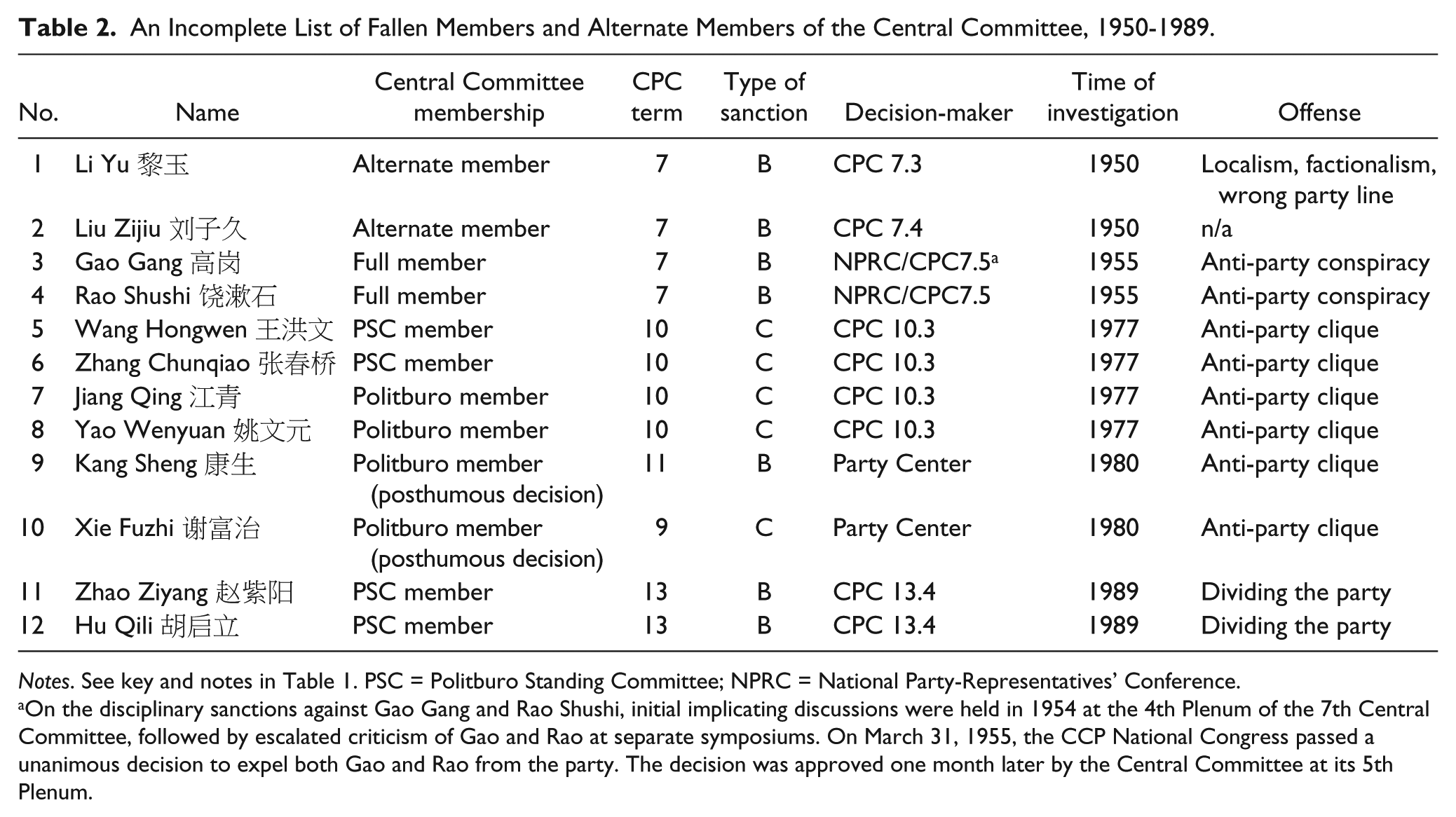
Notes. See key and notes in Table 1. PSC = Politburo Standing Committee; NPRC = National Party-Representatives’ Conference.
On the disciplinary sanctions against Gao Gang and Rao Shushi, initial implicating discussions were held in 1954 at the 4th Plenum of the 7th Central Committee, followed by escalated criticism of Gao and Rao at separate symposiums. On March 31, 1955, the CCP National Congress passed a unanimous decision to expel both Gao and Rao from the party. The decision was approved one month later by the Central Committee at its 5th Plenum.
Despite the party’s consistent denial (Anonymous, 2014b), the design of the disciplinary decision-making process allows party leaders to resolve political disputes and punish political offenders through what seem to be depoliticized anticorruption channels. This is because of the omnipresence of corruption among party officials, which means that all are vulnerable to charges of corruption, and because the combination of the concentration of disciplinary authority and the dictatorial nature of the disciplinary decision-making process provides power holders with considerable discretion to direct investigatory resources against selected targets.
Therefore, anticorruption is one stone that kills two birds. First, once the party has separated itself from individual party officials under investigation, anticorruption aligns the party with the interests of the people and hence provides legitimacy for the party’s rule. Second, it provides the party with an apolitical approach to consolidate political order without exposing conflicts and splits in its leadership. This is crucial because party unity is considered of paramount importance and a key factor for the party’s revolutionary success (Teiwes, 2001: 71). This belief was further strengthened after the party survived its most serious political crisis in 1989, which taught it “what might eventuate if differences [among the leadership] were not contained” (Teiwes, 2001: 72). Therefore, disciplinary actions based on corruption charges help the party to conceal internal disputes and conflicts from the public, preserve the strength of the party institution as a whole, and avoid exposure of its vulnerability if challenged by external political forces.
Furthermore, the consequences of the high degree of concentration and centralization of disciplinary power are twofold. On the one hand, party-led anticorruption activities are highly responsive to campaign-style enforcement. On the other hand, the scale and intensity of these anticorruption activities are prone to the vicissitudes of the membership of the Politburo and the CCDI, depending on the goals, strategies, and mobilizing capacities of campaign leaders as well as the relational dynamics between them and other members of the Politburo. These features explain why different campaigns launched at different times and under different leaders had different degrees of influence. For example, the high impact of the current anticorruption campaign, which began in 2012, undoubtedly the most forceful since the invention of such campaigns, is not due to some novel and mighty rules or measures that the party recently conceived. On the contrary, all the measures that this campaign is relying on have been in existence long before this campaign started, including the now highly productive operation of the roving Party Center Inspection Teams, a practice that was authorized as early as 2003 (Party Center, 2003) and inserted into the Party Charter in 2007. The impact of this campaign is more attributable to the ambition of the leaders of the campaign, their capacity to mobilize resources, and their ability to streamline the decision-making process between the CCDI, the Politburo Standing Committee, the Politburo, and the Central Committee.
At the same time, I should point out that the above-mentioned idiosyncratic nature of party-led anticorruption activities does not diminish their deterrent effect on corruption (although it does not maximize the deterrent effect either). In contrast to the findings of previous research, namely that the CDIs treat corruption leniently, a tendency believed to be attributable to the ineffectiveness of anticorruption activities (Gong, 2008: 149; Ma, 2008: 162–64), this article has shown the “affirmative” side of the CDIs activities that are conducted forcefully so as to detect and punish corruption expediently. Without acknowledging this aspect of party-led anticorruption activities, one cannot explain how the party has managed to contain corruption and to prevent it from getting out of hand as one might have expected to have happened, given the fact that the party has not fundamentally changed the authoritarian nature of the political and legal systems, arguably the root cause of corruption. This article has also shown that it is precisely the wide-ranging discretion inherent in the exercise of disciplinary power that has made the disciplinary system an indispensable tool for the party to consolidate political order and to centralize power in post-Mao China.
Conclusion
By tracking the longitudinal changes of the operative structure and rules of the party’s disciplinary institution, this article demonstrates how the party regulates its own enforcement agency and institutionalizes the decision-making process of all disciplinary activities. Two measures, as this article has identified, have been employed in a systematic manner in this process.
The first is the party’s delegation of authority to the CDIs. The delegation process started in the 1980s and accelerated in the 1990s. The CDIs are not only an enforcement agency of the party, carrying out its instructions, but also an agency that can take the initiative and make decisions in certain categories and serve as a supervisory body over disciplinary activities at subordinate levels. More importantly, the CDIs have the exclusive power to conduct investigations, a power that has grown in prominence especially after the authorization of coercive investigatory measures for interrogations. The coercive force of such measures makes CDI investigations particularly “productive” in establishing disciplinary violations, which in turn makes the CDIs more influential in shaping the final disciplinary decisions.
The second measure is the establishment of a controlling mechanism through which the party can impose its will on the CDIs, albeit only with a measured degree of engagement in the latter’s activities. This mechanism has two components. One is the introduction of a three-tier decision-making process, in which the authority to make, approve, and veto a decision is split among three linked party authorities: the investigating CDI, the corresponding party committee, and the superior CDI. This three-tier decision-making process allows the party committee to preserve its discretionary power to make and alter disciplinary decisions and at the same time to limit its engagement in disciplinary activities. The other component is the introduction of periodic interventions into disciplinary decision-making by the party committee. To this end, the CDIs’ activities are segmented into four interlocutory stages, at each of which the party committee can intervene so as to steer or change the direction of the CDIs’ activities. This kind of periodic intervention provides the party committee with early and multiple opportunities to adjust the CDIs’ investigatory activities and consequently shape the final disciplinary outcome.
This article has also identified three features of the party’s efforts to institutionalize the disciplinary decision-making process. The first is the concentration of disciplinary power in the executive bodies of party committees—the Politburo and its Standing Committee for the Central Committee and local party standing committees for local party organizations. The concentration of power in the much more compact party executive bodies allows party leaders to expedite the process of collective decision-making and to reach a consensus more quickly. This is of critical importance in corruption investigations since the element of surprise is crucial in curtailing the ability of the person under investigation to obstruct the investigation. A swift and firm decision also makes it more difficult for supporters of the fallen official to organize resistance.
The second feature is the centralization of disciplinary power vertically from local CDIs all the way up to the CCDI. Centralization makes the CCDI the most powerful disciplinary institution in the party-state. It has exclusive investigatory jurisdiction over elite party officials who enjoy deputy-provincial/ministerial rank and above. It assumes the authority to approve and review disciplinary decisions made by lower CDIs as well as a quasi-legislative function: to issue policies and operational rules to guide disciplinary activities of CDIs nationwide.
The third feature is that in the institutionalizing process, the party has also gone through a significant policy shift since 1989, whereby corruption has replaced political offenses and become the only nominally legitimate cause to expel party members. This shift depoliticizes party disciplinary activities, at least on the surface, which helps to preserve the image of party unity—a matter of crucial importance for the survival of single-party rule. This helps to account for the accelerated rise to prominence of anticorruption activities in the party’s agenda since the 1990s.
Footnotes
Acknowledgements
I wish to thank Jerome A. Cohen, Allen Clayton-Greene, and an anonymous referee, all of whom provided valuable comments and suggestions. All mistakes and errors remain mine.
Declaration of Conflicting Interests
The author(s) declared no potential conflicts of interest with respect to the research, authorship, and/or publication of this article.
Funding
The author(s) received no financial support for the research, authorship, and/or publication of this article.
Notes
Author Biography
 .
.