




Abstract
This article uses an investigation-trigger framework to explain the process that stimulates investigations of corruption in China, which has been treated more as a black box in the past. Reviewing China’s current anticorruption system, we argue that local party leaders’ decisions directly trigger corruption investigations, and that power competition between political elites is a major catalyst of the trigger. Moreover, drawing upon rarely accessible documentation and interviews addressing the successive downfall of two public security bureau chiefs in City H, we identify two channels through which the investigation-trigger catalyst works: the diminished patronage of corrupt officials after patron turnovers, and government insiders’ unconventional provocation of political opponents. The cases analyzed in this article also show that outside intervention may rupture the local protection of corruption and facilitate investigations. This finding supports the 2012 reform of China’s corruption control system.
Corruption in China has deepened across sectors, expanded to different government levels, and constantly changed formats since the 1990s (Gong, 1997; Wedeman, 2004; Guo, 2008; Wang, 2013; Manion, 2014; Pei, 2016). While tracing the trends and sources of corruption in China, scholars have also examined aspects of the anticorruption system, including its general institutional design (e.g., Manion, 2004); the history and structure of its primary anticorruption agency, the Central Disciplinary Inspection Committee (CDIC) (e.g., Young, 1984; Guo, 2014); the disciplinary organs’ relationship to the party (Gong, 2008; Sapio, 2008); the CDIC’s recent development (e.g., Fu, 2015; Manion, 2016; Li, 2016); and the role of other agencies, such as the procuratorate, in anticorruption (e.g., Li and Deng, 2015). An enduring problem in Chinese anticorruption practices, as noted by many scholars, is that a large majority of the cases received by the anticorruption organizations are not investigated (Manion, 2004; Wedeman, 2005; Cai, 2015). A speech by the current party general secretary, Xi Jinping, further highlighted the salience of the problem, emphasizing that the number of corruption cases that had accumulated in the past would be reduced as a new way of strengthening anticorruption endeavors (Pan, 2016). Although studies have identified several institutional factors that prevent cases from being investigated, little research has explained what kinds of cases in what kinds of situations stimulate corruption investigations in China. Answers to these questions can illuminate the broader context in which anticorruption decisions are made, enriching our understanding of the working mechanism of the Chinese anticorruption system.
In this article, we analyze a type of political anticorruption stimulus that usually stays hidden from public knowledge—power competition between local political elites in China. Elite power competition is suspected of influencing anticorruption enforcement in many countries, especially those with high levels of corruption and weak institutions. For instance, studies of African and former Communist countries have shown that anticorruption endeavors are “often consumed in the vortex of elite wrangling and political ambitions” (Adebanwi and Obadare, 2011: 203; Börzel and Pamuk, 2012). Similarly, scholars of Chinese politics, such as Xuezhi Guo, Melanie Manion, and Susan Shirk, have observed that corruption crackdowns are often initiated to serve certain political purposes and “as a way to solve intra-party power struggles and conflict,” rather than for the “sole aim of tackling malfeasance” (Guo, 2014: 617). Andrew Wedeman (2017) and Jiangnan Zhu and Dong Zhang (2017) have empirically demonstrated that factional purges can be a motivation for anticorruption campaigns in China. The focus of this vein of research is on leaders who have the capacity to directly initiate corruption investigations. However, another way that anticorruption may be “consumed,” and one that is probably more common in practice, is that officials who do not have the direct capacity to launch corruption investigations do everything they can to attract anticorruption agencies and instrumentalize anticorruption to get ahead in the power competition in China. This second type is the focus of this article.
Taking a process-centric perspective, we propose an investigation-trigger framework based on our extensive field interviews in a prefecture, City H, in X Province. We argue that under China’s anticorruption institutions, especially before 2012, the key to triggering corruption investigations of powerful local political elites, such as officials at or above county/division level 县处级, is the major local leaders’ decision and willingness to investigate them. In a prefecture, major leaders primarily refer to the members of the municipal party committee, particularly the party secretary, and, secondarily, to leaders of the provincial government. Moreover, intense power competition between local government officials, although not the only factor, can greatly encourage leaders to launch corruption investigations through two main channels. First, leadership turnovers in a city may simply replace the old factional patrons with new party leaders who have less incentive to protect corrupt followers of former executives. Second, to compete for power, local officials may individually or collectively act as provocateurs by disclosing the corrupt acts of their political opponents. The unconventional means adopted by insider provocateurs, such as spreading information about the corruption of and setting political traps for rivals, may foster opportunities for and pressure party leaders to investigate corruption. In the triggering process, local patron-client power networks may help to advance connected officials’ standing in elite competition and also get them involved in escalated power struggles. Hence, power networks between officials greatly shape the direction, scope, and outcome of corruption investigations. Publicized government decisions to investigate corruption may only be the end result of long-term and sophisticated intra-party elite power struggles.
Therefore, our study contributes to the literature on political stimuli of anticorruption in authoritarian regimes. Because concrete evidence is hard to obtain, there is a lack of research on the detailed pathways connecting elite contention and anticorruption. Our in-depth case studies illustrate the major channels via which elite power competition evolves into corruption investigations by tracing “who overtakes whom” in what ways (Trotsky, 1925). Our cases also reveal how corruption investigations occur in “a locally based bottom-up manner” (Gong, 2015: 685), thus complementing studies that mainly probe the top-down anticorruption approaches used by the central government. Finally, learning the process evoking anticorruption helps reveal why China’s corruption control system, although ineffective, still prevents corruption from completely freewheeling (Wedeman, 2012), a question ultimately related to the endurance of China’s authoritarian regime (Nathan, 2003).
In the rest of the article, we first present the “investigation-trigger” framework, followed by a detailed account of how we secured access to rarely publicized political documents on the corruption investigation of two heads of the local public security bureau (PSB) in City H. We then contextualize the analytic framework in the cases in City H. In the last section of the article we recap and discuss our findings.
An Investigation-Trigger Framework for Analyzing Anticorruption in Local Government
Disciplinary Organs’ Formal Processing Procedures and Investigation Ratios
The leading anticorruption organization in China is the Central Disciplinary Inspection Committee (CDIC), together with its local Disciplinary Inspection Committees (DICs), which are supplemented by the Ministry of Supervision (merged with DICs at the local level in 1993) and the procuratorate. The DICs are responsible for “countering a complex of deviant tendencies classified as degeneration of ‘Party style’” 党风, ranging from ideological deviation and official disobedience to various acts of economic misconduct (Young, 1984: 24–31). A core dimension of their job since the amendment of the Party Charter in 1982 has been to investigate the corruption of political elites (Li, 2016). With the “first mover” advantage, the DICs usually investigate cases before other agencies and decide whether to transfer them to the procuratorate for further investigation and prosecution (Manion, 2004). The prefectural-level DICs are structured like their superior counterparts at the provincial and central levels.
The DICs handle corruption reports by following five major steps: receiving cases related to violations of party regulations and administrative rules through both government internal channels (e.g., transferred from individual leaders, other departments, and higher-level governments) and public channels, such as letters, phone calls, online reports, and personal visits 受理; preliminary verification of evidence and materials accepted by DICs 初步核实; filing cases in the DIC having jurisdiction 立案; investigating and collecting evidence of violations of regulations 调查; and transferring cases to hearing offices for disciplinary or administrative punishment 移送审理. 1 In this procedure, thousands of cases are reported to DICs at different administrative levels annually. However, no more than a third of them are filed and even fewer are investigated and punished. For example, Figure 1.1 shows that from 1994 to 2013, among the cases reported to all the DICs nationwide, only 11–18 percent were filed for investigation (indicated by the horizontal gray line). The majority of the cases reported to the DICs are ignored (Guo, 2014). Figure 1.2 shows that although the situation varies across provinces, the case-to-filing ratio in most provinces was as low as 0.05–15 percent, with only seven provinces reaching 16–30 percent.
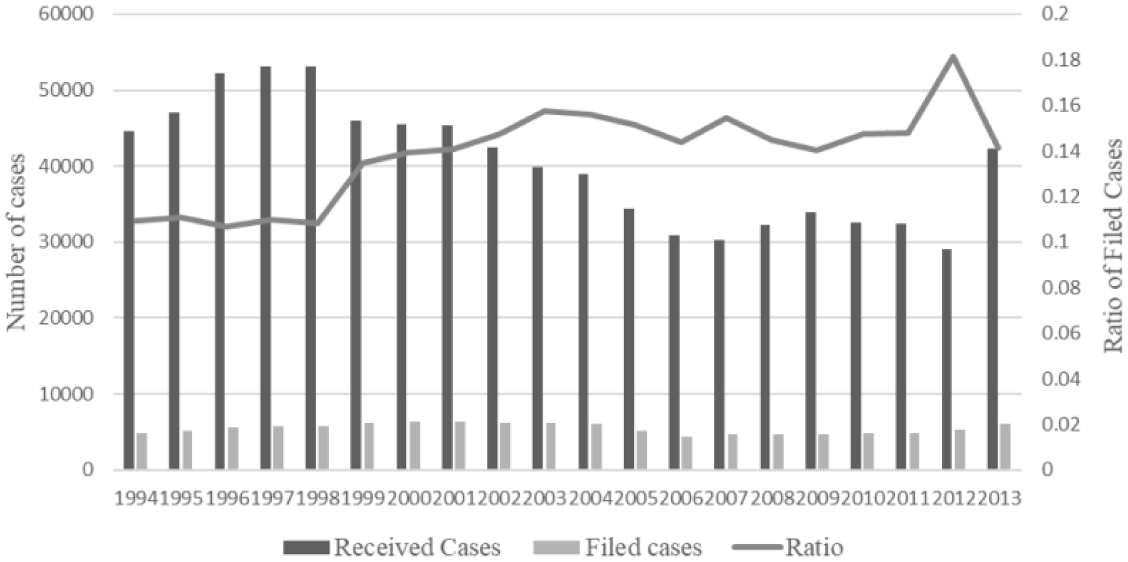
Filed cases versus received cases by Disciplinary Inspection Committees (DICs) nationwide, 1994–2013.

Total filed cases versus received cases by Disciplinary Inspection Committees (DICs) across provinces, 1994–2013.
Undeniably, numerous reported cases lack sufficient evidence to warrant filing. Cases are sometimes repeatedly reported through different channels, which inflates the number of corruption reports and lowers the filing and investigation rates. However, even when taking these factors into consideration, the cases that are formally filed and investigated are still a small minority of those received by DICs, indicating that reports of corruption are not automatically funneled into investigations. Many factors, such as bureaucratic foot-dragging, poor training of anticorruption agents, and limited inspection commission personnel, tend to prevent DICs from proactively investigating cases (Sullivan, 1984). 2 This prompts the question: When do DICs investigate cases, especially those involving local senior officials?
Direct Trigger: Party Leaders’ Willingness to Tackle Corruption
Whether a case is investigated primarily depends on the local party committee’s willingness to investigate and punish the perpetrators. Since the amendment of the Party Charter in 1956, the supervisory power of party committees over their corresponding DICs has been strengthened by changing their role from providing “advisory guidance” 指导 to “directing” 领导 DICs’ work (Li, 2016: 457). Although DIC heads are usually standing members of the party committees at the respective administrative levels, indicating the distinctive status of DICs, the DICs and other anticorruption organizations in China are essentially subordinate to the leadership of their corresponding party committees, which control DICs’ budgets and personnel, and coordinate specific investigation-related work (Manion, 2004; Li, 2016). Just as cases related to officials at or above vice-ministerial or deputy-provincial levels first must be approved by all of the members of the Politburo Standing Committee before being accepted by the CDIC (Guo, 2014), decisions to file and investigate a case involving a county-level official must be approved by the party committee at the prefectural level. A DIC officer told us, “We can’t investigate a case on our own without a nod from our local party secretary” (Interview with DIC Officer A, City H, Jan. 2011). Therefore, the resolve of local party committees, especially the party secretary, to investigate a case constitutes the basic trigger for a corruption investigation.
In addition, under the dual leadership system introduced in 1982, a prefectural DIC is hierarchically subject to the leadership of its provincial counterpart. Vertical leadership was strengthened in 2004 by the empowerment of the upper-level DICs, which can direct lower branches and step in a lower-level jurisdiction to investigate local leaders. Intervention from upper-level DICs often conveys upper-level party committees’ intent to check a corruption case, which is hard for local party committees to ignore. Thus, pressure from upper-level governments also contributes to directly triggering corruption investigations. However, vertical leadership over local DICs has not always been effective in the past (Fu, 2015; Manion, 2016). Most cases cannot bypass local officials and go directly to higher-level DICs, and upper-level DICs must rely on local governments’ cooperation to mount a case (Guo, 2014). Hence, we further classify the direct trigger into two levels: the investigative willingness and decisions of local top party leaders who have direct jurisdiction over a case as the front-line (primary) trigger of corruption investigations, and higher-level government pressure as the top-down (secondary) trigger.
Earlier research has identified several factors hindering the direct trigger from working effectively. For instance, if powerful party committees, especially the party secretary, want to protect a corrupt official, they can disapprove of or stop a corruption investigation (Manion, 2004; Guo, 2014). Reasons for protection vary from guanxi lobbying networks and local governments prioritizing economic development and social stability over anticorruption to selective enforcement of the law (O’Brien and Li, 1999; Sapio, 2005). However, what circumstances incentivize party leaders to pull the trigger on an investigation?
Trigger Catalyst: Elite Power Competition
Some factors inside and outside of the government may act as catalysts incentivizing party leaders to pull the trigger on an investigation. A survey of scandals in twenty-five states in the Middle East and North Africa conducted by Kate Gillespie and Gwenn Okruhlik (1991) shows that without institutional guarantees to curb corruption, anticorruption endeavors are often responses to internal or external stimuli, such as extreme public dissatisfaction with official corruption. In China, public resentment of corruption has exploded into protests and even large-scale demonstrations, such as in 1989, compelling party leaders to fight corruption and appease public discontent (Lü, 2000; Manion, 2004; Sun, 2004; Wedeman, 2012; Guo, 2014). However, the primary concern of most officials is to manage relations with their peers (Svolik, 2012). Thus, it is political elites’ competition for power that more commonly leads to corruption investigations.
In democracies fierce competition to win votes may encourage political parties to accuse their opponents of corruption or ineffective corruption control (e.g., Welch and Hibbing, 1997; Gordon, 2009). Although China lacks competitive elections between political parties, its political elites also compete for power, government positions, and access to office rewards (Ezrow and Frantz, 2011; Shih, 2016). The issue of official corruption and its control, as Susan Shirk has observed, has emerged as a potent weapon in leadership competition in the post-Mao era. An example is Li Peng discrediting his chief rival Zhao Ziyang in 1988–1989 by accusing him of mismanaging the economy, thereby causing inflation, corruption, and reduced grain production (Shirk, 1993: 88). Getting rid of an official by leveling a charge of corruption also seems to reflect the growing feeling within the leadership that officials should be removed for just cause, a notion that has been emphasized by procedural rules and evidenced in norm-bound succession in the past few decades (Teiwes, 1984; Nathan, 2003; Cheng Li, 2012). Yongshun Cai (2015) has also argued that unlike some types of duty-related malfeasance, which may be ideologically or legally justifiable, corruption is a crime that cannot be easily excused in the face of strong evidence. Therefore, charges of corruption have become a popular weapon in intra-elite battles for power in China. In other words, while political disputes can be resolved through a seemingly “depoliticized” anticorruption process (Li, 2016: 473), anticorruption is sometimes politicized in the battle over power. We have identified two channels through which elite competition increases local leaders’ willingness to investigate a corrupt official.
Losing Patrons, Diminished Patronage
Because neither a legal system nor a moral order can fully regulate elite power competition in China, many officials form and join factions to secure power and gain protection (Dittmer, 1995; Pye, 1995; Shih, 2004). Scholars generally agree that factions within the Chinese Communist Party (CCP) are informal groups bound by shared backgrounds (e.g., hometown ties, school ties), intertwined careers (i.e., as colleagues), bureaucratic responsibilities, and common loyalty to their leaders (Lieberthal and Oksenberg, 1988; Nathan and Tsai, 1995; Huang, 2000; Shih, 2004). Factions incorporate a series of patron-client pairs in which patrons are higher-level officials and clients are a coterie of second-rank leaders who can be patrons of their own subordinates (Liu, 1983). Patron-client networks are based on exchange through which patrons and clients seek power, positions, and wealth (Nathan and Tsai, 1995; Shih, 2008). In corruption investigations, patrons are often incentivized to protect their clients, because a client’s fall can be considered a sign of the patron’s weakness and may even implicate the patrons themselves.
However, when old patrons lose power through retirement or removal from office, the patronage enjoyed by their clients typically diminishes. New leaders usually have little incentive to protect corrupt officials who are followers of their predecessors, unless they share strong relationships. Even if newcomers do not initiate corruption investigations that proactively target specific local officials, they usually do not hinder investigations, which may potentially help to legitimize their rule and weaken the informal power of previous patrons (Gillespie and Okruhlik, 1991). For example, Mu Suixin, the infamously corrupt mayor of Shenyang, frequently ignored provincial leaders’ exhortations and obstructed the investigation of his subordinates. However, after he was arrested, his followers in important government positions were quickly investigated and prosecuted (Gongren ribao, 2001). Victor Shih and Jonghyuk Lee (2016) have shown that the removal of a patron indeed is more likely to result in clients’ demotion and removal. Thus, leadership turnovers of local factional patrons, such as local party secretaries, can boost local leaders’ willingness to investigate powerful officials who were previously immune to investigation.
To further clarify the trend of declining patronage for clients with their patrons’ losing power, we compared the yearly differences in the number of cases filed for investigation by the DICs from 1994 to 2013 (Figure 2). We found that in years without turnovers of provincial-level leaders (“normal years”), the mean of the first difference was almost zero, indicating that the total number of cases investigated by the DICs was about the same from year to year in most provinces. During turnover years, an average of 90 fewer cases were investigated than in normal years, very likely because the DICs intentionally slowed down the processing of cases given that they were busy and given the political uncertainties associated with local leadership changes. In contrast, in the year immediately after leadership turnovers, an average of 150 more cases across provinces were investigated than in the preceding year, a strong sign of corrupt officials’ diminished patronage after leadership turnovers.
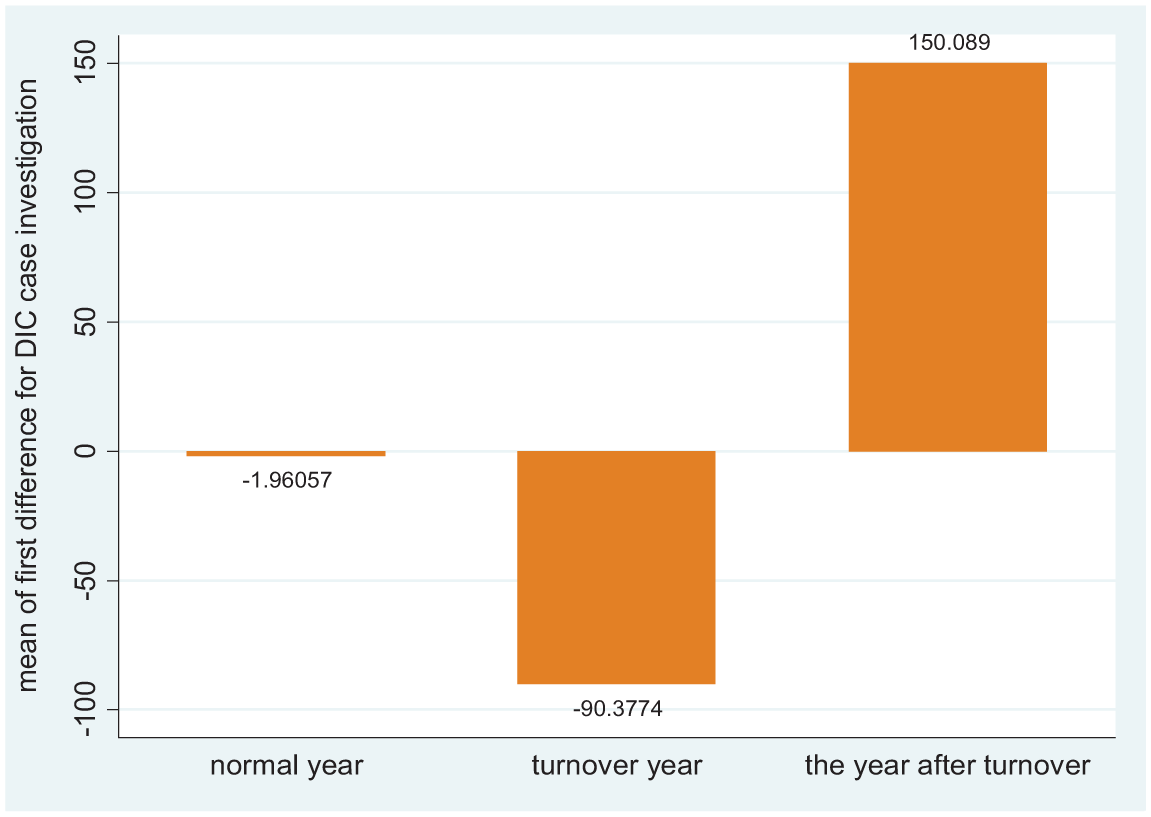
Mean of first difference for Disciplinary Inspection Committee (DIC) case investigation.
Insider Provocateurs Lift the Lid
To compete for power, local government officials sometimes act as provocateurs against their political opponents. According to a local DIC official of Henan province, at least half of the accusations of corruption sent to DICs during personnel changes were submitted by officials aiming to undermine their political competitors (Interview with DIC official, Henan, July 2012.). After all, “damaging information can be found on almost anyone” in politics if they are examined closely for long enough (Tumber and Waisbord, 2004: 1034). “Knowledge about corrupt acts is available to political actors as a function of their proximity to the acts” (Balán, 2011: 461). Hence, compared with government outsiders, officials are more likely to have firsthand access to such information. Yet, as insiders they know that corruption reported in conventional ways, such as anonymous letters, phone calls, and even personal visits, is often ignored. Thus, these “insider provocateurs” may use unconventional means to attract local leaders’ attention and prompt anticorruption organizations to investigate their political opponents. For instance, they may use various strategies to lure their rivals into committing administrative mistakes or faults, which creates opportunities for local party leaders to conduct further investigations into their opponents’ corrupt activities. Thus, although insider provocateurs to some extent play the role of whistle-blowers, they are motivated by selfish reasons and are much more politically savvy than whistle-blowers who are largely driven by professional norms and their personal values and are “organizationally naïve” (Rothschild and Miethe, 1999: 119).
In addition, competing leaders often have their respective factional followers. “Political factions are very sensitive to changes that can directly affect members’ political well-being.” Any rise or fall of a major leader in the factional chain “can set off a series of domino responses among the factional networks [that] extend throughout the system” (Huang, 2000: 82). Thus, individual elites’ struggles can ultimately result in factional infighting. Members of factions whose interests are threatened by opposing factions may converge into an “insider provocateur group” that is more willing to publicly denounce their opponents’ corrupt behavior and arouse the attention of society and higher-level officials. For example, Zhu Ruifeng, the independent anticorruption journalist famous for posting the sex video of Chongqing official Lei Zhengfu online, confessed that 90 percent of the explosive revelations of corruption were sent to him by government insiders in attempts to implicate their opponents in scandals (Tencent News, 2012). Corruption scandals may raise a public outcry and undercut the government’s image, further encouraging party leaders to investigate corruption.
Figure 3 depicts our investigation-trigger framework and illustrates how elite power competition catalyzes the direct triggering of corruption investigations through the two channels identified above. In both channels, the power networks of local leaders tend to underlie the process, influencing the scope and outcomes of corruption investigations. In the following discussion, we contextualize the framework using the cases of two former City H PSB heads. For each case, we first introduce elite power competition as the starting point and then explain how the two channels led to corruption investigations.
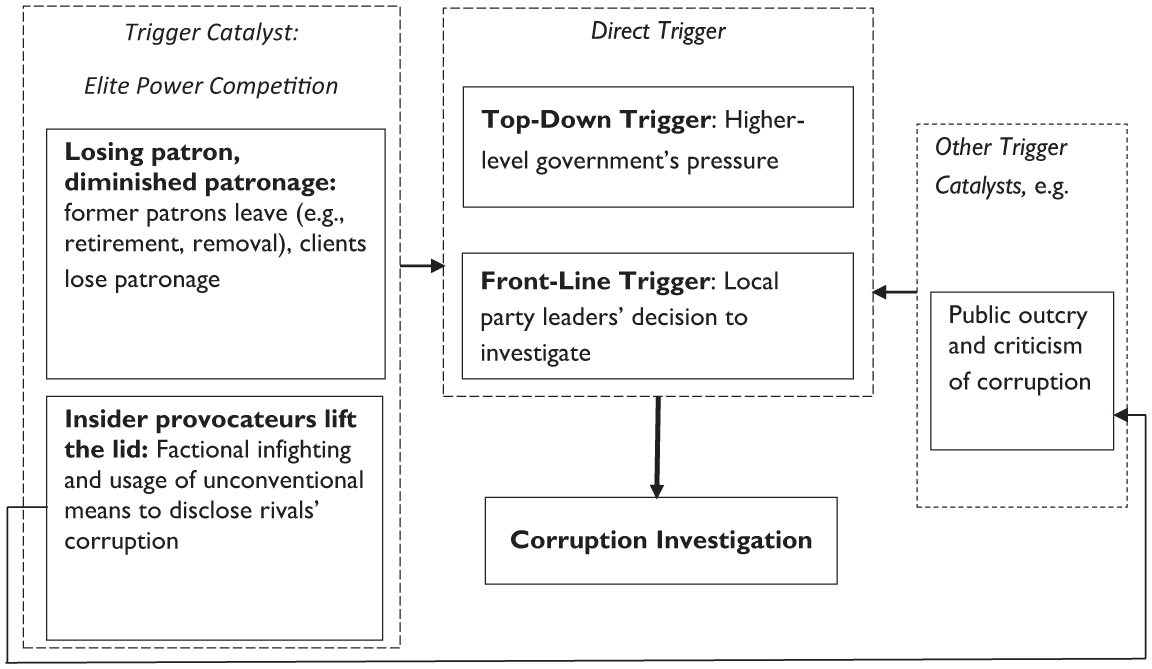
The “investigation-trigger” framework.
Data and Methods
Accessing the inner politics of political elites is always challenging. We collected our cases from City H using personal connections. City H was designated as a prefecture of an inland province, X, in the early 1970s. City H has a mid-sized population (approximately two million as of 2016). In terms of geographical features and average education levels, it is similar to other inland prefectures. More importantly, the anticorruption structure of prefectures is very much the same across China. Therefore, studying anticorruption procedures in City H can also clarify general practices in local government.
From 2009 to 2014, we collected two types of firsthand information in City H. First, we interviewed forty-six people involved in the two cases. They range from anticorruption decision-makers to insider provocateurs such as local party leaders, PSB officers, DIC staff members, and procurators. We conducted three rounds of interviews—in July 2009, January 2011, and October to December of 2014—with a focus on basic information about City H and its general bureaucracy, then the DIC, the Audit Bureau and the Anticorruption Bureau under the municipal procuratorate, and finally details of the two corruption cases. Using our personal connections, we were able to conduct multiple in-depth interviews (each more than one hour) with six key figures involved in the case investigations. Our second type of information includes the case archives 案件卷宗 maintained by the local procuratorate and DIC. The archives include letters reporting corruption of the PSB heads; the government’s decisions to file, investigate, and punish the two officials involved; relevant interrogation notes; appraisal letters from related organizations; and confessions from the two leaders.
Our article is largely based on the interviews since the deep-seated political reasons behind investigations are not recorded in archives. However, to understand the relations between the cases’ key characters, we have also used archival information. The prolonged information-collection process also provided us with an unexpected advantage. Many officials in charge of the two cases eventually retired and after that were more willing to discuss them. For example, a retired party secretary of City H disclosed many behind-the-scenes stories, such as the city’s factional networks, which have been extremely valuable for this research.
Elite Power Struggles and the Downfall of Two Public Security Chiefs
Background: PSB Chiefs in the Power Network of City H
The two cases involve two persons, Lu and Jing, who were heads of the PSB of City H successively from 1998 to 2003. 3 Being chiefs of an important local coercive institution, both Lu and Jing were members of the municipal standing committee, the core decision-making body of the city. 4 Both were consecutively dismissed for corruption between 2001 and 2003 and sentenced to fifteen years and fourteen years of imprisonment in 2002 and 2005, respectively. More importantly for our purposes, both were embedded in the complex power network of City H. As illustrated in Figure 4, the two PSB chiefs belonged to different local factions led by their respective patrons, the successive municipal party secretaries, Wang and Cheng.
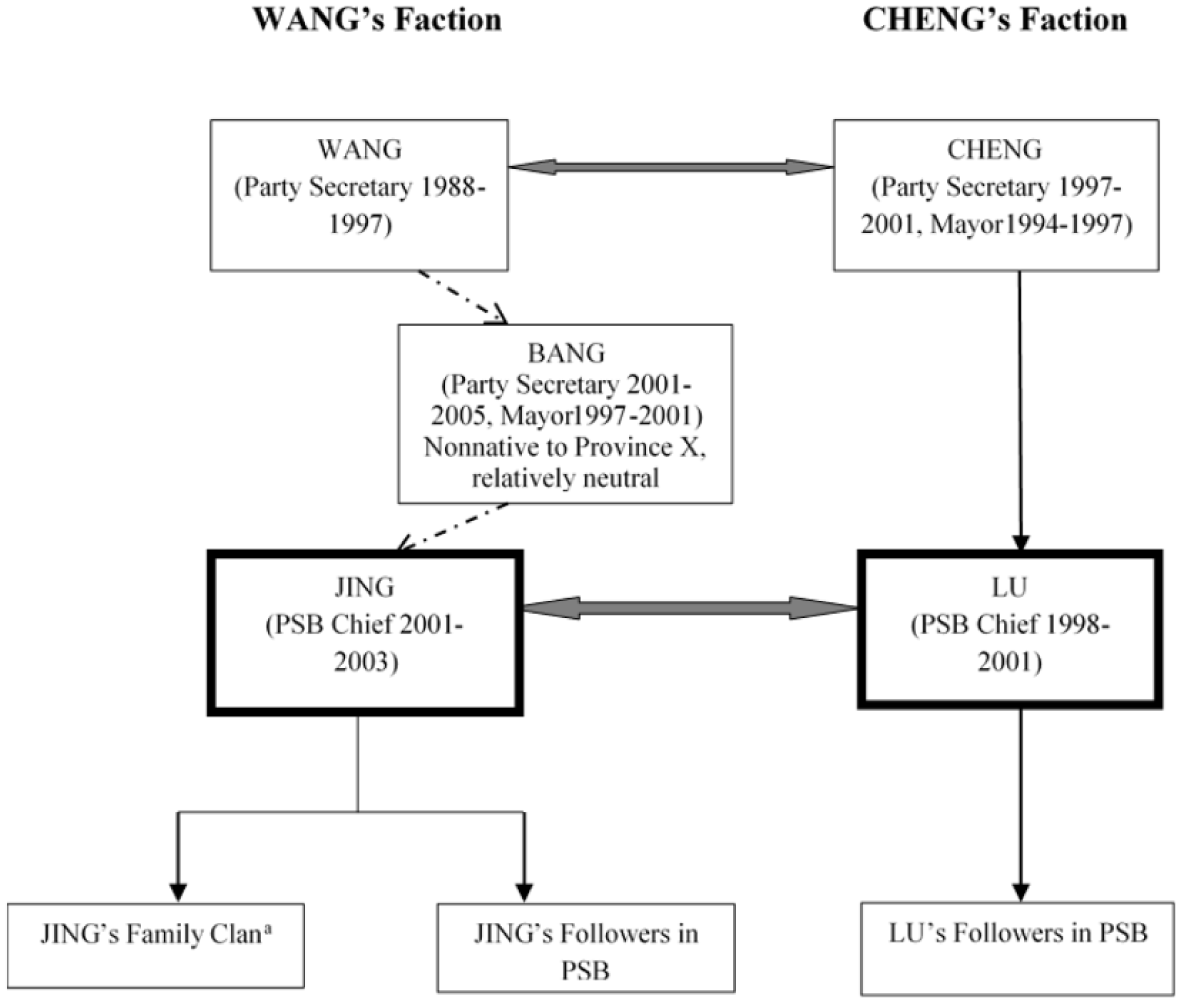
Power networks in City H.
According to a former party secretary of City H, high-level officials of City H mainly came from three nearby areas. Hence, hailing from the same place provides the primary basis for factional alignments among officials in City H, as in many other places in China (Interview, July 2009; see also Pye, 1981). 5 On top of the geographical connections, as the retired party secretary revealed, “Whether officials from the same place can form a strong faction mainly depends on whether one of them can emerge as the topmost leader of City H, the party secretary. The party secretary has power over personnel, which is the major factor fostering a faction” (Interview, July 2009). For example, Wang served two consecutive terms as the party secretary from 1988 to 1997, longer than any other party secretary in the history of the city. During his ten-year term, most officials he promoted were from his hometown. In this way, he established a massive factional network. 6
Party Secretary Wang’s hegemony, especially on personnel issues, dissatisfied Mayor Cheng, who felt compelled to construct his own informal network to protect and promote his career. 7 Cheng recruited supporters primarily from officials from other provinces since they had often been excluded by local factions and were eager to seek strong patronage. Thus, Lu, a demobilized army cadre transferred to City H from outside, quickly became a follower of Cheng. He was first assigned to the post of director general in the Foreign Economic and Trade Committee (FETC) of City H and then promoted to the PSB head after Cheng replaced Wang as the party secretary.
Lu’s successor in the PSB was Jing. Unlike Lu, who had a close relationship with his patron (Cheng), Jing was only a loose follower of Party Secretary Wang. That was mainly because their relationship stemmed simply from the fact of geographical proximity: their hometowns were in the same general area. Actually, instead of developing a close relationship with Wang, Jing seemed more interested in locally expanding his own family’s influence. Several of his family members and relatives held important positions in City H. His growing power later irked many local officials, including Bang, a loose ally of Wang’s who succeeded Cheng as party secretary (see Figure 4), and buttressed local leaders’ willingness to investigate Jing for corruption. From Figure 4, we can clearly see that the power competition between the two successive PSB heads was merely a subset of the contention among higher-level officials of City H.
Power Competition between the Chief and Deputy Chief of the PSB
As discussed earlier, factional networks include multiple patron-client relations. Although they were clients of the municipal party secretaries, each of the two PSB heads developed his own informal power network. For example, during his tenure as the PSB chief from 1998 to 2001, Lu actively promoted people who were loyal to him. He also sold offices to many of his PSB subordinates, who paid him both in cash and fidelity (see Appendix A). 8 Thus, selling offices was a way that Lu could kill two birds with one stone. Not only could he rake in large sums of money, but he could also build his own power network by assigning his supporters to important positions in the PSB.
However, “no faction will be able to achieve and maintain overwhelmingly superior power” (Nathan, 1973: 46). People who are excluded from the dominant network tend to form an opposition faction in a search for balance. In other words, the more expansive Lu’s network became, the more his rivals became united against him. Jing was indeed the leader of the faction opposing Lu.
When Lu was the chief of the PSB, Jing was the deputy chief leading crime investigations. According to someone who worked with both Lu and Jing, “Jing thought a lot of himself. He looked down on Lu because Lu didn’t know anything about the public security system. Jing, on the other hand, had expertise and won several official awards. For a long time he thought he was the best person for Lu’s position” (Interview with PBS officer, Oct. 2014). To compete for power, Jing acted as an insider provocateur against Lu, as we shall see.
Jing as the Insider Provocateur
Compared to ordinary people, government insiders know much more about how routine procedures can hinder the investigation of corruption. Therefore, insider provocateurs may look for alternative routes to reach their goal of triggering the investigation of their opponents for corruption. Taking advantage of their proximity to their targets, officials may regularly seek and grasp opportunities that catalyze party leaders into launching an investigation.
As a government insider, Jing knew very well that it was almost impossible to overturn someone like Lu—who held a prominent post and maintained a large patron-client network through nepotism in City H—by using merely a few reports of corruption. The municipal party committee and higher-level DIC would only investigate a major official like Lu if he seriously failed to carry out his duties and caused severe problems for City H. Therefore, Jing whipped up a case to frame Lu.
In June 1999, Jing led the investigation of a massive case of fraudulent value added tax (VAT) invoices. Family members of the prime suspect bribed key PSB leaders, including Jing, in order to gain the suspect’s release on bail. Jing anticipated that the suspect, who was very violent and who had been long involved in organized crime, would probably cause more trouble if he were released. In 2001, Jing agreed to approve bail, but right before the final approval he left town, deliberately leaving Lu the only person qualified to sign off on it (Interviews with DIC staff, Sept. 2014). As Jing expected, the suspect retaliated against the person who took his case to the authorities by shooting him shortly after being released. The case involving false VAT invoices evolved into a vicious homicide, shocking City H. Lu, whose signature was on the bail document, had to bear the responsibility for negligence. Thus, this seemingly haphazard incident was actually a stratagem concocted to undermine Lu.
Lu’s Diminished Patronage
Another channel that accelerated the investigation of Lu was his diminished patronage. Rumors that Lu welcomed bribes had long circulated throughout City H, dating back to when he worked in the FETC. The local DIC’s records showed that there had been frequent letters from the public condemning Lu’s corruption. Nonetheless, with the protection of Lu’s patron, Party Secretary Cheng, no action was taken against Lu (Interview with DIC officer A, Oct. 2014).
However, when the homicide occurred, Lu’s patron Cheng had just retired from his position as party secretary. The new party secretary, Bang, had never been a close ally of Cheng’s, leaving Lu without strong protection (Interview with DIC officer B, Oct. 2014). As a result, Lu was quickly handed to the procuratorate for a thorough investigation. The municipal chief prosecutor at the time was a long-time buddy of Jing. He swiftly collected evidence of Lu’s corrupt activities and nailed down his prosecution. A City H PSB cadre commented, “Jing was the primary director of Lu’s downfall by staging a large anticorruption drama” (Interview with prosecutor in charge of Lu’s case, Oct. 2014).
In principle, reducing patronage can greatly facilitate the investigation of corruption. In addition, as Lu’s downfall shows, although insider provocateurs may take a detour to frame their rivals, they will try to sabotage their opponents’ return to power by using anticorruption schemes, given that corruption is the most egregious form of misconduct for officials in China.
Power Struggle between the Jing and Lu Factions
As in Lu’s case, Jing’s downfall also grew out of an internal elite power struggle within the PSB. However, Jing’s case more vividly reveals how the existence of local power networks may force officials in factional chains into the elite struggle whirlpool and drive the direction and scope of corruption investigations. Since informal politics are prevalent in China, relinquishing one’s formal position, whether through rotation, retirement, or even subversion, does not necessarily mean that one’s influence immediately evaporates in a given area. As long as a leader’s factional networks remain, his or her followers may continue to behave as they did before and continue to cast a shadow over local political affairs (Huang, 2000). Hence, new leaders’ construction and extension of their power will threaten the interests of their predecessors’ followers. In our case, Lu’s eventual imprisonment did not mean that his network in the PSB immediately disappeared. Therefore, Jing’s promotion to PSB chief after Lu’s removal only presaged the start of larger-scale factional infighting between Lu’s followers and Jing.
Actually, followers of Lu and Jing all along had conflicting interests in terms of career advancement. The Lu faction had the upper hand in the past due to Lu’s patronage. Consequently, after Jing was made the PSB chief, the primary challenge facing him was that a large majority of the PSB staff were Lu’s followers, which could potentially hinder Jing from consolidating power within the PSB. Therefore, Jing set out to destroy Lu’s network to prevent his faction from making a comeback, while painstakingly developing his own factional network within the PSB. PSB officers recalled, “Jing mainly promoted three types of people: people who contributed to Lu’s downfall; people Jing considered trustworthy, such as his relatives, people from his hometown, and his mistresses; and people who came from rich or powerful backgrounds” (Interviews, Oct. 2014).
To hire and promote the people he favored, Jing used various tactics to evade open competition and the strict scrutiny emphasized in the new rules on personnel recruitment and promotion promulgated in 2002 (Sun, 2008; Zeng, 2016). He also appointed more officials beyond what the PSB quota allowed and sold offices to subordinates to advance his own supporters. Within only six months of August 2001, when Jing formally became PSB chief, he had already promoted ninety-three cadres and dismissed many competent people with good reputations. In this way he established a group of his own close followers. Appendix B summarizes the major strategies Jing used to manipulate personnel and promote his supporters.
Jing’s frequent manipulation of the cadre corps created chaos in the PSB. Moreover, during personnel reshuffles, many of Lu’s former followers were either removed from office by Jing or were denied promotions. People from Lu’s faction complained of being marginalized (Interview with PSB officer B, Oct. 2014). They were, therefore, angered primarily not by Jing’s financial misdeeds but by his abuse of his control over personnel to dismiss people from Lu’s faction while simultaneously expanding his own power base. Jing’s aggressive approach to the Lu faction and his free-wheeling promotion of his own henchmen eventually encouraged Lu’s followers to converge into an insider provocateur group, fiercely resisting him within the PSB.
Lu’s Faction as an Insider Provocateur Group
Officials who choose to organize into provocateur groups are usually desperate to protect themselves and perceive themselves as politically weaker than their opponents. They resort to collective action to advance themselves in power competitions. Thus, they are more likely to go to extreme lengths to expose their opponents’ corrupt acts, such as disclosing them to the public, in the hope of defeating them by relying on social pressure or discipline imposed by higher-level government.
Members of Lu’s faction were just as familiar with local power competition as Jing. They knew that a few perfunctory letters complaining of Jing’s corruption would be insufficient to have him overthrown and, therefore, adopted some new strategies. Officers publicly put up small character posters exposing Jing’s wrongdoings across City H five times. This bold move caught municipal leaders’ attention and escalated the conflict with Jing. Agitated by the posters, Jing deployed a large number of policemen to places where posters might appear. Furthermore, he used PSB equipment to tap telephone conversations between important leaders of City H and ordered police officers to examine all of the correspondence within the PSB; with municipal leaders, provincial PSB leaders, and offices; and with the Ministry of Public Security. He also grabbed all the correspondence reporting him (Interview with PSB officer C, Oct. 2014, and letters reporting Jing privately kept by a policeman).
Seeing the danger involving in putting up posters and their limited circulation, Lu’s faction began spreading the word through mobile text messages. As recalled by recipients, the short messages consisted of a comic doggerel about Jing’s involvement in bribery, his keeping of mistresses, and his promotion of cadres who had violated the rules. In a city of two million people, information spreads quickly. This special kind of reporting soon reached prominent leaders of key departments, such as leaders of the local DIC. It also sparked widespread rumors in City H and severely damaged the reputation of Jing and his family. Thus, an elite power struggle within the government developed into a government public image crisis through the acts of the insider provocateur group.
Higher-Level Government Pulls the “Top-Down Trigger”
As discussed previously, even with dual leadership, it is difficult for most corruption reports to reach higher-level DICs, much less activate the top-down trigger of corruption investigations. Unconventional reports of corruption by insider provocateur groups tend to instigate larger public reactions, which help capture higher-level governments’ attention and prevent governments from ignoring the problem. The Lu faction’s text message tactic proved to be an effective catalyst for a top-down trigger.
Outraged by the text messaging, Jing used his personal connections to ask the provincial PSB to launch an investigation, claiming cadres in City H had defamed him. The provincial PSB together with the provincial DIC sent members to City H right after receiving Jing’s report and arrested the mid-level cadres who had spread the text messages. However, in this case the provincial PSB and DIC could not simply side with an official because of his status and personal connections without facing large social repercussions. They asked the municipal DIC of City H to initiate a comprehensive investigation of whether Jing was actually guilty of the corruption claimed in the text messages.
The provincial leaders finally found that the accusations were not merely slander and warranted further investigation. Thus, in this case Jing was overconfident about his influence at the provincial level. Despite his personal connections with some provincial PSB officials, it was not possible to pull the wool over the eyes of upper-level leaders. The provincial PSB is too powerful and politically neutral to be manipulated by a city-level official. A DIC officer handling this case commented, Jing smashed his feet with the stones in his hands. Never had he thought that when provincial forces were involved in the matter, he would no longer have control over it. Had Jing dealt with the matter within City H in a low-key way and not drawn on support from provincial-level officials, the case may have turned out differently, or at least he would not have set fire to himself so quickly. (Interview with DIC officer C, Oct. 2014)
Thus, when a relatively neutral force was brought into City H, what was originally a political struggle was transformed into a genuine effort to root out corruption.
Jing’s Diminished Patronage
In Jing’s case, in addition to the top-down trigger, the power transitions of local leaders also catalyzed the front-line trigger of corruption investigation. The genuine factional protection Jing received from his patron Wang had faded with the turnover of party secretaries in City H. As Figure 4 illustrates, Jing and Lu held different positions in their respective factions. Lu was directly appointed by Cheng as the PSB chief and enjoyed Cheng’s protection. However, Cheng served as party secretary for only one term and was far less powerful in City H than Wang. Once Cheng retired, Lu immediately lost factional protection and fell. By contrast, in between Jing and his patron Wang there was a new party secretary, Bang. When Cheng was the party secretary, Bang was the mayor. Although Wang was retired at the time, he used Bang to contain Cheng’s influence so as to maintain his factional interests (e.g., his own interests and those of his family members). Bang understood that he was only acting as Wang’s agent in City H’s entire power network. However, being one of the few local leaders with a university education, Bang wanted to be more than merely Wang’s puppet. Bang was also born in a different province and was a complete outsider in City H, unlike many of his colleagues. He was reluctant to become involved in the complex factions of either Wang or Cheng. Therefore, although Bang appears to have been tight with Wang, in reality he was fairly independent and did not firmly attach himself to any of the existing factions in City H. After assuming the position of party secretary of City H, Bang tried to break away from Wang’s control. He intended to balance different factions left by his predecessors and reduce their influence in local politics so that he could work more independently. Thus, Bang had little incentive to protect Jing. At the same time, during Bang’s tenure in office, the head of the local DIC, who also originated from an outside province, also tried to steer clear of the factional networks in City H. When Wang lost his authority, the DIC head no longer had strong incentives to protect other members of Wang’s faction.
Moreover, the overexpansion of power networks can deprive a leader of the patronage of other officials and cripple him or her during a corruption investigation. The expansive influence of Jing and his family members irritated the new party secretary, Bang, and other prefectural leaders, further reducing their willingness to protect him from a corruption investigation. As the PSB chief, Jing controlled more than a thousand policemen. In addition, as shown in Figure 4, nine members of Jing’s family worked in key offices in City H, five as county-level officials and two as members of the municipal standing committee. Rumors circulated that Jing’s family met weekly to discuss how to further expand their influence in City H. These rumors actually reflected the fact that many local senior and mid-level officials felt threatened by and were jealous of Jing’s family, who monopolized many local political resources. Thus, when the provincial DIC officially ordered that Jing be investigated for corruption, the local party committee and DIC were more or less pushing the boat along the river.
Discussion and Concluding Remarks
This article has used an investigation-trigger framework to understand the process stimulating corruption investigation in China, which in the past has been treated more as a black box. This new perspective can help identify linchpins that vitalize formal institutions in the corruption control system and make them function more effectively. A review of the working procedures and investigation rates of DICs essentially shows that anticorruption agencies in China are reactive, requiring external triggers, especially local and higher-level party leaders’ decisions, to begin corruption investigations. This study has examined the cases of two PSB chiefs of City H to explore how local political elite power competition catalyzes party leaders’ investigation decisions.
Although the selection of locality and the cases was very much restricted by the authors’ personal connections, the political logic behind corruption investigations is by no means limited to the two cases in City H. Recently, prefectural party secretaries of several cities, including Maoming and Meizhou in Guangdong province, Hengyang in Hunan province, Nanjing in Jiangsu province, Kunming in Yunnan province, and Sanmenxia in Henan province, have been brought down by corruption. 9 The downfall of these officials all involved internal elite power struggles resulting in mutual denunciations for corruption. In fact, according to Minxin Pei, a majority of Chinese corruption cases have been uncovered due to officials’ allegations and counter-allegations, implicating more people in the same or different transgressions, although some of the allegations are not the outgrowth of power competition alone but can involve “disgraced officials [trying] to gain leniency by providing leads about their colleagues’ corruption” (Pei, 2016: 47). With the penetration of the internet, online posting of such things as pictures and videos of officials engaged in sex acts has become a new and popular way of revealing corruption. Although some of those posts have been from average netizens, a majority of them are actually from officials. In light of this, it is clear that Chinese officials behave no differently from politicians in countries with multiparty competitions. For example, Manuel Balán (2011: 461) found that in Latin America “most original revelations or leaks of government corruption come from actors inside government” who are either trying to get ahead in coalitions or jump ship to opposition parties.
An issue we have not explored deeply is the temporal order of the two major channels that turn elite power competition into corruption investigations. Based on the two cases discussed here, we may infer that insiders’ provocations tend to be a prerequisite for alerting local leaders to corruption. Insider provocateurs play the same role as whistle-blowers, although they instrumentally utilize anticorruption to serve their own political interests. Diminished patronage is an important condition that accelerates incumbent leaders’ decision to pursue investigations. Lu’s case indicates that local patronage of corrupt officials is an obstacle to investigations. At the same time, Jing’s downfall demonstrates that if the top-down trigger (i.e., higher-level government in the province) is dragged in, it is still possible to initiate an investigation. However, a more direct way to start an investigation is always to pull the front-line trigger (i.e., leaders in the prefecture), which is more closely associated with the turnover of local patrons. Therefore, local-patron turnover may facilitate insider provocateurs’ disclosure of their political opponents’ corruption since that turnover implies their opponents have lost their protection. This probably explains why both channels were seen working simultaneously in the two cases in City H. Future research should use cases that allow for the examination of the effects of each condition separately.
The case studies here also illuminate the complicated relationships between political elite power competition, factional infighting, and anticorruption, which have often been debated, especially during the large-scale anticorruption campaign launched by Xi Jinping in 2012. First, party leaders who initiate corruption investigations are not necessarily the ones who want to proactively use anticorruption to advance in elite power competitions. In our cases, neither Lu nor Jing can be considered to have been political opponents of Party Secretary Bang, who decided to investigate them. It could be lower-level officials who instrumentalize anticorruption investigations to compete for power. They may use all means, including unconventional methods of fostering opportunities and pressures, to encourage or force party leaders to decide to launch an investigation. Second, factional infighting may be neither the means nor the ends of anticorruption. Instead, it may be the outcome of individual elite power competitions. For example, the investigation of Lu largely resulted from his power competition with Jing at an individual level. However, in a political system plagued by informal power networks, rivalry between individual leaders is often embedded in more complex factional struggles and can easily escalate into larger-scale factional infighting. In our case, this led to Jing’s downfall. Thus, anticorruption is not necessarily motivated by factional infighting, although the prevalence of factional networks can strongly influence the outcome of anticorruption investigations.
Drawing these insights together, we argue that elite power competition and factional infighting help expose local corruption and facilitate the fight against corruption. These observations also shed light on contentious elite politics (Shih, 2016), as we can speculate that places and time periods undergoing leadership turnovers tend to experience more intense elite power competition and are therefore more likely to see higher-intensity corruption investigations. Figure 2 tentatively shows the correlation between higher investigation rates and the year immediately after power transitions. Future research should explore this further.
In addition to revealing the anticorruption stimuli within a local government, Jing’s case indicates that outside intervention can breach local factional protection of corruption and turn what was originally a politically motivated report of corruption into a normal investigation. In particular, upper-level governments and DICs are relatively neutral forces compared to local politics. Officials rotated from the outside may dilute local power networks and tend to support the investigation of preexisting corruption. Several new anticorruption measures implemented under Wang Qishan’s leadership of the CDIC after 2012 seem to parallel these findings. For instance, the hierarchical leadership over local DICs has been greatly strengthened by enhancing the CDIC’s personnel power, having the central government appoint provincial DIC secretaries, rejuvenating the central circuit inspection teams, and emphasizing that local DICs should comply with directives from the CDIC (Fu, 2015; Manion, 2016; Yeo, 2016). All of these measures may, to some extent, fight local protection of corruption.
Footnotes
Appendix
Jing’s Primary Means of Personnel Manipulation.

| Measures | Selected cases |
|---|---|
| Bypassing the standard personnel procedures | Jing let newly approved candidates assume positions simply by reading their names at a PSB party committee meeting without publicizing them; reshuffled 40 PSB cadres without seeking consent from PSB leaders and related departments; and recruited people without following a competitive process. |
| Appointing excessive numbers of cadres | Jing appointed an additional director and deputy director on top of the allotted quota for the domestic security team of City H. |
| Selling offices and problematic promotions | Jing received CNY50,000 for promoting an officer, and promoted two officers who were still under DIC investigation. |
Source. Interviews with DIC investigators, PSB officers, and prosecutors conducted in October 2014, and Jing’s court verdict.
Note. DIC = DIsciplinary Inspection Committee. PSB = public security bureau.
Acknowledgements
We thank Kathryn Bernhardt, Ting Gong, Lianjiang Li, Melanie Manion, Shiping Tang, Peng Wang, Zhengxu Wang, Vivian Zhan, Yu Zheng, Cai Zuo, and the three anonymous referees for their valuable comments. We also thank the excellent research assistance of Queenie Cheng, Siqin Kang, Charlie Liu, Kathy Man, Khalil Tsoi, and Gesang Zhuoma.
Declaration of Conflicting Interests
The author(s) declared no potential conflicts of interest with respect to the research, authorship, and/or publication of this article.
Funding
The author(s) received no financial support for the research, authorship, and/or publication of this article.