



Abstract
One hundred and thirty-four undergraduate psychology majors completed a survey assessing their evaluative ratings of importance of factors related to the graduate school application process. Results revealed that students rated issues with research experience, letters of recommendation, and GPA as strongly important. These results support efforts to enhance the preparation of undergraduate psychology students who aspire to attend graduate school.
Preparing undergraduate psychology majors for the graduate school application process can be a rewarding yet challenging experience for faculty. According to Neimeyer, Geoffrey, Saferstein, and Pickett (2004), there is significant demand on undergraduate programs to provide guidance and preparation for graduate study because psychology continues to experience a growing number of majors and a strong interest in students wanting to pursue a graduate education. For example, the number of master’s degrees and doctoral degrees in the field has sharply increased within the past 3½ decades, with a 275% increase for master’s degrees earned and a 147% increase for doctoral degrees earned (National Center for Education Statistics, 2009). Thus, the need for obtaining assistance with the graduate school application process will not be diminishing anytime soon; faculty members and advisors for psychology majors need continued awareness of the factors influencing this process.
Substantial research is available identifying factors considered important by search committees when determining which students will be accepted into graduate school programs. Keith-Spiegel and Wiederman (2000) identified the “big 3” factors considered most important by search committees: these include grade point average (GPA), scores on the Graduate Records Examination (GRE), and letters of recommendation. Other research has reported similar findings (Briihl, 2001; Keith-Spiegel, Tabachnick, & Spiegel, 1994; Landrum & Clark, 2005; Landrum, Jeglum, & Cashin, 1994). Landrum et al. (1994) found that search committees also place a heavy emphasis on personal statements and research experience. Moreover, Keith-Spiegel et al. (1994) reported that research experience, writing skills, and fit between student and institutional program were identified by selection committees as secondary selection criteria. Given our current knowledge about the graduate admissions process, the critical question becomes “do students also realize the criteria that are important to graduate admissions committees?” If there is a mismatch between student expectations and graduate faculty practices, undergraduate advisors need to know this information so that student misperceptions do not hinder pursuit of post-baccalaureate education. If students’ beliefs are in sync with graduate faculty criteria, then perhaps best practices can be extracted and shared broadly with faculty advisors.
Understanding the perceptions of current applicants can help psychology educators provide meaningful information and advice to navigate toward successful outcomes. We hypothesized that participants will exhibit varying levels of evaluative ratings for the components involved in the graduate school application process of undergraduate psychology majors.
Method
Participants
Administered as a national online study, 134 senior-level psychology majors participated from 14 different institutions (35 respondents did not provide an institutional affiliation). Seven institutions had one respondent each. There were multiple respondents from the following institutions: Boise State University, Bowling Green State University, Buena Vista University, the College of Mount St. Joseph, Missouri State University, Northern Illinois University, and the University of Iowa. The sample was comprised of 19 men (17.9%), 87 women (82.1%), and 35 participants did not indicate sex. All but two of the respondents indicating year in school were seniors. For those reporting age (n = 98), the average age was 24.68 years (SD = 6.1), ranging from 20 to 56 years old. The average self-reported GPA was 3.29 (SD = 0.4), and 38.5% of the respondents indicated that they were transfer students.
Materials
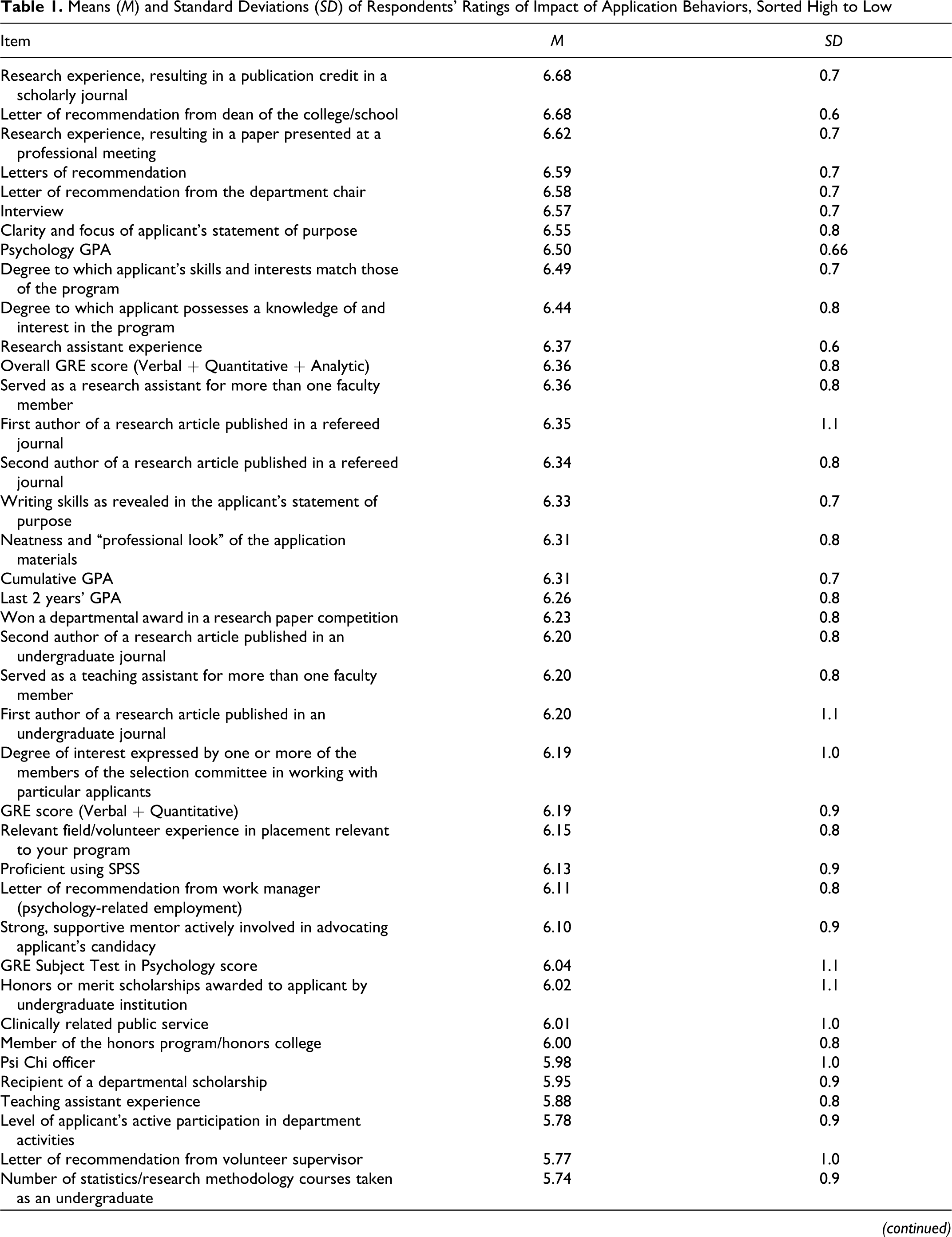
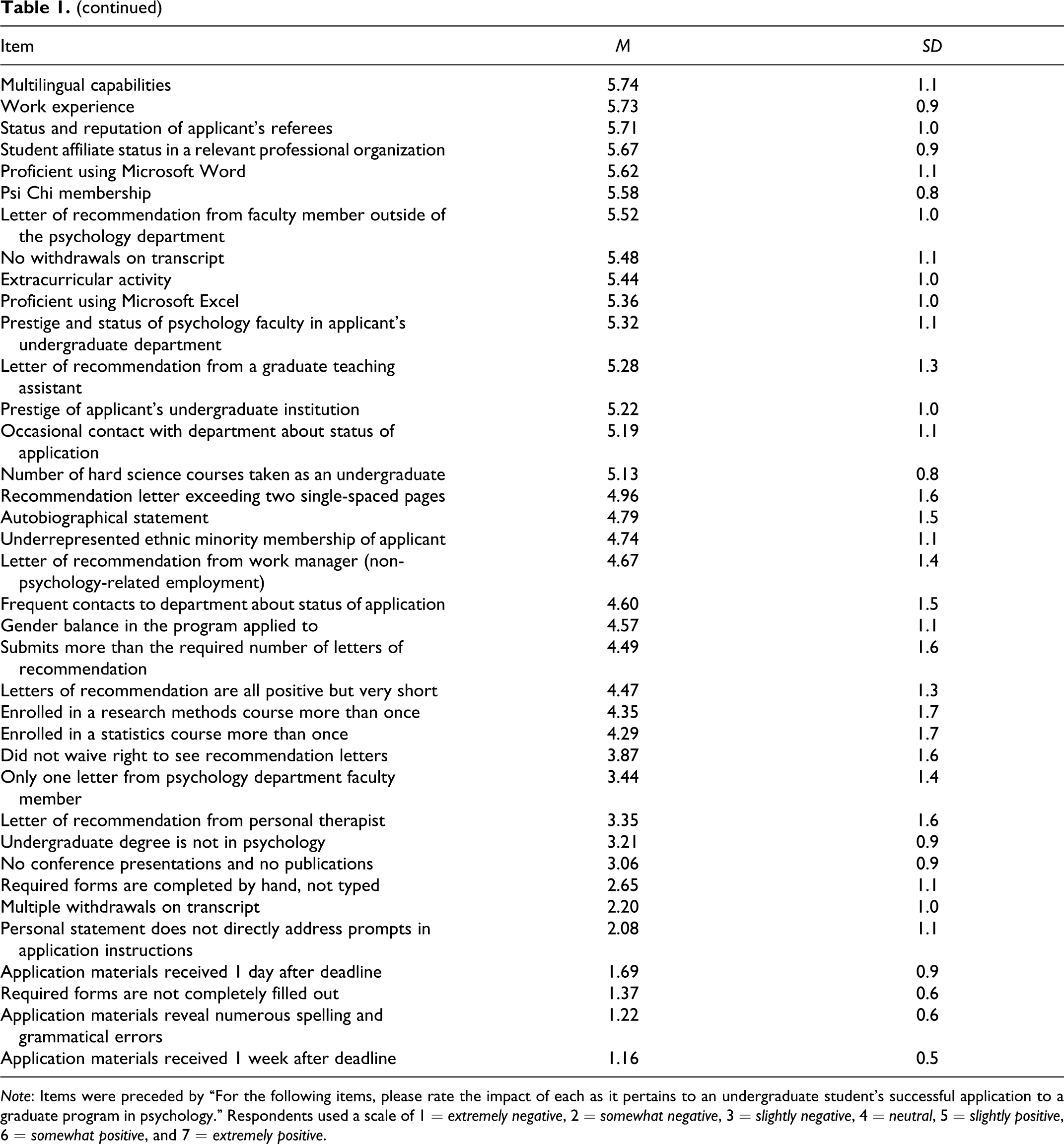
Based on a review of the literature (e.g., Keith-Spiegel, 1991) and consultation with content experts, we created a survey designed for senior-year psychology majors to ascertain their evaluative rating of the importance of behavioral components of the graduate school application process. The scale we developed was utilized to assess student perception of the importance of various components involved in the application process. Participants were shown a list of 76 items and were asked to rate how important each was in the application process using a scale of 1 = extremely negative to 7 = extremely positive. These items are presented in Table 1 with overall means and standard deviations. In addition, a questionnaire seeking demographic information was administered.
Means (M) and Standard Deviations (SD) of Respondents’ Ratings of Impact of Application Behaviors, Sorted High to Low
Note: Items were preceded by “For the following items, please rate the impact of each as it pertains to an undergraduate student’s successful application to a graduate program in psychology.” Respondents used a scale of 1 = extremely negative, 2 = somewhat negative, 3 = slightly negative, 4 = neutral, 5 = slightly positive, 6 = somewhat positive, and 7 = extremely positive.
Procedure
We mailed every Department of Psychology chairperson in the United States (N = 1,237) a letter requesting their participation in a series of national studies, individually described on postcards included with the letter (10 of the letters were returned as undeliverable). One of the postcards described the present study, and we encouraged the department chair to email senior-year psychology majors and provide a link to a Qualtrics survey pertaining to this research. We asked participants to complete the survey by December 2009, and we gave respondents unlimited time to complete the survey.
Results
Means and standard deviations for evaluative importance ratings of graduate school application behaviors can be found in Table 1, sorted from highest mean ratings to lowest mean ratings. Students rated issues with research experience, letters of recommendation, personal statement, GPA, and knowledge/fit with program as strongly important, whereas conference presentations, publications, and logistics/accuracy of application materials were rated at the lower end of importance.
Discussion
Little is known on a national level about the perceptions of senior psychology majors applying to graduate school, which makes the availability of descriptive outcomes valuable to both students and their advisors. That is, even though the institutional response rate to this survey request was extremely low (1.1%), to our knowledge, there is no other multi-institutional published account of the perceptions and attitudes of senior-level psychology students preparing to graduate and apply to graduate school. Thus, these data are invaluable as an exploratory insight into how psychology majors consider what is important concerning the graduate admissions process.
Examination of the descriptive outcomes from Table 1 (evaluative importance ratings of graduate school application behaviors) is instructive. The top and bottom ratings of Table 1 can help to confirm if our students are properly evaluating key components (i.e., behaviors) of the graduate admissions process, enhancing the prospect of correcting misinformation where it might exist. As hypothesized, the results revealed a varying level of evaluative ratings for the components involved in the graduate school application process of undergraduate psychology majors. Our interpretation of the current data indicates that students may be lacking in knowledge about the importance of certain aspects of the graduate admissions process. More advising attention on these factors is warranted.
Based on the findings of this study, it appears that the tools being used to prepare undergraduate students for the graduate school application process may not be sufficient. Students in the present study were not fully knowledgeable about what it takes to complete a successful application. Our findings support the idea that advisors should focus on boosting the student knowledge base of the application process.
Some practical methods that educators can implement following Bandura’s (1977, 1997) theory of self-efficacy include (1) assigning students the task of developing curriculum vitae and personal statements as this information will expose them to their own personal accomplishments, (2) scheduling a panel discussion of former students who have been successful at the process will “model” the behavior necessary to be accepted into a graduate program, and (3) interacting one-on-one with students in an advisor role will lower their anxiety levels and provide a forum for individual encouragement. When taking these methods into consideration, Lopez and Lend (1992) found that personal performance accomplishments are the strongest contributors to changing self-efficacy.
Although these findings add insight into student perceptions of the graduate school application process, there are limitations to the study. First, data were based on self-report. Investigation of students’ actual behaviors of the application process and comparisons to their perceptions would be helpful. A larger sample size and higher response rates would help bolster the external validity and applicability of these results. In addition, it is important to note that the type of graduate school (psychology vs. nonpsychology) plays a role in the selection process. Our data did not reveal what type of program students were pursuing. Future research should explore this issue. Moreover, collecting data of student perceptions, psychology departmental practices, and search committee opinions would allow comparisons to be made. Coordinated national efforts to ascertain answers to these questions would benefit faculty members, advisors, and students alike in building student knowledge about the graduate admissions process.
Footnotes
The authors declared no potential conflicts of interest with respect to the research, authorship, and/or publication of this article.
The authors received no financial support for the research, authorship, and/or publication of this article.