



Abstract
This article describes a classroom activity to demonstrate (dis)agreement in personality judgments, using an exercise derived from Watson’s research on the accuracy of rating strangers’ personalities. On the first day of class, undergraduate students in psychology courses rated their own personality and the personality of a classmate, using items from the International Personality Item Pool (IPIP). Across five samples, self-other correlations were strong for extraversion but varied for the other four traits. Comparisons with control groups on relevant test items provided preliminary evidence that the exercise promotes learning of relevant material. This exercise can be used in introductory or personality psychology courses to facilitate discussion of various topics including interpersonal judgment and accuracy and methodological and statistical issues.
Initial judgments about other people’s personality are automatic and ubiquitous (Uleman, Saribay, & Gonzalez, 2008). These judgments manifest in everyday conversation but also underlie important life decisions and outcomes, such as who individuals select as potential friends, romantic partners, and employees. People’s immediate judgments about others, in turn, impact targets’ own behaviors and self-views (cf., Funder, 2006). Given these consequences, the formation of such judgments is of considerable research interest and is a common topic in undergraduate psychology courses (e.g., personality and social psychology courses; Funder, 2006).
A common way to study these initial or “zero-acquaintance” personality judgments is to correlate self-ratings of personality with one or more other people’s ratings of that target’s personality (e.g., Watson, 1989). Using this approach, researchers address issues such as the accuracy of initial judgments (by treating the correlations as an index of accuracy), the types of cues people rely on to make these judgments (e.g., the target’s physical appearance, verbosity), and the factors that moderate this self-other agreement (for reviews, see Connelly & Ones, 2010; Kenny, 2004). These studies reveal several consistent findings, such as that (a) there is significant variability in levels of self-other agreement across the “Big Five” (or five-factor model) personality traits, (b) such agreement tends to be relatively strong for extraversion, and (c) agreement is stronger as the length of acquaintanceship increases (see Funder, 2006).
In this article, we describe how instructors can re-create these studies using a classroom activity. This exercise derives from Watson (1989). It can serve as a practical way to teach and stimulate discussion about topics including the (a) processes underlying the formation of these judgments, (b) importance of these judgments in everyday life, and (c) methodology and statistical analyses involved in studying (the accuracy of) these judgments.
Although several other articles have discussed interpersonal judgment exercises, these exercises typically entail having students assess the personality of “paper people,” photographs, or fictional characters (e.g., Berrenberg, 1987; Goldstein, 1998; Herringer, 2000; Symbaluk & Cameron, 1998). In contrast, for this activity, students rate their own personality and then rate the personality of a classmate based on real face-to-face interactions.
This alternative approach is valuable for multiple reasons. First, it reflects the realities of social judgments. In most real-world scenarios, individuals judge others while, concurrently, acting to create an impression for them. Evidence suggests that engaging in these simultaneous tasks of trying both to create and to form judgments partially explains why people are not more accurate in judging others (Vorauer, 2006). A second benefit of this design is that the personal relevance of this approach should translate into superior student learning (Enns, 1993). Finally, because both self-data and other data are collected, these results can serve as a measure of judgmental accuracy. The instructor then can leverage these results to discuss judgmental accuracy and also the appropriateness of using these correlations as a measure of such accuracy.
Method
Participants
Seven total samples (i.e., class sections) were used to implement the study. Five of these seven sections completed the activity, and the other two served as control conditions. Of the five sections that completed the activity, four were sections of an undergraduate psychology of personality course at a large Mid-Atlantic University (ns = 28, 37, 48, and 44) taught between 2009 and 2011. The other sample consisted of 25 undergraduate students in an introductory psychology statistics course at another university.
The two control condition samples consisted of a section of 22 students in the same psychology statistics course and 20 students from a human resource management (HRM) class, taught at different universities. The same instructor taught each of the four personality sections and a different instructor taught the other courses.
Measures
Personality
Participants completed “self” and “other” ratings of personality using 25 items from the International Personality Item Pool (IPIP; http://ipip.ori.org/ipip/; Goldberg, 1999). The IPIP is a project designed to provide measures of various individual difference variables, all in the public domain. The measures provide parallels of proprietary measures. The instructor of the personality course chose five items for each of the five factors (i.e., traits) measured by the NEO Personality Inventory (NEO PI; Costa & McCrae, 1985). The instructor chose items for each trait that he or she believed would be easily comprehensible to all students and that did not require reverse scoring. Students indicated the degree to which each statement described them (i.e., self-report) and a classmate (i.e., other-report) using a scale of 1 (strongly disagree) to 5 (strongly agree). Sample items include “I have a vivid imagination” (openness), “I have a good word for everyone” (agreeableness), “I panic easily” (neuroticism), “I feel comfortable around people” (extraversion), and “I am always prepared” (conscientiousness).
Learning in the personality sections and the HRM section
Students in the four personality sections and in the HRM section responded to the following item, “People can make fairly accurate 1 judgments about other people’s ___________ when they first meet them.” Consistent with research findings (e.g., Beer & Watson, 2010), extraversion should be the correct response.
Learning in the statistics section
Students in the two statistics sections responded to the following item, “Please compute a correlation coefficient for the following [data].” The instructor scored the item out of 12 total points. Scores did not enter into students’ course grade.
Procedure
We first describe how we implemented the activity in the personality course and then mention differences in the implementation in the statistics course. During the first class meeting of the semester, the instructor informed the students they would be engaging in an activity to give them a sense of the course content. The instructor explained that the first part of the activity entailed completing a standard personality measure. The instructor assured the students that the activity was just for demonstration purposes and that their responses would remain anonymous. After completing the self-report personality survey, students were told to sum their responses to items 1–5 and put that number next to the “N” (neuroticism), sum their responses to items 6–10 and put that number next to the “E” (extraversion), and so on.
Next, the instructor stated, “Before we continue with the exercise, I want to give you a chance to meet each other.” The instructor asked students to find and sit with a classmate they had never met and then to (1) tell each other why they were taking this course and (2) think of a question together about the course syllabus. 2 After 5 min, the instructor ended the conversations.
At that point, the instructor revealed that the true purpose of the activity was to examine self–other agreement in personality ratings and that the students now would rate the personality of the classmate with whom they just conversed. In order to match the two surveys without using names, the instructor had the students “count off” aloud, “1,” “2,” and so on. Students were then asked to record their own (i.e., self) number on the survey they already had completed (i.e., their self-ratings). The instructor collected the completed “self” surveys and passed out the “other” surveys. Students recorded their “self” number and their partner’s (i.e., “other”) number on this second survey. Students then rated their partner on each item. The instructor asked the students to cover their surveys while completing them and told the students “not to discuss their ratings after class.” The students again summed the scores for each of the five traits.
Immediately following the exercise, the instructor used this exercise to stimulate a discussion about personality traits and to introduce the Big Five traits. The instructor later entered the scale scores into a statistical program and computed self-other correlations.
The procedure for the statistics section was identical as above except that the instructor only provided the students with 2 min to converse, due to the class being shorter. Also, instead of using the activity (results) to discuss personality (judgments), the instructor used it when introducing the concept of correlation later in the semester. The instructor demonstrated how to compute a correlation coefficient in both sections using the extraversion data from the section that completed the activity. On the next day, students in both sections computed a correlation coefficient using unrelated data.
Students in the HRM course did not complete the activity. However, the instructor discussed the topic of personality judgment for a significant portion of a class period when covering the broader topic of personality at work. Students learned that self–other agreement tends to be highest for extraversion at zero acquaintance.
Results
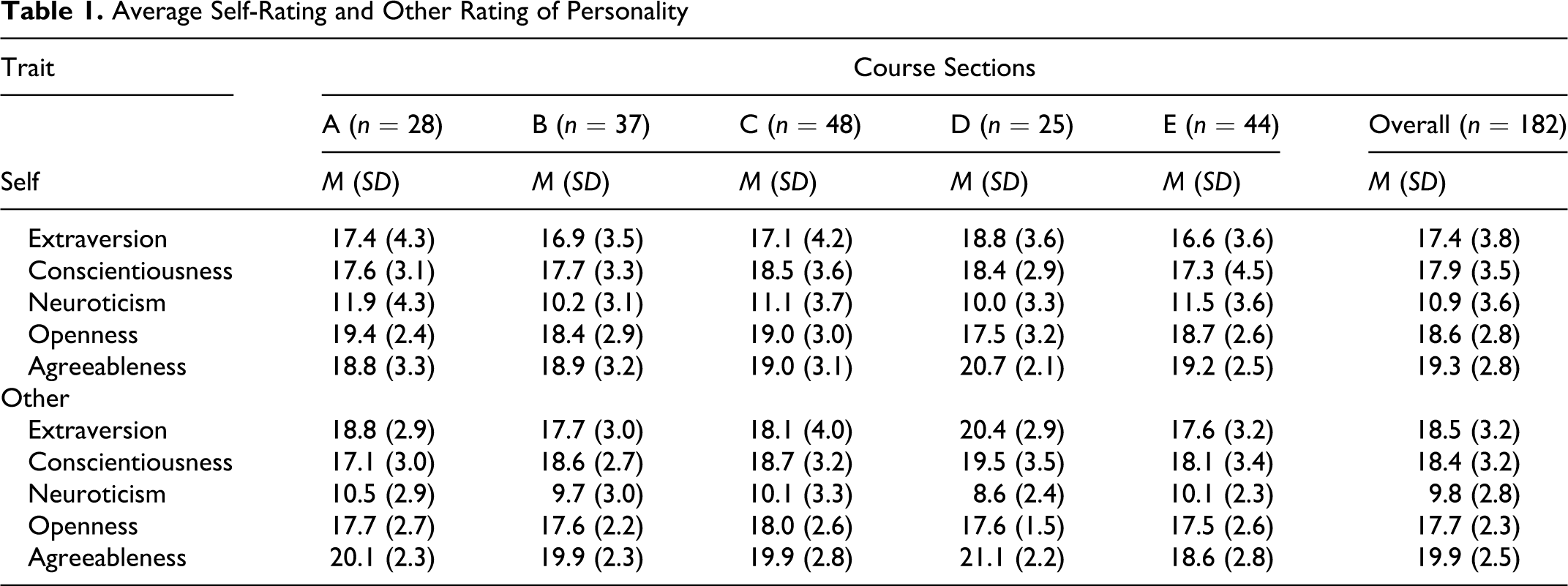
The means for self-rating and other-rating are shown in Table 1. Scale scores were relatively high and negatively skewed for all traits except neuroticism, for which the scores were low and positively skewed. The self–other correlations for each trait appear in Table 2. As shown, self–other agreement was strongest for extraversion across the five sections. The correlations generally were weaker, and also were much more variable, for the other traits.
Average Self-Rating and Other Rating of Personality
Correlations Between Self-Rating and Other Rating of Personality
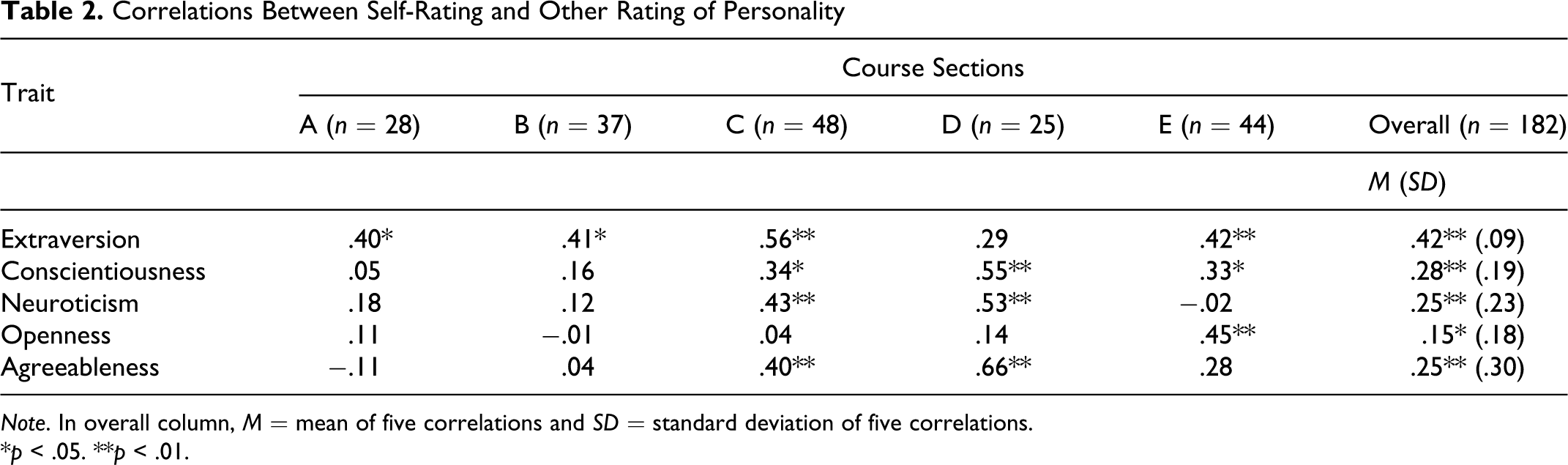
Note. In overall column, M = mean of five correlations and SD = standard deviation of five correlations.
*p < .05. **p < .01.
Across the four personality psychology sections, 85% of students correctly responded to the item asking about which personality trait people are fairly accurate in judging when they first meet them. In contrast, 13 (65%) of 20 the students in the HRM course (who did not complete the activity) answered this item correctly. Moreover, students from the statistics section who learned about correlation using their own data performed better on the correlation item (M = 10.12 [out of 12 points], SD = 2.06) than did the students in the control section (M = 9.41, SD = 2.66). Although these two comparisons were not statistically significant (ps > .10), they provide tentative evidence of the effectiveness of the exercise. In addition to facilitating student interest and learning, the exercise also helped to immediately establish a culture of open classroom discussion and to facilitate student interaction.
Discussion
The exercise can serve as a springboard for teaching several concepts traditionally covered in undergraduate psychology courses, including introductory psychology and personality psychology. First, this activity can be used to talk about various issues regarding interpersonal judgment. The instructor of this personality course shared the class’s results later in the semester when discussing interpersonal judgments of personality. He used these results to stimulate a discussion about the formation of these judgments, their importance in everyday decisions, why and when agreement would be higher or lower (i.e., focus on mediators and moderators), and on the consequences of these initial judgments of others (e.g., discrimination based on stereotypes). He also explained that this practice of correlating self-rating and other-rating was a common way that researchers index accuracy in personality judgments (e.g., Watson, 1989), and he asked the students to think about shortcomings of this practice (e.g., the assumption that people provide honest responses).
Also, this exercise can be useful for introducing students to the empirical research process; the exercise provides a tangible context for discussing methodological and statistical issues. In addition to using the results to discuss bivariate correlation, the instructor can leverage the activity to demonstrate and discuss the differing distributions for the various traits. For instance, the instructor could ask students for which traits they would expect higher or lower mean values and positive versus negative skew. Finally, the instructor can use these data to demonstrate the use of factor analysis as a means to “uncover” the structure of personality (cf., John & Srivastava 1999).
In closing, we encourage other instructors to tailor this exercise to suit their objectives. For instance, instructors could choose different traits, multiple measures of each trait, and could vary the topic of discussion, depending on the specific learning objectives and the results one hopes to demonstrate.
Footnotes
Both of the first two authors contributed equally to this article. The ordering of the names is arbitrary.
The authors declared no potential conflicts of interest with respect to the research, authorship, and/or publication of this article.
The authors received no financial support for the research, authorship, and/or publication of this article.