




Abstract
Incivility occurs frequently in college classrooms. However, recommendations to teachers for handling student incivility are based on anecdotal evidence. To address this gap in knowledge, students (N = 150) in the current study evaluated the effectiveness of several teacher responses to classroom incivility. Incidents of incivility, described in vignettes, varied in disorderliness and harmfulness. Students perceived ignoring incivility as the only ineffective response. Direct confrontation of uncivil students in class or outside of class received the highest overall ratings of effectiveness, and students tended to see immediate responses to disorderly behaviors as more effective than delayed responses. These results suggest that students perceive teachers as having a responsibility to manage classroom incivility, especially when it disrupts classroom order.
Incivility in college classrooms is often characterized as a growing problem (e.g., Feldmann, 2001; Price, 2011). Feldman defined the concept as “any action that interferes with a harmonious and cooperative learning atmosphere in the classroom” (2001, p. 137), but most incivility research focuses specifically on discourteous or disruptive student behavior. Common examples of classroom incivility include emotional outbursts, carrying on side conversations, lateness, and engaging in nonacademic activities (Bjorklund & Rehling, 2010; Boice, 1996). These types of behaviors are relatively frequent and negatively impact both teachers and students (Bjorklund & Rehling, 2010; Boice, 1996; Braxton & Jones, 2008; Nordstrom, Bartels, & Bucy, 2009); thus, the effective management of classroom incivility is an important topic for teachers. Arguably, psychology teachers must be especially concerned with incivility because they often have the added pressure of handling difficult dialogs surrounding individual differences and diversity, both of which are common psychology topics (e.g., Prieto et al., 2009). Suggestions for managing classroom incivility are both plentiful and diverse (e.g., Barrett, Rubaii-Barrett, & Pelowski, 2010; Berger, 2003; Feldmann, 2001; McKeachie, 2002; Price, 2011). However, all existing suggestions share the limitation of being based on anecdotal rather than empirical evidence; researchers have not provided data to support claims of effectiveness. The purpose of the current study was to assess student perceptions of effectiveness in order to offer the first research-based suggestions for responding to classroom incivility.
Recent research has explored the effectiveness of common teacher responses to inappropriate classroom behavior (Boysen, 2012; Boysen & Vogel, 2009; Boysen, Vogel, Cope, & Hubbard, 2009). However, that work specifically focused on prejudice, stereotypes, and discrimination; incivility differs from these forms of bias in several ways. To begin, previous evaluations of responses to bias have focused on classroom behaviors, such as the use of racial slurs (Boysen, 2012), that go well beyond simple discourtesy. Students tend to believe that such prejudice is plainly unacceptable and requires a response, but they have widely varying perceptions on what constitutes appropriate classroom civility (Bjorklund & Rehling, 2010). Consequently, although students uniformly believe that overt prejudice requires intervention, they may perceive incivilities such as checking text messages as none of the teacher’s concern. Another difference is the interpersonal harm posed by bias and incivility; bias is by definition impersonally harmful, but incivility varies greatly in harmfulness. For example, insulting another student would be harmful, but listening to headphones rather than the lecture is uncivil but poses little danger of interpersonal harm. Finally, unlike bias, classroom incivility is a frequent disruption (Bjorklund & Rehling, 2010). In fact, students report noticing incivilities such as side conversations, cell phone use, and nonacademic computer use more frequently than teachers (McKinne & Martin, 2010). Thus, there is a major difference in the everyday disruptiveness represented by bias and incivility. It should be noted, however, that incivility varies greatly in its disruptiveness. For example, repeated talking on a phone would effectively prevent classroom business, but texting during class may only disrupt one student’s attention. Overall, classroom bias and incivility are different in many ways, and research is needed to specifically examine the effectiveness of responses to different types of incivility.
The purpose of the current research was to provide the first empirically-based suggestions for responding to classroom incivility. Student evaluations are one widely-accepted method of assessing teaching effectiveness (Marsh & Roche, 1997), and students are the group directly impacted by teachers’ ability to maintain civility. As such, this study evaluated responses using student perceptions of effectiveness. Considering the previously outlined variations in disorderliness and harm posed by incivility, it was important to account for those differences in the experimental materials. Thus, the current study asked students to rate the effectiveness of teacher responses to scenarios describing classroom incivility that varied in disorderliness and harmfulness.
Method
Participants included a nonrandom sample of 150 students from a medium-sized college in the Northeastern United States who were mostly White (83%), women (77%), and of traditional college age (M = 19, SD = 1.27). Participants rated the general effectiveness of teacher responses to incivility using a scale from 1 (very ineffective) to 6 (very effective). Responses, taken from previous research (Boysen, 2012; Boysen et al., 2009), included immediately telling the student in class that the behavior was inappropriate (direct), leading a classroom discussion about the behavior (discuss), telling the student outside of class that the behavior was inappropriate (private), giving counterexamples to show the flaws in the students’ thinking that led to the behavior (counter), and ignoring the behavior (ignore).
Participants completed all materials anonymously online in exchange for partial course credit. The design of the study was entirely within subjects. All participants read brief descriptions of eight classroom incidents of student incivility. The order of the descriptions was initially randomized and then presented to all participants in the same order. The incidents varied in terms of disorderliness and harmfulness. For the disorderly incidents, the behavior was apparent to all individuals in the classroom; and in the nondisorderly incidents, the behavior was only immediately evident to the teacher. In the harmful incidents, the behavior was hurtfully directed at another student in the class, and in the nonharmful incidents, the behavior was not directed at another student. Thus, participants read two incidents each that were: disorderly and harmful (e.g., verbal insults), disorderly and nonharmful (e.g., phone repeatedly ringing), nondisorderly and harmful (e.g., surreptitious obscene gestures concerning a student presenter), and nondisorderly and nonharmful (e.g., listening to headphones). After reading about each incident, participants rated their perceptions of its appropriateness, disruptiveness, and harmfulness and their perceptions of the five teacher responses. Thus, the study was a 2 (Disruptiveness: High vs. Low) × 2 (Harmfulness: High vs. Low) × 5 (Response: Direct vs. Discuss vs. Private vs. Counter vs. Ignore) within-subjects design.
Analyses excluded 19 participants who failed to select the correct responses on items designed to assess attention to the materials. A preliminary manipulation check indicated that students rated all of the incidents as very inappropriate. In addition, the disorderly incidents received significantly higher ratings of disorderliness than the nondisorderly incidents. Although ratings of harmfulness were in the expected direction, participants only perceived the disorderly and harmful incident as significantly more harmful than the two nonharmful incidents.
Results
The main analysis consisted of a 2 × 2 × 5 (Disruptiveness × Harmfulness × Response) within-subjects analysis of variance using ratings of effectiveness as the dependent variable. The analysis utilized ratings averaged across the two analogous scenarios (e.g., the two harmful disorderly incidents). The three-way interaction was significant, F(4, 504) = 251.37, p < .001, η p 2 = .64, indicating the need for post hoc tests. Paired samples t tests examined for differences in the means with the p value adjusted to .001 to reduce the chances of Type I error. The first set of post hoc analyses compared effectiveness ratings of the five response types. For example, which response was perceived as most effective for a disruptive and harmful incident? The significant effects indicated that participants assigned direct confrontation and private confrontation the highest ratings of effectiveness across all types of incivility (see Table 1). In addition, students perceived ignoring to be significantly less effective than all other responses across all types of incivility. The second set of post hoc analyses compared effectiveness ratings of individual responses between the four types of incivility. For example, was discussion perceived as equally effective for disorderly harmful and nondisorderly nonharmful incidents? The direction of means and significant effects showed that participants tended to perceive direct confrontation, discussion, and providing counterexamples as more effective for disorderly incidents than nondisorderly incidents (see Table 1). These results suggest that disorderliness increases desire for an immediate response rather than a delayed (i.e., private confrontation) or passive (i.e., ignore) response.
Means and Standard Deviations of Students’ Ratings of Response Effectiveness
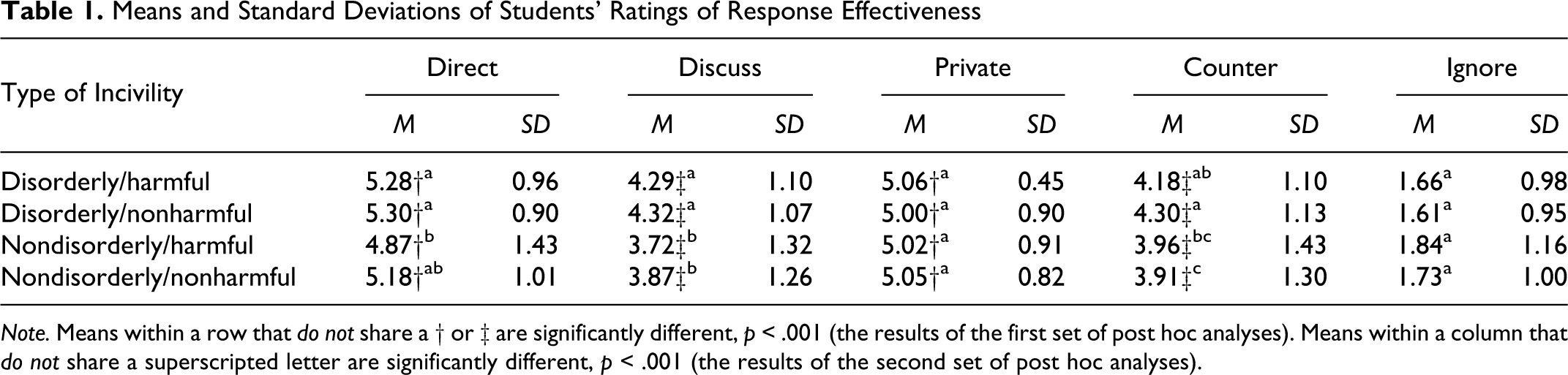
Note. Means within a row that do not share a † or ‡ are significantly different, p < .001 (the results of the first set of post hoc analyses). Means within a column that do not share a superscripted letter are significantly different, p < .001 (the results of the second set of post hoc analyses).
Discussion
How should teachers respond to classroom incivility? According to students, two responses stand out as most effective: direct and private confrontation. Confrontation can be difficult for some teachers because of their desire to avoid antagonizing or offending the uncivil student. Considering the results of this study, however, most students want teachers to take swift, decisive action in putting an end to incivility. Thus, rather than feeling like the antagonist of one student, teachers can feel like they are acting with the support of the rest of the class. Of course, any recommendation for direct confrontation must be accompanied with the warning to avoid disrespecting or humiliating students at all costs (McKeachie, 2002). As such, when immediate action is not advisable—for example, when direct confrontation would disrupt class more than the incivility—private confrontation is an equally effective alternative method according to students. Should disorderliness and harmfulness affect response choices? Direct confrontation, discussion, and providing counterexamples all received higher ratings of effectiveness when a situation was disorderly as opposed to nondisorderly; thus, these immediate responses are advisable when incivility is interrupting classroom activities. Harm did not seem to impact perceived effectiveness, but this may have been due to the relative weakness of the manipulation.
Perception of direct and private confrontation as the most effective responses to incivility contrasts with students’ perception of discussion as the most effective response to bias in the classroom (Boysen, 2012). Perhaps, students simply believe that there is less to discuss with incidents of incivility, which tend to be minor rule infractions rather than major incidents necessitating a full-class debriefing. One similarity with previous research, however, is students’ perception of ignoring incivility as ineffective, even for harmless, nondisruptive behaviors. Students seem to want teachers to exert control in difficult classroom situations.
The current research has the advantage of offering the first empirically-based guidance on responding to classroom incivility. Furthermore, students, the key population of interest, were the source of guidance. Nonetheless, it is important to point out that students’ perceptions of effectiveness may not generalize to effectiveness at stopping real-world incivility. In addition, it is not clear whether the students who conscientiously filled out this study’s survey for extra credit are representative of students who typically exhibit incivility. Despite these potential problems, this study offers a simple message: Students recognize classroom incivility as inappropriate and want teachers to take direct action to enforce the norm of classroom order and decorum.
Footnotes
Declaration of Conflicting Interests
The author declared no potential conflicts of interest with respect to the research, authorship, and/or publication of this article.
Funding
The author received no financial support for the research, authorship, and/or publication of this article.