



Abstract
This article documents a pluralistic ignorance project, which serves as an appropriate mid-level research experience for psychology students, and aims to foster students’ comfort and confidence with the research process. For the project, small groups of students utilized an established research paradigm to explore varied topics. After being assessed in a pilot study, the project was evaluated by a group of students enrolled in a social psychology course at various points throughout the assignment. Students reported broad enjoyment of the assignment and supported its future use. They also reported greater comfort and confidence with aspects of the research process (e.g., forming hypotheses, providing feedback to classmates). Data suggested the project has the potential to foster positive attitudes toward the research process, with potential long-term effects. Suggestions for customizing the pluralistic ignorance project are discussed.
Keywords
Although early exposure to conducting research can be useful, students given too much leeway may evaluate psychology as less scientific (Friedrich & Douglass, 1998). Method courses are critical for exposing students to concepts and shaping attitudes toward research. Psychology instructors are challenged to assign coursework that supports both novice and advanced students in their perceived ability to conduct independent research. This challenge is heightened in methods courses, where students may be uninterested or intimidated by research.
One way to support research self-efficacy is presenting students with successful, scaffolded research experiences (Cole, 1985; Vygotsky, 1978). This study describes a project, utilizing a pluralistic ignorance paradigm, designed to engage mid-level (sophomore- and junior-level) researchers and increase comfort and confidence with research, two qualities that bolster future research efforts (Harlow, Burkholder, & Morrow, 2002) and performance (Carlson & Winquist, 2011).
Pluralistic Ignorance
Pluralistic ignorance describes a discrepancy between personal attitudes and perceived social norms (Prentice & Miller, 1993) or a belief that similar public behavior is indicative of different private beliefs (Miller & McFarland, 1991). Studies have examined students’ personal comfort and perceptions of the average student’s comfort with drinking and hooking up behaviors (Lambert, Kahn, & Apple, 2003; Prentice & Miller, 1993), reporting a discrepancy between participants’ comfort level and beliefs about other students’ comfort level, indicative of pluralistic ignorance. Given applicability to various risky behaviors (e.g., binge drinking, unsafe sexual practices), pluralistic ignorance lends itself not only to increasing students’ comfort with conducting research but also to generating research questions relevant to campus life. This project utilized a similar procedure to examine pluralistic ignorance at one college campus.
Goals of the Project
This project exposes novice students to the research process without overwhelming them, allowing students to develop self-efficacy in conducting research. Providing a template for research prevents students from becoming overwhelmed with designing an entire project, allowing them to focus on developing crucial research skills: data collection, wording questions, peer review, and reporting results.
The project also exposes mid-level psychology students to research likely to be successful; 71% (20 of 28) of past projects produced at least two-thirds of questions with significant results 1 and only four had fewer than 50% of questions with significant results (see Table 1, http://web.reed.edu/psychology/pluralisticignorance/). Finally, the pluralistic ignorance project may help students share information about campus norms with the community, foster appreciation for work involved in research, identify realistic goals for later independent research, and develop a suitably critical eye toward research articles.
Examples of Questions Asked in the Pluralistic Ignorance Project Yielding Significant Discrepancies Between Perceived Norms and Average Self-Ratings
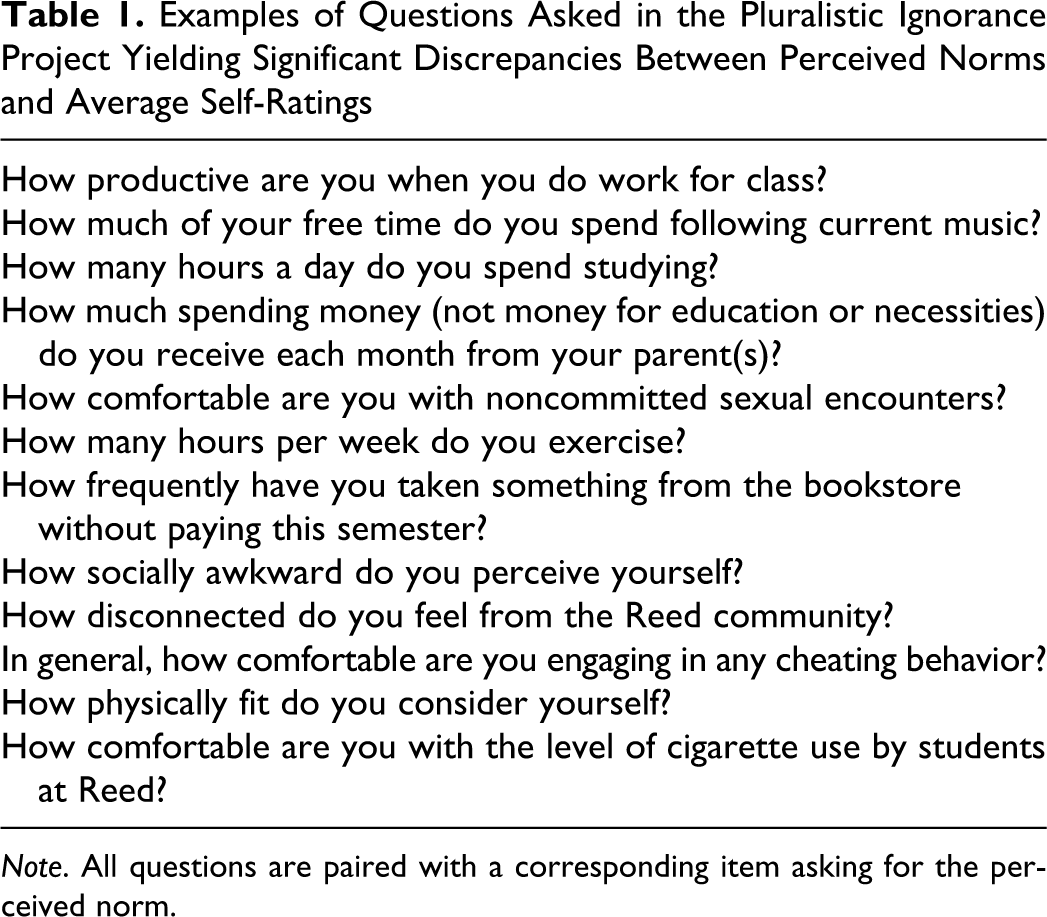
Note. All questions are paired with a corresponding item asking for the perceived norm.
Description of the Project
After discussing articles on pluralistic ignorance, students brainstorm topics to explore and form groups; this is designed to foster more engagement than selecting topics from a pregenerated list (Reeve, Jang, Carrell, Jeon, & Barch, 2004). Students are encouraged to consider campus norms (e.g., students being comfortable with drinking, study habits, religiosity) that might be misperceived; for example, there might be a perception that students are not looking for committed relationships when they are actually quite interested. Groups work together to write questions, modeled on Prentice and Miller’s (1993) research, and develop hypotheses. Participants taking the survey provide both (1) self-ratings and (2) ratings of their peers (e.g., “How comfortable are you/the average student with drinking on campus?”). Specific wording varies from year to year. Students also consider research methodology (e.g., counterbalancing). Following peer review of other groups’ questions, students recruit participants in person, through posters, or online using small incentives such as candy or fruit. The participants could complete the survey in person or online. The instructor analyzes the data (as a statistics course is not a prerequisite for the course) and presents results to the class; students then complete individual write-ups of their findings. The statistics are generally fairly straightforward, consisting primarily of paired t tests, so students with a basic statistics background could run their own statistics, allowing them to gain experience in another important aspect of conducting research.
Evaluation of the Project
A pilot study assessed long-term effects of the project. In an anonymous online evaluation 1 year after course completion, students evaluated the perceived benefits of the project through questions drawn from past articles (Corpus & Eisbach, 2005; Kardash, 2000; Plous, 2000). Students rated the project and course favorably, strongly recommended its future use, expressed high interest in conducting future psychology (but not pluralistic ignorance) research, and reported enhanced understanding of the college community and ability to provide feedback. Based on these findings, we constructed a more comprehensive review of the project.
Primary Study
Participants
A cohort of social psychology students was followed through completion of the pluralistic ignorance project. All 30 class members (70% women, 93% psychology majors, 87% sophomores and juniors) completed the first time point of the survey. Most had not yet taken the Research Design and Data Analysis course required for the Psychology major. Twenty-six students (86.7%) completed the survey at each subsequent point, with full data for 20 (66.7%) participants. Mid level psychology majors were included for analyses; seniors (n = 4) and nonmajors (n = 1) were excluded. 2
Procedure
Participants indicated their comfort and confidence in designing a psychology study, collecting data, and evaluating and providing constructive research feedback to others. They also reported their interest in conducting psychology research. All questions were answered on 9-point scales. Participants received candy and gift card lottery tickets at each time point.
To isolate the effects of the project (versus pluralistic ignorance readings), data were collected in class at four points: before discussing pluralistic ignorance, after studying pluralistic ignorance but before the project, after survey distribution and data collection, and after project results were discussed in class. During final data collection, participants answered additional questions concerning the project’s benefits. To ensure confidentiality, the instructor was not present during data collection and did not have access to hard data (coded with identification numbers) until after submitting final grades.
Results
Participants rated the project favorably, highly valued the project, and were likely to recommend the project and course to others (Table 2). They also reported learning about the campus community, understanding pluralistic ignorance, and facilitation in their ability to design hypotheses, collect data, and evaluate other projects. Participants did not report interest in future pluralistic ignorance research.
Evaluations of the Pluralistic Ignorance Project (N = 21)
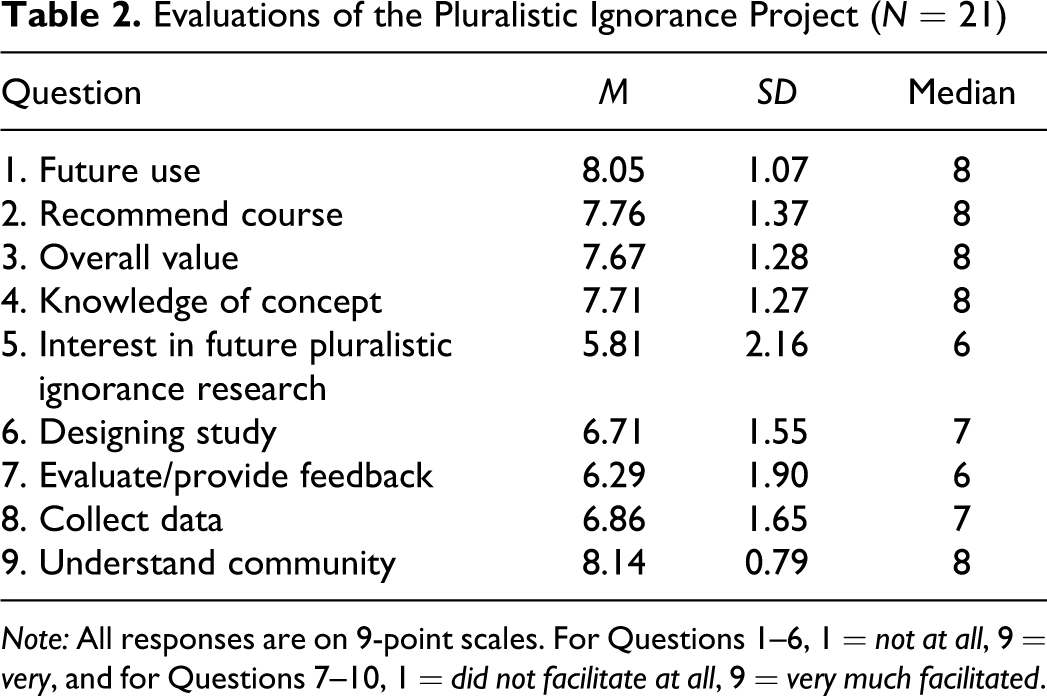
Note: All responses are on 9-point scales. For Questions 1–6, 1 = not at all, 9 = very, and for Questions 7–10, 1 = did not facilitate at all, 9 = very much facilitated.
We also explored changes in students’ comfort and confidence with aspects of research design (Table 3). After dropping one student with three missing time points, missing values for all students were replaced with the mean for that time point. Overall, the project successfully fostered students’ perceptions of their research skills, Fs > 3.17, ps < .03, ηp 2 s > .12. There were significant increases in reported ability to design a study (i.e., greater comfort at the third and fourth time points than the beginning of class, increased comfort from the second to final time point), collect data (i.e., increased comfort from second to final time point, increased confidence from second to third time points), and provide feedback to others (i.e., greater comfort at the final time point than first two time points, greater confidence at the final point than the initial one). Interest in conducting research significantly decreased from the initial to third and second to third time points; however, final and initial interest levels did not differ. Temporary reduced interest may be due in part to timing, with the second and third time points falling around school breaks (i.e., fall break, Thanksgiving).
Evaluations of the Pluralistic Ignorance Project From the Beginning to End of the Social Psychology Course
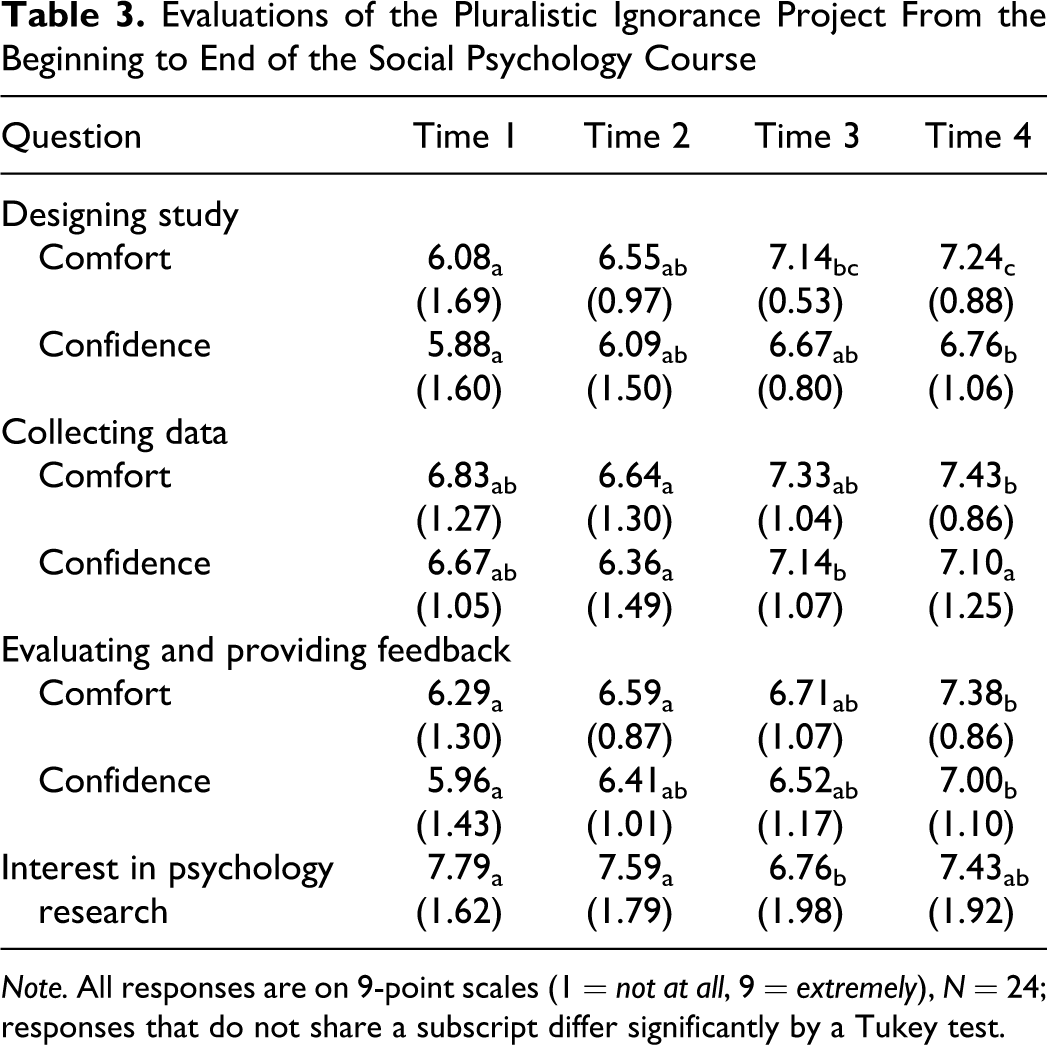
Note. All responses are on 9-point scales (1 = not at all, 9 = extremely), N = 24; responses that do not share a subscript differ significantly by a Tukey test.
Discussion
Students reported increased comfort and confidence in the research process—including study design, hypothesis testing, and providing feedback to peers—after completing the pluralistic ignorance assignment. Students also expressed valuing and enjoyment of the project. However, students did not report increased comfort with collecting data; this may be due to the use of online data collection. Instructors concerned with fostering this skill may instead have students collect data in person. The project also did not increase interest in conducting psychology research. This could be due to a ceiling effect, as students’ interest ratings started very high, with minimal room to increase. Courses with moderate initial student interest in research (e.g., methods courses) might witness an increase in research-related interest. Alternatively, students may have a more realistic—and, subsequently, less positive—view of research after their exposure to difficulties that can arise (e.g., Carlson & Winquist, 2011). Regardless, the project still may foster comfort and confidence in conducting research. While these positive effects could be attributed to the class itself, rather than the project, the changes occurring at critical points in the project (e.g., after data collection, analysis), suggest some impact from the project itself. Rather sizable effect sizes (ηp 2 s > .12) suggest the project has a meaningful impact on students’ self-efficacy toward research.
Flexibility and Variations
The project was implemented in a content-oriented social psychology class but can be easily tailored for other courses. For example, a methods class could include specific research techniques (e.g., reverse-ordering, pretesting) or manipulate independent variables (e.g., instructions, item order) when implementing the project. Instructors could also explore the importance of collecting a random sample of participants in accurately assessing pluralistic ignorance present in the school community.
Overall, we recommend this project for instructors interested in incorporating hands-on research experience into their mid-level content courses. The simplicity of design and wide degree of customizability make it a useful way to introduce students to research outside of strict methods or statistics courses. The project is enjoyable for students and may be beneficial to the wider college community as students empirically explore campus norms. Although learning data such as students’ grades were not collected in the present study, recent research suggests that for students engaged in hands-on research learning, students’ attitudes toward research predict their performance (Carlson & Winquist, 2011). The current research suggests that the pluralistic ignorance project may be valuable in improving students’ attitudes about the research process.
Footnotes
Acknowledgments
The Andrew W. Mellon Foundation and the office of the Dean of Faculty at Reed College provided grant support for this research. The authors are grateful to Anna McGee and Erin Westgate for their comments on a previous version of this article.
Declaration of Conflicting Interests
The authors declared no potential conflicts of interest with respect to the research, authorship, and/or publication of this article.
Funding
The authors disclosed receipt of the following financial support for the research, authorship, and/or publication of this article: The Andrew W. Mellon Foundation and the office of the Dean of Faculty at Reed College provided grant support for this research.