



Abstract
Introductory psychology textbooks have been criticized for being too long and too expensive. A national survey of introductory teachers found that 89% of introductory courses are only one term in length and that teachers could only cover 68% of a text’s topics. This situation has been made more problematic by the soaring prices of introductory texts, leading many students to not purchase them. However, a class of more concise, less expensive introductory textbooks has recently emerged. We provide an objective analysis of these concise texts, along with a comparison to previous similar analyses of full-length and brief introductory texts. For introductory teachers interested in adopting a concise text, these data will be helpful in the text evaluation and selection process.
A continuing criticism of introductory psychology textbooks is that they are far too long, bordering on encyclopedic (e.g., Johnson & Carton, 2006; Landrum, 2000). The most recent objective analysis of such texts found that the average length was 16 chapters and about 674 pages (Griggs & Jackson, 2013). Even the briefer versions of introductory textbooks are long, with an average length of 15 chapters and about 550 pages (Griggs & Koenig, 2001). Because 89% of introductory psychology courses are only one term in length (Miller & Gentile, 1998), it would appear that teachers cannot completely cover these lengthy texts. Indeed, Miller and Gentile (1998) found this to be the case in their national survey of introductory psychology teachers. The teachers reported covering an average of 68% of the text topics. The situation is made even more problematic by the cost of introductory psychology textbooks. Like all textbooks, they have soared in price. For example, a brief search of some publisher websites revealed retail prices over $200 for some hardbound, full-color introductory textbooks. Given these high prices and the inability of teachers to cover the entire text, many students do not even purchase texts for the introductory course, as Sikorski et al. (2002) found. Publishers’ surveys of college bookstores and anecdotal reports from faculty suggest that about 20% of students do not buy textbooks (Boyd, 2003).
As a remedy for this situation, some teachers have proposed teaching the introductory course without an introductory textbook (e.g., Johnson & Carton, 2006; Wulff, 1999). Such proposals usually involve using more specialized books and readings. In some cases, the teacher makes a set of standard texts available at some central location (e.g., on library reserve) for students to use as references for concept definition and elaboration (e.g., Zechmeister & Zechmeister, 1999). Griggs, Jackson, and Marek (2002) urged teachers in lieu of no text to consider using an inexpensive core text, such as a review/outline text (e.g., Wittig, 2002). Adopting such a text would at least provide students with some exposure to the core introductory course content and still allow teachers to use other specialized texts and readings.
There is, however, now an alternative solution available for the problem of introductory textbooks being too lengthy and too expensive. A new class of introductory textbooks that are much briefer and less expensive has emerged. These texts could be referred to as Psych Lite because they have great prices and are less filled with encyclopedic detail. So that these texts are not confused with what are termed brief introductory texts, which are invariably shortened versions of existing introductory texts, we will refer to these new texts as concise introductory textbooks. We are aware of five concise texts that are presently available. 1 An objective analysis of these concise texts has not yet been done. We fill that gap by conducting an objective analysis of this set of texts, so that introductory teachers who might be interested in adopting such a text would have some objective data to use in their text evaluation and selection process.
Method
We examined the most recent edition of each of the five concise texts except for McGraw-Hill’s PsychSmart text. We examined the 2011 version of this text, but there is a 2013 version which was not available to us at the time of our text analysis. First, we made the text length measurements used in Griggs and Jackson (2013) and Griggs and Koenig (2001) in order to compare our length data for concise textbooks to those for full-length and brief introductory textbooks, respectively. We counted the number of chapters, text pages (excluding front matter pages), and total pages (text plus back matter pages) for each textbook. In addition, we computed the average number of pages per chapter.
We checked the publishers’ websites to find the publisher retail prices for the five texts. Because text price information was not examined in previous introductory textbook studies, there were no comparable price data available for full-length and brief introductory texts. Thus, we retrieved publisher retail price information for the seven full-length textbooks analyzed by Griggs and Jackson (2013) for which briefer versions exist. Retail prices for the briefer versions were also retrieved.
Next, we conducted a content analysis to determine the percentage of each text devoted to the 16 standard introductory textbook topics (see Table 2) examined by Griggs and Jackson for full-length introductory textbooks. 2 Some of the topics are combinations (e.g., emotion/motivation and sensation/perception) because these topics are now typically combined in singular chapters in introductory textbooks (Griggs, 2006). We also included an Other category in case any of the concise texts included chapters on sex/gender or industrial–organizational/applied psychology (nonstandard topics often included in lower level introductory textbooks, see Griggs, 1999). We also checked to see (a) whether any topic received two-chapter coverage, (b) whether the research methods topic was given separate chapter coverage or combined with introductory material (e.g., history, perspectives, and career areas) in one chapter, and (c) whether, and where, statistics was covered.
Length and Price Data for Five Concise Introductory Psychology Textbooks.
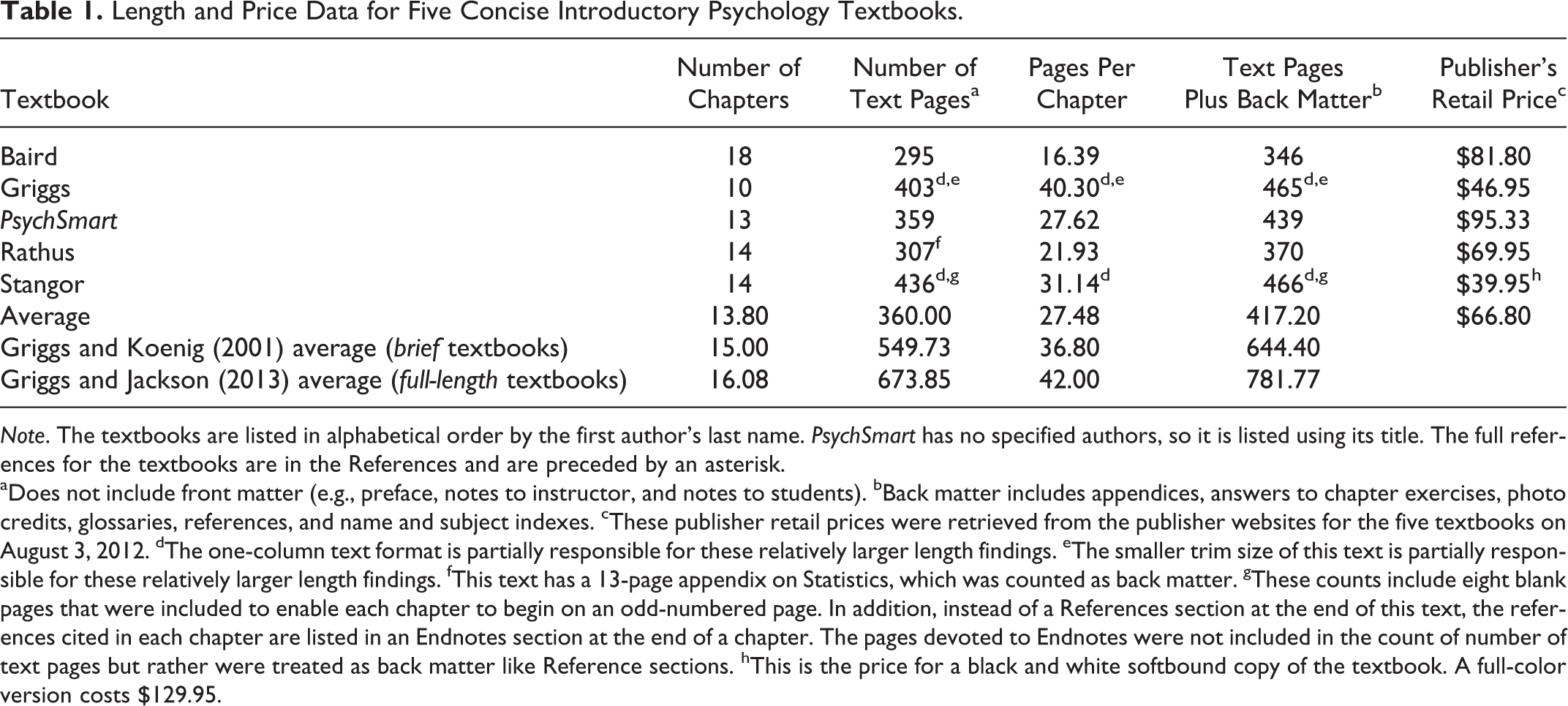
Note. The textbooks are listed in alphabetical order by the first author’s last name. PsychSmart has no specified authors, so it is listed using its title. The full references for the textbooks are in the References and are preceded by an asterisk.
aDoes not include front matter (e.g., preface, notes to instructor, and notes to students). bBack matter includes appendices, answers to chapter exercises, photo credits, glossaries, references, and name and subject indexes. cThese publisher retail prices were retrieved from the publisher websites for the five textbooks on August 3, 2012. dThe one-column text format is partially responsible for these relatively larger length findings. eThe smaller trim size of this text is partially responsible for these relatively larger length findings. fThis text has a 13-page appendix on Statistics, which was counted as back matter. gThese counts include eight blank pages that were included to enable each chapter to begin on an odd-numbered page. In addition, instead of a References section at the end of this text, the references cited in each chapter are listed in an Endnotes section at the end of a chapter. The pages devoted to Endnotes were not included in the count of number of text pages but rather were treated as back matter like Reference sections. hThis is the price for a black and white softbound copy of the textbook. A full-color version costs $129.95.
Percentage of Text Devoted to Standard Chapter Topics for Each Textbook.

Note. The textbooks are listed in alphabetical order by first author’s last name. PsychSmart has no specified authors, so it is listed using its title. The full references for the textbooks are in the References and are preceded by an asterisk. All percentages have been rounded to the nearest whole number so they may not add to 100% exactly for each text or for the averages across texts.
aThis text has two chapters on biological psychology—one on the brain and one on genetics/evolution. bThis text does not include a chapter on this topic but has some coverage of it in a related chapter. cThis category only includes coverage of sex/gender, which was covered in the Baird text. None of the texts included coverage of the other nonstandard topic, industrial–organizational/applied psychology.
The page counting process was straightforward for topics given chapter length coverage. For topics embedded in a more inclusive chapter (e.g., thought, language, and intelligence), page allocation was more complicated. In such instances, if coverage of the embedded topic comprised at least one third of the chapter, then we equally divided the chapter’s pages devoted to introductory outlines and chapter summaries and other preview or summary materials among the relevant topics. If coverage of the embedded topic was less than one third of the chapter, then we only counted the pages devoted to it. We then used text page counts for topics to compute the percentage of coverage of each topic in each text. Percentages were rounded to the nearest whole number, so that they could be compared to the results of previous studies of full-length and brief introductory textbooks. For all analyses, both authors counted pages. If our raw page counts differed, we jointly examined the texts to resolve discrepancies.
Finally, we examined the interior design for each text. We found two general design types in our examination, which we labeled traditional text and magazine style. We operationally defined a traditional-text design as a one-column text format with a judicious use of visual illustrations and magazine-style design as a multiple-column text format with an abundance of visuals including many large illustrations. We also noted whether a text was softbound or hardbound.
Results and Discussion
Table 1 contains the length and price data for the five concise introductory textbooks and compares the overall text averages for the length measures to those from Griggs and Koenig (2001) for brief introductory textbooks and from Griggs and Jackson (2013) for full-length introductory textbooks. As would be expected, all of the average length measures were less for the concise textbooks versus the brief and full-length textbooks. The concise texts only averaged 13.8 chapters and 360 pages of text, indicating that these concise textbooks should fit well with one-term introductory courses. The average for number of chapters is slightly distorted by the unusually large number of chapters (18) in the Baird text. The average number of chapters for the concise texts with the Baird text excluded is only 12.75. It should be noted, however, that although it has more chapters than the other four texts, the Baird text has the smallest average number of pages per chapter, 16.39. Hence, it has many chapters, but they are rather short. In contrast, the Griggs text has the lowest number of chapters (10) but the highest average number of pages per chapter, 40.3. In sum, within this set of concise texts, there seems to be sufficient variability to accommodate the length preferences of most introductory psychology teachers.
Compared to the average prices for full-length textbooks ($183.53) and briefer versions of these textbooks ($138.99), the average price for the five concise textbooks ($66.80) was less (about one half the average price for brief texts and slightly more than one third the average price for full-length texts). It should be noted that the Stangor concise text is published by Flat World Knowledge, an open textbook publisher, so this text can be read free online at the Flat World website by students in a class for which it has been adopted. 3 However, a print version of an open textbook is not free, but it is very affordable. A black and white softbound version of the Stangor text costs $39.95, the price we used in our analysis. A full-color version, however, is much more expensive, $129.95. The other four concise textbooks are published by traditional publishers and are all full color, making their prices relatively more attractive. All five textbooks were softbound. Two of the five texts (Griggs and Stangor) had a traditional text interior design format, and three (Baird, PsychSmart, and Rathus) had the more heavily illustrated, magazine-style design format.
With respect to two-chapter coverage of topics, only one of the five textbooks (Baird) included such coverage. It included two-chapter coverage of both biological and developmental psychology. This text was also the only text to include a chapter on a nonstandard topic, sex/gender. With respect to having a separate chapter devoted to research methods, two of the five texts (Baird and Stangor) included such a chapter. The other three texts (Griggs, PsychSmart, and Rathus) combined coverage of research methods with introductory material (e.g., history, perspectives, and career areas) in one chapter. With respect to coverage of statistics, three texts (Baird, Griggs, and Stangor) included this material with coverage of research methods, one text included it in an appendix (Rathus), and one text did not cover statistics (PsychSmart).
Table 2 provides the coverage information for the standard introductory text topics and compares the topic averages to those for recent full-length introductory textbooks analyzed by Griggs and Jackson (2013). The topic averages for concise texts are very similar to those for full-length texts. For three topics, the averages are the same; for 11 topics, there is only a 1% difference between the averages; and for three topics (biological psychology, emotion/motivation, and stress/health), there is a 2% difference between the averages. The latter differences are likely due to the fact that the averages for these three topics were distorted somewhat by the fact that one of the five concise texts had two biological psychology chapters, one did not have an emotion/motivation chapter, and two did not have a stress/health chapter. In sum, the overall pattern of topic coverage averages for the concise texts is fairly similar to that for full-length textbooks. In addition, there seems to be sufficient variability among the five concise texts both within and across topics to aid teachers in comparing these texts for possible adoption.
Summary
Based on the findings of our objective analyses of this set of concise textbooks, a concise text would seem to be a viable alternative for an introductory teacher who (a) thinks that introductory textbooks are too lengthy and too costly, (b) faces textbook decisions at schools with abbreviated calendars, or (c) needs to control textbook costs for students. These concise texts averaged only 13.8 chapters and 360 text pages in length and had an average retail price of $66.80. Proportional coverage of the standard introductory psychology topics was also very similar to that in full-length introductory texts, and there appeared to be sufficient variability in topic coverage within the set of concise texts to accommodate the topic coverage preferences of introductory teachers. There was also variation in interior text design, so that teachers who prefer a traditional text design or a magazine-style design could be satisfied.
By providing objective data, including a content analysis, for these five concise introductory textbooks, we hope that we have provided introductory teachers interested in such a text with a place to begin in evaluating these texts and some objective data to aid them in narrowing down their choice. After doing so, we strongly recommend that teachers actually read the texts to compare them. We believe that there is no better way to make the final selection decision.
Footnotes
Declaration of Conflicting Interests
The authors declared no potential conflicts of interest with respect to the research, authorship, and/or publication of this article.
Funding
The authors received no financial support for the research, authorship, and/or publication of this article.