




Abstract
Could the same interests that draw many students to psychology also predict departure from the major? I present a comparison of students and instructors with respect to professional interests and views of the scientific nature of psychology (Study 1) and an examination of the link between student interests and persistence in the major (Study 2). Instructors more than students tend to view psychology as scientific, instructors report greater scientist interests whereas students are more interested in practitioner activities, and students with the greatest interest in practitioner activities are actually at increased risk of changing majors. Psychology departments may need to find a curricular balance between scientific emphasis and student satisfaction.
Keywords
Surprisingly few publications address differences between student and educator views of their academic disciplines, nor have many researchers examined the outcomes that such differing views might predict. Some researchers have identified student–instructor differences regarding individual pedagogical issues not specific to psychology (e.g., Henry & Anderson-Yates, 1992; Kirby & Chugh, 1993; Landrum, 2010). Other investigators reported that students’ perception of similarity between themselves and their instructors with respect to various social, moral, and political attitudes is predictive of student course grades and students’ evaluations of instructor effectiveness, competence, likability, and desirability as an instructor (see Abrami & Mizener, 1983, 1985; Good & Good, 1973; Levenson & Leunes, 1974). Furthermore, congruence between student and instructor views concerning the characteristics of excellent teachers corresponds with higher student ratings of their instructors (Goldstein & Benassi, 2006). However, there seems to be no literature comparing the views of students and instructors with respect to the nature of their academic disciplines.
In any academic field, one would expect differences between students and instructors in level of content knowledge. In addition, it is common to hear anecdotal reports that students and instructors perceive academia differently in terms of their attitudes about appropriate study habits, assignment and exam difficulty, and other facets of the educational process. However, differences between psychology students and instructors may extend beyond these familiar workload variables. There seems to be no widely publicized debate that disciplines such as chemistry and biology are sciences, nor that disciplines such as history and philosophy are not sciences. Psychology may be unusual in that students and instructors sometimes appear to have fundamentally different views concerning the nature of the discipline itself, especially with regard to its scientific backbone. My objectives are to compare students’ and instructors’ professional interests and attitudes about psychology, and to examine student interests as predictors of persistence in the major.
Often students study psychology because of their interest in its applied and helping domains (Stalder & Stec, 2007) and many students may not initially recognize the empirical nature of the field (Holmes & Beins, 2009). One possibility is that any differences between students’ and instructors’ perspectives might be the result of simple lack of knowledge on the part of students and that exposure to the empirical nature of psychology would lead to an alignment of the views of students and the views of instructors. However, researchers have found that students’ views of the role of science in psychology remain quite stable even after several years of relevant coursework (Holmes & Beins, 2009) and that completion of a course specific to scientific research methods may actually reduce student interest in scientist activities (Manning, Zachar, Ray, & LoBello, 2006). An alternative possibility is that psychology students and instructors differ not only in their domain knowledge but also in their opinions about what constitutes compelling evidence for drawing conclusions about human behavior. The lack of clarity concerning the potentially differing perspectives is unfortunate since one might expect congruence between the views of teacher and student to predict more successful outcomes (see Abrami & Mizener, 1985). In other words, it seems likely that educational effectiveness would be enhanced when student and teacher agree on the appropriate mechanisms through which knowledge in a field is established.
The reason for anticipating that instructors’ views of psychology tend to differ from the views of students with regard to the importance of science is based on an important distinction. Most graduate training programs in psychology from which full-time college instructors are drawn require research training. Therefore, most college instructors represent both those who would self-select to enroll in such programs and who are sufficiently scientifically minded to complete the degree. In contrast, undergraduate psychology students tend to be most interested in the applied practice of psychology and content related to the helping professions (e.g., Stalder & Stec, 2007). In light of the very large number of undergraduate psychology degrees conferred each year, it is likely that most psychology majors do not ultimately pursue academic or research careers. Given this distinction in motivation and training between psychology students and their college instructors, it seems likely that the two populations would tend to have different perspectives concerning the nature of psychology as well as divergent professional interests.
A predominant framework for conceptualizing views and interests in psychology is the scientist–practitioner model, also known as the Boulder Model. Psychologists originally designed this conceptual model as a framework for clinical training, and the model rests on the assumption that students need not become researchers themselves to become proficient consumers of research in their professional activities (Baker & Benjamin, 2000). Leong and Zachar (1991) developed an inventory to assess scientist and practitioner interests and concluded in a subsequent study of graduate students (Zachar & Leong, 1992) that such interests are strongly rooted in personality. Specifically, Zachar and Leong found that scientific thinking is inconsistent with many students’ personalities, that “scientist and practitioner interests…were predicted by the same variables in opposite directions,” and that it is unusual for an individual to possess high interest in both the scientist and practitioner domains (p. 672). Researchers recently revealed that undergraduate psychology students tend to have greater interest in practitioner activities than scientific ones, and students’ levels of appreciation for the scientific aspects of psychology remain quite stable in the face of continued instruction in research methods (Holmes & Beins, 2009). Therefore, it may be challenging for instructors to motivate such students to appreciate research when it holds little perceived value, especially given that practitioner interests (which are so common and strong among undergraduates) are uncorrelated with the need for cognition—a desire to engage in effortful cognitive processing that is required for scientific thinking (Leong, Zachar, Conant, & Tolliver, 2007).
Study 1
The first study compared students and instructors on their views of psychology and their interests within the discipline. Based on previous findings (Holmes & Beins, 2009; Zachar & Leong, 1992), I formulated three hypotheses. First, I expected that instructors would more strongly endorse the view that psychology is a scientific discipline. Second, I predicted that instructors would report greater interest than students in scientist activities. Finally, I predicted that students would report greater interest than instructors in practitioner activities.
Method
Participants
The sample consisted of 702 undergraduate students and 119 college psychology instructors. Of the students, 71.4% were women and 28.5% were men with four participants not reporting their sex. Thirty percent of the students were psychology majors. Forty percent of the students were enrolled at a liberal arts college in the Northeastern United States and 60% were recruited using the Psyteacher e-mail list (managed by the Society for the Teaching of Psychology) to contact instructors who could recommend the survey to their students. There was one significant mean difference between the students at the single liberal arts college and those at other schools (in terms of scientist interests), but this difference did not affect any of the results or conclusions reported subsequently, so all participants were included as a collective sample. The student sample was split between first year (46.3%) and upper-level (53.7%) students. Among the instructors, 63% were women and 37% were men. Most possessed doctoral (62%) or master’s (36%) degrees, with 2% reporting that they held a bachelor’s degree. The majority were employed at 4-year institutions (60%), with the remainder teaching at 2-year colleges (37%) or at some combination of institutions (3%).
Instruments
Views of psychology as a science
The Psychology as Science scale (Friedrich, 1996) contains 15 items measuring the degree to which respondents view psychology as a science. Respondents rate items such as “Even though each person is unique, it is possible for science to find general laws explaining human behavior” on a 7-point scale (1 = strongly disagree to 7 = strongly agree). Friedrich reported an internal consistency coefficient (α) of .71 for a sample of undergraduate psychology majors. In the current sample, the α was .75 for students and .74 for instructors.
Scientist–practitioner interests
The Scientist–Practitioner Inventory (Leong & Zachar, 1991) contains 21 items assessing scientist interests (e.g., designing an experiment to study a psychological process) and 21 items assessing practitioner interests (e.g., conducting a psychotherapy session with an individual client). Respondents rate their interest in each of the 42 professional activities on a 5-point scale (1 = very low interest to 5 = very high interest). Leong and Zachar reported α coefficients of .91 for the Scientist subscale and .94 for the practitioner subscale for a sample of undergraduate psychology majors. The αs for the students in the current sample were .93 for each of the subscales. For the instructors, the αs were .95 and .97 for scientist and practitioner interests, respectively.
Procedure
I recruited student participants through announcements in classes and a posting on my department’s research website. Additional students were recruited via an e-mail solicitation directed to instructors on the Psyteacher e-mail list. Instructors participated via a separate e-mail post on the Psyteacher list. All participants completed the instruments online.
Results and Discussion
Tests of Hypotheses
Descriptive statistics for all group comparisons are shown in Table 1. The mean Psychology as Science item rating was significantly higher for instructors than for students, t(819) = 14.94, p < .001, Cohen’s d = 1.58, supporting the hypothesis that instructors would report a greater tendency than students to view psychology as a scientific discipline. Instructors’ mean item rating on the scientist subscale of the Scientist–Practitioner Inventory also was significantly higher than that of students, t(819) = 10.42, p < .001, Cohen’s d = .98, supporting the hypothesis that instructors would report greater interest than students in scientist activities. Finally, students’ mean item rating on the practitioner subscale was significantly higher than that of instructors, t(819) = 10.15, p < .001, Cohen’s d = .85, supporting the hypothesis that students would report greater interest than instructors in practitioner activities. Paired samples t-tests also demonstrated that students’ practitioner interests were significantly higher than their scientist interests, t(701) = 24.48, p < .001, Cohen’s d = .92, and that instructors’ scientist interests were significantly greater than their practitioner interests, t(118) = 7.11, p < .001, Cohen’s d = .74. In sum, instructors reported a stronger scientific orientation and greater interest in scientist activities than did students, whereas students reported greater interest in practitioner activities. 1
Mean Item Ratings Across Groups.
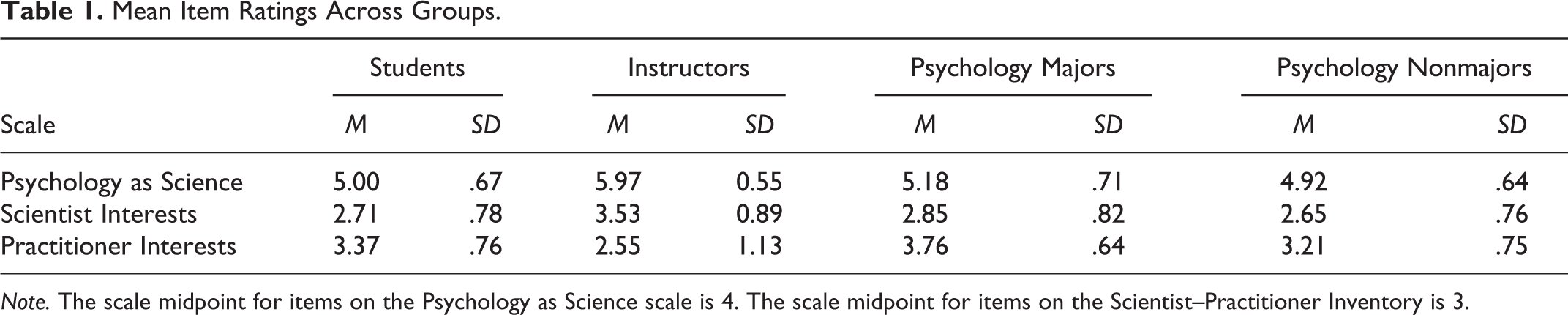
Note. The scale midpoint for items on the Psychology as Science scale is 4. The scale midpoint for items on the Scientist–Practitioner Inventory is 3.
Students’ mean item ratings were significantly different from instructors’ mean item ratings on all three of the self-report scales. However, both students’ and instructors’ mean item ratings were above the midpoint on the Psychology as Science scale, which masks additional important differences. To elaborate on the mean comparisons reported previously, I examined item-level statistics for several items from the Psychology as Science scale. I calculated the percentages of students and instructors rating each item either at the neutral midpoint or on the nonscientific end of the numerical scale. For example, 37.9% of students rated themselves as either neutral or in disagreement with the statement “The study of psychology should be seen primarily as a science.” Table 2 shows that very few instructors, but a noteworthy proportion of students (varying from roughly 23 to 43%) expressed views indicating neutrality or disagreement with statements reflecting the scientific nature of psychology.
Percentages of Respondents Reporting Scientifically Neutral or Unscientific Views.
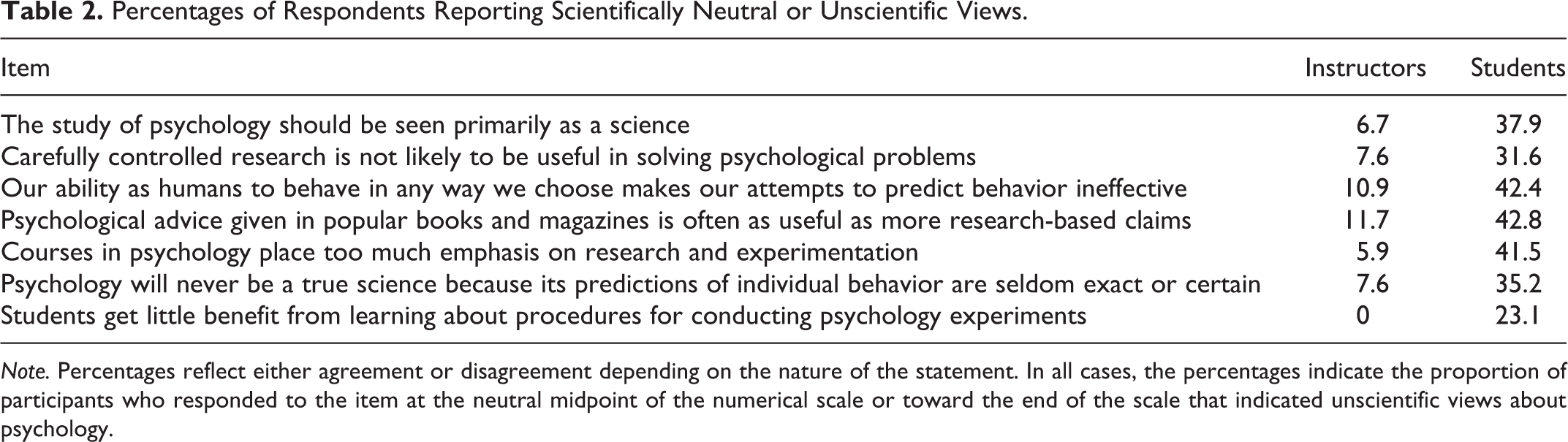
Note. Percentages reflect either agreement or disagreement depending on the nature of the statement. In all cases, the percentages indicate the proportion of participants who responded to the item at the neutral midpoint of the numerical scale or toward the end of the scale that indicated unscientific views about psychology.
Psychology majors tended more toward viewing psychology as a science than did nonmajors, t(700) = 4.69, p < .001, Cohen’s d = .38, but their tendency to do so was still well below that of instructors. Importantly, psychology majors’ reported interest in scientist activities was significantly higher than nonmajors’ scientist interests, t(700) = 3.16, p = .002, Cohen’s d = .25; however, majors’ and nonmajors’ interests diverged more notably with respect to practitioner activities. On this variable, majors reported far greater interest than nonmajors, t(700) = 9.24, p < .001, Cohen’s d = .79 (see Table 1 for descriptive statistics). Therefore, the divergence in practitioner interests between psychology instructors and psychology majors was even greater than the divergence in interests between psychology instructors and nonmajors.
Study 2
The psychology students who participated in Study 1 differed on average from the instructor participants in terms of their views of the scientific nature of the field as well as their preferred professional activities. Study 2 examined a potential implication of such differential interests—that of student retention. Predicting student retention in the psychology major is of broad utility (see, e.g., Landrum & Mulcock, 2007), and in this study, I examined scientist and practitioner interests among beginning psychology majors as predictors of students’ likelihood of remaining in the major. I predicted that psychology majors with high practitioner interests would be more likely to leave the major than students with low practitioner interests. I further predicted that students with low scientist interests would be more likely to leave the major than students with high scientist interests.
Method
Participants
The sample consisted of 130 psychology majors at or near the beginning of their college-level psychology training at a private liberal arts college in the Northeastern United States. The students (76% women and 24% men) were enrolled in an introductory laboratory course—required for psychology majors—during one of the four semesters.
Materials and Procedure
Each semester during the first laboratory meeting, the students in the course completed the Scientist–Practitioner Inventory (see Study 1 above; Leong & Zachar, 1991). They also responded to a single item rating their own intuition about human behavior from “much better than most people’s” to “much poorer than most people’s.” The criterion variable was whether a student was still enrolled as a psychology major 2 years after completing the inventory or had switched to another major.
Results and Discussion
Of the 130 psychology majors who participated, 23 had dropped the major within 2 years of completing the surveys. Therefore, the overall likelihood that a student would switch from psychology to a different major within 2 years was 17.7%. The mean practitioner interest item rating for those who left the major was significantly higher (M = 4.00, SD = 0.37) than the mean for those who remained in psychology majors (M = 3.75, SD = 0.54), t(128) = 2.18, p = .031, Cohen’s d = .54. Students with the highest practitioner interests were much more likely to leave the psychology major than those with low practitioner interests. The proportion of psychology majors in the top quartile of practitioner interests who later changed majors (28.1%) was significantly greater than the proportion of students in the bottom quartile of practitioner interests who later changed majors (5.7%), χ2(1, N = 67) = 6.12, p = .013. The proportion of psychology majors in the bottom quartile of scientist interests who later changed majors (25%) was higher than the proportion of students in the top quartile of scientist interests who later left psychology (10%), although the difference did not reach statistical significance, χ2(1, N = 62) = 2.39, p = .122. 2 Regarding students’ ratings of their own intuition, students in the top quartile of practitioner interests were significantly more likely than students in the bottom quartile to report that their own intuition about human behavior is better than most people’s, χ2(1, N = 67) = 7.15, p = .008. Interestingly, not a single student in this top quartile of practitioner interests rated his or her own intuition as average or below average.
General Discussion
College student participants in Study 1 differed from instructor participants in their views of psychology. Instructors more strongly than students endorsed the view that psychology is a science, and instructors reported stronger interest in scientist activities than in practitioner activities. In addition to weaker endorsement of the view that psychology is a science, students reported greater interest in practitioner activities than in scientist activities. Psychology majors reported a slightly stronger endorsement of a scientific orientation than did nonmajors, but their endorsement was still weaker than that of instructors. Further, a startling proportion of students (nearly 50% based on some survey items) expressed neutrality or direct disagreement with statements concerning the idea that psychology is a science and that scientific inquiry is important for understanding human behavior (almost no instructors expressed similar skepticism). Although the observed distinction between student and instructor views may not be surprising because it is consistent with the personal experience of many psychology teachers, it is important that instructors base assumptions on data rather than anecdotes. One point that scientifically minded psychologists should be vividly aware of is that deeply held beliefs about human behavior often do not stand up under the scrutiny of empirical study (e.g., Baumeister, Campbell, Krueger, & Vohs, 2003).
I suggest that the results of Study 2 offer preliminary evidence that psychology majors' interests in scientist and practitioner activities predict whether they are likely to remain in psychology majors. Psychology majors with practitioner interests in the top quartile among students beginning an introductory-level laboratory course were nearly 5 times more likely to leave the major than students in the bottom quartile of practitioner interests.
The overall findings illustrate a difference between many college students and instructors in terms of their interests within psychology and views about how best to understand human behavior, and suggest that especially high practitioner interests predict reduced retention in the major. From the current results, it is clear that many students arrive in college psychology courses already skeptical of the relevance of science to psychology, as indicated by the fact that a large minority of students—in some cases approaching 50%—expressed neutrality or disagreement with statements reflecting the importance of science in understanding human behavior. The power of cognitive dissonance to maintain attitudes means that bridging the gap will require innovative solutions. A person who believes that he or she does not need science to understand people may resist evidence to the contrary, and the common tendency toward undue confidence in one’s own intuition is likely to lead students to resist information that threatens that confidence.
Certainly all academic disciplines are characterized by differences between students and instructors in their levels of discipline-specific knowledge. However, psychology may be unusual in that students and instructors tend to differ not only in their level of knowledge but also in their fundamental opinions about acceptable modes of inquiry and the ways in which meaningful knowledge is accumulated. Students, of course, represent a broader sample than professors, in that the vast majority of students are not future academicians. In fact, college faculty members represent the tiny fraction of people who have completed graduate degrees and chosen to pursue a career in education. Most students who major in psychology will not pursue graduate degrees and most who pursue graduate degrees will not become college instructors. Psychology instructors would be wise to recognize that they have different motivations, interests, and ways of looking at the world than many of their students; these differences may play a role in whether students persist in psychology or move on to fields that they perceive as better fitting their views.
Conclusions and Implications
The observed differences between students’ and instructors’ perspectives should inform the strategies of those who teach psychology courses. Particularly noteworthy is that nearly 40% of students expressed either neutrality or disagreement regarding the statement “the study of psychology should be seen primarily as a science.” As is usually the case in educational research, it is not possible to precisely determine the representativeness of the sample. However, the samples of students and instructors in Study 1 were neither small nor drawn from a single institution. One wonders what the reaction would be among chemistry, biology, or physics faculty if 40% of the students in those disciplines questioned or denied that they were studying sciences. Past findings with undergraduates suggest that interests within psychology are likely rooted in personality and linked with stable characteristics such as cognitive style and general views about how the world works (Leong et al., 2007; Zachar & Leong, 1992). It is therefore not surprising that instructors sometimes experience frustration that students’ appreciation for empirical research often does not change much over time (Holmes & Beins, 2009) or that psychology students sometimes experience frustration when they must study research and quantitative analysis. One group of researchers even suggested that psychology may attract the “wrong” students for courses with a scientific emphasis and that introductory psychology in particular probably draws students seeking to avoid rigorous science courses (Nathanson, Paulhus, & Williams, 2004, p. 8).
The implications of Study 2 depend on one’s agenda. If the association between high practitioner interests and likelihood of departure from the psychology major is replicated, departments whose faculty members are motivated to retain students may elect to move some practice-oriented courses earlier in the curriculum so that students with very high practitioner interests do not depart prematurely. On the other hand, advancing the scientific identity of psychology might mean increased emphasis on scientific training and thinking early in the curriculum—with the possible loss of some students who do not value this approach to knowledge or see its relevance to their career plans. Even in departments with a strong scientific orientation, it might be advisable to delay some intense scientific coursework in the interest of keeping practitioner-oriented students in the major because such students do tend to increase their scientific literacy over the course of their undergraduate education (Holmes & Beins, 2009).
Footnotes
Acknowledgment
The author is grateful to Barney Beins, Sheila Singh, Eric Landrum, and Leigh Ann Vaughn for providing feedback on this manuscript.
Declaration of Conflicting Interests
The author declared no potential conflicts of interest with respect to the research, authorship, and/or publication of this article.
Funding
The author received no financial support for the research, authorship, and/or publication of this article.