



Abstract
This study examined the prevalence of psychological myths and misconceptions among psychology students and within the general population. In total, 829 participants completed a 249-item questionnaire designed to measure a broad range of psychological myths. Results revealed that psychological myths and misconceptions are numerous and widely held. A number of widely held, potentially harmful, and socially divisive myths were identified. Psychology students recognized more myths than did the general population. However, effect sizes were small, indicating that education has only a very limited success in alleviating psychological myths and misconceptions.
Myths and misconceptions are broadly defined as “beliefs that are held contrary to known evidence” (Taylor & Kowalski, 2004, p. 15). Misconceptions concerning human behavior can be pervasive and destructive. For example, myths regarding mental health (Schulze, 2007), victims of sexual abuse (Lonsway & Fitzgerald, 1994), or sex differences in occupational potential (Bagilhole, 1993) have led to social stigma, isolation, unjustified criticism, and discrimination. Fortunately, empirical psychological investigation and greater psychological awareness have served to refute numerous psychological myths (e.g., Pinfold et al., 2003; Scior, 2011), in turn, changing the way in which people view each other. This study was designed to achieve two main aims: first, to estimate current levels of psychological knowledge (operationalized by belief in psychological myths) and, second, to examine whether psychology students showed greater levels of myth recognition than the general public.
Despite the often surprising and counterintuitive results of psychological research, many of the findings within the field are criticized for being statements of the obvious (Houston, 1983, 1985), simply commonsensical (Barnett, 1986; Furnham, 1983, 1989; Furnham, Callahan, & Rawles, 2003; Kelley, 1992). If the majority of psychological knowledge is “common sense,” the prevalence of myths and misconceptions should be low. However, this has certainly not always been the case.
There is a long-standing academic interest in psychological myths and in particular, the misconceptions students hold prior to undertaking psychological education (Lamal, 1979; McKeachie, 1960; Nixon, 1925; Tupper & Williams, 1986; Vaughan, 1977). For example, Nixon (1925) surveyed prospective students’ psychological knowledge prior to taking his course and found an alarming level of misconceptions, suggesting that the students held a wide range of “unsubstantiated beliefs” about human behavior. More recent studies conducted by Furnham and colleagues (Furnham, 1992; Furnham, Thompson, & Baluch, 1998; Furnham et al., 2003) have revealed similar results, indicating that prior to embarking upon psychology courses (at university or college), prospective students believe approximately 50% of psychological myths and that prior psychological experience (e.g., courses attended and books read) was found to have little or no relationship with psychological knowledge and myth detection.
Although prospective or early students often hold numerous misconceptions about psychology, it has been argued that misconceptions should decrease following the completion of formal psychology courses (Nixon, 1925). Accordingly, numerous studies have assessed student’s psychological knowledge with a view to evaluating the success of introductory courses in alleviating misconceptions (Arntzen, Lokke, Lokke, & Eilertsen, 2010; Gardner & Dalsing, 1986; Giggs & Ransdell, 1987; Lamal, 1979; McKeachie, 1960; Standing, & Huber, 2003; Vaughan, 1977). Generally, results have been consistent, showing high levels of misconception (40–70%) prior to education, which are reduced, but only slightly, following education. Although the improvement in psychological knowledge and myth recognition has, in some instances, been statistically significant (e.g., McKeachie, 1960; Vaughan, 1977), it has almost always been unimpressive in terms of effect size and practical significance. Thus, the benefit of education in reducing myths and misconceptions appears limited (Taylor & Kowlaski, 2004). Both Brown (1983) and Lamal (1979) have argued that the limited effect of education is unsurprising, considering students have relatively long histories of exposure to widely held beliefs concerning psychology via the mass media, parents, and peers.
One recent exception to the generally unimpressive results concerning psychological education is noted by Kowalski and Taylor (2009), who found a substantial average increase in student’s myth recognition scores from 38.5% to 66.3%. The students in this study were taught using refutational methods (i.e., presenting evidence directly contrary to the belief). The main difference between the previously discussed studies and Kowalski and Taylor’s study is the use of refutational methods. Given the marked difference in results from this study and those discussed previously, it would appear that the refutational method has some merit. However, before refutational approaches can be adopted, widely endorsed myths must first be identified. This study aimed to help toward this latter end.
Lilienfeld, Lynn, Ruscio, and Beyerstein (2010) also utilized the refutational method throughout their book, 50 Great Myths of Popular Psychology. The 50 myths cover diverse areas of psychology, ranging from myths about the brain and perception to myths concerning psychology and the law. In addition to the 50 main myths, Lilienfeld et al. presented 249 other “mythlets” in need of exploration, which they suggest serve as a useful list of urban legends, misconceptions, and non-proven assertions to investigate. Using the Lilienfeld et al. mythlets, we set out to estimate the levels of psychological misconception in a general population sample of British adults and compare levels of myth recognition between psychology students and the general population.
Most extant studies concerning psychological myths and misconceptions have utilized modest sized psychology student samples, and although a few studies have also used nonpsychology student samples (e.g., Furnham, 1993; Furnham et al., 2003; Houston, 1985), a number of questions persist. Estimates of the level of psychological misconception in the general public remain imprecise and it is also unclear whether and to what extent students of psychology are less likely to believe in myths than other population groups. This study will be the first to compare misconceptions held by psychology students and the general public using a large sample. Thus, this study is, in essence, a gauge of current psychological literacy in the general population and a cross-sectional estimate of the impact of education upon myth recognition. On the basis of the past evidence reviewed, we hypothesized that those who have undertaken psychological education would show greater levels of myth recognition compared to people without such training. However, given the generally limited effect of psychological education upon myth recognition, the difference between psychology students and the general public may well be small.
Method
Participants
A total of 829 participants completed the questionnaire. Following the removal of participants with high levels of missing data (more than 40% of responses), the final sample numbered 767. Of the final sample, 53.8% were men and 46.2% were women. The mean age was 28.61 years (standard deviation = 10.91 years). Fifty-three percent of participants identified themselves as ethnically Caucasian, 31% as Asian, 5.7% of African descent, 4% as mixed race, and 3.7% utilized the “Other” option. With regard to marital status, 45.7% were single, 34.7% were married, and 20.4% were divorced/separated/widowed. In terms of religious affiliation, 45.4% were Christian, 32.5% were atheist/agnostic, 10.3% were Muslim, 3.9% Buddhist, and 3.8% Hindu. Thirty-four percent (267) had undertaken previous study of psychology or psychiatry at school, college, or university. In terms of general education, 81 (11%) had a school education (up to age 16), 278 (37%) had a college education (ages 16–18), 219 (29%) had undergraduate degrees, and 164 (22%) had postgraduate experience.
Measures
The myths and misconceptions were derived from Lilienfeld et al. (2010). This book has 50 established myths and 249 mythlets that the authors describe as “other myths to explore.” The myths were categorized by chapter topic in 11 different areas, namely, brain and perception, development and aging, memory, intelligence and learning, consciousness, emotion and motivation, interpersonal behavior, personality, mental illness, psychological treatment, and psychology and the law. The 249 mythlets were used to construct items for the current myths scale. As all of the items presented within the questionnaire were myths, the “correct” answer was always false. The questionnaire instructions read: “How much do you know about human behavior and the behavioral and social sciences? This questionnaire lists a number of often quoted facts about all sorts of issues from memory and motivation to mental illness. Read each short statement and then indicate (by ticking) if you personally believe it is: Definitely True: There is good scientific evidence to support the statement. Probably True: There is enough evidence pointing to the fact that it is more-or-less correct. Probably False: There is little good scientific evidence to support the statement. Definitely False: There is no evidence to support the statement and indeed the opposite may be true. Don’t Know: You have personally no idea whether it is true or false.”
The questionnaire offers a number of distinct advantages over previous tools used in similar studies (e.g., McCutcheon, 1991). First, the list of myths is extensive and was designed to cover a very broad spectrum of psychological misconceptions. Second, respondents were asked to make their judgments regarding the efficacy of the statements within the context of the amount of supportive scientific evidence. Third, the response options offered greater sensitivity than the traditional true or false response scale (e.g., Vaughan, 1977). Response options were broken down into “Probably” and “Definitely” true or false, allowing for greater information to be gleaned regarding the kinds of true and false responses. In addition, the “Don’t Know” option improves upon some previous tests, as participants could indicate a lack of knowledge, rather than guessing or leaving items unanswered (Arntzen et al., 2010).
To assess whether participants had undertaken previous psychological study, they were asked to indicate whether or not they had previously studied psychology or psychiatry using a yes or no response scale. In addition, participants responded to a number of demographic questions regarding age, sex, ethnicity, educational attainment, marital status, and religious ideation.
Procedure
Departmental ethical approval was gained prior to data collection. A market research organization collected data from 500 Londoners. The remaining participants were recruited by the principal author and colleagues in various universities across London. Participants gave informed consent before proceeding. The questionnaire took an average of 40 min to complete. Participant groups were briefed upon completion.
Results
Prevalence of misconceptions
All of the items presented were myths; thus for all items, the “correct” answer was false (probably or definitely). Participants’ false responses were summed in order to create a myth recognition score for, each item, each of the 11 categories and the whole questionnaire.
Domain-level analyses
Table 1 shows response trends across each of the 11 domains and the whole survey. On average, participants correctly identified 37% of the myths to be false, incorrectly believed that 43% of the myths were supported by scientific evidence, and did not know whether 20% of myths were true or false. Thus, for more than 60% of the myths presented, participants were unable to accurately recognize that the statements were not supported by scientific evidence and were myths.
Percentage of Myths Thought True, False, or Unknown, Across the 11 Domains and in Total.
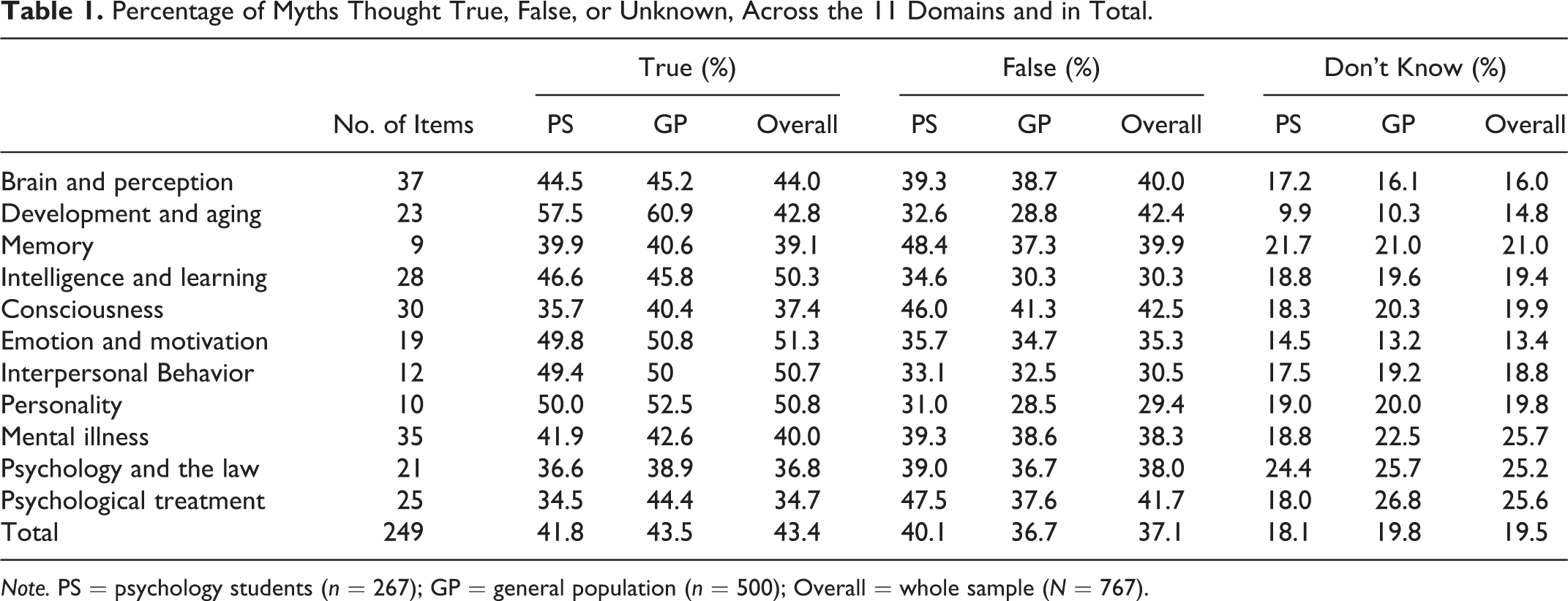
Note. PS = psychology students (n = 267); GP = general population (n = 500); Overall = whole sample (N = 767).
Item-level analyses
Some of the items were believed by the majority of participants; in total, 37 (15%) myths were believed by two thirds (66.6%) or more of the sample. These most widely believed myths (e.g., Humans have five senses; alcohol kills brain cells; women have a “G-spot,” a vaginal area that intensifies sexual arousal; positive self-affirmations are a good way of boosting self-esteem; direct and immediate feedback is the best means of ensuring long-term learning) were typically topics that are commonly discussed in modern popular culture and the media, so it is perhaps unsurprising to find them the most widely believed.
Previous researchers (e.g., Brown, 1983) have considered endorsement rates of 50% or greater as indicative of a widely held misconception. Using this criteria, 90 (35%) of the myths were believed to be true, these myths spanned all 11 psychological categories. For illustrative purposes, Table 2 contains 20 of the myths endorsed by 50% or more of the sample that were considered to be of social and psychological significance by the authors. 1
Twenty Myths Believed to Be “True” by Over Half of the Respondents.
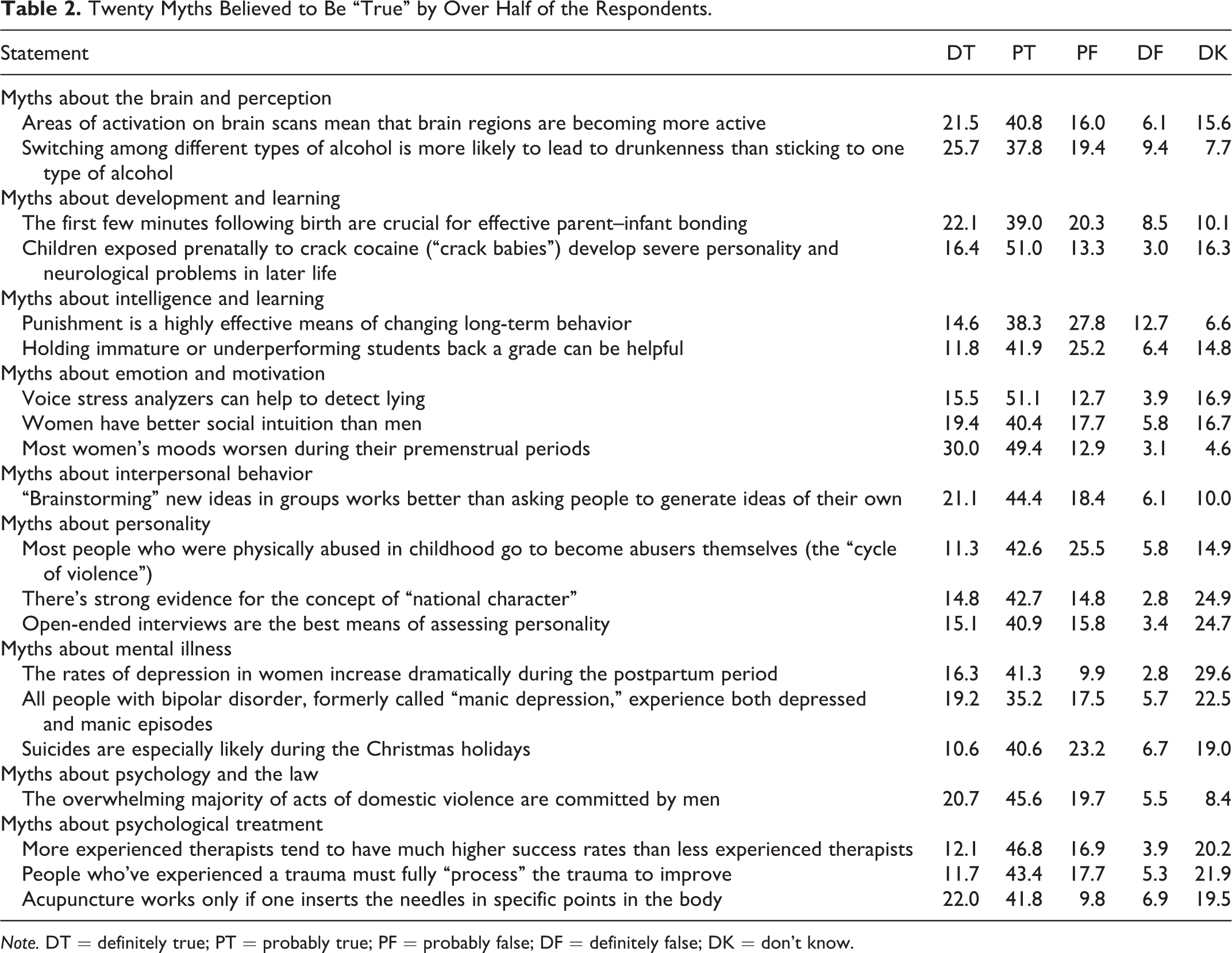
Note. DT = definitely true; PT = probably true; PF = probably false; DF = definitely false; DK = don’t know.
Not all of the myths were widely believed. For example, the myths most often recognized as false were all people with anorexia are female; one can’t become an alcoholic by drinking beer only; astrology predicts people’s personality traits at better than chance levels; if we dream that we die, we actually die; sleeping pills are a good long-term treatment for insomnia; and psychopaths are untreatable. In addition, a number of items received a large number of “Don’t Know” responses. The vast majority of such myths contained either names (e.g., Skinner and Kitty Genovese) or specific terminology (e.g., alpha consciousness and biofeedback) that would likely be unknown to nonpsychologists or subject matter experts.
Education and Myth Recognition
Finally, we examined differences in myth recognition between psychology students and the general population. A multivariate analysis of covariance (MANCOVA) was estimated. Myth recognition (total false scores) was entered as the outcome variable with previous psychological education entered as the grouping or predictor variable. Age was entered as a covariate, as knowledge increases with experience and age. The MANCOVA revealed a significant but small multivariate main effect for previous psychological study, F(12, 732) = 8.382, p = .001, η p 2 = 0.121. Previous psychological study was associated with significantly greater myth recognition in 5 (development and aging, memory, intelligence and learning, consciousness, and psychological treatment) of the 11 categories and also in total score. However, despite statistically significant group differences, estimates of effect size were small, ranging from 0.006 to 0.039.
Discussion
This study was designed to survey members of the public as well as psychology students on their belief in psychological myths and to examine whether there were any differences between the two samples. In line with past research, the endorsement of psychological myths was common and previous psychological study was only weakly related to greater levels of myth recognition.
The difference in myth recognition between psychology students and members of the general population did reach statistical significance. Yet, the effect sizes attributable to this grouping variable were negligible, accounting for around 2% of the variance. Thus, although the difference was statistically significant, it was not practically significant. The fact that psychology students scored almost equivalently with those who have had no psychological schooling means that there is little evidence in this study that would serve to counter the prevailing consensus that formal psychological education is of limited benefit in alleviating psychological myths. Despite previous evidence showing little or no effects of psychological education upon misconceptions, it still remains somewhat surprising and a little disconcerting.
Evidently, psychological myths are resilient and are not commonly rebutted as part of psychological education; if this were the case, the difference between the two groups examined would have been much more substantial. If we are to reduce psychological misconceptions, it seems a sensible step to first focus on our students. We must do more during our educational programs to highlight common myths and misconceptions. Evidence thus far suggests that in doing so, we should employ refutational methods and the results of this study suggest that using the Lilienfeld et al.’s (2010) book as a focal point for introductory seminars and workshops might be one way to approach this.
When interpreting the current results, and those from previous research, it is important to note that two crucial elements are currently unaccounted for, namely, the quantity and quality of that education and, important individual difference traits (e.g., cognitive ability and Conscientiousness). It may well be the case that students who receive top degrees, who are intrinsically motivated and passionate about psychology show substantially reduced levels of misconception when compared to other students and the general population. Future research should take into account the quality of education received and relevant individual differences. Indeed, the work of Kowalski and Taylor (2009) suggests that the educational method of delivery is an important variable in alleviating psychological myths and misconceptions.
The current results replicated findings of earlier studies on misconception prevalence (Arntzen et al., 2010; Furnham, 1992; Furnham et al., 2003; Furnham et al., 1998; Furnham et al., 2003; Lamal, 1979; Nixon, 1925; Taylor & Kowalski, 2004) showing that a large number of myths were widely believed and on average, participants did not know whether 20% of statements presented were true or false. These findings are contrary to claims that psychological knowledge and research findings are commonsensical (Houston, 1983, 1985). Rather, the fact that 35% of the myths were believed by over 50% of the respondents suggests that psychological findings are often counterintuitive.
If we consider the myths mostly considered false versus those believed to be true, it is somewhat comforting to note that potentially harmful and socially divisive misconceptions regarding, psychopathy, anorexia, and substance use are less prevalent than myths concerning the number of senses we hold and the efficacy of positive self-affirmations. However, some of the myths widely believed are potentially harmful and sources of distress and prejudice. For example, the myths “Children exposed prenatally to crack cocaine (“crack babies”) develop severe personality and neurological problems in later life” and “Punishment is a highly effective means of changing long-term behavior” which could have worrying implications for the perception of children from backgrounds of drug abuse and in the shaping of people’s views of disciplinary and penal policies. Myths and misconceptions of any kind are wholly undesirable, but it is those that are likely to be socially divisive or detrimental to the health and well-being of oneself or others who are in need of the most urgent attention. For those interested in confronting and debunking myths, it seems important to start with trying to establish which myths are most widely held. This study has gone some way to identifying a large number of common myths and misconceptions.
A number of limitations must be considered when interpreting the results of the current investigation. First, although the sample was by far the largest in this field of enquiry, and as such overcame the many issues regarding underpowered studies (Tomcho & Foels, 2009), it was not perfect. The sample was heterogeneous but not fully representative in terms of age, religious views, marital status, and educational attainment. Further, the participants were all currently living in London, England. It is possible that the prevalence of psychological misconception varies within and across countries and cultures.
Second, due to an administration-level error, one of the myths was omitted, so the study examined 249, rather than the full 249 myths. However, given the size and comprehensive nature of the item pool, results from the missing item would not have had a significant impact upon the results obtained or the conclusions drawn. The size of the question pool in general was large and fatigue effects may have had an influence. However, response trends, in terms of the distribution of responses and the levels of missing data, did not differ between the first 50 and last 50 items. Nevertheless, future studies could use the results obtained here to generate a more concise item pool.
This study has shown that psychological myths and misconceptions are abundant and persistent. Many widely believed myths are potentially harmful and socially divisive. Worryingly, previous psychological education is largely unrelated to the levels of psychological misconceptions. Evidently, considerable efforts are needed to improve psychological awareness in the population at large and also to improve education for psychology students, so that they may be better equipped to identify likely truths and myths. It is possible that assessment of misconceptions early in introductory psychology courses, combined with workshops and tasks designed around refutational methods akin to those used by Kowalski and Taylor (2009) and Lilienfeld et al., (2010), has the potential to reduce levels of misconception. This study can be used to identify myths and misconceptions in need of refutation.
Footnotes
Declaration of Conflicting Interests
The authors declared no potential conflicts of interest with respect to the research, authorship, and/or publication of this article.
Funding
The authors received no financial support for the research, authorship, and/or publication of this article.