



Abstract
Classroom demonstrations of empirically supported learning and memory strategies have the potential to boost students’ knowledge about their own memory and convince them to change the way they approach memory tasks in and beyond the classroom. Students in a Human Learning and Memory course learned about the Method of Loci (MoL) mnemonic technique, then created and used their own Memory Palaces based on campus locations to remember a grocery list. Pretest to posttest improvements in memory for the serially recalled list, along with significant increases in self-reported use of MoL in daily life, suggest that this activity may improve knowledge and application of this powerful memory strategy. More broadly, these types of activities can strengthen undergraduates’ metacognitive sophistication.
Research suggests that undergraduates may not be aware of empirically supported memory strategies that could enhance their success in college courses (e.g., Hartwig & Dunlosky, 2012; McCabe, 2011). Even if they know about a particular strategy, they may not choose to use it (e.g., spaced/distributed study, Susser & McCabe, 2013). Both lack of awareness and underuse may be due to the desirable difficulties (Bjork, 1994) inherent to many of these strategies; that is, their advantages are not obvious because they slow down learning in the short term, only showing their memory benefit over a longer period of time.
Most psychology students are exposed to information about memory strategies, even in introductory courses. The issue then becomes one of the motivation and behavior change: What can be done in the psychology classroom to encourage use of effective strategies? One possible solution is to provide convincing demonstrations of the effectiveness of such strategies. Several psychology researchers have endorsed the explicit teaching of memory improvement techniques in college courses (e.g., Balch, 2005; Carney, Levin, & Levin, 1994; Shimamura, 1984).
Following this suggestion, I assessed the impact of demonstrating the memory benefit of the Method of Loci (MoL) mnemonic technique in a Human Learning and Memory course. MoL involves imagining an ordered list of to-be-remembered items being dropped off in locations along a well-known route; then, at the time of recall, taking a mental walk through those locations in order to “pick up” the items. This technique is one of the oldest mnemonics documented and has been researched as an effective memory aide over the past 40 years (e.g., Roediger, 1980).
Mnemonics such as MoL are thought to be beneficial to memory because they increase effortful attention to the material and enhance organization, chunking, and elaboration (Bellezza, 1996; Carney & Levin, 1998; Levin, 1983). MoL has the added advantage of incorporating vivid mental imagery (Paivio, 1986). Yet when undergraduates were surveyed about familiarity, use, and helpfulness of various mnemonics, MoL was second lowest, above only the peg word method and below several common mnemonics such as first-letter techniques (McCabe, Osha, Roche, & Susser, 2013). Clearly, undergraduates are not familiar with and/or not using MoL, although it has great potential to improve memory.
To assess improvement in memory, I collected scores from a grocery list recall task. First students took the pretest, using any strategy, then they read the popular press book, Moonwalking with Einstein (Foer, 2011), in which the author describes how to create a Memory Palace (i.e., the mental space containing places along a route for use with MoL). As homework, students created their own Memory Palaces using locations on their home campus at Goucher College. For the posttest, they used their Memory Palaces to remember the order of items in a new list. For example, to remember the first 2 items, one could visualize eggs splattered all over a dorm room’s doorframe, then slices of bread lining the floor like tiles in the hallway.
Thus, one outcome of interest was the change in recall scores from pretest to posttest, which would demonstrate the memory benefit of MoL. Another dependent measure was the pretest to posttest change in a memory aids questionnaire, with the hypothesis that students would show an especially large increase in their self-reported use of “the place method” (i.e., MoL) in daily life.
Method
Participants
Participants were 30 undergraduates in the Spring 2013 semester and 27 undergraduates in the Spring 2014 semester from a 200-level Human Learning and Memory course taught by the author at Goucher College. Only those students present in class on both days of data collection were included in the central analyses. As there were no differences on any dependent measures between the two semesters, all analyses combine the two sections unless otherwise noted.
Materials
Two lists were used for the recall task, each consisting of 12 common grocery items (see Appendix). The lists were constructed to have the same number of total syllables. The presentation order of the lists was counterbalanced across semesters.
The “Memory Aids” questionnaire (Harris, 1980; modified by Baddeley, 2004) contained descriptions of 19 commonly used mnemonic aids, namely, shopping lists, first-letter memory aids, diary, rhymes, the place method, writing on hand, the story method, mentally retracing a sequence of events or actions, alarm clock, kitchen timer, the pegword method, turning numbers into letters, memos, face-name associations, alphabetical searching, calendars, asking other people to remember things for you, and leaving objects in special or unusual places. The questionnaire used the following self-rating scale: 0 for never use, 1 for used less than three times in last 6 months, 2 for used less than three times in last 4 weeks, 3 for used less than three times in last 2 weeks, 4 for used three to five times in last 2 weeks, 5 for used six to ten times in last 2 weeks, and 6 for used eleven or more times in last 2 weeks.
Procedure
During the first week of class, prior to discussion of memory strategies, pretest measures were collected. First, I instructed students to list the numbers 1 through 12 on a blank piece of paper and to write a code name at the top that they would use for multiple anonymous activities throughout the semester. Next they were told to try to remember a list of 12 grocery items using any strategy, then attempt to recall them in order. After hearing the list read aloud, students completed the recall task. They then self-scored their lists, computing three dependent measures, each out of a maximum of 12: strict serial score (1 point for each item recalled in the correct position), lenient serial score (1 point for each item recalled in the correct relative serial position, for example, if “apples” was in position 3 instead of position 4, but in the correct order after the item preceding it, this would be correct), and nonserial recall score (1 point for each item recalled correctly, regardless of serial position). 1 In the Spring 2014 class only, I asked students to write down which (if any) strategies they used to remember the list.
Later in that same class period, students were given class time to complete the Memory Aids questionnaire (Harris, 1980), again with their code name written at the top of the page. Using the code name strategy allowed me to keep the data anonymous and retain the ability to conduct within-subjects comparisons.
Over the next 2 weeks, students read Moonwalking with Einstein (Foer, 2011), including chapters about the history of MoL, how to create and use a Memory Palace, and the author’s success implementing the method in the U.S. Memory Championship. As a homework assignment, each student created his or her own Memory Palace using 12 ordered locations on Goucher College’s campus. Students were asked to draw a map of the campus, with the 12 locations labeled, and to practice mentally walking the route while imagining the sensory experiences associated with each location. They brought their Memory Palace maps to class (see Figure 1) and were given 5 min to study their maps and practice taking the “mental walk” through their ordered locations. Next, they put their maps away and were given the posttest for a new list of 12 grocery items. I asked them to use their Memory Palaces to remember this list. Following the list, they recalled the items in order, self-scored their papers as described previously, wrote their code names, then submitted the recall sheets. Approximately 2 months later, students again completed the Memory Aids questionnaire (Harris, 1980).
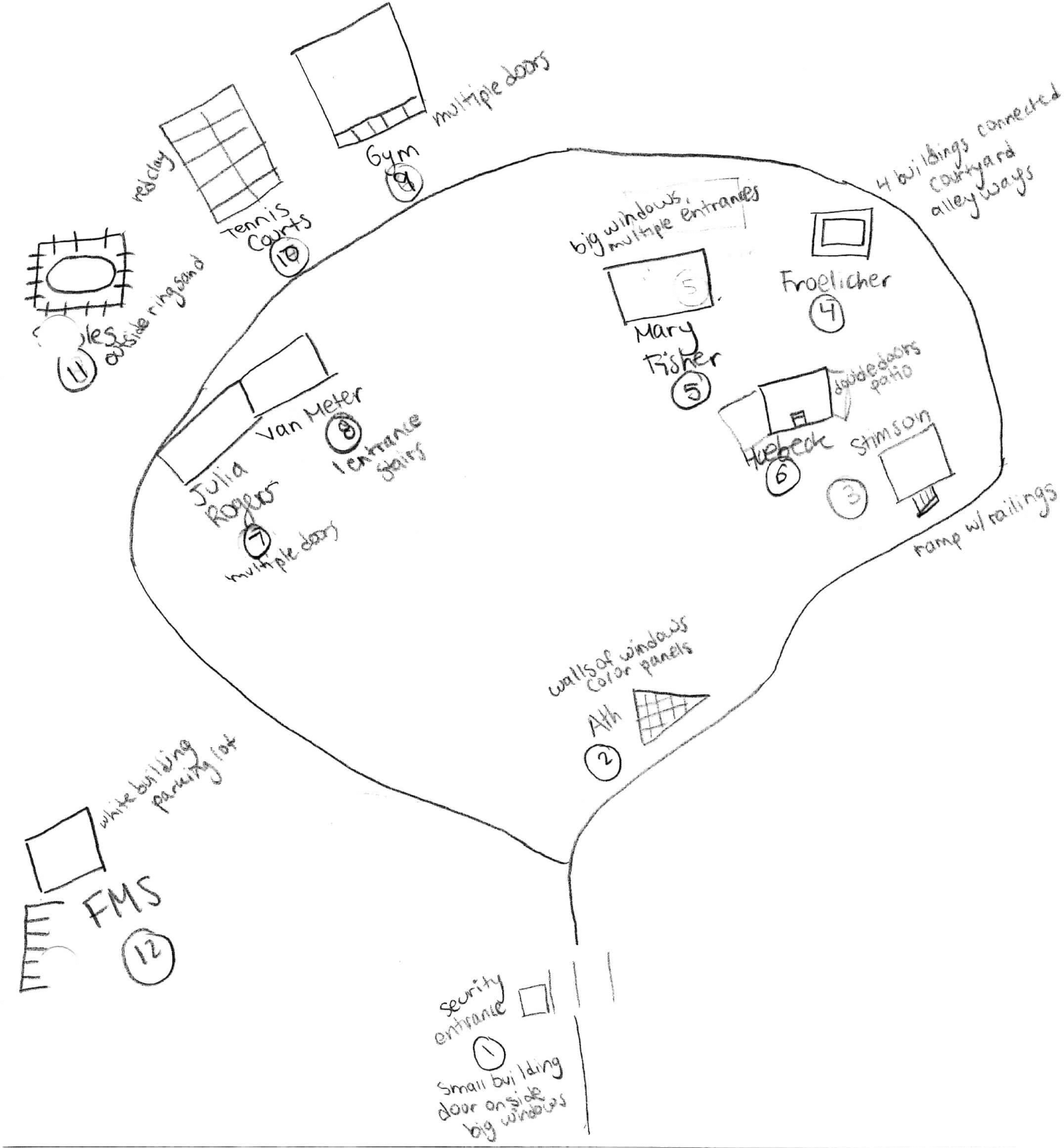
Sample memory palace from class activity. 2
Results
The α level was set at .05 for all analyses.
Grocery List Recall
Paired-samples t-tests revealed significant improvements in recall for all three memory measures. For strict serial recall, the pretest mean was 8.47 (SD = 2.60) and the posttest mean was 10.45 (SD = 2.30), t(39) = 3.87, p < .001. For lenient serial recall, the pretest mean was 9.68 (SD = 2.18) and the posttest mean was 10.63 (SD = 2.13), t(40) = 2.26, p = .029. For nonserial recall, the pretest mean was 10.56 (SD = 1.42) and the posttest mean was 11.10 (SD = 1.56), t(40) = 2.31, p = .026.
Another way to consider the data is to look at frequencies of recalling the list perfectly (i.e., 12 of the 12 items in correct serial positions) or nearly perfectly (11 of 12). At pretest, 12% of the participants achieved this perfect strict serial score and 14% scored 11 of 12. At posttest, 18% scored perfectly and 32% scored 11 of 12. Combining these percentages, 26% at pretest and 50% at posttest scored perfectly or nearly so. A McNemar test, computed to determine if these percentages were different from pretest to post-test, returned a significant result (p = .001).
As noted in the Procedure section, students in the Spring 2014 section of the course were also asked about which strategies they used to remember the list during the pretest. The most commonly stated strategy was repetition (n = 13 participants out of 26), followed by chunking/grouping strategies (n = 4), and rehearsing the items to a song or rhythm (n = 3). Interestingly, two participants explicitly mentioned MoL (although one noted he or she did not have enough time to use it) and two described visualizing the items as they would put them in a cart on a trip to the grocery store, a strategy which resembles MoL.
Memory Aids Questionnaire
Because the self-report scale from the questionnaire was ordinal (Harris, 1980; modified by Baddeley, 2004), I conducted nonparametric analyses to compare pretest to posttest scores. Wilcoxon signed-ranks tests revealed that only the following two memory aids out of 19 showed increased frequency of use: the place method (i.e., MoL), N = 47, Z = 2.07, p = .038 and “face-name associations” (i.e., the face-name mnemonic), N = 47, Z = 2.26, p = .024. All other ps > .05.
Discussion
The goal of this research was to provide evidence for an effective pedagogical technique to help students learn about, create, and more frequently use a specific mnemonic strategy, the MoL. Although empirical research has shown MoL to be effective, particularly for serially ordered lists (e.g., Roediger, 1980), knowledge and use of MoL in undergraduates is low (McCabe et al., 2013).
Following an assigned reading on MoL and the creation of individual Memory Palaces based on campus locations, students showed significant increases in serial recall of a 12-item grocery list from pretest to posttest; the percentage who recalled the list perfectly or near perfectly nearly doubled. These data replicate prior research showing the memory benefits of the MoL technique. More importantly, the activity allowed students to experience real time the improvement in their own memories, using a memory device personally meaningful to them (i.e., self-reference effect; Rogers, Kuiper, & Kirker, 1979) and reusable in future situations. Further, by describing the pretest and posttest results to the students in the subsequent class period, they could see the increases in group mean recall scores. It is my hope that students would walk away from this activity feeling more convinced that memory skill is “made, not born” (Ericsson, 2003) and that this in turn would increase motivation and effort toward improving their memories.
A related question of interest pertains to the strategies students used for the pretest, specifically whether they were aware of MoL before the class intervention. Qualitative data showed that only a few students listed this type of strategy. The overwhelmingly modal response for strategy used was repetition. This is in line with research showing undergraduates report nonelaborative strategies such as repetition, rereading, and highlighting as preferred choices of study activities (Karpicke, Butler, & Roediger, 2009). It also supports the idea that ignorance and/or nonuse of desirably difficult (Bjork, 1994) strategies, including mnemonics such as MoL, may be the norm among college students.
Students were asked to self-report frequency of using a variety of memory aids via questionnaire. The fact that there was a significant increase in reported use of the place method (i.e., MoL) from the start to the end of the semester suggests that the activity may have helped change their behaviors to apply this mnemonic more often in their lives. As a corollary supporting argument, the only other memory aid on the questionnaire that showed a significant increase in use was face-name associations. This is likely not a coincidence, as we spent considerable class time discussing and practicing the face-name mnemonic (i.e., a key word that sounds like a person’s name is associated by way of mental image to a physical or personality trait; see Smith, 1985). The finding that the only two memory aids (of 19) showing pre–post increases were the ones on which in-depth classroom demonstrations were based supports the argument that this type of activity may encourage students to use memory strategies more frequently. It is also possible that the frequency-of-use ratings reflect students’ enhanced familiarity with these strategies due to the class demonstrations. Future research could tease apart these factors.
A criticism of MoL is that for as much time and effort as it takes to create a Memory Palace, its usefulness may be questionable beyond remembering what to get at the store or, for those few dedicated memory experts, memorizing decks of cards (Foer, 2011). I respond to this by sharing with my students educational applications for the mnemonic (e.g., to learn Erikson’s stages, Carney et al., 1994) and recently published research showing that MoL assisted people with depression by aiding retrieval of self-affirming episodic memories “stored” at each location of a Memory Palace (Dalgleish et al., 2013). I encourage them to be creative in finding other nontraditional uses for MoL, allowing for this powerful memory technique to be applied in a variety of situations.
In conclusion, a simple activity that took no more than 10 min of time on 2 days of class was associated with substantial improvement in participants’ memories when using MoL, and with increased MoL use ratings on a self-report questionnaire. More broadly, there is potential for a variety of mnemonic techniques to be taught and demonstrated in a concrete way in the psychology classroom, contributing to students’ knowledge about their own memories and, generally speaking, to their metacognitive sophistication.
Footnotes
Appendix
Acknowledgment
I thank Brandon Meyers-Orr for assistance with data entry.
Declaration of Conflicting Interests
The author declared no potential conflicts of interest with respect to the research, authorship, and/or publication of this article.
Funding
The author received no financial support for the research, authorship, and/or publication of this article.