



Abstract
The current study examined the impact of mobile applications or apps on student learning in an introduction to psychology course. Students were assigned to complete a learner-centered worksheet activity on the brain and central nervous system using either an interactive 3-D Brain app or their online course textbook. We measured student learning based on the change in performance from pretest to posttest separately on labeling and multiple-choice items and then from a composite (labeling + multiple choice) score. There was a significant increase in performance from pretest to posttest for the app group on all measures, however, there was only a significant increase in the labeling measure for the text group. The app group answered more items correctly than the text group on the multiple choice and composite measures, but there was no difference in the labeling measure. Also, there was no difference in self-reported ratings of enjoyableness between the app and the text conditions on the worksheet activity. The results demonstrate one way in which mobile devices, in general, and mobile apps, specifically, can be effectively integrated in an introduction to psychology class to enhance student learning.
The prevalence of mobile devices (e.g., laptops, smartphones, and tablets) on college campuses has increased dramatically over the past several years. In fact, according to one survey, college students own an average of 6.9 tech devices (Marketing Charts Staff, 2013). Moreover, students perceive that mobile devices support and contribute to their overall academic success by helping them stay focused, organized, and be more efficient (Kay & Lauricella, 2011).
Despite students’ perception of their value, research in higher education is mixed as to whether the use of mobile devices in the college classroom promotes student learning. Many faculty anecdotally report that the use of mobile devices during class increases students’ level of distraction, encourages a shallow level of cognitive processing, invites multitasking/task switching, and/or causes disengagement. These negative outcomes have led many faculty and even institutions to ban their use in class (Mueller & Oppenheimer, 2014; Yamamoto, 2007).
In support of this view, some researchers in psychology have found that the use of mobile devices in class does negatively affect performance. In a recent study, Mueller and Oppenheimer (2014) conducted three experiments in which students were assigned to take notes on a lecture either by writing longhand or by typing on a laptop computer. According to the researchers, using a laptop for note taking encourages verbatim or “mindless” transcription of lecture material, resulting in a shallow level of processing leading to poor memory. On the other hand, using longhand encourages the use of paraphrasing and summarizing, resulting a more conceptual (or deeper) level of processing leading to better memory (Craik & Tulving, 1975; Mueller & Oppenheimer, 2014). Not surprisingly, Mueller and Oppenheimer found that students who used a laptop for note taking performed more poorly on an immediate memory test on conceptual but not factual-type questions than those who took notes by hand. Moreover, this effect remained even when students in the laptop condition were given explicit instructions not to transcribe their notes verbatim (Experiments 1 and 2). In addition, students who used a laptop for note taking performed more poorly on a delayed memory test (1 week) on both conceptual- and factual-type questions even though they were given the opportunity to review their notes. These results provide evidence that laptop use in class, at least for the purpose of note taking from lecture, may be a detriment to student learning.
As higher education shifts away from a lecture-centered to a more learner-centered pedagogy (Hara, 2010), many professors now encourage their students to use mobile devices in class, believing that they have educational value and can be used as an opportunity for more innovative teaching (Zhu, Kaplan, Dershimer, & Bergom, 2011). In fact, Zhu et al. (2011) suggest that mobile devices can increase student learning “when they fulfill a clear instructional goal and when they are used in specific ways that support student learning” (p. 5). Therefore, it is imperative that faculty think more intentionally about the best way to utilize technology in the classroom.
The majority of research examining the impact of mobile devices on student learning has focused on laptop computers, as they are still the most commonly used devices by the college student population (Marketing Charts, 2013). Notwithstanding the ubiquitous presence of laptops in our society, over the past several years, ownership and use of smartphones and tablets have risen. A 2014 survey revealed that more than 75% of U.S. households own smartphones and more than 50% own tablets. These percentages increase to 88% and 70%, respectively, for parents who have children in the household (Fidler, 2014). More importantly, younger adults (18–29) are more likely to download a variety of apps on their smartphone and tablets, thus spending more time using these apps on their mobile devices (Marketing Charts, 2013).
Despite their increased accessibility and interactivity, research on the potential benefit of mobile apps as pedagogical tools in higher education is largely understudied. In the field of psychology, we located only one empirical study that investigated the educational value of mobile apps. In this study, Burgess and Murray (2014) compared the use of app-based flashcards and traditional flashcards for studying outside on student exam performance and overall grade point average in an introduction to psychology class. According to the researchers, the advantages of the app-based flashcards were that they were portable, immediately accessible, and had the potential to increase study time outside the class across multiple settings. The instructors provided their students with either app-based or traditional flashcards of key terms and corresponding definitions from the course text. Although the use of flashcards increased across exams, Burgess and Murray concluded that this result was mainly due to the use of the traditional, rather than app-based, flashcards. Also, the use of flashcards decreased significantly when the instructor no longer supplied the flashcards (Burgess & Murray, 2014). Furthermore, while the instructor’s learning objective may have been for students to learn vocabulary, both the app-based and the traditional flashcards may also have encouraged a shallow level of processing, in the form of memorization, rather than a deeper andmore conceptual level of processing. This explanation could account for the failure to find significant differences in performance across class exams.
Current Study
Our goal was to examine the use of mobile apps to enhance student learning in an introduction to psychology course. Unlike Burgess and Murray (2014), we designed a learner-centered, in-class activity in which students would complete a worksheet on the brain and central nervous system using an interactive 3-D Brain app (Cold Spring Harbor Laboratory DNA Learning Center, 2013) or their online course textbook. We measured student learning based on the change in performance from pretest to posttest separately on labeling and multiple-choice items and then from a composite (labeling + multiple choice) score. The multiple-choice items contained a combination of factual, conceptual, and applied-type questions, thereby assessing different levels of cognitive processing. We predicted that students using the app would show greater evidence of learning from pretest to posttest due to the flexibility, accessibility, and interactivity of the app relative to the text on all three measures (labeling, multiple choice, and composite). In addition, we predicted that students using the app would perceive that activity as more enjoyable than those using the text.
Method
Participants
Participants were 54 undergraduate students (20 male and 34 female) enrolled in one of two sections of introductory psychology at Berry College, a national liberal arts college in Georgia. Twenty-eight and 26 students participated from the 9:00 a.m. and 10:00 a.m. sections, respectively. The same instructor taught both sections. Students were informed that their participation in the worksheet activity was part of their required coursework but that completion of the pretest and posttest was voluntary. However, no students declined participation. Also, all students were given an option to write a 1–2 paragraph paper based on the class activity for one of their course writing assignments.
Materials and Procedure
Prior to the start of the experiment, the first section was randomly assigned as the text (control) group and the second section as the app (experimental) group. Students were given no information about the study prior to their first class session. The course met 3 days per week (Mondays, Wednesdays, and Fridays), and the study spanned three consecutive class sessions.
We designed a pretest as a baseline measure of students’ knowledge about the location and function of some subcortical and cortical brain structures. The pretest consisted of two diagrams: The first diagram depicted a left-lateral view of the brain and participants were asked to label the pons, reticular formation, cerebral cortex, brain stem, and cerebellum. The second diagram presented a superior view of the cerebrum, and participants were asked to label the four cerebral lobes (frontal, occipital, parietal, and temporal). In addition, participants answered 11 multiple-choice questions that assessed their ability to identify, locate, and apply their knowledge of the hindbrain, midbrain, and cerebral cortex. Three short follow-up questions asked students whether they had already read the brain and central nervous system chapter of their textbook, if they had taken an introductory psychology course before, and/or if they had taken another course prior to this one (e.g., human anatomy) that covered the human brain. Students completed the pretest within the first 20 min of the class.
The evening before the next class session, all students were sent an e-mail reminder to bring their mobile devices. Additionally, students in the app condition were instructed to download the free 3-D Brain App (Cold Spring Harbor Laboratory DNA Learning Center, 2013) to their smartphone or tablet from either the iTunes or the Google Play store. Those using laptops were given the web version of the same app (http://www.g2conline.org/) at the beginning of class. We selected the 3-D Brain app to use for our study for several reasons. For one, it is rated highly (4+ out of 5) and designed for use as an educational tool; the version of the app we used was free and could be used with different platforms (e.g., Apple and Android). Additionally, the app is interactive and allows the user to rotate the brain vertically and horizontally and zoom around 29 color-coded brain structures in 3D space using their finger. A touch menu positioned along the right-hand side of the screen contains learning modules about case studies, cognitive disorders, damage, associated functions, and general information about each structure. The app also contains brief abstracts and links to current research on each structure.
During the next class meeting, all students individually completed a worksheet based on the brain using either their course text or the app, depending on their class section. Two versions were created that covered the same content. The app worksheet contained additional instructions to rotate the various brain structures with fingers and to review the case studies. The worksheet was divided into four sections. Section 1 asked students to label the same two diagrams that appeared on the pretest. In addition, students identified the associated functions, associated cognitive disorders, and deficits from damage for six different brain structures (amygdala, brain stem, cingulate gyrus, corpus callosum, hippocampus, and thalamus). Section 2 of the worksheet covered the four cerebral lobes and asked —two to three short questions about the location, function, and resulting deficits from damage to the area. Section 3 of the worksheet activity required students to locate four structures within the limbic system (thalamus, hypothalamus, amygdala, and hippocampus) and to briefly describe some of the functions associated with those structures. Finally, in Section 4, participants were given a right sagittal view of the brain and told, “See if you can identify the general location of structures from this view on your own without the help of the textbook [for control group] or app [for experimental group].” Students were given the entire 50-min class period to complete the worksheet, which the instructor collected at the end of the class. Worksheets were returned to students following completion of the posttest.
Students in both groups were given a posttest during the first 20 min of the third class session. The posttest was designed to measure learning following the class worksheet activity. The posttest was modeled after the pretest and consisted of two diagrams, on which participants were asked to label the same brain structures. The critical difference was how the views of the brain were presented—the first diagram depicted a right lateral view of the brain and the second diagram depicted a left lateral view. The posttest also contained 11 multiple-choice questions that differed from those in the pretest but that covered the same general content. Three short follow-up questions inquired as to whether students had read the section in their textbook on the brain since the pretest, that date they read it, and to what extent they enjoyed the class activity on a 1 (disliked) to 5 (liked) range.
Results
Table 1 contains the Ms and SDs for the app and text groups on the pretest and posttest for the labeling, multiple choice, and composite measures. Composite scores were computed by summing the number of correct answers for the multiple-choice and labeling sections. To make sure students’ knowledge was not different before the activity, we first compared the text and the app participants’ scores on the pretest. Participants’ scores were compared separately for their performance on the multiple choice and labeling questions. For the pretest multiple-choice questions, the number of questions answered correctly did not differ significantly between two groups, t(52) = −.66, p = .510, 95% confidence interval (CI) [−1.28, .645]. Participants in both groups also did not differ on the number of correct answers for the labeling section, t(52) = 1.59, p = .117, 95% CI [−1.98, 1.73]. Consequently, there was no difference in the composite pretest score for the two groups, t(52) = .556, p = .581, 95% CI [−1.16, 2.06].
Mean Performance and Standard Deviations (In Parentheses) for App and Text Groups on Labeling, Multiple Choice, and Composite Pretest and Posttest Measures.

To evaluate whether using the 3-D Brain app improved students’ scores, we compared pre- and posttest multiple choice, labeling, and composite scores (see Figure 1). Participants in the app condition had significantly improved composite scores after using the 3-D Brain app compared to their baseline composite scores, t(24) = −4.74, p < .001, d = 0.92, 95% CI [−4.52, −1.78]. Because the multiple choice and labeling assess different components of students’ knowledge, and since labeling more directly relates to the possible benefits of the 3D app program, we also compared pre- and posttest performance for these two sections separately. App condition participants had significantly improved scores on the multiple-choice section after using the 3-D Brain app compared to their baseline test scores, t(24) = −2.53, p = 0.018, d = 0.51 95% CI [−2.17, −.22]. For the labeling section, participants also improved significantly from the pretest to the posttest, t(25) = −6.57, p < .001, d = 1.24, 95% CI [−2.80, −1.42].
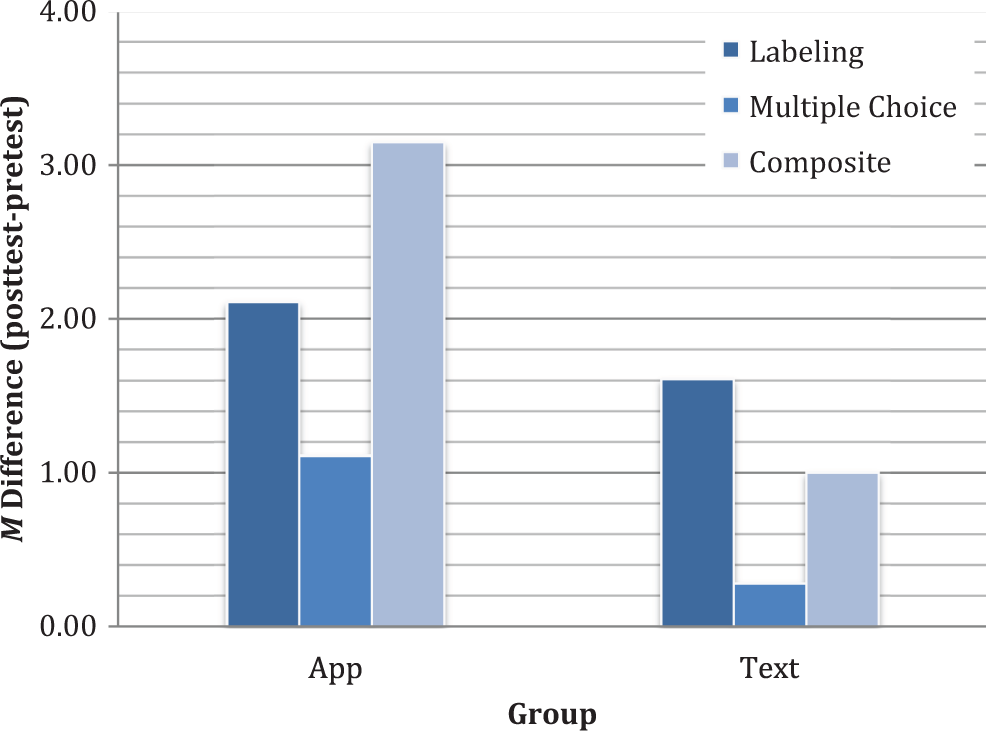
M difference (posttest–pretest) of items answered correctly on labeling, multiple choice, and composite measures for app and text groups.
We also evaluated how participants’ scores changed between pre- and posttests for those in the text condition (see Figure 1). For composite scores, text condition participants showed no improvement from the pretest to the posttest, t(27) = −1.76, p = .088, 95% CI [−2.16, .16]. Multiple-choice and labeling sections were also evaluated separately; text condition participants’ scores on the multiple-choice items did not differ significantly between the pre- and the posttest, t(27) = 1.41, p = .16, 95% CI [−,27, 1.48]. In fact, their performance actually was lower on the posttest compared to their pretest scores. For the labeling section, participants actually improved significantly from the pretest to the posttest, t(27) = −5.11, p < .001, d = 0.96, 95% CI [−2.25, −.96]. Because participants in both the app and the text condition significantly improved from the pre- to posttest on the labeling portion, we examined whether the amount of gain differed between the two conditions. Those participants in the app condition had slightly higher gain compared to those in the text condition, but the difference was not significant, t(53) = −1.38, p = .17, 95% CI [−1.59, .29].
Because we expected students to find the app activity helpful and fun to do, participants in both conditions responded as to how much they enjoyed doing the activity. In the app condition, little less than two thirds (60.7%) of participants rated that they either somewhat liked or liked doing the activity. Participants reported an average rating of 3.77 (SD = 0.697, 95% CI [3.50, 4.05]). We also asked participants in the text condition if they enjoyed the class activity. Fifty-seven percent rated that they either somewhat liked or liked doing the activity, and 20% reported that they somewhat disliked or disliked the activity. All in all, participants reported an average rating of 3.46 (SD = .1.17, 95% CI [3.01, 3.91]). We had thought participants in the app condition would like the activity more than students who were in the text condition, but there was no significant difference in their rating of their respective activity, t(53) = 1.21, p = .235, 95% CI [−.21, .84].
Discussion
The goal of this study was to determine whether using mobile apps in class had any educational advantage. As predicted, students using a mobile app (3-D Brain; Cold Spring Harbor Laboratory DNA Learning Center, 2013) showed a significant increase in performance from pretest to pretest on the labeling, multiple choice, and the composite measures. In addition, the increase in performance was significantly greater on the multiple choice and composite measures for app group as compared with the text group. The text group only showed an increase in performance from pretest to posttest on the labeling measure. Although the app group performed slightly higher on labeling from pretest to posttest, the difference in performance between groups was not significant. Finally, it appeared that students in both the app and the text groups found the worksheet activity equally enjoyable.
Taken together, our findings suggest that using mobile apps in class could serve as a useful pedagogical aid to enhance student learning. Unlike Mueller and Oppenheimer (2014), we used learner-centered approach to integrate technology in class and designed our worksheet activity around learning objective for the brain and central nervous system topic. Thus, rather than having students “mindlessly” take notes to a lecture using laptops, students used their mobile devices to label, summarize, and discover new knowledge. We also assessed learning using a combination of labeling and multiple-choice questions. The worksheet encouraged different levels of cognitive processing (factual, conceptual, and applied), and the multiple-choice questions assessed learning beyond the memorization of key terms and definitions.
Although our primary goal was to investigate the utility of mobile apps when students are in class, the app activity could easily be adapted and completed outside class (see Burgess & Murray, 2014). By doing the activity in class, we controlled how much time students spent using the app or text to complete the worksheet. In addition, because students worked individually and were instructed to turn in the completed worksheet at the end of class, they were unable to become distracted by nontask-related activities such as conversations with friends or using their devices to access social media, e-mail, and texting.
Faculty should be cautious when selecting an app to make sure it can be used to meet their learning objectives. It is also important to consider the technical limitations when designing a mobile app-based activity. Although the majority of college students own a laptop, smartphone, or tablet (Fidler, 2014; Marketing Charts, 2013), there may be students who do not own one of these devices. Our institutional library will loan laptops and iPads to students, but quantities are limited and they must be returned within a 24- or 48-hr period, respectively. Furthermore, our institution does not allow additional apps to be downloaded to the iPads, which could be problematic for an activity like ours.
Although students did not self-report the app as being more enjoyable than the text, this may, in part, be explained by the fact that the instructor was also using an online text. That is, students in the text group used their mobile devices to search for information, turn pages, and view two-dimensional diagrams of the brain. So in some respects, they were also interacting with their mobile device to gather information from their text, though not using an app. Thus, we predict the effects may be even more pronounced when a physical copy of the text is used. Furthermore, it is possible that the ratings of enjoyment for the text and app groups are reflecting two different underlying psychological constructs. For instance, the text groups’ rating may be reflecting a general liking for learner-centered activities when compared to teacher-centered (e.g., traditional lecture with note taking). On the other hand, the app groups’ ratings may have reflected a specific enjoyment of using the app itself to complete the worksheet activity. Further research would need to be conducted to test these hypotheses.
In summary, the data suggest that the use of mobile devices, in general, and mobile apps, specifically, in the classroom is enjoyable and enhances student learning. Faculty can use apps to develop innovative learner-centered activities and even adapt an activity to promote collaborative learning. With greater instructional training, some faculty could also learn to develop their own apps to implement in their courses. As higher education moves toward a more learner-centered model and the popularity of mobile devices and downloadable apps continue to grow, faculty can use this as an opportunity to enhance teaching and learning in their classroom.
Footnotes
Declaration of Conflicting Interests
The authors declared no potential conflicts of interest with respect to the research, authorship, and/or publication of this article.
Funding
The authors received no financial support for the research, authorship, and/or publication of this article.