



Abstract
Studies of master teaching have investigated a set of qualities that define excellent teaching. However, few studies have investigated master teachers’ perspectives on excellent teaching and how it may differ from other faculty or students. The current study investigated award-winning teachers’ (N = 50) ratings of the 28 qualities on the teacher behavior checklist. There was substantial overlap in the importance placed upon various teaching qualities among award-winning teachers and other faculty. However, excellent teachers placed more value upon being prepared and forming rapport with students. Full professors placed more importance on several teaching qualities than associate and assistant professors. Teaching training programs should include broad definitions of excellent teaching that incorporate components that some faculty may otherwise overlook.
The study of excellent teaching has a long and varied history (see Buskist & Keeley, 2014, for a review). Regardless of how it is studied, although, investigations of excellent teaching share the common goal of improving teaching through understanding the practices and qualities of excellent teachers. By identifying the key qualities of excellent teaching, researchers can build a database for use by teachers who aspire to improve their teaching.
Definitions of excellent teaching are remarkably consistent across students (Buskist, Sikorski, Buckley, & Saville, 2002; Faranda & Clarke, 2004; Revell & Wainwright, 2009), faculty (Barnes et al., 2008; Ismail, 2014), administrators (Skelton, 2004), and alumni (Moore & Kuol, 2007; Yair, 2008). Common across these general definitions is the recognition that excellent teaching requires sufficient expertise in content and pedagogy (Bain, 2004; Elton, 1998; Shim & Roth, 2009), although possessing only one or the other is insufficient by itself. In addition, excellent teachers are aware of how they impact their students, regarding both course content and students’ motivation to learn (Kreber, 2002).
There is also impressive consistency among specific descriptions of excellent teacher qualities. Buskist and colleagues (2002) found that students and faculty agreed that some of the most important aspects of excellent teaching are (a) having realistic expectations and fair grading practices, (b) being knowledgeable about the topic, (c) being approachable and personable, (d) being respectful, (e) being creative and interesting, and (f) being enthusiastic. These qualities generalize across the range of higher education institutions (Ismail, 2014; Schaeffer, Epting, Zinn, & Buskist, 2003; Vulcano, 2007; Wann, 2001). Students from different cultures also tend to value similar aspects of teaching, although there are some differences, for example, students from Eastern cultures prefer more structure to interaction with professors and more certainty about faculty expertise than their Western colleagues (Keeley, Christopher, & Buskist, 2012; Liu, Keeley, & Buskist, 2015 ).
Notably lacking from the literature on excellent teaching is the perspective of those teachers who are considered by their peers to be excellent teachers. Most of the work on excellence in teaching has focused on students and faculty who are willing to participate in such studies; no special effort has been made to select faculty who are known for their excellence in teaching (although see Lowman, 1995). Thus, for the current study, we selected individuals who have won at least one national teaching award in psychology. By virtue of winning such an award, these individuals have been consensually vetted by a group of peers (award selection committees) as exemplifying a variety of highly desirable characteristics as college and university teachers. The selection criteria for all of the awards in this study included information from students, peers, self-reflection, and other forms of evidence of teaching excellence, including impact on the field and engagement in the scholarship of teaching and learning. In addition, each of these awards is competitive; respective selection committees chose their awardees from among pools of the finest teachers in psychology.
The perspective of teaching award winners regarding what constitutes excellent teaching may differ from students and colleagues. It is possible that they may differentially emphasize particular practices and qualities. For example, students often favor the interpersonal aspects of teaching more than faculty, and faculty tend to value the technical aspects of teaching more than students (Buskist et al., 2002; Keeley et al., 2012; Keeley, Smith, & Buskist, 2006). It may be that excellent teachers recognize the importance of both sets of qualities. Alternatively, novice teachers tend to narrow their focus on a single aspect of excellent teaching, while expert teachers tend to have a more pluralistic understanding of excellent teaching that takes many qualities into account simultaneously (Dunkin, 1995). Whereas both novices and experts agree on what qualities constitute excellent teaching, experts incorporate more of those qualities into their practice of teaching (Hativa, Barak, & Simhi, 2001). Thus, excellent teachers may have more equivocal rankings of excellent teacher practices and qualities than other faculty because they consider many aspects of teaching simultaneously. Similar to the infamous Dodo bird verdict, excellent teachers may proclaim that all teaching qualities are important, and none should be meaningfully placed above another. Thus, the purpose of the current study was to investigate how award-winning psychology teachers view excellent teaching qualities in comparison to their colleagues for the purpose of identifying particular features that may help distinguish truly excellent faculty.
Method
Participants
Participants were winners of the following national teaching of psychology awards: the American Psychological Foundation Charles L. Brewer award, the Society for the Teaching of Psychology (STP) Presidential Citation, the STP Robert S. Daniel Teaching Excellence award (4-year college or university), the STP Wayne Weiten Teaching Excellence Award (2-year College), the STP Jane S. Halonen Teaching Excellence Award (early career psychologists), the STP Wilbert J. McKeachie Teaching Excellence award (graduate students), and the STP Adjunct Faculty Teaching Excellence Award. We identified all award winners from 2000 to 2013 (63 individuals) for inclusion in the study; we recused two for being investigators in the current study, one individual was deceased, and six others had no identifiable e-mail address. Of the remaining 54 individuals, we received completed surveys from 50 (93% return rate).
Of the 50 individuals who completed the survey, 7 had won two of the awards and the remaining 43 won one. On average, participants had won 4.70 (SD = 3.86) total teaching awards, including those awards that qualified them to participate in this study. Participants were nearly evenly distributed among doctoral (30%), masters (28%), and baccalaureate (26%) institutions, with fewer coming from community colleges (16%). Most participants were full professors (66%) with 14% holding the rank of associate professor, 18% holding the rank of assistant professor, and 2% holding the rank of lecturer. On average, participants had been teaching an average of 21 years (SD = 11.98).
Materials
Participants completed the teacher behavior checklist (TBC), a 28-item behaviorally anchored measure of excellent teacher qualities (Keeley et al., 2006). Buskist, Sikorski, Buckley, and Saville (2002) developed and refined the TBC by distilling the qualities of master teachers and operationalizing them through specific behaviors. The TBC evidences a two-factor structure, representing Caring and Supportive and Professional Competency/Communication Skills subscales, that combines into a total “excellent teaching” score. The TBC has demonstrated good internal consistency (αs = .90 to .95; Keeley et al., 2006), test–retest reliability (rs = .68 to .72; Keeley et al., 2006), and interrater reliability (ICCs = .68 to .91; Landrum & Stowell, 2013) and has been shown to be useful for a variety of purposes, including student evaluation of teaching (Filz & Gurung, 2013; Keeley, Furr, & Buskist, 2010; Lammers, Savina, Skotko, & Churlyaeva, 2010). In addition, participants completed a short demographic questionnaire including questions about the type of institution at which they teach, professorial rank, and years working as a professor.
Procedure
We e-mailed a cover letter and an information letter with a URL to a Qualtrics survey to each of 54 national teaching of psychology award winners who qualified for the study and for whom we could locate an e-mail address. The Qualtrics survey consisted of a short demographic survey and an electronic copy of the TBC. We instructed participants to use a 10-point scale to rate each TBC item according to its importance in excellence in teaching (1 = not at all important to 10 = highly important).
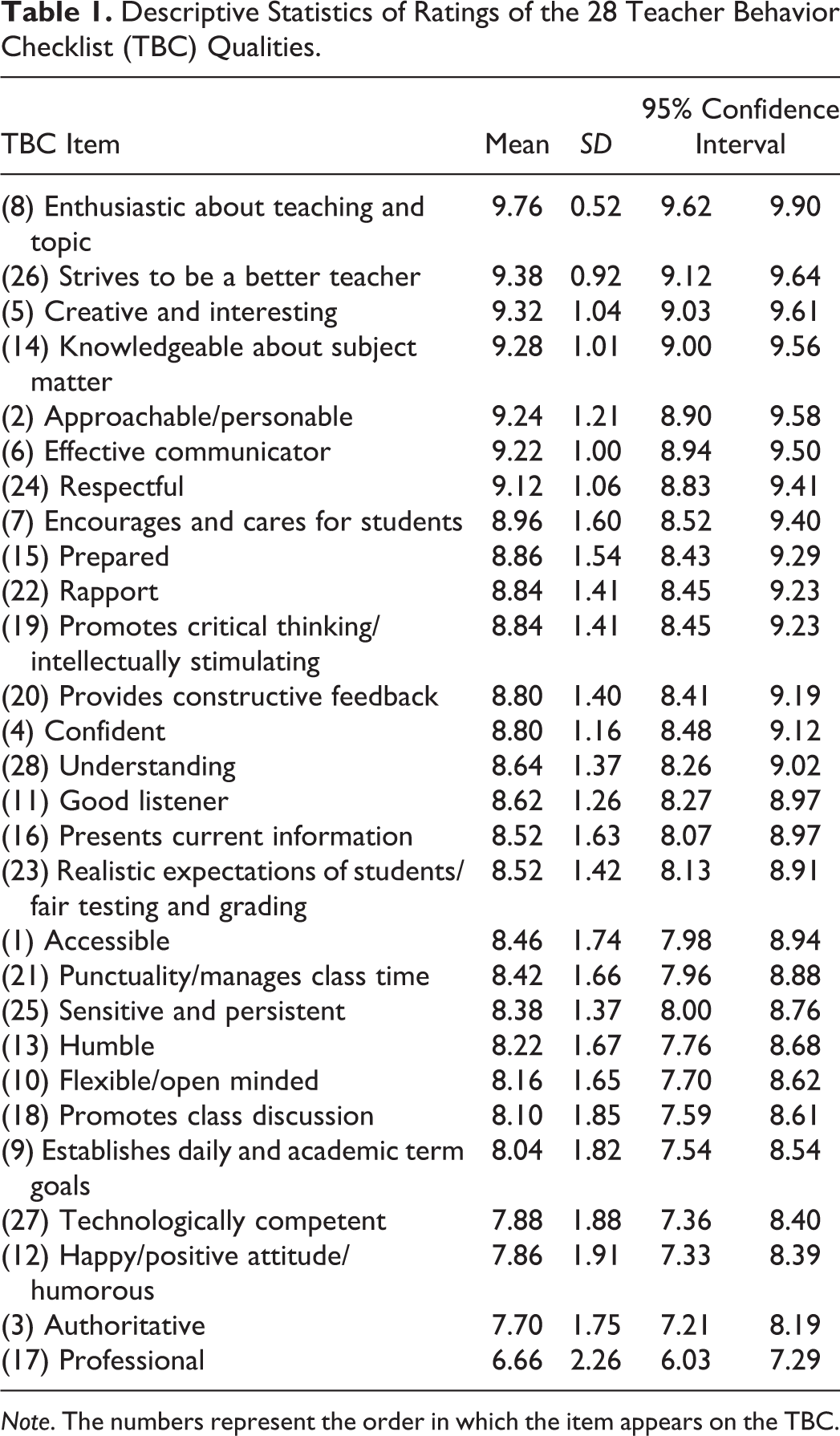
Results and Discussion
The average rating of importance of each of the 28 TBC qualities is presented in Table 1. We have also provided the 95% confidence interval (CI) around each mean, such that one can determine whether any particular mean is statistically equal to any other, given the variability of ratings and the size of our sample. For example, the highest rated item (enthusiastic about teaching and topic) is statistically higher than all other items (95% CI = [9.62, 9.90]; the next highest mean is 9.38). Similarly, the item rated as least important by our participants (professional) was significantly lower than all other items.
Descriptive Statistics of Ratings of the 28 Teacher Behavior Checklist (TBC) Qualities.
Note. The numbers represent the order in which the item appears on the TBC.
Participants considered all items to be relatively important (i.e., all ratings had an average above the midpoint of the scale). However, given that the TBC is intended to measure teaching excellence, it is not surprising that all items would be rated highly. Taking that caveat into account, award winners meaningfully differentiated the relative importance of teaching qualities and their attendant behaviors. The hypothesis that excellent teachers would equally value all aspects of excellent teaching is not true. Participants clearly considered enthusiasm to be the sine qua non of excellent teaching, as it out rated all other qualities, which is consistent with previous non-TBC studies of master teaching (e.g., Eble, 1984; Feldman, 1976; Lowman, 1995).
Additionally, there was a wide range of experience among our award winners. We divided the award winners into those who were full professors versus those of any other rank (assistant, associate, or lecturer). Full professors placed more emphasis on several TBC qualities: effective communicator (9.42 vs. 8.82), good listener (8.94 vs. 8.00), knowledgeable about subject matter (9.58 vs. 8.71), prepared (9.24 vs. 8.12), provides constructive feedback (9.18 vs. 8.06), punctuality/manages class time (8.76 vs. 7.76), and respectful (9.42 vs. 8.53; all ps < .05). Consistent with the finding that experts have more complex definitions of excellent teaching (Dunkin, 1995; Hativa et al., 2001), more experienced faculty placed higher emphasis on a wide range of excellent teaching qualities. One implication for faculty development programs is that novice faculty may need encouragement to broaden their focus, specifically regarding the qualities listed above.
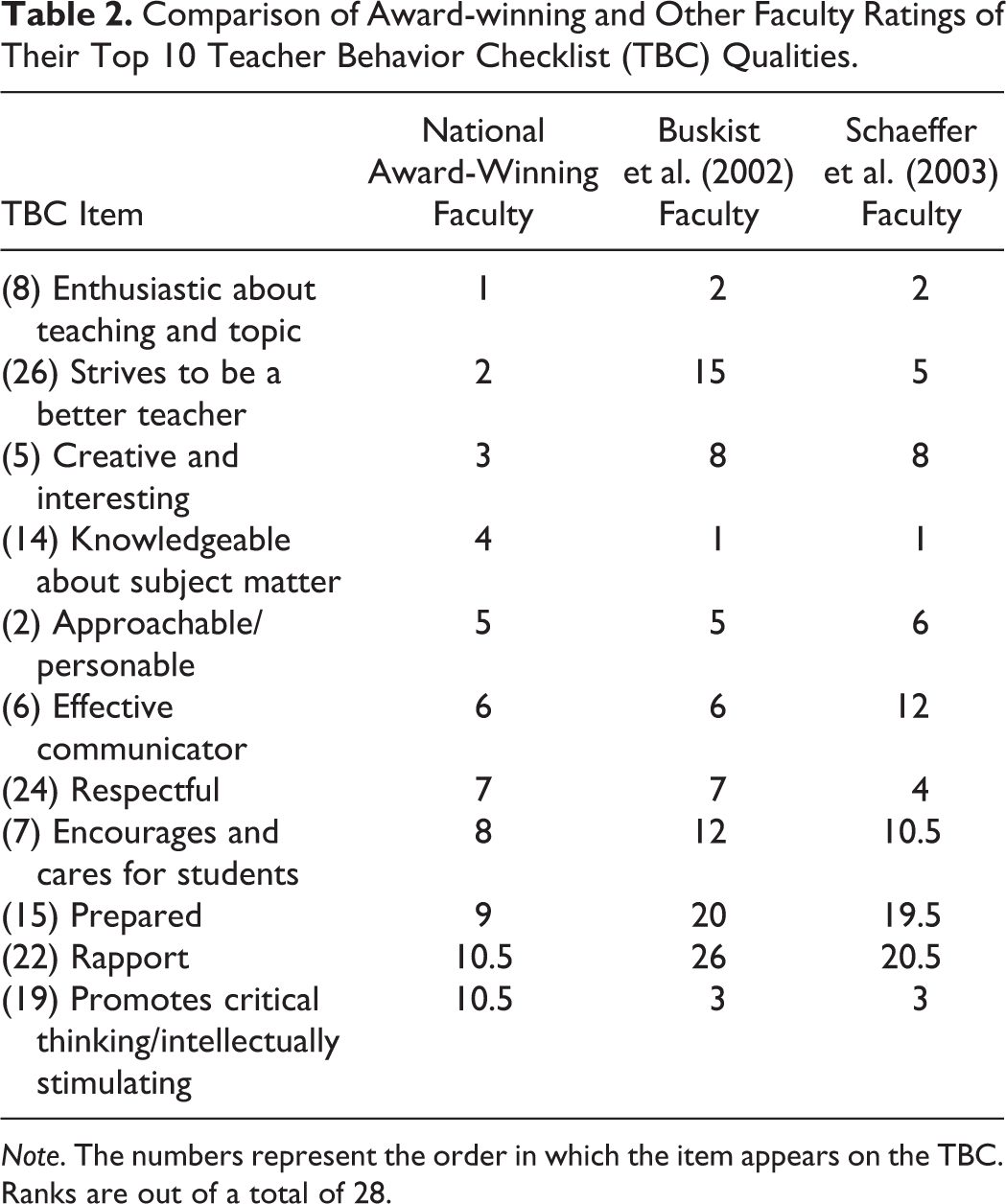
The highest rated qualities of teaching award winners were not identical to those of faculty in previous TBC studies (see Table 2; cf., Buskist et al., 2002; Schaeffer et al., 2003). 1 TBC items that made the national award winners’ list but were not represented in the top 10 qualities of other faculty include “encourages and cares for students,” “prepared,” and “rapport.” Of particular note, rapport was ranked near the bottom of previous faculty’s representations, although students have rated it as being fairly important, placing it 11th of 28 (Buskist et al., 2002). The degree of discrepancy between previous faculty ratings and the award-winning faculty makes this finding worthy of discussion, even though rapport was not their top-rated characteristic. There is mounting evidence that behaviors’ indicative of rapport between faculty and students are linked to higher student motivation, perceptions of learning, and self-reported grades (Benson, Cohen, & Buskist, 2005; Wilson & Locker, 2007; Wilson, Ryan, & Pugh, 2010; Wilson & Taylor, 2001). Thus, perhaps one of the defining characteristics of excellent teachers (vs. average ones) is the relationship they cultivate with their students. Award-winning teachers also placed much more emphasis on being prepared than their colleagues. It is interesting that excellent teachers stress this component of teaching, when it may be easy for others to take it for granted.
Comparison of Award-winning and Other Faculty Ratings of Their Top 10 Teacher Behavior Checklist (TBC) Qualities.
Note. The numbers represent the order in which the item appears on the TBC. Ranks are out of a total of 28.
However, several confounds could explain the difference between award-winning faculty and these other samples. First, award-winning faculty may differ on other important characteristics, such as personality or motivation, thereby leading to the differences in emphasis they place upon TBC qualities. Second, award-winning teachers might differ in their amount of experience. The amount of experience of the Buskist, Sikorski, Buckley, and Saville (2002) and Schaeffer, Epting, Zinn, and Buskist (2003) samples is unknown, but differences emerged among the award-winning faculty based upon their professorial rank; future work should explore this possibility. Nonetheless, many categories rated within the top 10 of national award winners concur with previous TBC data. Much of what faculty consider to be important about excellent teaching seems to be consistent across participants from different TBC studies.
The qualities endorsed by award-winning teachers also overlapped meaningfully with the ratings of undergraduate students. In four different TBC samples representing U.S. students from a research-intensive university (Buskist et al., 2002), U.S. students from a liberal arts college (Keeley et al., 2012), Japanese students from a liberal arts college (Keeley et al., 2012), and Chinese students from a large university (Liu et al., 2015), the ratings of award-winning faculty overlapped substantially, sharing 6, 7, 7, and 6 of the top 10 characteristics, respectively. Some of the discrepancies among the lists reflect minor differences among TBC items that are rated very closely and so should not be overinterpreted. However, it is worth noting that students value certain characteristics (e.g., realistic expectations of students/fair grading, good listener, happy/positive/humorous, and understanding), especially those that are directly related to their experience, more than faculty, even when those faculty represent the very best the discipline has to offer (i.e., our award-winning sample).
Excellent psychology teachers, operationalized as those who have won a national teaching award in psychology, have something meaningful to say about excellence in teaching above and beyond what has been indicated by many, if not most, faculty. In particular, excellent teachers of psychology know the value of being prepared and encouraging classroom rapport. Consistent with previous findings, they also note that enthusiasm is perhaps the most important quality of an excellent teacher (Eble, 1984; Feldman, 1976; Lowman, 1995).
These findings present a clear suggestion for preparing new teachers in psychology (i.e., graduate students and new faculty) as well as for more experienced teachers wishing to improve their teaching skills. Teaching training programs, training seminars, and workshops for faculty should incorporate a broad definition of excellent teaching and focus on a variety of areas, not just the standard fare of traditional teaching techniques (e.g., how to lecture, create PowerPoint slides, lead discussions). In particular, faculty—especially early in their career—may not value characteristics like preparation and rapport building as much as award-winning teachers, and training programs could emphasize the importance of these additional areas for enhancing instruction.
Footnotes
Declaration of Conflicting Interests
The authors declared no potential conflicts of interest with respect to the research, authorship, and/or publication of this article.
Funding
The authors received no financial support for the research, authorship, and/or publication of this article.