



Abstract
Flipped pedagogy has become a popular approach in education. While preliminary research suggests that the flipped classroom has a positive effect on learning in Science, Technology, Engineering, and Mathematics and quantitative courses, the research on the flipped classroom in a content heavy social science course is minimal and contradictory. We flipped four class topics in an introduction to psychology course, evaluated resulting student attitudes, and compared students’ performance on the flipped units to their performance on traditionally delivered content. We found mixed results for the effectiveness of the flipped classroom that were moderated by student characteristics and experiences with previous online or flipped courses. Students reported an overall preference for traditional classroom delivery but suggested retaining the flipped approach for some class periods.
The flipped, or inverted, classroom is a relatively new pedagogy that has been widely touted as an innovative and effective teaching method, which some propose should replace the traditional lecture format (Fitzpatrick, 2012; Mazur, 2009; Rosenberg, 2013). In a flipped classroom, the material that has been customarily presented in lecture is moved outside class time, generally in the form of digital videos (vodcasts), which students view before the class period (Bowen, 2012). Flipped pedagogy differs from a fully online format, however, as in-seat class time is spent actively applying concepts, working through problem sets (activities previously assigned as homework) as well as answering student questions and engaging students in discussions.
Despite the strong endorsement of the flipped classroom, research investigating its effectiveness has been sparse and has primarily examined the effectiveness of the flipped classroom in Science, Technology, Engineering, and Mathematics and quantitative courses (STEM-Q). Few studies have examined whether the flipped classroom is an effective pedagogy in introductory-level psychology classes, which do not lend themselves as easily to in-class applications and assignments. The goal of the current study is to examine the impact of the flipped classroom in an introductory psychology course on both student attitudes and learning.
There are many potential advantages associated with the flipped classroom, which are commonly extolled, along with less widely advertised potential pitfalls. Possible benefits include the following: Students may view the vodcasts at their own pace or review the material multiple times (Goodwin & Miller, 2013); lectures can be broken down into smaller units, and students can view them when most convenient and optimal (Forsey, Low, & Glance, 2013; Jensen, 2011); active learning, an effective teaching technique, can be employed during class time (Daniel & Braasch, 2013; Freeman et al., 2014; Karpiak, 2011); and instructors can work individually and make deeper connections with students who are having difficulties (Goodwin & Miller, 2013). The following drawbacks are also possible: Students may find the taped lectures less engaging than the typical classroom lecture and encounter more distractions when viewing the vodcasts (Jensen, 2011; Foertsch, Moses, Strikwerda, & Listzkow, 2002); students prefer to have a teacher available during lecture to answer questions (Chandra & Fisher, 2009; Foertsch et al., 2002); some students are less able to anticipate, schedule, and complete the out-of-class learning (Dunning, Johnson, Ehrlinger, & Kruger, 2003); when students watch taped lectures, there may be decreased compliance with the reading assignments (McLaughlin et al., 2014); and finally, students may have technical problems downloading or viewing the vodcasts, particularly those with fewer financial or technical resources (O’Bannon, Lubke, Beard, & Britt, 2011).
Student Attitudes Toward the Flipped Classroom
Several studies have assessed attitudes toward the flipped classroom in STEM-Q courses, with generally encouraging results. Students have reported strongly positive reactions to the flipped paradigm in multiple courses, including biology, economics, nursing, and physics, (e.g., Critz & Knight, 2013; Deslauriers, Schelew, & Weiman, 2011; Lage, Platt, & Treglia, 2000; Moravec, Williams, Aguilar, & O’Dowd, 2010). Not only have students reported positive attitudes toward flipped classes, but they have also endorsed a preference for flipped pedagogy over traditional content delivery in courses in organic chemistry, nutrition, accounting, and calculus (Christiansen, 2014; Gilboy, Heinerichs, & Pazzaglia, 2015; McGivney-Burelle & Xue, 2013; Phillips & Trainor, 2014).
On college-administered, anonymous course evaluations, flipped courses have received higher ratings than traditionally taught lecture courses in engineering computing, statistics, and physics (Foertsch et al., 2002; Peterson, 2016; Stelzer, Brookes, Gladding, & Mestre, 2010; Wilson, 2013). However, flipped pedagogy did not affect teacher or course evaluations in an introductory spreadsheet class (Davies, Dean, & Ball, 2013).
To our knowledge, only two studies have examined student attitudes toward the flipped paradigm in an introductory-level social science class. Jensen (2011) flipped four class periods of an introduction to psychology course and, in contrast to the broadly positive responses to flipped STEM-Q courses, found that students preferred the traditional lecture method and perceived it as more helpful to their learning. Forsey, Low, and Glance (2013) flipped a sociology course taught in Australia and found that, after 2 weeks, students had mixed reactions. They appreciated the flexibility and the short length of the vodcasts but had concerns about technological compatibility and aptitude and the loss of the shared lecture experience.
In summary, there has been a generally positive response to the flipped classroom in STEM-Q courses, which may be the ideal venue for the flipped classroom. STEM-Q topic areas lend themselves easily to spending class time solving math, engineering, and computing problems or engaging in laboratory and practical applications. In contrast, there is preliminary evidence that students in an introduction to psychology course do not respond as positively to the flipped classroom. Subject matter in this course often involve ideas or concepts that are less amenable to hands-on applications in the classroom than those in STEM-Q courses.
Effectiveness of the Flipped Classroom
The literature evaluating the effectiveness of the flipped pedagogy is even more scant than the work investigating student attitudes. The research that does exist is mixed, although generally positive. Again, the majority of the research examines STEM-Q courses that involve the learning of practical skills or the application of formulas or algorithms.
Within mathematics-related disciplines, three studies included measures of effectiveness. Wilson (2013) and Peterson (2016) compared student performance in flipped statistics classes with performance in traditionally taught classes from a previous academic year and found that students’ overall course grades in the flipped classes were significantly higher than those in the previous semesters. In a more targeted application of flipped pedagogy, McGivney-Burelle and Xue (2013) flipped a difficult topic in a calculus class in one section while using the lecture format in an alternate section. Students in the flipped condition performed better on the relevant exam and assignment than those in the traditional condition.
In an introductory biology course, Moravec, Williams, Aguilar, and O’Dowd (2010) flipped three units in one section and compared students’ performance with students from previous years who used the lecture-only format. Students who participated in the flipped units performed better than those in the lecture-only classes but only on the questions directly related to the flipped activities.
Within physics courses, Stelzer, Brookes, Gladding, and Mestre (2010) moved one third of the lecture material to an online format and used active pedagogy during class time. This change was related to modest increase in test scores when compared to the previous semester. In contrast, Deslauriers, Schelew, and Weiman (2011) used a slightly different pedagogy in their physics class, which they called the deliberate practice method. Rather than viewing videos, students in the experimental group engaged in separate readings and quizzes outside the classroom. Deslauriers et al. found that students in the deliberate practice condition performed almost twice as well as students in the traditional lecture condition on a test of the material.
Final exam scores and final course grades were used as measures of effectiveness in two studies. In a graduate pharmaceutics course, McLaughlin et al. (2014) flipped the entire course; students in the flipped course attended more regularly and earned higher final exam scores than students in the previous nonflipped semester. Talley and Scherer (2013) flipped one unit on synaptic transmission in an upper level physiological psychology course (which they labeled a STEM course). Students who experienced the flipped unit earned higher final grades than those from the previous semester who did not. It is not clear, however, whether this difference was due to the flipped exercise or to confounding factors (e.g., variation in class performance across years), as information about performance on synaptic transmission test questions was not provided.
Also looking at global measures, Lavelle, Stimpson, and Brill (2013) examined course grade distributions. They compared student performance in a flipped one-credit engineering economics class with the performance of those in a traditionally taught course from three previous semesters. The overall distribution of grades was similar for the flipped and the traditionally taught courses. However, students in the flipped class were more likely to fail the course than students in the traditionally taught courses.
Two studies have examined the effectiveness of the flipped class in introductory social science courses. Jensen (2011) flipped four class periods of an introduction to psychology course and found no difference between the online quiz scores of the two groups. Lewis and Harrison (2012) utilized a quasi-experimental design for an “introductory social science course” comparing test scores of a traditionally taught course with scores of the same class with flipped pedagogy. They found the students in the flipped classroom outperformed the students in the traditional courses on two of the four exams and on the final exam.
In conclusion, evidence suggests the flipped classroom tends to have a positive impact on student performance and learning in STEM-Q courses. The utility of the flipped classroom in a content and theory heavy social science course, such as introduction to psychology, is only beginning to be explored and findings are inconclusive.
Moderators
Regardless of the context of the pedagogy, little is known about which students may prefer or benefit from the flipped classroom. For online classes, the research suggests the effectiveness of the pedagogy is not moderated by gender, age, or grade point average (GPA; Wan, Fang, & Neufeld, 2007). Although the flipped class partially relies on online delivery, the classroom component may limit the applicability of this finding. Lage, Platt, and Treglia (2000) reported no differences between men and women on preference for the flipped versus traditional classroom format in an economics course. However, women believed they learned more from the flipped format, and they rated the course activities more positively than the men. Researchers need to replicate and extend these findings with other types of flipped courses.
Experience with technology may also moderate the relationship between performance and teaching technique. Arbaugh et al. (2009), in a review article, reported that performance is enhanced for online business courses when the student has prior experience with technology. Studies have shown that students become more favorably inclined toward the flipped classroom as they become more familiar with the experience (Butt, 2014; McLaughlin et al., 2014). Little is known, however, if students’ previous experiences with flipped or online courses influence their success in flipped classrooms.
Personality may also impact preference for and performance in the flipped classroom. Schniederjans and Kim (2005) examined the relationship between the Big Five personality factors and performance in an online business information systems class and found that students who were high in conscientiousness, openness, stability, and agreeableness (but not extroversion) performed better in the online class. To date, researchers have not explored the role of personality in students’ responses to flipped classrooms, which rely heavily on in-class discussions and interactions. It may be that, unlike the online environment, extroverts have an advantage or a preference for these classes.
Finally, cognitive abilities may affect attitudes and performance in the flipped classroom. Harrington (1999) found that students with lower GPAs performed more poorly in an online statistics class than those in a traditional class, whereas scores of students with a higher GPA were not impacted by the online course format. The relationship between cognitive factors and performance in flipped versus traditional courses may be different from online courses because of the extra scaffolding flipped classes offer. This scaffolding may be particularly beneficial for less accomplished or prepared students.
Research Questions
The goal of the present study was to examine the impact of the flipped classroom in introduction to psychology, a content-heavy, introductory-level course. Secondarily, we intended to extend the current research by evaluating whether cognitive, personality, or demographic variables impact the effect of teaching style on outcome and attitudes. Our four major research questions were: (1) What are students’ attitudes toward a flipped introduction to psychology course? (2) What effect do cognitive, personality, and demographic variables have on these attitudes? (3) How does flipping the classroom affect test performance among students in an introductory psychology course? and (4) How do personality characteristics, cognitive characteristics, or demographic features moderate the effectiveness of flipped pedagogy?
Method
Participants
The students who participated in the flipped classroom were 131 undergraduate students enrolled in an Introduction to Psychology course at a small liberal arts college in the Midwest during the spring semester. Participants were primarily female (68.9%) and Caucasian (82%). Most students were in their first year of college (71.3%), followed by 19.7% sophomores, 4.1% juniors, and 4.9% seniors. Two professors each taught two sections of the course. Students enrolled without knowing that the course would include flipped class periods. Additionally, students were provided with informed consent in order for the researchers to obtain prior academic records and standardized test scores. Students who participated in the study received credit toward the research participation requirement for the course. Ninety-three percent (121) of the introductory psychology students agreed to complete the survey about the flipped classroom and allowed us to access their college records.
As a comparison group, we used aggregated test data (percent answering a question correctly for each test item) from 126 students from the previous spring semester. These students received traditional instruction in the Introduction to Psychology course with the same two faculty members (two sections each). Women comprised 56% of the 2013 sample, which was 89% Caucasian.
Procedure
The instructors designated four topics to be flipped: Research methods, sensation and perception, learning, and personality. The other class periods were taught using traditional pedagogy. These topics were chosen because (a) students often struggle with the concepts and (b) the content lent itself to active learning activities. Each topic was covered in a single, 80-min class period, with the exception of sensation and perception, which was covered in two class periods.
The traditional class periods involved lectures, with occasional activities and discussions, and students were expected to read the textbook prior to coming to class. When class periods were designated as flipped, students were instructed to prepare for class by watching the assigned vodcast(s) along with reading the text. Vodcasts were prerecorded videos in which the professor presented the lecture material, using PowerPoint, similar to the way a lecture would be presented in a traditional class period. Each vodcast lasted 10–15 min, and students were assigned to watch two to four vodcasts per flipped class period. As part of the flipped portion of the class, students engaged in interactive activities including worksheets individually or in pairs, small group or full class discussions, enacting and role-playing particular concepts, identifying ideas or definitions from the vodcasts, in-class videos or text examples that encouraged application of concepts, and interactive demonstrations.
Measures
Demographics and individual differences
Participants provided self-report data regarding their prior experience with flipped and online courses, year in college, gender, and ethnicity. Students also completed the Big Five Personality Inventory (John, Naumann, & Soto, 2008), which yielded scores in extroversion, neuroticism, agreeableness, conscientiousness, and openness to experience. Students’ college GPA as well as American college testing (ACT) and scholastic assessment test (SAT) scores were obtained from the Registrar’s Office.
Attitudes toward flipped classes
Usefulness and interest of each flipped class period were measured on a 3-point scale: 1 (very useful or interesting), 2 (slightly useful or interesting), and 3 (not useful or interesting), whereas overall preference was based on a 5-point scale from 1 (strong preference for lecture) to 5 (strong preference for flipped). The students were invited to provide comments after each of the questions and contribute suggestions.
At the end of the course, students were queried about their preferred teaching method (flipped vs. traditional lecture) on a 1 (strongly prefer lecture style) to 5 (strongly prefer flipped style) response range. Interest level and overall effectiveness were also measure on a 1 (low interest and effectiveness) to 5 (high) response range. Additionally, students were asked if they would recommend the continued use of the flipped classroom, which was measured on a 1 (yes, flip all class periods) to 5 (no, use the lecture format only) response range.
Course evaluations
We compared student responses from the flipped and nonflipped semesters to college-wide course evaluation that is administered at the conclusion of each semester. There were three types of questions on this assessment: Course evaluation questions, which began with “This course helped me enhance the following skills and habits of learning…” included items on curiosity and technology use. These questions had five options, ranging from 1 (a great deal) to 5 (not at all). Teacher Assessment questions, which began with “Please select the term that you feel best describes your instructor…” included items that addressed the degree to which the instructor structured course activities effectively, stimulated subject interest, provided challenge, and provided support of student learning. These items also had five options ranging from 1 (strongly agree) to 5 (strongly disagree). One question assessed the overall value of the course, with five possible responses ranged from 1 (very valuable) to 5 (not at all valuable). We collapsed categories if there were less than three responses in a cell for each year.
Course performance
Student course performance was assessed using multiple-choice exam questions. For each flipped unit, some exam questions reflected both the course content that had been delivered prior to class and reviewed using an in-class exercise, while other exam questions covered material presented only in the preclass preparation (the textbook or vodcast). Course performance was assessed in three key ways. First, the performance of students from the flipped condition was compared with the performance of students in the nonflipped condition, using the relevant exam questions (between subjects). Second, we examined only the students in the flipped condition, comparing their performance on the flipped course components to their performance on the nonflipped elements (within subjects). Third, we isolated performance on the flipped units only; here, we compared students’ performance on test questions covered in the flipped class activities to the questions from the same unit but covered only in preparatory materials (within subjects).
Results
Experience With Flipped and Online Classes
A minority of students had taken at least one online class (20.2% in high school and 7.7% in college). The majority of students had experience with flipped classes (26.9% in high school and 74.0% in college).
Preferences and Attitudes Regarding Flipped Versus Traditional Classes
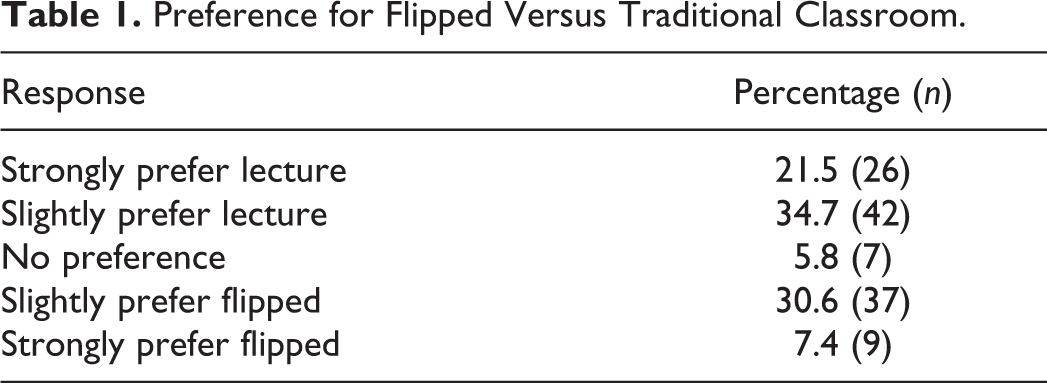
A majority (56.2%) of students either slightly or strongly preferred lecture to the flipped classroom, whereas only 38% preferred the flipped method (see Table 1).
Preference for Flipped Versus Traditional Classroom.
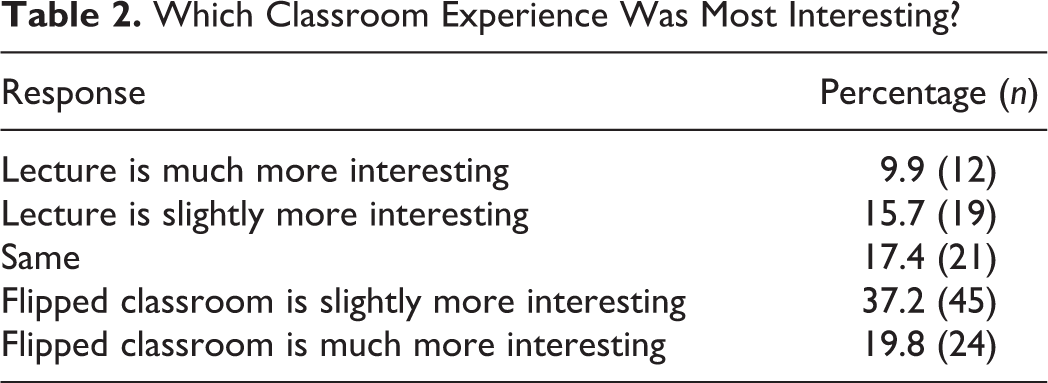
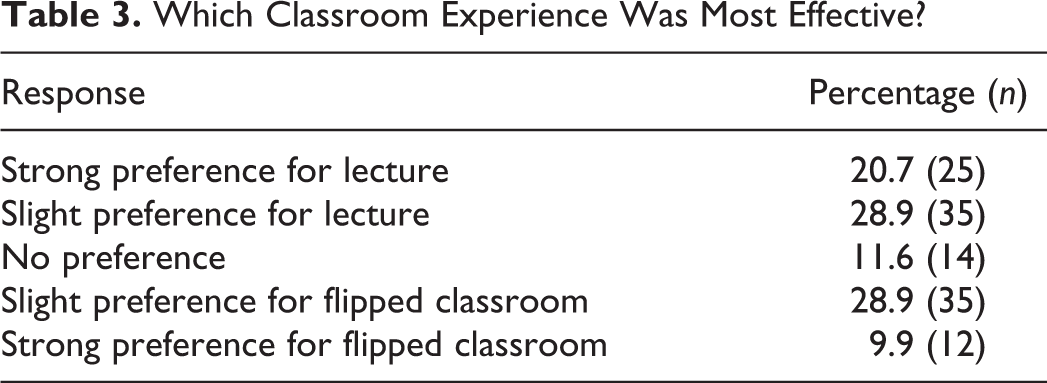
Despite a slight preference for the lecture format, most students found the flipped classroom more interesting than lecture (57.0%). However, they also believed that the traditional lecture style classroom was more effective in helping them to learn the material (see Tables 2 and 3).
Which Classroom Experience Was Most Interesting?
Which Classroom Experience Was Most Effective?
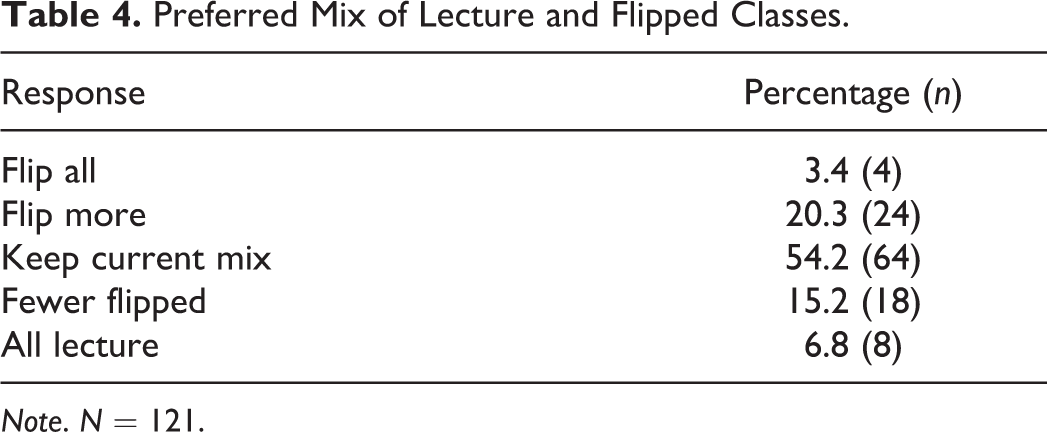
Overall, the vast majority (93.0%) of students recommended using the flipped classroom teaching method to some degree (see Table 4). Therefore, although most students preferred the traditional lecture format to the flipped, almost every student wanted some combination of flipped and traditional classroom experiences.
Preferred Mix of Lecture and Flipped Classes.
Note. N = 121.
Predictors of Attitudes Toward Flipped Versus Traditional Classroom
χ2 Tests of independence revealed that preferences for teaching method did not differ reliably across gender, year in college, White and non-White, and students with different instructors (ps >.11). Similarly, the Big Five personality traits were not correlated with student preferences (ps > .11).
To understand how cognitive factors may have impacted student perceptions of the flipped classroom, we correlated our cognitive measures with student preferences. GPA, r(97) = −.20, p = .049; mean test performance, r(119) = −.36, p < .001; and final exam score, r(117) = −.38, p < .001, were all significantly related to preference toward the flipped classroom. The correlation between standardized test composite percentile and preference trended toward significance r(97) = −.18, p = .081. Students with lower GPAs and lower exam and standardized test scores tended to prefer the flipped classroom format.
Effect of Flipped Classroom on Course Evaluations
To assess whether the flipped classroom was related to the standard college-administered course evaluation, χ2 analyses were conducted comparing course evaluations from the flipped (2014) versus the non-flipped conditions (2013). Compared to students taught using traditional methods, students in the flipped condition were more likely to agree that the workload was heavier (χ2 = 6.2, n = 173, p = .04), they felt more challenged (χ2 = 9.58, n = 205, p = .05), they used technology and the library (χ2 = 18.33, n = 192, p < .01), and the class was effective (χ2 = 5.86, n = 205, p = .05). A statistical trend indicated students in the flipped condition more strongly agreed that the student–faculty relationship supported learning (χ2 = 6.3, n = 204, p < .08).
Relationship Between the Flipped Classroom and Test Performance
To understand whether the flipped classroom pedagogy was related to student test performance, we conducted a 2 (pedagogy: flipped, traditional) × 2 (faculty member) × 2 (year: 2013, 2014) repeated-measures analysis of variance (ANOVA). Each line of data represented a test item that was used in both 2013 and 2014. The dependent variable was the percentage of students who answered the item correctly, resulting in a within-test item comparison between 2013 (traditional pedagogy) and 2014 (flipped pedagogy). There was a main effect for year, F(1, 331) = 14.56, p < .001, η2 = .037. Overall, students performed better in 2013 (M = 78.6%, SD = .17, n = 355) than in 2014 (M = 76.9%, SD = .18, n = 335), with a mean difference of 2.3%, 95% confidence interval [CI]: [1.1, 3.5]. The interaction effect of Year × Pedagogy was not statistically significant, F(1, 331) = 0.28, p = .60, nor was the main effect of pedagogy F(1, 331) = .30, p = .25. Thus, students’ performance was not related to whether the class was flipped. The main effect for faculty was not significant F(1, 331) = .06, p = .81. The Faculty × Year interaction effect was significant, F(1, 331) = 39.62, p < .001, η2 = .102; however, the Year × Faculty × Pedagogy interaction effect was not significant, F(1, 331) = 2.11, p = .15.
Next, we examined student performance on only the units that were flipped (research methods, learning, sensation and perception, and personality). This isolated the impact of the flipped exercises on test performance, comparing performance on test items that were covered by an in-class exercise/discussion and test items covered only by the textbook and vodcast. We conducted a 2 (exercise: exercise, no exercise) × 2 (faculty member) × 2 (year: 2013, 2014) ANOVA for only those test items from the flipped units (above). The dependent variable was the percentage correct, a within test-item comparison between 2013 and 2014. There was a main effect of year, F(1, 75) = 4.13, p = .046, η2 = .040. Again, students performed better in 2013 (M = 80.8%, SD = .16) than 2014 (M = 78.6%, SD = .18), a mean difference of 2.2%, 95% CI [0.04, 4.1]. There was also a marginal effect for the Year × Exercise interaction, F(1, 75) = 3.81, p = .054, η2 = .037. Figure 1 illustrates several points about this relationship. First, the flipped exercises covered concepts that students had most difficulty with in 2013 (3.0% lower than items related to concepts that were not flipped in 2014). Second, on average, students performed more poorly in 2014 than in 2013. Third, on the questions that were related to a class exercise, we did not see the expected decrease in 2014 test scores that occurred with nonflipped units (1.2% decrease) and with test items on flipped units for which we did not create an exercise (3.6% decrease). This suggests that the flipped exercises did help students learn the material. Finally, the 3.6% decrease in the scores for the flipped unit questions that were not related to an exercise was larger than expected when compared to the decrease in scores on the nonflipped units (1.2%). It appears the exercises neutralized the overall poorer performance of students in 2014; however, the flipped pedagogy may have also had a slightly negative effect on the retention of information not covered in class exercises.
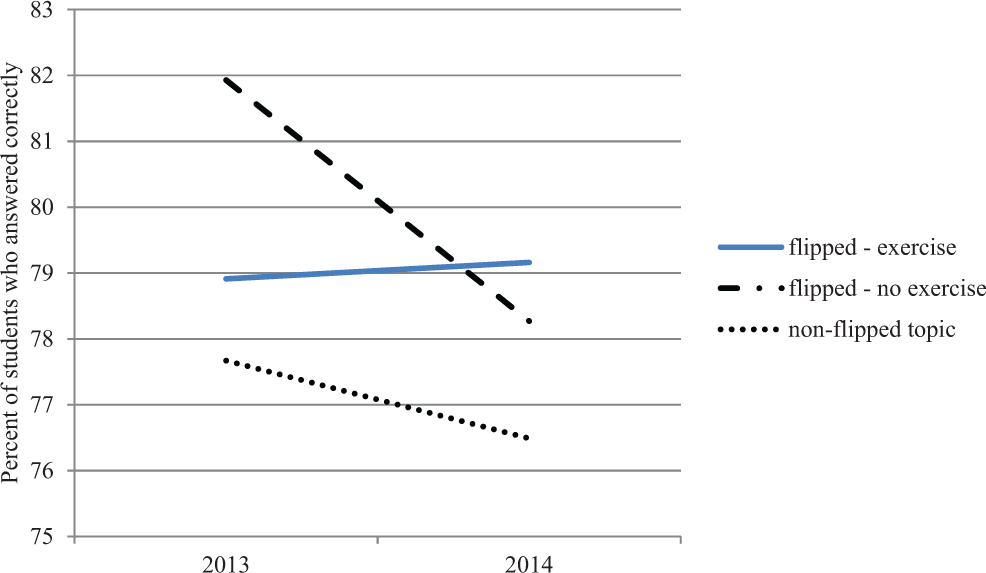
Test performance on flipped topics that were covered by an in-class exercise versus test items that were not covered in class.
As with the analysis of the flipped unit versus nonflipped unit, the Year × Faculty interaction effect was again significant, F(1, 74) = 20.29, p < .001, η2 = .378. However, the three-way interaction effect (Exercise × Faculty × Year) was not statistically significant, F(1, 74) = 0.07, p = .79.
Moderators of the Relationship Between the Flipped Classroom and Student Performance
First, to test categorical moderators (i.e., gender, ethnicity, and year in college), we used mixed ANOVAs, comparing students’ average scores on test items related to flipped units versus nonflipped units. The majority (i.e., gender, ethnicity, and year in college) did not have a statistically significant impact (ps > .46). However, there was a significant interaction effect of Experience × Unit, F(1, 120) = 4.33, p = .04, η2 = .035. As Figure 2 displays, students with previous online class experience performed better (M = 77.5%, SD = .09) on the flipped units than on the traditionally taught units (M = 74.5%, SD = .10), a mean difference of 3.0%, 95% CI [0.6, 5.4], whereas method of instruction did not affect scores of students without a history of online courses.
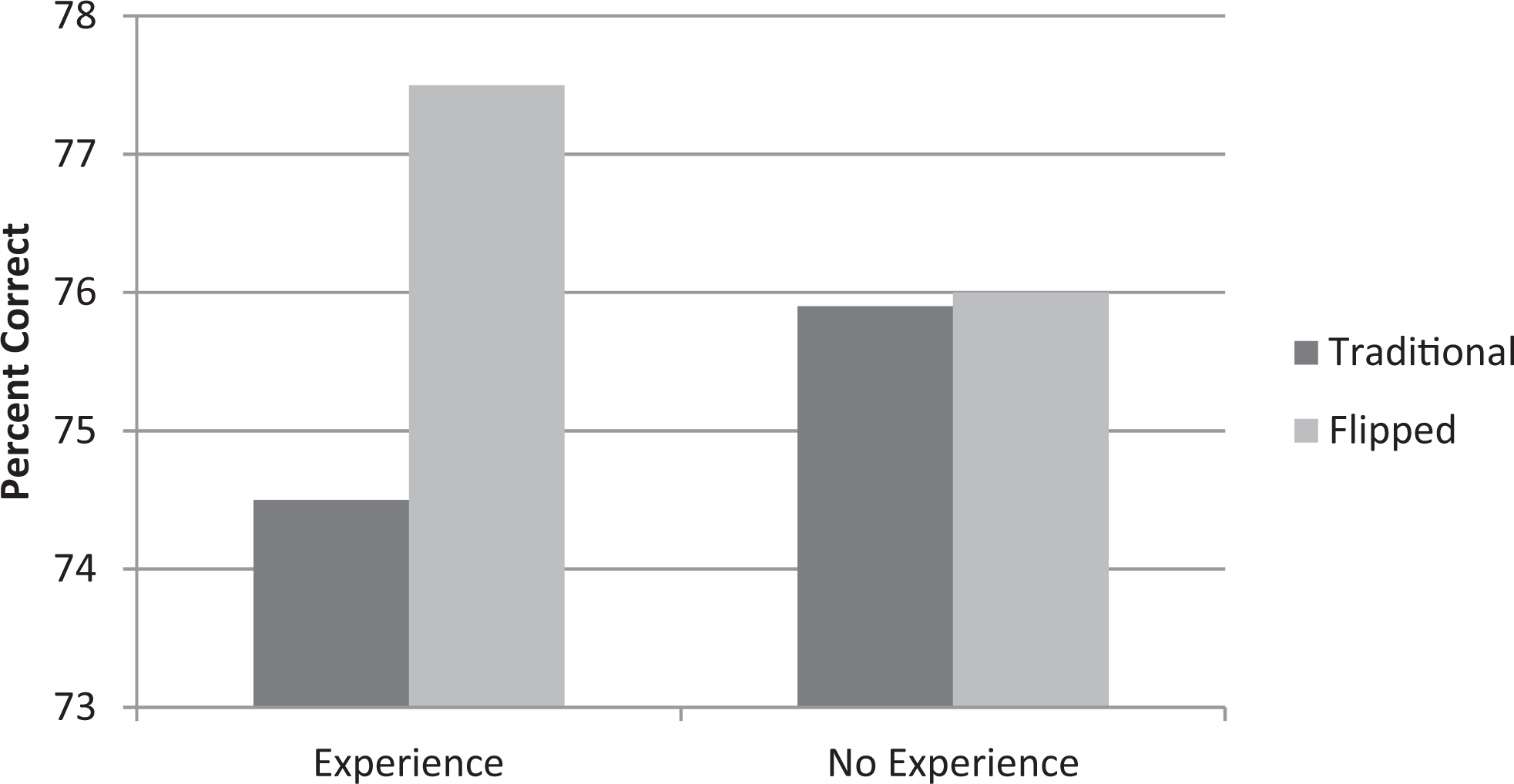
Relationship between experience with online courses and performance on test questions from flipped versus traditional (nonflipped) class units.
We next examined the potential continuous moderators: College GPA, standardized test scores (percentile), personality traits, and preference for the flipped classroom. To represent the impact of flipped pedagogy, we created a difference variable, subtracting the average score on traditional content test items from the average score on flipped content test items. We correlated this variable with our potential moderators. These correlations were not statistically significant (ps > .08) with the exception of neuroticism, r(102) = .20, p = .045. Students higher in neuroticism scored higher on the flipped content test items, relative to the traditional content items.
To identify which students, if any, benefited most from the questions related to flipped exercises relative to the nonflipped exercises, we used similar procedures, isolating flipped units, comparing questions that were covered by an exercise with those that were not covered by an exercise. Among categorical variables, only year in college had a statistically significant Year × Exercise effect, F(1, 113) = 6.46, p = .012, η2 = .054. As seen in Figure 3, first-year students performed better on test items with exercises (M = 75.8%, SD = .15) compared to test items without exercises (M = 72.2%, SD = .15), a mean difference of 3.3%, 95% CI [0.7, 5.9].
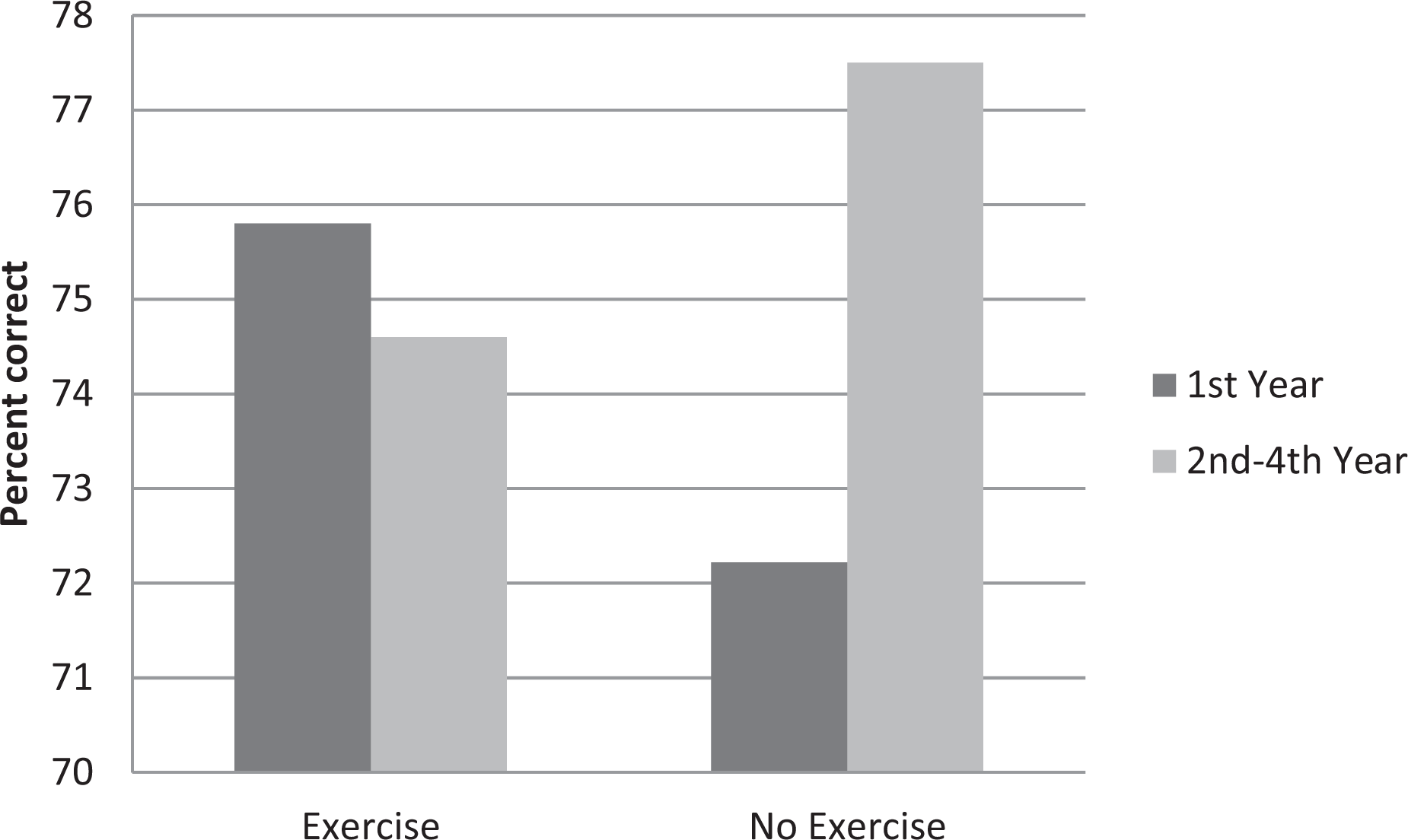
Relationship between class year and performance on test questions from flipped classroom units that were covered versus were not covered by a class exercise.
To evaluate the continuous moderators, we correlated the difference variable with the demographic, cognitive, and personality variables. Only the correlation with GPA approached statistical significance, r(99) = .19, p = .053. Students with lower GPAs tended to perform more poorly on flipped test items that were not directly covered by a class exercise.
Discussion
This study extends our understanding of the attitudes toward and the effectiveness of the flipped classroom in an introductory social science course, specifically introduction to psychology.
Attitudes Toward Flipped Pedagogy
Our results regarding preference replicate and extend past research on an introductory psychology course. Similar to Jensen’s (2011) findings, students showed a slight preference for the traditional teaching method over the flipped method, and they reported that the traditional method was more effective for learning. Students in our study, however, also report that the flipped class was more interesting than the traditional lecture, and the majority supported including some flipped classes during the semester. These results diverge from the research on flipped STEM-Q courses in which students believed the flipped paradigm to be highly effective and tended to prefer it to traditional lecture (e.g., Christiansen, 2014; Deslauriers et al., 2011; McGivney-Burelle & Xue, 2013; Wilson, 2013). We believe this difference is due to the material in an introduction to psychology course, which is less amenable to “flipping” than material in the STEM-Q courses. As one student stated, “I liked the activities for the flipped class, but the teaching style of lecture would have been better for the material.”
The relationship between personality variables and the majority of the demographic variables with pedagogical preference was nonsignificant. Only academic performance affected preference. Students with lower college GPAs and students with lower class test scores preferred the flipped classroom more than higher performing students. Lower performing students may need repeated exposure and more time interacting with the material for long-term retention. Although flipped pedagogy is not the only way to provide this extra time on task (Chickering & Gamson, 1991), the flipped classroom does provide a better fit for the learning needs of these students than the traditional classroom. In contrast, high-performing students may comprehend and retain the information after one exposure, rendering the videos and exercises redundant. As one student stated: I like a lecture style class best because often I only need to hear things once for them to stick in my mind, so having to read the modules, watch the vodcasts, and do the activities in class were a bit of a waste of time for me.
Effectiveness of Flipped Pedagogy
The flipped classroom appears to have had a very modest and nuanced effect on learning in an introductory psychology class. The flipped class exercises resulted in increased performance on test items directly related to those exercises (cf. Moravec et al., 2010). However, this increase may come at a slight cost to the test items not covered by a class exercise. This may clarify the contradictory findings of Lewis and Harrison (2012) and Jensen (2011). As the convergence of concepts included in the class period and the concepts covered on the test increases, we would expect the positive impact of flipped methodology on test scores to increase. Lewis and Harrison may have tested more heavily on concepts covered in class activities.
Expanding the existing literature, we have identified variables that may impact the effectiveness of the flipped pedagogy. Specifically, prior experience can influence the effectiveness of the flipped methodology. First-year students and novice students may have interpreted the lack of class coverage as a signal that those concepts were not important and therefore neglected them. Alternatively, the increased demands associated with the flipped classroom (e.g., additional vodcasts) may have led students to take shortcuts (such as skimming readings or multitasking during videos), resulting in less careful course preparation. Indeed, in course evaluations, flipped course students rated it as more challenging and time intensive than the students who experienced the traditional approach. One student summed up this sentiment, “Having to watch the vodcasts and read the modules was quite time consuming. If all my classes were like that, it would be pretty difficult to get everything done.” Some students may not devote the time necessary to learn the material not covered in class exercises.
In contrast to the flipped introductory psychology courses, flipped STEM-Q classes appear to have a more consistently positive effect on student performance (e.g., Deslauriers et al., 2011; McGivney-Burelle & Xue, 2013; Stelzer et al., 2010; Wilson, 2013).
Moderators of the effectiveness of flipped pedagogy were both similar and dissimilar to online environments. Neither gender nor age was significant moderators (cf., Wan et al., 2007). Of the Big Five personality characteristics, only neuroticism moderated the relationship between pedagogy and test performance; students higher in neuroticism performed better on the flipped units than the nonflipped units. This diverges from the research related to online classes, which found that students who were high on conscientiousness, openness, stability, and agreeableness performed better in online compared to traditional courses (Schniederjans & Kim, 2005). The varied environments of flipped and online classrooms seem to impact the relevance of personality traits regarding performance. The multiple opportunities to learn in the flipped classroom may provide an added level of reassurance to the highly anxious (neurotic) students, positively impacting their achievement.
Additionally, students with previous experience online class experience benefited from the flipped classroom, whereas those without prior experience did not. Learning how to approach the flipped classroom may be a skill that students need to develop to receive the benefits of the flipped paradigm in an introductory psychology course.
Our findings suggest that students with lower GPAs and first-year students did not benefit as much from the flipped exercises as those with higher GPAs and upper level students. Specifically, they tended to do poorly on test questions based on content not covered in class. These results may be due to the approach lower performing and inexperienced students take toward the flipped material. They may rely more heavily on classroom lecture than independent reading when learning the material. If lecture is removed, students may not get the underlying scaffolding they need to benefit from flipped class exercises. Additionally, underperforming students may substitute the vodcasts for the reading, which may be a less effective form of learning (Daniel & Woody, 2010). Ironically, students with lower GPAs were more likely to prefer the flipped environment. Although flipped pedagogy has been marketed as a way to effectively reach more students (e.g., Bergmann & Sams, 2012), our findings suggest that this approach may have privileged already successful and more experienced students.
Summary and Recommendations
The flipped classroom has the potential to be an effective pedagogy in an introduction to psychology course. Given students’ preferences, we recommend faculty use a combination of lecture and flipping in the introductory course. However, faculty must choose class activities carefully. The concepts considered central to psychology will be best emphasized in in-class exercises, as in-class exercises appear to increase retention. Additionally, we suggest faculty judiciously select topics amenable for class exercises. For example, hands-on experiences and discussions can easily reinforce the concepts presented in vodcasts and readings for research methods and sensation and perception. Finally, rather than flipping an entire class period, portions of a class could be flipped, retaining lecture for concepts that don’t lend themselves to in-class exercises.
For optimal impact, faculty will want to orient students to the most effective ways of consuming online resources. This could be particularly helpful for novice, first-year, and lower performing students who do not appear to benefit from the pedagogy as much as other students. Learning how to approach the flipped classroom (e.g., avoiding distractions and taking notes while watching videos) may be a skill that students need to develop to get the full benefit of the paradigm. Faculty must also signal to students that information not covered during class time is still important to learn. This can be achieved through quizzes or worksheets that hold students accountable for learning prior to coming to class, which other researchers have included in their study design (e.g., McLaughlin et al., 2014; Wilson, 2013). With guidance and experience, students may grow to rely less on the instructor, taking more responsibility for their learning via flipped pedagogy.
Limitations and Future Research
Flipped classes are only as good as the class exercises and vodcasts that accompany them. Additional research is needed to explore the benefits of the flipped classroom in introduction to psychology and other social science courses, specifically which techniques and exercises should be paired with each type of course material to maximize learning. Research on the effectiveness of the flipped classroom for a more diverse group of students, particularly international students, is also recommended. Students with limited or developing English skills could control the pace of the vodcasts and replay the recordings to understand concepts that are unclear to them, benefiting their learning. These unanswered questions underscore the need for more investigation of this still new pedagogy. While the flipped classroom has a great deal of potential for psychology students, educators need to approach it with caution to ensure that it is used appropriately and benefits all students.
Footnotes
Declaration of Conflicting Interests
The authors declared no potential conflicts of interest with respect to the research, authorship, and/or publication of this article.
Funding
The authors disclosed receipt of the following financial support for the research, authorship, and/or publication of this article: This research was supported in part by an award to Hope College from the Howard Hughes Medical Institute through the Undergraduate Science Education Program.