



Abstract
School psychology is experiencing a personnel shortage crisis, and scholars suggest that a possible contributing factor is its underrepresentation in undergraduate psychology curricula. Most school psychology trainers do not teach at the undergraduate level, thus undergraduate psychology students may not be adequately exposed to school psychology during undergraduate training. Research suggests that increased knowledge and exposure to school psychology are associated with increased intentions for school psychology. In the current study, 55 undergraduate students completed measures of knowledge, exposure, self-efficacy, outcome expectations, and choice intentions at the beginning and end of professional psychology courses. Results indicated that students enrolled in undergraduate psychology courses did not demonstrate significant increases in the aforementioned areas for school psychology. Efforts such as creating school psychology–specific courses or infusing material should be made to increase the representation of school psychology in undergraduate psychology curricula.
A shortage of school psychology personnel has been a long-standing problem (Curtis, Castillo, & Gelley, 2012). Moreover, recent changes in federal education legislation may also increase the demand for school psychologists. For example, the Every Student Succeeds Act advocates and calls for increased federal funding to meet the academic, behavioral, and mental health needs of all youth (National Association of School Psychologists [NASP], 2016). Accentuating supply challenges is the dearth of school psychologists from diverse backgrounds. Although the profession has recognized these shortage issues for decades, only in recent years have scholars attempted to examine these challenges from a quantitative, research-supported theoretical framework (Bocanegra, Newell, & Gubi, 2016). Researchers in school psychology have increasingly called for new approaches to address these shortages (Bocanegra, Gubi, Fan, & Hansmann, 2015; Proctor & Simpson, 2016). The current study examines the effectiveness of current practice (i.e., predominant reliance on undergraduate curricula) through a social cognitive career theory (SCCT) framework (see Lent, Brown, & Hackett, 1994, for framework details), to assess these constructs’ impact on racial/ethnic minority and nonminority students’ intentions for entering the profession of school psychology.
Addressing the Recruitment Gap
The field of school psychology underwent rapid growth during the late 1970s, due in part to federal legislation (Merrell, Ervin, & Peacock, 2012); however, many of these professionals are now nearing retirement (Curtis et al., 2012; Curtis, Grier, & Hunley, 2004; Curtis, Walker, Hunley, & Baker, 1999). Some scholars have noted that although retirement is likely a contributing factor, “there has never been a time when the supply of school psychologists was sufficient to meet demand” (Fagan, 2004, p. 419). Regardless of the cause, today the profession is experiencing what has now commonly been referred to as the shortages crisis (i.e., a severe shortage of school psychologists), which has impacted the profession at both the practitioner and trainer levels, with many positions going unfilled for multiple years (Ysseldyke et al., 2006).
A related issue is that only 9.3% of all school psychologists come from racial or ethnic minority backgrounds (Curtis et al., 2012), while just over 50% of public school students are from diverse racial and ethnic minority backgrounds (U.S. Department of Education, 2014). Thus, the proportion of school psychologists who mirror the children and families they serve is alarmingly small. Likely due to the scant racial/ethnic diversity found within school psychology, much of the recruitment research in school psychology has largely focused on diversity recruitment. For example, Proctor, Simpson, Levine, and Hackimer (2014) examined minority recruitment research in school psychology and related professional psychology disciplines (i.e., clinical psychology, counseling psychology, and combined practitioner programs) and concluded that, while all professional psychology fields struggle to recruit minority applicants, school psychology lags behind in terms of diversity. They emphasized the need for several recruitment techniques including program administrative supports (e.g., financial supports), outreach efforts (e.g., communication and relationships with minority—serving professionals and institutions), inclusionary practices within school psychology programs (e.g., courses, curriculum, diversity-infused grand round programming), and raising awareness of the profession. Proctor and colleagues suggested that although many attempts have been made to improve the recruitment of diverse individuals into the profession, these attempts have been largely unsuccessful due, in part, to a lack of research-based models. It is postulated that the use of a research-based model would allow for more efficient and effective recruitment-related practices.
Following Proctor and colleagues’ recommendations, Bocanegra, Gubi, and Cappaert (2016) used a research-based model, SCCT, to examine factors that may support the recruitment of minority applicants into school psychology. A national sample of 283 minority undergraduate psychology students completed instruments examining learning experiences, self-efficacy, outcome expectations, and choice intentions to enroll in a school psychology graduate program. Path analysis results from a structural equation model mediation analysis suggested that outcome expectations (i.e., anticipated benefits from a career in school psychology) mediated the relationship between exposure to the field of school psychology and intention to apply to graduate programs in the field. Moreover, a follow-up analysis, within the same study, did not find a significant difference between minority and nonminority samples regarding the SCCT model. Thus, both minority and nonminority undergraduate students may benefit from greater exposure to the profession of school psychology.
Recruiting Through Undergraduate Psychology Coursework
Several school psychology leaders and researchers have suggested that undergraduate coursework may be an ideal venue for increasing knowledge and exposure and, in turn, promoting interest in school psychology among college students (e.g., Grapin, Bocanegra, Green, Lee, & Jaafar, 2016; Grapin, Lee, & Jaafar, 2015). Undergraduate curricula in psychology can provide opportunities to explore various applied psychology careers via special topic courses, field experiences, and professional psychology courses. For example, Norcross et al. (2016) found that approximately 84% of undergraduate psychology departments offered one or more courses in clinical and/or counseling psychology. More broadly, approximately 90% of these departments offered field experiences in psychology, and nearly 40% offered a course on careers in psychology. However, a common finding in the school psychology recruitment literature is that undergraduate psychology students generally report less knowledge and exposure to school psychology compared to the fields of counseling and clinical psychology (Bocanegra et al., 2015; Graves & Wright, 2009).
Moreover, a recent study suggested that school psychology graduate students gained initial exposure to the profession through a variety of sources including professors/faculty advisors (19.5%), Internet searches (18.7%), and family or friends (15.5%; Bocanegra, Rossen, & Grapin, 2017). In contrast, only 8.9% reported first encountering school psychology through undergraduate coursework (Bocanegra et al., 2017). These findings suggest that although students learn about school psychology through a variety of channels, few gain initial exposure to the profession through undergraduate psychology courses such as professional psychology courses.
Importance of the Study
School psychology must overcome current and future personnel shortages in order to adequately serve its burgeoning clientele. One consequence of the shortage is that many school psychology practitioner and trainer positions will remain unfilled, meaning that current school psychologists will continue to carry excessively large caseloads that inhibit their ability to implement comprehensive prevention services (Curtis et al., 2012). Furthermore, a shortage in school psychology trainers also impacts the number of school psychologists that can be trained, which exacerbates the overall school psychology shortage. Unfortunately, there is little evidence that these shortages will be remediated in the near future. The persistence of a personnel shortage is believed to be due in part to limited empirical research regarding the effectiveness of current training practices that may impact interest in school psychology, such as advising and undergraduate coursework. The current study was designed to address this gap and to provide a better understanding of how participation in an undergraduate professional psychology course influenced SCCT variables associated with the pursuit of school psychology training. A short-term longitudinal design was used, wherein students in nine different sections of an undergraduate professional psychology course completed pre- and postcourse measures assessing variables such as perceived knowledge, actual knowledge, exposure, and career intentions related to school psychology.
Based on our literature review, we hypothesized that there would be no overall significant difference between pre- and postcourse measures for most variables, after controlling for academic standing. However, we did expect to find a significant difference between perceived and demonstrated knowledge, even after controlling for academic standing.
Method
This study was approved by the first and second authors’ university institutional review board and took place at a racially/ethnically diverse, midsize university in the Northeast United States. All participants were informed by their university instructors in person and by e-mail regarding the research opportunity. This university was chosen because it offers a professional psychology course and serves a racially/ethnically diverse student body. Similar to most institutions, the psychology department at this university does not offer a course specifically devoted to the study of school psychology.
Participants
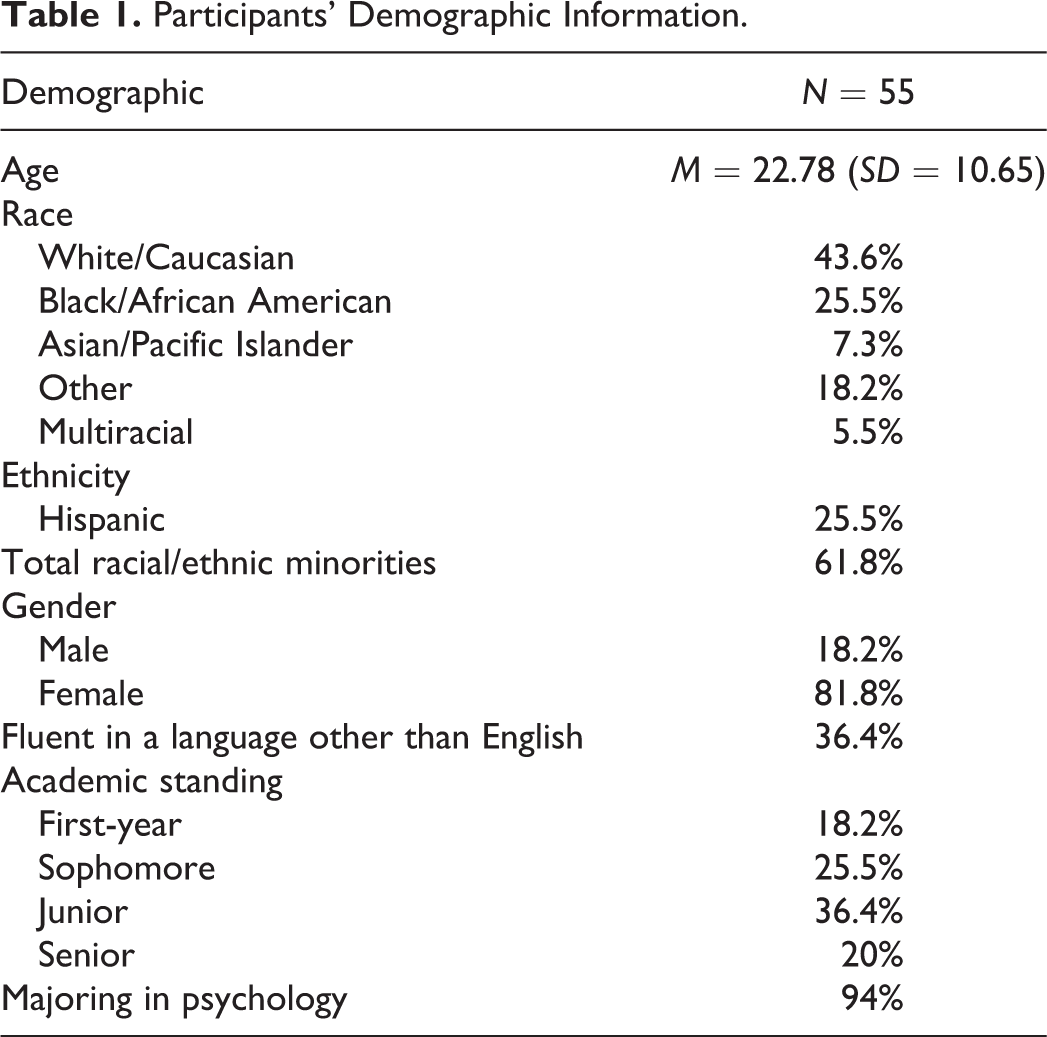
To take part in this study, participants had to be undergraduate students actively enrolled in the university’s Professional Psychology course. Participants received research credits for taking part in the study. A total of 95 undergraduate psychology students completed the precourse scales during the first month of the course. Of the participants who completed the precourse scales, 62 also completed the postcourse scales. Students completed all scales online. Seven of these 62 cases were excluded due to missing data (i.e., more than 15% of scale data were missing). Thus, a total of 55 undergraduate psychology students completed both the pre- and postmeasures. The mean age of participants was 22.8 years, and 82% self-identified as female. Regarding race and ethnicity, 43.6% endorsed White, 25.5% African American, 7.3% Asian/Pacific Islander, and 25.5% Hispanic (see Table 1 for details). Thus, approximately 61.8% of participants self-identified as racial/ethnic minorities. The most commonly reported academic standing was junior (36.4%) and the least common was first year (18.2%). Approximately 94% of the participants were psychology majors.
Participants’ Demographic Information.
Course
Students were enrolled in a course titled Professional Psychology, which was offered in the fall and spring semesters. This course is designed to introduce students to applied professions in psychology. According to the university’s undergraduate catalog, the objective for this course is to “establish the basic skills necessary for planning and pursuing a career in psychology.” A total of nine different sections, each taught by a different instructor, were represented in this study.
Measures
We used these scales: Perceived Knowledge of School Psychology, Demonstrated Knowledge of School Psychology, Exposure to School Psychology, Self-efficacy for Achieving Academic Milestones, Outcome Expectations for School Psychology, and Choice Intentions for Entering School Psychology. These scales measure different social constructs identified within the SCCT framework as important for understanding and predicting career and academic choices.
Perceived knowledge of school psychology
The Perceived Knowledge Scale is a 5-item Likert-type scale. An example of an item from this scale is “Please tell me how well you think you can accurately describe the following characteristics of the profession of school psychology”…“Where they work.” Response options are on a 5-point scale and range from can’t describe at all (1) to can describe in great detail (5). Previous studies have found this scale to have excellent internal consistency (α = .91) and appropriate factor loading (Bocanegra et al., 2015). In the present sample, the internal consistency for this scale was also found to be excellent for precourse (α = .92) and postcourse measures (α = .94).
Demonstrated knowledge of school psychology
The authors developed this scale in order to help validate students’ perceptions of their knowledge of school psychology. This scale was created with the assistance of three school psychology professors from three different universities in the United States. It includes 31 items with 24 true or false (T/F) statements regarding school psychology and 7 multiple-choice items in which participants differentiate between professional psychology types. An example of a T/F statement is “With the appropriate training, school psychologists (PhD level) can work with both K–12 students and adults (e.g., college-age students).” An example of a multiple-choice question is “If a teacher needs ideas for academic interventions, who would the teacher most likely go to see?” Possible response options for this question are (a) clinical psychologist, (b) school psychologist, (c) school counselor, and (d) social worker. The major difference between the Demonstrated Knowledge Scale and the Perceived Knowledge Scale is that the former assesses participants’ actual knowledge of school psychology 1 , whereas the latter assesses their perceived degree of knowledge about the profession.
Exposure to school psychology
This 8-item Likert-type scale assesses students’ perceived exposure to school psychology. A sample question found in this scale is “How much information did you receive about school psychology from…professors/advisors?” Response options are on a 6-point scale and range from none (1) to a great deal (6). Previous research has found this scale to have good internal consistency (α = .86; Bocanegra et al., 2016). For the present sample, the internal consistency was good for the precourse measure (α = .88) and excellent for the postcourse measure (α = .93).
Self-efficacy for achieving academic milestones in school psychology
This scale was modified from Lent et al.’s (2008) Self-Efficacy Scale to reflect the field of school psychology. The current self-efficacy measure is a 4-item Likert-type scale. A sample question on this scale is “If right now you were asked to interview for a school psychology graduate program, how confident are you that you would be accepted into their program?” Response options are on a 5-point scale and range from no confidence to complete confidence. Prior research using this scale to measure undergraduate psychology students’ self-efficacy for achieving academic milestones for school psychology indicated that the measure had good internal consistency (α = .83; Bocanegra et al., 2016). For the present sample, the internal consistency was also found to be good for both the precourse (α = .84) and postcourse measures (α = .86).
Outcome expectations for graduating with a degree in school psychology
This 10-item Likert-type scale was modified from Lent et al.’s (2008) Outcome Expectations Scale to reflect the field of school psychology. A sample question found on this scale is “Graduating with a degree in school psychology will likely allow me to do work that I find satisfying.” Response options are on a 5-point scale and range from strongly disagree (1) to strongly agree (5). A previous study used the modified scale to measure undergraduate psychology students’ outcome expectations for school psychology. That study found the measure to have excellent internal consistency (α = .90; Bocanegra et al., 2016). For the present sample, the internal consistency was excellent for both precourse (α = .90) and postcourse measures (α = .94).
Choice Intention Scale for entering a school psychology program
This 5-item Likert-type scale was created by the first author through an analysis of critical steps required to enter a school psychology graduate education program. A sample item is “In the near future, how likely are you to research online about different school psychology programs?” Response options are on a 7-point scale and range from very unlikely (1) to very likely (5). Prior research using this scale indicated excellent internal consistency (α = .95; Bocanegra et al., 2016). For the present sample, the internal consistency was excellent for both precourse (α = .97) and postcourse measures (α = .97).
Procedure
Researchers invited all students enrolled in the Professional Psychology courses to participate in this study. Instructors read an approved statement to students in class. Students also were invited to participate via e-mail. Eligible students completed both precourse and postcourse surveys, which included demographic items and the five aforementioned scales. Participants completed the precourse survey within the first 2 weeks of the semester and the postcourse survey during the final 2 weeks prior to the end of the semester. All participants received e-mail notifications from the undergraduate director of research reminding them to complete the surveys during the appropriate windows. Students who took part in this study received research credits.
Data Analysis
Researchers conducted a preliminary analysis to identify possible patterns in noncompletion between pre- and postmeasures and to identify possible outliers. An analysis of missing data for the postsurvey did not find significant differences by GPA or intended graduate degree. There was a significant difference for instructor, t(92) = 2.25, p < .027; however, this difference likely did not significantly impact the primary variables of interest due to the large number of instructors (n = 9) teaching these courses. Thus, we did not correct for this significant difference. Subsequently, we computed descriptive statistics, checked assumptions, and used a mixed multivariate analysis of covariance to address the primary research questions, with minority status as the between-subject variable and academic status as the covariate. Assumptions of multivariate normality and homogeneity of covariance matrices were met.
Results
When examining the correlations between postcourse scale scores (i.e., perceived knowledge, exposure, self-efficacy, outcome expectations, and choice intentions for entering school psychology), we found that all correlations were significant, with the exception of the correlation between self-efficacy and exposure. Subsequently, we calculated descriptive statistics for each scale (see Table 2). Next, we examined the significant difference from pre- to postcourse in participants’ knowledge, exposure, self-efficacy, outcome expectations, and choice intentions, and possible interactions (see Table 3). We did not find any significant within-subject contrasts. We also did not find any significant interactions between pre- and postcourse scores and minority status.
Correlation Between Postcourse Scores.
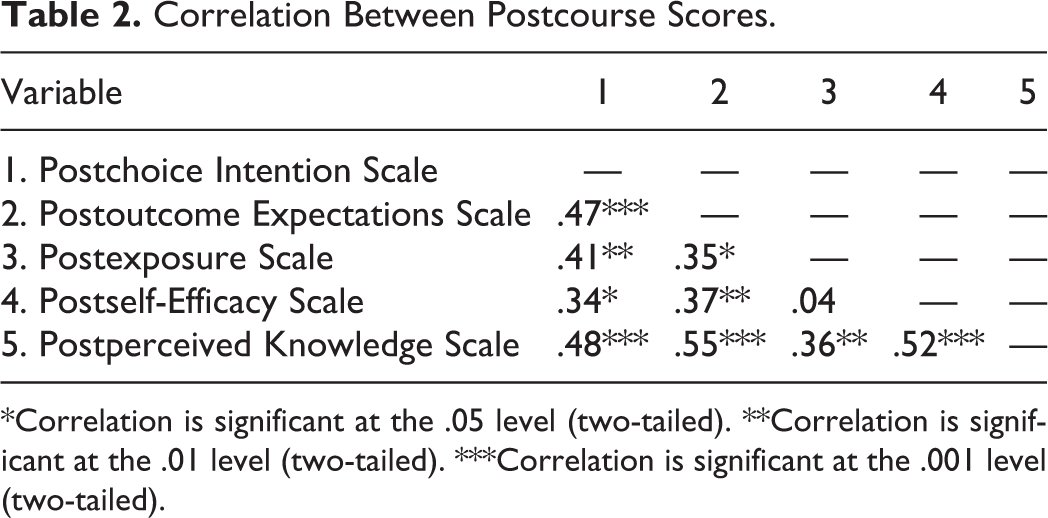
*Correlation is significant at the .05 level (two-tailed). **Correlation is significant at the .01 level (two-tailed). ***Correlation is significant at the .001 level (two-tailed).
Descriptive Statistics for Measures and Gain Score.
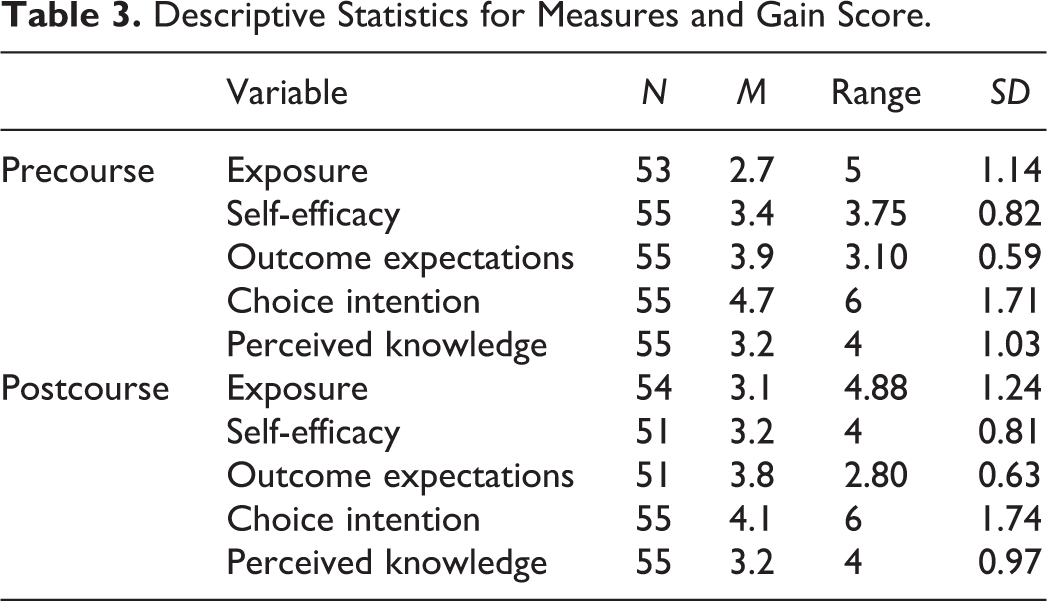
Due to not finding a significant increase in students’ pre- and postperceived knowledge of school psychology, we assessed participants’ knowledge of school psychology using the Demonstrated Knowledge of School Psychology Scale. A t test revealed no significant difference between pre- and postmeasures of actual school psychology knowledge (t = .369, df = 46, p = .714). Additionally, to better understand differences based on minority status, we conducted a multivariate analysis of variance with minority status as the between-subject factor and postcourse scale scores as the dependent variables. Regarding postcourse scale scores, racial/ethnic minority students were found to report significantly higher choice intentions for school psychology than nonminority students, F(1, 46) = 18.30, p < .001,
Discussion
This study is the first to use a short-term longitudinal design to directly examine the extent to which undergraduate psychology coursework influences students’ intentions for entering the field of school psychology. Our study contrasts with prior research that has been largely descriptive, retrospective, or focused on data collected at a single time point (Bocanegra, Gubi, et al., 2016; Bocanegra, Newell, et al., 2016; Bocanegra et al., 2017). Moreover, this study explored whether students from minority backgrounds reported different levels of interest and/or beliefs about school psychology, as compared to students from nonminority backgrounds. Our results contribute to the literature on minority and nonminority recruitment and strongly suggest that current recruitment practices (i.e., passive recruitment of undergraduate psychology students) should be revisited.
The results from the current study indicate that overall, students enrolled in Professional Psychology did not report significant increases in exposure, self-efficacy, outcome expectations, or choice intentions for school psychology, which supported our hypothesis. However, we also found no significant changes from pre- to postcourse on knowledge measures (neither perceived nor actual knowledge). This was surprising, given that participants were enrolled in a course designed to explore different career opportunities in professional psychology.
Interestingly, and unexpectedly, in our study, racial/ethnic minorities reported significantly greater choice intention for school psychology than nonminorities. This finding is important due to the historical dearth of racial/ethnic minorities in school psychology and the association of exposure, choice intention, and entering school psychology. Researchers should attempt to reproduce this finding to determine its generalizability and, if supported, to better understand its implications for increasing minority representation in the field.
Limitations
Although the sample size was adequate, replication research is needed to examine these findings across additional universities and regions of the United States before making broad generalizations from the findings. Furthermore, future studies should follow students over several years to better identify the relationship between the variables of interest and choice action (i.e., did they actually choose and enter a school psychology graduate program). Lastly, the current study did not evaluate all constructs within the SCCT framework. Future research should investigate the applicability of this framework for understanding the recruitment of undergraduate and minority students.
Implications
These findings have several important implications for the profession of school psychology. Specifically, school psychology leaders should collaborate with undergraduate psychology instructors to increase students’ exposure to school psychology. This could be accomplished by increasing the presence of school psychology in courses designed to introduce students to career pathways in psychology. For example, the NASP offers premade materials (e.g., PowerPoint presentations and brochures) designed to introduce advanced undergraduates to the profession of school psychology (available at nasponline.org). In addition to using these prepared materials, instructors can invite school psychologists to deliver guest lectures on the profession.
Instructors of professional psychology courses can also adapt and utilize resources designed specifically for undergraduate school psychology courses. Similar to courses in other areas of professional psychology (e.g., clinical psychology), school psychology courses are designed to provide a broad overview of the profession to advanced psychology majors and have become increasingly popular in undergraduate institutions (particularly those that house school psychology graduate programs). Sample syllabi, assignments, and course materials for these courses can be found in NASP’s Graduate Educators’ Community Library. In addition to these materials, several recent publications have provided guidance on the development of undergraduate school psychology courses as well as recommendations for accessible classroom activities for advanced psychology majors (e.g., Grapin, Bocanegra, & Schilling, 2016; Schilling, Grapin, & Hyson, 2016).
Due to the critical role that school psychologists can play in helping to ensure our youth’s academic, emotional well-being, and school safety, it is imperative that current recruitment practices be revisited and that school psychology and undergraduate psychology trainers work together to help overcome this crisis. According to the present study, a reliance on traditional undergraduate coursework may not be sufficient due to a potential lack of inclusion of school psychology. Although other factors likely impact the shortage, the lack of exposure to school psychology appears to play a role in students’ intentions to pursue a career in school psychology. Moreover, we speculate that this effect is magnified when coupled with a predominant focus on other professional psychology types.
Nevertheless, numerous reasons could be posited as to why the field of school psychology may be underrepresented in undergraduate education, such as its relatively smaller size and that most school psychology trainers teach at the graduate level. However, we contend that, regardless of the cause, school psychology is a highly rewarding field with a vast amount of professional opportunity. Thus, it is worthy of increased inclusion in undergraduate curricula. Furthermore, an underrepresentation within undergraduate education does not just negatively impact the field of school psychology and K–12 students but also undergraduate psychology students who may never experience school psychology as a viable, and rewarding, career path.
Footnotes
Declaration of Conflicting Interests
The authors declared no potential conflicts of interest with respect to the research, authorship, and/or publication of this article.
Funding
The authors received no financial support for the research, authorship, and/or publication of this article.