




Abstract
The challenge of teaching communication skills outlined in Goal 4 of the APA Guidelines for the Undergraduate Psychology Major is that it occurs in many contexts and the communicator must adapt the form to match both context and purpose. We created a taxonomy of dimensions and kinds of communication that represents the various contexts in communication assignments in psychology classes. We propose a curricular-level solution to assessing the development of communication skill, including multiple assessment opportunities in both course and curriculum with progressively higher standards. We discuss how different forms of rubrics can be used to assess communication and created a “common” rubric that can be adapted and used to assess communication across many different contexts. Finally, since social media have increased the frequency of exposure to often engaging, but misleading or inaccurate communication, we discuss the value of being able to judge the validity of received communications and the importance of teaching students how to evaluate messages critically.
Developing effective communication skills, Goal 4 in the APA Guidelines for the Undergraduate Psychology Major: Version 2.0, hereafter referred to as Guidelines 2.0, is fundamental to achieving the other stated Goals (American Psychological Association [APA], 2013). Specifically, this goal requires students to demonstrate effective writing for different purposes (4.1), exhibit effective presentation skills for different purposes (4.2), and interact effectively with others (4.3). For example, students must be effective recipients of oral and written communication about research findings in order to learn about the key concepts and principles within psychology. They must be able to craft cohesive, persuasive oral and written arguments as part of developing critical thinking skills. They must be able to describe and share their research findings with the rest of the field. They must convince faculty supervisors and institutional review boards of the ethical propriety of their research. Finally, communication skill is essential for professional development and career advancement.
The Importance of Communication
The National Association of Colleges and Employers (NACE) conducts an annual survey of employers to determine what career competencies employers seek most in potential employees. The top four of eight critical competencies have remained the same for the past 3 years: critical thinking/problem solving (4.66), teamwork/collaboration (4.48), professionalism/work ethic (4.41), and oral/written communication (4.30; NACE Staff, 2019). The mean rated importance of each competency, of a possible 5, is given in parentheses, showing how tightly clustered these four competencies are. By comparison, the fifth-rated competency, digital technology is 3.84. While communication is rated fourth, it remains a highly sought after skill, and it is hard to imagine how employees can accomplish any of the top-rated competencies without effective communication skills. It raises the question as to whether NACE is defining oral/written communication differently than is described in Guidelines 2.0. NACE defines oral/written communication as a key career readiness skill in the following way (NACE, n.d.). Articulate thoughts and ideas clearly and effectively in written and oral forms to persons inside and outside of the organization. The individual has public speaking skills; is able to express ideas to others; and can write/edit memos, letters, and complex technical reports clearly and effectively. Students should demonstrate competence in writing and in oral and interpersonal communication skills. Students completing foundation-level courses should write a cogent scientific argument, present information using a scientific approach, engage in discussion of psychological concepts, explain the ideas of others, and express their own ideas with clarity. Students completing a baccalaureate degree should produce a research study or other psychological project, explain scientific results, and present information to a professional audience. They should also develop flexible interpersonal approaches that optimize information exchange and relationship development.
Defining Communication for Psychology
To begin, we need a functional definition of communication for psychology. Our work group considered many definitions, such as the definition used by the National Communication Association (n.d.), “Communication focuses on how people use messages to generate meanings within and across various contexts…” (NACE, n.d.). For our purposes, we settled on the following definition of communication: Dissemination of information such that understanding is exchanged and achieved between participants. Our emphasis is on the desired outcome, a shared understanding among participants. It indicates that creating that shared understanding is the joint responsibility of both parties, the originator and the recipient of the communication. The definition is appropriate for both written and oral communication and for a variety of contexts, from one-to-one conversions to large group interactions and from formal technical communication to informal social media messages.
Goal 4 of the Guidelines 2.0 has three subgoals for communication. They are:
4.1 Demonstrate effective writing for different purposes
4.2 Exhibit effective presentation skills for different purposes
4.3 Interact effectively with others
Consistent with our definition of communication, the subgoals state that students should learn both oral and written communication and that they should learn both individual and group communication. Moreover, the communication should be tailored for different purposes, ranging from full APA style reports to short descriptions of assessments and concise memos to colleagues. Effective communication varies by purpose, audience, and context, and students must learn how to identify and adapt their communication to fit the demands of a specific situation.
The Contexts of Communication for Psychology
To teach students communication skills for psychology, we must specify the relevant contexts in which students will need to learn how to communicate effectively. Our work group specified four dimensions in which communication context can vary for students of psychology: role, mode, purpose, and target of the communication. Each of these dimensions contains specific categories (e.g., for mode of communication, oral, written, and nonverbal). The four dimensions and their categories are listed in Table 1. The categories across the four dimensions can be combined into any grouping, thereby creating a 2 × 3 × 7 × 5 matrix and a wide variety of communication contexts. We now consider each dimension.
Dimensions of Contexts for Student Communication With Their Categories.
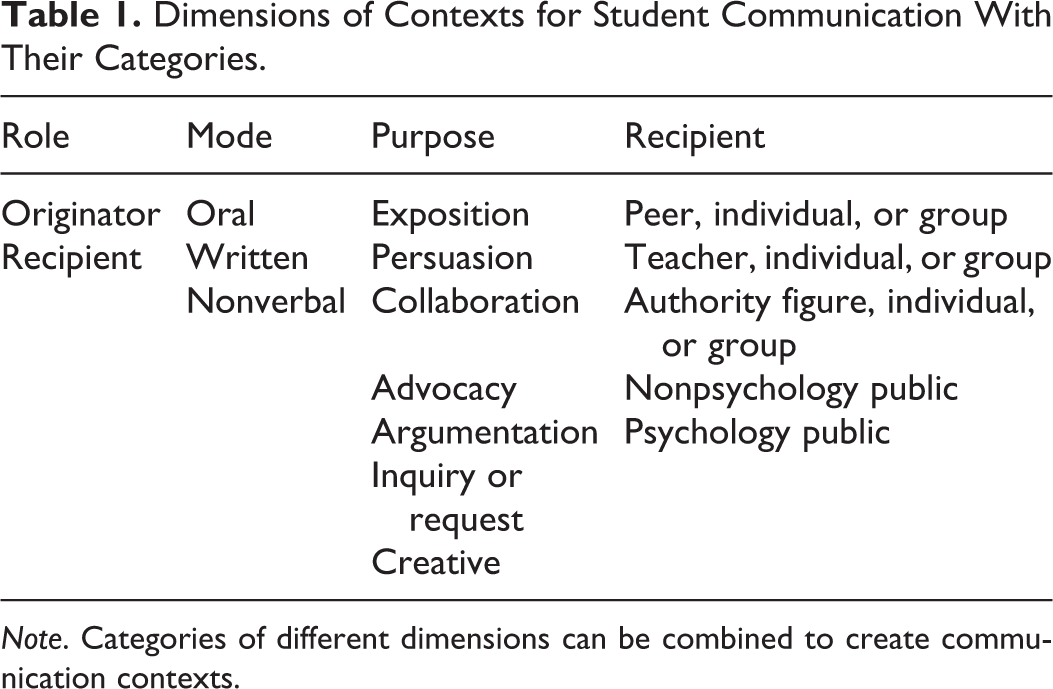
Note. Categories of different dimensions can be combined to create communication contexts.
Role refers to the student is either the creator or the recipient of the communication. The creator must construct a communication that is accurate, complete, and comprehensible. The recipient must decode the communication and correctly fill in any missing or implicit information. It is up to the recipient to formulate or ask questions to provide missing, critical information or to reduce uncertainty or ambiguity.
The mode refers to whether communication is written or oral, both of which are considered verbal, and nonverbal communication such as facial expression and body posture. Singer and Goldin-Meadow (2005) showed that the nonverbal gestures that a teacher produces during explanations can affect student learning.
The purpose of the communication is broken down into seven overlapping categories. Exposition involves conveying or reporting information, such as writing a lab report or a literature review on a given topic. Persuasion involves using evidence or reasoning to argue for one particular viewpoint over others. For example, a group of students may meet with their teacher to persuade her to extend the deadline for an assignment because they need more time to do a good job. Collaboration is for sharing information with a group so that everyone in the group will have a common understanding. The communication should promote group cohesion and unity of purpose. Students working on a group research project communicate with each other to coordinate their efforts.
Advocacy involves both convincing people of the rightness of a cause and motivating people to act in support that cause, moving beyond persuasion to promoting action. It is typically used for matters of public policy. A group of psychology students, for example, might send an email to the college president explaining the need for expanding mental health care services on campus.
Argumentation involves the careful consideration of evidence that supports or refutes a particular thesis. This form of writing is marked by careful considerations of evidence and strength of argument. For example, a teacher assigns students to write a research-based essay on the pros and cons of using standardized test in education, but they must conclude the paper by using the evidence to argue for or against their use. This category covers scholarly articles that examine complex and controversial issues and champion a particular viewpoint.
Inquiry has to do with formulating questions for information and clarification. A simple example is writing to a faculty member asking about the possibility of conducting research with them. Inquiry-based communications can have powerful effects on student learning and critical thinking (e.g., Alexander et al., 2010).
Finally, creativity involves speculation or innovative thinking and serves a learning or scholarly goal. For example, in order to help students understand the differences between behaviorist and cognitive perspectives on development, a teacher might assign an essay in which students create a hypothetical discussion between John Watson and Jean Piaget. For a developmental psychology class, the teacher may require students to compose a fairy tale that teaches children how to recognize and deal with anger to help the students learn about emotion development and regulation.
The recipient of the communication refers to the student’s intended audience for the communication. The recipient consists of two components that can be addressed with two questions. First, is the communication one-to-one or one-to-many? Second, what is the status of the recipient? For example, is the communication intended for a classmate or an authority figure? In the course of their classes, students will conduct interpersonal communications with peers and teachers. Students often have to communicate outside of the classroom to people who have higher authority or status, such as college administrators or prospective employers whom the student does not know. Students may also write a blog or social media post intended for general viewing by the public This kind of communication is impersonal because the student has no idea who might read it. Finally, psychology students learn to make presentations and write research papers according to professional standards These papers can be for a general audience or can be high-level technical reports for psychological researchers and professionals.
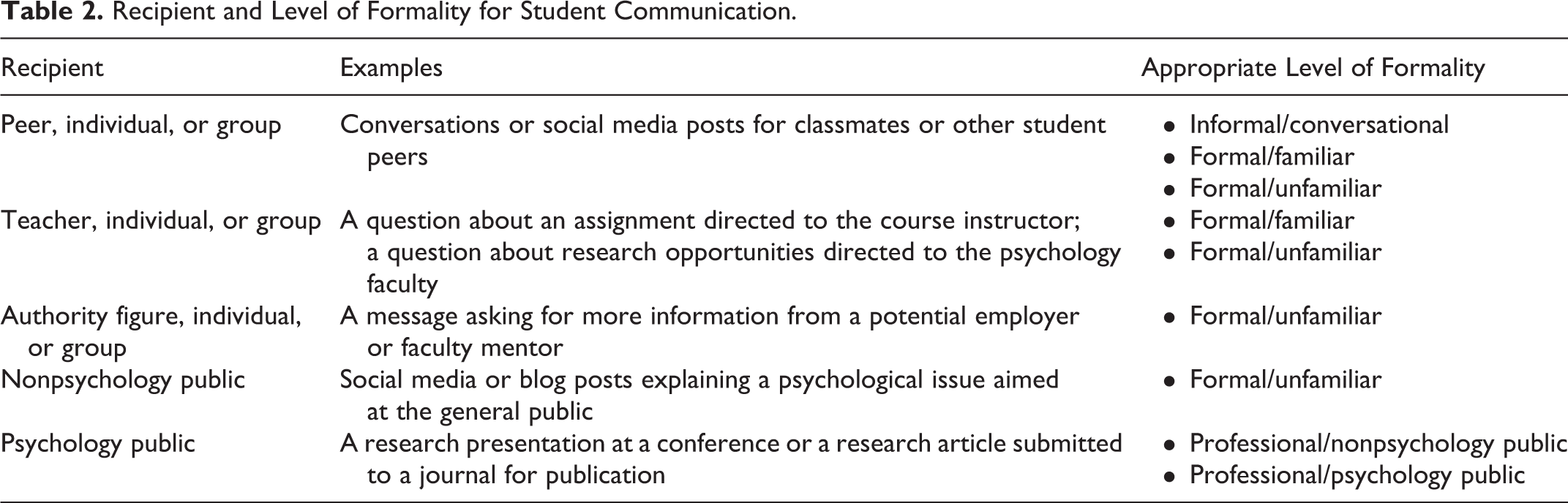
In communication, students must consider the appropriate level of formality for the recipient. Formality refers to the level of etiquette that is expected due to the status, prestige, or position of authority of the recipient. Formality is not a dimension of context, but it is critical for effective communication. Table 2 lists the appropriate level of formality for each category of recipient with examples. Peer to peer communication can often be informal with use of slang and abbreviations. Messages to an instructor, however, require more formal communication etiquette that indicates deference to the teacher’s position of authority. A student should not send an informal, interpersonal message intended for a peer to a teacher. We refer to the level formality for communications between students and their teachers as formal/familiar because there is a level of familiarity between them. Formal/unfamiliar communication occurs when a student makes contact with an authority figure who has no preexisting relationship to the student. For example, a student might reach out to a researcher at another institution who is doing work of interest to the student to inquire about research opportunities. The last two levels of formality are professional/nonpsychology public and professional/psychology public. Both of these involve formal writing for the public beyond the psychology program. For professional/nonpsychology public, the student is writing for a general, nonpsychology audience. An example might be a blog post or an article in a newspaper or magazine. Professional/nonpsychology public refers to psychology-specific, disciplinary writing, such as writing research reports or journal articles in APA style. The category covers class research papers and presentations, conference research posters, and journal articles.
Recipient and Level of Formality for Student Communication.
Key Contexts
To be effective, communication has to be adapted to a particular audience, purpose, and context (van der Vleuten et al., 2019). Some of the contexts outlined in Table 1, such as writing argumentative essays for a general audience, are taught throughout secondary school. Most psychology students, however, have little to no training in the most critical communication contexts within the field. Rather, students learn and master these forms of communication during their undergraduate courses. Here are some of the most important contexts. Originator—oral—exposition—psychology/public
This combination describes oral research presentations before psychology faculty and researchers at a meeting or conference. Originator—written—expository or argumentative essay—psychology/public
This combination represents a research report written in APA style. This can be a research paper for a class or a scholarly manuscript intended for journal publication. Originator—written—expository or inquiry—interpersonal/teacher
This combination involves communication with a teacher. Students should address teachers with respect and not as peers. Originator—written—expository or inquiry—peer or nonpsychology/public
This combination refers to social media posts, blog posts, or public messages. Once posted, these messages live on forever. If they are crude or cruel, they can affect a student’s future employment and educational opportunities.
Communication occurs across many contexts and takes many forms, but the most effective communication is adapted to the context. Effective communicators can express the same message in multiple forms in order to suit the specific purpose and context. Some contexts are especially important for psychology students, such as writing formal papers in APA style, and these tend to be the focus of instruction in courses. Students, however, should have an understanding of how to tailor communication to a context to optimize the likelihood of communication success and to modify communications in the face of feedback about how a message is being received. In the next section, we discuss how students develop such communication skills within the psychology major.
Principles for Developing Communication Skills
Writing well is a complex skill that takes years of practice to develop. Writing well for psychology contexts is even more specialized. Students develop general expository writing skills throughout secondary schooling, but the level of writing skill and experience varies greatly. Most students will take one or two writing composition courses in college that will further emphasize general writing ability. Psychology courses typically introduce students to technical writing using APA style for research reports. Whereas some undergraduate students have experience with in-text citations and references in APA style, few have experience with writing whole APA style manuscripts. Thus, advanced psychology courses such as Research Methods are often students’ first experience with technical writing in comprehensive APA style. Such writing can prove counterintuitive and challenging for students. The same situation holds for making oral research presentations. Students may have experience and training in making general presentations, but little experience making formal research presentations. Psychology students learn to tailor communications across a wide variety of situations, but technical reports and presentations in APA style present a significant learning challenge.
The best approach to developing communication skills in psychology majors takes a curriculum-level approach. Instruction in various forms of communication should be distributed across multiple courses in the curriculum (van der Vleuten et al., 2019). Developing these communication skills should be an integral part of the curriculum so that they are inescapable, and the standard for good communication should be progressively more sophisticated in higher level courses.
To help students develop communication skills, students should receive timely, constructive feedback on their writing and speaking. At least one advanced psychology course should feature a major instructional unit on writing journal articles in APA style and making formal research presentations. Major writing assignments and oral presentations should be common within the psychology curriculum. At least one course should require a draft of a paper in which students receive feedback and then are required to revise the paper based on feedback and to resubmit it for grading. Finally, at least one course should include instruction on plagiarism and proper citing of sources.
Development of writing skill in psychology is more than applying APA style conventions correctly. Effective writing skill depends on three related concepts: metacognition, self-regulation, and self-efficacy. LaVaque-Manty and Evans (2013) implemented metacognitive interventions that made students reflect on their own writing processes. These interventions focused on planning, choices in writing strategy, and evaluation of writing such as what strategies had been useful. Using a metacognitive intervention, they found that student writing became more complex and reflected more critical thought. Negretti (2012) conducted a longitudinal study of writing development across a course. She used reflective journals to promote metacognitive awareness during the writing process. Negretti found that, initially, students were concerned with meeting the requirements of assigned papers such as length and due date. Over four assignments, however, students became increasingly focused on the audience and the ideas they were trying to express. Negretti concluded that the metacognitive reflection helped students develop more sophisticated writing skill and promoted self-regulation of writing. Taken together, these studies show that instruction in writing should not be focused solely on use of correct grammar and APA style but emphasize these larger concepts as well.
The cycle of planning goals, choosing and executing a strategy, evaluating the outcome, and then repeating the cycle if the final goal has not yet been met is strikingly similar to the stages of self-regulation in writing. de Milliano et al. (2012) studied struggling writers and found that those who engaged in more self-regulatory activities, particularly in the initial planning phase before writing even began, showed greater improvements in writing quality. Zimmerman and Risemberg (1997) described three kinds of self-regulation needed for effective writing. Covert regulation has to do with regulating one’s emotions, such as anxiety. Cognitive self-regulation has to do with mental strategies for writing such as setting goals for a writing period. Finally, environmental self-regulation has to do with structuring the environment to support writing, such as reducing noise and eliminating distractions. An effective writer is able to accomplish all of these things.
Metacognitive and self-regulation interventions are linked to the concept of self-efficacy in writing. Bruning et al. (2013) developed writing self-efficacy measures for students based on three components: generating ideas, expressing those ideas using accepted writing conventions, and successfully managing writing decisions and behaviors. The last component is essentially self-regulation of writing. Bruning et al. found that self-efficacy, when measured this way, correlates with self-reported writing performance.
Taken together, the research suggests emphasizing the importance of planning what one wants to accomplish by writing, selection of optimal writing strategies, and evaluation and reflection on what has been written. If the evaluation falls short of the planned goal, then the cycle repeats with possible modifications in the strategies used until the desired goal is achieved. Teachers should emphasize, model, and support the development of metacognition, self-monitoring, and self-efficacy in learning to write.
Assessing Communication Skills
To assess the development of any skill, multiple points of assessment can guide teaching. The use of formative assessments (i.e., quick, low-stakes activities designed to give both student and teacher feedback about the student level of understanding) should be routine, with the results being used to help teachers shape pedagogy and help students to calibrate learning strategies (Clark, 2012; Yin et al., 2008). A high-stakes exam or research paper should never be the first time a teacher has assessed student learning.
Communication, like all skills, has a developmental trajectory over time (van der Vleuten et al., 2019). What qualifies as an acceptable standard of communication for first-year undergraduates may be considered deficient for a graduating senior. Even within the same class, students should show progress in skill development. Each revision of a paper should be an improvement over the last one. Assessments of skills such as communication should ideally occur both across the time line of a specific class and across the time line of a curriculum. Teachers should employ a progressively higher standard in more advanced classes.
Assessment, then, must take multiple forms. For example, it would be inappropriate to use an assessment for an informal communication such as a blog post to evaluate a manuscript written for publication. The notion of developing an assessment for every possible context for communication is daunting, especially if one wants the assessment to have strong psychometric properties. Teachers cannot wait for such assessments to be developed; they have to find assessments they can use now. The good news is that many assessment tools have already been created and many of them are freely available. These assessments range from formal assessments with documented psychometric properties to utilitarian assessments developed and used by teachers that can only claim face validity. But even utilitarian assessments, used with appropriate caution, can be helpful to student and teacher and better than no assessment or inappropriate assessment. When selecting an assessment, teachers should be aware of both the psychometric history of the assessment and its alignment with the teacher’s learning goals for the class. One final consideration is that unexpected outcomes often arise during assessment. Assessments should be flexible enough to accommodate these unexpected outcomes. For example, in grading the Results section of a research report, the teacher may find the section well-written but discover that the student did not understand the statistical methods used or came to an erroneous conclusion. The assessment tool must allow the teacher to take that into account.
For psychology teachers new to assessment, a good place to start is the APA Assessment Guide for Psychology Teachers (Halonen et al., 2018), which is available for free download at the link in the references. The guide was written for high school psychology teachers, but the information is germane to teachers at any level who would like a comprehensive introduction to assessment.
Teachers may prefer to use standardized measures of communication competence. Several measures of interpersonal communication competence have been developed for different groups (e.g., Rubin & Martin, 1994). Interpersonal communication competence is a person’s ability to manage all the factors that contribute to effective communication, such as self-disclosure, empathy, and expressiveness.
Teachers should also be aware of two other valuable assessment resources. The first is the APA Project Assessment website (http://pass.apa.org/). Access to the resources on the website is free with registration. This website was established as part of the APA Summit on National Assessment of Psychology, held in 2016. Project Assessment is a collection of assessment activities and resources keyed to Guidelines 2.0. The second resource is a set of rubrics created by the Association of American Colleges and Universities (AAC&U, 2009) called the Valid Assessment of Learning in Undergraduate Education (VALUE) rubrics. AAC&U developed the VALUE rubrics as part of their Liberal Education and America’s Promise initiative (Rhodes, 2010). The VALUE rubrics can be downloaded at https://www.aacu.org/value-rubrics with free registration with AAC&U. The two VALUE rubrics of interest for our purposes are the ones on written communication and oral communication.
Rubrics for Assessing Communication Skill
Assessment of learning relies heavily on rubrics, and assessment of communication skill is no different. A rubric lays out criteria and expected levels of performance for evaluating student work (Halonen et al., 2018). Rubrics make teacher expectations explicit for students. For example, they can show point values or percent weighting for different criteria, which reflects the priorities of the assignment. Teachers can also use rubrics to provide formative and summative assessment of student work and to make grading more efficient and uniform. Each of these general benefits of rubric use can also enhance the quality and effectiveness of assessment of communication skill in psychology.
Selection of criteria that are valid and comprehensive is key to the utility of a rubric (Brookhart, 2018) as well as the starting point for rubric development. Table 3 shows common criteria found in many rubrics for assessing written research reports. The quality of the content is important, but so are the writing mechanics, the proper use of APA style, the organization and coherence of the paper, and the use of figures and tables.
Common Criteria in Written Communication Rubrics.
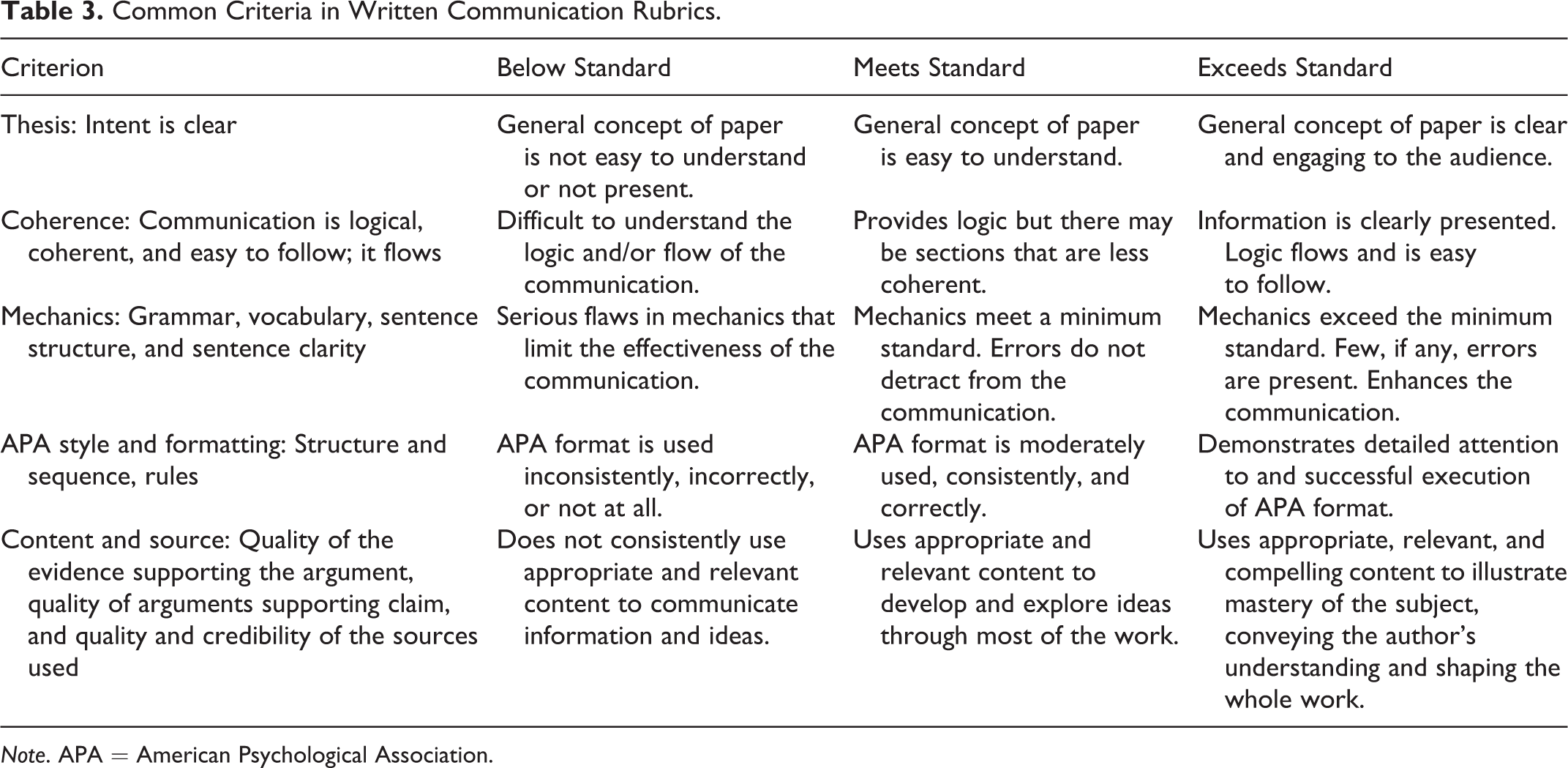
Note. APA = American Psychological Association.
Rubrics can take many forms. They often seen take the form of a two-dimensional matrix of criteria by standard of performance. One dimension represents the grading criteria, and the second dimension represents different levels of achievement. The common rubric in Table 3 takes this form. Each row represents a criterion. Each column represents one of the three levels of achievement: below standard, meets standard, and exceeds standard. The VALUE rubric for written communication uses the matrix format with a slightly different set of evaluation criteria and four levels of achievement. In both the common rubric and the VALUE rubric, each cell in the matrix describes the characteristics of that particular criterion achieved at that particular level of achievement.
Rubrics can also take the form of checklists of criteria with point values or weightings. Supplementary Table S1 shows a checklist rubric with point values for each component. In many ways, the function of the rubric, for formative assessment or for grading, dictates its form and composition. The VALUE rubric for written communication might be most useful for guiding student writing and formative assessment, but teachers may find it cumbersome to use for summative grading. A checklist rubric, such as the one shown in this Supplemental Table, may be easier to use for grading. It breaks down each element of the written paper and assigns points to be awarded for each criterion.
A single-point rubric for assessing written papers is shown in Supplementary Table S2. The single-point rubric has gained popularity as somewhat of a compromise format (Halonen et al., 2018). For each criterion, there is only a single point of adequate achievement, with the option of indicating whether a student has achieved that level, exceeded it, or fallen short of it. This single-point rubric can be used for formative and summative assessment and also has point weightings that allow it to be used for grading purposes. APA Project Assessment has a collection of single-point rubrics in the unit called AA Written Assessments Using Single-Point Rubric.
Ideally, assessment within a course is aligned with student learning outcomes, curricular goals, university goals, and disciplinary goals. The same assessment used to give students feedback can also be used for grading and for college-wide assessments of student learning. In reality, the rubric format that is best for guiding students through the writing process may not be the best one for reporting overall student learning for accreditation purposes. Student work may have to be graded using different rubrics for different purposes. Supplementary Table S3 contains an example of a checklist rubric used by the psychology faculty at Samford University to assess oral research presentations. This rubric is not used for formative assessment, but it is a summative assessment for reporting student progress in oral communication for college-level accreditation purposes. For a checklist rubric with different criteria for assessing oral communication, see Aryadoust (2015). For a matrix format rubric for assessing oral communication, see Schreiber et al. (2012).
Rubrics are in common use, with freely accessible collections of rubrics such as Project Assessment and the VALUE rubrics. If the rubrics discussed here are not adequate, teachers can find rubrics online that can be adapted to their purpose, which saves the time and effort of creating new rubrics. See Halonen et al. (2018) for more on rubrics and how to construct them.
APA Project Assessment
APA Project Assessment has multiple units for developing and assessing oral and written communication skills across multiple contexts. Supplementary Table S4 organizes these units according to their purpose. Section 1 of the table lists student writing assignments. These assignments cover different kinds of writing. A grading rubric is generally included with each individual writing assignment. Section 2 lists activities that involve oral presentations. Once again, there is a variety of contexts represented where students must give oral presentations, and scoring rubrics are often included in the activity. Section 3 lists rubrics for assessing oral and written communication. This section includes assignments that have assessment rubrics that can be adapted and used for a variety of assignments. Section 4 has assignments to help learn APA style. Although only one assignment is currently listed here, APA Project Assessment materials are regularly updated. Teachers who have created assignments for developing and assessing communication skill should consider submitting their assignments for sharing on the APA Project Assessment website.
With the release of the new seventh edition of the APA style manual, APA has provided a website of resources to help learn APA style. They can be found at https://apastyle.apa.org/apa-style-help. In addition, many helpful examples can be found at the APA style blog at https://apastyle.apa.org/blog/. The Society for the Teaching of Psychology website is another good source of communication assignments. Look under the Teaching of Psychology Idea Exchange, which can be found at http://topix.teachpsych.org. Keep in mind that all these activities were created under the sixth edition of the APA style manual and the assignments may have to be modified for changes in the seventh edition.
Evaluating Received Communications
This chapter on assessing communication skills has focused primarily on producing effective communications for the comprehension of others. This emphasis reflects the historic priority of academia, how to write and speak well. In recent years, however, deep concern about a different issue related to communication has emerged, that of being influenced by communications that are misleading or contain misinformation. In such cases, students are the recipients of false, misleading, or careless communications. The influence of misinformation is not new in psychology, but the prevalence of social media and its intentional use to distort and mislead has made the issue an important and pressing concern for teachers and students alike.
Recent research shows the magnitude of the problem. Cook et al. (2015) found that misinformation can be hard to correct and efforts to correct mistaken beliefs can actually backfire and strengthen the mistaken belief. More recently, Breakstone et al. (2019) found that high school students were easily misled by doctored social media posts. The majority accepted social media posts at face value and were poor at evaluating the validity of websites. De keersmaecker et al. (2020) found that the more people see misinformation repeated, the more likely they are to judge the misinformation as true, and this illusory truth is robust over different cognitive styles. Still, people believe they are good at spotting “fake news.” Jang and Kim (2018) studied the third-person effect, the fact that people think that others are influenced by misleading social media messages but they themselves are not. They found strong evidence of the third-person effect as a function of political affiliation. Members of each party believed that members of the other party were more susceptible to fake news than members of their own party, and they felt they personally were less susceptible than anyone else.
In short, the deluge of information in a networked, digital world has revealed an important concern, how do we train students to be critical recipients of communication?
To see past dazzling, engaging messages and evaluate the validity of the content? People do not seem to be good at making judgments of validity, but the problem is that they think they are good at it, or at least better than others. Goal 4 of Guidelines 2.0 and high-quality assessment related to developing effective communication skills can help teachers address such societal and cognitive pitfalls. For now, this work is in its infancy and deserves to be the subject of intense research interest in the future.
Concluding Comments
In this article, we have established the importance of communication skill as a critical skill for academic, career, and personal success. We have defined communication skill for the psychology major and described the widely varying contexts of communication. Students need to become effective communicators across multiple contexts. Teachers therefore must design instruction and opportunities for students to develop complex communication skills. We have discussed best practices and strategies for assessing communication skill through the use of rubrics. We have described several resources for teachers for both communication assignments and assessments. Finally, we have pointed out the emerging problem of the prevalence of misleading but highly persuasive messages that inundate our lives as never before.
Supplemental Material
Supplementary_materials_for_article_6_--_Chew_et_al - Assessing Goal 4 Communication Skills for Psychology Across Audience, Purpose, and Context
Supplementary_materials_for_article_6_--_Chew_et_al for Assessing Goal 4 Communication Skills for Psychology Across Audience, Purpose, and Context by Stephen L. Chew, Garth Neufeld, Sharon Hamill, Annette Taylor and Salvador Macias in Teaching of Psychology
Footnotes
Acknowledgments
The authors are grateful for the American Psychological Association’s Education Directorate and Committee on Associate and Baccalaureate Education sponsorship of Summit on National Assessment of Psychology.
Declaration of Conflicting Interests
The authors declared no potential conflicts of interest with respect to the research, authorship, and/or publication of this article.
Funding
The authors disclosed receipt of the following financial support for the research, authorship, and/or publication of this article: Additional resources were provided by grants from the National Science Foundation (Division of Undergraduate Education, award number 1622982), the University of Wisconsin–Green Bay, American Psychological Association’s Board of Educational Affairs, Society for the Teaching of Psychology, Psi Chi, and Psi Beta.
Supplemental Material
Supplemental material for this article is available online.
References
Supplementary Material
Please find the following supplemental material available below.
For Open Access articles published under a Creative Commons License, all supplemental material carries the same license as the article it is associated with.
For non-Open Access articles published, all supplemental material carries a non-exclusive license, and permission requests for re-use of supplemental material or any part of supplemental material shall be sent directly to the copyright owner as specified in the copyright notice associated with the article.
