



Abstract
Introduction:
In the past decade, use of screen media has increased dramatically among young adults.
Statement of Problem:
Mounting evidence suggests that high levels of media use are associated with a range of negative psychological outcomes.
Literature Review:
We present instructions for a four-day electronic media fast assigned in a course module on positive psychology. Drawing from student accounts and direct classroom observations, we illustrate student experiences that suggest substantial positive changes in learning, media habits, and well-being.
Teaching Implications:
An electronic media fast is an easily implemented class assignment which enables students to reflect on their media use and make adjustments to support their learning and well-being. It is appropriate for use in a range of undergraduate psychology courses including introductory psychology, social psychology, psychology of adolescence, and positive psychology.
Conclusion:
When undertaken with a flexible, sensitive, and collaborative approach, a media fast can be a powerfully transformative learning experience.
Keywords
In the past decade, the influence of electronic media has skyrocketed in the lives of young people. According to the Pew Research Center (2019), 96% of 18- to 29-year-olds own a smartphone (www.pewresearch.org/internet/fact-sheet/mobile/). A recent study undertaken by the advocacy group Common Sense Media found that teens (aged 13–18) spend an average of over 7 hours a day in front of screens, including computers, tablets, smartphones, e-readers, video game consoles, and televisions (Rideout & Robb, 2019). Mounting evidence suggests that high levels of electronic media use are associated with a wide range of negative outcomes, including sleep disruption, emotional dysregulation, impaired academic performance, and depression (Dunckley, 2015; Elhai et al., 2016, 2017; Lee et al., 2017; Lemola et al., 2015).
Several recent studies suggest that media fasts can have a positive impact on well-being. In a study of pre-service teachers, Damico and Krutka (2018) asked participants to give up a social media platform (e.g., Facebook, Instagram) and/or a device (e.g., cell phone, laptop) of their choice for 24–48 hours. Qualitative analyses of participants’ reflection papers indicated a largely positive impact on social interactions, emotional states, and productivity. In a large-scale quantitative study, the Facebook accounts of over 2,000 users were deactivated for four weeks in 2018, leading to small but significant increases in well-being (Allcott et al., 2020).
In this article, we present an exercise developed by the first author in which students fast from electronic media for 4 days as part of a course module on positive psychology in order to deepen learning and support well-being. Similar to the studies cited above, this was not a “cold turkey” fast in which people avoid screen media completely. Rather, the fast refers to a significant reduction in media use.
We use a transformational teaching approach, which is defined by Slavich and Zimbardo (2012) as the creation of “dynamic relationships between teachers, students, and a shared body of knowledge to promote student learning and personal growth” (p. 569). Within this approach, the media fast is an example of experiential learning, defined as “promot[ing] learning by having students engage in, and reflect on, personal experiences” (Slavich & Zimbardo, 2012, p. 573). A growing body of evidence indicates that experiential learning can improve academic performance and depth of understanding (Richmond et al., 2017; Richmond & Kindelberger Hagan, 2011; Yoder & Hochevar, 2005). The assignment is linked to course concepts from positive psychology including mindfulness (Shapiro & Carlson, 2009), self-compassion (Germer, 2009), flow (Csikszentmihalyi, 1990), attention restoration (Kaplan & Kaplan, 1989), goal setting, and social connection (Lyubomirsky, 2007). This exercise could be readily adapted for use in a range of undergraduate psychology courses including introductory psychology, social psychology, and psychology of adolescence, as well as in other college and high school courses.
The assignment is designed to benefit the well-being and personal growth of students by increasing their awareness of the role of media in their lives, providing breaks from the negative outcomes associated with excessive screen time, and presenting a process by which they might consciously alter their media use in the future. In this article, we (1) describe the electronic media fast class assignment, (2) illustrate a range of student experiences with the assignment through quotes taken from reflection papers, and (3) draw from these accounts, and firsthand observations of the class, to share suggestions for making the assignment a successful learning experience.
Overview
Students in a required lower division psychology class, psychology of self-discovery, are asked to choose four consecutive days within a one week time frame for their fast. During this time, they are instructed to refrain from or minimize the use of screen media beyond what is needed for school, work, basic communication, and other responsibilities. Within these broad parameters, they are asked to set their own specific personal goals. The fast is intended to be challenging, yet feasible and attainable. Approximately one week after the fast, the students write a four-page paper reporting on their experiences and employing course concepts to reflect on them. See Open Science Framework Materials (Gomes, 2020) for a full description of the assignment.
Guidelines and Instructions of the Media Fast
Goal Setting
Prior to the fast, class time is set aside to present several course-wide goals including (1) removing electronic devices from the ongoing stream of daily life (such as when walking on campus, waiting for class to start, or spending time with friends); (2) avoiding multitasking and random web surfing and scrolling; (3) minimizing or eliminating social media such as Snapchat, Instagram, and Facebook; and (4) setting clear boundaries around phone use (such as designating specific times and places to check messages).
Students then participate in an in-class writing exercise in which they reflect on and set additional personal goals for the fast, including both behavioral goals (specifying what to include in the fast) and outcome goals (identifying the benefits they hoped to derive from fasting). See Open Science Framework Materials (Gomes, 2020) for a full description of the writing exercise and examples of behavioral and outcome goals. In discussion groups, students consider their intentions in light of Lyubomirsky’s (2007) distinction between approach goals (moving toward a desired outcome) and avoidance goals (moving away from an undesired outcome). Lyubomirsky summarizes evidence that approach goals are typically more effective than goals based on avoidance. The process of reflecting on intended benefits allow students to reframe the process in terms of approach goals.
Honesty and Trust
Asking students to set their own personal goals is intended to encourage their motivation and cooperation. Mutual trust between instructor and students is further supported by giving clear but flexible guidelines and acknowledging that lapses do occur. We find it helpful at the outset of the fast to introduce the concept of self-compassion (Germer, 2009). Students are encouraged to take a lighthearted approach and be gentle with themselves when encountering lapses, setbacks, or unexpected challenges. The media fast process is designed to foster an atmosphere of open communication and to minimize temptations to cheat or exaggerate. Reflection papers are graded credit/no credit to minimize grade pressure and emphasize intrinsic motivation (Ryan & Deci, 2000).
Strategies for a Successful Fast
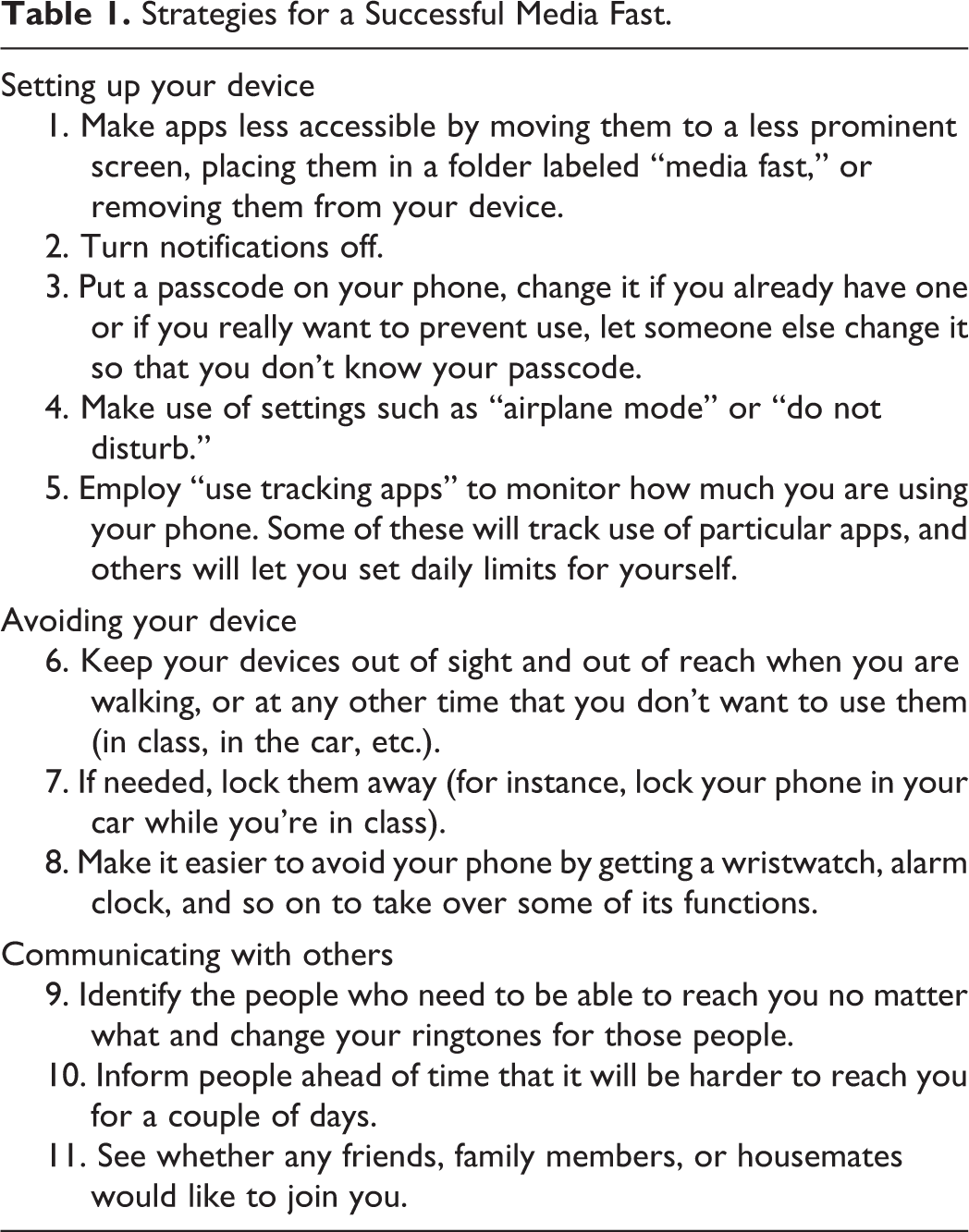
Several strategies for a successful fast are suggested (see Table 1), including those that minimize automatic use (e.g., removing apps from the home page of their phone) and those that make the fast more satisfying (e.g., invite close others to participate with them or plan some fun alternatives for their newfound free time). Students are invited to share suggestions with each other, which often makes for a lively class discussion. The students themselves tend to be very knowledgeable about the latest options available on their devices to track and minimize use, and they enthusiastically exchange ideas for ways to make their devices harder to use.
Strategies for a Successful Media Fast.
Written Reflection and Emerging Themes
Participants included 36 students enrolled in psychology 270, psychology of self-discovery, in spring 2017. Of the 36 students, 22 (19 females and three males) volunteered to have their papers reviewed for emerging themes. Thirteen of the volunteers were White, six were Latinx, and three were multiracial. One student was a sophomore, 13 were juniors, and eight were seniors, with a median age of 22, and an age range of 20–31.
A week after the completion of the fast, students submitted four-page reflections, in which they presented their personal goals, described the highlights of the experience, and discussed what they learned. After reading the original 36 papers, the first author created a preliminary list of themes occurring across papers. The first and second authors independently read the 22 papers of students who agreed to have their papers included. The following quotes were identified by both readers as illustrative of each identified theme.
The nine themes that emerged are organized into three sections: “Phase 1: Beginning the Fast” (experiences that typically occur during the first day of the fast), “Phase 2: The Heart of the Fast” (themes that predominate once the students have settled into the fast), and “Phase 3: Ongoing Impact” (students’ reflections on changes in their relationship with screen media that have the potential to endure beyond the fast itself). Within each theme, relevant literature is introduced that can be used as supplementary learning material when assigning a media fast.
Phase 1: Beginning the Fast
Encountering obstacles: Automatic use and the force of habit
Early in the fast, particularly on the first day, 12 students reported using their devices without fully realizing that they were doing so: “I caught myself holding my phone in my hand ready to look something up without thinking about it” or “Without even thinking about [it] my hand reached into my backpack and took out my phone and before I realized what was happening I was already scrolling through Instagram.” These instances of “automatic use” were often surprising and humbling to the students. They presented an opportunity in class to discuss the power of habit and how to go about changing automatic patterns. Many students responded to these lapses by employing various strategies (e.g., putting their phone on airplane mode, locking it in their car, placing all their apps in a folder and entitle it “media fast”).
The strength of students’ media habits is consistent with research by Hoffman et al. (2012) on the relative strength of habits in people’s everyday lives. In their study of desires that people attempt to resist, media use was the desire that led to the most frequent self-control failures, more than desires for sex, tobacco, food, sleep, or drugs and alcohol, despite the fact that some other desires (such as sleep and sex) were experienced more intensely. Follow-up research suggests that people are more prone to “social media self-control failure” when they (1) think frequently about their social media presence even when off-line, (2) engage in habitual checking, and (3) receive frequent notifications (Du et al., 2019). This research can be presented in class to help students take a self-compassionate attitude toward their instances of automatic use.
Other people’s use of devices
Seven students reported becoming more aware of other people’s use of media. As they were no longer fully participating in the world of media use, they were now struck by how frequently the people around them were engaged with their devices. One student recounted her experience of a birthday dinner she attended during the fast: “There were at least 15 people at this long table…[as] soon as we all sat down, everyone was on their phones. EVERYONE! It was the saddest dinner party I have ever been to.”
Boredom
Without their devices to fill their moments, students encountered newfound free time. As one student put it, “I found myself with an excess amount of time, almost not knowing what to do with myself.” Some realized that they had become reliant on their phones as a way to avoid boredom. Others expected to be bored and were surprised that they weren’t. Speaking of the final day of the fast, one student reported,
That whole day I found myself to be in a reflective mode. I…filled my normal cell-phone use moments with sitting there quietly to observe the surroundings around me. I questioned why I thought this to be boring. What I discovered was I felt this need that I should be doing something every second of the day. It never occurred to me that it was ok to sit and be as is.
Nine of the students mentioned boredom.
Phase 2: The Heart of the Fast
Present-moment awareness
One of the most common themes, mentioned in 14 of the fasting reports, was “present-moment awareness.” Using a range of terms such as presence, sensory awareness, mindfulness, immersion, and flow, many students described these experiences as a hallmark of their fast. These experiences often occurred outside while walking between classes or taking work breaks:
I would close my eyes and use all of my senses to feel what was going on around me…I was becoming aware of the sounds of the birds, and the smell of the grass, and I could feel the wind on my face and I was completely relaxed.
Several students specifically contrasted being “in the moment” with their usual habit of photographing and posting these moments on social media: “As soon as I let go [of] acquiring the perfect picture, I had an amazing time. I realized that the idea of how I looked on the internet was preventing me from being happy in reality.” They often found themselves savoring the moment while in transition:
During my walks from my dorm to my classes, I took my time breathing in the fresh air. Focusing on my breath helped me savor my time being outside and eased my anxiety about not being on my phone. By the time I got to class, I had become so consumed with my breathing and sense of place I forgot about my phone altogether.
The increase in present-moment awareness is consistent with students’ descriptions of heightened well-being, relaxation, calm, and happiness during the fast. The widespread tendency to monitor devices throughout the day, and to turn to them during breaks, may inadvertently lead to a sense of depletion (Kaplan & Kaplan, 1989). By taking opportunities to complete necessary tasks undistractedly, and replacing “tech breaks” with the cultivation of present-moment awareness, the students were refreshing their minds and restoring their emotional well-being.
This process is clearly illustrated by the experience of a student who worked at an emotionally demanding off-campus job:
I work with children with autism who are high on the spectrum and it can be very mentally and physically exhausting…During my fast, I stepped outside during my break for a few seconds and took a deep breath of the fresh air and looked up at the sky and let my mind kind of be empty, instead of scrolling through my phone. I found this to be much more of a beneficial way to clear my mind.
Many of the students were experiencing long periods of uninterrupted attention for the first time in years. These episodes of micro-mindfulness were often deeply nourishing.
Productivity and learning
The media fast provided an opportunity for students to experience “monotasking,” that is, doing one thing at a time (von Pfetten, 2016), particularly in relation to school assignments:
I was able to stay on top of my assignments and get all my work done in a more efficient manner and with a lot more focus…Being able to see firsthand how my mind was affected by this fast was an eye-opening experience. I could feel how focused my mind was while doing my assignments and how the scattered feeling that I usually feel was completely gone.
In the words of another student:
The last day of my media fast…it was almost shocking how quickly I was able to power through assignments…I feel like my mind is a little clearer because I am not thinking about so many things at once or keeping up with social media.
This theme, mentioned by eight students, is consistent with a growing body of research demonstrating that mental focus is undermined by the presence of electronic media, as summarized by Carr (2017) in his essay “How Smartphones Hijack Our Minds.” In classroom settings, he notes, mobile phones disrupt learning through the distractions of “task-switching,” as students text or surf the internet in class. Further, the mere presence of a cell phone, even when ignored, reduces intellectual acuity, possibly because it takes a distracting level of mental effort to resist the pull of a nearby phone. The more distant the phone, the better the performance: when phones were placed in another room, learning improved notably, more than when they were tucked away in a nearby backpack (Ward et al., 2017). Several studies have found significant negative associations between cell phone use and learning among college students (Gingerich & Lineweaver, 2014; Lee et al., 2017; Lepp et al., 2014).
Improved sleep
According to the student participants, improved sleep was another immediate, practical benefit of the fast. Several studies have found an association between electronic technology use and poor sleep when devices are used at night (Christiensen et al., 2016; Demirci et al., 2015; Thomee et al., 2011). In one study comparing e-reading to print book reading at night, subjects using e-readers experienced delayed melatonin release, took longer to fall asleep, and felt less rested the next day (Chang et al., 2015).
For this reason, many of the students specifically limited their media use close to bedtime. Five students mentioned better sleep, longer sleep, or waking more rested: “Normally I wake up a couple of times in the middle of the night, but this time, I was able to sleep through the whole night. It was an amazing feeling the day after.” Mounting research evidence links sleep quality with a variety of psychological outcomes: Adequate sleep is positively associated with emotional regulation, concentration, creativity, and the capacity for learning and remembering new information, and negatively associated with aggression, anxiety, depression, and suicide (Walker, 2017). In fact, among adolescents, disrupted sleep has been identified as a mediating variable between cell phone use and depression (Lemola et al., 2015). For all these reasons, many experts are suggesting that people avoid screens in the hours leading up to bedtime as a matter of basic self-care (Dunckley, 2015; Walker, 2017).
Deepened connections
Without the presence of media, 12 students reported being able to engage more deeply with the people around them. Consistent with research showing that people feel less connected and empathically attuned in the presence of a cell phone (Misra et al., 2014; Przybylski & Weinstein, 2013), they reported better connections with family, friends, and classmates during the fast. In the words of one student, “Not using my phone while with my friends was a way of working on my relationships…I noticed a difference between the conversations that night compared to other times.” Significant relationships were especially enriched. One student invited her boyfriend to participate in the fast with her. As a result, she said, “We ended up sharing things about each other’s past that we hadn’t talked about before, so it felt good to get to know him a little deeper.”
Social awkwardness
In the current social milieu, many people fill quiet moments by using their devices, and it can be socially awkward for a lone individual to refrain from doing so. For example, one student reported that,
Watching other people using technology made it challenging to not do the same thing. I realized that this is part of the problem. Once you see one person on their phone, you feel inclined to copy their behavior in order to avoid the awkward silence.
Another student stated,
What I learned from the media fast was that I tend to use social media in social gatherings like those first awkward moments before class, when I’m waiting in line, and especially when I’m alone at places. I noticed that I use my phone as an escape from the feelings of boredom, awkwardness, and loneliness.
Seven students mentioned this theme.
Phase 3: Ongoing Impact
Interrupting the habit
For some students, the fasting period interrupted the momentum of their media engagement, creating an opportunity for lasting change. In the words of one student, “The desire that I used to have turned from a loud screaming impulse to a faint whisper. The idea of going back to my old patterns and usage of technology did not have the same appeal for me.” Others mentioned being “better able to resist the pull of the screen” or “less entertained by social media.” Another said, “I had gotten used to not checking social media during the day and I feel like I stopped caring. I realized I wasn’t really missing out on much and checking it all day is so unnecessary.” Some expressed less attachment to their phone more generally: “Once I had broken the habit, it became much easier.” This theme, mentioned by 10 students, is consistent with research on the significance of habits, particularly “checking habits,” in driving smartphone use (Oulasvirta et al., 2012).
Reducing media use is particularly challenging due to the demands of daily life, which often require that people engage with screen media, thereby opening the door to more extensive use. Former Google design ethicist Tristan Harris (2017) has pointed out ways that electronic media is designed to capture and hold attention, making it exceedingly difficult to regulate one’s use. This occasionally came up in student accounts, such as the student who stated, “I allowed myself half an hour after my homework to check messages and check out any social media I wanted to. I ended up caving and stayed on my phone for an hour.” It is useful to inform students of the systemic challenges of moderating their use (for instance, by showing Harris’s TED talk in class and following up with a class discussion).
Conclusion
Despite the challenge of asking students to make such a substantial change in the patterns of their daily lives, a media fast can provide a powerfully transformative learning experience. For many students, their initial wariness gives way to positive engagement as they navigate their way through the assignment. In end-of-semester course evaluations, students frequently mention the media fast as one of their favorite aspects of the course. In the words of one student, “Honestly, I wasn’t sure how I felt about this assignment when it was first announced but after completing it, it was one of my most eye-opening assignments yet.”
A flexible, sensitive, and collaborative approach is crucial to the success of this assignment. Patterns of engagement with electronic media are constantly shifting, making it necessary to adapt this exercise to the needs and realities of the moment. For example, “cold turkey” fasts, in which people avoid screen media altogether, became much less viable with the widespread use of smartphones and the integration of computer technology into education. The assignment will be further adapted as the COVID-19 pandemic brings more of our lives into online formats. Currently, evidence is beginning to emerge that implicates heavy phone and internet use in the mental health struggles of children and adolescents in response to the pandemic (Duan et al., 2020). Throughout these societal shifts, the benefits of media fasting, such as increased awareness and more conscious engagement, are more important than ever.
Footnotes
Declaration of Conflicting Interests
The authors declared no potential conflicts of interest with respect to the research, authorship, and/or publication of this article.
Funding
The authors disclosed receipt of the following financial support for the research, authorship, and/or publication of this article: This research was supported in part by a Social Sciences Undergraduate Research Initiative Grant from Sonoma State University.