



Abstract
Intercultural competence—the ability to successfully interact and communicate sensitively with members of other cultural groups—is an essential skill in multicultural societies and an increasingly globalized world. A quasi-experimental study revealed that completing a cross-cultural international psychology course increased college students’ perceived intercultural competence substantially, relative to students in a control (research methods) course. The curriculum included an extensive 10-week Cultural Immersion Project, conducted on campus and in the local community, and weekly experientially based group projects. The course may be especially effective for college students with less prior intercultural experience.
Keywords
Intercultural competence—the ability to interact successfully and communicate sensitively with members of other cultural groups (Deardorff, 2006; Dinges, 1983)—is an essential skill in multicultural societies and an increasingly globalized world (Canfield et al., 2009; Fantini, 2000; Gertsen, 1990). Although there is disagreement among scholars, intercultural competence can be defined as a multidimensional construct that consists of three central components: 1) a cognitive component (e.g., awareness and understanding of cultural differences, knowledge of other cultural groups), 2) an affective/motivational component (e.g., appreciation of cultural differences, positive emotions and attitudes toward other cultural groups), and 3) a behavioral component (e.g., skills and abilities, as well as self-confidence and self-efficacy). Intercultural/cross-cultural competence can be distinguished from multicultural competence by its international emphasis and focus on cultural differences across national groups, rather than within national groups.
Perceived intercultural competence refers to people’s perception of their own ability to interact successfully with members of other cultural groups. Albeit there are individual differences in people’s ability and willingness to report accurately their intercultural beliefs, attitudes, and skills, there is predictive utility in measuring these perceptions (for a review, see Matsumoto & Hwang, 2013). Higher perceived intercultural competence (as assessed with various self-report inventories) is associated with greater cultural adjustment among expatriates (Lee & Sukoco, 2010), more social contact and friendship with culturally different others (Briones et al., 2009; Hammer, 2011), greater knowledge of a host culture (Hammer, 2011), and more positive attitudes toward immigrants (Briones et al., 2009). The focus of the present study was on college students’ perceived intercultural competence.
Teaching Intercultural Competence
In the past few decades, the psychology profession has embraced the goals of teaching intercultural and multicultural competence and of infusing undergraduate and graduate psychology curricula with greater cultural content. The International Union of Psychological Science (IUPsyP) lists cultural competence in its international declaration of core competences in professional psychology (IUPsyP, 2013, p. 12). Goal three of the American Psychological Association’s Guidelines for the Undergraduate Psychology Major (2013), states that college students should be taught skills related to “ethics and social responsibility in a diverse world,” including “learning how individual differences, social identity, and worldview may influence beliefs, values, and interaction with others” (p. 26).
Although the need for greater intercultural competence among undergraduate students in psychology and related disciplines is clear, teaching these skills and acquiring this competence can be challenging (Deardorff, 2006; Mak, 2012). Achieving this goal is particularly difficult for instructors in traditional lecture-based university courses where there may be limited opportunities for students to interact directly with people from other countries (Barden & Cashwell, 2013; Chiodo et al., 2014; Larson et al., 2010). The conventional approach of lecturing about different cultures and countries, without an experiential learning component, may not translate into positive changes in attitudes and behaviors (Arredondo & Toporek, 2004), since exclusively expanding cultural knowledge and beliefs may have the unintended negative consequence of reinforcing cultural stereotypes (Arredondo & Toporek, 2004) and promoting over-generalizations (Deardorff, 2006).
Premised on the “contact hypothesis” and intergroup contact theory (Allport, 1954), attitudinal change and skill acquisition are most likely to occur when people have direct, prolonged contact with others while immersed in a cultural environment that is significantly different from their own (Barden & Cashwell, 2013; Tropp & Pettigrew, 2004). Study abroad and cultural immersion experiences with a residential component (e.g., a home stay with an immigrant family) can provide ideal conditions for acquiring intercultural competence (Dinges, 1983; Earnest et al., 2016; Harmon-Vukić & Schanz, 2012). However, for most undergraduate students, extended international travel is prohibitively expensive and time-consuming, as well as impractical due to family and work obligations (Harmon-Vukić & Schanz, 2012; Nieto, 2006). To illustrate, less than 10% of all college students in the United States study abroad during the course of their undergraduate education (Institute of International Education, 2018).
Albeit presumably less impactful, cultural immersion experiences (CIEs) on campus and in the local community, and classroom-based activities can provide suitable alternative learning opportunities, as indicated by qualitative analyses of students’ reflective journals (Nieto, 2006; Spooner-Lane et al., 2013). Coursework with a significant experiential component is more likely to lead to meaningful and long lasting change in beliefs, attitudes, and behaviors, and generally is regarded as superior to traditional lecture-based methodologies (Lopez et al., 1998; Mio, 1989; Neville et al., 2014). In designing the present course, we sought to include highly engaging experiential activities, including weekly group projects and participation in a 10-week Cultural Immersion Project (described in Appendix).
We are aware of no published study that has tested whether completing an experientially focused cross-cultural psychology course effectively increases students’ perceived intercultural competence, relative to students in a non-culture-related course, using a quasi-experimental design, pre/post measures, and quantitative scales. As such, the present study adds to the literature on cross-cultural psychology education. We predicted that perceived intercultural competence would increase significantly among students in the cross-cultural psychology course, but not the control (research methods) course.
Method
Design
The study employed a quasi-experimental design with condition (cross-cultural psychology; research methods) as a between-participants factor and time (beginning of academic quarter; end of academic quarter) as a repeated measure.
Overview of Courses
The course “Psy 465 Cross-Cultural International Psychology” is an elective, four-credit, upper division course for undergraduate students. The course met 2 days a week for 10 weeks (total of 40 hours of instruction). The course is designed to examine cultural differences in numerous psychological phenomena (e.g. cognition, self, child development, marital and family relationships, emotions, mental/physical health, etc.), primarily contrasting collectivist and individualist cultures. In so doing, the course revisits numerous canonical psychological theories, presenting evidence for cultural variability and/or universality where applicable.
The curriculum consisted of the Cultural Immersion Project, group projects, poster presentations, videos, classroom discussions, and lectures and readings. The Cultural Immersion Project is described in the Appendix and Figure 1. The group projects consisted of student-led presentations (e.g., “Weddings in Five Cultures”), experiential activities, and debriefing discussions. 1 Groups of students (four to five) prepared and delivered 15–20 minute presentations comparing and contrasting cultural practices in different countries (e.g. coming of age ceremonies, holidays, funerals, etc.). The presentations were followed by experiential activities, modeled after those outlined in Goldstein’s (2008) Cross-Cultural Explorations and Seelye’s (1996) Experiential Activities for Intercultural Learning. Readings for the course were drawn from Cultural Psychology (Heine, 2011) and New Readings in Cultural Psychology (Peng, 2004). Course materials, sample group projects, and sample poster presentations are available at the Society for the Teaching of Psychology's resources for teachers website (STP, 2020) and at Cal Poly’s Digital Commons (Spencer-Rodgers, 2020).
The control group consisted of students enrolled in a required, four-unit, upper division psychology research methods course. 2 (No students were enrolled in both the research methods and cross-cultural psychology courses.) This course similarly met for 2 days a week for 10 weeks (total of 40 hours of instruction). The curriculum did not emphasize cultural content. The course was taught by a different instructor; however, both instructors were European American women, in their 40 s, with comparably high student ratings of overall teaching effectiveness in the respective courses (cross-cultural psychology: 4.81/5.0; research methods: 4.88/5.0).
Participants and Procedure
The total sample consisted of N = 43 undergraduate students at a mid-sized public university in Central California. Ninety-one percent of participants completed both assessments (four participants were absent from class at time two, and their data were removed). In order to reduce participants’ concerns about anonymity, due to the small class sizes, no demographic information (e.g., gender, ethnicity, or age) was obtained from participants. 3
To reduce suspicion and psychological demand characteristics, participants were told that the study was about “communication skills among college students.” At the end of the quarter, the students were fully debriefed about the true nature of the study. The participants volunteered to complete the questionnaire during the first and last weeks of the quarter. They were assured that their responses would be anonymous and confidential (a code was used to track responses over time). The instructor left the room and the informed consent forms and questionnaires were administered by an undergraduate research assistant. The study was approved by the university’s Institutional Review Board.
Measures
A large number of scales have been developed to measure perceptions of intercultural competence, and there is little agreement among scholars regarding the most appropriate definition and assessment of the construct (for a review, see Matsumoto & Hwang, 2013). To capture the full breadth of the construct (cognitive, affective, behavioral), we employed two scales. The first scale emphasizes understanding of cultural differences (cognitive component) and perceived skills/abilities (behavioral component), and the second focuses on affect/attitudes.
Cultural self-efficacy
Participants completed 11 items adapted from the Cultural Self-Efficacy Scale for Adolescents (CSES-A; Briones et al., 2009), 4 The authors define cultural self-efficacy as “a person’s perception of his/her own capability to function effectively in situations characterized by cultural diversity” (p. 301). Briones and colleagues reported acceptable levels of internal consistency reliability (Cronbach’s α = .94) and concurrent and criterion validity in a large student sample. People who score higher on the CSES-A show a preference for cultural integration and have greater social contact with culturally different others (Briones et al., 2009). Participants indicated the extent to which they could complete a given task, on a 7-point Likert-type scale, ranging from 1 = cannot do at all to 7 = certainly I can do. Cognitive-type items included: “Approaching a different culture, I can…” 1) “understand how parents and children relate in a different culture,” 2) “understand other religious beliefs,” and 3) “understand how couples relate in a different culture.” Behavioral-type items included: “If I lived in another culture, I would be able to…” 1) “adapt to the customs and norms of that culture,” 2) “make new friends,” and 3) “ask information on terms related to that culture.” Cronbach’s αs were as follows: time 1 (cross-cultural course = .86, control course = .87) and time 2 (cross-cultural course = .88, control course = .93).
Intercultural sensitivity
Participants also completed 14 items from the Intercultural Sensitivity Scale 4 (ISS; Chen & Starosta, 2000). According to the authors, the ISS taps the affective component of interculturally competent communication or a person’s “ability to develop a positive emotion towards understanding and appreciating cultural differences that promotes appropriate and effective behavior in intercultural communication” (Chen & Starosta, 1997, p. 5). Chen and Starosta (2000) reported acceptable levels of internal consistency reliability (Cronbach’s α = .86) and concurrent validity in a college student sample. Higher scores on the ISS are associated with speaking more languages (Karras, 2017) and having lived abroad (Ruiz-Bernardo et al., 2012). Participants rated their agreement on a 7-point Likert-type scale (1 = strongly disagree; 7 = strongly agree) with items such as: “I respect the values of people from different cultures,” “I enjoy interacting with people from different cultures,” and “I respect the ways people from different cultures behave.” Cronbach’s αs were as follows: time 1 (cross-cultural course = .80, control course = .86) and time 2 (cross-cultural course = .82, control course = .88).
Results
Cultural Immersion Activities
As part of a graded assignment, students in the cross-cultural psychology course listed and described their cultural immersion activities. Two research assistants categorized the open-ended responses according to type of activity. The coding of the responses was conducted independently, and there was 93% agreement on the initial categorizations. Disagreements were resolved by the first author. The most frequently reported cultural immersion activities are presented in Figure 1.
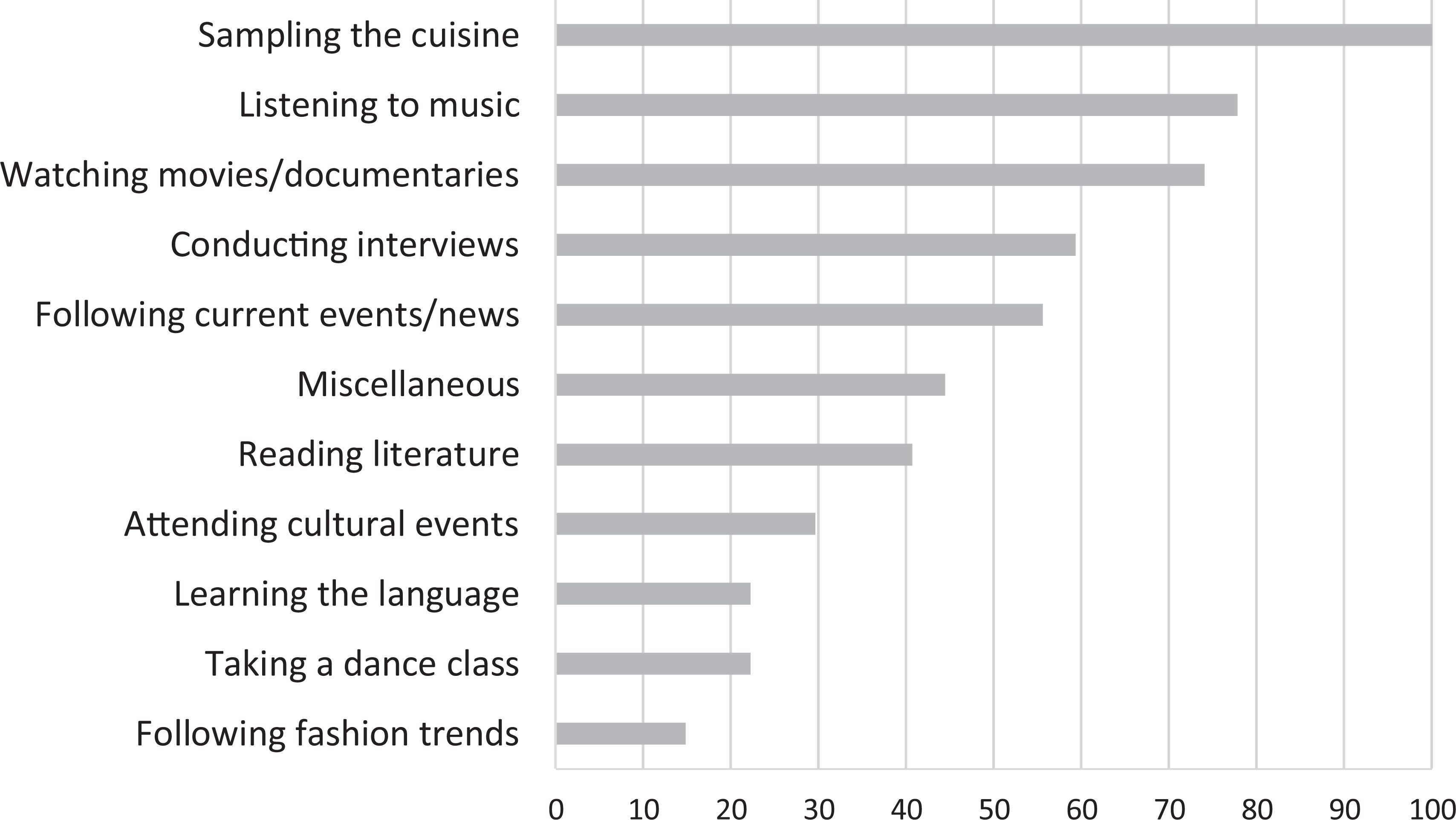
Cultural Immersion Activities. Note. Percentage of participants in the cross-cultural psychology course who engaged in each activity.
Perceived Intercultural Competence
An analysis of variance (ANOVA) was conducted on the cultural self-efficacy scores (CSES-A), using condition as a between-participants factor and time as a repeated measure. There was a significant interaction, F(1, 37) = 5.01, p = .031, η2 p = .12. Cultural self-efficacy increased significantly from time 1 to time 2 among students in the cross-cultural psychology course, but decreased (non-significantly) among those in the control course (see Table 1). A second ANOVA was conducted on the intercultural sensitivity scores (ISS). Although the interaction was not significant, F(1, 37) = 2.01, p = .17, η2 p= .051, the pattern of results was similar, with a significant increase in intercultural sensitivity from time 1 to time 2 among students in the cross-cultural psychology course, but not the control course.
Pre- and Post-Assessments of Perceived Intercultural Competence.
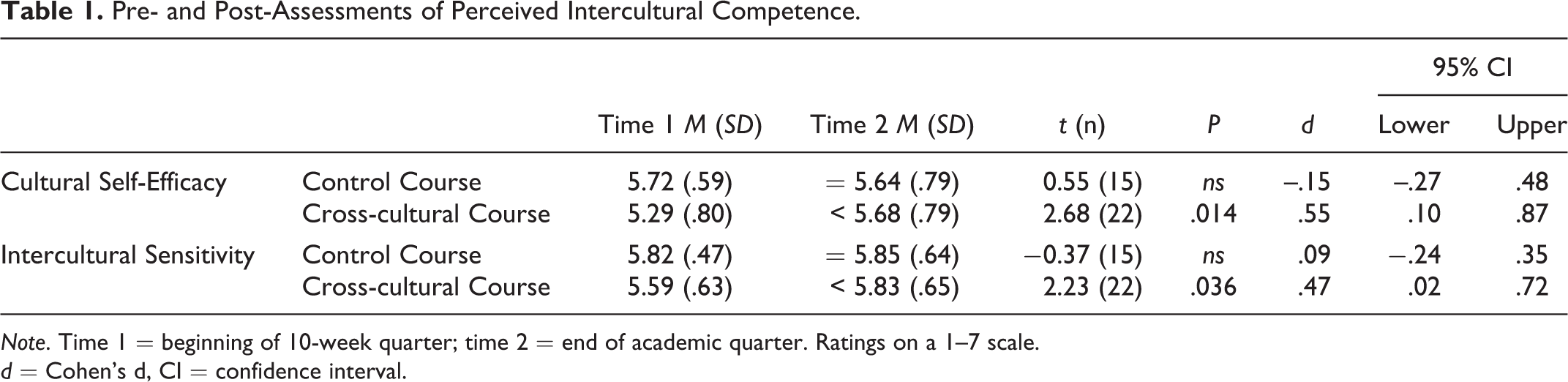
Note. Time 1 = beginning of 10-week quarter; time 2 = end of academic quarter. Ratings on a 1–7 scale.
d = Cohen’s d, CI = confidence interval.
Discussion
We found that completing a cross-cultural psychology course significantly increased college students’ perceived intercultural competence (cognitive, affective, and behavioral components), and the effect sizes were substantial (Cohen’s d = .55 and .47 represent medium effects). Students frequently reported that the course broadened their perspectives, as indicated by anonymous narrative comments on the course evaluations (e.g., “The class has inspired me…I hope to travel and learn more soon,”…“Very eye opening to other perspectives of other cultures,”…“I learned so much about myself and other people in this class,” “It helped me understand why I cannot apply Western psychology to everyone in the world”). Prior qualitative studies have found that cultural immersion activities challenge stereotypes and cultural worldviews, and increase cognitive flexibility, perspective-taking, and critical thinking skills (Nieto, 2006; Spooner-Lane et al., 2013).
Travel and study abroad are considered the gold standard for the acquisition of intercultural competence, assuming that several key conditions are met, including equal status between group members, common goals, intergroup cooperation, and institutional support (Allport, 1954; Earnest et al., 2016; Tropp & Pettigrew, 2004). In practice, the literature on study abroad’s effectiveness has yielded mixed results due to variability in the quality and length of the educational programs (Williams, 2005). Even if study abroad programs were ideal, the vast majority of college students cannot avail themselves of these travel opportunities. Most undergraduate students, even those from relatively affluent countries, are unable or unwilling to study abroad due to the considerable financial expense and time commitment involved (Institute of International Education, 2018). This study suggests that experientially focused cross-cultural psychology courses can provide suitable alternative learning opportunities.
One interesting finding from the present study is that students in the cross-cultural psychology course scored lower on the intercultural competence measures than did control participants at the beginning of the quarter. This result is consistent with other research that found that psychology undergraduates who elected to study abroad possessed lower pre-departure intercultural competence scores than did a comparison sample of psychology undergraduates enrolled in domestic courses (Earnest et al., 2016). One might have expected our cross-cultural psychology and control participants to have similar initial scores, and there are a number of alternative explanations for this outcome. Efforts were made to conceal the purpose of the study; however, as with any questionnaire study of this kind, the findings could be due to psychological demand. Albeit unlikely, differences in the demographic composition of the samples (or some other participant characteristic) could explain this finding. Another possibility is that the control participants had an exaggerated sense of their intercultural skills and abilities, whereas the cross-cultural psychology students possessed a more realistic assessment of their intercultural competence. A likely explanation is that the students who decided to enroll in cross-cultural psychology, an elective course, did so because they perceived they lacked intercultural knowledge and experience and/or lower self-confidence, and were interested and motivated to learn about global cultural diversity. Many of the students at this educational institution are from politically conservative rural areas and small communities, and have had little previous exposure to people from different cultures and countries. Future research could assess student’s reasons and motivations for taking the course.
One implication of this finding is that the cross-cultural psychology course might be most effective for college students with less intercultural experience. This would parallel the literature on multicultural psychology education. Studies show that courses with multicultural content have a stronger impact on majority group members, such as European Americans (Cole et al., 2011) and people who report having had less meaningful contact with people from different ethnic backgrounds (Smith et al., 2010). The latter authors found that among students with fewer ethnically diverse friends, exposure to more diversity-related courses was associated with greater perceived multicultural competence. In contrast, among students with a greater number of ethnically diverse friends, there was no association between curricular diversity and multicultural competence.
Course Modifications
The present course could be modified and taught in a number of instructional formats, such as a hybrid format. In a hybrid format, weekly lectures and videos could be presented online and the group projects, classroom discussions, and poster presentations could be conducted in class. In large courses (> 60 students), group presentations might be impractical, and a paper or exam could be substituted. With additional validational studies, the instructional materials could be adapted for use with community college and high school students. Although the Cultural Immersion Project was designed for use in cross-cultural psychology courses, “culture” could be defined broadly to include a wide range of groups, such as cultural groups in the United States (e.g., Mexican American, Jewish culture, etc.) and non-ethnicity-based cultures (e.g., LGBT, deaf culture, etc.).
Limitations and Future Directions
Although a large number of educational tools have been developed to foster intercultural competence (Canfield et al., 2009; Crampton et al., 2003; Deardorff, 2006; Nieto, 2006; Williams, 2005), few of these pedagogical methods have been evaluated using pre/post assessments and control/comparison groups. Hence, one of methodological strengths of this study, relative to the published literature, was its use of a quasi-experimental design. However, the study possesses certain limitations. The students were not randomly assigned to the courses and there may have been self-selection bias. Additional variables not measured in this study (e.g., differences in class level) could have led to the results. As outlined in the introduction, the focus of this research was on perceived intercultural competence, assessed with self-report inventories, rather than objective intercultural competence. This study, as with almost all of the empirical studies on intercultural/cultural competence (see Matsumoto & Hwang, 2013), is susceptible to social desirability and other response biases. The field as a whole would be advanced by more research using behavioral indicators and other-report measures of intercultural competence.
The generalizability of this study is limited by its convenience sample of college students. On the other hand, the students at this mid-sized public university are predominantly European American, middle to upper-middle class, and live in a small town in the Western United States. Many of these students have had limited opportunity to travel abroad and to engage meaningfully with people from other countries. As such, they are precisely the type of students who could most benefit from taking a cross-cultural psychology course with experiential learning components, such as the Cultural Immersion Project and weekly group activities.
Conclusion
A recent review of 200 undergraduate psychology programs in the United States revealed that only 6% of the institutions required a diversity-related course as part of the major (Fuentes & Shannon, 2016). Meanwhile, students would benefit from greater intercultural competence education and training due to globalization. This study provides empirical evidence of the effectiveness of a cross-cultural psychology course that is suitable for this purpose.
Footnotes
Appendix
Acknowledgments
Julie Spencer-Rodgers received a Learn by Doing Scholar Award (California Polytechnic State University) in recognition of the research reported in this article.
Declaration of Conflicting Interests
The authors declared no potential conflicts of interest with respect to the research, authorship, and/or publication of this article.
Funding
The authors disclosed receipt of the following financial support for the research, authorship, and/or publication of this article: This research was funded by an Instructional Resource Award and a Scholarship of Teaching and Learning (SoTL) Grant from the Society for the Teaching of Psychology awarded to Julie Spencer-Rodgers.