



Abstract
Introduction:
Developing greater multicultural competence is predicated on developing continual awareness and education about issues relevant to marginalized identities. One way to promote this competence is by engaging in productive intergroup dialogue with individuals representing a diversity of perspectives.
Statement of the Problem:
Intergroup dialogues can be difficult and require training and skill to keep them collaborative and not adversarial. The challenge for instructors is how to build in the kinds of activities necessary to help students become effective collaborators.
Literature Review:
We review the definition of multicultural competence and note the under-emphasis on developing culturally relevant skills. With that in mind, we discuss the importance of difficult dialogue in advancing multicultural competence and briefly discuss what effective collaboration entails.
Teaching Implications:
Finally, we discuss a model for building this type of skills training into psychology courses using an online, chat platform designed to help develop collaborative skills called CREATE.
Conclusion:
We provide recommendations for inclusion of the CREATE system in psychology courses as a strategy for facilitating multicultural awareness and skills.
Increasing diversity in U.S. society, combined with growing tensions between various groups that make up this diversity, has highlighted the need for developing multicultural competence as a critical skill for successful professional and personal lives. Multicultural competence is generally defined as the ability to work effectively with individuals who are culturally different (Mio et al., 2019). The term “culture” can be construed broadly (Sue et al., 1996), encapsulating several important demographic identities (e.g., religion, sexual orientation, gender; Hays, 2016) and perspectives beyond ethnicity, race, or nationality that can meaningfully shape experience. Thus, the complexity of identities in cross-cultural interactions can be overwhelming, leading scholars to emphasize the importance of a multicultural orientation (Owen et al., 2011). Such orientations stress that multicultural competence is a lifelong learning process built upon self-appraisal and respectful, humble interactions with others that reflect a genuine desire to grow (Owen et al.; Watt, 2007). This raises the question of how it is that college educators can prepare the next generation of global citizens for the challenge of engaging in effective cross-cultural interactions.
There is a great deal of literature on multicultural education and pedagogy, including the development of intergroup dialogue for the purposes of improving intergroup relationships (Frantell et al., 2019; Gurin et al., 2013). The growth of this literature has largely paralleled the development of multicultural competence theory and research. Research on the promotion of multicultural competency (including multicultural awareness, knowledge, and skills) has primarily focused on graduate training or health service delivery (Gregus et al., 2019; A. Soto et al., 2018), receiving relatively less attention in undergraduate courses. When it is explicitly addressed, it is often in the context of multicultural psychology courses or similarly-focused courses (Fuentes & Shannon, 2016), putting an enormous responsibility on these courses to provide a solid foundation on which to build the skills needed to gain greater multicultural competency. While many multicultural courses succeed in increasing knowledge and awareness around important topics such as racism, privilege, oppression, prejudice, and bias (Alvarez & Domenech Rodriguez, 2020; Gurin et al., 2013; J. Soto et al., 2020), less is known about whether and how they develop the collaborative communication skills needed to facilitate effective practice/interactions with diverse others, especially when taking part in difficult discussions around diversity and social justice issues (Gurin et al., 2013; Watt, 2007). We argue that the development of these types of communication skills can and should be a target of multicultural psychology courses and possibly other psychology courses. Toward this end, we share our approach and describe the online chat platform, called CREATE, that we use to foster the development of these critical skills.
Difficult Dialogue Skills as a Multicultural Competency
The definition of multicultural competence used in the current paper, has its origins in the counseling and clinical literature, but the concept also applies to contexts outside of the helping professions. Multicultural competence entails three broad learning goals: 1) greater awareness of one’s own cultural attitudes, values, and beliefs, 2) greater knowledge of the cultural attitudes, values, and beliefs associated with different worldviews, and 3) development of culturally appropriate interpersonal skills (Mio et al., 2019). These goals can be unpacked further into a) attitudes and beliefs, b) knowledge and understanding, and c) skills necessary to achieve ongoing learning objectives of multicultural competence.
Most multicultural psychology courses explicitly target the development of greater awareness of self and other worldviews. For example, learning about topics such as stereotypes, prejudice, and health disparities provides a richer context for students to appreciate their own place in society as cultural beings and the various social positions occupied by others in society. Instructors of these courses often use exercises and assignments to help deepen this learning (e.g., creating cultural genograms, watching relevant films). Not surprisingly, a collection of studies indicate that undergraduate psychology courses can significantly increase multicultural knowledge (Chappell, 2014; Estrada et al., 2002; Robinson & Bradley, 1997) and awareness of white privilege, racism, and systemic injustice (Case, 2007; Patterson et al., 2018). However these courses do not always promote the development of multiculturally-relevant skills (e.g., interpersonal communication skills; Estrada et al., 2002; Robinson & Bradley, 1997).
Courses in psychology provide less explicit guidance for the development of culturally appropriate interpersonal skills. This type of skills-based learning is more challenging to incorporate into larger, lecture-based undergraduate courses. And yet, development of these skills is critical because these skills facilitate the application of knowledge about one’s own culture and other cultures to promote behaviors that facilitate effective intergroup relations and alliances to challenge social injustices (Frantell et al., 2019; Gurin et al., 2013; Mio et al., 2019; Nagda, 2006). Increasing greater awareness of one’s own and others’ cultural perspectives without developing students’ ability to apply this new-found knowledge, may leave students feeling helpless when interacting interculturally and tackling social inequities. This may be especially true for members of dominant/privileged groups who may be more likely to avoid dealing with social justice issues due to guilt and cognitive dissonance (Case, 2007; Sue, 2013; Tatum, 1992; Valentine et al., 2012). Thus, we need to find a way to better support the development of interpersonal multicultural skills.
One interpersonal skill that can promote multicultural competency is the ability to engage in productive discussions with others who hold different worldviews. Such discussions have been referred to as intergroup dialogue, racial dialogue (when focusing solely on racial identity), or, as we will refer to them, difficult dialogue (Dessel & Rogge, 2008; Gurin et al., 2013; Watt, 2007). Difficult dialogues are defined as conversations between people in a safe space with the aim of exchanging and exploring potentially polarizing views about injustice/inequality and participants’ involvement in larger societal issues (Dessel & Rogge, 2008; Watt, 2007). These types of discussions are rooted in theories of critical consciousness (Friere, 1970), which emphasize the ability to critically reflect on the various mechanisms contributing to existing social injustices and a corresponding commitment to take constructive action. These conversations can involve some degree of discomfort or conflict when perspectives are challenged and participants may respond with defensiveness (Watt, 2007; Watt et al., 2009) or avoidance of the discussion altogether (Sue, Lin et al., 2009; Sue, Torino et al., 2009). Nevertheless, participation in difficult dialogues has been advanced as one of the principal ways to develop critical consciousness (Watt, 2007). As such, some universities have embraced difficult dialogues as a means to address issues of multiculturalism and social justice in their community (World in Conversation, 2019; Zúñiga et al., 2012).
There is a sizable literature that addresses the design, implementation, and outcomes related to difficult dialogues (Frantell et al., 2019; Gurin et al., 2013; Nagda, 2006). Models of difficult dialogue usually require sustained, face-to-face, critical-reflective conversations between individuals of diverse identity groups, moderated by trained facilitators (e.g. Dessel & Rogge, 2008; Frantell et al., 2019; Gurin et al., 2013; Miles & Mallinckrodt, 2017; Nagda, 2006). Thus, developing difficult dialogue skills is a long-term endeavor that requires repeated practice (Watt, 2007). Programs that promote difficult dialogues can produce positive learning opportunities and socio-emotional outcomes (World in Conversation, 2019). However, these programs require extensive resources and efforts to train facilitators to regulate communication processes for participants.
Notably, the use of facilitators in these endeavors also speaks to the level of expertise needed to make these dialogues productive. We believe that at the heart of this expertise is the ability to productively engage in collaborative sense-making activity. Thus, the challenge for educators is how to integrate this form of collaborative sense-making expertise into multicultural courses. If we can increase students’ collaborative efficacy, we can maximize both the likelihood that they will engage in these conversational opportunities and the likelihood that these exchanges will be productive. Below we outline an approach to developing this critical skill in the service of multicultural competence development within courses with the aid of a system called CREATE. We also provide the empirical and theoretical underpinnings that informed the CREATE system and how they are instantiated in the system when used in a course.
Building Collaborative Competency Using CREATE
The Foundations of Collaborative Competencies
Borge and Shimoda (2019) designed a flexible, online Collective Regulation and Enhanced Analysis Environment (CREATE) to help facilitate and support the development of collaborative competencies. The CREATE system is informed by learning theories and research that conceptualize the communication processes that occur during collaboration as a type of collective cognitive activity that requires ongoing regulation for productive collaborative learning to occur (Cooke at al., 2008; Gibson, 2001; Järvelä & Hadwin, 2013; Stahl, 2006). Research shows that students need to regulate collective thinking processes in order to improve the ongoing and future quality of collaborative activities (DeShon et al., 2004, Järvelä & Hadwin, 2013; Wecker & Fischer, 2011). However, regulation of group activity is difficult because individuals often lack awareness of group processes, leading some to argue that groups need a way to “relive” their processes after the fact, to gain awareness of potential issues (Cooke et al., 2000, 2008). In addition, for self-assessments to be productive, individuals require expertise and structured guidance (Panadero, 2017; Panadero et al., 2012), something many students do not have and many instructors cannot provide.
To address these challenges, the first author designed and tested a series of tools and interventions, grounded in the empirical and theoretical literature, to improve students’ collaborative knowledge and skills (Borge & Carroll, 2010; Borge et al., 2012, 2015; Borge & White, 2016). These tools include models of effective collaborative activity, rubrics to evaluate collaborative discussion quality, guides to help students identify problems and select strategies to improve collaboration, and a model of instruction that synthesizes all the tools into a singular experience (Borge et al., 2018; see Appendix, Items 2–5). Research on the use of these tools has demonstrated their effectiveness in improving the quality of collaborative processes (Borge et al., 2018), though students found them to be somewhat cumbersome. Thus, Borge and Shimoda (2019) designed CREATE to embed all the tools into a singular, cohesive system. Though the CREATE system is still in its infancy, initial studies support that the system can help students to regulate their collaborative processes and improve them (Borge et al., 2018, 2020). For a complete review of the theoretical and empirical grounding, iterative studies evaluating the system, and case studies of system use see Borge et al. (2018), and Borge and Shimoda (2019).
Implementing CREATE in the Classroom
At its core, CREATE provides a synchronous chat platform with a relatively simple interface, consisting of five tabs (Plan, Chat, Reflect, Monitor, Revise), each corresponding to a step in a structured discussion activity (see Appendix, Item 1). Prior to the discussion, individuals are assigned to teams of two or three students, and introduced to the system and the goals of the discussion activity. Teams are encouraged to use the PLAN tab to schedule the time and goals of their discussion. Before each discussion activity, individuals are asked to provide written answers to thought-provoking questions about course concepts to serve as the kindling for their discussion activity.
Discussions in the CREATE environment take place in three parts. Part one of the activity, is the main discussion itself, part two is a self-reflection activity, and part three is a collective reflection and planning activity. Part one, the main discussion, occurs in the CHAT tab. It entails a synchronous online meeting, 50–75 minutes long, where students share their perspectives on the reflection questions provided earlier in order to make collective sense of course concepts.
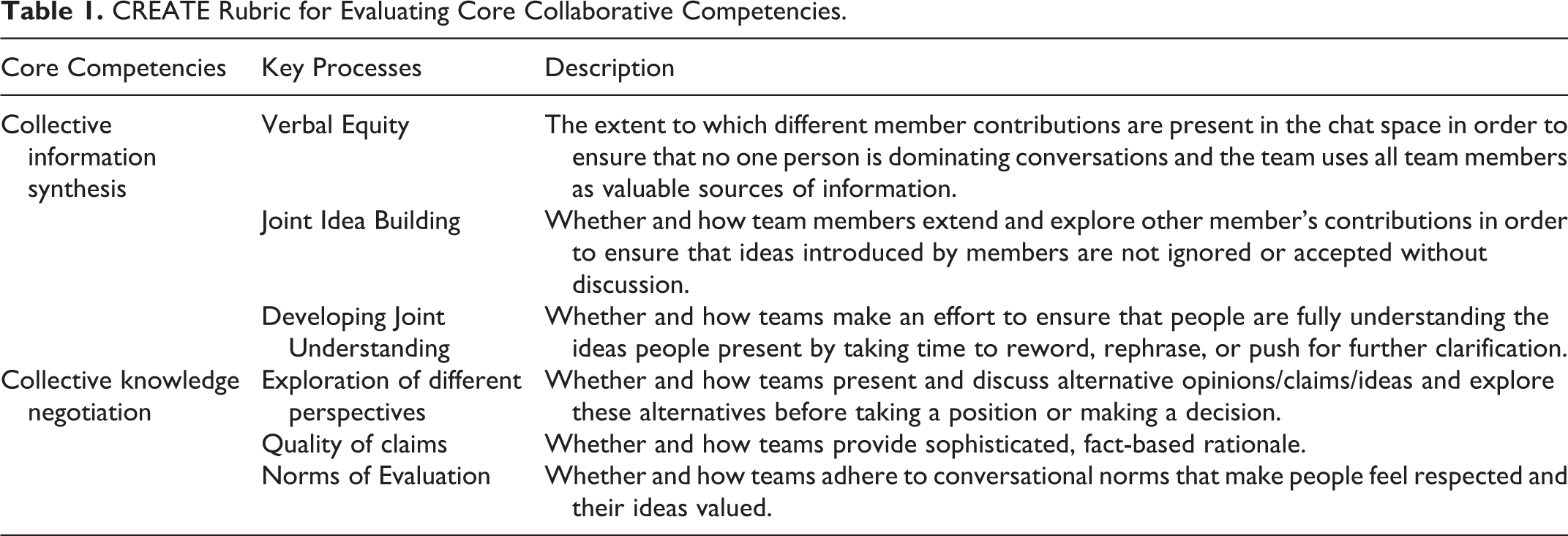
In Part two, the system prompts individuals to move to the REFLECT tab and spend 15–20 minutes assessing the quality of their discussion. Self-assessment of this kind is important, because it is how students identify problems in need of improvement (Panadero et al., 2012, 2016). To help cultivate expertise in assessment of collaborative processes, CREATE provides concrete assessment criteria for six key communication processes that research has shown to impact the quality of collaboration (Borge et al., 2018) and rubrics for assessing each process (see Table 1 for description of key processes and Appendix for links to the rubrics). The system also prompts students to compare their existing processes to the rubrics in order to identify areas in need of improvement (i.e., gap analysis) and provide evidence for assessment scores from the actual chat transcript; a processes deemed essential for successful regulation (Nesbit, 2012; Winne & Nesbit, 2009).
CREATE Rubric for Evaluating Core Collaborative Competencies.
Part three involves collective reflection and planning. After individuals submit their self-assessment scores, the system prompts team members to move to the MONITOR tab and spend 15 minutes collectively discussing their scores and rationales to decide on one main process strength and weakness. This type of socially shared regulation has been shown to increase awareness of students’ collaborative processes and improve collaborative activity (Borge & White, 2016; Cooke at al., 2008; DeShon et al., 2004; Järvelä & Hadwin, 2013; Rogat & Linnenbrink-Garcia, 2011). To support socially shared regulation, the system provides teams with a visualization of the teams’ average score for each assessed item. Once teams identify their main strength and weakness, the system suggests tailored strategies in the REVISE tab, based on their identified weakness, that they can use to improve future discussions. They can choose one or more of these strategies (or create their own) to implement in the next CREATE chat. These collaborative activities are repeated each time a team engages in a discussion, typically three or four times throughout the semesters. In between the discussion activities, instructors can provide teams with feedback to help them better calibrate their self and collective assessments of collaborative activity over time.
Recommendations and Challenges
There are both technologically-supported and paper-based options available for instructors interested in incorporating the collaborative activities described above. The current CREATE system is housed on local servers at the first author’s university, but the original system can be set up to run on any server (which would require technical expertise for proper installation and management). However, instructors can also run the entire activity in a public chat room, with paper-based supports (Borge & Shimoda, 2019). This is possible because all of the tools integrated into the CREATE system are publicly available and can be used to recreate the CREATE experience in any synchronous chat environment. While there are potential disadvantages associated with a chat-based platform (e.g., differences in typing speed), our system provides real-time feedback on active typing (i.e., ellipses while typing) and has the advantage of automatically archiving the discussion text, making it easier for students to self-reflect on process, a critical ability for improving collaboration and developing multicultural competence. The online format also provides a feasible method to have students engage in discussions when being in the same physical space is not possible (e.g., during breaks, during remote learning, etc.). However, as is the case with educational technology, there are important considerations for ensuring that these activities produce the desired outcomes.
Assigning Students to Discussion Teams
Many external factors can help or hinder teams. For example, diversity with regard to race, gender, and personal backgrounds can introduce different perspectives and facilitate innovative thinking and problem solving (West, 2007; Woolley et al., 2010). In multicultural psychology classes, collecting information sheets at the beginning of the semester that might include questions about student interests (e.g. intellectual interests? values you live by?), general demographics, or even individual intersections of social privilege and marginalization (Kliman, 2010) can be useful for dividing the class into diverse teams. However, instructors should exercise caution not to tokenize or overburden students with underrepresented identities who often find themselves educating individuals with dominant identities (Chesler et al., 2005).
There are also practical considerations when assigning students to teams. Students need to be able to meet at the same time to chat synchronously. For resident courses this can be accomplished by assigning CREATE discussions during a usual class period (in lieu of lecture), so that students can meet online with their teams during that time. For online courses, availability to meet synchronously is paramount. Thus, polling students about their general availability for each day of the week in a set standard time (i.e., EST, early morning, late morning, midday, etc.) can ensure that only students with overlapping availability are put on the same team.
Another important consideration is when to construct the teams. We recommend that teams be assigned two-to-three weeks into the semester. Doing so increases the likelihood that the course roster is stable so teams do not have to be restructured to account for students adding or dropping the course. We also suggest a collaborative check-in (non-discussion-based team activity) at least 1 week prior to the CREATE discussion to ensure that team members are responsive to teammates. Such check-ins provide time to address issues within teams before the first discussion is scheduled.
Preparing Thought Provoking, Content-Based Questions
The fodder for the CREATE discussions comes from the individual content-based questions that students complete prior to their discussions. These questions need to be carefully devised with the explicit aim of providing prompts that could produce interesting and deep discussions and responses of one-to-two paragraphs per question. Questions should relate to course content and require higher-order thinking, to push students to synthesize, extend, or analyze concepts that may be central to the course (Gurung et al., 2016). For example, after reviewing biological and sociocultural constructs of race and the history of psychology with respect to multiculturalism, the second author provided the following questions: How would you define the construct of race? Is race a useful construct for psychology or society? How has race influenced the development of science?
Higher-order thinking allows students to make connections between course concepts, previous knowledge, and personal experiences. In doing so, these questions provide opportunities for students to consider multiple viewpoints and recognize ideas they may not have considered or previously misunderstood. This adds richness and depth to the conversations and helps students grow intellectually. Ensuring that the questions are closely related to the course topics also helps students to see the CREATE discussion activity as valuable and integral to the learning goals of the course.
Promoting and Providing Opportunities for Improvement
As Watt (2007) argues, it is important that students have opportunities for iterative improvement of dialogue skills. We recommend that instructors incorporate three to four CREATE discussions over the course of a semester. This frequency allows for a natural beginning, middle and end, which helps students track their own collaborative skill development. Having fewer than three discussions may limit growth due to having fewer opportunities for collaborative and regulatory practice and more than four conversations may feel burdensome or overwhelming.
It is also important to temper performance expectations by stressing to students that collaborative competencies are difficult to develop. Thus, we stress improvement from beginning to end as the most important outcome. In fact, we often base the grading for the various chat assignments on their best group chat performance across the semester (based on the scoring rubric). This incentivizes their efforts to improve their collaborative discussion skills and does not penalize students for a relative weakness in a skill that most have not had opportunity to develop throughout their education.
Adapting CREATE Discussion to Diverse Psychology Topics
CREATE activities provide opportunities to engage in collective sense-making on a broad range of topics. Currently, the CREATE system is being used in educational psychology, developmental psychology, human sexuality, information sciences, and educational technology courses. Instructors addressing cross-cutting themes in the psychology curriculum, will find that this tool provides a rich resource to promote higher-order collective thinking beyond multicultural courses. For example, in teaching psychological research methods, students can use CREATE activities to discuss the consequences of conducting research primarily with Western, educated, industrialized, rich, and democratic populations (WEIRD populations [Henrich et al., 2010]; e.g., undergraduate students in the U.S.). Similarly, when learning about topics in abnormal psychology students can consider cultural concepts of distress and multicultural considerations in the treatment of mental disorders (see Table 2 for additional examples). Such dialogues will help students to integrate knowledge about multiple ecological levels (social policy, community, organizational, family & individual variation) and the psychological pillars including biological, cognitive, developmental, social, and mental and physical health while also developing collaborative competencies in the service of multicultural competence (see Table 2).
Addressing Cultural and Social Diversity through Difficult Dialogues.

Conclusion
The CREATE system and its activities are adaptable, theory-driven educational tools that are well aligned with recommendations for the development of a multicultural orientation and communication skills (Abbott et al., 2019; American Psychological Association, 2013). They complement multicultural competence theory/practice by augmenting the skills necessary to engage in difficult dialogues in a reflective manner that fosters growth and discovery. The activities can be implemented with or without technology. Notably, the implementation effort is minimal compared to what students and instructors stand to gain in the form of interpersonal communication skills and conceptual understanding of course content. Finally, CREATE activities offer the scaffolding necessary for students to challenge pre-existing knowledge, to synthesize, and extend what they learn in psychology courses to develop life long multicultural skills and orientations.
Footnotes
Appendix
Resources for the CREATE system and the collaborative activities Introduction to the CREATE system: https://youtu.be/Fer9ZWeA2yI. Assessing Collaborative Discussion Processes (Rubric): https://sites.psu.edu/mborge/wp-content/uploads/sites/17389/2016/05/Process-Rubric-for-year-3-SP2016-F-students.pdf. Understanding collaborative processes in the rubric—Explanations of the rubric items: https://sites.psu.edu/mborge/understanding-collaborative-processes/. Collective Information Synthesis guide: https://sites.psu.edu/mborge/wp-content/uploads/sites/17389/2016/05/Information_Synthesis_goals_and_strategi.pdf. Collective Knowledge Negotiation Guide: https://sites.psu.edu/mborge/wp-content/uploads/sites/17389/2016/05/Knowledge_Negotiation_Goals_and_Strategi.pdf.
Declaration of Conflicting Interests
The authors declared no potential conflicts of interest with respect to the research, authorship, and/or publication of this article.
Funding
The authors received no financial support for the research, authorship, and/or publication of this article.
