



Abstract
Background:
Research shows distributed practice enhances learning and skill development, but less is known about the effect on perceptions and attitudes toward the material being learned.
Objective:
This study examined whether distributed practice could improve performance and attitudes in statistics, a subject that students report finding unpleasant and anxiety-provoking.
Method:
This quasi-experiment compared statistics students who received distributed practice with Excel throughout the semester to a control group without distributed practice. At the end of the semester, all students completed a major data analysis project with Excel and a self-report measure of their perceptions and attitudes toward the class and statistics.
Results:
Significant results suggest students who received distributed practice: earned higher project grades; liked statistics more; and perceived the class to be more effective for knowledge and skill development, even though they found statistics to be more difficult than the control group.
Conclusion:
This study suggests distributed practice helps improve students’ performance and attitudes toward statistics, even though they think it is difficult.
Teaching Implications:
In addition to improving performance in challenging subjects, distributed practice may be used to help students appreciate and feel more favorably about classes they find difficult.
Keywords
Distributed Practice and Performance
Distributed practice, or spacing out practice/study sessions over time, has been well-documented in the literature to benefit learners across several domains (see reviews in Cepeda et al., 2006; Delaney et al., 2010; Donovan & Radosevich, 1999; Dunlosky et al., 2013). For instance, several comprehensive meta-analyses have reported improved memory and recall of verbal information (Cepeda et al., 2006; Janiszewski et al., 2003) as well as improved learning of basic motor skills (Donovan & Radosevich, 1999). Although many moderating variables have been examined in regard to the effectiveness of distributed practice, it is generally concluded that better learning outcomes are derived from using inter-study intervals (ISI; the time period between practice/study sessions) longer than 1 day or even on the order of weeks to months, depending on the length of the retention interval (the time period between the last practice session and final testing session; see review by Cepeda et al., 2006). Moreover, these beneficial outcomes in learning have been found even when practice sessions involved different types of activities, such as memory retrieval, repeated practicing of skills, and practice testing (see Dunlosky et al., 2013).
In addition to relatively simple tasks such as verbal recall and basic motor learning, distributed practice has been associated with positive effects in more complex domains such as mathematics and statistics. For example, participants that distributed their practice of 10 math problems (calculating the number of permutations of a letter sequence) across two sessions compared to massed practice in one session performed significantly better on a final test (Rohrer & Taylor, 2006). In another study, Rickard et al. (2008) examined skill learning associated with repeated arithmetic calculations. Specifically, they compared sets of multiplication problems that differed in the amount of spacing between problems, one set with short inter-item spacing and the other with longer spacing (Rickard et al., 2008). In line with the positive effects associated with distributed practice, results indicated that problem sets with greater spacing led to improved accuracy and reduced reaction times on a test given 1 week after initial learning.
Math-related curriculum in undergraduate psychology programs typically encompasses statistics. Here too, benefits of distributed practice have been demonstrated. Budé et al. (2011) compared two statistics courses that differed in length: one course lasted 6 months while the other was reduced to 8 weeks. Both versions of the course were equivalent in content and implementation of activities (e.g., lectures, group work, and practical sessions), but they differed such that the shorter 8-week course did not allow students the same amount of distributed study that the longer course provided. Students in the longer course (i.e., with more distributed study time) compared to the shorter course scored higher on a final exam and had a stronger conceptual understanding of statistics, as evidenced by better performance on open-ended questions examining statistical hypothesis testing (Budé et al., 2011).
Distributed Practice and Student Attitudes
Unfortunately, statistics courses (much like mathematics courses) can present a unique challenge to instructors in that students often have anxiety and negative attitudes toward the subject (see review in Onwuegbuzie & Wilson, 2003). In fact, many students find statistics to be the most anxiety-inducing course they undertake (Onwuegbuzie & Wilson, 2003; Zeidner, 1991) and come to think of the experience as highly negative (Onwuegbuzie, 1997). Unfortunately, these negative attitudes and anxiety can influence behavior and impede performance in statistics coursework (Gal & Ginsburg, 1994; Onwuegbuzie & Seaman, 1995; Onwuegbuzie & Wilson, 2003; Zeidner, 1991).
A few possibilities for reducing statistics anxiety and negative attitudes have been researched, such as incorporating humor in examples (Schacht & Stewart, 1990), allowing supporting material to be used during untimed exams (Onwuegbuzie, 2000), incorporating performance assessments other than exams like projects or active investigations (Onwuegbuzie & Wilson, 2003), or limiting opportunities for procrastination (Macher et al., 2012). That said, it would seem advantageous when addressing negative attitudes to try leveraging evidence-based strategies or best practices that already demonstrate a wealth of benefits to learners. For example, Woodward and Brown (2006) set out to examine an intervention using evidence-based principles aimed at teaching mathematical concepts to middle school students at risk for special education math services. One key component of their intervention was the distributed practice of important skills and concepts. Results showed that students in the intervention compared to control group not only scored higher on a standardized achievement test, but they also reported more positive attitudes toward math (Woodward & Brown, 2006). Unfortunately, teasing apart the unique contribution of distributed practice from the overall findings is difficult since the intervention included several other components such as emphasizing explicit connections between topics, extensive use of visual models, maintenance of high expectations, and a significant focus on conceptual understanding (Woodward & Brown, 2006). Therefore, it appears as though evidence-based tactics like distributed practice may, at least in part, contribute to changing student attitudes toward negatively perceived content like mathematics and statistics.
The Present Study
Considering the aforementioned research, the present study examined whether distributed practice could improve both performance and student attitudes in an undergraduate psychology statistics course. Importantly, the primary focus was not to directly compare distributed practice to another form of practice (e.g., massed practice), but instead to examine whether the benefits of a distributed practice intervention would extend beyond improved performance—namely, to attitudes and perceptions of the material to be learned. To this end, we used a quasi-experimental design to compare a group of students who completed four Excel-based data analysis assignments spaced 3 weeks apart (distributed practice group) to a group of students receiving no such practice with Excel (control group). At the end of the semester, all students completed a major data analysis project with Excel and a self-report survey evaluating their perceived effectiveness of the class, and a self-report measure of their attitudes toward statistics. Based on the large body of research demonstrating the learning benefits of distributed practice, and research examining this in college math and statistics classes specifically (e.g., Budé et al., 2011; Rickard et al., 2008; Rohrer & Taylor, 2006), we hypothesized that the distributed practice compared to control group would demonstrate significantly higher scores on the major data analysis project (Hypothesis 1), and report significantly more perceived knowledge and skill development from the class (Hypothesis 2). In addition, a prior study found that distributed practice may contribute to changing student attitudes (Woodward & Brown, 2006). That said, there are likely substantial differences between middle schoolers and college students. To our knowledge, no study to date has examined the influence of distributed practice on the attitudes and perceptions of college students. Taken together, we hypothesized that the distributed practice compared to control group would report significantly more positive attitudes toward statistics (Hypothesis 3).
Method
Participants
A sample of 158 undergraduate Introductory Statistics students from a 4-year state college in the Southwestern United States participated in the study. Demographic data was not collected from the students to maintain anonymity and because demographics were not relevant to the hypotheses being tested in the study. However, at the time of data collection, the student population at the college was: 74.8% female and 25.2% male; 38.3% White, 27.5% Hispanic, 10.8% Asian, 10% Black or African American, 5.9% Two or More Races, 1.7% Native Hawaiian or Pacific Islander, 0.5% American Indian or Alaskan Native, and 5.3% of unknown race/ethnicity. All procedures were approved by the college’s Institutional Review Board.
Measures
Student performance
Students in all sections completed a major final project during the last 3 weeks of the semester. The project required groups of two to three students to select and use three of the analyses covered in the class to analyze data from a large dataset. Students had to select the appropriate analyses based on the nature of the data, prepare and analyze the data in Excel, create APA-style tables and figures illustrating the results, write APA-style explanations, and write simple explanations. All projects were graded using a detailed and standardized rubric (see Appendix). Student performance was analyzed at the group-level based on each group-based grade (%) on the final project. There were n = 58 final group project submissions in the control group and n = 22 final group project submissions in the distributed practice group.
Student attitudes toward statistics
Students responded to the Student Attitudes Toward Statistics (SATS; Schau et al., 1995) survey on a scale from 1 = strongly disagree to 7 = strongly agree. The survey included a single item measuring confidence (i.e., “How confident are you that you can master introductory statistics material?”). The survey also had four subscales with six items measuring affect (e.g., “I like statistics.”; α = 0.87), cognitive competence with six items (e.g., “I understand statistics equations.”; α = 0.86), value with eight items (e.g., “I use statistics in my everyday life.”; α = 0.89), and difficulty with seven items (e.g., “Statistics involves massive computations.”; α = 0.78). All negatively worded items were reverse-coded so higher scores indicate more of each construct.
Perceived knowledge and skill development
Students responded to seven goal-oriented statements about the knowledge and skills they gained from the Excel portion of the class (Warner & Meehan, 2001) on a scale from 1 = strongly disagree to 7 = strongly agree. Each item assessed different goals, so they were examined individually instead of being used to create a mean subscale (see items in Table 1).
Differences in Performance, Attitudes, and Perceptions Between Students Who Received Distributed Practice (Dist. Practice) and Students Who Did Not (Control).
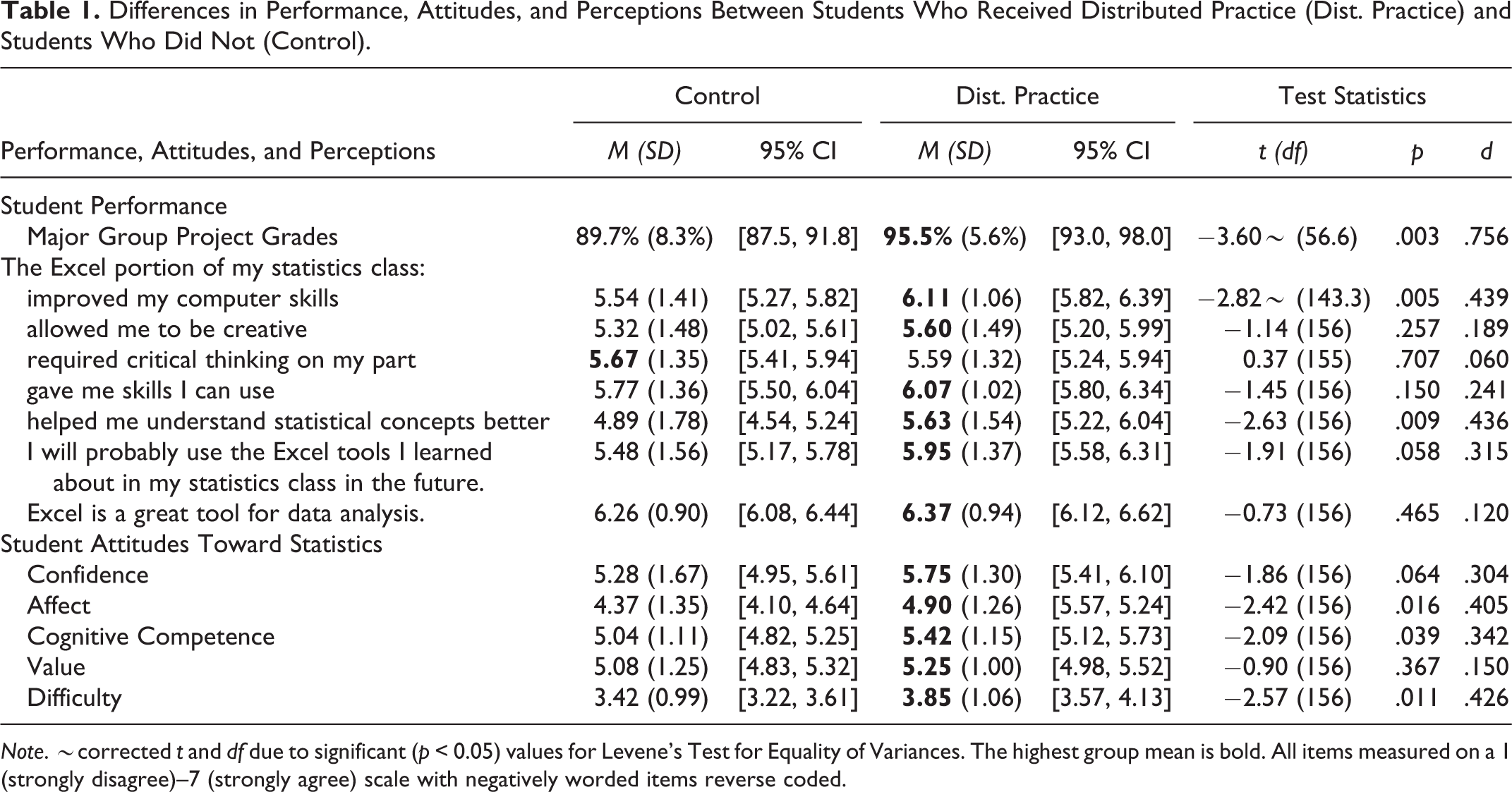
Note. ∼corrected t and df due to significant (p < 0.05) values for Levene’s Test for Equality of Variances. The highest group mean is bold. All items measured on a 1 (strongly disagree)–7 (strongly agree) scale with negatively worded items reverse coded.
Procedure
A quasi-experimental design was used to compare students receiving distributed practice to a control group. All semesters and sections of the class were taught by the same Instructor, with the same video lectures, assignments, and major data analysis project. Students read the textbook and watched video lectures about statistical concepts and computations. Then they completed practice problems and brought them to class for completion credit. Class time was typically spent making the key for practice problems as a class and discussing how statistics is relevant to us all. There were multiple choice knowledge checks due after class, where students could apply what they learned from discussing practice problems in class. Students also completed exams in class after every few chapters. The only difference among the sections was that some received distributed practice with Excel through completion of small-scale Excel assignments throughout the semester (Weeks 4, 8, 11, and 13) before completing the major data analysis project (Weeks 14–16). The distributed practice assignments had students follow an Excel video tutorial to analyze data from a published journal article and interpret the results. The control sections did not learn about Excel until starting the major project.
At the end of the semester, all students (those receiving distributed practice and those in the control group) were asked to complete the survey measures described above. Their grades on the major data analysis project were also recorded. There was a total of six sections (153 students) who received the version of the class with no distributed practice; of those students, 101 (66%) students completed the surveys at the end of the semester. There was a total of two sections (64 students) who received the version of the class with distributed practice; of those students 57 (89%) completed the surveys at the end of the semester. All data was included with no outliers or transformations required.
Results
A series of two-tailed t-tests for independent samples were used to examine differences in performance, perceptions, and attitudes between the students who received distributed practice and the control group. To help control for Type I error across multiple comparisons, we calculated the false discovery rate (FDR) using the Benjamini-Hochberg method (Benjamini & Hochberg, 1995). The FDR controls for the expected rate of Type 1 Error among the significant effects and adjusts the critical value for statistical significance based on p-value order, with more conservative corrections for higher p-values (Benjamini & Hochberg, 1995). In addition to testing for the statistical significance of differences, the practical size of the effect was measured with Cohen’s d. A value near d = 0.20 indicates a small effect, d = 0.50 indicates a medium effect, d = 0.80 indicates a large effect, and d = 1.30 indicates a very large effect (see Maher et al., 2013).
Student Performance
Results provide full support for Hypothesis 1 (i.e., Students who receive distributed practice will demonstrate significantly higher scores on the major data analysis project). As seen in Table 1, students in the distributed practice group had significantly (p = 0.003) and substantially (d = 0.756) higher grades on their final major data analysis projects than students in the control group, with a very large effect size.
Perceived Knowledge and Skill Development
Results provide partial support for Hypothesis 2 (i.e., Students who receive distributed practice will report significantly more perceived knowledge and skill development from the class). As seen in Table 1, students in the distributed practice group reported that the Excel portion of the class significantly improved their computer skills (p = 0.005; d = 0.439) and helped them understand statistical concepts significantly better (p = 0.009; d = 0.436) than students in the control group, with a medium effect size. Students in the distributed practice group consistently provided more positive ratings for the other items evaluating the Excel portion of the class (except for requiring critical thinking) than students in the control group, but these differences were not statistically significant (p > 0.05).
Student Attitudes Toward Statistics
Results provide partial support for Hypothesis 3 (i.e., Students who receive distributed practice will report significantly more positive attitudes toward statistics). As seen in Table 1, students in the distributed practice group reported significantly more positive affect toward statistics (p = 0.016; d = 0.405), while also reporting that statistics was significantly more difficult (p = 0.011; d = 0.426) than students in the control group, all with a medium effect size. Students in the distributed practice group also reported higher levels of cognitive competence, confidence in statistics, and perceived value of statistics than students in the control group, but these differences were not statistically significant (α = 0.05 with FDR correction).
Discussion
The present study examined whether distributed practice could improve both performance and student attitudes in an undergraduate psychology statistics course. Confirming our first hypothesis, results indicated that students in the distributed practice compared to control group scored significantly higher on the major data analysis project. This finding dovetails with research demonstrating that distributed practice interventions are associated with improved performance in a variety of task types and domains (see reviews in Cepeda et al., 2006; Donovan & Radosevich, 1999; Dunlosky et al., 2013). This finding also contributes more specifically to the emerging body of research on the beneficial effects of distributed practice in the context of statistics (Budé et al., 2011).
The present study also sought to examine whether distributed practice was associated with student attitudes and perceptions of the material being learned. Indeed, we found that students in the distributed practice compared to control group reported higher levels of perceived effectiveness in statistics; they reported that the class helped them better understand statistical concepts and improved their computer skills. In addition, students in the distributed practice group reported higher levels of positive affect in statistics. These findings are in line with previous studies that showed more positive attitudes toward mathematics resulted from interventions that included distributed practice components (Woodward & Brown, 2006). Hence, students who received distributed practice benefited not only from higher grades on the final project, but they also appeared to benefit from improved perceptions and attitudes toward the subject. This is an important finding given the notorious reputation that statistics has among students for being anxiety provoking and highly unpleasant (Onwuegbuzie, 1997; Onwuegbuzie & Wilson, 2003).
Another interesting finding was that students in the distributed practice group found statistics significantly more difficult than students in the control group, even while they outperformed the control group on the major project and reported more positive attitudes toward the subject. Distributed practice is one example of strategies that create learning contexts which some researchers have termed “desirable difficulties” (R. A. Bjork, 1994). According to E. L. Bjork and Bjork (2011), desirable difficulties are conditions that initially create challenges or difficulties during acquisition—they may even slow the rate of apparent learning, but by doing so often lead to more durable and flexible learning. It is believed that the cognitive processes utilized by the learner to overcome the difficulties are those that have also been shown to optimize learning, comprehension, and long-term retention (as long as the difficulties can indeed be overcome; Soderstrom & Bjork, 2015). Considering this research, it is possible that the distributed practice assignments in the present study produced a desirable difficulty for students, which in turn may have influenced their performance on the major project and their attitudes toward statistics in general.
Limitations and Future Research
The mechanisms through which distributed practice may have influenced positive attitudes were not directly assessed in this study. That said, one possibility is that distributed practice may have been associated with a reduction in statistics anxiety. To be clear, we did not measure statistics anxiety specifically, but the construct has been shown to highly correlate with attitudes toward statistics (Baloğlu et al., 2007; DeVaney, 2010; Finney & Schraw, 2003). For example, lower levels of anxiety have been associated with more positive attitudes toward statistics, as measured by the same SATS scale (Schau et al., 1995) that was used in the present study. Additionally, Onwuegbuzie and Wilson (2003) have recommended using performance assessments (rather than only exams) as a way to reduce statistics anxiety. Our distributed practice manipulation embodied several effective components of performance assessments, such as tying performances to student outcomes (Onwuegbuzie, 2000; Worthen, 1993) and combining key concepts with specific problems (Baron, 1990; Onwuegbuzie, 2000). Therefore, it is plausible that the positive attitudes assessed in the present study may have been influenced by a reduction in statistics anxiety. As such, additional investigations should also directly measure statistics anxiety to better assess its possible role in the improvement of student attitudes as a function of distributed practice.
There are also limitations of this study that are largely unavoidable in quasi-experimental research that lacks random assignment to conditions. This study took place over the course of 2 years with eight different sections of the statistics class. There are certainly individual differences among students that were not randomized between the two conditions, but it is worth noting that all sections were held in the afternoon (i.e., between 12:00 p.m. and 5:00 p.m.), had the same pre-requisites, majors (i.e., psychology, business, pre-nursing, and pre-education), classroom, and class running-time. Future research examining the effects of distributed practice should use a pre-test and post-test to control for random differences in performance, attitudes, and perceptions among students.
There is also the possibility that the performance gains seen in the distributed practice group could be due to them receiving additional learning materials (i.e., the Excel assignments), rather than being due to the distributed practice itself. Recall that our primary focus was not to directly compare distributed practice to another form of practice (e.g., massed practice), but instead to examine whether the benefits of distributed practice could extend to improving attitudes and perceptions. Hence, it remains unclear whether other forms of practice would also be associated with similar effects—an important factor to consider in future research.
Conclusion
In summary, instructors have many options when selecting possible strategies or interventions to help improve student learning in their courses. A growing body of research, including the present study, suggests that selecting distributed practice is favorable since it is associated with outcomes beyond improved performance—it may have the added potential to improve student attitudes and perceptions of the material being learning. These effects are particularly relevant to subjects like statistics, in which students typically report their experiences as unpleasant and anxiety-provoking (Onwuegbuzie & Wilson, 2003).
Footnotes
Appendix
Declaration of Conflicting Interests
The authors declared no potential conflicts of interest with respect to the research, authorship, and/or publication of this article.
Funding
The authors received no financial support for the research, authorship, and/or publication of this article.
