



Abstract
Background
Research suggests growth mindset interventions can support student achievement, particularly among students at risk of academic struggle, but it remains underspecified which at-risk populations will benefit from such interventions.
Objectives
This study aimed to experimentally evaluate whether highly (vs. moderately or minimally) nontraditional community college students would benefit from a growth mindset intervention and whether their performance differed at baseline and after the intervention.
Method
A sample of 155 students in introductory psychology at a 2-year community college was randomly assigned to complete a growth mindset or control intervention, and all participants completed an extensive background survey.
Results
Results showed improved exam performance among highly nontraditional students in the mindset (vs. control) condition but no benefit among other students. Highly nontraditional students showed similar pre-intervention performance to peers, but their exam scores declined more over the semester than did control peers.
Conclusion
Growth mindset interventions may offer a low-cost strategy for supporting nontraditional community college students at risk of a downward performance trajectory.
Teaching Implications
Instructors can use easily administered mindset interventions to support at-risk students’ academic performance. They may also wish to evaluate the performance-related messages they convey to students and work to create a growth-oriented classroom environment.
Keywords
Extensive research has explored the claim that mindsets about intelligence, also referred to as lay theories or implicit theories of intelligence, predict students’ academic success (Dweck, 1986; Dweck & Leggett, 1988). According to Dweck and colleagues, students who possess a growth mindset, a belief that intelligence is flexible and can be grown over time, tend to have more positive outcomes than students who possess a fixed mindset, a belief that intelligence is innate and fixed (Yeager & Dweck, 2020). Many correlational studies examining the link between mindsets and academic achievement have focused on childhood and adolescence (Blackwell et al., 2007; Bostwick et al., 2019; Claro & Loeb, 2019; Claro et al., 2016; OECD, 2019; Romero et al., 2014), but research also suggests an important role for mindsets as young adults enter college (Aditomo, 2015; Flanigan et al., 2017; Shively & Ryan, 2013). The current study examines the impact of mindsets among nontraditional college students, where nontraditionality is defined along a seven-point continuum, reflecting how many of the following seven factors characterize a student: delayed enrollment, part-time status, financial independence, full-time work, having dependents, single parenthood, and having a GED (0–1 = minimally nontraditional, 2–3 = moderately nontraditional, and 4–7 = highly nontraditional; Choy, 2002; Horn & Carroll, 1996).
Strong evidence for the connection between mindsets and academic success comes from random-assignment experiments where participants in growth mindset interventions show improved academic performance compared to participants in control interventions (Aronson et al., 2002; Binning et al., 2019; Blackwell et al., 2007; Chao et al., 2017; Fink et al., 2018; Good et al., 2003; Paunesku et al., 2015; Yeager et al., 2016a, 2016b, 2019). However, several studies have failed to detect significant associations between mindsets and achievement (Bahník & Vranka, 2017; Bazelais et al., 2018; Li & Bates, 2019) or show any impact of a growth mindset intervention on performance (Burnette et al., 2020; McCabe et al., 2020; Sriram, 2014). Moreover, two recent meta-analyses demonstrated weak associations between mindsets and achievement (Costa & Faria, 2018; Sisk et al., 2018), leading some to caution that claims about the impact of mindsets are overblown (Burgoyne et al., 2020; Moreau et al., 2019).
In response to this controversy, Yeager and Dweck (2020) have proposed that the disparate results reflect meaningful heterogeneity across studies, both in terms of learner attributes and their learning environments. This argument gains support from a preregistered, national study of a growth mindset intervention among ninth graders, which showed the intervention improved grades among lower-achieving students only, with larger effect-sizes emerging in school contexts where peers held stronger growth mindset beliefs (Yeager et al., 2019). Despite their critique of the growth mindset evidence base, even Sisk et al. (2018) acknowledged in their meta-analysis that certain groups may selectively benefit from mindset interventions: students from low socioeconomic status (SES) backgrounds and others deemed “at risk” of academic struggle. Yet the parameters of what makes a student at risk of struggle are not well-defined. As Burnette et al. (2020) note, “finding ways to better describe and report the at-risk characteristics of samples is of primary importance to making progress in helping students most in need” (p. 112) through mindset interventions or other strategies. Thus, this investigation examines whether and how nontraditionality may moderate the effect of a mindset intervention on achievement.
The current study has two interrelated goals. First, it explores the hypothesis that growth mindset interventions selectively help at-risk students by targeting a novel population: nontraditional undergraduate students enrolled in introductory psychology at a community college. To evaluate potential heterogeneity in the mindset effect, the intervention or a control condition was administered to three groups: minimally, moderately, and highly nontraditional students who were distinguished using a detailed demographic survey.
Second, as reviewed below, it remains uncertain whether nontraditional students are at risk of poor achievement relative to more traditional students. Accordingly, this study tests for a performance difference between highly nontraditional students and their peers. To foreshadow, the features of the study—a random-assignment experiment, a unique population of purportedly at-risk undergraduates, and thorough background information—provided results that advance understanding of heterogeneous mindset effects and establish the benefits of a mindset intervention for supporting nontraditional students with personal contexts that contribute to academic risk.
The Role of Mindsets
According to mindset theory, students’ implicit beliefs about the malleability of intelligence form the foundation of their cognitive, affective, and behavioral responses to academic challenges (Dweck, 1986; Dweck & Leggett, 1988; Yeager & Dweck, 2012). Students with growth mindsets are more likely to attribute challenges to controllable factors like ineffective study and respond positively to effortful strategies for improvement (Aditomo, 2015), whereas students with fixed mindsets tend to internalize struggles as evidence of limited intelligence (Kennett & Keefer, 2006) and avoid difficult learning activities. Students with growth mindsets are also expected to maintain positive motivational profiles even when navigating setbacks. For instance, growth mindsets have been linked to greater enjoyment and valuation of academics (Aronson et al., 2002), enhanced self-regulatory processes like goal setting and monitoring (Burnette et al., 2013), and improved interest in STEM fields like computer science (Burnette et al., 2020).
Yeager and Dweck (2020) emphasized the association between student mindsets and achievement goals (i.e., the reasons why students engage in learning activities), and the mediating role that achievement goals may play in the relationship between mindsets and academic success. According to mindset theory, growth mindsets lead students to adopt learning or mastery goals, with a focus on gaining understanding, whereas fixed mindsets engender performance goals, with the aim of demonstrating ability—or avoiding failure (Dweck & Leggett, 1988). Research has borne out the association between growth mindsets and learning goals (Blackwell et al., 2007; Hong et al., 1999; Robins & Pals, 2002), with mediation analysis supporting the hypothesis that such goals help drive mindset effects on academic outcomes (Blackwell et al., 2007; see Yeager & Dweck, 2020, for discussion of this mindset “meaning system”).
As noted earlier, many correlational studies have linked growth mindsets to greater academic achievement, either directly or indirectly (Aditomo, 2015; Bostwick et al., 2019; Claro & Loeb, 2019; Claro et al., 2016; Dupeyrat & Mariné, 2005; Flanigan et al., 2017; OECD, 2019; Romero et al., 2014; Shively & Ryan, 2013; but see Bahník & Vranka, 2017; Bazelais et al., 2018; Li & Bates, 2019). Performance benefits of growth mindset interventions have provided strong evidence for a causal link between mindsets and achievement (Aronson et al., 2002; Binning et al., 2019; Blackwell et al., 2007; Chao et al., 2017; Fink et al., 2018; Good et al., 2003; Paunesku et al., 2015; Yeager, Romero, et al., 2016; 2016b; 2019; but see Burnette et al., 2020; Costa & Faria, 2018; Sisk et al., 2018). No published research, however, has examined the utility of growth mindset interventions for promoting achievement in nontraditional students. Dupeyrat and Mariné (2005) explored the relationship between mindsets and achievement among returning to school adults (i.e., older students with a mean age of 31 who had previously dropped out of high school). They found that mindsets indirectly predicted adult learners’ exam scores because fixed-mindset students were less likely to espouse learning goals and therefore less likely to exert the effort necessary for success. The current experiment builds on this work, exploring the possibility that a growth mindset intervention may benefit nontraditional undergraduates.
Characterizing Nontraditional Students
Nontraditional students are commonly viewed as an at-risk undergraduate population (Bowl, 2001) due to more challenging life circumstances than “traditional” students who enroll in college immediately after high school, reside on campus, and receive financial support from parents. Supporting that view, nontraditional students are significantly more likely than traditional students to leave college without a degree (Choy, 2002; Horn & Carroll, 1996; Radford et al., 2015; Skomsvold et al., 2011). They are subject to additional stressors that traditional students typically do not have to manage, including family-school conflict, school-work conflict, and financial difficulties, which can adversely affect their well-being (e.g., Kohler Giancola et al., 2009).
However, literature provides evidence that nontraditional undergraduates can perform comparably to traditional peers when they persist in their studies. Eppler and Harju (1997) found no GPA difference between nontraditional and traditional students enrolled in a large, 4-year university; McNeil et al. (2016) observed no GPA difference between nontraditional and traditional engineering students in their multi-institutional study at public research universities; and Spitzer (2000) showed that nontraditional students at a private liberal arts college had higher GPAs than traditional students. Consequently, it remains an empirical question whether a performance difference will emerge in the current sample of nontraditional and traditional students enrolled in a 2-year community college.
Despite the potential risk factors faced by nontraditional students, research highlights some noteworthy strengths of this population. Nontraditional students enjoy going to class and doing homework more than traditional students, while worrying less about performance (Dill & Henley, 1998). Similarly, Eppler and Harju (1997) observed that nontraditional students endorse learning goals more strongly than traditional students and are more resilient to maladaptive effects of irrational beliefs (e.g., a desire for everyone’s approval). As the authors describe, “perhaps because of their life experiences beyond school, they are more resistant to learned helplessness in an academic setting” (p. 570). Mesa (2012) extended these findings to community-college mathematics students, who demonstrated learning goals, strong self-efficacy about math work, avoidance of self-handicapping, and positive math self-concepts.
The tension between common perceptions of nontraditional students and the positive attributes described above highlights the potential for educators to underestimate nontraditional students’ capacity for academic success. For example, Mesa (2012) discovered that on average, math instructors underestimated community-college students’ learning orientation, confidence in their ability, and interest in taking on effortful mathematics coursework. Another study in the United Kingdom revealed institutional contexts that were unresponsive to nontraditional undergraduates’ needs and tended to problematize such learners (Bowl, 2001). Overall, the evidence portrays nontraditional students as a population at risk of attrition and poor well-being due to the demands and stressors they face, but also possessing motivation, skills, and knowledge that may be underestimated. Given this dynamic, the growth mindset message may prove especially powerful for supporting this student group in achieving their potential.
Hypothesis and Predictions
The central hypothesis of this study proposes nontraditional undergraduates are at risk of underperformance due to stressful personal circumstances, and a growth mindset intervention will help them (but not more traditional students) persevere through academic challenges and perform up to their potential. Specifically, nontraditional students are expected to benefit from a growth mindset intervention because of its reinforcement of learning (vs. performance) goals, which have been shown to mediate the relationship between growth mindsets and achievement in adult learners Dupeyrat & Mariné, 2005). The personal, financial, and time stress experienced by nontraditional students may curtail their motivation to engage in effortful learning strategies, with negative consequences for exam performance. However, a growth mindset intervention may remind nontraditional students to interpret setbacks not as indications of intellectual limitations, but as problems to be solved through adaptive study and others’ support. In particular, the intervention may benefit nontraditional students by strengthening the learning goals that seem to drive their academic engagement in the first place (Eppler & Harju, 1997; Mesa, 2012). If this hypothesis holds true, then the following results are predicted: 1. Among more nontraditional students, those in the mindset condition will outperform those in the control condition. 2. Among less nontraditional students, the mindset and control conditions will have equivalent performance. 3. In the control condition, more nontraditional students will exhibit poorer performance than less nontraditional students.
Method
Participants
The sample consisted of students enrolled in face-to-face and online introductory psychology courses at a rural, 2-year community college in the pacific northwest of the United States. Data collection occurred during the winter 2018, spring 2018, fall 2018, winter 2019, and spring 2019 quarters. Students received course credit for either participating in the study or completing an alternate assignment. A total of 223 students participated in the study, with 68 excluded from analysis: 18 were under the age of 18 and ineligible to provide informed consent; 37 did not complete all parts of the study; one cheated on an exam; 6 mis-entered their ID number, assigning them to the opposite/wrong condition during one of three phases in the experiment (see Procedure for details); and 6 students had demographic data that was incomplete or included self-described information that did not map onto the categories used in this study. After all exclusions, the final analyzed sample included 155 participants.
Of those 155 participants, 84 (54.2% of sample) were enrolled in face-to-face courses and 71 (45.8%) in online courses. Ninety-nine students (63.9%) identified as female and 56 (36.1%) as male.1 In terms of race/ethnicity, 124 students (80.0%) identified as White, 22 (14.2%) as underrepresented minorities (Black or African American, Hispanic or Latinx, or American Indian or Alaska Native), and nine (5.8%) as Asian. Finally, 59 students (38.1%) were categorized as minimally nontraditional, 46 (29.7%) as moderately nontraditional, and 50 (32.3%) as highly nontraditional using a Nontraditional Index derived from the demographics survey (see OSF Materials; Fink, 2021).
Design
The design factorially combined two between-subjects variables (Condition and Nontraditional [NT] Level) and one within-subjects variable (Dose). Condition had two groups: a tips-for-college-success control and a growth mindset intervention (GMI). Following Horn and Carroll (1996) and Choy (2002), NT Level had three degrees of nontraditionality: minimal (ncontrol = 29; nGMI = 30), moderate (ncontrol = 26; nGMI = 20), and high (ncontrol = 26; nGMI = 24); the following section describes the procedure for determining these groups. Four exams were administered, with Exam 1 occurring before the intervention manipulation and Exams 2–4 occurring after either one, two, or three phases of the intervention, respectively. Exam number can be viewed as a dose variable, reflecting 0, 1, 2, or 3 intervention doses. In sum, the design was a 2 (Condition) x 3 (NT Level) x 4 (Dose) mixed factorial.
Procedure
At the beginning of the quarter, all students completed the Psychology Knowledge Inventory (PKI; Solomon et al., 2021; the pretest) for course credit as a baseline for their psychology knowledge. In the second week, students were informed about the “research assignment” and presented with two options: write a summary of a scientific article or submit informed consent and elect to participate in the study. All students took Exam 1, which served as a baseline for student performance. After Exam 1, participating students were instructed to complete “study-skills training session 1” (Phase 1) by logging into an online Qualtrics survey via the course Canvas page. Based upon the last digit of their student ID number, students were assigned to the GMI condition (even-numbered digit) or the control condition (odd-numbered digit). Students then completed their first condition-specific session. Students had until the night before Exam 2 to complete Phase 1 as part of the assignment (usually 2 weeks, depending on that quarter’s schedule). After Phase 1, students completed Exam 2.
The day after Exam 2, students received access to Phase 2 and completed either the second GMI or second control session. They had until the night before Exam 3 to complete Phase 2 (two and a half to 3 weeks, depending on the dates of Exams 2 and 3). After Phase 2, students completed Exam 3.
The day after Exam 3, students received access to the third and final intervention (Phase 3) and completed either the third GMI or third control session. They were simultaneously given access to the demographics survey. They were asked to complete both Phase 3 and the demographics survey by the night before the final exam (2 ½ to 3 weeks, depending upon the dates for Exam 3 and the Final Exam).
Experimental events were thus interleaved with course assessments. Following the pretest and Exam 1 baselines, each phase of the intervention (3 total) was accessible to students during two to three weeks prior to one of the remaining exams (Exams 2–4). The demographics survey was administered toward the end of the semester, in tandem with Phase 3, to minimize any potential impact on students’ experience in the course.
Materials
Pretest
All students took the PKI (Solomon et al., 2021) at the beginning of the quarter to assess their prior/baseline psychology knowledge. The PKI consists of 33 questions covering the five content pillars laid out by the American Psychological Association for introductory-level psychology courses. The reliability and validity of the PKI were previously established for the target population; specifically, the original study developing and validating the measure included four student samples from introductory psychology courses at the community college in the present study (Solomon et al., 2021). In the current study, the PKI provided a baseline instead of ACT or SAT scores because the community college does not require or record college-admissions test scores, as per their open-admissions policy.
Growth Mindset Intervention Materials
A GMI was administered in three phases via Qualtrics surveys, following the procedure used in Fink et al. (2018). In Phase 1, students read an article intended to induce a growth mindset called “You Can Grow Your Brain” (adapted from Yeager et al., 2016b). The article provided scientific evidence that effortful practice strengthens connections in the brain, arguing that effort, good study strategies, and help from others can allow anyone to improve their academic skills. Students then responded to a four-question comprehension quiz including one open-ended item (“In 1-2 sentences, please describe how the brain is similar to a muscle”), followed by three multiple-choice items (e.g., “What did studies of adult animal brains reveal about the connections between brain cells?”).
In Phase 2, students were presented with a set of four key points from the article (e.g., “The brain is like a muscle because you can strengthen it through exercise”) and asked to reflect on the article in a brief open-ended response (“With this in mind, explain in a brief paragraph how these ideas will influence the way you’ll prepare for the upcoming Psychology 100 exam.”). Students were allowed to view the article again if they wanted.
In Phase 3, students were again presented with four key points from the article and were once more asked to write a paragraph about how the ideas from the mindset article would help them prepare for the upcoming exam. They were then asked two additional questions, “In what ways, if at all, did doing these assignments about learning and the brain change your approach to Psychology 100?” and “Did doing these three assignments change your approach to any other courses?” Students were again offered the chance to view the mindset article to help prepare their responses.
Control Condition Materials
To maintain parity between the GMI and control conditions, students in the control condition also completed a three-phased sequence in which they read an article about tips for college success, then responded to questions related to the article, following the Fink et al. (2018) procedure. In Phase 1, students read an article covering topics like organization, maintaining health and balance, actively participating in courses, and using available resources like TAs. After finishing the article, students were asked a series of four multiple-choice comprehension questions (for example, “Which one of the following tips for staying organized was provided in the article?”). Phases 2 and 3 for the control condition followed the same pattern as Phases 2 and 3 in the GMI condition. The reflection prompts and procedures (e.g., timing relative to exams, opportunities to view the control article again during each phase, provision of the demographics survey) were identical.
Demographics Survey and the Nontraditional Student Index
During Phase 3, students were asked to complete a 48-question survey via Qualtrics. The survey collected information about student demographics (e.g., age, gender, race/ethnicity) and educational background (e.g., GED or high school diploma, number of AP or IB courses taken in high school). The survey also asked questions about the college readiness of the student (e.g., if the student is the first person in their family to attend college, what advice the student received from their family about attending college), financial stressors (e.g., the number of dependents, if the student receives financial aid), and time stressors (e.g., commute distance, hours spent working). The full survey can be viewed in the OSF Materials (Fink, 2021).
Following Horn and Carroll (1996) and Choy (2002), the demographics survey was used to derive a “nontraditional index” (NT index), reflecting the degree to which students diverge from the profile of “traditional” undergraduates who attend college full-time immediately after high school, with financial support from their parents. The NT index combines information from the educational background, college readiness, and financial portions of the survey to identify seven potential features of nontraditional students (Choy, 2002; Horn & Carroll, 1996). All participants began with an NT index of zero and gained one point for each nontraditional feature: 1. Delayed enrollment was coded for students who had attended college prior to their current enrollment or who had more than a 1-year gap between their high school completion and college enrollment. 2. Part-time status was marked for students enrolled in less than 12 credit hours (full-time at the community college). 3. Financial independence was coded for students who reported not receiving financial support from family or friends to pay for college and living expenses. 4. Full-time work was marked for students with a full-time job. Participants with multiple part-time jobs were not ascribed this feature because in all but one case, it was unclear if they met an hourly criterion for full-time work status (e.g., 35+ hours, Choy, 2002). 5. Dependents were coded if students reported one or more children or family members who are financially dependent on them (e.g., elderly parents, siblings). 6. Single parenthood was marked for all those with dependents and no spouse. 7. Lack of high school diploma was indicated for students who earned a GED instead of graduating high school.
A categorical variable was created by binning students into minimally nontraditional (NT index of 0–1 out of 7), moderately nontraditional (NT index of 2–3), and highly nontraditional (NT index of 4+) groups (Choy, 2002; Horn & Carroll, 1996).
Reliability and Validity of NT Index. The current study does not address the reliability of the NT index over time. However, one might expect the measure to remain stable because some characteristics used to compute the index are immutable (e.g., delayed enrollment in college, GED) and others involve major life changes (e.g., possession of dependents, changes in employment). In terms of validity, the demographic survey provides some evidence of convergent validity between the NT index and other student characteristics.
Demographic Descriptive Statistics by NT level

aProgram in Washington state allowing high-school students to earn college credit.
bNot the student’s first time attending college.
cAccess to transportation or distance from campus has caused student to enroll in the online version of a course instead of the face-to-face version.
dAP, IB, or other advanced placement courses. Reported range: 0–4.
Exams
Students completed four exams as a part of their regular course requirements. Each exam consisted of 50 multiple-choice questions. The exams were delivered as pen-and-paper, closed-book, and closed-note exams for the face-to-face courses. To reduce the likelihood of cheating in the online courses, questions were randomized from a larger pool of questions, and open-book, open-note exams were given. Each exam focused on a particular set of topics, with exam difficulty increasing throughout the quarter. Exam 1 focused on history and systems, research methods, the brain, and the neuron. Exam 2 focused on learning, behaviorism, and memory. Exam 3 focused on consciousness, cognition, Freud, and personality. Exam 4 focused on social psychology and abnormal psychology. No cumulative exams were used.
Results
All analyses were conducted in R version 3.6.0 (R Core Team, 2020). A list of the specific packages and functions used is provided in the Supplemental Material (Fink, 2021).
Verification of Equivalence Due to Random Assignment
Equivalence Tests of Random Assignment
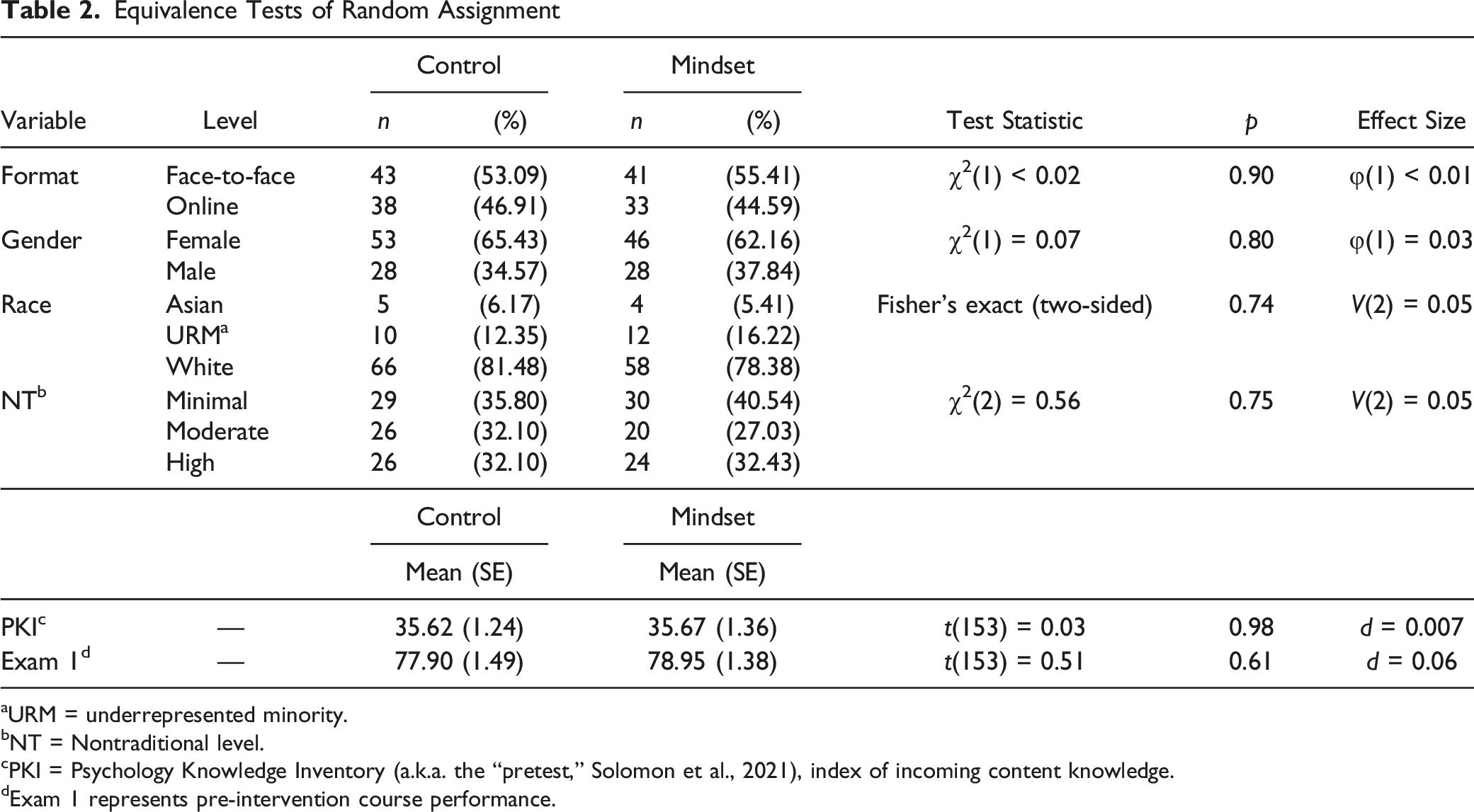
aURM = underrepresented minority.
bNT = Nontraditional level.
cPKI = Psychology Knowledge Inventory (a.k.a. the “pretest,” Solomon et al., 2021), index of incoming content knowledge.
dExam 1 represents pre-intervention course performance.
Overall Intervention Effects on Mean Exam Performance
To evaluate the effects of Condition and NT on course performance, we first analyzed mean exam performance across Exams 2–4 as the primary outcome measure. Exam 1 was excluded from this analysis because it occurred prior to the first phase of the intervention. To provide maximum sensitivity for detecting effects of Condition and NT, we included the Psychology Knowledge Inventory (PKI) and Exam 1 scores as covariates in a 2 (Condition: GMI or control) x 3 (NT: minimal, moderate, or high) between-subjects Analysis of Covariance (ANCOVA).
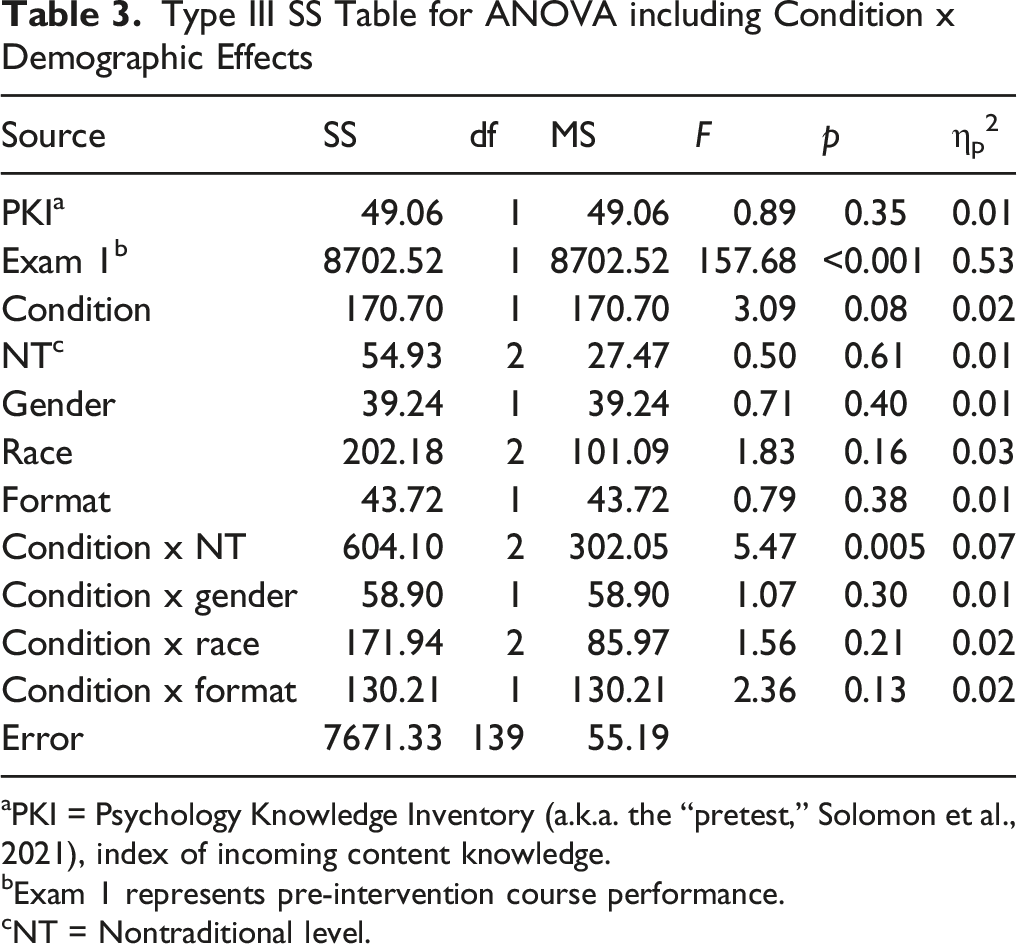
This analysis revealed that PKI did not reliably predict exam performance, F(1, 147) = 1.06, MSE = 56.58, p = .30, ηp2 = .01, but that performance on Exam 1 was highly associated with post-intervention exam performance, F(1, 147) = 161.93, MSE = 56.58, p < .0001, ηp2 = .52. More importantly, the Condition effect approached significance, F(1, 147) = 3.69, MSE = 56.58, p = .06, ηp2 = .02, with estimated marginal means revealing higher average exam performance among the GMI group (M = 77.74, SE = 0.89) relative to the control group (M = 75.39, SE = 0.84). Critically, this overall GMI benefit was qualified by a significant Condition x NT interaction, F(2, 147) = 4.23, MSE = 56.58, p = .02, ηp2 = .05 (see Figure 1). There was no main effect of NT, F(2, 147) = 0.58, MSE = 56.58, p = .56, ηp2 = .01. These results remain stable when additional demographic variables are included in the model and allowed to interact with Condition (Table 3), supporting the hypothesis that NT is the key moderator of the Condition effect. Effects of GMI on Exam Performance across Levels of Nontraditionality. Note. GMI = Growth mindset intervention. NT Level = Level of Nontraditionality. Bars represent estimated marginal means from the Condition x NT ANCOVA. Error bars represent the Standard Error of the estimated marginal means. Connectors with asterisks represent significant pairwise contrasts. Not all possible pairwise contrasts were conducted—see text for analysis details Type III SS Table for ANOVA including Condition x Demographic Effects aPKI = Psychology Knowledge Inventory (a.k.a. the “pretest,” Solomon et al., 2021), index of incoming content knowledge. bExam 1 represents pre-intervention course performance. cNT = Nontraditional level.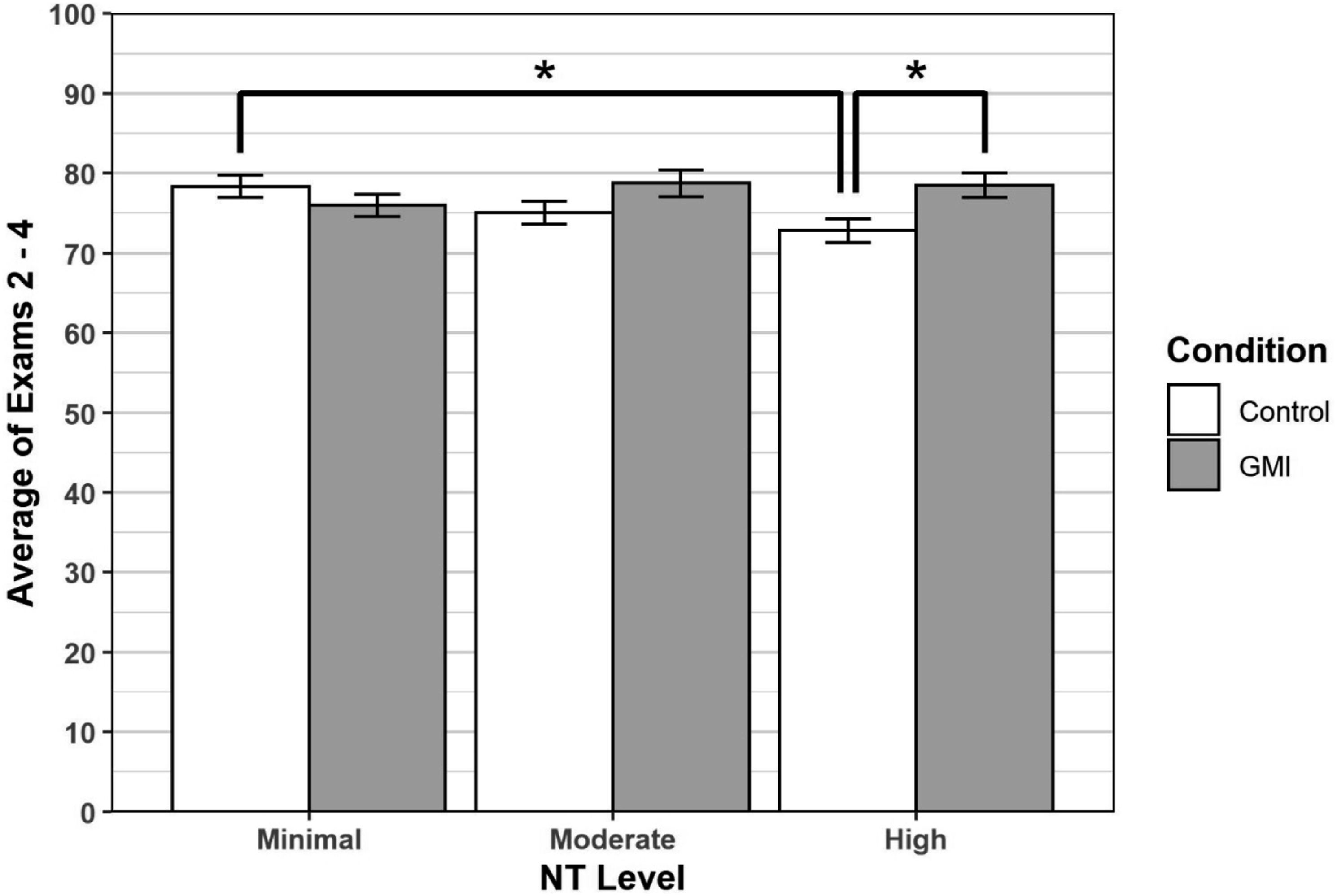
As Figure 1 shows, the benefits of the GMI were limited to students who were more nontraditional. Simple pairwise contrasts (Tukey-adjusted for three comparisons) indicated that the GMI significantly improved exam performance (relative to the control group) for the High NT students, t(147) = −2.67, p = .02, but not for the Moderate NT, t(147) = −1.63, p = .24, or Minimal NT students, t(147) = 1.20, p = .46. These results directly support predictions 1 and 2, respectively. An alternative perspective on this interaction is that performance varied across NT level in the control condition, but not in the GMI condition. Within the control condition, the simple main effect of NT was significant, F(2, 147) = 3.77, p = .025. Supporting prediction 3, simple pairwise contrasts (Tukey-adjusted for three comparisons) showed a significant advantage of Minimal NT students relative to High NT students, t(147) = 2.72, p = .02. Moderate NT students did not differ significantly from Minimal NT, t(147) = 1.62, p = .24, or High NT students, t(147) = 1.07, p = .53. In contrast, within the GMI condition, the simple main effect of NT was not statistically significant, F(2, 147) = 1.07, p = .35.
Performance Patterns Across the Quarter
The previous analysis established overall performance patterns with a single composite score; the following analyses track performance across the quarter to better understand the dynamics of both NT-based performance differences and the Condition effect across doses. The experimental design allowed each exam to correspond to a specific intervention dosage (Exam 1 = 0 doses, Exam 2 = 1 dose, Exam 3 = 2 doses, and Exam 4 = 3 doses).
First, we compared students’ scores on Exam 1, which was taken before any intervention occurred. A 2 (Condition: GMI vs. control) x 3 (NT: minimal, moderate, or high) between-subjects Analysis of Variance (ANOVA) revealed no Exam 1 performance differences based on NT, F(2, 149) = 0.83, p = .44, η p 2 = .01, indicating all students regardless of NT demonstrated similar early-quarter performance. The ANOVA also confirmed there was not a significant main effect of Condition, F(1, 149) = 0.11, p = .74, ηp2 < .01, or Condition x NT interaction, F(2, 149) = 1.16, p = .32, ηp2 =.02.
Next, we analyzed scores across all exams to understand the trajectory of performance across the quarter. To account for multiple observations per student, we conducted a mixed-effects model in which both the intercept and the slope of Dose were treated as random effects allowed to vary across students. Condition, NT, and Dose were included as fixed effects in the model, with Dose treated as a numeric predictor and centered around the “dosage midpoint” (dose = 1.5) rather than dose = 0. As a result of centering, effects not involving Dose were evaluated at this midpoint rather than at dose = 0, simplifying their interpretation. This centering did not have any effect on the estimates of effects involving Dose.
Type III SS ANOVA Table for Mixed-Effects Model
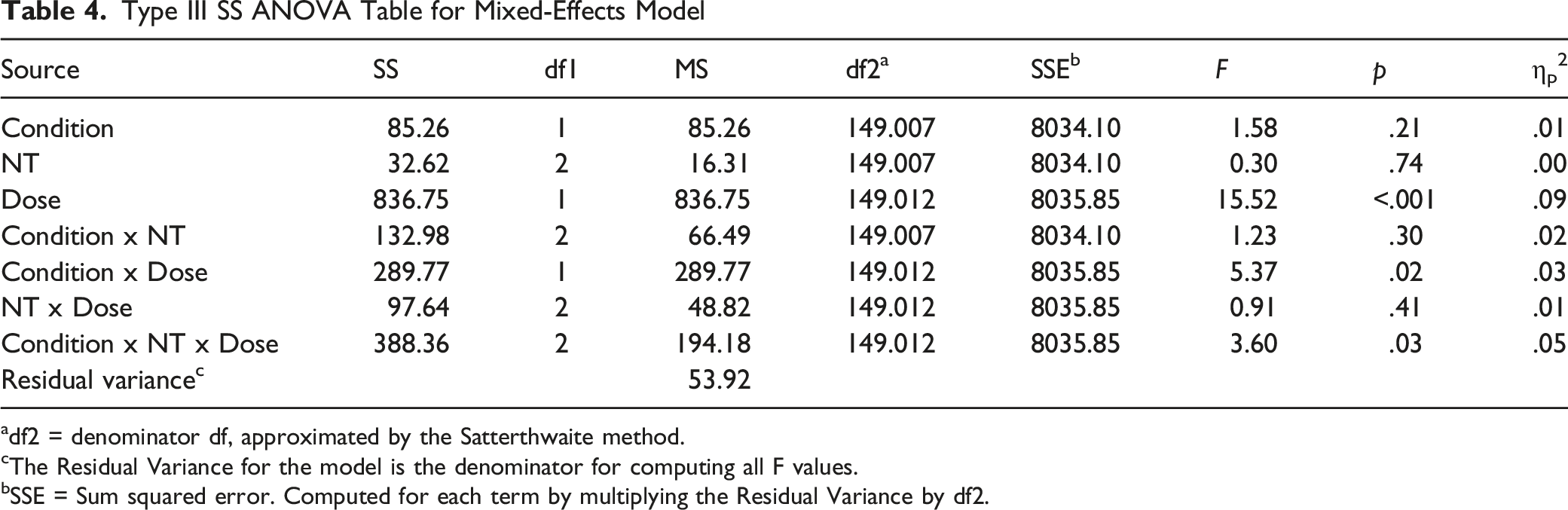
adf2 = denominator df, approximated by the Satterthwaite method.
cThe Residual Variance for the model is the denominator for computing all F values.
bSSE = Sum squared error. Computed for each term by multiplying the Residual Variance by df2.
The 3-way interaction (see Figure 2) indicates that the slope of Dose (or the trajectory of performance across the quarter) differed as a function of NT and Condition. To unpack this pattern, we computed the marginal linear trends (i.e., Dose slope) at each combination of NT and Condition. These slopes represent a group’s estimated change in score per exam. For example, a slope of −2 would indicate a drop of 2% from one exam to the next or a total drop of 6% between Exams 1 and 4. After computing these slopes, we conducted simple effects tests and simple pairwise contrasts to test for significant differences in slopes among groups. Performance Across Exams as a Function of GMI and Level of Nontraditionality. Note: GMI = Growth mindset intervention. NT = Nontraditionality. Lines represent estimated marginal trend predictions from the mixed-effects model treating dose as a numerical predictor. Points and error bars represent the descriptive mean and the standard error of the mean for the given level of NT, Condition, and Dose. Control and GMI points are slightly offset horizontally to avoid overlapping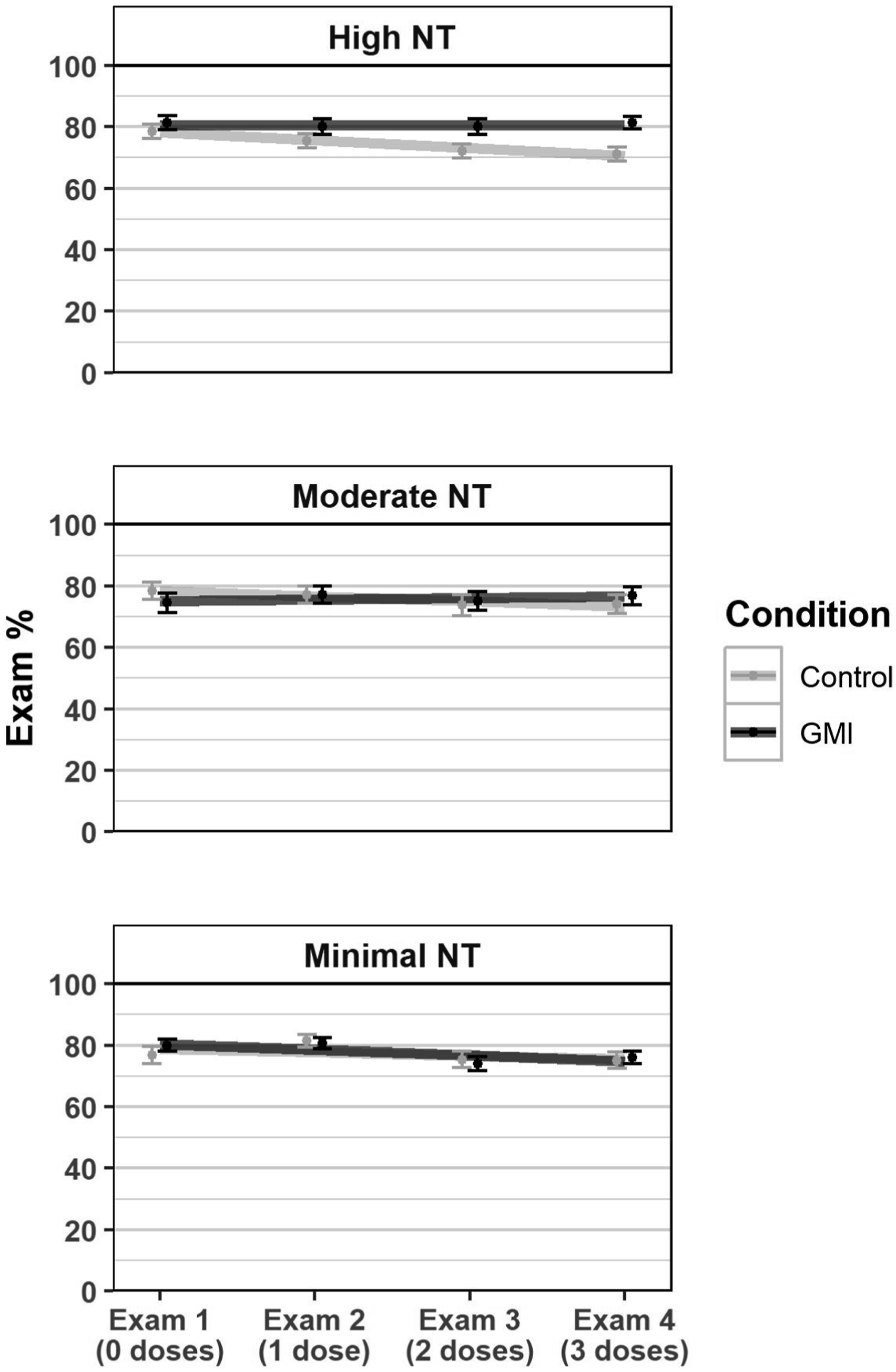
First, at each NT level, we conducted simple pairwise contrasts comparing the Dose slopes in the control versus GMI condition (Tukey-adjusted for three comparisons). This difference was not significant within the Moderate, t(149) = −2.03, p = .11, or Minimal NT groups, t(149) = 0.81, p = .70. However, the control and GMI slopes differed significantly within the High NT group, with slopes of −2.54 and 0.02 for the control and GMI groups, respectively (difference = 2.56, t(149) = −2.59, p = .028). The model estimates negligible performance changes across the quarter for High NT GMI participants but an overall performance drop of 7.62% from Exams 1 to 4 for High NT controls. Descriptive data for High NT students align with the model, showing a performance gap that grew from Exam 1 (Mcontrol = 78.54%, MGMI = 81.25%, gap = 2.71%) to Exam 2 (Mcontrol = 75.46%, MGMI = 80.08%, gap = 4.62%) to Exam 3 (Mcontrol = 72.23%, MGMI = 80.00%, gap = 7.77%), and to Exam 4 (Mcontrol = 71.15%, MGMI = 81.33%, gap = 10.18%).
The alternative way to understand the 3-way interaction is to examine, separately within the control and GMI conditions, how slopes differed across NT. Within the control condition, the High NT group descriptively −2.54 had a steeper negative slope than the Moderate NT group (−1.64) and Minimal NT group (−1.12), but the simple effects test reveals no significant difference among these slopes, t(149) = 1.15, p = .32. The simple effects test within the GMI group indicates significant variation among the slopes, t(149) = 3.28, p = .04. Although none of the simple pairwise contrasts (Tukey-adjusted for 3 comparisons) reached significance, this significant simple effect is driven by the fact that the negative slope from the Minimal NT group (−1.86) differed notably from both the Moderate NT slope (0.47), t(149) = −2.32, p = .06, and the High NT slope (0.02), t(149) = −1.97, p = .12. The GMI helped Moderate and High NT students improve or maintain performance across the quarter but did not benefit Low NT students.
Discussion
Heterogeneous Mindset Effects
Addressing the first aim of this study, the results confirmed that a growth mindset intervention provides a selective benefit to nontraditional students. Among highly nontraditional students (NT index = 4–7), those who received the GMI averaged 5.71% higher on post-intervention exams (2–4) than those in the control condition. In contrast, the exam performance of minimally nontraditional students (NT index = 1) and moderately nontraditional students (NT index = 2–3) did not differ significantly across conditions. Importantly, longitudinal analysis revealed the GMI performance benefit among highly nontraditional students developed over time, growing from a non-significant 2.71% difference prior to the intervention (Exam 1), to 4.62% after Phase 1 of the intervention (Exam 2), and ultimately 10.18% after the complete intervention (Exam 4). These results support the hypothesis that heterogeneity in GMI benefits can be linked to meaningful individual variation (Yeager & Dweck, 2020), with the intervention differentially boosting the achievement of at-risk groups (e.g., Sisk et al., 2018). Confirming the predictions of this study, the results support the specific hypothesis that nontraditional students constitute an at-risk population whose academic outcomes can be improved by a GMI.
Such results expand the range of at-risk groups for whom selective effects have been observed. Previous intervention research has often targeted identity groups underrepresented in their educational contexts and therefore susceptible to stereotype threat, including Black, Hispanic, and Native students in majority White institutions and women in quantitative fields (Aronson et al., 2002; Binning et al., 2019; Fink et al., 2018; Good et al., 2003; Yeager et al., 2016b; see Burnette et al., 2020, and McCabe et al., 2020, for null results). Other work has focused on low-income students who face limited financial resources and educational opportunities (Chao et al., 2017; Yeager et al., 2016b; see also Claro et al.’s 2016 correlational study). Yet other intervention studies have focused not on identity or background characteristics, but instead on students considered at-risk simply because of prior poor performance (Paunesku et al., 2015; Yeager et al., 2016a; 2019; see Sriram, 2014, for null results). By targeting the novel population of nontraditional students, this study advances understanding of the circumstances that contribute to academic risk, the potential for mindset interventions to mitigate that risk, and the heterogeneous mindset benefits that result from individual variation.
Achievement of Nontraditional Students
This study’s second aim was testing for an NT-based performance difference in the current sample. Prior to the intervention (exam 1), performance was equivalent between minimally and highly nontraditional students. However, as the quarter continued and exams 2–4 became harder (per the course instructor’s description and the observed exam averages), performance differences emerged. In the control condition, the exam performance of highly nontraditional students declined 7.61% over time, compared to 3.37% among minimally nontraditional students. These declines were not significantly different, but they suggest the increasing course intensity was particularly difficult for nontraditional students to navigate. Such results provide equivocal support for the third prediction of this study: highly NT controls exhibited descriptively worse performance than minimally NT controls, but that performance difference was absent at baseline. The data add nuance to the hypothesis that nontraditional students are academically at risk, showing their capacity for high achievement but also their vulnerability to struggle. Such results echo the findings of Blackwell et al. (2007), who described a downward trajectory in the math performance of adolescent students unless they participated in a GMI, which improved their math grades.
How can the current finding of an emergent performance difference be reconciled with previous research showing no difference between nontraditional and traditional students? At least two factors may explain the divergent results: different institutional contexts and metrics of nontraditionality. Whereas prior research was conducted at a large, 4-year university (Eppler & Harju, 1997), multiple public research universities (McNeil et al., 2016), and a liberal arts school (Spitzer, 2000), this study assessed the performance of nontraditional students in the context of a rural, 2-year community college. Observation of a performance difference only in certain institutional contexts or student populations suggests nontraditional students have the capacity to perform on par with traditional students, but their success is context-dependent. If institutional data reveal performance differences based on nontraditionality, low-cost strategies like the mindset intervention may serve as a stopgap measure, reinforcing the strengths of nontraditional students (Dill & Henley, 1998; Eppler & Harju, 1997; Mesa, 2012) and encouraging them to achieve their potential.
Another reason for divergent performance results could be the inconsistent metrics used to identify nontraditional students. This investigation followed Horn and Carroll (1996) and Choy (2002) in describing nontraditional students along a continuum determined by seven characteristics: delayed enrollment, part-time status, financial independence, full-time work, having dependents, single parenthood, and having a GED. Their research, along with others’ (Radford et al., 2015; Skomsvold, et al., 2011), demonstrated more nontraditional students are at greater risk of leaving college without a degree, just as this study found highly nontraditional students at risk of underperformance. In contrast, prior studies that failed to detect performance differences between traditional and nontraditional students relied on only one or two variables when identifying nontraditional students (age only, Spitzer, 2000; age and part-time status, McNeil et al., 2016; age and delayed enrollment, Eppler & Harju, 1997). Those studies may have painted nontraditionality with too broad a brush, washing out potential differences when moderately and highly nontraditional students were grouped together.
Potential Mechanisms
In this context, at least two explanatory mechanisms for the mindset effect arise. One hypothesis proposes that GMIs support nontraditional students’ performance by helping maintain their motivation. In particular, the theorized relationship between mindsets and achievement goals may play a key role (Dweck & Leggett, 1988; Yeager & Dweck, 2020), with the GMI supporting adoption of learning (vs. performance) goals and thereby producing downstream performance benefits (Blackwell et al., 2007; Dupeyrat & Mariné, 2005; Hong et al., 1999; Robins & Pals, 2002). Nontraditional students are known to possess positive motivational attributes (Dill & Henley, 1998), including a preference for learning goals (Eppler & Harju, 1997; Mesa, 2012). However, as introductory psychology became progressively more challenging, and highly nontraditional students’ personal and professional lives continued to demand time and effort, they may have struggled to maintain a learning orientation and their strong early performance on exam 1. While scores gradually declined among nontraditional students in the control condition, the GMI may have reinforced the learning orientation of nontraditional students, leading to greater achievement. By contrast, minimally nontraditional students did not receive a mindset benefit, perhaps because they do not share highly nontraditional students’ unique motivational profile or because greater college readiness enabled them to succeed regardless.
The potential role of college readiness suggests a second, related hypothesis: the GMI benefit among highly nontraditional students may stem from its encouragement of adaptive study techniques. In addition to promoting the idea of flexible intelligence, the intervention also addressed how academically successful students need to exert effort, use effective study strategies, and seek help from others. In other words, the GMI emphasized the behavioral correlates of a learning orientation (Dweck & Leggett, 1988; Yeager & Dweck, 2020): active and challenging practice that students may initially struggle with, but which ultimately produce better conceptual learning and transfer than do passive techniques that create a false sense of familiarity with content (Dunlosky et al., 2013). As a result, the intervention may have directed nontraditional students to enact study strategies (c.f., Fink et al., 2018) and help-seeking behaviors they might otherwise have forgone. The demographic survey data demonstrated that highly nontraditional students have less opportunity for college-preparatory experiences, including limited access to AP classes, Running Start, and parental expertise. Therefore, the GMI may have selectively helped nontraditional students because they lacked (a) knowledge of how to study effectively or (b) understanding that help-seeking is an appropriate strategy for improvement.
Both hypotheses emphasize the importance of supportive, growth-oriented messaging from instructors. Given the documented tendency for instructors to underestimate the potential and skills of nontraditional students (Bowl, 2001; Mesa, 2012), resources that cultivate instructor belief in student capabilities and help instructors guide students toward more effective study could prove fruitful for enhancing the achievement of nontraditional students. Indeed, a growing body of evidence demonstrates that students are sensitive to instructor mindsets about student abilities, with consequences for their motivation, engagement, and achievement (e.g., Canning et al., 2019; Muenks et al., 2020). In addition, recent research shows that GMIs are most effective when students are surrounded by peers who also hold growth-oriented beliefs (Yeager et al., 2019). Therefore, educators who wish to support the success of nontraditional and other at-risk students might address instructor mindsets and the culture of their learning environments.
Conclusion
Using a random-assignment experimental design, this investigation established that a GMI can improve the exam performance of highly (vs. minimally and moderately) nontraditional students enrolled in introductory psychology at a community college. This rigorous design was combined with a detailed demographic survey that elaborated on the complex nature of nontraditional students’ academic risk, which is rooted in financial stress, conflicting time demands, and limited college-preparatory experience and expertise. Despite such challenges, the early achievement of highly nontraditional students in this course matched their peers; a performance difference in the control condition did not emerge until later in the quarter, as the scores of highly nontraditional controls gradually declined. This study is subject to limitations, including its focus on a single institution and the absence of a pre- and post-survey measure to evaluate whether the intervention modified students’ mindsets (or achievement goals). Nonetheless, it provides novel evidence that advances understanding of heterogeneous GMI effects, academic risk in higher education, and the potential for GMIs to support students who face challenging personal circumstances. By reinforcing students’ belief in their own capabilities and guiding them toward effective study strategies and help-seeking, GMIs offer a low-cost strategy for improving the achievement of highly nontraditional students.
Footnotes
Acknowledgments
The authors thank Gabby Stark and Jessica “Pua” Sweeney for their assistance with informed consent and data collection and Mitchell Schneider-Hobbs for his assistance in preparing the data for analysis.
Declaration of Conflicting Interests
The author(s) declared no potential conflicts of interest with respect to the research, authorship, and/or publication of this article.
Funding
The author(s) received no financial support for the research, authorship, and/or publication of this article.
Transparency and Open Science Statement
The raw data and analysis code used in this study are not openly available but are available upon request to the corresponding author. Some materials (the demographics survey) are provided in the supplementary OSF Material (Fink, 2021), while others (the GMI materials) can be found in a prior publication (Fink et al., 2018) and are also available upon request. No aspects of this study were pre-registered.
