



Abstract
Background:
Although undergraduate psychology curriculum should cultivate performance-based skills to prepare students for helping professions, little work to date has addressed this standard.
Objective:
This research replicates the methods used in a previous study by examining pre-post changes in empathic communication skills and perceived communication competence across two applied psychology courses: Basic Helping Skills and Internship. This study extended this work by also exploring learning gains from different formats (i.e., face-to-face vs. online), internship types (mental health-related vs. not mental health-related), and the longevity of learning gains.
Method:
Psychology students (N = 171) completed a measure of communication competence and provided written empathic responses on a vignette-based performance measure at the start and end of the semester.
Results:
Students perceived their communication skills as improving over time; however, only students in the Basic Helping Skills course showed improved empathic communication skills, especially when the instruction was in a face-to-face format. Students with previous skill training maintained their learning gains over time.
Conclusion:
Student empathic communication improves most with face-to-face instruction in Basic Helping Skills rather than an internship experience.
Teaching Implications:
For the development of empathic communication skills, prerequisite requirements for Internship and instructive scaffolding for the application of skills may be recommended.
Keywords
Approximately one in five psychology majors will go on to human services professions (American Psychological Association, 2018), such as clinical, counseling, and school psychologists, which are projected to show faster than average occupational growth (14%) by 2026 (U.S. Department of Labor, Bureau of Labor Statistics, 2017). Thus, an important objective of many undergraduate psychology programs is to prepare students for helping professions. To this end, providing opportunities to develop communication and helping skills, such as empathic communication skills, is important. In fact, the most recent American Psychological Association (APA) Guidelines for the Undergraduate Psychology Major (APA, 2013) identifies a key program outcome is to “interact effectively with others” by demonstrating a “capacity for listening” (APA, 2013, p. 31). This report also emphasizes the importance of describing and formally assessing skill sets of psychology majors, though acknowledges that interpersonal effectiveness is among the most difficult skills to formally measure.
Psychology programs, then, are tasked with providing opportunities for communication skill development as well as assessing the degree to which such skills have been obtained. Psychology programs typically offer opportunities for growth through applied course work, such as community internship and skills training. Little is known, however, as to how effective these educational experiences are for communication skill development. To date, we identified only one published study that assessed helping skill development within psychology undergraduate students. Katz and colleagues (2014) examined empathic communication skill responses and communication competence among 45 undergraduate students. These students were enrolled in applied psychology courses, including a community internship and a skills training course. Students in these courses completed a vignette-based measure of empathic skill performance and a communication competence scale. Regardless of the course, students showed increased confidence in their communication skills over the course of the semester; however, improvement in empathic communication skills rated by independent observers was only evident for students receiving skills training and not internship students. Notably, this study had a small sample and did not include an assessment to determine if skills were maintained over time, nor did it compare student performance at different types of internship sites. Therefore, it remains possible that students’ skills deteriorate after the training ends, or that certain types of sites (e.g., more mental-health focused internship sites) could be beneficial for empathic skill building.
Beyond the question of applied course type, one might wonder which format of instruction is most helpful for communication skill development. With the increased use of online formats in higher education (Lederman, 2018), it is important to understand the degree to which an online format can be successful in comparison to face-to-face classrooms when the learning objective is inherently interpersonal, such as empathic communication skills. Few studies have examined the relative effectiveness of face-to-face versus online instruction for human service-related performance outcomes. The superiority of face-to-face courses has sometimes been shown with such learning outcomes as business communication skills (Callister & Love, 2016) and multicultural case conceptualization skills (Gainor & Constatine, 2002); whereas other studies have failed to find a difference between formats when examining microcounseling skills (Ferreira, 2005) and rapport building (Murdock et al., 2012).
The purpose of this research was to examine which applied psychology course (i.e., Basic Helping Skills or Internship) is most helpful for communication skill development, particularly empathic listening skills. This study replicates the method of the Katz et al. (2014) study, in that we compared changes in observed empathic communication skills and self-reported perceived communication competence among students enrolled in one of two applied psychology courses. Like Katz et al., we examined pre- and post-course assessments across multiple instructors and included the same outcome measures used in their study. Based on findings by Katz and colleagues, we hypothesized that students in both courses would report improved communication skills, but only Basic Helping Skills students would show improvement of skills as rated by independent observers, whereas Internship students would not show empathic communication skill improvement. Additionally, this research further expanded the work of Katz et al. by exploring whether skills seemed to be retained over time as well as exploring differences in performance across course formats (i.e., online vs. face-to-face) and type of internship sites (i.e., mental health-related vs. not mental health-related).
Method
Participants
Participants were students enrolled in either Basic Helping Skills or Psychology Internship at the time of data collection. Over the 4-year period 275 students consented and participated in a learning outcomes assessment. Students were excluded from the analysis if they failed to complete either the questionnaires at the start or end of the semester (n = 82), provided incomplete data (n = 7), were enrolled in both courses simultaneously (n = 8), or had an internship before taking part in Basic Helping Skills (n = 7). The final sample included 171 students (MAge = 21.22 ± 3.37 years, 73% female, 85% psychology major/minor) completing the Psychology Internship (n = 85; 21% of which had previous taken Basic Helping Skills) or the Basic Helping Skills course (n = 86; 52% of which were in an online section). Sample characteristics are presented in Table 1. The majority of students (63%) reported having previously completed six or more psychology classes, with 32% completing 10 or more. The last collected GPA (at time of degree completion for most participants) was MGPA = 3.25 ± 0.48. The internship course was only available to upper level psychology majors, and also had significantly more female students (84%) than the Basic Helping Skills course (62%), χ2(1, N = 171) = 10.29, p = .001. The two courses (i.e., Internship and Basic Helping Skills) did not differ by age, t(169) = 0.46, p = .65, d = −0.07, 95% CI [−0.37, 0.23], term GPA, t(166) = 0.19, p = .85, d = −0.03, 95% CI [−0.33, 0.27], or last available GPA, t(166) = 0.76, p = .45, d = −0.11, 95% CI [−0.42, 0.19], respectively. 1 Term GPA and last available GPA were not well correlated with outcome variables (i.e., perceived communication competence or empathic communication ratings) at any of the time points, all rs < .13 and ps > .10.
Description of the Sample.

Note. N = 171. Internship type data was not available for four students.
Courses
The Basic Helping Skills course was an elective 4 credit upper-division psychology course open to students from a variety of majors. Objectives included training students in active listening, such as empathic communication skills and theories of behavior change. The course was offered in a traditional face-to-face version (four sections) and an online version (three sections) with Mclass size = 27.40 ± 4.83. The face-to-face and online format shared many similarities, including comparable time spent with lecture and text-based learning regarding microcounseling skills (including verbal tracking, empathic responses), broader concepts such as multicultural and ethical considerations, as well as theoretical orientations such as client-centered perspectives. Both the face-to-face and online sections required three to four recorded role plays for course credit. Both formats included two to three exams and weekly class discussions (or online forum discussions in the case of the online section).
A notable difference between Basic Helping Skills course formats (i.e., face-to-face vs. online) was the opportunity to practice with peers and receive feedback. In the face-to-face sections, several weeks of class time was devoted to breaking into groups of four in which two students would role play the client and helper while two students observed and provided feedback using forms provided by the instructors. The online sections were conducted asynchronously, which led to substantially less practice and feedback time experienced by students, though they were encouraged to practice via online chat with one another. In addition, the online sections were taught by one instructor who utilized Chang’s (2013) Developing Helping Skills text and accompanying online materials, whereas the face-to-face courses were taught by two different instructors, one utilizing the Hill’s (2014) Helping Skills: Facilitating Exploration, Insight, and Action and the other instructor using Poorman’s (2003) Microskills and Theoretical Foundations for Professional Helpers.
The internship course was an elective capstone experience for psychology majors. Following a 2-credit pre-internship course focused on ethics, professional behaviors, and site selection, students were placed in a community site, interning a minimum of 9 hours per week. Most internships involved direct care within mental health or community agency settings, but some were related to human resources or organizational psychology (see Table 1). For analysis, these internships were dichotomized as either mental health-related (62%) or not mental health-related (38%) for the sample of 85 internship students. 2 Students met weekly for group supervision with the faculty supervisor to discuss experiences, ethical and professional issues, and connect coursework to applied experiences. Weekly reflections logs, self-selected readings, and a writing and presentation assignment were also incorporated. Over the course of the study, there were 11 sections of internship (Mclass size = 10.90 ± 3.51) with four unique course instructors, though syllabi and course expectations were relatively consistent.
Measures
Perceived communication competence
Student perceptions of their own communication skills were measured by the 12-item Perceived Communication Competence Scale (Richmond & McCroskey, 1998) that asks respondents to rate how competent they would feel in a variety of situations (e.g., “talk to a stranger,” “present a talk to a group of acquaintances”). Students rated each item on a scale from 0 = completely incompetent to 100 = completely competent. The mean of these 12 items was calculated for each student at both time points. There was high internal consistency for items in this measure with the current sample, α = .90.
Perceived counseling communication skills
We developed two items for this study to assess students’ perceptions of their own competence more specifically with individual and group counseling because these topics are not explicitly covered in the Perceived Communication Competence Scale. These items were: “providing counseling to an individual who is seeking my help” and “providing counseling to a group that is seeking my help.” These items were rated in the same manner as the other items in the Perceived Communication Competence Scale with 0 = completely incompetent to 100 = completely competent. Given the novel nature of these items, they were analyzed separately from the Perceived Communication Competence Scale total score. There was high internal consistency (α = .88) between these two items.
Empathic communication skills
The 6-item Helping Response Questionnaire (Miller et al., 1991) is a measure of empathetic communication skills. The measure presents participants with six vignettes from the perspective of the client speaking and asks participants to “write the next thing you would say if you wanted to be helpful” (p. 444). An example vignette prompt is:
A 15-year-old girl tells you: “I’m really mixed up. A lot of my friends, they stay out real late and do things their parents don’t know about. They always want me to come along, and I don’t want them to think I’m weird or something, but I don’t know what would happen if I went along either.” Write here what you would say next.
Student responses were coded on a 5-point scale with higher numbers indicating a higher quality response. These ratings took into account aspects of responses, which would both increase and decrease quality. For example, responses that included judgment, advice, or interrogation were considered “roadblocks” that may lower an otherwise higher quality response. The ratings were as follows: 1 = conversational “roadblocks,” 2 = neither a “roadblock” nor a reflection (e.g., an open question) or a reflection that was spoiled by a “roadblock,” 3 = reflection of the content of the client statement, 4 = reflection of inferred meaning, and 5 = reflection of inferred meaning and a feeling that fits the original statement or an appropriate metaphor. For example, a representative “1” response to the sample vignette was, “You should explain to the girls that what they are doing is not your scene and don’t feel comfortable,” whereas a representative “5” response as, “You feel torn between the pressure to please your friends and please your parents, and are unsure how to move forward.” Two clinical-counseling psychology masters students, blind to student course type and other responses, independently coded the responses. There was moderate agreement between coders, κ = .60. All instances of disagreement were reviewed together until consensus was achieved. The mean score of the six responses was calculated for each participant at both time points.
Demographics
Students also provided basic information about themselves at the start of the semester, including age, gender, year in school, major, psychology courses taken, GPA, and internship type. Additional data was pulled from student records, including course grade, overall GPA, and declared major on record.
Procedure
Like the Katz et al. (2014) study, the instructors of the courses in the study asked students to complete the questionnaires before the end of the first week of classes and again within the last two weeks of the semester. Unlike the Katz et al. (2014) study, students completed the assessments online rather than in the classroom. The assessments were considered part of the course expectations and were awarded a small number of points for completion. Students could request an alternative assignment; however, none did so. All procedures were approved by the university’s institutional review board.
Results
Statistical Approach
Student improvement on each of the two outcomes (communication skills, empathic communication) was assessed separately via mixed factorial ANOVAs. In these 2 (course) × 2 (time) ANOVAs, course was a between-subject factor and time (start of semester/end of semester) was a within-subjects factor. The effect size partial eta square (
Likewise, 2 × 2 ANOVAs were utilized to examine whether improvement varied as a function of class format (i.e., face-to-face vs online), in addition to 2 × 2 ANOVAs examining improvement dependent on internship type (i.e., mental health-related vs other sites). To examine whether students with previous Basic Helping Skills training retained their gains, a one-way ANOVA was used to compare internship students with previous Basic Helping Skills training with three other groups of students (i.e., internship students without prior Basic Helping Skills training, students in the face-to-face Basic Helping Skills course, and students in the online Basic Helping Skills course) at the start of the semester. Descriptive statistics for perceived communication competence and the empathic communication skills across course comparisons and follow up analyses can be found in Table 2.
Sample Size and Descriptive Statistics for Confidence in Communication Skills and Empathic Communication Skills Performance in Each Course and Student Subgroup.

Note. n = 171; BHS = Basic Helping Skills course; Empathic skill = Helping Response Questionnaire ratings (ratings could range from 1 to 5, with higher scores reflecting more empathic responses); Perceived competence = self-reported perceptions of communication skills on the 12-item version of the Perceived Communication Competence Scale (ratings could range from 0 to 100, with higher scores reflecting greater perceived competence).
Perceived communication competence
For the pre-post comparison of self-reported communication competence, a 2 (time) × 2 (course) ANOVA revealed a main effect for time, such that across courses, students rated themselves as more competent on the 12-item Communication Competence Scale at the end of the semester relative to their self-ratings at the start of the semester, Time main effect F(1, 169) = 48.10, p < .001, which is a large effect
Furthermore, for the comparison of Basic Helping Skills course format (i.e., face-to-face vs online) a 2 (time) × 2 (format) ANOVA revealed that student perceptions of communication improvement did not vary as a function of course format, Time × Format interaction effect F(1, 84) = 0.42, p = .52,
Empathic Communication Skills
For the comparison of the Internship versus Basic Helping skills courses, a 2 (time) × 2 (course) ANOVA revealed that empathic communication skill improvement from the beginning to the end of the semester was dependent on which course the student was enrolled in, Time × Course interaction effect F(1, 169) = 91.16, p < .001, which is a large effect
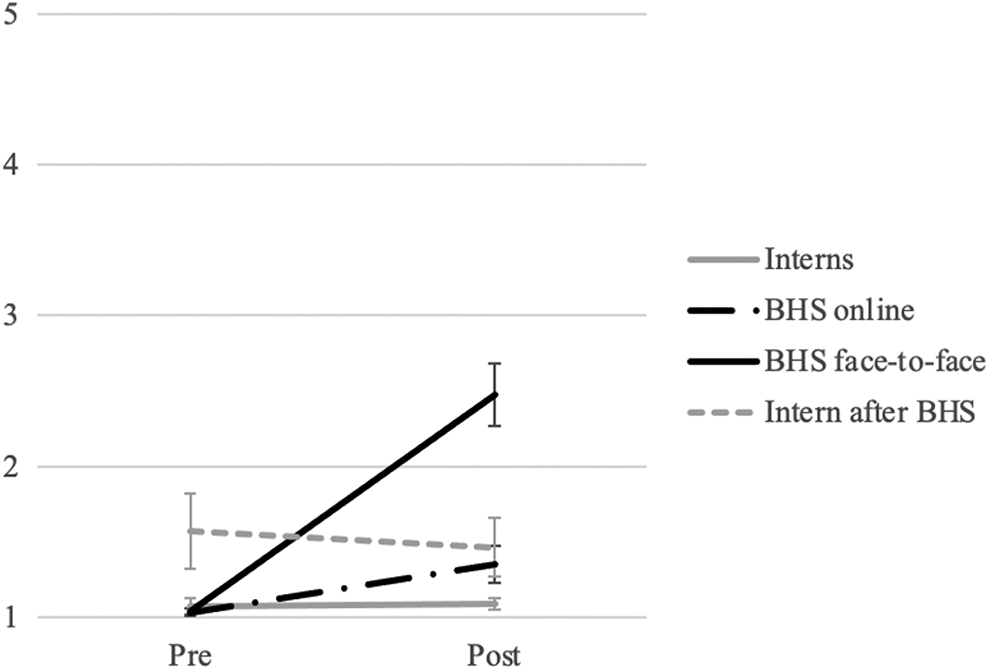
Student group differences for empathic communication skills at the beginning and end of the semester.
For the comparison between students in the face-to-face format versus students in the online format Basic Helping Skills course, the 2 (time) × 2 (format) ANOVA revealed that the degree of empathic skill improvement from beginning to the end of the semester was dependent on format type, Time × Format interaction effect F(1, 84) = 92.44, p < .001, which is a medium effect
For the Internship students, 2 (time) × 2 (internship type) ANOVA revealed that there was no reliable change in empathic communication skills, Time main effect F(1, 84) = 0.11, p = .73,
The longevity of these empathic skill gains was explored by examining a subset of students who completed Basic Helping Skills before their internship began. A one-way ANOVA revealed that the internship students who had previously completed Basic Helping Skills began their internship semester at a significantly greater empathic communication skill level than all the other groups of students (i.e., internship students without prior Basic Helping Skills training, students beginning the face-to-face Basic Helping Skills course, and students beginning the online Basic Helping Skills course), F(3, 167) = 31.33, p < .001, which is a large effect
Discussion
The current study replicated the method and findings of Katz and colleagues (2014) with a larger sample. We found that students believed their communication skills had improved from the start to the end of the semester, regardless of the class in which they were enrolled; however, reliable improvement in their actual empathic communications skills was only evident in the Basic Helping Skills course and not observed for Internship students. Although confidence is important and may even be a precursor to counseling skill performance (Hill et al., 2016), it is not a substitute for skill performance. This discrepancy between perception and performance may be a manifestation of the Dunning-Kruger effect in which those who have the very least amount of knowledge and experience in a field tend to overestimate their abilities and competence (Kruger & Dunning, 1999). Interestingly and consistent with the Dunning-Kruger phenomenon, a post hoc analysis of empathic responding and confidence in communication skills at the end of the semester revealed an inverse relationship such that students who felt more confident were actually less empathically skillful, r(171) = −.21, p = .006. Of additional note, not only has past research demonstrated increased confidence in communication skills among internship students over the course of the experience (Arnold et al., 1995; Peterson et al., 2014; Reddy & Hill, 2002) but their supervisors seem to share this perception of improvement (Shoenfelt et al., 2012; Simons et al., 2012). Given the potential for inaccurate assessments for empathic skill communication progress during applied psychology courses, educators may wish to emphasize that empathic responding is a modifiable skill set rather than innate ability (Ehrlinger et al., 2008) as well as develop and implement concrete metrics of performance feedback to aid in assessment. However, future work examining ebbs and flows in confidence in these courses might clarify this meaning. It should also be noted that student names were linked to the surveys for credit purposes, and as such, the perceived confidence-ability gap could reflect impression management or a desire to communicate a positive impression of the learning experience not otherwise captured by the survey.
Nonetheless, students in the Basic Helping Skills course showed improvement in empathic communication skills rated by outside observers over time, whereas students in the Psychology Internship did not. Likewise, the internship students who had previously taken the Basic Helping Skills course seemed to begin the semester at a higher empathic skill level than their internship peers who did not have this prior experience; however, the internship students with previous Basic Helping Skills training did not seem to improve further over the course of the semester. This suggests that Basic Helping Skills students maintained their learning gains over time. One explanation for why Basic Helping Skills might be superior to Internship for empathic communication skill learning could be due to major differences in course learning methods.
Internships typically offer observational learning. Though internship supervisors strive to incorporate practice and feedback with internship students, a much larger proportion of internship students’ time might reasonably be expected to be spent in direct care, observation and modeling from supervisors and other professionals. Within an internship experience, direct instruction of skills and immediate feedback may not always be logistically possible. Furthermore, feedback may be less consistent, common, or immediate depending on internship goals, supervisor style and comfort with providing feedback, and practicalities inherent in the setting (e.g., feedback may need to be delayed to attend to more pressing client needs). However, procedural learning outcomes (i.e., performing a skill) may be best attained with direct instruction, deliberate practice, and immediate feedback (Ambrose et al., 2010, pp. 18–19). As such, empathic communication skills might be better attained in a classroom learning environment with repeated deliberate and targeted practice and feedback (Hill et al., 2007, 2016), such as Basic Helping Skills courses. That is, these findings might suggest that microcounseling skills, such as empathic communication, may require specific targeted training and feedback for growth. Therefore, these findings might also suggest that internship students may need more scaffolding and guidance on how to translate knowledge gained in courses to these applied contexts (Costopoulos & Howes, 2016). Undergraduate psychology programs might consider requiring a counseling skills class as a prerequisite for certain types of internships. Of course, it should be noted that the differences in student performance in Basic Helping Skills versus Internship in the current study might not reflect differences in learning methods. Though the consistency with Katz et al. (2014) suggests some stability in the finding, it remains possible that other differences between the two courses and their administration could account for these results.
In the current study, we also found that students in the face-to-face Basic Helping Skills course improved more for empathic communication skills than the students in the asynchronous online course. Due to the asynchronous nature of the course, practice sessions were less feasible and less frequent than the face-to-face version, which might account for this finding. Virtual environments can present barriers such as less interpersonal interaction (e.g., Callister & Love, 2016), which could also account for these findings. It should be noted, however, that some studies of microcounseling skills (Ferreira, 2005) and rapport building skills (Murdock et al., 2012) have not found a difference in format, suggesting that there may be educational strategies for these contexts that might overcome these barriers. For example, the online students in the Murdock and colleagues (2012) regularly used private chatrooms with classmates for practicing skills, whereas the online students in our sample mostly completed brief video recorded role plays with friends or loved ones who volunteered to help and who likely were not educated or trained to also provide feedback but was otherwise asynchronous. In addition, success in online courses may be mediated by student factors like self-regulated learning (Winters at al., 2008). For example, Waschull (2001) found that when students selected an online general psychology course, they were more likely to fail the course than students who selected traditional face-to-face class formats, but this effect was not present when students were randomized into different formats. Notably, the students in the current study self-selected the course format. Though the face-to-face and online courses in this study shared many qualities, they also differed in some respects (e.g., instructors, textbook materials), leaving open the possibility that factors other than format are responsible for the discrepancies in the learning outcomes, and suggesting this finding should be interpreted with caution.
It is important to note that the lack of improvement for empathic communication skills among internship students does not preclude other sorts of learning gains and skill development associated with internship experiences. Though empathic communication skills are an important skill set, there are many other important specific helping skills (e.g., open questions, nonverbal behaviors, managing internal reactions), ethical (You, 2014), and multicultural (Simons et al., 2012) competencies, none of which were measured in the current study. Likewise, internship students might have gained valuable new knowledge of particular procedures, work environments, populations, and so on that might foster professional development (Bailey et al., 2017; Simons et al., 2012). Internship students might have also developed a deeper understanding or retention of empathy-related concepts, even if procedural learning was not improved.
Additional limitations for the current research should be noted. Due to the lack of random assignment, different instructors and textbooks for courses, and unknown student-specific factors such as engagement of students (particularly in the online section), it remains unclear how much these factors may have influenced our findings.
Investigators can advance this research further by utilizing alternative research methodologies. For example, in the current study, we utilized programmatic data increasing the ecological validity; however, researchers could randomly assign students to better untangle potential self-selection effects from instructional method and learning factors. Similarly, when making comparisons between face-to-face versus online formats, it would be valuable to keep curriculum, assignments, and assessment methods similar across classes to more finely parse out learning differences between delivery format. In addition, in the current study, we utilized written vignette responses to measure empathic communication skills. Although one study found that gains observed with this vignette-based measure mirrored behavioral ratings based on video-recorded performances (Miller & Mount, 2001), the oral skill performance of the students in this study is unknown. Furthermore, the ultimate purpose of skill acquisition and performance is to provide better care. Therefore, future researchers might measure oral skill performance, client satisfaction, and other student outcomes.
Though the current findings suggest the superiority of face-to-face Basic Helping Skills instruction for the empathic response skill, it should be highlighted that the average final scores for this group were modest (M = 2.48 on a 1 to 5 scale). The scores suggest that the average student response in Basic Helping Skills by the end of the semester may be relatively free from potentially harmful responses (i.e., “roadblocks” such as advice and judgment), but not yet consistently offering simple paraphrases and reflections. Altogether, this suggests there is plenty of room to improve our preparation of psychology majors for human service professions, with regard to empathic communication skills development within applied psychology courses.
Footnotes
Declaration of Conflicting Interests
The authors declared no potential conflicts of interest with respect to the research, authorship, and/or publication of this article.
Funding
The authors received no financial support for the research, authorship, and/or publication of this article.