



Abstract
Background
Understanding students’ naive conceptions about the norms that guide scientific best practice is important so that teachers can adapt to students’ existing understandings.
Objective
We examined what incoming undergraduate students of psychology believe about reproducibility and open science practices.
Method
We conducted an online survey with participants who were about to start their first course in psychology at a university (N = 239).
Results
When asked to indicate how a researcher should conduct her study, most students endorsed several open science practices. When asked to estimate the proportion of published psychological studies that follow various open science practices, participants’ estimates averaged near 50%. Only 18% of participants reported that they had heard the term “replication crisis.”
Conclusion
Despite media attention about the replication crisis, few incoming psychology students in our sample were familiar with the term. The students were nevertheless in favour of most open science practices, although they overestimated the prevalence of some of these practices in psychology.
Teaching Implications
Teachers of incoming psychology students should not assume pre-existing knowledge about open science or replicability.
Methodological and reporting practices in psychology have changed over the last decade, partly precipitated by the “replication crisis”: The discovery that many close replications of published studies did not replicate the original findings (Klein et al., 2014, 2018). Of course, psychology is not alone; the replication crisis extends to other fields, including economics (Camerer et al., 2016) and medicine (e.g., Errington et al., 2021). These apparent problems with replication have led to various potential solutions to make research practices more reproducible and transparent, including more published replication studies (see Brandt et al., 2014), more thorough reporting of methods and results (Wigboldus & Dotsch, 2016), open sharing of data (see Meyer, 2018), and preregistration of data collection and analytic plans (Nosek et al., 2018). These calls for more reproducible and transparent research practices have prompted the discipline to examine researchers’ norms, attitudes, and practices (e.g., Baker, 2016; Beaudry et al., 2021; Harris et al., 2018).
These changes present significant pedagogical challenges for the teacher of psychology. Keeping textbooks and other instructional materials up to date is difficult when supposedly well-established findings are contradicted by new replications emerging at a rapid pace. Furthermore, knowledge of emerging methodological practices is crucial for graduate student training. Even for students who do not go on to conduct research, an understanding of contemporary methodological practices—and problematic methodological practices—is essential for becoming informed and critical consumers of psychological knowledge. Studies have explored strategies for educating psychology students about replicability and open science practices (e.g., Chopik et al., 2018; Grahe et al., 2012; Jekel et al., 2020). These initiatives may help ingrain open science norms and change attitudes about research practices, but we know little about what students know or believe about open science research practices prior to entering the university classroom. This knowledge could be useful for two main reasons.
First, unlike some psychological phenomena in undergraduate courses (e.g., the internal workings of human senses), the replication crisis is frequently discussed in mainstream and social media (e.g., O’Grady, 2020; Yong, 2016, 2018). As such, incoming students might have some knowledge about these issues prior to their formal studies. Teaching methods should be informed by understanding students’ pre-existing levels of knowledge.
Second, anecdotal evidence suggests that students being taught about open science practices and reproducibility reforms (e.g., open sharing of data and code) are sometimes surprised that these are not already standard practice. This could imply a need for educators to reinforce and build on students’ “naive” impressions rather than radically altering their understanding of research practices. On the other hand, some evidence suggests that undergraduate students may quickly begin to engage in practices that hamper reproducibility. For example, Moran et al. (2021) found that 26.5% of the undergraduate students in their sample admitted to “Conducting multiple statistical analyses on the same dataset in an attempt to find a statistically significant result” (p. 14; i.e., p-hacking), while 9.6% reported rounding down p-values to meet a significance threshold. Knowing the extent to which incoming psychology students may—or may not—be “naive open scientists” could help guide pedagogical approaches.
To examine this, we conducted a descriptive study, asking incoming students in undergraduate psychology courses about their beliefs regarding reproducibility and open science practices. Our survey encompassed questions concerning norms (how students felt research should be conducted), norms in practice (how students believe psychological research is conducted), and replicability (how replicable students believe psychological research is). Our study was exploratory (see Wagenmakers et al., 2012) and descriptive; as such, we did not specify or test hypotheses.
Method
We preregistered the exploratory nature of this study on the Open Science Framework (Beaudry et al., 2022a). Our materials, data, and analytic code are are openly available in the same project (Beaudry et al., 2022a). Ethical approval was granted by Swinburne University of Technology.
Procedure
Contacts from tertiary institutions in Australia, New Zealand, the UK, and the USA invited students enrolled in their first-year psychology course to participate in the online survey hosted on Qualtrics. These contacts were identified through several avenues: direct contact with our colleagues, a session at the international meeting of the Society for the Improvement of Psychological Science (2019), and a Twitter thread with >15,000 impressions. We did not have inclusion criteria with respect to country, but most contacts who advertised the study were from the United Kingdom, Australia, or New Zealand.
Each contact sent their students invitations to participate via email or a course website 1–2 weeks before their course began. The invitation specified that students needed to be 18 years or older and starting their first course/unit of study in psychology at a university within the following month and included a link to the survey. The measures and items in the survey were presented in the same order for all participants.
Participants
Of those who started the survey (n = 423), we screened out 184 participants who were ineligible based on our preregistered exclusion criteria. Specifically, we screened out people who were younger than 18 years (n = 7). We also screened out individuals who had already started a psychology unit at a university, regardless of whether they had completed it (n = 72); were not enrolled in a psychology unit at a university (n = 1); or did not answer this question (n = 14). We excluded additional responses that Qualtrics flagged as spam (n = 1) or as a survey preview (n = 1). Finally, we excluded participants who met all other eligibility criteria, but did not respond to any of the main survey items (n = 88).
Of the eligible 239 participants, most reported that they were 18–24 years old (n = 193); 21 reported that they were 25–34 years old, 12 were 35–44 years old, 12 were 45–54 years old, and 1 was 55–64 years old. Most participants (n = 192) reported that they were women, 46 reported that they were men, and 1 participant reported non-binary gender.
Most participants attended university in Australia (n = 160), the United Kingdom (n = 63), or New Zealand (n = 11). Nearly all reported graduating from high school or secondary school (n = 230). Of those who attended high school, fewer than half completed high school psychology courses (n = 106). Participants reported 26 different nationalities; the most common were from Australia (n = 125), the United Kingdom (n = 43), and China (n = 15). About two-thirds of participants reported that at least one of their parents attended university (n = 157).
Material
Open Science Norms and Counternorms
Norm and Counternorm Items

Note. Participants responded to each item in the context of the scenario, “Imagine that Deborah is a psychology researcher who has designed a study to test a specific hypothesis.” Responses were provided on a Likert-type response scale ranging from 1 (strongly disagree) to 5 (strongly agree)
Each practice was elucidated by a pair of items (pro-open science; counter-open science) in the context of a common scenario (see the note accompanying Table 1). Participants rated their agreement separately for each norm and counternorm on a 1 (strongly disagree) to 5 (strongly agree) scale. We used the scenario of a specific researcher rather than referring to psychology researchers in general because the items were more concrete, engaging, and clear.
Beliefs About the Practice of Psychological Science
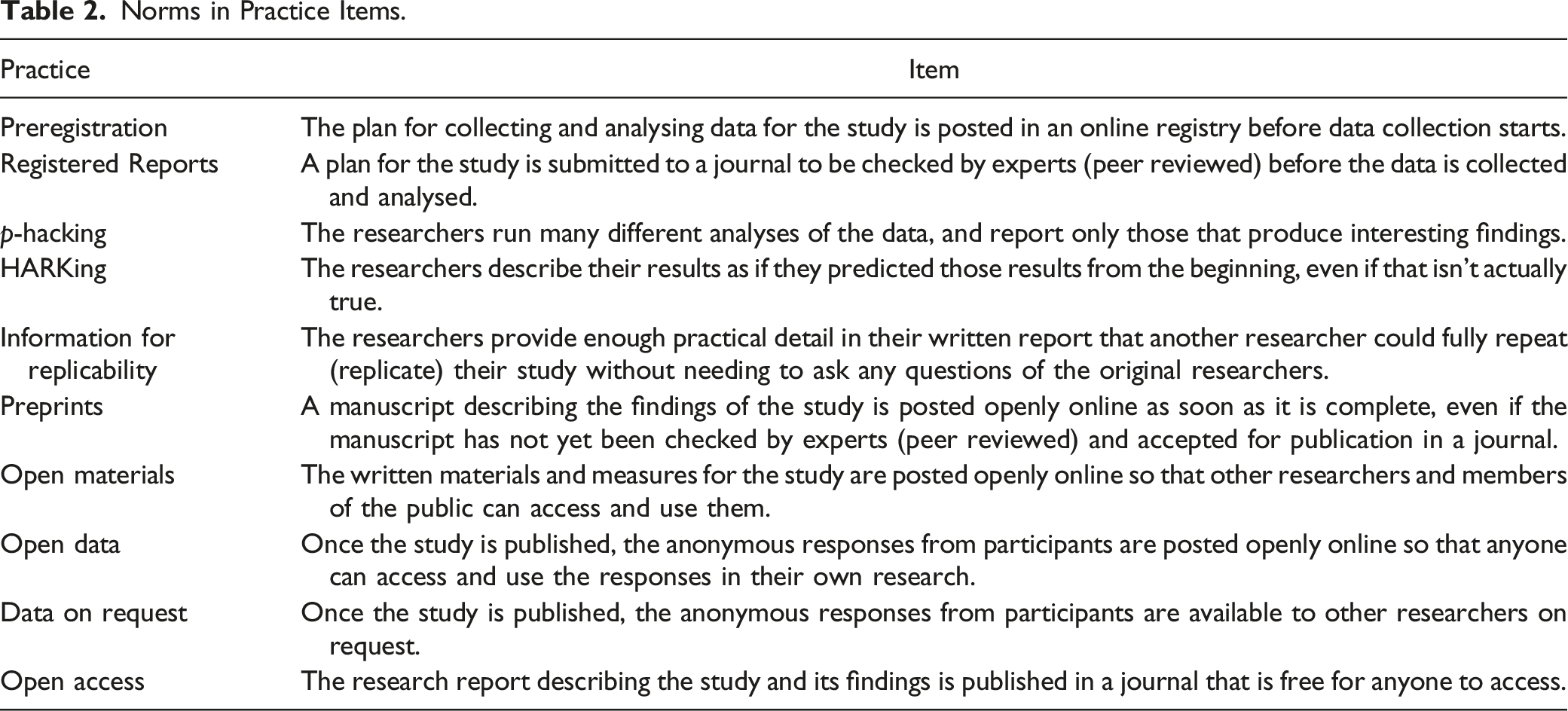
Norms in Practice Items
Beliefs About Replications
Two questions measured participants’ beliefs about the replicability of results in psychological science. The first asked participants to:
Imagine that a set of researchers selected 100 published studies about psychology, and repeat each study again, exactly how it was described in the original report but with a new set of participants. We call repeating a study like this a ‘replication study.’ At a guess, how many of these replication studies do you think would produce the same conclusions as the original studies?
Estimates were recorded using a visual slider from 0% to 100%. A second question asked participants whether they had heard of the replication crisis. Those who had heard of the crisis were asked two additional open-ended questions: (1) describe the replication crisis, and (2) name the scientific disciplines most affected by the replication crisis.
Results
Means and Standard Deviations for Norms, Counternorms, and the Difference Between Norms and Counternorms, With 95% Confidence Intervals (in Square Brackets)

In general, the students seemed to endorse open science practices: For seven of the 10 open science practices, agreement with the norm item was stronger than for the corresponding counternorm item. However, participants’ endorsement of norms varied substantially across different practices. Participants most strongly endorsed norms that researchers should provide sufficient information about studies to permit replicability, be critical of published findings, and avoid p-hacking. They also tended to agree that researchers should avoid HARKing, share papers as open access, share open materials, and preregister their studies. On the other hand, they tended to disagree with the practice of sharing preprints prior to peer review and, to a lesser extent, with sharing open data.
Norms in Practice
Means, Standard Deviations, and 95% Confidence Intervals for the Prevalence Ratings for Each Research Practice

The Replication Crisis
Interestingly, only 18% of participants indicated they had heard of “the replication crisis.” Most (74%) indicated that they had not heard of the crisis; 8% did not respond.
Participants who indicated they had heard of the replication crisis were asked, “What do you think ‘the replication crisis’ is?” Two independent coders marked the responses as accurate or inaccurate; they agreed on 92.50% of the descriptions and resolved disagreements through discussion. Of the 40 participants who answered this question, most (82.50%) provided responses consistent with the conventional interpretation of the term (i.e., describing a realisation that some scientific findings cannot be replicated). For example, “Where previously trusted studies have been replicated the results were not able to be replicated.” Only seven responses indicated a misunderstanding of the term (e.g., “Plagiarism”).
Participants’ estimates of the replicability of psychological studies were variable (see Figure 1). The mean (M = 56.56) was near the midpoint of 50%, but with substantial variability around this estimate (SD = 21.49, range = 0–100). Histogram of participants’ estimates of the percentage of psychology studies that replicate
Discussion
Despite efforts to improve the replicability of research and the corresponding media attention, most incoming psychology students in our sample were unaware of the replication crisis. Encouragingly, on the other hand, most tended to endorse open science norms more-so than counternorms. Notably this was not the case for all open science practices (namely sharing of preprints and open data). It may well be that scientific training has enshrined peer review as an essential practice that is robust to change.
Participants’ estimates of the proportion of published psychological studies that apply open science practices tended to hover around 50%. Although this could imply that participants literally believe these practices are roughly as commonly applied as not, it might also represent participants’ uncertainty or indifference about the application of these practices. This said, 50% was the modal response for only a minority of practices (open access, data availability on request).
That the mean estimated prevalence was no higher than 64% for any practice is inconsistent with the sometime-reported claim that incoming students tend to naively assume that science is conducted openly. Nevertheless, the students appear to have at least somewhat over-estimated the prevalence of some open science practices. For example, on average students estimated that nearly a third of published psychological studies share data openly and that nearly half of studies are preregistered. In contrast, an examination of a random sample of 250 psychology articles published between 2014 and 2017 (Hardwicke et al., 2021) found that just 2% shared open data and 3% were preregistered.
Strengths and Limitations
Despite a moderate sample size, our results provide an imperfect picture of new psychology students’ methodological understandings. Our use of convenience samples coupled with the imprecision of polling students’ impressions at one point in time suggest that we can make only tentative generalisations to a wider population of incoming psychology students. In particular, the fact that our sample mostly comprised students from Australia, NZ, or the United Kingdom limits the extent to which our findings can be generalised to other populations.
Our questions focused primarily on attitudes and beliefs so that we could better document the implicit understanding that guided students’ thoughts about the research process. However, we did not probe students’ factual knowledge of most methodological findings or concepts, except the replication crisis. It is quite possible that reform in secondary school instruction has improved students’ understandings of more fundamental statistical (e.g., confidence interval estimation) and design (e.g., direct replications) considerations without necessarily influencing their open science attitudes and beliefs. Yet, research at the tertiary level casts doubt that the methodological reform in psychology has had much impact on the content of our teaching (Friedrich et al., 2018).
Although we have interpreted participants’ responses to the norm and counternorm items as reflecting students’ personal endorsement of practices, their perceptions of what we might perceive as the “right” answers could have also influenced their responses. Differences between endorsement of norms and counternorms might have also been affected by wording differences between the matched options; for example, the HARKing, information for replicability, and p-hacking counternorm items included the phrase “good scientific practice” whereas their matched norm items did not. More broadly, our choices of terminology in constructing items might have affected participants’ responses to some degree. For example, the reference to keeping data “protected” in the open data counternorm item may have nudged participants towards endorsing this item because failing to “protect” participants’ data might sound irresponsible. Future research could examine the influence of revised language on participants’ responses.
We did not investigate the degree to which results differed according to whether or not participants had studied psychology in high school. Interested readers could conduct this and other comparisons using our open data.
Conclusion and Teaching Implications
Our findings suggest that these incoming psychology students had a degree of sympathy for open science norms. Nevertheless, despite significant media attention, few had heard of the replication crisis. Similarly, the students seemed to be relatively unfamiliar with responses to the replication crisis (e.g., open science practices). It is therefore important that teachers of psychology not assume pre-existing knowledge among incoming students.
For teachers interested in systematically surveying their students’ existing understanding of open science practices in psychology, our survey questions could be a useful resource (available from Beaudry et al., 2022a).
Supplemental Material
Supplemental Material - What do Incoming University Students Believe About Open Science Practices in Psychology?
Supplemental Material for What do Incoming University Students Believe About Open Science Practices in Psychology? by Jennifer L. Beaudry, Matt N. Williams, Michael C. Philipp, and Emily J. Kothe in Teaching of Psychology
Footnotes
Acknowledgments
The idea of this research was conceived at the 2018 University of Queensland Open Science Conference and further developed at the 2019 Society for the Improvement of Psychological Science Unconference, What do first year psychology students think about (open) science? Our special thanks to those who contributed to the data collection effort including: Benjamin Le, Katie Gilligan-Lee, Annayah Prosser, Ian Fairholm, Jennie Ferrell, Kait Clark, Catherine Orr, Nick Burns, Rachel Searston, Rachel Stephens, Matthew Thompson, Aaron Drummond, Kathryn McGuigan, and Peter Cannon.
Author Contributions
JLB: Conceptualization, Data curation, Formal analysis, Investigation, Methodology, Project administration, Validation, Visualization, Writing - original draft, Writing - review & editing; MNW: Investigation, Methodology, Validation, Writing - original draft; MCP: Conceptualization, Investigation, Methodology, Project administration, Writing - original draft; EJK: Conceptualization, Data curation, Validation, Visualization, Writing - review & editing.
Declaration of Conflicting Interests
The author(s) declared no potential conflicts of interest with respect to the research, authorship, and/or publication of this article.
Funding
The author(s) received no financial support for the research, authorship, and/or publication of this article.

Supplemental Material
The Supplemental material for this article is available online.
References
Supplementary Material
Please find the following supplemental material available below.
For Open Access articles published under a Creative Commons License, all supplemental material carries the same license as the article it is associated with.
For non-Open Access articles published, all supplemental material carries a non-exclusive license, and permission requests for re-use of supplemental material or any part of supplemental material shall be sent directly to the copyright owner as specified in the copyright notice associated with the article.
