




Abstract
This paper discusses how the culture of migration influences the aspirations of undergraduate students in Tamil Nadu. Migration aspirations among Tamil youths may be influenced by strong historical and contemporary migration culture. Data for this study were collected by conducting in-depth interviews with 30 undergraduate students in Chennai. Findings were divided into three main themes: career-focused versus marriage-focused plans after graduation; escaping gendered and hierarchical relationships; and having a US-born child. The findings show that male students tended to focus on career and family obligations while female students focused on marriage migration. This study shows that a culture of migration, family obligation and the influence of traditional gender roles influence youths’ migration dreams.
Introduction
Migration is not a new phenomenon in Tamil society. Although most Tamils live in Tamil Nadu, India, there is a large population of Tamils in Sri Lanka, Singapore and Malaysia. 1 Many classic literary works, such as Tolkappiyam 2 and Chilappatikaaram, 3 discuss the historical seafaring activities of Tamils. Archaeological finds in the Southeast Asian region provide evidence of seafaring activities by Tamils in the third and fourth century CE (Guy, 2011). One of the biggest migrations of Tamils happened in the form of indentured laborers during the British colonial times of the late 19th and early 20th centuries (Tumbe, 2012). The Tamil laborers were mostly brought to work in estates in Malaysia (Malaya), Myanmar (Burma) and Sri Lanka (Ceylon) (Guilmoto, 1993).
The long history of out-migration from Tamil Nadu has resulted in a diaspora presence in 17 countries around the world (Rajan et al., 2016). At home, the phenomenon has resulted in valorizing international migration in everyday life, as will be detailed in the Findings section. Migration has also figured in popular culture. In Tamil films, marriage to an America mappilai (American groom) is portrayed as the epitome of success for a young woman even though the America mappilai often fails to marry the heroine in the end. In most movies, the heroine chooses the local, rustic hero over the English-speaking, stylish, fair-complexioned, rich American groom.
A long history of migration, continuing migration and everyday narratives suggest that Tamils have a strong culture of migration. The term “culture of migration” refers to the cultural atmosphere that influences many people to migrate. When many members of a society migrate, it changes the local culture, and this affects both the families of migrants and non-migrants (Ali, 2007). The success experienced by migrants and their social mobility encourages others to migrate or to desire to migrate (Ali, 2007; Thompson, 2017). Ali (2007: 39) defined the culture of migration as: … the ideas, practices and cultural artefacts that reinforce the celebration of migration and migrants. This includes beliefs, desire, symbols, myths, education, celebrations of migration in various media, and material goods.
This paper explores how the culture of migration shapes the aspiration of youths in Tamil Nadu to migrate and the expectation of changes in their life if/when they migrate. It starts with a theoretical discussion on the reason for migration and perpetuation of migration in a society. This is followed by a discussion on the contemporary trends in international migration in India, methodology and the findings of the study. The discussion section explores how family obligation, gender and traditional gender roles are associated with youths’ aspiration to migrate. The paper concludes that social mobility is an important reason for migration, but young men and women have very different expectations on how migration would change their lives. The gendered experience of migrants learned through everyday experiences and narratives is reflected in the dreams and aspirations of young people.
The context
Contemporary international migration in India
India is one of the top source countries for international migration. In 2017, India was the country of origin of 17 million international migrants with the United Arab Emirates (UAE) and the United States (US) receiving the highest number of migrants at 3.3 million and 2.3 million migrants, respectively (United Nations, 2017).
Within India, Tamil Nadu is an important origin of international migrants, especially young migrants. In 2010, it was reported that international migration to a foreign country in Tamil Nadu is 170 and 12 (per 1,000) for males and females, respectively. This is higher compared to the all-India rate of 86 and 11 (per 1,000) for males and females, respectively. Compared to other South Indian states, male out-migration in Tamil Nadu is higher than that in Karnataka and Andhra Pradesh (55 per 1,000 and 103 per 1,000, respectively), but lower than that in Kerala (421 per 1,000). Female international migration in Tamil Nadu is lower than that in Andhra Pradesh and Kerala (17 per 1,000 and 47 per 1,000, respectively), but higher than that in Karnataka (10 per 1,000). In a survey involving 20,000 households in 2015, the Tamil Nadu Migration Survey 4 (TMS 2015), Rajan et al. (2016) estimated that there were 2.2 million international migrants from the state, of whom 14.7 percent were women. The survey showed that the highest percentages of international migrants are between the ages of 25–34 for both male and female respondents (Rajan et al., 2016). Singapore was the primary destination with 410,000 migrants from Tamil Nadu, whereas the US is the most important destination for 300,000 highly skilled migrants (Rajan et al., 2016). For international migration, male and female migrants identified employment and accompanying family as their top reasons for migration, respectively (Rajan et al., 2016).
In addition, studying abroad has become part of young people’s dreams and aspirations. India ranks as the second biggest source for international students after China; also, approximately 73 percent of international students from India are males (Sondhi and King, 2017). In 2017, 278,383 Indian students were pursuing higher education in other countries (UNESCO Institute for Statistics, 2017).
Origin and perpetuation of migration
A single model is not enough to explain the decision to migrate made by individuals (Cohen, 2004; De Haas, 2010a). In the economist model of migration, international migration is often seen as a form of investment to reap the rewards of high wages in a foreign land (Cohen, 2004; Massey et al., 1993). However, international migration patterns show that this is not always the case (De Haas, 2010b). Other than monetary benefits, the net advantages sought by migrants may include other lifestyle-related gains. To achieve this, individuals are willing to incur a tangible cost (e.g., traveling, relocation) and intangible costs (e.g., emotional and psychological losses) (Massey et al. 1993).
The continuity of international migration over space and time can be explained using the network theory. Migrant communities have extensive networks both in the origin and the destination country. Such networks are a form of social capital and are helpful in reducing the cost and risk incurred by later migrants and encourage other community members to migrate (Massey et al., 1993). Migrant networks based on kinship and friendship provide information and support to potential migrants both in the origin and host country. For potential migrants, the experiences of migrants in their social networks (e.g., social mobility experienced through remittance; possible opportunities; sustainability of culture in the host country) may reinforce their positive views about migration and encourage them to migrate (Hercog and Van de Laar, 2016; Cohen, 2004). Slowly, migration becomes part of their everyday experiences and values associated with migration become embedded in the values of the society and this supports the emergence of the culture of migration in a society (Cohen, 2004).
Kandel and Massey (2002) explained the emergence of a culture of migration among Mexican communities. When migration becomes common in a society and leads to success, it is often seen as a preferred path for social mobility. Youths in that society may grow up having plans of migrating and achieving what other migrants have accomplished (Kandel and Massey, 2002). Tumbe (2012), in his paper on remittance-based migration, concluded that there had been a strong culture of migration supporting the continuity of migration in Tamil Nadu. Remittance-based migration denotes internal and international migration where a family’s livelihood is largely dependent on money sent home by these migrants.
Similarly, Ali (2007) explained how the culture of migration influenced migration processes among Muslims in Hyderabad. Migration is so common in Hyderabad that those who choose not to migrate are considered as “deviants.” Migration challenges the traditional order in the society and changes established notions of status and hierarchy in the Muslim society in Hyderabad. In addition, he explained that the culture of migration in this society influenced the educational choices and aspirations of young adults (Ali, 2007).
Migration is a gendered process, so male and female migrants’ behaviors and aspirations are different (Kandel and Massey, 2002). Hirsh (2000, as cited in Kandel and Massey, 2002) showed that Mexican women’s migration to the US helped them to improve their bargaining power and achieve a more egalitarian marriage. In Hyderabad, the culture of migration influenced marriage practices for both men and women and other societal norms (Ali, 2007). Another study among middle-class Tamil Brahmans showed a strong preference for America varan, 5 i.e., to arrange marriage alliances for their daughters with Indians residing in the US or Canada. Although the specific matrimonial strategies may have evolved since the early 1960s, America varan is still much sought after and is seen as prestigious for the bride’s family. The continuity of America varan shows how this form of migration has become a norm in this society and shapes contemporary social aspirations (Kalpagam, 2005).
De Haas (2010b) pointed out that a discussion on migration aspirations is missing in migration theories even though it is important to explain the process of migration. Therefore, this study contributes to the present literature by showing how the culture of migration shapes the dreams and aspirations of young people in a society. The experiences of migrants in their society give them a picture of the life of a migrant and young people grow up dreaming or aspiring to achieve similar success in their life. This study offers empirical evidence on how the gendered nature of migrants’ experiences shared in a society is reflected in the expectations and aspirations of young people’s future migration. While both men and women expect social mobility through migration, their emphasis on the changes in lifestyle and relationships is rather different. It shows the important role played by their family and future family in their aspiration to migrate.
Other than that, scholars have highlighted that most studies related to migration have a “northern” bias because they often concentrate on the migrant “receiving” countries (Gardner and Osella, 2003; Mooney, 2006). Gardner and Osella (2003) also emphasized the need for ethnographic studies focusing on the effect of migration on individual lives and local areas in the origin country.
Data and methodology
Profile of respondents.
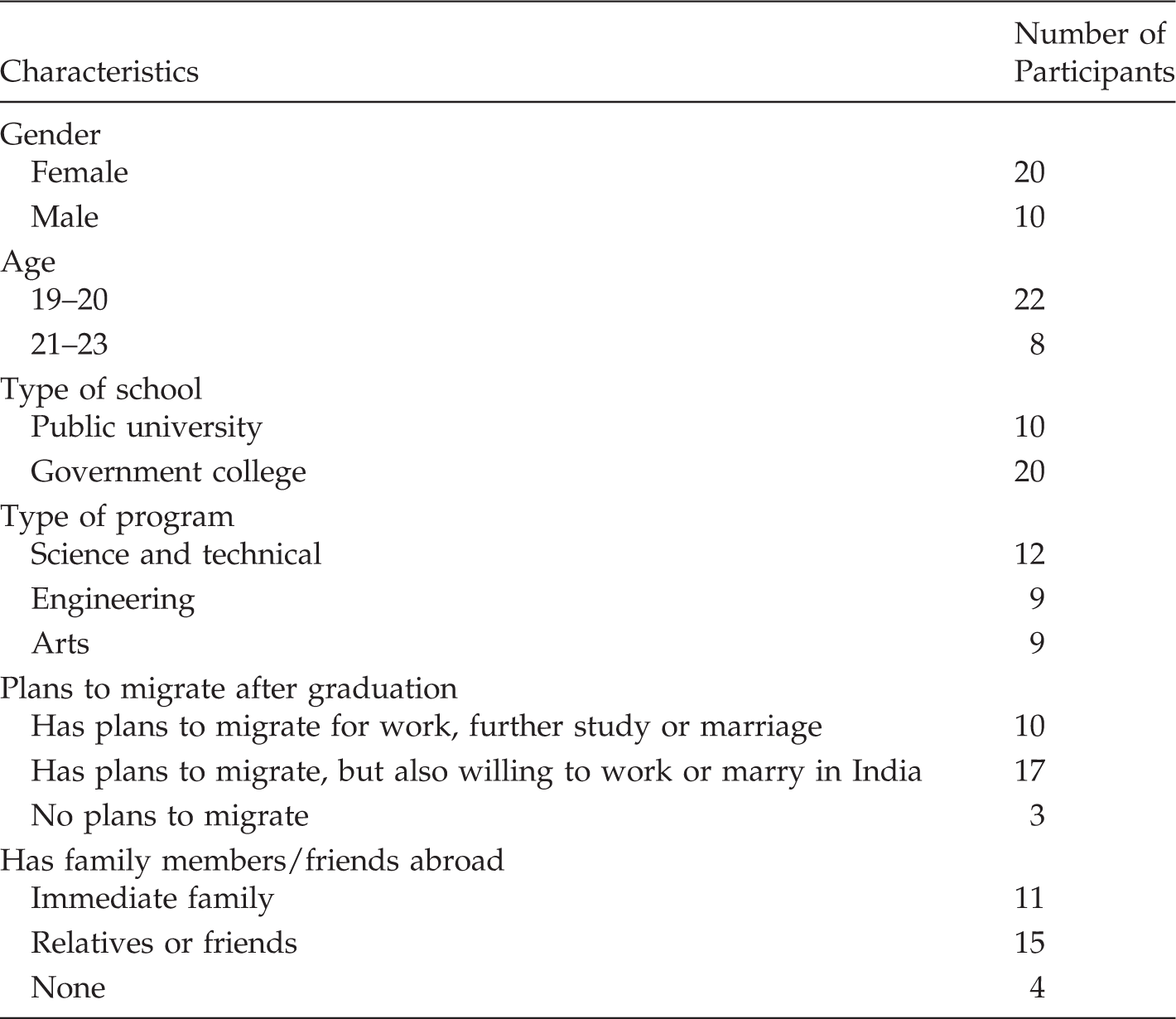
The participants were between the ages of 19 and 23. Sixty percent of the participants were from single-income families, with mostly their fathers as the bread winner. About one-third of the participants’ parents were in service- and transportation-related jobs, laborers, civil servants and small business owners. For the rest of the participants, their parents were professionals in the civil service, private business organizations and multinational corporations, and business owners.
Participants were asked about their plans for their future, which involved discussions about their aspirations in various aspects of life including marriage and career. These discussions presented various interesting views regarding their hopes and dreams vis-à-vis international migration. Some interviewees spontaneously brought up the topic of migration. However, when other participants did not discuss this subject unprompted, the researcher asked them if they had considered the possibility of migration. They were also asked about their motivations for migration. All the interviews were transcribed. Interviews in Tamil were translated by the researcher. The categories were created after the researcher had familiarized herself with the data and carried out two rounds of coding. The participants’ names used in this paper are pseudonyms. One limitation of this study is that the influence of caste and different types of educational qualifications on migration were not fully explored.
Findings
This section is divided according to three main themes, namely: career-focused vs. marriage-focused plans after graduation; escaping gendered and hierarchical relationships; and having a US-born child. The first theme focuses on the youths’ plans after their graduation, which includes the possibility of migration for work or marriage. The second theme is largely about female youths’ expectation that migration will help them to escape gendered and hierarchical family relationships. The third theme is about the youths’ plan on having a child in a developed nation to ensure the future mobility of their family.
Career- vs. marriage-focused plans after graduation
All male participants explained that they would be looking for a job after their graduation. Only one participant, Balan, an engineering student, wanted to work in India. Four male students hoped to work in other countries, while five others preferred to work abroad but would accept a good job locally. Balan decided to work in India to be able to be with his family. He missed seeing his father while growing up because his father was working in Dubai. Even though he appreciated the sacrifice his father made for his family, he admitted that he hardly knew his father. This shows how a negative experience related to migration may influence an individual to reject the idea of migration.
For most students who wanted to work in a foreign country, their first choice was the US followed by the Gulf countries. Anand, an engineering student, preferred to go to the US because he felt that the quality of life was better in the US. He highlighted that migrants to Dubai had a hard life. He would opt for countries such as Australia or Singapore if he was not able to go to the US. When asked, “why America?” Anand answered: Anywhere is OK if it gives us a better job and pay. But I want to live in America … America. It is nice to tell people that … They say thirai kadal odiyum thiraviyam thedu
6
[ride the seas to find wealth]; that is what I want to do.
As for the female students, most aspired to work for some time, but did not foresee themselves pursuing a career over a long duration, even though they would graduate with similar qualifications as the male students. Only three female students said they would continue working when they were married. One participant, Divya, expressed that a good career was very important to her. She explained that she was from a backward class and her success in her education and career was very important. She was the first person in her extended family to pursue higher education. Reflecting on her family background, she sometimes felt that she has achieved far beyond what was thought possible in her community, hence, she felt obliged to support her family and community members in the future.
None of the female participants planned to migrate for work. Instead they looked forward to the possibility of migrating after marriage. Four participants stated that in the process of finding an alliance or a marriage partner, working abroad was a prerequisite, as their family would not consider any potential groom working locally. This was seen as an important criterion by their families, because their siblings or parents’ siblings were already settled abroad. While this was not a priority for the others, they did see it as a preferable choice. Many of them highlighted the complexity of finding a marriage partner and that certain aspects of marriage cannot be planned. They explained that finding a good marriage partner depended not only on their choice but also their parents'. Other than that, some participants emphasized that finding someone who has equal or better economic status within the same community or caste may be difficult. In addition to this, some participants also talked about the need to find someone with a matching horoscope and how this depended on one’s destiny.
Another two female participants were hoping to pursue their graduate studies in the US or Europe. Both Tasneem and Mary have families that emphasized the benefits of completing a graduate degree in Europe and the US. Furthermore, Tasneem had two siblings who did their masters in the UK and were living there. Tasneem’s brother received a scholarship to go to the UK while her sister was financially supported by her family. She would like to follow in their footsteps and felt that with her siblings there, she would find it easy to settle down in the UK. She hoped to get a scholarship to support her studies; otherwise, she believed that her parents and brother would support her financially. Mary is the eldest, but she felt that her younger brother would eventually study abroad with her parents’ moral and financial support. Mary identified herself as coming from a middle-class family and explained that her parents had made plans (e.g., saving money, sending them for additional tuition class; gathering information regarding courses overseas) to send her and her younger brother abroad in the future. Family support in terms of encouragement to migrate has been identified as an important factor in Indian students’ plans of moving abroad (Hercog and Van de Laar, 2016).
Most participants admitted that they were excited about the idea of living in another country. The male students were enthusiastic about working in a different environment and earning more money than in India. The female students were equally excited and had much knowledge about the life of migrants through the experiences of their family members. Shanti, a computer science major, explained: If I migrate with a spouse visa, I think I will not be allowed to work. So, I will be a housewife. I think being housewife in [the] US is better than here. In both places, I am going to be a housewife. At least there it will be more exciting like in that [Tamil] movie, ‘Achamundu! Achamundu!’. My cousin sister
7
is living in New York. When I see her photos in Facebook, they are very nice. It is nice to see them traveling everywhere … Just them, husband, wife and baby.
Another student, Mala, talked about her sister who was living in California. Her sister was very happy in California experiencing so many new things in her life. At the same time, she felt that her sister was closely connected to her family through frequent phone calls and sharing of experiences on how she maintained family traditions in a foreign land. She told my mom that she can easily find Indian products or food … she found many Indian stores selling all types of products from here. The other day she found murunga keerai (drumstick leaves) there. She was so excited.
Those with intentions to migrate did not have plans to cut off ties with their family in India. Instead, they expressed intentions to maintain strong connections with both the origin and destination countries. The youths explained how their friends and family working and living abroad sent money home; returned to attend functions and festivals; returned to marry someone of their parents’ choice; and were constantly in touch with their family. Female students especially expressed how closely their sisters or cousins remained connected to their mothers in India. The migrant family members felt that they were “just a phone call away.” Some participants recollected how their siblings called to find out about recipes or home remedies related to child care. Both male and female students were fascinated by the idea of living in another country and experiencing new things. From the experiences of other family members or friends, they were aware of various lifestyle issues and the demands of living in another country but were nevertheless looking forward to those experiences. Most discussion centered on the excitement and positive aspect of migration. Most participants imagined that they would have more disposable income (either from work or marriage) to spend for their family in India and abroad. They also discussed the excitement of new experiences. Many talked about traveling to various places and sites, such as Niagara Falls, Las Vegas or the Statue of Liberty. Some participants mentioned the prospect of wearing different types of clothes, such as winter coats, boots, or formal suits, which are not commonly used in India. One participant shared that she hoped to play in the snow and perhaps try some skiing. Although aware of the difficulties experienced by low-skilled migrants in countries such as the UAE, Malaysia and Singapore, the participants did not mention potential problems that they might encounter. This suggests a positive bias in the narratives related to migration and the tendency of potential migrants to highlight the positive aspects of migration while downplaying the negative experiences faced by some migrants. Similarly, they also tend to focus on the positive aspects of migration as depicted in films while ignoring some of the difficulties. For example, the film “Nala Damayanthi” (2003) shows the struggle of a migrant without proper documents in Australia. The migrant was arrested, experienced racial harassment and was deported. Nonetheless, all eight participants who mentioned the film discussed the positive aspects, such as the intimacy between Sriman and his wife (supporting roles); the cleanliness of Australia; and new experiences and places.
Many participants expected some level of upward mobility associated with international migration, either through work or marriage. For male students, their perception of lack of opportunities and monetary rewards for their qualifications in India is an important factor that influenced their migration intentions. Male youths constantly expressed the hope that their family conditions would improve when they work in a foreign land. Some of their hopes were to: improve the conditions of their family home; to help their parents with the cost of educating their siblings; and to help with the marriage of their female siblings. However, the “glamor” of working and living abroad, particularly in the US, is also a big influence on their aspirations.
Youths felt that living abroad was exciting and was highly regarded by other members of the society. Having family members or marrying someone in a developed nation is seen as a status symbol by these youths. Therefore, social mobility and other lifestyle benefits are important reasons for the youths to aspire to migrate.
Escaping gendered and hierarchical relationships
Many female students expected to be married soon after their graduation. For some students, their parents were looking for a suitable groom at the time of the interview. Many female students accepted that their life as a married woman would involve some level of subordination to their husband and parents-in-law. They felt that being away from India would help improve their relationship with their husband and parents-in-law. Banu, a sociology major, felt that she would have a better relationship with her husband if they lived abroad. I think your relationship with your husband will be very different when you are there [a foreign land]. There, you don’t have anyone, so you have to depend on yourself … Unlike here, there are so many things to do, so many functions to attend. So many people to please … I do not have to think what others would say when I do things or dress differently.
In India, marriage involves some form of territorial dislocation for a woman, where newly-wed couples live with the grooms’ parents (Palriwala and Uberoi, 2005; Rammohan and Vu, 2017). Living in the parents-in-law’s house is synonymous with entering their territory/space. The rules and norms of this space have been established by the groom’s family, hence, a bride would be expected to conform to the existing norms. On the other hand, if she lived with her husband away from her parents-in-law, she would be able to live in her own space, “bend” some social norms and establish new norms for their everyday life.
Migration affects gender relations in a family, but these effects are complex and dependent on the context of the movement (Gardner and Osella, 2003). Through long-distance migration, women are able to fulfil some social and material aspirations and escape family and community pressure. At the same time, it could leave them in a very vulnerable position without any support from their natal community (Palriwala and Uberoi, 2005). International migration — particularly to the West — is often described by migrant women as a way to escape the traditional Indian extended family structure and to negotiate new gender roles (Kalpagam, 2005). On the other hand, return migration is accompanied by renegotiation of gender roles for many women (Varrel, 2011). The participants in this study expected such changes in their gender roles as part of the migration process and were willing to renegotiate their gender roles when they return to visit their family. Participants clearly articulated how they would negotiate their gender roles and norms in the home and host countries. One participant, Meena explained how her friend called her husband by his name when they were in the US but switched to a more hierarchical term when his family visited them or when they came back to India for vacation. Similarly, some felt that sharing of household chores, such as cooking and cleaning, would be an embarrassment if they were done in front of their parents-in-law. Therefore, couples would avoid this when they were back in India. This may seem trivial for some families, while for others it is a big issue. Even though many participants perceived the husband as the head of the family, they expected a less hierarchical relationship — more sharing of decision-making and household chores and more egalitarian gender roles — when they live in another country.
Many female participants saw that life in India would not allow them to escape hierarchical and gendered relationships. They felt that they would constantly be judged by their families, neighbors or friends. The phrase, naalu peru enna solvanga? [What would these people say?] was commonly uttered, suggesting deference to the views of others. They seem to be concerned about others’ views and how those views would affect their parents. They felt that if they did something different from the norm, people would talk about it and their parents would feel embarrassed. This seemed to carry a lot of weight among the female students. They felt, however, that this burden would be lifted if they lived overseas. Migration provides them the space to depart from the norms, and they expected to feel much freer elsewhere.
Participants’ views on bending old norms and establishing new norms through international migration show the importance of agency in their aspirations. The role of agency in migration has been highlighted by De Haas (2010b). Choices are never made totally free of societal influences, but at the same time choices are not determined by structure alone (Davis, 2009). In other words, an agent is capable of exerting some control and transform social relations to a certain degree within a given structure. Agency, therefore, is formed by resources that are available to a person in a particular setting or environment. Many of the views expressed in this study suggest that the youths’ aspirations were guided by their understanding and knowledge of the society they live in. Their views suggest that the crossing of political boundaries would give them space to transgress symbolic boundaries in their relationships that would otherwise create conflict in the family if such transgressions were committed at home. In addition, transgressions of “home” norms while living abroad are sometimes accepted as adjustments that are necessary for survival, which can be renegotiated after returning home.
Marriage is an important site where gender hierarchies are produced and reproduced. In general, in Indian society, marriage is not just a personal matter but also involves the family. Decisions related to marriage and within marriage are often made in the context of family and kin (Desai and Andrist, 2010; Jejeebhoy and Halli, 2005). Thus, the distance provided by international migration is expected to give women more freedom to make decisions related to their nuclear family. As mentioned earlier, some female participants expected that outside of India, there would be more discussion between the husband and wife, unlike at home when decision-making is often in the context of an extended family.
Male participants also expressed that the distance from the family would give them freedom in what they decide and do as a couple. However, migration to another country is not likely to change the nature of their relationship with their wife. Male participants said that they would be the main bread winner, the head of the family and the one responsible for important decisions in the household, which reflects the position of husbands in India. This contrasts with the view of female participants who, although acknowledging the husband as the head of the family, expected that decision-making would be shared when living abroad. In general, male participants focused on changes in lifestyle, career and social mobility in relation to migration and did not comment much on relationships. Even though not all the participants were from middle-class families, their notions of family roles reflect what Sondhi and King (2017) described as views typical of a middle-class Indian family where sons are groomed to be the breadwinners and (with their wife) take care of their aging parents, while daughters are prepared for motherhood and household management.
Having a US-born child
One of the most interesting illustrations of how family influences the decision to migrate is related to youths’ future families. Students who hoped to migrate to the US discussed the hope of having children born in the US, as they felt that it would give their children better opportunities in life. They believed that life in the US would be easier for their children. As rational actors, these youths felt that migration, together with having a child in a developed nation, is the best way to maximize the benefits of migration. They hoped that their migration would help to improve their own lives and also those of their future children.
Archana, a female engineering major, explained: When I was young, I used to see some women coming back to India to have their child. Now, I hardly see that. Most people choose to have their child in the US. Most of the time, their mom or mother-in-law will go there to take care of them. When a baby is born there, the baby is American. The baby would be assured of having a good life in future.
Even though most rational action theory related to migration focuses on individual choice, new approaches in economics of migration emphasizes the importance of family. In this study, youths wanted to migrate to share the benefits with their family and aspired to share the benefits with their future children as well. They hoped that their migration would give their future children a head-start in life.
Gendered dreams, converging dreams
The dreams of these youths suggest a gendered divide. Although young men and women both have dreams of living in another country, the reasons for their migration — what they will be doing there, and what they expect to achieve — are very different.
Male students often talked about careers when discussing migration. Similar findings came out from a study of male science and engineering students in India, which revealed that expectations of good working conditions and high salaries were strong motivators for migration intentions. Work-related reasons also played an important role (Hercog and Van de Laar, 2016). In this study, male participants’ current or future educational choices were related to their migration plans. They had chosen a degree program, or would choose a graduate program, which was perceived to increase their chances of being employed, preferably in other countries. At the time of data collection, there was a preference for courses related to information technology (IT). For those who were not enrolled in IT-related programs for their undergraduate degree, many hoped to do a certification program in the IT field. Some participants were trying to improve their English communication skills to ensure that they would be able to communicate better if they were to migrate. This shows how the prospect of migration was influencing the current choices made by youths (Kapur, 2010).
Generally, participants identified that family obligations influence their desire to migrate or not to migrate. It is common in Indian culture that a child is expected to fulfil his/her family obligations. This involves doing something (work, study, marriage) that would honor and support his/her parents and other family members. Similarly, in the case of out-migration, providing for the family becomes an important reason to migrate. In most cases, a son is still expected to provide for his family while a daughter is expected to contribute to the well-being of her new family when she is married. Overall, the expected benefits of migration to one’s family influenced the youths’ aspiration to migrate (Hercog and Van de Laar, 2016).
Female students’ dreams were mainly related to their family and most imagined their migration in connection with marriage. They would like to move to another country to follow their husband who would be working there. Many hoped to migrate to the US and as dependents, given the condition of their visa, they expected to be homemakers. Like their male counterparts, they hoped that migrating to the US will help them pursue their goals and aspirations. The net benefit they expected from migration was not primarily monetary but rather in terms of changes in their social status and gendered relationships. They imagined being a homemaker or a “soccer mom” — similar to what they have seen in some Tamil movies. They seemed to know much about the terms and conditions of a spouse visa. Here again, the culture of migration among Tamil women influenced them to aspire to marry someone who was working in a foreign country, especially the US. At a young age, they were aware of women who had migrated after marriage and knew of the changes that came with migration. They, therefore, hoped to experience the same in their future lives.
Being socialized in a highly patriarchal society, female youths were aware of, and understood, how rigidly gendered and hierarchical family relationships are in Tamil society. They were aware of the expectation that a woman would leave her natal house and live in her husband’s home (Palriwala and Uberoi, 2005). They understood the difficulty in breaking away from traditional gender norms and roles locally. Therefore, these students hoped to make some changes in their relationship with their family members when they will live abroad.
Because migration is common in India, girls learn from their social networks how migration helped to make changes in family relationships. They hoped to see similar changes in their own family relationships when they migrate. Among others, they hoped they would have a more egalitarian relationship with their husbands and to have more share in decision-making. Migration, thus, will not only entail crossing political boundaries, but also crossing symbolic boundaries that define femininity and gender roles in Tamil society. Outside of India, their transgression of gender roles will not stigmatize them as breaking away from traditional norms. In this study, the prospects for women’s empowerment lie not in enhanced earning capacity (because most expected to be homemakers after they were married), but the physical distance and the lack of social constraints on women. Their expectation about how migration would change the nature of the marriage relationship is similar to marital changes documented by Hirsh (2000, as cited in Kandel and Massey, 2002). It is interesting to note that, whereas female students hoped that migration will change the nature of relationship in the family, they often emphasized that they were not trying to break away from tradition. This indicates a struggle between their aspirations for a more egalitarian family relationship and internalized traditional values in a patriarchal society. Donato et al. (2006: 6) explained that migrants are “aware of the relational and contextual nature of gender as they attempt to fulfil expectations of identity and behaviour that may differ sharply in the several places they live.” The participants’ views on how they would negotiate their gender roles at home and abroad indicated a good understanding of the contextual nature of gender in the lives of migrants even though they have yet to migrate. On the other hand, male participants accepted their role as the main bread winner. Being socialized in a patriarchal society, they accepted the hierarchical nature of family relationships and did not expect much change in this aspect.
While the participants’ views suggest a clear gender divide in their aspirations, we see a convergence when they anticipated the next steps in their lives. Eventually, all the students planned to get married and start a family. When discussing their children in the future, both male and female students would prefer their children to be born in the US if they were living there. Similar dreams were expressed for other European countries, Australia and New Zealand, but the highest preference was to be in the US. In Asian culture, where family obligations are important, most migrants hoped to secure a good job and earn money to help promote the upward mobility of their families. This was an important driving force among male participants, especially those with a working-class background. They often described how important their academic and professional success was to their families. One participant, Karthik, a member of a backward class, described how his family members, including his younger siblings, were sacrificing their own success to ensure that he succeeded both in his education and career. His parents described him as their only beacon of hope and way out of poverty.
With such high expectations for social mobility, it is not surprising that the students were already planning to have a child in a more developed society, with the hope of creating a secure future for their children. They felt that this would help to ensure the continuous process of upward mobility in their family. In addition to this, they perceived that life in countries such as the US, Australia and New Zealand would be easier for their children than their lives in India. They saw this as a form of “investment,” similar to how their parents invested in their higher education that would enable them to migrate.
Scholars have argued that migration is initiated for economic reasons; but eventually, it becomes institutionalized and a cultural way of life in origin communities (Cohen, 2004; Donato et al., 2006). Overall, the discussion of the participants showed that their aspirations were motivated by social mobility but also their expectations of the changes in their lives were based on the positive narratives of migration available in the immediate and extended network in their society. As a result, migration is seen as influencing the current choices (e.g., study subjects, marriage) made by the participants. If migrants are seen as rational actors, their choices to migrate would be based not only on the benefits of migration but also on the probability of actually achieving the reward. The common occurrence of migration somehow contributes to the perception of the inevitability of migration, which in turn makes migration a plausible choice. Therefore, youths were socialized to pursue migration as a path in their lives. This shaped their aspiration to migrate and contributes to the perpetuation of migration in their society.
Conclusion
Dreams of international migration, especially to the US, were common among Chennai youths in this study. Their desires and hopes were shaped by the culture of migration which is dominant in their society. Youths growing up in a society where migration is common are able to draw information and other resources from already established networks about the process of migration.
The dreams of the youths were gendered. Male students focused on migrating for work to improve the economic conditions of their families, while female students aspired to migrate to follow their husbands working in a foreign country. Young women perceived that migration would help them escape from gendered and hierarchical relationships, allowing them to build a more egalitarian marital relationship away from home. This divide lessens and seems to converge when participants thought of possibilities of having a child in a foreign land such as the US. They believed that having children born in a Western country would help secure a better future for their children. This is another indication of participants’ desires to meet family obligations and ensure their families’ upward mobility. Based on findings from TMS 2015 (Rajan et al., 2016) and other studies (Hercog and Van de Laar, 2016; Sondhi and King, 2017), there is a strong reason to believe that highly educated Tamil youths would continue to aspire to migrate to more developed countries in the future.
Footnotes
Declaration of conflicting interests
The author declared no potential conflicts of interest with respect to the research, authorship, and/or publication of this paper.
Funding
This research received no specific grant from any funding agency in the public, commercial, or not-for-profit sectors.
1
Most Tamils have been living in these countries for four to six generations, mainly as descendants of emigrants during the British colonial times (Naujoks, 2013).
2
Tolkappiyam is estimated to have been written between the first or second century BCE and the fifth century CE (Zvelebil, 1973).
3
Chilappatikaaram is a Tamil epic written by Ilanko Atikal in the fifth century CE (Parthasarathy, 1993).
4
TMS 2015 is used to give an indication of the migration trends in Tamil Nadu because no comprehensive survey on migration was done in Tamil Nadu prior to this (Rajan et al., 2016).
5
America mappilai (groom) and America varan (alliance) both refer to marriage arranged with a groom from the US. Earlier in this paper, the word mappilai was used because it is commonly used in movies and popular reading. However, the author adopts the term varan here, as it is the term more commonly used by the Tamil Brahmans who were the focus of this particular study.
6
This is a saying by Avvaiyar in Kondrai Venthan. It is believed to have been written between the ninth and 12th century (Zvelebil, 1975). Avvaiyar is a title given to female poets who were active in different periods of Tamil literature. Kondrai Venthan is a set of single line maxims written according to the Tamil alphabet.
7
“Cousin sister/brother” is a term that is commonly used in Indian English and in the Tamil diaspora. It refers to parallel cousins, i.e., paternal uncles’ children or maternal aunts’ children. In Tamil society, these types of cousins are like one’s “siblings.” One does not marry his/her “cousin brother or sister,” whereas it is possible to marry cross-cousins, i.e., maternal uncles’ children or paternal aunts’ children.
8
Participants in this study added that the relationship between a husband and wife among non-resident Indian characters in Tamil movies, such as “Achamundu! Achamundu!” (2009) and “Nala Damayanthi” (2003), is “friendlier” compared to what they have observed in their own families and communities.