




Abstract
Using data from the 2012 National Multicultural Family Survey, this study examines various factors that influence female marriage immigrants’ participation in economic activities and their working conditions in South Korea. The results suggest that household characteristics, human capital and social relations–discrimination factors, as well as experience with employment support services, have significant positive effects on female marriage immigrants’ participation in economic activities and their working conditions. While the government’s employment support services positively affect marriage immigrants’ decision to participate in economic activities, they do not contribute toward improving their working conditions. There is a need for governmental employment support services to take specific actions to help improve the working conditions of immigrant women.
Keywords
Introduction
The number of marriage immigrants in Korea, overwhelmingly women, has been increasing steadily for the past several years, reaching 90,000 in 2007, 125,000 in 2010 and 150,000 in 2014. However, this trend now appears to be slowing down (Ministry of Security and Public Administration, 2014). With the increase in the number of marriage immigrants, the number of multicultural families has also grown. Survey results provided by the National Statistical Office indicate that the average household income in 2012 was KRW 4,092,000, which was higher than the average household income of multicultural families (National Statistical Office, 2014). According to the Ministry of Gender Equality and Family (2012), 31.4 percent of multicultural families (which also happen to be the largest group) had a monthly income of KRW 2,000,000–3,000,000.
As an indicator of economic well-being, the lower household income of multicultural families raises policy concerns now and in the future. With an average age gap of 12.1 years between a female marriage immigrant and her Korean husband (Kim et al., 2013), when the husband retires, the former is expected to work outside the home to support their family. The economic participation of female marriage immigrants not only helps improve their families’ economic status, but also enhances their economic independence. According to Kim et al. (2013), female marriage immigrants’ integration in the labor market marks their “second round of adaptation.” Interestingly, 72.6 percent of female marriage immigrants who have lived in South Korea for more than five years are more likely to experience difficulties due to economic problems than cultural differences (Ministry of Gender Equality and Family, 2012).
If female marriage immigrants enter the labor market without obtaining job skills or vocational training, they are highly likely to work in low-paying, low-skill jobs or to become little more than decoration. Additionally, the potential increase in social costs if women fail to adapt to the labor market and subsequently retreat from it must be considered. If female immigrants fail to enter the labor market, multicultural families that already have low income levels are likely to join the ranks of low-income or poor families. The growing number of low-income and poor families will require bigger social welfare expenditures, which will exert financial pressure on the government. Therefore, employment support policies for married immigrants must be considered and developed (Kim et al., 2013). The government has introduced policies and programs aimed at facilitating the entry of marriage immigrants in the labor market, but the impact of these interventions on their economic activities and working conditions need to be examined. This study aims to provide empirical bases for addressing this question. Two key aspects pertaining to the economic activities of female marriage immigrants are probed in this paper: (a) the factors that affect their participation in economic activities; and (b) the factors that affect their working conditions, focusing specifically on government employment support services.
The central and local governments have been expanding their budgets to better support marriage immigrants, many of whom have moved to Korea with limited linguistic, cultural and economic capital. Although some Koreans consider marriage immigrants a burden to society and do not welcome the government’s policies for aiding multicultural families (Park et al., 2016), these interventions aimed at improving their employment chances can benefit Korean society. First, these interventions can be considered social investment policies that create a virtuous cycle of economic growth and welfare. Second, improving the employment competency of married immigrant women could help in relieving labor shortage due to low birthrate and population aging in Korea. Third, improving the employment competency of female marriage immigrants will encourage them to contribute to Korea’s economic development, which could, in turn, promote their integration in Korean society. Fourth, the social and economic participation of marriage immigrants can enhance the cultural diversity of Korean society.
Theoretical background
Female immigrants’ participation in economic activities is of research interest because it is a significant indicator of integration in the immigrants’ new society (Foroutan, 2008; Gilbertson, 1995). In the Korean context, most research on female marriage immigrants has focused on their socio-cultural adaptation and living conditions (Jeong et al., 2007; Kim et al., 2007; Seol et al., 2005).
Previous studies in Korea (Bae, 2009; Kim, 2012; Kim et al., 2003; Lee et al., 2013) have identified structural factors that influence their economic participation. Bae (2009) has underscored the role of government agencies in establishing support centers for job-seeking women, providing vocational training and policies promoting a women-friendly work environment. Kim et al. (2013) have examined the relationship between human capital social support and the economic participation of marriage immigrants. Based on their findings, Bae (2009) and Kim et al. (2013) identified several recommendations to support marriage immigrants’ employment and participation in the labor market. First, apart from policies for cultural adaptation, specific polities to promote the economic activities of marriage immigrants are needed. Second, programs and services, such as the provision of childcare facilities and promotion of work–life balance, are important facilitative factors. Lastly, programs should aim for better matching between training programs and labor market needs.
However, these studies have limitations in explaining the dynamics of female marriage immigrants’ participation in economic activities. First, they do not distinguish or specify the different factors that impact participation in economic activities. Each of these sets of factors has different features. Next, they do not offer a comprehensive analysis of the effects of policy factors on economic activities and working conditions. Most studies focused on female marriage immigrants’ participation in the labor market but did not pay as much attention to their working conditions after entering the labor market (Bae, 2009; Kim, 2012; Kim et al., 2003; Lee et al., 2013). Finally, prior research did not take into account the selection bias that could occur in terms of female marriage immigrants’ participation in employment support services. This research attempts to address these limitations by classifying the factors that affect female marriage immigrants’ participation in economic activities and their working conditions into four categories: household characteristics; human capital; social relations and discrimination factors; and policy factors.
Household characteristics
In general, the employment of female marriage immigrants is highly influenced by their household characteristics. Unlike migrant workers who come to Korea purposely for employment, marriage migrants have to juggle paid employment with work inside the home and childcare responsibilities. Having a preschool-aged child is an important variable that determines a female marriage immigrant’s participation in economic activities. Specifically, previous studies generally concur that women with one or more preschoolers have a lower probability of participating in economic activities than women without preschoolers (Browning, 1992; Connelly, 1992; Lehrer, 1992; Nakamura and Nakamura, 1994; Stolzenberg and Waite, 1984). Also, in South Korea, the care of preschool children can constrain women’s economic participation in the labor market (Kang and Lee, 2012; Kim and Lee, 2015). Thus, findings indicate that women with preschool children have lower wages and are more likely to work part-time compared to women without preschool children (Kim, 2004, 2013).
In South Korea, having preschool children does not constrain female marriage immigrants from engaging in economic activities as it does on other women. There are three reasons behind this. First, the households of female marriage immigrants are economically worse off than ordinary Korean households. In 2012, 41.9 percent of multicultural households had an average monthly household income of less than KRW 2,000,000 compared with 17 percent for South Korean households; in other words, multicultural households are economically more disadvantaged (National Statistical Office, 2014). Second, child support costs will compel them to participate in economic activities despite the burden of child care (Lee at al., 2013). Third, according to some studies, working female marriage immigrants in South Korea can give their children a good image that can help their children to adapt to society (Yang and Kim, 2011; Cho, 2002). Furthermore, the inducements for these women to participate in economic activities are more likely to have greater employment opportunities (Kim, 2012). H1: Having a preschooler does not deter the probability of female marriage immigrants’ economic participation and their working conditions (wage, hourly wage and fully employed workers). H2: High income households will have a negative influence on the probability of female marriage immigrants’ participating in economic activities and their working conditions (wage, hourly wage and fully employed workers).
Human capital
Human capital refers to a person’s knowledge and ability to produce economic value. Different human capital investments lead to differences in labor productivity, wages and employment (Becker, 1965). Human capital is typically acquired through education and work experience; opportunities to earn higher wages increase with the acquisition of more human capital (O’Sullivan and Sheffrin, 2003). Antecol et al. (2003) examined the relationship between female marriage immigrants’ human capital characteristics and their wages and found that age, education level and language skills have a positive influence on the wages of female marriage immigrants. Hall and Farkas (2008) studied Latin and white immigrant workers and how their human capital (education, age, language skills, ethnicity and race) affects their wages. According to the results, earning higher wages is associated with higher levels of education and language skills in both groups (Latin and white). In the same context, research has found that as immigrants’ education levels and language skills increase, both their participation in economic activities and their wages increase (Portes and Rumbaut, 2001; Read, 2004; Takenoshita, 2005). Moreover, according to Boyd (1982), the younger the immigrants are when they immigrate, the higher their chances are of participating in the labor market and receiving wages similar to those of local residents. H3: The human capital of female marriage immigrants will have a positive influence on their probability of participating in economic activities and their working conditions (wage, hourly wage and fully employed workers).
Social relations and discrimination factors
Social relations and discrimination factors exert a fundamental influence on immigrants’ decision to participate in the labor market and on their working condition. Social relations refer to social networks which have been found to help in promoting the integration of female marriage immigrants (Kim, 2012; You, 2012). Kim (2012) found that the social relations of female marriage immigrants were related to their labor market participation and concluded that social relations were related to assimilation. You (2012) uncovered that female marriage immigrants who participate in social activities, such as volunteering, improve personal empowerment and are increasingly participating in economic activities in rural areas. Likewise, being in a community where female marriage immigrants can participate in various social activities not only provides the opportunity for them to build confidence, but also promotes more active social and economic participation (Docherty et al., 2001).
In most societies, social discrimination against immigrants affect their job seeking process (Sole and Parella, 2003). Theoretically, social discrimination has both a positive and negative effect on immigrants’ economic activities and working conditions. On the one hand, it may add to the psychological costs of the job search process and have negative effects on immigrants’ attachment to the labor market and their participation therein (Pager et al., 2009). On the other hand, immigrants who experience discrimination in the labor market may make positive changes to their work situation in reaction to these experiences. For instance, immigrants who experienced discrimination in the past are more likely to find a job with better working conditions because they feel that low-wage jobs are associated with greater discrimination (Neumark and McLennan, 1995). Considering that these competing explanations can lead to confusing research results (Neumark and McLennan, 1995; Pager et al., 2009), this study seeks to establish an exploratory hypothesis on the effects of discrimination on female immigrants’ economic activities and working conditions. H4: The social relations of female marriage immigrants will have a positive influence on their participation in economic activities and their working conditions (wage, hourly wage and fully employed worker). H5: The experience of discrimination among female marriage immigrants will have an impact on their participation in economic activities and their working conditions (wage, hourly wage and fully employed worker).
Policies
The employment prospects and working conditions of female marriage immigrants are also influenced by policy factors. Currently, they can avail themselves of various employment support services offered by a Women’s Employment Center, 1 basic employment training and projects connecting women to employment training institutions through Multicultural Family Support Centers 2 and programs to promote successful employment through Employment Centers. 3
Female marriage immigrants who have received government-funded employment support services appear to have higher employment rates and better working conditions than those who have not received support (Bae, 2009; Kim et al., 2003; Nam, 2004; Jeong et al., 2007). The educational training offered by support centers to immigrants is a determining factor in maintaining their employment status (Jeong et al., 2007). Nam (2004) found that female marriage immigrants with prior experience with employment support services received more job offers than those without. Bae (2009) emphasizes that without these support services, female immigrants may lack information necessary for improving their employment chances and working conditions. Thus, policies that support these programs enable female marriage immigrants to become more fully prepared to participate in the labor market and to secure better working conditions. H6: Experience with employment support services will have a positive influence on female marriage immigrants’ probability of participating in economic activities and their working conditions (wage and position).
Data and analysis
Data set
Data for this study were drawn from the 2012 National Multicultural Family Survey conducted among multicultural families in Korea by the Ministry of Gender Equality and Family. This survey has been conducted every three years since July 2009 as a Designated Statistics Survey under the Multicultural Families Support Act. It targeted a total of 15,341 sample households randomly selected from multicultural families nationwide which include marriage immigrant households (i.e., the foreign spouse has not yet become a Korean citizen) and naturalized citizen households (i.e., the foreign spouse has become a Korean citizen). This study excludes naturalized citizen households because we are interested in marriage immigrant households. The final sample used in this analysis included 12,531 female marriage immigrants. Four different questionnaires—for married immigrants, naturalized citizens, Korean spouses and children between the ages of 9 and 24—were developed to gather information to understand the current state and condition of multicultural families (Ministry of Gender Equality and Family, 2012). The questionnaires obtained information about the size, distribution and structure of multicultural families.
The current study analyzes the influence of employment support services on the probability of female marriage immigrants participating in economic activities and on their working conditions. For this study, we have divided working conditions into three sub-factors: income; hourly wage; and full- or part-time employment status.
Three-level analysis strategy
This study adopted a three-level analysis approach. First, a logit model was used to analyze the influence of female marriage immigrants’ individual characteristics and their experiences with employment support services on their probability of participating in economic activities. The dependent variable was economic participation, which was measured by asking the respondents whether they worked more than one hour to earn a wage or more than eighteen hours in a family-run business without earning a wage. The independent variables, as suggested in the hypotheses, included household characteristics, human capital, social relations and discrimination factors, and policies (specifically, availment of employment support services). This analytical approach enabled us to address the research question whether the probability of participating in economic activities is higher for female marriage immigrants with experience of employment support services than for those without.
Second, this study analyzed the influence of the independent variables, including female marriage immigrants’ individual characteristics and whether they have availed themselves of employment support services, on their working conditions. Working conditions were indicated by income and hourly wage, which are continuous variables, and full- or part-time employment status, which is a categorical variable. Regression analysis was used for cases in which the dependent variable was continuous (income and hourly wage), whereas logit models were used when the dependent variable was a binominal variable (full- or part-time status). At this stage, each model included the female marriage immigrants’ individual characteristics, to control for possible differences between those with economic activities and those without. Differences were examined by household characteristics, human capital, social relations and discrimination factors, and availment of employment support services, as well as the individual’s length of residency, residential area and nationality.
Even so, this model fails to consider the selection bias that could occur in terms of female marriage immigrants’ participation in employment support services. If we find that those who have made use of employment support services are more dedicated and have higher technical skills than those who have not, they may be working in better conditions because of their intrinsic characteristics and skills rather than because of their experiences with employment support services. For these women, the regression coefficient of the dummy variable for whether the person has experience with employment support services will reflect not only improvements in working conditions, due to accessing employment support services but also other effects that cannot be identified. This could potentially cause measurement error by exaggerating the influence of employment support services. From an econometric perspective, if these unidentified characteristics are linked to working conditions (dependent variable) and to whether the individual has experience with employment support services (independent variable), the regression coefficient for employment support services would become biased and inconsistent.
For the last portion of the analysis, the Heckman model and a double probit model were used to analyze the influence of availment of employment support services on improvement in working conditions. This approach enabled the correction of sample selection bias and the observation of an unbiased consistent measurement value in the improvement in working conditions model. The analysis used the maximum likelihood estimation which measures every variable in a model simultaneously rather than following Heckman’s two-level process. However, any variable that is included in the selection model, but not in the effect model, must exist to identify the coefficient in the model. The degree of social participation is one such a variable in the current study. The degree of social participation was measured by asking the respondents whether they have participated in local residential meetings, volunteer work/hobbies, or group activities. Participation was denoted by 1 and non-participation was denoted by 0 for each measure. The measures were then aggregated to derive the degree of social participation. Theoretically, female marriage immigrants with higher levels of social participation are more likely to make use of employment support services. However, it is unlikely that a high level of social participation will always influence the improvement in working conditions.
Results
Descriptive statistics
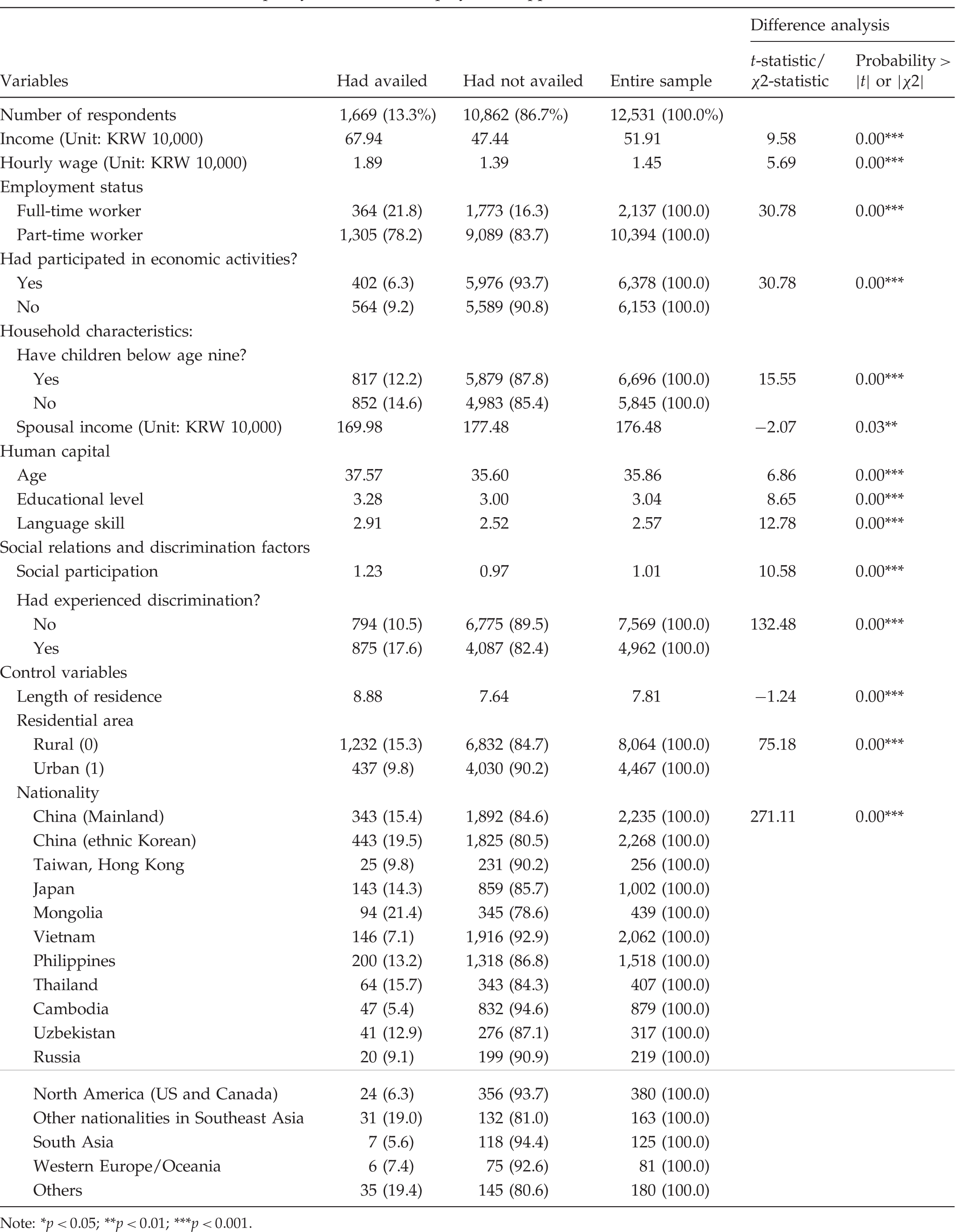
Characteristics of the sample by availment of employment support services.
Note: *p < 0.05; **p < 0.01; ***p < 0.001.
In this study, the four main variables were measured as follows. Economic activities were indicated by the following: whether she had worked for more than one hour for pay during the last week (1 July 2012 to 7 July 2012) or whether she had worked for more than 18 hours in a family-run shop, factory or farm without pay. Working conditions were indicated by the following: the total wage and salary earnings for workers (income), the ratio of total wage and salary earnings for workers divided by weekly working hours (hourly wage), and whether or not she was fully employed (fully employed worker). Among the 12,531 respondents, 6,378 (52.4 percent) participated in economic activities. Among those involved in economic activities, the distribution of female marriage immigrants by job status is as follows: temporary workers, 35 percent; regular workers, 29 percent; daily workers, 18.9 percent; unpaid family workers, 9.5 percent; self-employed workers without employees at 5.2 percent; and self-employed workers with employees at 1.5 percent. Income was in 15 intervals according to monthly average wage during the last three months, which ranged from less than KRW 500,000 to more than KRW 7,000,000. In this study, the average wage was converted into the median value, and that value was measured as the income of female marriage immigrants.
Two variables captured household characteristics: whether or not the individual has a child under age nine (children below age nine); and the average income of the spouse (spouse income).
Four variables capture human capital. Age was a continuous variable measured in years; educational level was measured by a six-point scale (0 = uneducated; 1 = did not complete primary school; 2 = junior high graduate; 3 = high school graduate; 4 = some college; 5 = college graduate; and 6 = completed graduate school); and language skill refers to Korean speaking ability and ranged in value from 1 (very bad) to 5 (very good).
The social relations and discrimination factors refer to whether the individual participates in a local residents’ meeting, whether the individual participates in volunteer work or has a hobby, and whether the individual participates in group activities. For each of these measures, participation was indicated by 1 and 0 for not participating. All three measures were summed up to indicate the degree of overall social participation. The variable, experienced discrimination, was marked as 1 if the individual had had an experience of discrimination and 0 if none. Control variables include female marriage immigrants’ length of residency (number of years lived in South Korea), residential area (whether rural, the referent, or urban) and nationality (i.e., country of birth).
Level 1 analysis: Influence of experience with employment support services on the probability of participating in economic activities
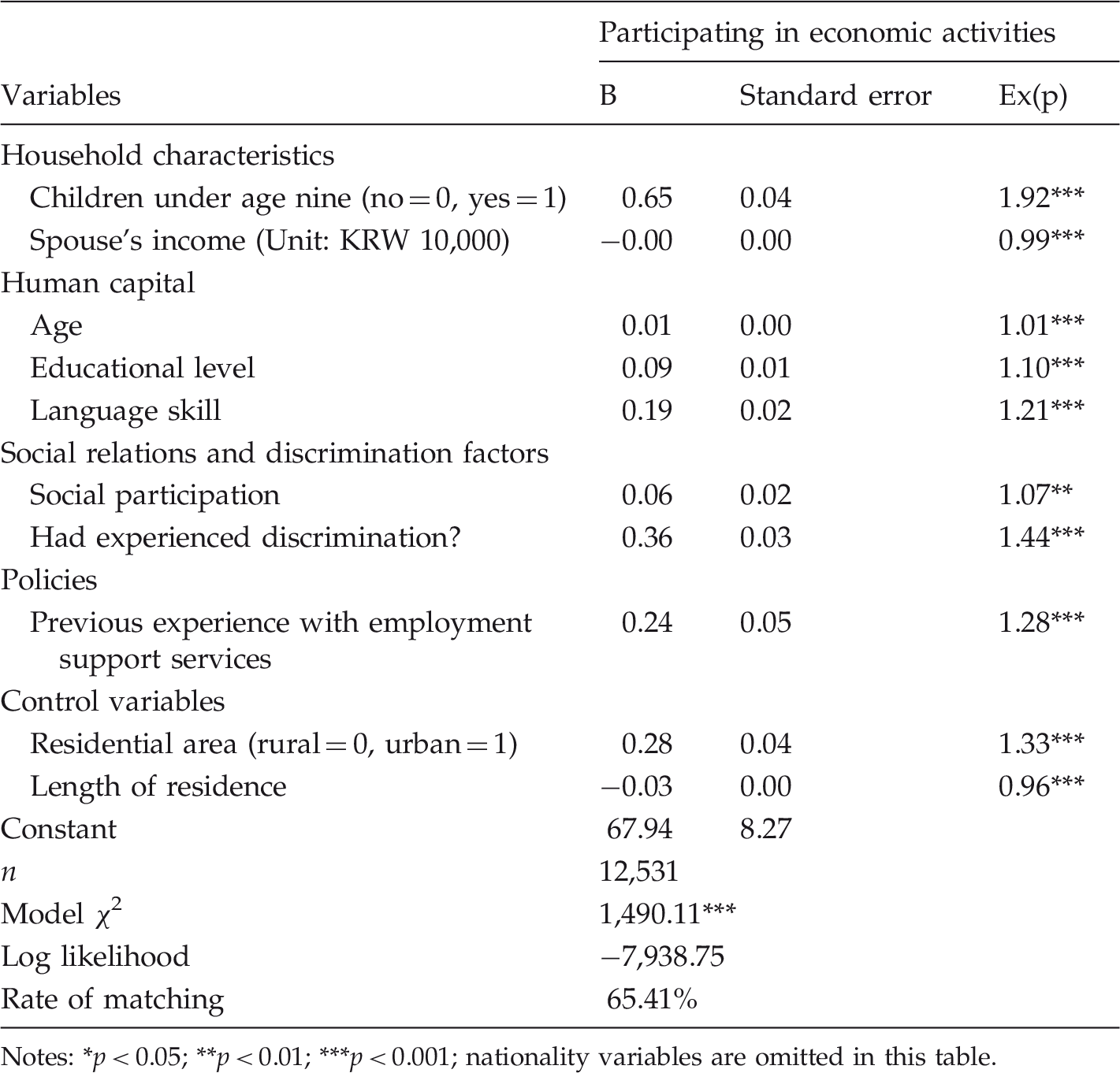
Logistic regression analysis of participating in economic activities.
Notes: *p < 0.05; **p < 0.01; ***p < 0.001; nationality variables are omitted in this table.
According to the results, among female marriage immigrants with children under age nine, the probability of participating in economic activities increased by 92 percent. A spouse’s income was found to negatively influence the probability of participating in economic activities, which supports the hypothesis. In other words, the probability that female marriage immigrants participating in economic activities decreased by 1 percent when their spouse’s income increased by KRW 100,000. Furthermore, the probability of participating in economic activities increased as age increased. The probability of participating in economic activities increased as education level increased. The probability of participating in economic activities increased as the level of Korean language skill increased. The probability of participating in economic activities increased with higher levels of social participation. The probability of participating in economic activities increased for those who had experienced discrimination. Specifically, the probability of participating in economic activities was 44 percent higher for female marriage immigrants who had experienced discrimination than for those who had not experienced discrimination. The utilization of employment support services was found to positively influence the probability of participating in economic activities. Therefore, it is not surprising that the group who made use of employment support services was 28 percent more likely to participate in economic activities than the group who did not. This result implies that current employment support services are helping female marriage immigrants to achieve their goal of employment in some degree.
These results all support the hypotheses. However, the result indicating that the degree of social participation influences economic participation suggests that sample selection error could occur when analyzing working conditions, as the degree of social participation could be considered a natural characteristic of female immigrants.
Level two analysis: Experience with employment support services and working conditions
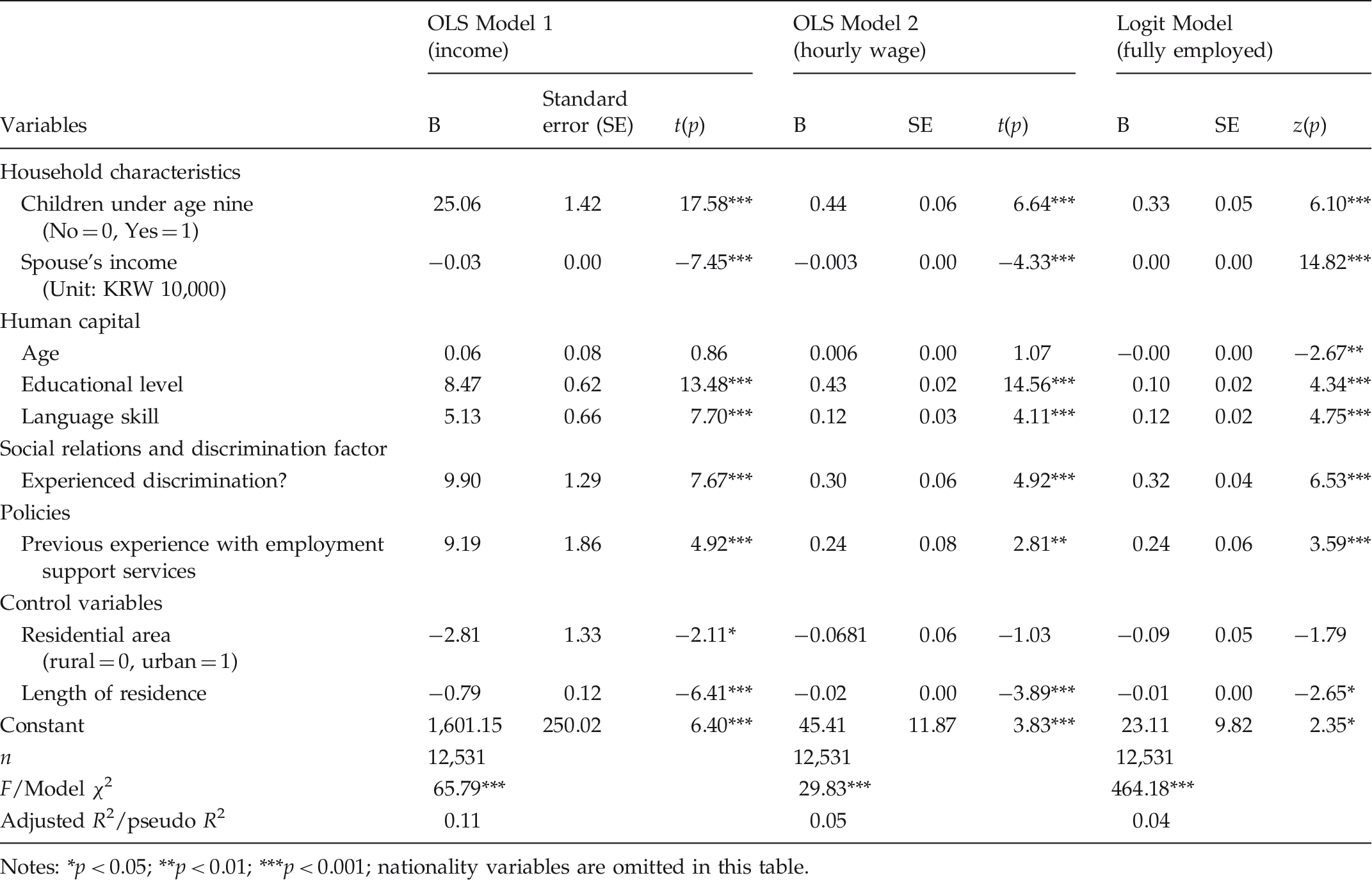
Analysis on the influence on working conditions.
Notes: *p < 0.05; **p < 0.01; ***p < 0.001; nationality variables are omitted in this table.
The regression analysis for income yielded the following results. In terms of household characteristics, having a child younger than nine years old was found to have a positive influence on income. To state the finding another way, the income of female marriage immigrants with a child below age nine was higher by approximately KRW 250,000 than the income of their counterparts who did not have children below nine years of age. A spouse’s income was found to have a negative influence on income. Age (a human capital factor) did not have a statistically significant effect on income. Educational level was found to positively influence income: as educational level increased, income also increased. Language skills also had a positive influence on the income of female marriage immigrants. Additionally, the experience of discrimination (a social relations and discrimination factor) had a positive influence on female marriage immigrants’ income, as did previous experience with employment support services (policies factor).
The regression analysis for hourly wage revealed the following results. First, having a child below nine years of age had a positive influence on hourly wage. In other words, female marriage immigrants with a child below age nine had a higher hourly wage by approximately KRW 4,400 than their counterparts who did not have a child below age nine. This finding is consistent with Hypothesis 1. Since most female marriage immigrants aspire to have a better life for themselves and for their family in their home country, having young children may serve as motivation for active economic participation. In other words, they tend to continue to be economically active to ensure that they will not experience a setback in their occupational career if they will stop working after childbirth.
Examining the results further, a spouse’s income had a negative influence on the hourly wage of female marriage immigrants. Age did not have a statistically significant effect on hourly wage. Educational level had a positive influence on female marriage immigrants’ hourly wage: higher hourly wages were associated with higher levels of education. Language skills also had a positive influence on female marriage immigrants’ hourly wage. Additionally, having experienced discrimination had a positive influence on female marriage immigrants’ hourly wage, as did experience with employment support services.
Finally, the results of the logit model analysis on full-time employment status indicated the following. First, having a child under 9 years of age (a household characteristic factor) had a positive influence on the probability of working full-time. In other words, female marriage immigrants with a child younger than nine had a higher probability of working full-time. Additionally, a spouse’s income positively influenced the probability of female marriage immigrants being full-time workers, which contrasts with the result for working conditions. In other words, the lower their spouse’s income was, the more likely female marriage immigrants were to work at temporary jobs with low hourly wages; conversely, the higher their spouse’s income was, the more likely these women were to work full-time. Furthermore, as age increased, the probability of working full-time decreased. Education level had a positive influence on female marriage immigrants’ probability of working full-time. In other words, as their education level increased, the probability of working full-time also increased. Language skills, as well, had a positive influence on female marriage immigrants’ probability of working full-time. Having experienced discrimination had a positive influence on female marriage immigrants’ probability of working full-time, and so did experience with employment support services.
Heckman model analysis
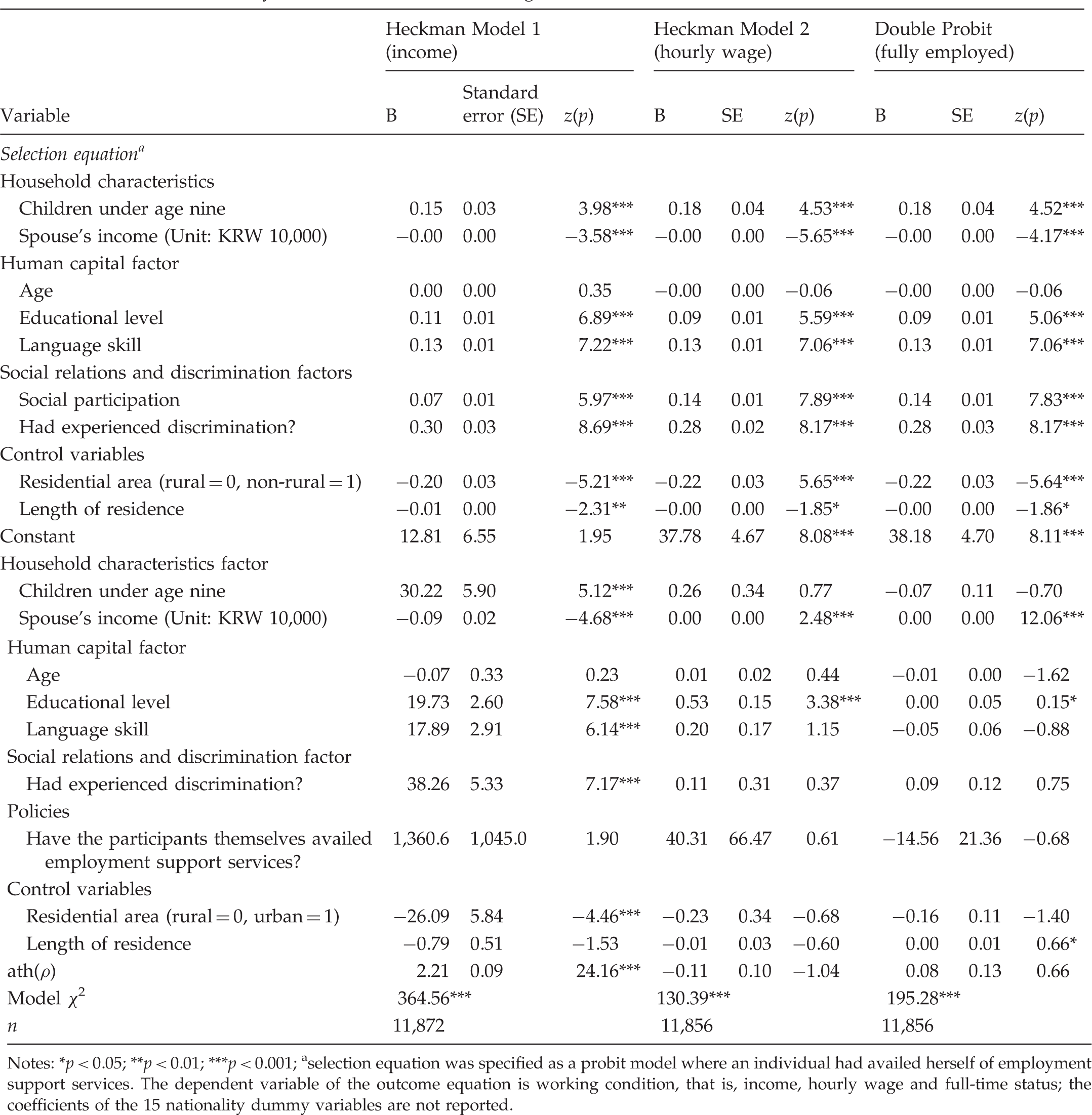
Heckman model analysis of the influence on working conditions.
Notes: *p < 0.05; **p < 0.01; ***p < 0.001; aselection equation was specified as a probit model where an individual had availed herself of employment support services. The dependent variable of the outcome equation is working condition, that is, income, hourly wage and full-time status; the coefficients of the 15 nationality dummy variables are not reported.
Conclusion
The three-level analysis results indicate that the household characteristic factor, human capital factor, social relations and discrimination factor, and availment of employment support services all have a significant influence on female marriage immigrants’ participation in economic activities and better working conditions. However, the Heckman model analysis on working conditions resulted in a significant decline in the influence of employment support services participation on the improvement of female marriage immigrants’ working conditions.
The results of this study indicate that although female marriage immigrants’ experience with employment support services is associated with a higher rate of economic participation, availing themselves of these services does not have a statistically significant influence on their income, hourly wage or full-time employment status. This finding suggests the need for more collaboration between employment support service organizations and Multicultural Family Support Centers. Second, low-income female marriage immigrants and those with a child under nine years of age have a higher probability of participating in economic activities due to financial need. Effective employment support services need to be developed to enhance their employability for high-paying jobs. Third, from a human capital perspective, female marriage immigrants’ education levels and language skills have a significant influence on their economic participation and working conditions. In this regard, the Korean language and Korean culture education programs provided by Multicultural Family Support Centers must be expanded, as they have a significant impact in promoting economic participation and better working conditions. Beyond providing basic level conversational language training, these programs should offer employment-related training programs, advice on preparing resumés, job search strategies, how to conduct oneself during a job interview and the like. The analysis revealed that education level was the largest and the most consistent factor influencing female marriage immigrants’ working conditions and enhancing their human capital. Scholarship programs, skills development training and child care support are examples of interventions toward this end. Policies to reduce discrimination against immigrants in the Korean labor market are also needed. Finally, those residing in urban areas have a higher probability of participating in economic activities but are more likely to have poor working conditions and positions. This may hint at informal jobs which do not offer basic protection and prospects for occupational mobility. These measures require government intervention and political will to create an enabling labor market environment for female marriage immigrants.
Footnotes
Declaration of conflicting interests
The authors declare no potential conflicts of interest with respect to the research, authorship and/or publication of this paper.
Funding
This research received funding support from the Hansung University.
1
These centers are comprehensive employment support organizations that support the employment of Korean women, particularly those who have stopped working or could not work because of childbirth, childcare and other domestic responsibilities. There are 155 centers established across Korea. (For details, see  ).
).
2
These centers have a focus on foreign spouses of Korean nationals. They offer a variety of services such as Korean language education, interpretation and translation, counseling and case management, social training and occupational training for female marriage immigrants. There are 222 Multicultural Family Support Centers across Korea. (For details, see ).