



Abstract
This paper used a bootstrapped linear regression model to examine the role of amenities and economic opportunities in migration patterns in China based on the 2010 census at the city level. The results reveal that striking disparities characterize migration at the city level in China. Most migrants tend to move into several major cities in urban agglomerations in the eastern coastal region and provincial inland capitals. The cities farther away from provincial capitals have weak inflows and even suffer from serious population loss. The results suggest that job opportunities and wages contribute to the uneven pattern of migration in China even as amenities have also become important pull factors of migration. Regarding amenities, migrants prefer to move into cities with warm winters, less-humid summers, clean urban environments and friendly and open social climates. Social services, including facilities for education, recreation and commuting, also play an important role in attracting migrants. Findings from the study improve our understanding of China's internal migration and contribute to the debate on the role of economic opportunities and amenities in migration.
Introduction
Since the relaxation of the household registration system (hukou) and the economic reform in the late 1970s, China has experienced unprecedented large-scale internal migration. China's 2010 population census shows that the total number of migrants rose to 221.03 million, which accounts for a growth rate of 180.64 percent over the last decade. A striking imbalance characterizes migration at the city level in China, however, which restricts sustainable development and coordinated development across the regions. Some cities, such as Beijing and Guangzhou, attract more migrants to live and work there and, consequently, face serious urban problems, such as environmental pollution and traffic congestion (Qi and Liu, 2015). Meanwhile, other cities suffer from population loss, which then contributes to losses for the local economy (Liu and Yan, 2013). To address these issues, the central government has put forward a new urbanization development plan that aims to promote population redistribution across cities of different sizes. This calls for an examination of the factors that attract migrants to urban areas.
In general, the ability of cities to attract migrants is often highly dependent on local amenities and economic opportunities (Buch et al., 2014). In China, most migrants are usually without hukou status at their destinations and, consequently, they cannot enjoy public services as can local inhabitants. Previous studies about Chinese migration have mainly stressed the role of economic drivers, such as per capita gross domestic product (GDP), GDP, wage (Chen and Coulson, 2002; He and Pooler, 2002; Zhu, 2002), off-farm job opportunities, foreign direct investment, unemployment, investment (Fan, 2005a; Zhao, 2005; Lu et al., 2006; Shen, 2012), and the structure and absolute size of the local economy (Gries et al., 2016; He et al., 2016). With the exception of several recent studies (Liu and Shen 2014a, 2014b; Yang et al., 2017), amenities have gained little attention.
Amenities, however, play an increasingly important role in China, especially now that the limitations of hukou on migration are getting weaker (Zhang, 2010) and the country's entry into the upper middle-income range. Due to the government's efforts, the restrictions of the hukou system on migrants' access to public services are gradually being relaxed. For example, many local governments have built schools for migrants' children, and migrants can also pay fees for their children to attend local schools. Further, even without local hukou status, migrants can still enjoy some amenities, such as better climate, clean air, bus services, recreation areas, cinemas and museums (Xia and Lu, 2015). Moreover, compared with previous decades, the age composition of current migrants has gradually gotten younger, their education level tends to be higher and they have higher incomes (Zhang, 2010). Additionally, as China's per capita has increased to more than USD 4,200, this means that China now ranks among the upper middle-income countries (Zhang, 2013), which suggests that people would pay more attention to amenities. In this context, the role of amenities in migration decisions has become increasingly important. Some surveys have already found that people migrate to large cities to obtain better public amenities and quality of life (Yang et al., 2017; Xiao, 2016). Thus, besides economic factors, amenities that affect quality of life should also be considered.
The role of amenities in migration has been examined considerably in developed countries. China is at a different development stage, however, and has a different culture, and thus, studies from developed countries may be inadequate or limited in explaining migration in China. This paper tries to update our understanding of China's internal migration at the city level by exploring the role of economic factors and amenities. This understanding is essential to enlighten local government and urban planners, and contributes to the debate about the roles of economic opportunities and amenities in migration by providing new evidence. The following sections of this article are organized as follows. A brief literature review is provided, followed by an introduction to the methods, variables and data employed by this research. The results and discussion are then presented and finally, we summarize the conclusions and implications of the study.
Literature review
As early as the 1930s, John Hicks, a famous economist, claimed that migration was a reaction to spatial disequilibria of economic opportunities (Hunt, 1993). Migration was seen as a rational behavior based on cost–benefit calculation (Sjaastad, 1962; Greenwood, 1985; Hunt, 1993; Waltert and Schläpfer, 2010). From the perspective of non-equilibrium models, economic factors were emphasized as the sole driver of migration. The empirical studies found that job opportunities, unemployment and wages significantly affect migration (Buch et al., 2014).
Observing the population growth in the US Sunbelt, such as Florida and California, since the end of the Second World War, however, Ullman (1954) and Graves (1976, 1980) noticed that climate can have a pronounced influence on migration. Following this, Graves and Linneman (1979) classified the factors driving migration as traded goods (mainly referring to economic opportunities) and non-traded goods (such as weather, crime rate, racial discrimination, etc.). They said that the non-traded goods could compensate migrants for insufficient economic opportunities. People also move to meet their different needs for non-traded amenities (Thomas and Knapp, 1989). Hence, different amenities may also be among the main drivers of migration (Graves, 1976; Chi and Marcouiller, 2011), a view that has gained increasing popularity in past decades (Mueser and Graves, 1995; Partridge et al., 2009, 2012; Scott, 2010; Rodríguez-Pose and Ketterer, 2012; Zheng, 2016). Numerous empirical studies reveal that amenities have a pronounced impact on migration flows (Graves, 1976, 1980; Knapp and Gravest, 1989; Rickman and Wang, 2017).
These case studies based on equilibrium theory have mainly examined the role of natural, social and services amenities. Climate was the first to be considered (Graves, 1980; Greenwood and Hunt, 1989). A pleasant climate—with factors such as a warm winter, cool summer, comfortable humidity, wind speed and sunshine—was found to have a positive effect on migration (Clark et al., 2003; Rappaport, 2007; Liu and Shen, 2014a, 2014b). In addition, green space and pleasing landscapes, such as seashores and lakes, were also considered (Rodríguez-Pose and Ketterer, 2012; Buch et al., 2014). Social amenities include low crime rate, social openness and inclusiveness—these can affect migration decisions from a psychological perspective. A lower crime rate often implies safety, which appeals to potential residents (Clark, 2003; Sousa, 2014). Social openness and inclusiveness, as indicated by diversity, tolerance, gay index, share of foreigners and bohemian index, can attract residents, especially skilled people (Florida, 2002a, 2002b; Sanchez-Serra, 2014; Zheng, 2016). The services amenities that are positively associated with migration include education, recreation, health care, transport, and cultural and artistic services (Niedomysl and Hansen, 2010; Kemeny and Storper, 2012; Rodríguez-Pose and Ketterer, 2012; Zheng, 2016). Overall, these studies suggest that amenities play a key role in migration.
Notwithstanding the above, there is still a vigorous debate on the relative importance of amenities vis-a-vis economic factors in migration (Rodríguez-Pose and Ketterer, 2012; Buch et al., 2014). Some studies, particularly in European countries, have emphasized the role of economic factors. The role of amenities in studies on migration was found to be either ambiguous or contradictory (Shapiro, 2006; Faggian and McCann, 2009; Scott, 2010). For example, Cheshire and Magrini (2006) found that weather played a role in national interregional migration flows but did not matter in flows among countries in Europe. Biagi et al. (2011) found that economic factors were the main driver for migration in Italy, and amenities only played a role in short-distance migration. Storper and Scott (2009) suggested that the compensation effect of amenities for insufficient economic opportunities was exaggerated. Some scholars consider both factors as relevant (Royuela et al., 2010; Rodriguez-Pose and Ketterer, 2012; Yang et al., 2017; Rijnks et al., 2018). In a word, the evidence on the role of economic opportunities and amenities in migration is insufficient and/or mixed. Furthermore, most studies looking into how amenities affect migration were carried out in developed countries—particularly in North America (Glaeser and Gottlieb, 2006; Partridge, 2010; Scott, 2010; Wang and Wu, 2011; Brown and Scott, 2012) and Europe (Cheshire and Magrini, 2006; Royuela et al., 2010; Biagi et al., 2011; Rodriguez-Pose and Ketterer, 2012; Buch et al., 2014). The fast economic development and urban growth in developing countries call for exploring the role of amenities in these contexts (Duranton, 2016). As China moves into the ranks of middle-income countries, the migration flows in China's cities are not only driven by economic opportunities, but also by urban amenities. Therefore, China can provide a very interesting example in contributing to the literature.
Although China's migrants are moving toward areas rich in amenities (Shen, 2012), the relationship between specific amenities and migration has not been well understood (Yang et al., 2017). Although the few studies based on the equilibrium approach suggest the importance of amenities (Liu and Shen, 2014a, 2014b; Yang et al., 2017), the unit of analysis thus far has focused on provinces, which are large units. The provinces of China, which consist of a few prefecture-level cities, are often larger than some European countries, and have obvious disparities in economic opportunities and locally available amenities. Studies at the province level may lose sight of disparities among cities in the same province. A more accurate assessment of how amenities influence migration may be provided by considering a smaller administrative unit, the city level. Liu and Shen (2014a, 2014b) and Song et al. (2016) focused on the interprovincial migration of skilled labor, but other migrants also pay increasing attention to specific amenities in their localities as their incomes grow (Xia and Lu, 2015; Yang et al., 2017). In addition, the studies only concerned a limited set of potential amenity-drivers, such as green space, climate and education. In the equilibrium model of migration, all nonmarket factors can be regarded as amenities (Xing and Zhang, 2013). For example, urban environment, air quality and traffic conditions could all have powerful impacts on migration, but their role in migration has not been substantially investigated. Particularly in China, we need to investigate the influence of more amenities-related factors on migration at the city level.
Materials and methodology
Data sources
The cities in this study pertain to 286 prefectural-level cities in China. Except for the prefectural-city level data on tourist density, the data for the rest of the dependent and explanatory variables are at the urban district level, which is closest to the city level. 1
In this article, the term ‘migrants’ refers to persons staying more than six months in an administrative unit other than the one indicated in their hukou (Yang et al., 2017). This definition captures the temporary migrants or floating population counted in China's census (Chan, 2012; Yang et al., 2017). At the city level, the number of migrants can be counted by the difference between the city's total resident population and the household-registered population. If the resident population is more than the household-registered population, a city has a net inflow; otherwise, it has a net outflow. The net migration rate, used as a dependent variable, is estimated by the proportion of net inflows in the total resident population or the proportion of net outflows in the total registered population. When the net migration rate is higher than 0, a city has a net in-migration flow; if it is below 0, a city has a net out-migration flow. All of these population data are derived from the 2010 census.
Concerning data on natural amenities, climatic data were gathered from the Chinese Meteorological Data Sharing Service Network (https://data.cma.cn/en) for the years covering 1980–2010, while the data on air quality were taken from the China Environment Yearbook (National Bureau of Statistics and Ministry of Environmental Protection, 2010). All other data on socio-economic indicators and urban construction were sourced from the Chinese City Statistical Yearbook (Department of Urban Socio-economic Survey, National Bureau of Statistics, 2010), the Chinese Urban Construction Statistics Yearbook (Ministry of Housing and Urban-Rural Development, P.R. CHINA, 2010) and the Chinese Regional Economic Statistical Yearbook (National Bureau of Statistics, 2010).
Explanatory variables
Urban amenities include a variety of conditions and factors that contribute to a livable and pleasant living environment in cities (Ullman, 1954). They consist of the natural environment, social services and built environment, and social climate (Wen et al., 2014; Li et al., 2016; Yu et al., 2016).
Studies in the USA and China find that people prefer a mild climate with warm winters and less humid summers (Partridge, 2010; Liu and Shen, 2014b). Informed by existing studies (Liu and Shen 2014a, 2014b), the temperature severity index and average relative humidity in July from 2000 to 2010 were selected as indicators to represent temperate climate. In this study, the temperature severity index refers to the differences in the average temperature between January and July. As mentioned in the literature review, educational, recreational, health care, transport and cultural and artistic services can be expected to have a positive relationship with in-migration (Buch et al., 2014; Liu and Shen, 2014b; Yang et al., 2017). Considering that these social services are mainly sustained by facilities and workers in public services (Yu et al., 2016; Garretsen and Marlet, 2017), we selected teachers per 1,000 pupils to represent educational services, doctors per million people to indicate medical services, buses per million people and per capita road area to indicate transport services, and the number of cinemas and theaters as indicators of cultural and artistic services. A city attracting more tourists would have more recreational services and resources. Song et al. (2016) pointed out that the tourist attractions of a region represent generally related specific amenities, especially recreational amenities. Therefore, the tourist density, i.e., number of tourists per square kilometer, was chosen to indicate recreational amenities. Since the number of tourists may also be influenced by other amenities, the average number of tourists from 2006–2009 was used to calculate the tourist density. For indicators of local public goods reflecting the quality of life, the study evaluated a clean environment through the following three variables: rate of road cleaning, rate of garbage treatment in living areas and sewage treatment rate. With increasing environmental pollution and degradation, air quality and green space also affect people's habitat and environment. Hence, we selected the ratio of excellent air quality days out of a year to measure air quality, and per capita public green areas as a measure of green space (Li et al., 2016; Yang et al., 2017). The social environment is mainly defined by the social profile of a city (Buch et al., 2014). A society with more highly educated and skilled residents should be friendlier, more open and more tolerant. Shapiro (2006) found that a high percentage of skilled residents encourages the availability of more consumer services, such as bars and restaurants, which are positively related to migration. Additionally, the tolerance and openness of the social climate are positively associated with the share of highly educated people (Buch et al., 2014). Thus, the study included the share of highly educated people to indicate a city's social profile.
Apart from amenities, economic opportunities are the other driver of migration. They often include wages, unemployment levels and job opportunities (Etzo, 2011), which are measured by urban wages, unemployment rate and the number of available jobs, respectively. China's employment statistics, however, omit a significant network of informal jobs. Thus, it is difficult to accurately assess a city's real employment potential. Since employment potential ultimately depends on the level of economic development, based on existing research (Yu, 2012; Liu et al., 2015; He et al., 2016), the study used the variables per capita GDP and share of non-agricultural industries in the GDP as indicators of job opportunities.
Descriptive statistics for the dependent and exploratory variables.
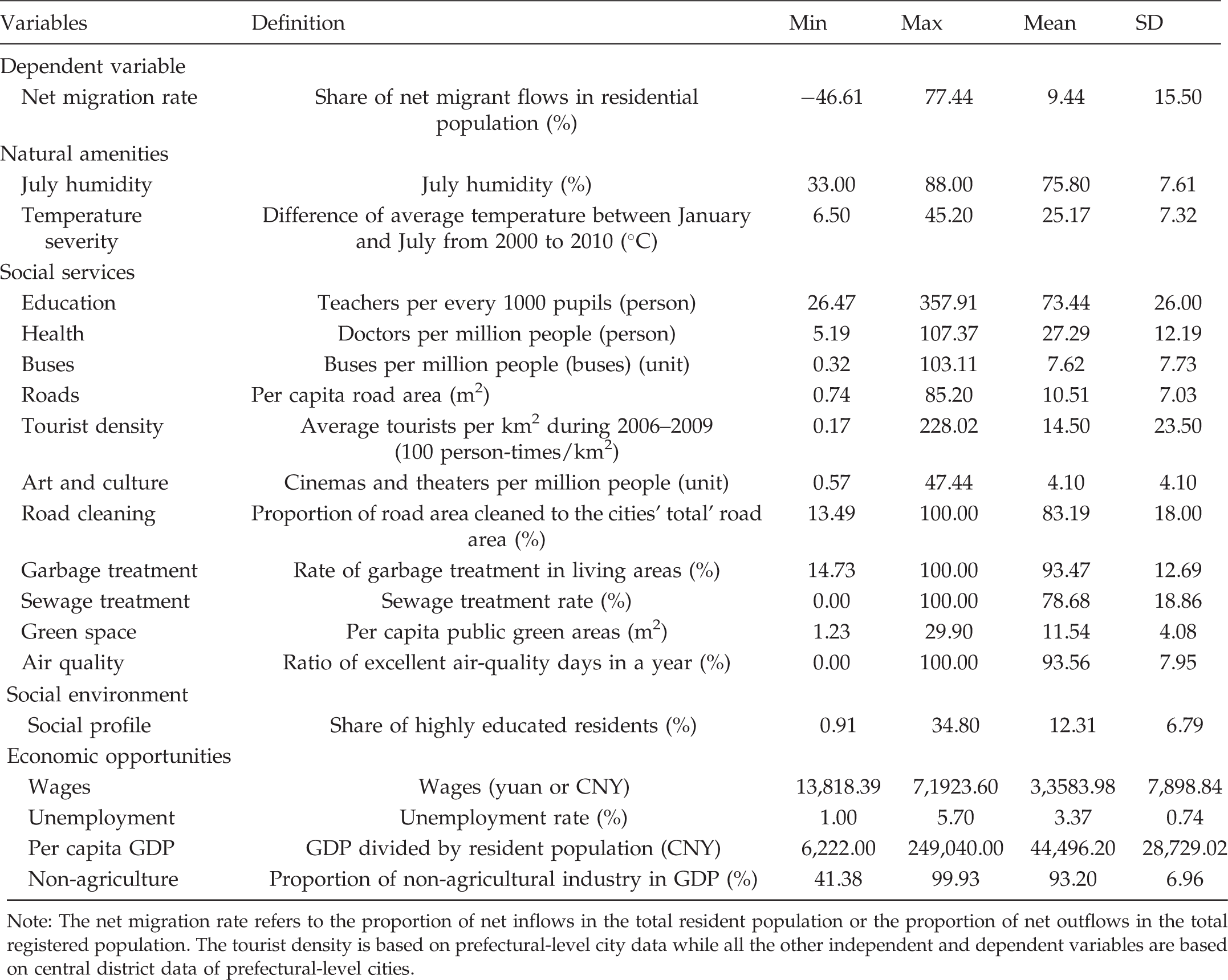
Note: The net migration rate refers to the proportion of net inflows in the total resident population or the proportion of net outflows in the total registered population. The tourist density is based on prefectural-level city data while all the other independent and dependent variables are based on central district data of prefectural-level cities.
Regression model
Generally, migration is driven by pull and push forces. Considering that Chinese internal migration is predominantly driven by pull forces (Fan, 2005a; Shen, 2012; Gries et al., 2016), however, this study highlighted the role of amenities as pull factors. The relationship between migration and these drivers were explored through multiple linear regression (Yu et al., 2017). The model is specified as

The net migration rate does not strictly conform to a normal distribution, which is the condition for multiple linear regression. The bootstrap, a repeat sampling method of correlation estimations, is significantly helpful when the theoretical distribution of the test statistic is unknown (Sanchez, 2018). Moreover, when heteroscedasticity exists, the bootstrap method can provide more accurate estimates than robust and general regression models, especially when the sample size is small (Flachaire, 2005; Chen, 2014). In view of the possible heteroscedasticity of the cross-section analysis carried out in this study, we employed bootstrap regression analysis to examine the relationship between the explanatory variables and the net migration rate. To avoid possible endogeneity, except for the natural amenities variables, all the other independent variables are one year ahead of the dependent variable. We first estimated Model 1, which only considered amenities, and Model 2, which only included economic opportunities. Then, we added all the explanatory variables into Model 3 to estimate the key pull drivers for migration. In the process of bootstrap regression estimation, the tolerance and variance inflation factor (VIF) were calculated to determine whether there is a collinear relationship.
Results
Varying levels of migration at the city level
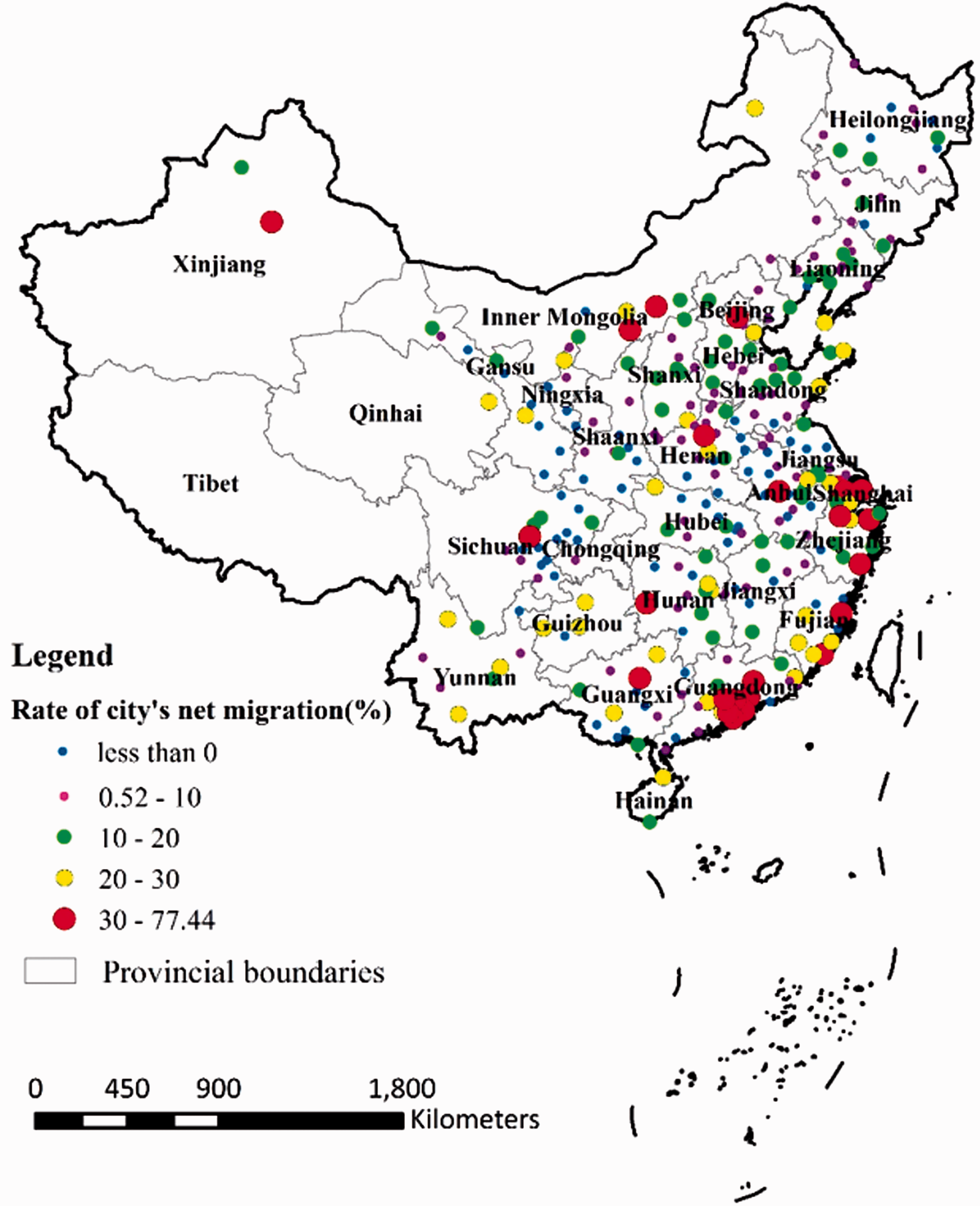
As shown in Figure 1, approximately 26 percent of cities have a net migration rate of less than 0, while there are 212 cities (about 74 percent) with net migration rates greater than 0. Among the cities, approximately 31 percent have net in-migration rates from 0–10 percent, while cities with net in-migration rates from 10–20 percent account for 23 percent. The rest, which have net in-migration rates at 20–30 percent, 30–40 percent and more than 40 percent, account for just a small proportion (12 percent, 5 percent and 3 percent, respectively). The city with the largest in-migration rate is Dongguan (77.89 percent), followed by Shenzhen (74.91 percent), Ordos (55.33 percent), Zhongshan (52.20 percent) and Wenzhou (52.04 percent). The average net in-migration rate is just 7.85 percent, far less than the maximum and median. The results suggest that striking disparities characterize migration at the city level in China, and only a few cities attract most of the migrants.
Proportion of China's cities across ranks of net migration rate in 2010.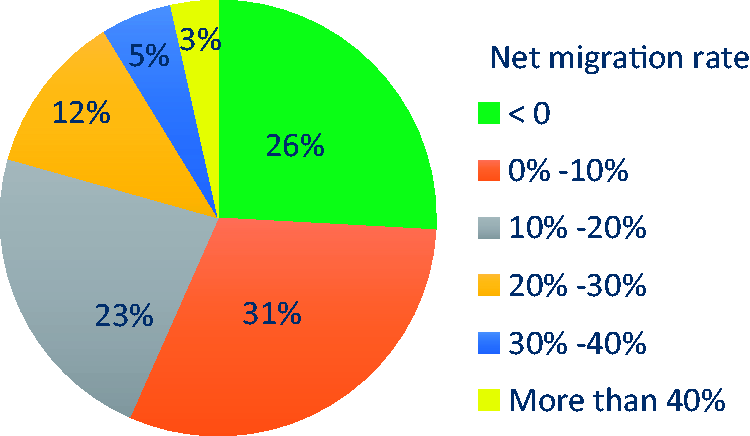
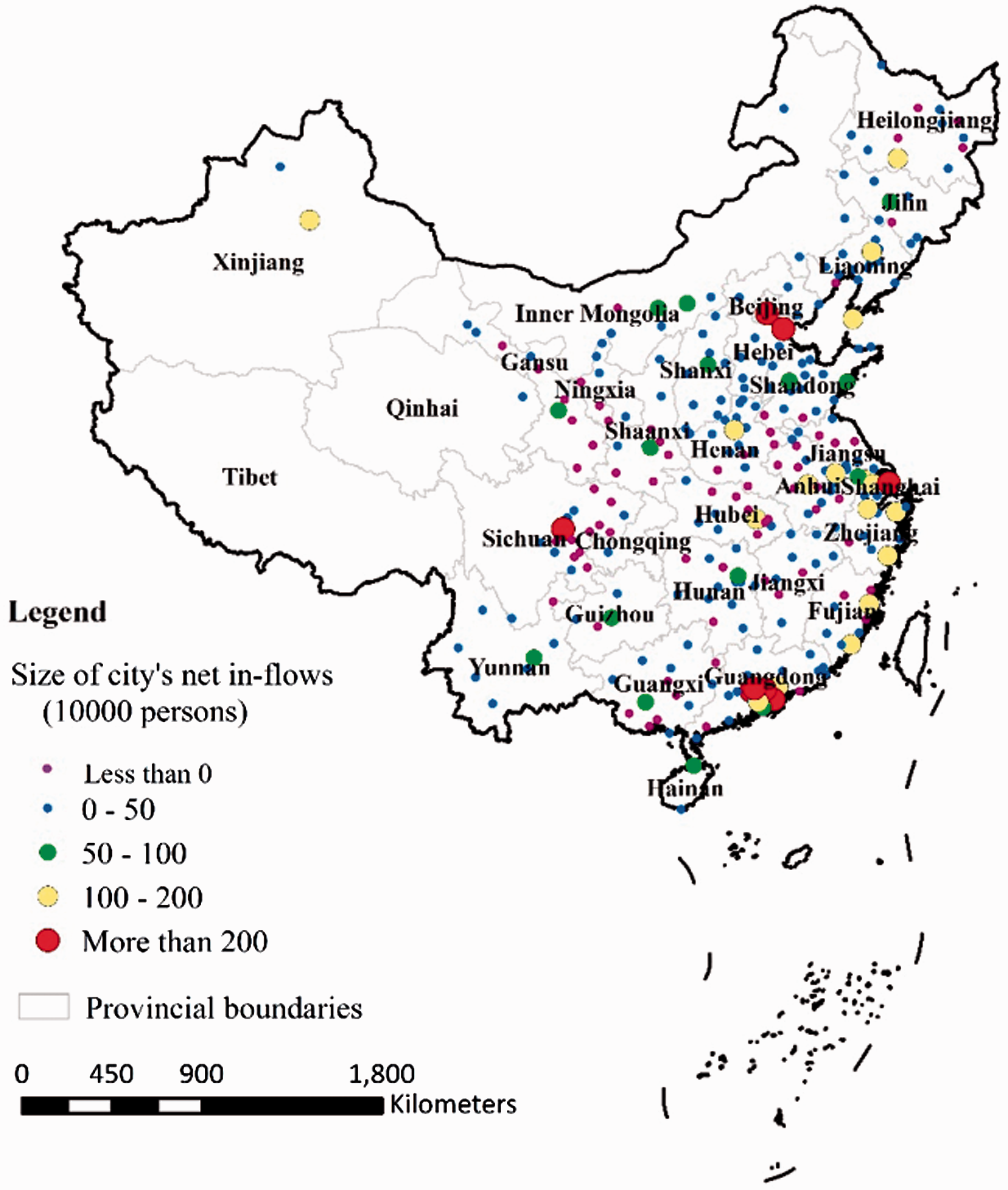
From a spatial perspective, China's urban migration is characterized by imbalance. As shown in Figure 2, the cities with net outflows are mainly distributed intensively in the area between the Yellow River and the Yangtze River, and are scattered throughout the southern hilly regions, while the cities with net inflows are distributed all over China. Furthermore, there are significant differences in the size of net inflows and net migration rates. In terms of net inflow size, the strongest inflows (more than two million) are only distributed in seven cities, i.e., Shenzhen, Guangzhou, Dongguan, Shanghai, Chengdu, Beijing and Tianjin (see Figure 3). The cities with the second strongest inflows (one to two million) are mainly located in China's eastern coastal zone, with only a few located in inland provinces. The net inflows for the other cities are less than one million. In terms of net migration rate, the cities with net in-migration rates greater than 20 percent are mainly located in the Zhujiang River Delta, Southern Fujian and the Yangtze River Delta, with only a few located in inland provinces (see Figure 4). Most of these cities are provincial capitals and regional economic centers. Meanwhile, a discrete distribution of the lower net in-migration rate (less than 20 percent) is indicated in the peripheral areas of provincial capitals and economic center cities (Figure 4). Overall, migration at the city level in China is markedly spatially imbalanced. Migrants tend to move into several major cities in the eastern coastal region and the provincial inland capitals, and the cities farther away from provincial capitals suffer from serious population loss.
Distribution of cities with net inflows and net outflows in China. Scale of net inflows at the city level in China. Pattern of net migration rate at the city level in China.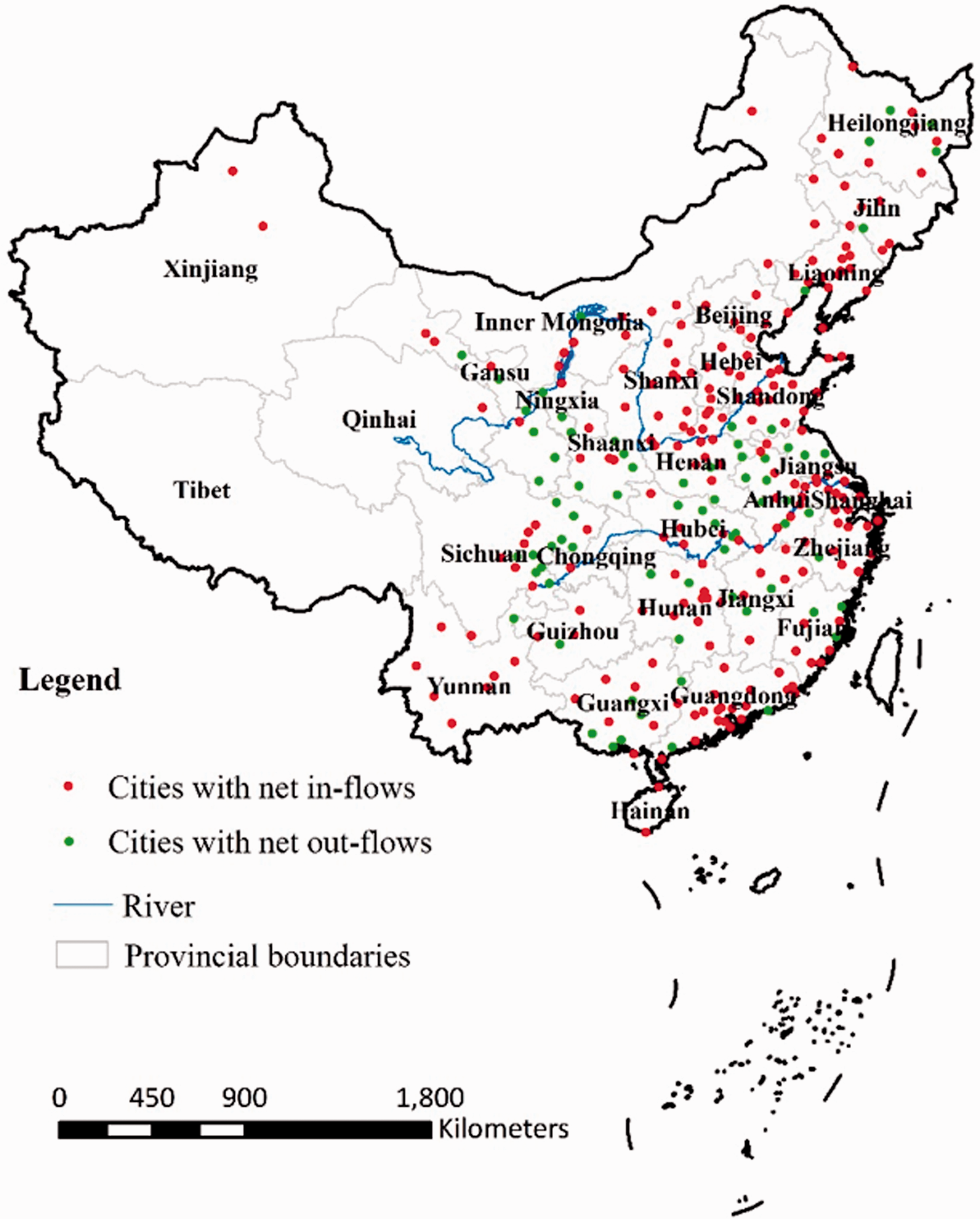
Estimated results of the regression model
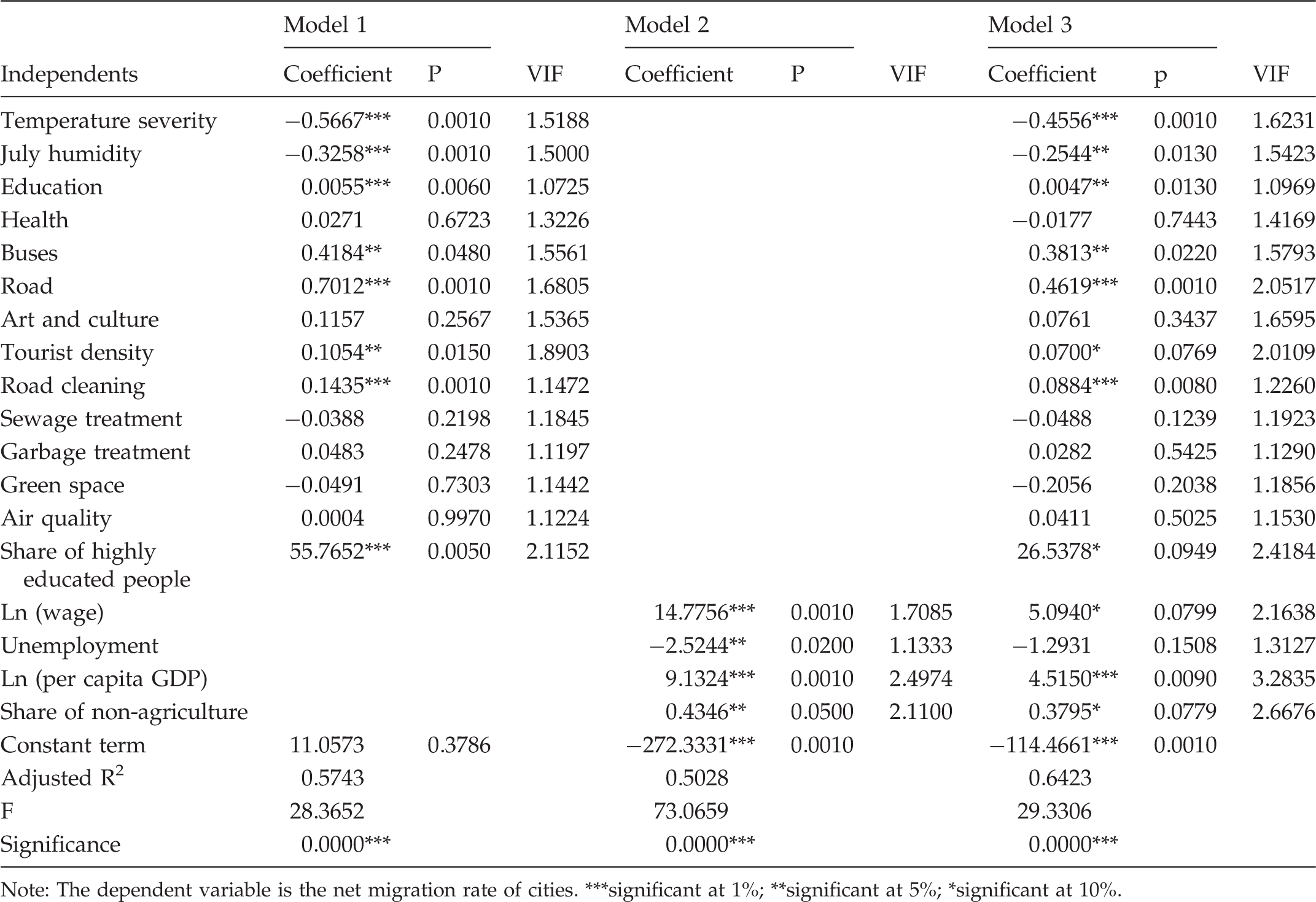
Results of bootstrapped regression (dependent variable = net migration rate).
Note: The dependent variable is the net migration rate of cities. ***significant at 1%; **significant at 5%; *significant at 10%.
Natural amenities. According to Table 2, both temperature severity and July humidity have a significant influence on the net migration rate at the city level. In Models 1 and 3, both variables are negatively correlated with net migration rate, indicating that migrants prefer less humid summers and warm winters. Social services. Models 1 and 3 in Table 2 indicate five variables that pass the regression models' significance test. Education is positively associated with urban migration in both Models 1 and 3. In Model 1, the two transportation services variables, buses and roads, have coefficients of 0.4184 (p < 5 percent) and 0.7012 (p < 1 percent), respectively. In Model 3, both variables still pass the statistical test. The coefficient of tourist density is 0.1054 at the 5 percent confidence level in Model 1 and 0.0700 at the 10 percent confidence level in Model 3. These results reflect that cities with more recreational services and resources can attract more migrants. In Models 1 and 3, the variable road cleaning is found to be significantly and positively associated with the dependent variable. According to the estimated results, the social services that affect urban attractiveness cover educational, transportation and recreational services and a clean urban environment. Surprisingly, health, and art and cultural services, do not pass the significance test. Similarly, there are no significant relationships found between the net migration rate and air quality, green space, and sewage and garbage treatment—nonetheless, these are important factors that promote a clean urban environment. Social environment. Table 2 suggests that social profile is highly significant (p < 1 percent) and positively associated with the dependent variable (the coefficient is up to 55.7652) in Model 1. Although the coefficient is down to 26.5378 in Model 3, the social environment still presents a significant (p < 10 percent) and positive effect. This result means that a city with an open and friendly climate would attract more potential residents. Economic opportunities. In Model 2, all of the four economic opportunities variables pass the significance test. Wage is positively associated with the dependent variable in Model 2 and Model 3. This means that a city with a higher salary level would be more attractive to migrants. Unemployment, which represents employment stability, is significantly and negatively associated with the dependent variable in Model 2, but not significant in Model 3. The variable per capita GDP has a coefficient of 9.1324 in Model 2 and a coefficient of 4.5150 in Model 3. Furthermore, the proportion of non-agricultural industry in GDP is significant and positively related to urban migration in both Model 2 and Model 3. These results suggest that wages and employment opportunities play an important role in attracting population.
Discussion
Imbalanced urban migration in China
The results reveal marked spatial imbalances of migration at the city level. From Figures 2 and 3, we can surmise that the strongest inflows are mainly toward the eastern coastal regions of China, as well as several major inland cities. Interregional migration, particularly imbalanced migration, is a reflection of uneven regional development (Fan, 2005b; Yang et al., 2017). In turn, imbalanced migration will hinder China's development due to disparities in resources and environmental conditions in different regions. Hence, guiding migration flows into the central and western regions would be an important strategy to narrow down the economic divide between China's coastal and inland regions, and improve sustainability.
Figure 3 shows relatively modest differences in the net in-migration rate in the southeast coastal area, particularly in the Yangtze River Delta Urban Agglomerations, Pearl River Delta Urban Agglomerations and Fujian coastal area. The central cities in central and western China, however, are often surrounded by cities with low net in-migration rate and even net outflows, such as the capitals of Sichuan and Henan. Meanwhile, in some provincial capital cities, the net in-migration rate is less than 20 percent, much lower than in Guangdong, Fujian, Zhejiang, Jiangsu, Shanghai and others. These patterns reflect the spillover effects of China's eastern urban core, which has led to a high level of regional integrated development, while the inland areas are still lagging behind in development. Therefore, strengthening the core cities' attractiveness to potential residents in inland areas and some cities in peripheral areas of inland urban agglomerations needs to be addressed.
Amenities and economic opportunities: Drivers of migration at the city level
Unlike some existing studies that emphasize only the role of either amenities or economic factors (Rodríguez-Pose and Ketterer, 2012), this study found both amenities and economic factors significantly influencing migration at the city level in contemporary China. This finding is in accordance with Chen and Rosenthal (2008), Royuela et al. (2010), Rodriguez-Pose and Ketterer (2012) and Yang et al. (2017), who found both factors relevant to migration. This finding also supplements what has been established by past studies emphasizing economic factors (Zhu, 2002; Fan, 2005a). The study reveals that in present-day China, migration can also be influenced by natural environment, social services and urban environment considerations.
As noted above, this trend can be explained by China becoming an upper-middle-income country and increasing incomes, which incline migrants to pay more attention to quality of life, thereby increasing the demand for amenities. The changing composition of migrants in China has also brought about increased demand for amenities. From 2005–2010, the proportion of urban–urban migrants increased by 26 percent, reaching 9.02 million (Yang et al., 2017). Furthermore, the age composition of rural–urban migrants is becoming younger. Migrants in previous generations tended to return to their original homes, while the more recent and younger migrants, who often have more education, are as interested in amenities as economic opportunities (Song and Xie, 2017). In recent years, western and central China have made great progress in economic development, and cities in these regions are attracting migrants. This overall economic development has weakened the influence of economic opportunities on the distribution of in-migration flow (Li et al., 2018).
Natural amenities enhance the appeal of cities. As the results imply, cities with a pleasant climate, i.e., less humid summers and warm winters, attract more migrants. There are huge migrant flows from the cold northeast to warm southern China, while some cities in southern China, such as Kunming, Dali and Lijiang, also attracted large numbers of migrants. In comparison with most previous studies of Chinese internal migration (Chen and Coulson, 2002; Zhu, 2002; Zhao, 2005; Fan, 2005a, 2005b; Qi and Liu, 2015; Liu et al., 2015), we can put forward that natural amenities have also become an important factor shaping and driving migrants’ destination choice.
The significance of social services. As shown in Table 2, educational facilities are significant in both Models 1 and 3. With increasing family migration (Deng et al., 2015; Song and Xie, 2017)—one indication, for example, is the large population of migrant children in Beijing, Shanghai, Guangdong, Jiangsu and Zhejiang (Li et al., 2018)—the demand for educational services has also increased. As early as 1996, the Ministry of Education had issued a policy requiring local governments to provide access to compulsory education for the school-aged children of migrants. This policy was further reinforced in 2001 and 2003. In response to these policies, urban governments had made significant efforts to make local public schools available to temporary resident children. In addition, many special schools for migrant workers' children were founded. Educational opportunities for migrant children vary from region to region, however, due to different fiscal capacities and educational resources in different cities. Hence, access to educational opportunities became a factor in migrants' destination decisions. Li et al. (2018) found migrants tended to select places that offer educational amenities, prioritizing this factor over higher-paying jobs. Thus, cities offering more educational opportunities will attract more migrants (Su et al., 2018).
In terms of transportation services, bus service and per capita road area are positively associated with migration. Access to public transportation and ease of commuting are important to urban residents' life satisfaction.
The significance of recreational services, as indicated by tourist density, shows that people have begun to concern themselves with the quality of life and pay increased attention to leisure and recreation, rather than pursuing merely economic benefit (Zhang, 2010; Yang et al., 2017). In the last decades, many Chinese cities have pursued tourism as one of the strategies for regional economic development, prompting local governments to invest substantial resources to improve the urban environment and recreational services. Hence, cities with a higher tourist density also tend to attract more migrants. Additionally, recreational services and the service industry in these cities create job opportunities that also pull migrants in.
A clean urban environment, as proxied by the variable road cleaning, strongly affects the inhabitants' quality of life and health. This result means that the urban environment is an important element of a city's attractiveness in present-day China. Urban development policies need to address variations in urban sanitation in China's cities.
It is worth noting that several indicators of social services did not have significant impact on migration rates. Firstly, health services do not affect China's migration at the city level, perhaps because the New Rural Cooperative Medical Insurance and Urban Resident Basic Medical Insurance are still closely linked with the hukou. Medical expenses can only be paid by medical insurance in the place of household registration. Thus, migrants often return to the household registration location for treatment when they suffer from serious illness. Reforming the medical insurance payment system in China is important for urban development. Secondly, art and cultural services are not associated with the net migration rate. Developments in information communication technology may have reduced the importance of cinemas and theaters. It is also possible that less-skilled migrants may have other interests. Liu and Shen (2014a, 2014b) also found art and cultural facilities not significantly associated with migration. Thirdly, similar with the results from the study by Yang et al. (2017), garbage and sewage treatment and green space do not account for differences in migration at the city level. In recent years, almost all Chinese cities have paid much attention to improving urban infrastructure and promoting green space, and these efforts may have narrowed differences between cities. What is very surprising is the finding that air quality is not significantly associated with urban migration. This finding does not mean, however, that migrants are not concerned about the air quality of their destination. It may be because poor air quality is a common challenge for most cities in central and eastern China (Zang et al., 2015).
Social environment significantly affects urban migration. The results of the study point to the concentration of migrants in a few large cities in the eastern coastal region and the capitals of inland provinces. Generally, these cities also have a higher percentage of skilled residents, a more highly educated population and more social diversity. In China, migrants often suffer from discrimination because they do not have hukou and they work in low-end jobs. Cities that are more open and inclusive would have less prejudice against migrants. Therefore, the cities that provide a more comfortable experience would be favored by migrants. Thus, policies on urban development should not only be concerned with investments in public services and infrastructure, but should also focus on creating a friendly, open and tolerant social climate.
Economic opportunities are still crucial. Almost all the previous studies on Chinese internal migration point to economic factors determining the patterns of migration in China (Liu et al., 2015). Our study provides further evidence that higher wages and job opportunities influence migration. Thus, the eastern coastal region and large inland cities, which have more job opportunities and offer higher salaries, attract more population. This is confirmed by current Chinese migration patterns, where people tend to migrate to the developed eastern regions and a few central cities in the central and western regions (Fan, 2005a; He et al., 2016). Although western and central China have developed in the last decades, the transfer of enterprises from the eastern region and more investments in non-agricultural industries inland will favor optimizing China's urban system and balanced development among regions.
Conclusions and policy implications
China has experienced an unprecedented migration since the late 1970s, but the process has been uneven, with some cities attracting inward migration while others have suffered from population loss. This is mainly due to disparities in economic opportunities, but also, as this study has indicated, amenities are becoming pull drivers of migration at the city level in China.
Our study shows that migration at the city level is characterized by striking disparities and spatial imbalance. The cities with net outflows are distributed intensively in the area between the Yellow River and the Yangtze River, and are scattered throughout the southern hilly regions while the cities with net inflows are distributed all over China. There are, however, significant differences in the size of net inflows and net migration rates across China's cities. Most migrants tend to move into several major cities of urban agglomerations in the eastern costal region and provincial inland capitals. In contrast, the cities farther away from provincial capitals suffer from weak inflows and even serious population loss. Additionally, the gradient of net migration rate between the provincial capital and its surrounding areas is much greater than for the Yangtze River Delta Urban Agglomerations, Pearl River Delta Urban Agglomerations and Fujian coastal area.
Unlike previous studies that emphasized either economic factors or amenities alone, findings from the study stress that both groups of factors are relevant to migration. In present-day China, while economic opportunities still matter a great deal, amenities have also become important. Cities with less-humid summers, warm winters, and better and more access to educational, transportation and recreational services could attract more migrants. Further, a clean urban environment and a friendly and open social climate are also positively associated with in-migration. In terms of economic factors, both job opportunities and wages attract migrants, and uneven economic development still strongly affects the pattern of migration.
While this study improves our understanding of the pull of Chinese internal migration at a smaller unit and level of analysis, and adds new evidence on how economic opportunities and amenities influence migration in a developing country context, some issues need to be examined further. For one, migration data at the city level can only be gathered from the census dataset; this study was based on the sixth national census data for 2010. More robust and accurate results can be estimated with the panel data from the seventh census in 2020. Moreover, preferences and importance of amenities vary across different groups of migrants (Buch et al., 2014). Hence, we need to investigate the significance of amenities for different groups of migrants at the city level, such as migrants with different educational levels, various ages and occupations, the new graduates and experienced workers, the rural–urban migrants and urban–urban migrants. In addition, it would be interesting to explore whether local culture affects migration.
The findings of the study may offer guidelines for policies on urban and regional development. Firstly, a strategy focusing only on urban sprawl and economic growth would be insufficient in light of findings indicating that amenities are also important drivers of migration. Moreover, the rise in incomes and the transformation from low-end manufacturing to a skill- and knowledge-intensive economy that requires skilled labor (Yang et al., 2017; Xiao, 2016) are likely to fuel the demand for amenities. Hence, amenities should be considered in urban planning and development. Cities are not only workplaces: they should also be beautiful and pleasant spaces for living and recreation. Access to education services, sufficient space and services for commuting, and recreational amenities will be increasingly important to urban residents. This suggests that the government should also focus on improving the urban environment and social climate. Secondly, the pattern of migration also has implications for the spatial dimensions of regional development. The inland central cities of China and its surrounding areas have lagged behind in terms of integrated development. Considering the leading role of central cities in regional development, strengthening their attractiveness could help regional economic disparities in China while also paying attention to improving the medium and small cities surrounding central cities.
In China, a prefecture-city, defined from the perspective of administrative governance, includes several municipal districts that are urban areas, and some counties that consist of small towns and rural areas. Besides the prefecture-cities administered by provinces, Beijing, Tianjin, Shanghai and Chongqing, which are directly under the central government, are also included in this paper.
Footnotes
Declaration of conflicting interests
The authors declared no potential conflicts of interest with respect to the research, authorship, and publication of this article.
Funding
This research was funded by the Fundamental Research Funds for the Central Universities (grant number 2015KJJCB30).