




Abstract
China has 287 million migrant workers and identifying and preventing their unemployment risk holds theoretical and practical significance. This study collected data in 2019 to explore the structure of migrant workers’ perception of unemployment risk. In the first stage of this study, in-depth interviews and grounded theory analysis were conducted and an interpretation framework for migrant workers’ unemployment risk perception (URP) was developed. In the second stage, a URP scale for migrant workers was developed and then tested and verified using a questionnaire survey and factor analysis. The results showed that the URP of migrant workers is composed of many dimensions: mental, financial, relationship, citizenization and re-migration.
Keywords
Introduction
The term “migrant workers” emerged during the reform of the contemporary Chinese economic and social system, and is closely related to China’s reform and development strategy. Since the implementation of the reform and opening-up policy in 1978, China’s economy has developed rapidly, which has placed enormous demands on its labor force. In response to these demands, huge numbers of the rural population migrated to the cities to engage in production and service work.
There are currently 287 million migrant workers in China, mainly employed in labor-intensive industries (National Bureau of Statistics of China, 2018). Due to their low level of knowledge and skills, migrant workers often occupy low positions with low incomes and are generally in an unfavorable position in the labor market (Zhang and Liu, 2015; Wang and He, 2019). When economic downturns occur, migrant workers in labor-intensive firms are particularly vulnerable (Wen, 2015; Qin et al., 2019). Increasing trade frictions, such as the recent Sino-United States disputes, are bound to adversely affect labor-intensive firms and the migrant workers they employ, thus increasing the unemployment risk faced by migrant workers.
Research has shown that unemployment not only affects the social and financial status of workers but is also closely related to their behavior and psychology (Strully, 2009; Broom et al., 2006). Scholars have found that individuals’ psychological perceptions of unemployment risk have a significant effect on their work commitment, career expectations and individual development (Zhang and Liu, 2015; Lucas et al., 2004). Migrant workers face specific challenges: in addition to the need to make a living and develop a career, they have a deep-seated need for citizenization or full integration in the city, during which process they gradually transform into citizens both psychologically and behaviorally (Chen et al., 2013; Xu et al., 2019b). Therefore, the unemployment risk perception (URP) of migrant workers must be closely related to their citizenization, which leads to chain reactions at the social and financial levels. In the current situation, research on the URP of migrant workers is urgent.
Research on the URP of migrant workers belongs to the field of risk perception research in the Chinese context. Fang (2017) argued that studies on risk perception in China have focused on the shaping of social and cultural functions and their influence on human beings but have paid little attention to the internal construction of human beings in the face of risks. As a result, the literature has neglected individuals’ internal initiative and consciousness of responsibility. URP research also faces this dilemma. Indeed, research has failed to provide not only exploratory studies of the perceived content and structural logic of unemployment risk, but also focused analyses of such key groups as migrant workers. Research on the URP of migrant workers is located at the intersection of sociology and psychology. Psychological research not only helps to explore the structure of migrant workers’ URP from a psychological perspective, but also expands the body of local research in psychology. Sociological research helps to understand the unemployment problem from a sociological standpoint and gives a broader picture of the field, significantly enriching the theories of unemployment.
Literature review
The perception of unemployment risk
The URP is an essential branch of risk perception. The theory of risk perception, based on cognitive psychology, mainly discusses the measurement and structure of risk perception and the effect of risk on behavior (Fischhoff et al., 1978). Different people have different attitudes toward and opinions about different risks. People can go to great lengths to avoid certain risks while remaining indifferent to others (Slovic, 1987). This phenomenon shows that although risks exist objectively, there are differences in personal cognition. In terms of risk assessment, Sitkin and Pablo (1992) summarized the characteristics of risk and found that risk perception has three essential dimensions: outcome uncertainty, outcome expectations and outcome potential. Kasperson et al. (2003) further pointed out that risk perception does not have a static structure, but also involves dynamic changes.
The interaction of psychological, social, cultural and political factors leads to the social amplification of risks (Kasperson et al., 1988, 2003). Unemployment risk, a type of social risk, not only affects people’s socio-financial status, but deprives them of social and cultural participation. Furåker and Blomsterberg (2003) found that unemployed people in Sweden experienced a general sense of shame, and their own unemployment experience and potential unemployment perception not only reduced their criticism of the unemployed, but also encouraged a similar forbearance from their family members or close friends. This phenomenon can be seen as a manifestation of the social amplification effect of URP, spreading from individuals to larger social units.
While URP is a branch of the theory of risk perception, the theory started with the notion of job insecurity. In an early study, Greenhalgh and Rosenblatt (1984) defined job insecurity as the inability to maintain continuity of work in an unsafe situation and divided the threat of unemployment into losing a job and losing the job’s features. With further research, Lange (2013) and Virtanen et al. (2013) described job insecurity as the inner insecurity faced by individuals in their careers, which can lead to depression and mental illness and result in adverse consequences for organizations. It is not difficult to place the insecurities caused by unemployment risk in this definition of job insecurity. Furthermore, some scholars have explicitly defined job insecurity in the context of insecurity caused by the threat of unemployment during work (Ashford et al., 1989). De Witte (2005) argued that job insecurity includes unemployment threat perception and related concerns and pointed out that job insecurity refers to an individual’s perception of the threat of unemployment, with the cognition and emotions surrounding the awareness of the likelihood of unemployment and related concerns about unemployment. However, job insecurity is not directly equivalent to URP. Job insecurity is the subjective intuition of individuals that their work or the sustainability of their work is threatened (Sverke and Hellgren, 2002). Involuntariness and powerlessness are the core traits of job insecurity (Ashford et al., 1989). While URP is based on the theory of job insecurity, in its actual construction, URP follows the logic of risk perception research (Sverke and Hellgren, 2002), focusing on the uncertainty of risk and its consequences. This is related to the detraditionalization of the logic of risk perception research, by which social-level issues are introduced through psychological methods and presented as individual perceptions (Broom et al., 2006).
In their studies of URP, Lucas et al. (2004) and Grafova and Monheit (2019) stated that URP comes from past unemployment experience, which creates trauma for the unemployed and ultimately affects their quality of life. Clark et al. (2001) also pointed out that past unemployment experience can create trauma, which will cause permanent psychological damage. The above scholars classified URP as the memory of past unemployment affecting the current and future behavior of individuals. However, other scholars have proposed different views. Chirumbolo and Hellgren (2003) and Laine et al. (2009) argued that URP comes from the perception of future occupational insecurity, which leads to negative behavioral responses and attitudes, such as reduced work commitment and satisfaction. Knabe and Rätzel (2011) also suggested that the fear of unemployment is not a fear of past unemployment, but rather an expectation of future unemployment. However, although the above scholars showed differences in their understanding of the composition of URP, their views on the negative effect of unemployment perception on psychological behavior were relatively consistent.
Unemployment risk of migrants
Unemployment risk is the possibility of unemployment for a person who has the ability to work (Wang, 2001). Research on the unemployment risk of migrants has been divided into two areas: the unemployment risk of transnational immigrants and domestic migrants. Research on the unemployment risk of transnational immigrants has mainly focused on developed countries. Scholars have found that birthplace, period of local residence and proficiency in the English language are the main factors affecting the unemployment risk of foreign immigrants in their destination countries (Inglis and Stromback, 1986). In the USA, the unemployment rate of Mexican immigrant men is comparable to that of native White men, especially at the height of the recent recession, when they faced a high risk of unemployment (Laird, 2015). In Germany, Turkish immigrants usually face a higher risk of unemployment and have difficulty finding stable positions (Uhlendorff and Zimmermann, 2014). In Australia, the unemployment risk of immigrants is not only related to human capital and other demographic characteristics, but also to some extent to the length of their local residence (Junankar et al., 2010).
In contrast, research on the unemployment risk of domestic migrants has mainly focused on China, Kenya and Russia and examined unemployment and the relationship to social development during the migration process (Brennan, 1983; Popov and Clarke, 2000). China’s urban immigration is in phase with the development of urbanization, with migrant workers constituting the main body of migration. China currently has 287 million migrant workers and the number continues to increase (National Bureau of Statistics of China, 2018). Therefore, in China, the risk of unemployment among migrant workers is a greater academic concern than other migration fields.
Scholars have proposed that the unemployment risk of migrant workers in China is linked with their accumulation of human capital. According to 2018 data from the National Bureau of Statistics of China, the educational level of Chinese migrant workers is relatively low. The share of migrant workers in China with high school education and above is only 27.5 percent, with the remaining 72.5 percent having completed middle school or less (National Bureau of Statistics of China, 2018). This low human capital accumulation among migrant workers is not conducive to a competitive advantage in the labor market and, under certain conditions, leads to unemployment risk (Wen, 2015).
The unemployment risk of migrant workers is also related to their high employment mobility compared with ordinary urban workers (Knight and Yueh, 2004). Most migrant workers come to the city when their farms are inactive and return to their village for agricultural production, when their farms need tending (Wang, 2001). More importantly, the relationship between Chinese migrant workers and their employers is mainly maintained through informal employment and informal labor contracts. These forms of employment objectively reduce the stability of the relationship between employers and employees, as confirmed by the 2008 global financial crisis (Knabe and Rätzel, 2011; Wang, 2001). Regarding the question of why there are more informal contracts among migrant workers, Zhang (2006) argued that it is more difficult for rural migrant workers to bear the risk of unemployment because they cannot obtain unemployment social security at a level equal to that of urban workers. Therefore, needing to reduce their risk of unemployment, migrant workers will often lower their employment conditions, which is an important reason for why the proportion of migrant workers in informal employment is higher than that of urban residents (Wen, 2015; Zhang, 2006). The instability of informal employment inevitably further increases the unemployment risk of migrant workers, giving them the highest unemployment rate of all groups.
The unemployment risk of Chinese migrant workers is also closely related to the economic environment in which they operate. Zhang and Liu (2015) noted that significant adjustments to the industrial economic structure create uncertainty in the employment of migrant workers and lead to unemployment risk. China’s industrial structure is currently undergoing a transition from labor-intensive to capital-intensive and technology-intensive production. As mentioned earlier, only 27.5 percent of China’s migrant workers have more than nine years of education (National Bureau of Statistics of China, 2018), which falls short of the minimum years of education required by capital-intensive secondary industries (10.4 years) and technology-intensive tertiary industries (13.3 years) (Wen, 2015). Cai (2013) proposed that these adjustments to the economic structure and the low accumulation of human capital among migrant workers have aggravated the employment risk of migrant workers. Furthermore, Wen (2015) pointed out that a lack of social security also increases the high unemployment risk of this group: their lack of unemployment insurance, work injury insurance and other institutional guarantees tend to amplify the effect of unemployment risk in the face of unforeseen factors.
In summary, current research has theoretically developed the concept of unemployment risk and the specific unemployment risk of migrant workers, yielding important results. However, it still has the following shortcomings. First, current theoretical research on URP has been limited to the field of psychology and has not yet been made compatible with the frontiers of sociology and other disciplines. Scholars have proposed that risk perception should be discussed in a specific social and cultural context, as this concept has different risk landscapes in different cultural and social frameworks (Branden and Vincent, 1987). Research on the theory of risk perception has passed the development stage of the early “rationalism” paradigm and is moving toward the theory of cultural risk perception (Broom et al., 2006). In this sense, however, the theory of URP is underdeveloped. Indeed, research has mainly focused on the URP of the general population, without analyzing the characteristics of URP in specific regions and among key populations. In addition to paying attention to the paradigm of the general risk perception theory, it is necessary to integrate the theory of URP in the study of specific scenarios.
Second, research on unemployment risk, for both transnational and domestic migrants, has mainly focused on its formation mechanisms and influencing factors. The present study explores unemployment risk of domestic or internal migrants in China. The URP of migrant workers has not yet been fully addressed from a micro perspective. China’s current social and economic development draws hundreds of millions of migrant workers to the cities, where they face challenges in the workplace. In this context, it is not only beneficial but also urgent to understand the URP of migrant workers.
Definition of core concepts
Risk perception is a psychological reaction to negative or uncertain events and represents a person’s cognitive and psychological perception when highly valued things, states or visions are threatened (Setbon et al., 2005; Broom et al., 2006). URP can be classified as a type of risk perception, as it satisfies its standard elements (Zhang and Liu, 2015; Wang, 2001). First, URP is essentially a subjective experience of uncertainty, belonging to the category of individual cognition, similar to disaster risk perception, environmental risk perception and food risk perception. Second, URP is characterized by both difficulties in controlling the process and serious consequences.
Beyond sharing these two elements of general risk perception, which are basically psychological in nature, this study makes the following assumptions about the URP of migrant workers. First, the trigger point for URP is the uncertainty of unemployment, not other types of events. For an individual, unemployment may have occurred as a past event, or it may exist as a future uncertainty, an event which has not yet happened but may happen in the future. Second, URP has many influencing factors, including the external environment, the individual’s current work status, and the knowledge and skills acquired through previous experience. Third, URP stems from the individual’s perception of his/her future unemployment uncertainty. Due to significant differences between individuals, the effect of unemployment risk on individuals varies within a certain range, which also changes their URP. Fourth, URP has multiple dimensions. As work and occupation are the underlying bonds that maintain the material foundation of individuals and families, once an individual is unemployed, not only is his/her financial source lost, but perhaps also his/her opportunity to participate in society and culture (Slovic, 1987; Sitkin and Pablo, 1992). In other words, URP is not only significant on a psychological level, but must also be comprehensively investigated from multiple perspectives, in combination with economic and social factors.
Methodology
The purpose of this study is to explore the structure of URP among migrant workers. This research field is currently in its infancy. There is no mature theoretical framework and no well-developed measurement tools for reference. Therefore, relying on a single research method is insufficient to explore in depth URP among migrant workers. Due to the particularity and pioneering nature of research in this field, this study adopted a hybrid research method of qualitative and quantitative analysis. Qualitative research achieves theoretical construction by collecting, describing and consolidating empirical data, while quantitative analysis conducts theoretical verification and induction by measuring and calculating research phenomena (Xu et al., 2019a). Creswell and Clark (2010) listed hybrid research methods as triangulation design, embedded design, interpreted design and exploratory design. In the absence of a guiding structure, a theoretical framework and measurement tools, as was the case in this study, an exploratory design approach is used to explore, construct, measure and verify the theory using predetermined and post-quantitative methods (Creswell et al., 2003).
In the first phase of qualitative research, the research team used semi-structured in-depth interviews to collect first-hand information on the URP of migrant workers and explore the respondents’ perceptions and intrinsic motivations. This process aimed not only to capture macro content, but also to discover micro details. At the same time, grounded theory was used to discover and examine the different concepts and categories of the URP of migrant workers, to explore and construct the theory. After completing the qualitative study, an initial scale was developed and a large-scale questionnaire was used to measure, verify and correct the structure of the scale of the URP of migrant workers using exploratory factor analysis (EFA) and confirmatory factor analysis (CFA).
Qualitative study
Research design and source of materials
Semi-structured interviews can simultaneously obtain structured and unstructured information, increasing the amount of information collected. To ensure the quality of this type of interview, the interviewer starts with introductory questions and then gradually moves on to the formal theme. The main questions asked in the interviews in this study were the following. (a) Have you experienced unemployment? From what type of job? How long did you hold that job? (b) Can you describe what happened on the day you became unemployed? What did you think about this event? What do you think was the reason for this incident? (c) What effect does this topic have on you? (d) Are you afraid of losing your job again? Why are you afraid? (e) Have you talked to relatives, friends or others about this? What were their reactions? (f) After becoming unemployed, how long did it take to find your next job? How did you spend your time while unemployed? What difficulties did you encounter? What support did you get from outside?
This semi-structured interview framework was designed to generate in-depth responses. To obtain more detailed information, the interviews also included open-ended questions based on the respondents’ answers to the above questions.
No specific number of interviewees was set in advance. The number of respondents was based on the needs of theoretical construction and concept development during the research process. Based on the principle of theoretical saturation, the interviews were alternated with grounded theory analysis until no new concept emerged.
The choice of respondents is the key to success in collecting useful data from interviews. The respondents involved in this study came from a range of industries, including manufacturing, logistics, construction and catering. When choosing specific interview methods, telephone interviews and online interviews were expected not to be conducive to close observation and to make it difficult to capture body language, thus negatively affecting the quality of information. Hence, the interview method adopted in the study was face-to-face interviews by appointment.
For most Chinese people, “unemployment” is a sensitive topic, thus the privacy of the respondents needed to be respected. Indeed, some people associate unemployment with a lack of skills, which could have led to a sense of shame and affected the progress of the interviews. Therefore, to ensure the quality of the interviews, the research team conducted the interviews and communication in a manner that would gain the confidence of the respondents. Considering that the recording equipment used during the interviews could make the interviewees uncomfortable, we informed the respondents of the use of this recording equipment in advance and conducted formal research after confirming their understanding. Before the start of the official interviews, an informed consent form was distributed, containing information, such as the objectives, the method, the duration of the interview and the rights of the interviewee. All interviewees had to sign this informed consent form prior to the interviews. The ethical aspects of this study complied with the ethical guidelines of scientific research of Nanjing University. There was no conflict of interest in this study. These methods supported the quality and effectiveness of the interviews and laid the foundation for follow-up research.
The respondents were mostly migrant workers aged 20 to 55, with unemployment experience over the last three years. The youngest respondent was 18 years old and the oldest was 58. Twenty-five respondents were interviewed. After collecting first-hand information on the URP of migrant workers through interviews, a scene switch was made by searching for interview reports through the Baidu search engine. After completing the analysis and organizing the material obtained, no new category was found for coding.
Coding and model construction
This study used grounded theory to conduct qualitative research. Grounded theory starts with empirical data and develops concepts using bottom-up logic (Strauss and Corbin, 1990). The structured coding paradigm of grounded theory cannot only explore and construct new theories, but also mine the data so that the theoretical framework better reflects the facts (Suddaby, 2006; Binder and Edwards, 2010). In the specific process, the researchers extract categories from the material by mining textual information, identify the nature and structure of the categories, and finally establish the relationship between the categories to form the theory. This process consists of three parts: open coding, axial coding and selective coding (Creswell et al., 2003).
Open coding
Open coding is a process that involves conceptually analyzing the original interview material, sentence by sentence and paragraph by paragraph, creating conceptual labels, and then summarizing and exploring the categories (Chen, 2000). At the same time, we grouped the categories with similar meanings in the coding process and eliminated the categories with certain contradictions and those that were not closely related to the research topic and objectives. In this round of analysis, 206 concept entries and 34 categories were obtained. Table 1 shows the categories and sample sentences.
Open coding categories and sample statement.
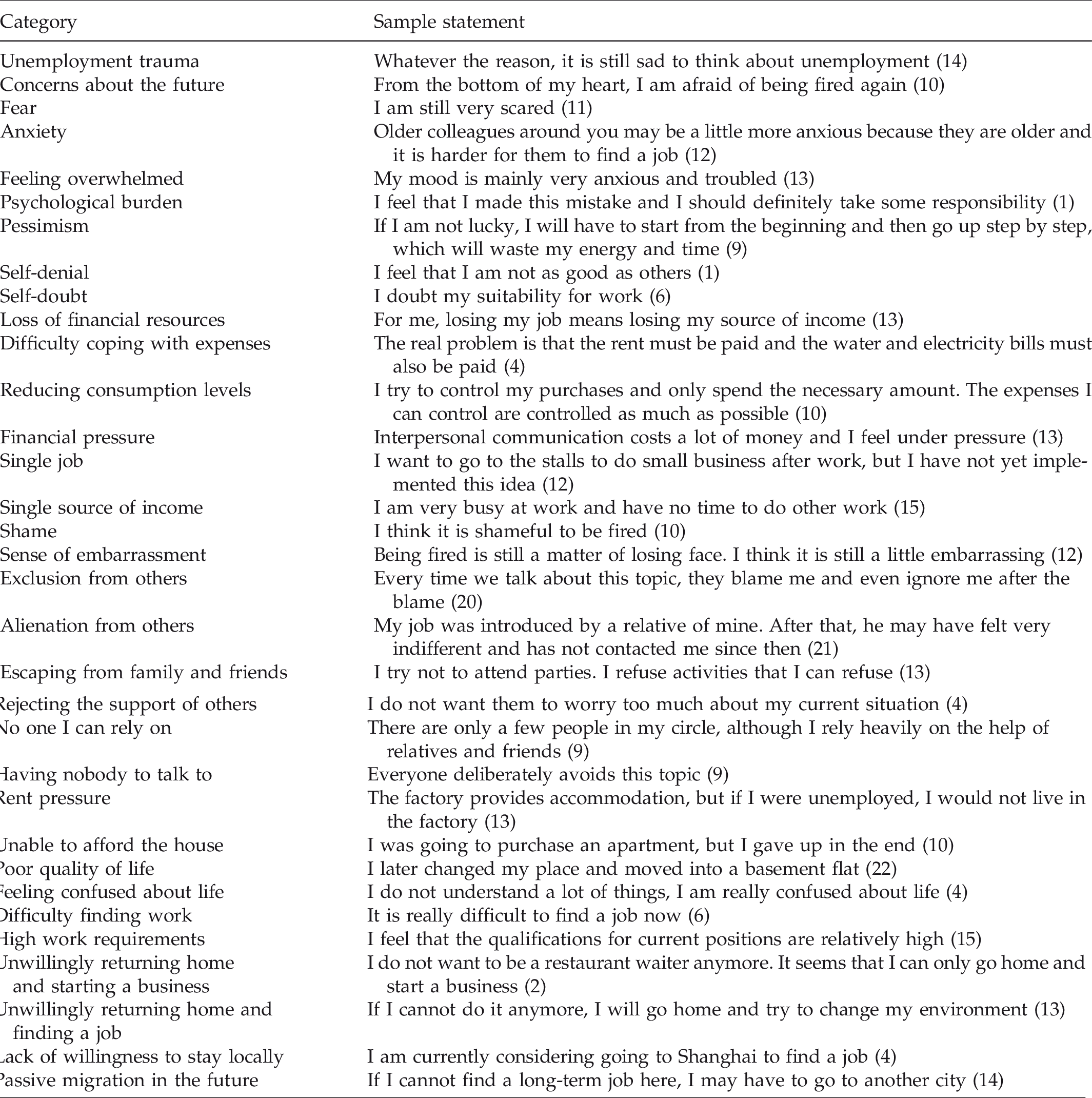
The interview data collection and coding analysis were conducted continuously throughout this process. After completing each interview, the data were coded immediately and then the next interview was conducted. This process helped us to continually verify and improve the initial concepts. To avoid omitting valuable information from the original material and reduce the effects of researcher bias on the original text, the original text was encoded without modification.
Axial coding
Although open coding is suitable for summarizing the initial textual information, the scope of the meaning and the relationships obtained are still relatively broad. At this point, axial coding helps deepen the main categories and explore the potential logical relationships between the categories (Chen, 2000; Strauss and Corbin, 1990). Through axial coding at this stage, the research team explored the intrinsic links between the categories by repeatedly comparing different categories at the conceptual level. In this way, we extracted the main categories, such as unemployment fear, nervousness, mental stress, negative emotions and reduced expenditure. The main categories and their definitions are shown in Table 2.
Axial coding categories and definitions.

Selective coding
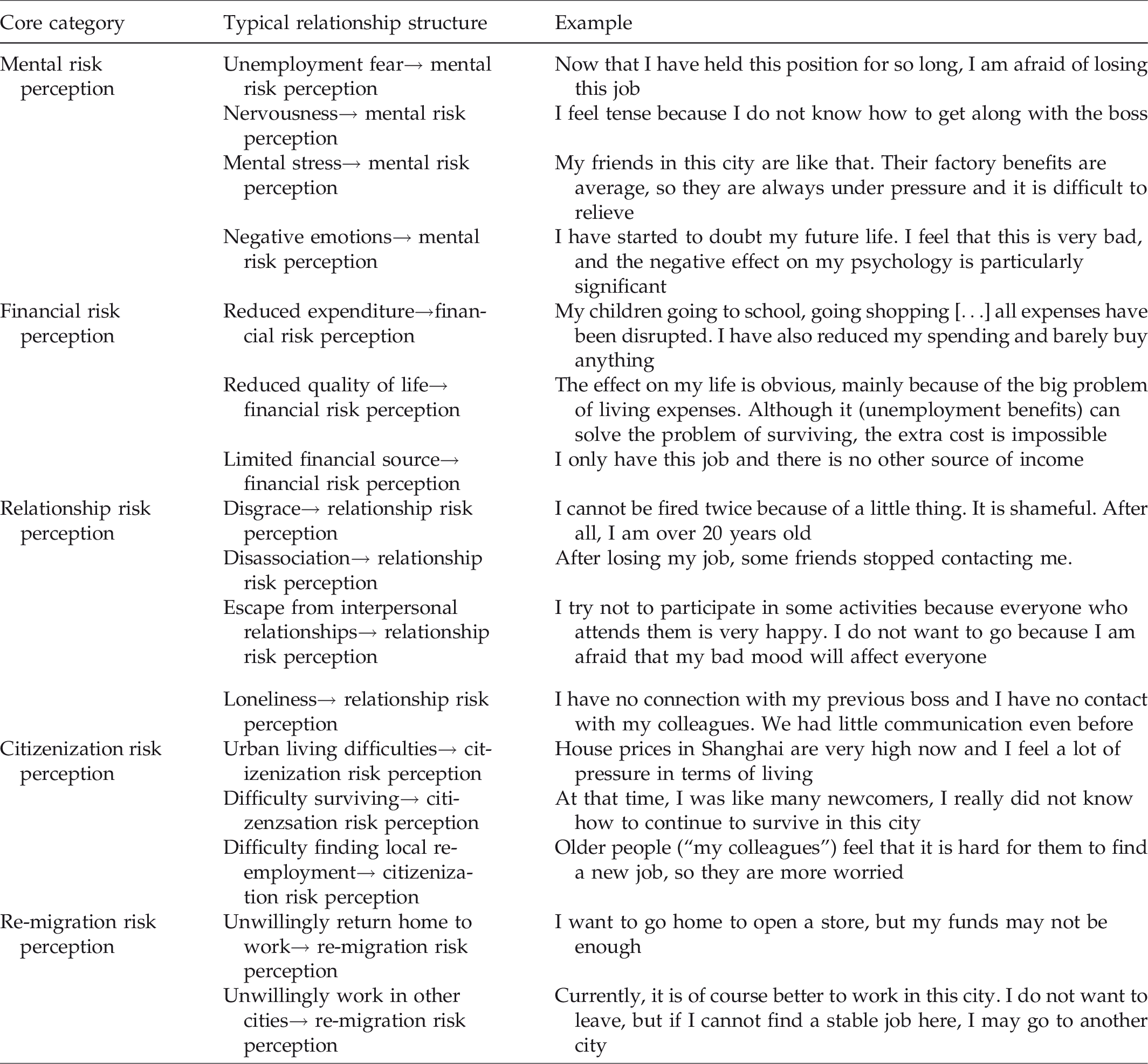
After developing the main categories, we selected and refined a set of core categories to integrate the main categories. After defining the core categories of the URP of migrant workers, we systematically described the overall theory by creating a “storyline” around each core category. From a structural point of view, the final result formed around each storyline was the typical relationship structure. As shown in Table 3, this study ultimately explained the URP of migrant workers through five core categories of risk perception: mental, financial, relationship, citizenization risk perception and re-migration. The corresponding construct of migrant workers’ URP was also given its initial form. Based on the extracted main categories and with reference to the risk perception scale, we constructed an initial scale of migrant workers’ URP.
Relationship structure of core categories and examples.
Quantitative study
Pretest
Based on the qualitative results, we developed an initial scale of the URP of migrant workers. Before conducting the formal survey, the authors first invited experts in the field to discuss the rationale for and completeness of the scale items. We then pre-tested the scale to check its legibility and ensure that no ambiguous or incomprehensible item appeared in the questionnaire. During the pretest, 22 migrant workers with more than a year of work experience completed the questionnaire. Thanks to this pretest, the problems with the original scale were fixed and a final scale of the URP of migrant workers was obtained. The responses were scored on a 5-point Likert scale.
Data collection
Sampling
The research team first contacted migrant workers working in firms in Jiangsu, Zhejiang and Guangdong provinces through teaching and research networks. The researchers then approached relevant companies for distribution.
According to statistics from the National Bureau of Statistics of China (2018), close to 80 percent of all migrant workers are employed in industries, such as manufacturing, construction and real estate, hospitality and catering, logistics, and business services. Therefore, we chose to survey migrant workers who worked in these industries.
We collected data in January 2019. We surveyed five companies—two manufacturing factories, one construction company, one logistics company and one hotel—in Nanjing, Jiangsu Province. A total of 120 questionnaires were distributed in Nanjing. We surveyed four companies in Guangzhou, Guangdong Province, including two manufacturing factories, one construction company and one restaurant. A total of 84 questionnaires were distributed in two manufacturing factories, one construction company and one restaurant in Guangzhou. We surveyed four companies in Wenzhou in Zhejiang Province and distributed 63 questionnaires in one manufacturing factory, one supermarket, one education service company and one hotel. A total of 63 questionnaires were distributed in Wenzhou. Overall, 267 questionnaires were distributed and 259 were returned.
To ensure the validity of the questionnaire and the quality of the data collected, the study was carried out with the support of senior management and human resources managers. The researchers randomly sampled participants based on the lists of employees provided by the human resource management departments of the firms. After sampling was conducted, most of the questionnaires were distributed during the morning meeting or other meetings. A small number of questionnaires were answered at the respondents’ work sites. Before distributing the questionnaires, the human resource management manager or the researchers first explained the objectives and requirements of the questionnaire. The respondents filled in and returned the questionnaire and were given small gifts.
To reach as many migrant workers as possible and enhance the reliability of the survey results, the researchers took advantage of the Spring Festival to include migrant workers outside of their workplaces. Nanjing and Wuxi in Jiangsu Province are important destination cities of migrant workers. We chose the railway stations in these two cities to distribute questionnaires to migrant workers. The research team approached migrant workers, informed them about the purpose of the survey, and obtained their consent to participate. The research team provided guidance on filling out the questionnaires. A total of 299 questionnaires were distributed and 270 were collected (146 in Nanjing and 124 in Wuxi). In total, 566 questionnaires were distributed, of which 529 were collected. After checking for inconsistent responses, the number of valid questionnaires was 509. The sample size was based on the recommendations of Zhang (2002), who proposed that the size of a sample for factor analysis should be five to 10 times the number of items to be measured, and of Hair et al. (1995), who proposed that the sample size should be five to 20 times the number of items.
Sample characteristics
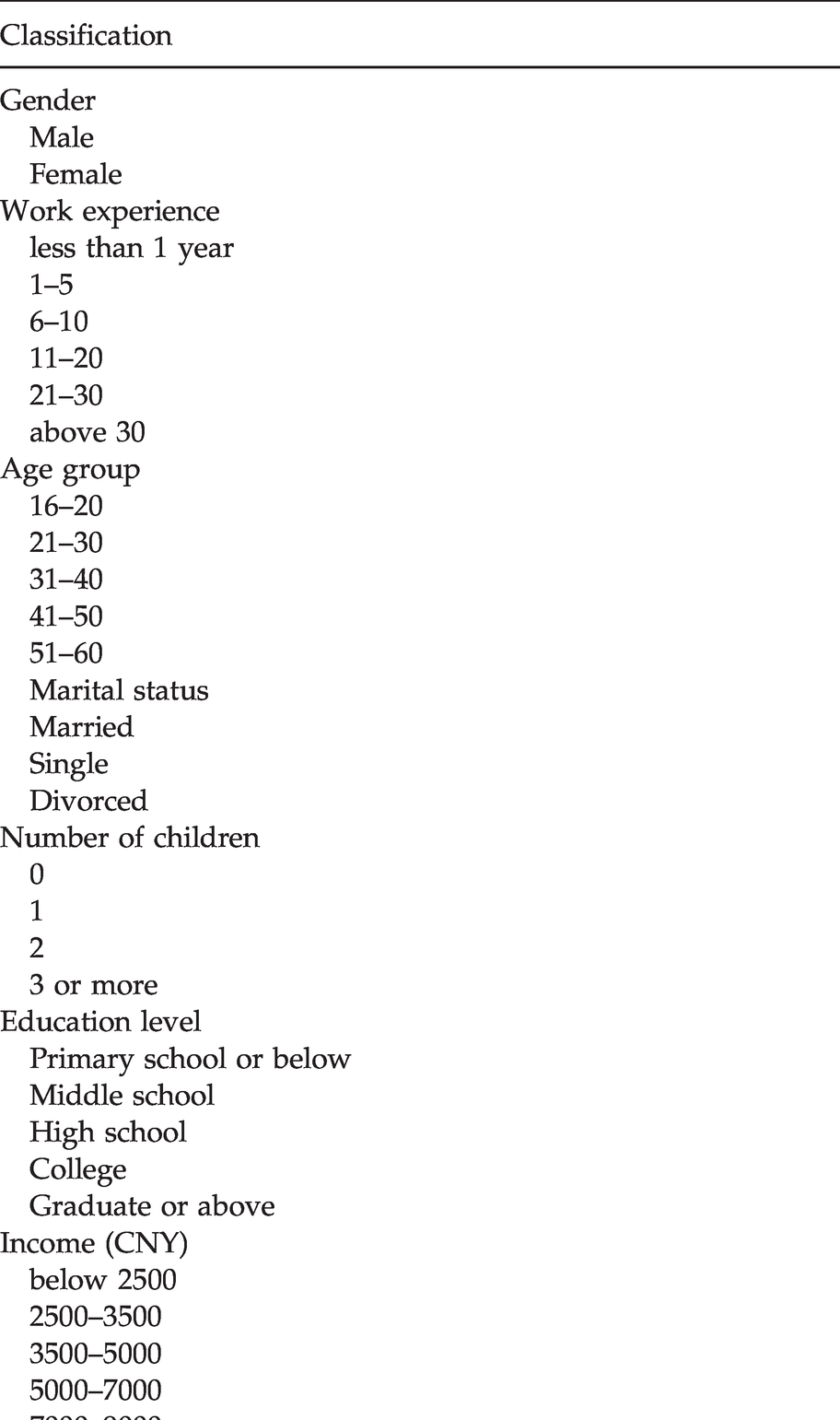
Based on the sample characteristics shown in Table 4, there were slightly more male than female respondents, and most respondents had between five and 20 years of work experience. Their ages ranged from 21 to 50. Most respondents had a monthly income between CNY 3500 and CNY 7000. In terms of marriage and family, more respondents were married than single or divorced, and 66.3 percent had one or more children. Most of the migrant workers surveyed had a middle school or high school education level. Manufacturing, construction, logistics and accommodation services were the main industries in which the respondents were engaged. The statistical profile of the sample is similar to that of the “2018 Migrant Workers Monitoring Survey Report” published by the National Bureau of Statistics of China (2018), indicating that the characteristics of the survey respondents reflect the characteristics of the population of migrant workers.
Characteristics of the sample (n = 509).
EFA
The EFA and CFA were performed separately on two different sets of data based on data grouping. The random number generator provided by the Statistical Package for the Social Sciences (SPSS) was used to separate the sample into two groups. One group was then used for EFA and the other group for CFA.
The goal of EPA is to identify factors with theoretical significance. This study conducted tests using SPSS version 19. First, Cronbach’s α was used to test the internal consistency of the questionnaire, with a threshold value set to 0.7. In addition, the correlation coefficient (CC) of each measurement item with other measurement items was estimated using the corrected item-total correlation. Cronbach’s α for the scale was 0.931, suggesting that the scale was in the high confidence interval, indicating that the related items explained the research variables relatively consistently and that the scale had good internal consistency.
Second, we used the Kaiser–Meyer–Olkin (KMO) and Bartlett’s test values. The KMO value is used to detect the simple CC and the partial CC between the variables. The results of these tests showed that the KMO value was 0.905, and the Bartlett’s test of sphericity had a probability of 0.000. These results revealed that the scale was suitable for the subsequent factor analysis.
Principal component analysis was used for factor extraction, according to the standard of eigen values being greater than 1. In the extraction process with varimax rotation, five factors were extracted with an accumulative total contribution of 78.886 percent. The breakdown of the factors and items is shown in Table 5.
Results of exploratory factor analysis.

CFA
The EFA is based on the form of the sample data and is used to determine the number and distribution of factors in the context of an unconfirmed theoretical model. However, the factor structure obtained with this method needs to be further tested using CFA. AMOS version 18 was used for the CFA.
When verifying the URP measurement model of migrant workers, it was found that the initial model fit was not ideal, with some fit indicators lower than the ideal requirements. Therefore, the initial model needed revision. As shown in Figure 1, after deleting the fourth item of mental risk perception (“Worrying about unemployment has affected my emotions”), the fit of the modified model greatly improved and met the fit requirements.

Diagram showing the results of confirmatory factor analysis.
Table 6 shows the fit indicators before and after the revision of the model. χ2/df, the goodness of fit index (GFI), and the root mean square error of approximation (RMSEA) are absolute fit indices for the comparison of models, while normed fit index (NFI) and comparable fit index (CFI) are relative fit indices. According to the test requirements, χ2/df should be less than 3, RMSEA should be less than or equal to 0.08, GFI should be greater than or equal to 0.90, NFI should be greater than 0.90 and CFI should be greater than 0.90.
Results of confirmatory factor analysis: fit indices and fit standard comparison.
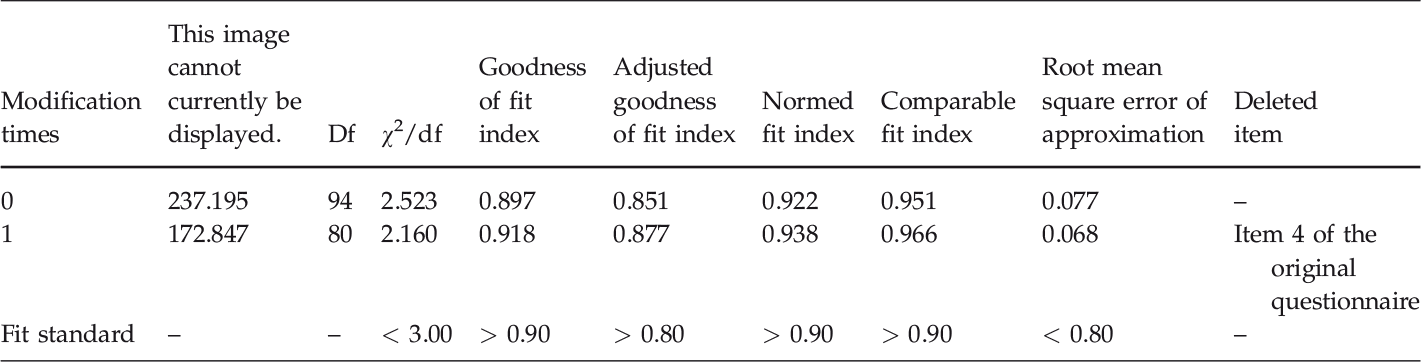
The CFA model showed a good fit (χ2/df = 2.160, GFI = 0.918, adjusted goodness of fit index = 0.877, NFI = 0.938, CFI = 0.966, RMSEA = 0.068). This indicated that the established measurement model for the URP of migrant workers was acceptable.
As shown in Table 7, composite reliability for the five latent variables was higher than the reference standard of 0.70 proposed by Fornell and Larcker (1981). In terms of convergent validity, the average variance extracted (AVE) values of the five latent variables were above the recommended threshold of 0.5 proposed by Bagozzi and Yi (1988). The CCs for each latent variable in the study were smaller than the arithmetic square root of the AVE values, indicating that the variables had good discriminant validity. These results indicated that the scale of the URP of migrant workers and its structural model were a good reflection of the corresponding five latent variables and had good reliability and validity.
Correlation matrix showing the composite reliability (CR) and average variance estimated values (AVE) of risk perception variables.

Notes: * p <0.05, ** p <0.01; the diagonal of the correlation coefficient is the arithmetic square root of the AVE value.
Discussion and conclusion
This study used a mixed methods approach to design and verify a scale to measure the URP of migrant workers, using in-depth interviews and grounded theory. An initial scale of the URP of migrant workers was developed and pretested. A large-scale questionnaire survey was then conducted with migrant workers in Jiangsu, Zhejiang and Guangdong provinces. The quantitative results of the URP of migrant workers were verified.
The empirical results indicated that the scale of the URP of migrant workers developed in this study had high reliability and validity and accurately reflected the structure of URP among migrant workers. URP consisted of different risk perceptions: mental, financial, relationship, citizenization and re-migration.
Mental risk perception among migrant workers is related to their psychological state, reflecting their tensions and concerns about unemployment. Kim and Von dem Knesebeck (2016) and Nica et al. (2017) proposed that unemployment leads to a risk of depressive symptoms. This may also indicate that anxiety related to unemployment will affect an individual’s mental health and increase the risk of mental disorder. The findings confirm theoretical views indicating that mental risk perception is a common and basic type of risk perception in different situations.
Financial risk perception is the economic loss that migrant workers perceive that they will suffer due to unemployment. This includes both the fear of losing their income and the fear of a decline in their quality of life due to unemployment. Although unemployment is obviously accompanied by financial risks (Strully, 2009), financial risk perception related to unemployment among Chinese migrant workers has its specific formation logic. The migration of Chinese migrant workers is not only a migration from primary industries to secondary and tertiary industries, but also a regional migration from rural to urban areas. Compared with urban residents, the initial resource endowment of rural migrant workers is very low and there is no economic and material support from their families. Therefore, migrant workers feel more financial pressure in urban life.
Relationship risk perception is related to the social network and social relationships of migrant workers. Relationships are both a key resource that migrant workers rely on in their daily work and life in the city, and a resource that they can constantly create and accumulate in their day-to-day experience in the urban areas. Whether relationship resources can be maintained and strengthened is affected by their vocational status in addition to factors such as kinship and rural ties. Unemployment means the interruption of employment status, affecting the foundation and transformation of relationship resources. Faced with the risk of unemployment, migrant workers not only worry about being rejected by their relatives and fellow citizens, but also have to deal with a feeling of shame and wanting to escape their current social circle.
Citizenization risk perception is related to the risk perception of future living conditions. Chinese migrant workers mainly come from rural areas where the economy is relatively less developed. The cities offer migrant workers more job opportunities and better living conditions than rural areas. Migrants, thus, aspire to have similar opportunities as urban resident. The risk of unemployment presents a threat to migrant workers’ citizenization level in urban areas.
Re-migration risk perception refers to the risk perception of migrant workers with regard to potential return to their hometowns or migration to another location. The first refers to migrant workers’ perception of returning to the rural area because they cannot continue to live in the city due to unemployment. The risk perception of passive migration to other cities is migrant workers’ perception that they cannot live in their present city location due to unemployment and they must find another job in another city. Re-migration risk perception belongs to migrant workers’ future behavior. In terms of content, this type of risk perception signals the end of the local careers of migrant workers, prompting migrants to anticipate migrating to another city, rather than a perception shaped by proactively planning to re-migrate. Compared with other types of URPs, re-migration risk perception involves greater uncertainty of future remigration in search of alternative workplaces.
Contributions
This study deepens the theoretical study of unemployment. Research on the theory of unemployed migrant workers in China belongs to the field of Chinese local unemployment theory. Recent research on the factors influencing unemployment risk has been carried out in this field and the effects of factors, such as the macroeconomic environment and human capital on the unemployment risk of migrant workers, have been clarified. However, by focusing on the macro mechanisms of unemployment, there is a research gap at the micro level of the psychology of migrant workers. Based on research on traditional macro mechanisms, this study explored the URP of migrant workers from a micro perspective, thus enriching the theoretical structure of research on Chinese migrant workers’ unemployment risk. The model constructed in this study further improves the theoretical framework for research on unemployment risk among migrant workers.
This study also widens the research scope on URP. Although researchers have made efforts to explore the definition and mechanisms of URP, a theoretical consensus has not yet been reached, especially on the issue of URP. In addition, although general studies have examined URP, they have not highlighted the situational characteristics of URP. This study focused on Chinese migrant workers using grounded theory, and the results indicated that the URP of migrant workers includes three general forms of risk perception (mental, financial and relationship risk perception) and two specific forms of risk perception related to migrant workers (citizenization and re-migration risk perception).
This study integrated URP research in the specific social context of China’s new urbanization process, combined sociological and psychological theories, revealed the risk perception characteristics of migrant workers in the process of citizenization, and addressed some shortcomings in current theories used in research on this important group.
This study adopted a mixed methods approach, constituting a methodological innovation in the theory of unemployment risk. A hybrid research method combining qualitative and quantitative analysis was useful to avoid the shortcomings of a single research method. Overall, the mixed methods approach used in this study was a useful means of deepening the theoretical understanding of URP among Chinese migrant workers, and promoting the study of URP.
Future research
This study has certain limitations. As the research questionnaire was mainly distributed in Jiangsu, Zhejiang and Guangdong provinces in China, future research should widen the geographical scope of the survey to validate the theory and generalizability of the findings. In addition, this study only involved the measurement of the URP of migrant workers. It did not address the formation or subsequent effect of risk perception. Future research should use the URP of migrant workers as the core variable, appropriately increase the range of other variables, and explore the formation and effect of migrant workers’ URP, to further examine URP among migrant workers.
Footnotes
Declaration of conflicting interests
The authors declared no potential conflicts of interest with respect to the research, authorship, and/or publication of this paper.
Funding
This research received funding support from the National Natural Science Foundation Innovation Group (Grant Number: 71921003), the National Social Science Fund Major Project (Grant Numbers: 20ZD and 160) and the National Office for Philosophy and Social Sciences (Grant Number: 17VZL018).
