



Abstract
This article proposes the concept of religious asylum to examine how Christian asylum-seekers utilize religion to cope with their emotional experiences, induced by a sense of insecurity, during prolonged displacement. Drawing from interviews and ethnographic observations of people seeking asylum in Hong Kong, this research determines that asylum-seekers use religion to redefine their positive sense of self beyond their current situation, which is central to the construct of well-being. While religion supports asylum-seekers going through psychosocial distress and suffering, this discussion on religious asylum shows how asylum-seekers utilize the religiously inflected space to make the experience of prolonged displacement meaningful.
Introduction
By the end of 2020, the Asian and Pacific region hosted 4 million refugees (UNHCR, 2020). Asia is a “black hole” for asylum-seekers and refugees because most countries and territories in the region have not signed the 1951 Convention Relating to the Status of Refugees and its 1967 Protocol (Shum, 2019), and asylum-seekers and refugee rights are not legally protected. In Asia, Hong Kong has a significant number of asylum-seekers and refugees originating from different South and Southeast Asian and African countries (Shum, 2019). Although the city has been a principal port of first asylum in Asia since the Vietnamese refugee crisis in the mid-1970s (Chan, 2011), Hong Kong is not a signatory party to the 1951 Refugee Convention. This means that refugee settlement in Hong Kong is impossible. Between 2009 and 2021, approximately 38,208 people filed refugee claims at the Hong Kong Immigration Department, of which only 272 were substantiated (Hong Kong Immigration Department, 2021). This recognition rate has remained lower than 1 percent, leaving the refugees trapped in states of prolonged displacement. Although the Hong Kong Immigration Department reported that there were only 1,213 outstanding claims at the end of September 2021 (Hong Kong Immigration Department, 2021), many claimants were on appeal. Some claimants were rejected by the authority and became undocumented migrants in Hong Kong (Shum, 2019).
Asylum-seekers may have different security concerns at various stages of their asylum-seeking journeys. People flee their country of origin primarily due to lack of protection from the state that puts civilians’ lives in grave danger. According to the 1951 Refugee Convention and its 1967 Protocol, a refugee is defined as “someone who is unable or unwilling to return to their country of origin owing to a well-founded fear of being persecuted for reasons of race, religion, nationality, membership of a particular social group, or political opinion” (UNHCR, 2010).
When asylum-seekers arrive in Hong Kong, they initially experience safety because they are far from the insecurity and danger in their country of origin. However, their new circumstances also present an array of challenges. For example, in Hong Kong, asylum-seekers are deprived of fundamental human rights, such as the right to work and the right to receive an education (Shum, 2019), which have far-reaching negative impacts on the livelihoods and psychological conditions of asylum-seekers. The poor mental health of asylum-seekers and refugees could be the result of post-displacement factors such as the loss of their family and home, cultural bereavement, and resettlement (Wong et al., 2017). This research offers an instructive perspective for examining how asylum-seekers deal with emotional suffering through self-care strategies in Hong Kong. Specifically, it aims to examine how Christian asylum-seekers utilize religion to cope with their emotional experiences, induced by a sense of insecurity during prolonged displacement.
While a large body of work demonstrates how asylum-seekers and refugees use religion as a source of social and material support in North American or European countries (e.g., Cadge and Ecklund, 2007; Dorais, 2007; Eppsteiner and Hagan, 2016; Mayer, 2007; Şafak-AyvazoĞlu, et al., 2021), little is known about the relationship between religion and asylum-seekers’ well-being in Hong Kong. An exception is Chan’s (2017) work entitled No Strangers Here, where she used the theological lens of Christian hospitality to examine asylum-seekers’ lives in Hong Kong. She argued that Christian hospitality is both a gift and a challenge to the body of Christ and that churches play a vital role in caring for asylum-seekers in Jesus’s name. This article builds upon this discussion, examining asylum-seekers’ emotional suffering induced by a sense of insecurity during their prolonged displacement in Hong Kong, and how they cope with these sentiments through religion. Specifically, it explores how religion and religious organizations facilitate the building of a sense of self among asylum-seekers, which is central to their subjective well-being. In this study, religion is defined as “a process, a search for significance in ways related to the sacred” (Pargament, 1997: 32). The sacred refers to “the holy, those things ‘set apart’ from the ordinary, worthy of veneration and reverence. The sacred includes concepts of God, the divine, and the transcendent” (Zinnbauer et al., 1999: 907). In this article, the concept of “religious asylum” is proposed to analyze how religion supports asylum-seekers who suffer from psychosocial distress and further discusses how asylum-seekers utilize the religiously inflected space to make their prolonged displacement meaningful.
To develop the concept of religious asylum, this article begins by examining the ideas of security and emotion from the viewpoints of religiosity and subjective well-being and considers the role of religion in asylum-seekers’ subjective well-being during prolonged displacement. Next, the research methods and field sites are discussed, followed by the key findings. The findings section discusses the asylum-seeking arrangements in Hong Kong, how religious organizations assist asylum-seekers in redefining their positive sense of self and settling into their lives, and the concept of religious asylum. In the final section, the article concludes by arguing that understanding the role of religion within the studies of asylum-seekers’ subjective well-being is important for developing a more nuanced understanding of their emotional journeys in Hong Kong. Also vital is knowledge of religion’s role in how asylum-seekers actively develop self-care strategies to cope with feelings of frustration and depression.
Security, emotion, religiosity, and subjective well-being
Although they have fled from a situation of insecurity, asylum-seekers often find themselves feeling unsafe and insecure in the country of asylum. Security issues often lead to war or violence (Innes, 2014). Several researchers of security studies have argued that the conceptualization of security should be broadened, and focus on a stable sense of self, anchored in the belief that the experiences of refugees have a degree of certainty and continuity (Innes, 2014). However, new circumstances in the host society present an array of challenges, including lack of income and employment, food, education, and medical assistance. In non-signatory states or cities such as Hong Kong, additionally, they run the risk of being considered as “irregular migrants” by the government. Innes (2014: 268) stated that, “the concept of human security establishes a nexus between individual security, state security and the security of the international system.” In this sense, human insecurity refers to material deficiency in one of the aforementioned categories. Human security is achieved by identifying what people lack and providing them with the necessary material goods.
In Hong Kong, since the enhancement of the administrative screening mechanism in 2009, the substantiation rate has remained less than 1 percent, creating “prolonged displacement conditions” (Doná, 2015). In the context of displacement, change, and deprivation, internal feelings and beliefs of the asylum-seekers—such as terror, fear, and a sense of disorientation—can affect their identity reconstruction in the host society. Identity is individual and collective, and it “relates to people’s concepts of who they are, what sort of people they are, and how they relate to others” (Hogg and Abrams, 1988: 2). Numerous variables play a vital role in identity formation, such as society, culture, politics, and law. In the case of refugee migration, a person who was formerly a citizen of a country is now an asylum-seeker, which can have a significant impact on their identity and sense of self. Apart from legal distinctions, some scholars (e.g., Robinson and Rubio, 2007) argue that the sense of “otherness” is also apparent in daily interactions between asylum-seekers and local people in the host society. For asylum-seekers, coping with their new life in the host society is a highly emotional undertaking (Burrell, 2008). Emotions, according to Svašek (2012: 3), are “dynamic processes through which individuals experience and interpret the changing world, position themselves vis-à-vis others, and shape their subjectivities. The self is captured by their surroundings, engaging with past, present, and future situations.” When arriving in their host society, all migrants are confronted by government officials and local residents. Governmental policies and structural constraints are intrinsic to institutional settings in the host societies and can influence migration-related emotional dynamics (Svašek, 2012).
The emotional suffering and mental health issues of asylum-seekers have attracted significant scholarly discussion in the past few decades. Two main approaches—trauma-focused and psychosocial—dominate academic debates on issues related to the conceptualization of the mental health needs of asylum-seeker populations (Bjertrup et al., 2018). To examine the social determinants of health, many scholars (e.g., Akinyemi et al., 2016; Bjertrup et al., 2018; Chuah et al., 2018; King et al., 2017; Wong et al., 2017) have used psychosocial approaches because they strongly believed that the overarching socio-economic and political landscape of the host society could influence the mental health of asylum-seekers. For example, in their studies on the mental health of African asylum-seekers and refugees in Hong Kong, Wong et al. (2017) found that a significant number of their informants exhibited depressive symptoms, which were closely related to the lack of family and social support, financial restrictions, and limited healthcare access.
This article builds upon recent works on refugee studies that examined the impact of policies and asylum-seeking arrangements on asylum-seekers’ mental health (Ahearn, 2000; Chuah et al., 2018; Coffey et al., 2010; Wong et al., 2016, 2017). Aligned with most of these studies, this research explores the relationship between the social determinants of health and the subjective well-being of asylum-seekers. Specifically, this work focuses on changes in the asylum-seekers’ emotional condition throughout the asylum-seeking processes in Hong Kong, which creates uncertainties that influence asylum-seekers’ subjective well-being.
Villani et al. (2019) examined the role of religiosity in people’s subjective well-being. Religiosity is the “formal, institutional, and outward expression of one’s relationship with the sacred, and it is typically operationalized as beliefs and practices associated with a particular religious worldview and community” (Villani et al., 2019: 1526). Religious identification offers a distinctive sacred worldview and group membership (Ysseldyk et al., 2010). A religious social group is developed based on a shared belief system that offers certainty. Moreover, religious identity promotes subjective well-being through self-enhancement and collective engagement (Piacentini, 2008; Ysseldyk et al., 2010). Subjective well-being corresponds to “overall satisfaction with one’s life and long-term levels of happiness that result from a global self-evaluation of whether individuals are living a good existence or not” (Villani et al., 2019). Social structures provided by religious affiliation, prayer, and self-transcendent emotions are factors in mediating the positive relationship between religion and subjective well-being (Villani et al., 2019).
In Hong Kong, Christian asylum-seekers go to churches for worship as both cultural practices and ways to cope with daily challenges, such as, emotional and financial problems (Chan, 2017; Shum, 2019). These religious coping strategies, according to Pargament (1997: 23) are “ways of understanding and dealing with negative life events that are related to the sacred.” How asylum-seekers in Hong Kong perceive themselves and how their life goals are shaped by personal faith are subjects worthy of scholarly discussion, as they are a group of individuals with ambiguous legal status.
This paper aims to contribute to the exploration of the relationship between religion and subjective well-being among asylum-seekers in Hong Kong. Specifically, it examines how faith and refugee-focused religious programs shape the identity and moral directions of asylum-seekers, and how their emotions and concepts of security have changed over time during prolonged displacement. To the best of my knowledge, this has not been extensively explored in the context of Hong Kong.
Research methods and field sites
During fieldwork, researchers attempt to position themselves in the same situation as informants and gradually reflect on their emotions, identity-work, and roles during fieldwork through first-person accounts of their emotions, thoughts, and behaviors (Venkatesh, 2013). Self-reflexivity determines the researcher’s positionality which influences a study by creating power relations between the researcher and research participants, and by affecting how empirical results are interpreted (Bonfanti et al., 2018).
In this ethnographic research project, conducted from 2017 to 2019, my positionality created a combination of insider and outsider views (Spradley, 1980). On the one hand, I am neither a Christian nor an ethnic minority, which created a sense of being an outsider. On the other hand, I have served as a long-term volunteer in various nongovernmental organizations and churches that have provided humanitarian assistance to the asylum-seeker community in Hong Kong for almost ten years. I therefore became familiar with humanitarian and immigration policies and developed friendly relationships with asylum-seekers as well as workers from the humanitarian and religious organizations. A sense of being an insider developed and led to a detailed understanding of the material and emotional worlds of the asylum-seekers.
In this article, I identify the research participants as asylum-seekers who are constantly struggling on a path toward recognition in Hong Kong. Research participants were identified, contacted, and selected from two nongovernmental organizations. Over the years, as a volunteer for these organizations, I have attended different activities and gatherings that allowed me to build rapport with the core research participants. For this study, I first approached asylum-seekers who had been staying in Hong Kong and attending the churches for a long time (at least five years) to serve as core research participants. Thereafter, I was introduced to more asylum-seekers by attending their social gatherings. This study uses an inductive approach (Creswell, 1998; Lincoln and Guba, 1985) to assess factors related to asylum-seekers’ emotional conditions and well-being during prolonged displacement. It aims to gather research participants’ perceptions and experiences of suffering and hope during extended uncertainty. This enables the researcher to directly learn about the perceptions and images of research participants as they work out their asylum in Hong Kong (Benezer, 2002). Fundamental to this approach is that categories regarding religious coping emerged from the data and not from existing theories (Creswell, 1998; Lincoln and Guba, 1985).
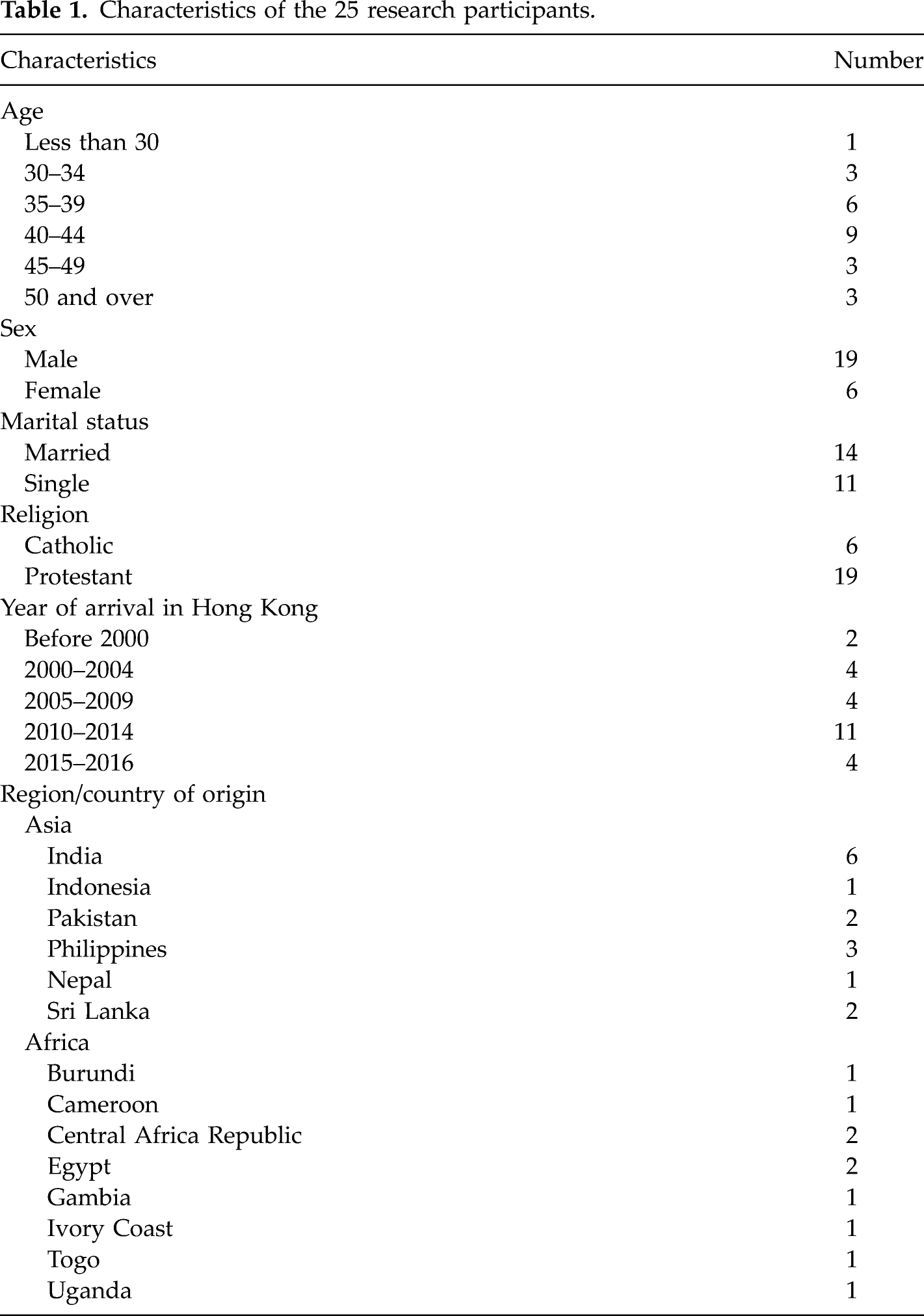
Characteristics of the 25 research participants.
In addition to interviews, I also conducted participant observation in their communities, to explore how they seek a sense of security in religion. The sites identified for this study were two churches. In Hong Kong, many local churches use Cantonese for communication; therefore, refugees turn to English-speaking churches. Every weekend in Hong Kong, one could find asylum-seekers in different English-speaking churches—whether Protestant, Catholic, or Orthodox. Some asylum-seekers were affiliated with more than one church or pastor (Chan, 2017).
For this study, I conducted fieldwork in two English-speaking churches that had a special focus on asylum-seeker communities—The Vine and Kowloon Union Church. Founded in 1997, The Vine is an international Evangelical church located in Wan Chai, Hong Kong. The church organizes two fellowships for asylum-seekers—the South Asian fellowship (every Wednesday, from 11:30 a.m. to 1:00 p.m.) and the African fellowship (every Thursday, from 11:30 a.m. to 1:00 p.m.). Approximately forty asylum-seekers participated in this event weekly. These weekly fellowships begin with an approximately one-hour praise and worship session, followed by a lunch gathering in the kitchen and pastoral and counseling services in different consultation rooms of the church. Founded in 1927, the Kowloon Union Church in Jordan, Kowloon is a Protestant church with historical links to the work of the London Missionary Society (Chan, 2017). The church has a weekly fellowship for asylum-seekers coming from South Asia, Africa, the Middle East, and other parts of the world, who worship and learn together. The church also has a public education program called “Refugee Kitchen,” which serves as a platform for asylum-seekers to showcase their culinary skills and share their cultures with local communities.
Ethical approval was obtained from the Research Ethics Committee of Hong Kong Metropolitan University. Interviews were digitally recorded and transcribed verbatim. I first wrote down field data on paper notepads which were then typed into a computer. NVivo 12 was used to organize, analyze, and derive insights from the qualitative data. I adopted three coding phases for the data analysis. First, I read and reread the interview transcriptions line by line to develop abstract and refined categories for analysis (Miles and Huberman, 1994). Second, I reread and recoded all interview transcriptions using the established categories. Finally, after all data was coded, I returned to the coded qualitative data to establish patterns for analysis (Lofland and Lofland, 1995). The links between categories of codes addressing the most common hardships faced by asylum-seekers and the associated emotional responses were investigated. The goal was to define the relationship between asylum-seekers’ stressors, well-being deterioration, and tactics for addressing suffering. For the protection and privacy of the research participants, I used pseudonyms throughout this article.
Key findings
Asylum-seeking arrangements in Hong Kong
Hong Kong hosted refugees from Vietnam between 1975 and 2000. The first group arrived in Hong Kong in 1975 after the Vietnam War and over 5,000 were granted Hong Kong identity cards and have assimilated into Hong Kong society (Chan, 2011: 7). However, the number of new arrivals continued to increase especially after the outbreak of the border war between China and Vietnam in 1979. In 1982, the Hong Kong colonial government detained new arrivals in closed camps until their resettlement to a third country (Chan, 2011). In 1988, the Hong Kong colonial government adopted a screening policy to distinguish refugees from non-refugees, and the latter were repatriated to Vietnam. The last Vietnamese refugee camp closed in 2000. The more than 2,000 remaining Vietnamese refugees who were not eligible for resettlement were given Hong Kong residency (Chan and Shum, 2011: 65).
Even after Hong Kong’s return to China in 1997, Hong Kong remains a popular place for people seeking protection in Asia. This is because Hong Kong is one of the most popular tourist destinations in the region with easy-to-meet visa requirements (Shum, 2019). Unlike the previous Vietnamese refugees who arrived in Hong Kong on boats, today’s asylum-seekers mainly travel to Hong Kong individually or in small groups by using air travel. Some arrive in China as tourists and are then smuggled to Hong Kong by boats, while others first travel to China as tourists and then apply for a visa to travel to Hong Kong by train (Shum, 2019). By the end of September 2021, there were 1,213 people (778 males and 435 females) originating from different South and Southeast Asian and African countries seeking protection in Hong Kong (Hong Kong Immigration Department, 2021). There is no government statistics on the marital status of asylum-seekers in Hong Kong. However, based on my conversations with asylum-seekers over the years, I learned that majority of them came to Hong Kong alone and got married with Hong Kong Chinese, foreign domestic workers, or fellow asylum-seekers in Hong Kong. 1
Hong Kong is not a party to the 1951 Refugee Convention and it does not have a refugee law applicable domestically (Loper, 2010). Due to the lack of legal infrastructure, the burden of screening and resettlement completely fell on the United Nations High Commissioner for Refugees (UNHCR) until 2014. Since March 2014, the Hong Kong Immigration Department has been using a new procedure called the Unified Screening Mechanism, which is responsible for determining whether an asylum-seeker meets the criteria of a refugee. Once an asylum-seeker’s claim for refugee status has been determined, the UNHCR office in Hong Kong will handle the resettlement process. However, the refugee status determination process is slow. As a result, many asylum-seekers are stuck in Hong Kong for an extended period of time. All asylum-seekers and recognized refugees are prohibited from working, thus creating a dilemma on how they can support their day-to-day needs.
Ng (2020) argues that the Hong Kong government creates a repressive policy regime of social exclusion and criminalization to foster its control of refugee flows by not regularizing the process of seeking asylum. Asylum-seekers are living in a total institutional context (Lau et al., 2018), which indicates that they are socially excluded from the mainstream society (Kennedy et al., 2019; Lai and Kennedy, 2017; Ng et al., 2019; Vecchio and Ham, 2018). According to the asylum-seeking arrangement of the Immigration Department, asylum-seekers need to overstay their visa and become “irregular” to file their protection claims and receive minimal humanitarian assistance from the Hong Kong government. They must surrender themselves to the Immigration Department and go through a process of mandatory detention. Following detention, the asylum-seekers are given identity papers (called recognizance papers) issued by the Immigration Department which prevents them from being jailed for overstaying visas while their protection claims are pending (Shum, 2019). They need to report to the Immigration Department once a month (Shum, 2019). Because Hong Kong is a party to the 1984 Convention against Torture and Other Cruel, Inhuman or Degrading Treatment or Punishment, the asylum-seekers would not be deported by the authority when their cases are pending, based on the principle of non-refoulement. Today’s asylum-seekers in Hong Kong are not detained in refugee camps. They live in apartments in different neighborhoods similar to any ordinary citizen in the city. In 2020, each asylum-seeker received HKD 1,500 (USD 192) (for adults)/HKD 750 (USD 96) (for children) rental allowance paid directly to the landlord and an electronic card with HKD 1,200 (USD 154) per month per adult for food purchases at designated supermarkets (Refugee Concern Network, 2020). This minimal humanitarian assistance is insufficient in a city known for its high cost of living. Therefore, most asylum-seekers are forced to take illegal employments to make a living (Mathews, 2007, 2011, 2014; Shum, 2019; Vecchio, 2015, 2016, 2017).
In Hong Kong, the funding source of nongovernmental organizations serving asylum-seekers is mainly from the Hong Kong government while a small amount comes from private donations. Although nongovernmental organizations and refugee community organizations play a significant role in the lives of asylum-seekers in Hong Kong, some scholars (Lau, 2021; Vecchio and Gerard, 2014) argue that these organizations, which heavily depend on the Hong Kong government’s financial funding, serve as social controls and disempowering agents. The nongovernmental organizations always take relatively conservative roles and avoid challenging the funding provider. Because of the legal and social environment, other than basic subsistence support, asylum-seekers are unable to access employment and education (Lau, 2021).
Seeking protection in Hong Kong is emotionally draining due to the unfavorable social environment and inadequate support provided by the government (Wong et al., 2017). No matter how extensive the social networks and connections the asylum-seekers can make, there is still an element of emotional adjustment involved in making sense of the asylum-seeker’s life in Hong Kong. According to Christou (2011: 254), “emotions surface during everyday encounters and everyday relations.” Uncertainty and insecurity were often directly linked to poor psychosocial well-being. While some research participants described how stress and depression led them and their family members to frequently smoke and drink, many of them expressed that praying and meditation reduced their emotional suffering to a certain extent. The remainder of this article will focus on the experience of faith and well-being among asylum-seekers in Hong Kong.
Churches as spaces of support, a sense of continuity, and identity formation
Asylum-seekers in Hong Kong have limited participation in wider society owing to their irregular status. They seek out the familiar and welcoming communities where they can belong. When asked how they managed to cope with their sense of insecurity of being in limbo in Hong Kong, almost all research participants responded with “the help of God.” Religious beliefs and practices do offer some insight into how asylum-seekers cope with their asylum-seeking journeys and how they settle into their difficult lives in a foreign society (Eppsteiner and Hagan, 2016: 50). The Vine and Kowloon Union Church are centers of collective identity and a source of empowerment that redefines and nurtures their sense of self during prolonged displacement. Churches often offer opportunities for asylum-seekers to interact with peers and build supportive relationships. Robert, from Pakistan, belongs to a religious minority in his home country. He left behind his parents and came to Hong Kong in 2008 with only USD 1,000. He stated: I thank my church and my church brothers and sisters; they always supported me in everything, including the rent of my house. I feel supported and less worried. (Robert, 38 years old male, Pakistani, Protestant) I am proud of myself as a Christian. In my home country, we all dress up when we go to church because going to church was a very special event in our lives. But in Hong Kong, the experience is different—many problems outside, many troubles. But I have a strong feeling of home in the church. Firstly, because I can continue to practice my religion in a relaxed and familiar place, I can do what I want. Secondly, pastors always gave me good advice and a new meaning for my terrible life in Hong Kong. We help each other. That’s why I always go to church. (Leta, 40 years old, male, Gambian, Catholic) No matter, whether we are Hindu or Christians, we all believe in God, who listens to our prayers. We all share the same values and beliefs, which are oneness, forgiveness, and love. But as a Hindu, sometimes I was a bit confused worshiping so many gods in my religion. If people do something wrong to me, I have to forgive them and love them. (Susan, 42 years old, female, Indian, Protestant)
During lunch break after the fellowship, I joined a group of Indian asylum-seekers (Tina, Aaron, and Ben) who were discussing the identity issue. Tina (47 years old, female, Indian, Protestant) agreed with Gary (a fellow asylum-seeker) that God was great. She said, “I worked as a housemaid before. Now I don’t. I can follow God. I am free to follow God. Five years in Hong Kong, I don’t think I am a refugee.” Aaron and Ben laughed. She said confidently, “Yes! Really. God brings me to this place. Before, I was a Buddhist. Now I have become a Christian and I know it’s God who puts me here.” Aaron (40 years old, male, Indian, Catholic) interrupted, “Sister, I know. We all have to know our identity, why we are here, know our position in the Kingdom [of God]. That’s our identity and we will never lose it.”
Religion provides opportunities for asylum-seekers to think through and question beliefs and values, which are helpful in the construction of identity (Markstrom, 1999). The accounts of Gary and Tina demonstrated that churches offer ideological cohesiveness, social networks that nurture and sustain beliefs, and opportunities for sacred and communal transcendence (Ebstyne King, 2003) among asylum-seekers. The teaching and the words proclaimed together in worship through singing and dancing further affirm asylum-seekers’ identity in Christ. This religious identity gives them strength, power, and hope to continue despite their marginalized identity as asylum-seekers in Hong Kong.
The power of prayer: Feeling calm and cared for
Prayer, as a coping response to internal and external stressors, is concerned with perceived images and intentions of the deity, people’s personal feelings of deservedness, expectations of positive results, and other future possibilities (Spilka and Ladd, 2012). Prayer is both psychologically and theologically important as it relates to improved sense of well-being, social connectedness, emotional management, and dealing effectively with anger (Spilka and Ladd, 2012). Turning to their faith was essential for asylum-seekers to be able to cope, heal and adjust to their new surroundings, accompanied by a strong belief that God could solve their problems. As Robert said: I always pray. When I go to church listening to the word of God, I can feel God’s presence. The words of God make me feel calm—they make me feel hopeful in life. (Robert, 37 years old, male, Pakistani, Protestant) God has healing power. One morning, when I was in bed. I felt as if my whole body was in pain and could not move. I said God, please help me. Then my body could move. I stood up, but I could not see anything. I was so scared. I said God, please help me. What happened? Please wake me up. Then I could see. (Lucy, 63 years old, female, Filipino, Catholic)
Religious practices and the power of the present moment
Clinging to the past and worrying about the future made asylum-seekers feel depressed and anxious. During worship, pastors and other church staff members always encouraged asylum-seekers to focus their attention on the present moment. Lots of clapping accompanied the music during worship; the atmosphere was lively and happy. I observed that the refugees all felt relaxed and joyful during the service. Their attention was on their singing, dancing, and interactions with fellow congregants. Annie (43 years old, female, Protestant), a Ugandan asylum-seeker, said, “Glorifying God with dancing and singing in church is our private time. I just enjoy that moment and make my prayers. God will listen and will respond at the correct time.”
In Kowloon Union Church, meditation was used to bring asylum-seekers’ focus back to their breathing and emotions during the service. The pastor led the session. I asked Franco, from India, how he liked the meditation session in the church. Franco replied: I enjoy it very much. I also practice meditation at home because it is a personal mindfulness journey. I can feel more emotionally stable. Before, I always had a headache and could not sleep. Now, no more. (Franco, 35 years old, male, Indian, Protestant) Because God is with us all the time, I don't need to worry about the past and the future, just keep hoping. I also share with other people who have similar problems how I handled problems and emotion over so many years. Three simple words: based on faith. I feel like I am closer to God than before. (Alex, 52 years old, male, Burundi, Protestant)
Discussion and conclusion
Conceptualizing religious asylum
The concept of religious asylum in this article incorporated ideas from the concepts of asylum (Denora, 2015) and religious coping (Pargament and Raiya, 2007). According to Denora (2015), asylum is defined as a space of one’s own that serves as protection from further harm, generating a sense of security. This space offers a sense of security to “someone who is unable or unwilling to return to their country of origin owing to a well-founded fear of being persecuted for reasons of race, religion, nationality, membership of a particular social group, or political opinion” (UNHCR, 2010: 3). The idea of security as a determinant of well-being is widely accepted and is based on the notion of protection from harm—which is fundamentally linked to an individual’s perception of the self (Chase, 2013). Previous research has found that religiosity is positively related to the mental well-being of both migrants and non-migrants (AbdAleati et al., 2016; Berzengi et al., 2017; Eppsteiner and Hagan, 2016; McLellan, 2015; McMichael, 2002; Schweitzer et al., 2007; Shaw et al., 2019). In the present study, asylum-seekers’ sense of self was mostly re-established through religion. They use religion as a coping mechanism to “search for significance in times of stress” (Pargament, 1997: 90). According to Pargament and Raiya (2007), religious coping is “ways of understanding and dealing with negative life events that are related to the sacred.” By harnessing religion to cope, individuals can discover meaning, garner control, acquire comfort by virtue of closeness to God, achieve closeness with others and transform life (Pargament et al., 2004). Pargament and his colleagues’ research on religious coping has been primarily quantitative, tending to examine religious coping from an outsider’s perspective (Xu, 2016). Such approach disregards religion as a social process that involves interactions between individuals. To address the limitations of religious coping, the concept of “religious asylum” highlights the practical, symbolic, and ideological aspects of coping process.
The concept of religious asylum can be understood as a space of security, either physical or spiritual, where refugees eventually aim to acquire a firm sense of self and lead a meaningful life through religious coping. In this research, religious asylum teases out the practical, symbolic, and ideological roles of faith and its community in assisting asylum-seekers to maintain security and well-being. On the practical side, the physical structure of the church provides asylum-seekers with a sense of security through familiarity. Churches offer a social space where refugees can form communities and reconstruct their religious and linguistic identities by establishing various networks with fellow Christians and compatriots. Asylum-seekers appreciate that, within the church, people do not discriminate; instead, they show love, donate requisite materials, and listen to each other’s problems. Indeed, a sense of security, warmth, and food are the fundamental human needs provided by churches. The accounts of Robert and Leta demonstrate how churches assisted asylum-seekers to achieve human needs and security to a certain extent by identifying what they lack and providing them with necessary material goods (Innes, 2014).
Symbolically, the weekly fellowship in the churches are religious rites of passage. These are unique events for celebrating and affirming asylum-seekers’ sense of identity as Christian believers by observing and imitating the life or conduct of Jesus (Oman and Thoresen, 2003). These events recognize asylum-seekers’ role within their faith community. In the case of Robert, the church helped him not only solve his accommodation problem but also to explore his Christian identity. The churches offer a caring, safe, and familiar environment for asylum-seekers, as well as peace, affirming that God has a purpose for them in Hong Kong. The religious values gained from sermons also serve as guiding principles in life. The churches are centers for collective identity, a source of empowerment, and an instrument for teaching—all of which emphasize perseverance. Most importantly, many research participants expressed that their Christian faith gives them direction in life based on the teachings of Jesus Christ.
Asylum-seekers in Hong Kong attempted to transform some features of their living environment to maintain a space for self, security and belonging (Denora, 2015) due to their slim chance of settlement and resettlement. The accounts in this article demonstrated that religious identification to a church offers a sound social support system, a moral mechanism, and a unique psychological enrichment to which asylum-seekers hold fast (Ysseldyk et al., 2010). From worrying thoughts to hopeful attitudes, religious asylum nurtures members’ perseverance to weather challenging times until God brings them a good future. The concept of religious asylum captures the link between the outer and inner worlds of asylum-seekers. Religious asylum is based on the asylum-seekers’ belief in an unfinished asylum-seeking journey and their strong desire to have a better life beyond Hong Kong.
Conclusion: Insights and recommendations
This study illustrated the emotional experiences of asylum-seekers during prolonged displacement and how they use religion to redefine their positive sense of self, which is central to their well-being. Religion clearly helps individuals find their purpose in life and provides psychological comfort. This study does not suggest that asylum-seekers and migrants need religious life only after experiencing prolonged emotional suffering in Hong Kong. Furthermore, the study does not suggest that asylum-seekers are more religious than non-asylum-seekers, nor that there is a distinction in the role of religion for asylum-seekers and non-migrants. Most asylum-seekers in this Hong Kong study continued the religious practices they had in their home countries. Interestingly, this research demonstrates that prolonged displacement has provided spaces and resources for enhancing asylum-seekers’ religious learning and beliefs. Religion plays a crucial role in nurturing asylum-seekers’ perseverance, which can decrease their emotional suffering while they are in a bureaucratic limbo. This result aligns with the findings of a recent paper in psychology, which argued that perseverance cultivates a sense of purposefulness that can create resilience against depression and anxiety (Zainal and Newman, 2019). Further qualitative longitudinal research on the relationship between religion, perseverance, and mental health conditions among asylum-seekers should be conducted to explore how these phenomena change over time.
Religious asylum is a much-needed conceptual tool to understand how the emotional experiences of asylum-seekers are influenced by religious teachings during prolonged displacement. Although living in Hong Kong as the first place of asylum may not be fulfilling, religious asylum can allow refugees to cope. Religious practices have a strong history of promoting and providing supports for migrants, including refugees (Ager and Ager, 2015). The fundamental religious beliefs of Christianity and others like Islam and Buddhism provide practitioners the motivation to help migrants and play a significant role in service provision (Shaw et al., 2019). At the policy level, governments should consider providing more support to religious organizations offering religious programs that promote the well-being of asylum-seeker communities. At the academic level, additional research is needed to examine the following issues: the relationship between religion, asylum-seekers, and nongovernmental organizations supporting asylum-seekers during prolonged displacement; how other faith traditions (such as Islam and Buddhism) assist asylum-seekers to cope with their emotional experiences during prolonged displacement; how asylum-seekers with no religious affiliation cope with emotional experience during prolonged displacement; and how the religious experiences among asylum-seekers vary according by country, particularly in Asia, where most countries have not signed the 1951 Refugee Convention.
Footnotes
Acknowledgments
The author would like to thank May Fung for research assistance as well as the anonymous reviewers for their scholarly comments on a previous draft.
Declaration of conflicting interests
The author(s) declared no potential conflicts of interest with respect to the research, authorship, and/or publication of this article.
Funding
The author(s) disclosed receipt of the following financial support for the research, authorship, and/or publication of this article: This work was supported by the Research Grants Council of the Hong Kong Special Administrative Region, China (UGC/FDS25(16)/H05/16).
